Bellissimo Bellagio

Instead of moving to France from Germany eight years ago, I tried to convince my husband to consider Italy as our future home.  It seems such a happy, fun, cheerful place.  I love the language, the people, the food, the countryside.  But, Bob finds it all a bit too chaotic, so France won and life here is fine (see previous blog post, All about Life in France).  But, I still adore Italy and am always thrilled with visits.

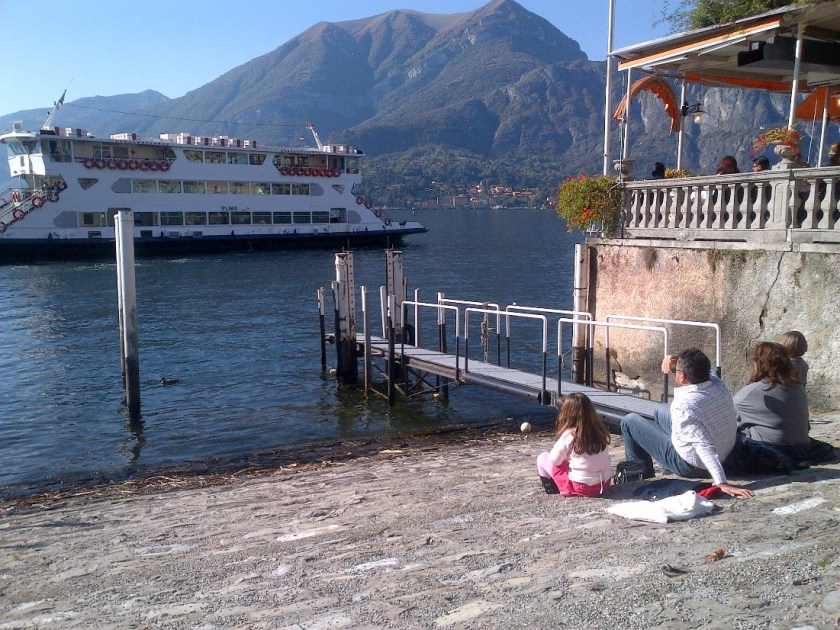
Watching the boats go by.

On the way home from our recent trip to Germany we spent three joyful days in Bellagio on the shores of Lake Como.  Friend Trina, whom we visited later in nearby Comerio, suggested the perfect hotel, Silvio, www.bellagiosilvio.com, just outside of town where we had a room with a balcony overlooking the lake and the distant Alps.  We’d been to Bellagio twice before, once with my mother who was also a fan of bella Italia and loved Bellagio.

View from our balcony at the Hotel Silvio.

The ancient village is perched on the shores of this idyllic lake ringed by mountains.  Steep steps climb skinny alleys lined with intriguing shops.  Sightseeing ships and ferries blow their horns as they pull in and out of the harbor.  It’s the perfect place to hang out and enjoy il dolce far niente (the sweetness of doing nothing)

Our journey began with a car ferry ride at sunset from Colico on the northern end of the lake to Bellagio which sits on the promontory jutting into the water at the junction between the Como and Lecco legs of the lake.  Unfortunately the lens on my Canon Rebel camera froze on our last stop in Germany, so my photos were limited to my Blackberry.  I was amazed.  Not too bad.  And, there were

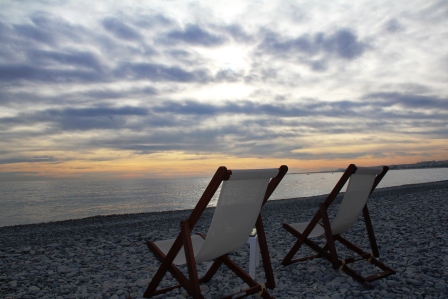
Lake Como at sunset.

scenic, spectacular photo opps all around —  splashes of coral and orange across a dark sky streaked with wisps of clouds, rays of light dancing on the rippled water, postcard villages hugging the shore — all framed by deep blue silhouettes of mountains.

We did more than lounge on that lovely hotel balcony and ponder the Bellagio scenery.  Walk.  Down to the shore and through the perfectly manicured gardens of the Villa Melzi along the lake.  The English garden is enhanced with

October at the Villa Melzi Gardens.

sculptures, small ponds, a stream, exotic plants and ancient trees.  The complex, including the neoclassical villa, was built between 1808 and 1816 for Francesco Melzi d’Eril, Duke of Lodi, and vice president of the Italian Republic under Napoleon. www.giardidivillamelzi.it

The  garden walk led us to the village where we wandered in and out of the shops and found the perfect souvenir – an olive wood basket.  It was pricey, almost beyond our budget.  I tried to bargain, but the proprietor and craftsman, who had his workshop on the premises, would not budge.  He explained that it was a very time consuming process to create this piece.  We splurged – and are happy we did.  It’s a sensation on our table.Basket

Bellagio is known for another villa on a hill above the town, the Villa Serbelloni, owned by the Rockefeller Foundation.  It is used mainly for conferences.  On a previous visit we toured its gardens which are open for guided tours from April to October.  In town the Grand Hotel Villa Serbelloni is the address of class where Churchill and John F. Kennedy stayed.

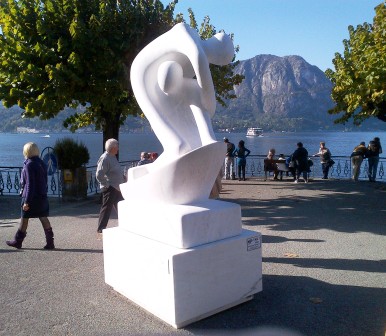
Along the shore in Bellagio.

Another day we walked up a hill and along a road to Pescallo which I had remembered as being a quaint fishing village.  My memory failed.  It was not much.  No fishing boats.  We did find a lakeside restaurant where we had an expensive but disappointing lunch.  The next day we set out by car for a hair raising ride along the all- too-narrow- winding coastal road (well suited to the Honda S2000) to Lezzeno and a fabulous lunch at the restaurant of the Hotel Villa Aurora adjacent to the lake.  www.hotelauroralezzeno.com   There, as well as at the restaurant in the Hotel Silvio, we enjoyed fresh fish from Lake Como.  Twenty-eight different species are said to thrive in its waters.  Lavarello is a favorite.

On the way back home to France, we stopped first to visit the major town on the lake, Como, and its majestic cathedral, then to Comerio to visit Trina in her gorgeous apartment overlooking Lake Varese.  I met Trina years ago in an Italian class in Germany (she was the star of the class).  Her husband Ian, who used to work in Italy, now works in London. Trina, who teaches English, and her faithful companion, Lucky, a precious 16-year-old Bichon Frisé, are holding down the fort in Italy.bellagio17

We arrived on the evening of Bob’s birthday.  Trina prepared a delicious mussels pasta dish for our dinner – and there was a tart with a candle for the birthday boy.

See slideshow below for more photos. For a holiday brunch, try the Puffed Apple Pancake, recipe in column at right. Comments on blog post and recipes are welcome. See “Leave a Reply” below under Comments. Subscribers also welcome.  Don’t miss future posts.  Click on Email Subscription at top right.

This slideshow requires JavaScript.


Back to Germany

Germany was my home for 28 years. Good times, wonderful memories – and fabulous friends.  Husband Bob and I recently returned to reconnect with many of those friends,  to visit old haunts, as well as other destinations that I will be writing about for the magazine German Life. (www.germanlife.com).

Maybe we’ve lived in the boondocks of rural France too long (since 2004).  Here life is tranquil, serene, quiet.  This time we found Germany a bit chaotic with monstrous traffic jams on the autobahns, construction sites  almost everywhere and  crowds of people in the city centers.  It’s hard to imagine that anyone could be unemployed in Deutschland with so much building in progress.

We spent several  nights with friends Klaus and Dagmar who live in Gerlingen just outside of Stuttgart. They urged us to take the U-bahn downtown to see the massive and controversial construction site for Stuttgart 21, the city’s  new railway and urban development project  which involves  57 kilometers of  new railways, including some 30 kilometers of  tunnels and 25 kilometers  of high-speed lines. Protesters still demonstrate at the site every Monday.  The project, which is estimated to  cost as much as six billion Euros, won’t be completed until 2020.  Another attraction adjacent to the site is the  new library, a modern and dazzling wonder in white by architect Eun Young Yi which has been likened to a Rubik’s cube puzzle.

Dagmar invited several of our friends for an excellent dinner, an antipasti of grilled vegetables, followed by  a  Swabian favorite,  stuffed breast of veal, all topped by  our very favorite German dessert, Rote Grϋtze, a yummy compote of red fruits.  Friend  Heti also entertained us with an amazing meal of Peruvian delicacies:  ceviche (fish  marinated in lime juice) and veggies, gallina picante parmesana (chicken with aji -hot yellow pepper), quinoa risotto with veggies, and for dessert, coconut flan and Tonka bean mousse.  All over the top.  More on those beans to follow.

Heti is an inspiration, and not just in the kitchen.  She recently lost 14 kilos on the Dukan diet combined with an hour of aqua jogging every day in the nearby Sindelfingen indoor pool.  When I lived  in the area, I frequently swam there year round.  There are also several outdoor pools for summer months.  Sadly, France is lacking in these first-class swimming facilities.

Klaus and Marianne, other friends from the Stuttgart area who frequently housesit for us in France, treated us to a delicious pasta lunch and a homemade Swabian apple pie at their new apartment.

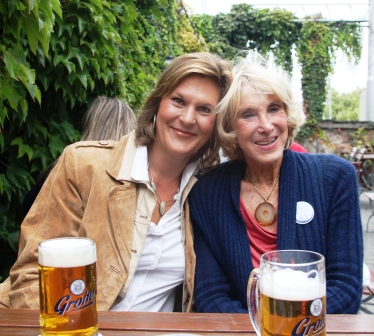
We took a trip north to the Darmstadt area to see more friends.  For years I worked for the military newspaper Stars and Stripes which was previously headquartered just outside the city.  A group of former colleagues met us at an Italian restaurant for a fun evening.  Special pal Andrea, whom I consider a surrogate step-daughter, and her husband Thiemo, joined us at Darmstadt’s famous brewery, Grohe, where we sat outside in the sunshine savoring the brew.  Another Darmstadt friend, Wilma, invited us for a delicious salmon dinner and stimulating conversation with her friend Erik.

Our travels also  took us to the Bergstrassee south of Darmstadt, Kaiserslautern, Augsburg, Munich and the Starnberg Lake district south of Munich.

For many years while I worked at Stars and Stripes, I lived in Jugenhiem at the northern end of the Bergstrasse in an apartment I called the “Treehouse.”  It was the top two floors of a former seniors’ home at the edge of a forest  and surrounded by tree tops.  We stopped for a visit, and it’s still the same – an idyllic hideaway in a jungle of green.

The best of the visit to the Bergstrasse, which extends 70 kilometers south from Darmstadt  to Heidelberg, and where many an ancient castle and castle ruins crown hilltops, was wine  The Bergstrasse wine region is divided into two parts, vines in the south in the state of Baden Württemberg, and those in the north in Hessen.  The former is Germany’s smallest wine region. German wines, as well as wines everywhere, have improved thanks to up-to-date knowledge and techniques, an expert told us.

For years German wines had a bad rep because “we exported the wrong wines, “ such as the  sweet Blue Nun, explained Maria Zimmermann of the regional tourist board.   Today German vintners are also well-educated, studying viniculture, not just learning the trade from their parents. We tasted some fine wines, and  Bob  made several purchases.

In the town of Weinheim, we toured a lovely garden followed by the best restaurant meal of the trip, an amuse bouche of scallops topping  a pumpkin salad sprinkled with mandarin oil, and a Hirsch (venison) medallion with an elderberry sauce and Steinpilze (boletus),  plus  parsley root puree. It was perfection.

Heppenheim is the quintessential Bergstrasee town with a market place of well-preserved half-timbered houses.  We joined an after-dark tour up and down the ancient streets and stairways, following a costumed story teller and her lantern carrying assistant.  Periodically they stopped with the story teller relating charming tales and fables of the region, most translated from old German into an English that rhymed.  Very impressive and a delightful, unusual experience.

The greatest number of Americans outside of the U.S., some 50,000 who are military or civilians working for the military, makes their home in the Kaiserslautern area. There I interviewed Wolfgang Tönnesmann, director of the Atlantic Academy, who had a life-size cardboard replica of Obama in his office. Like me, he is no doubt thrilled with the recent election results.

My quest to try local food specials in Kaiserslautern led us to the town’s only half-timbered building and the restaurant Spinnrädl. We were in the Rhineland Pfalz area and the restaurant served up  Pfälzer dishes written in the local dialect on the menu:  Brotworscht, Saumaa, Lewwer (Bloodwurst, potatowurst so named because it is stuffed into a pig’s stomach or Saumaa) and liverwurst. Hearty fare accompanied by Grumbeerstampes   (mashed potatoes).

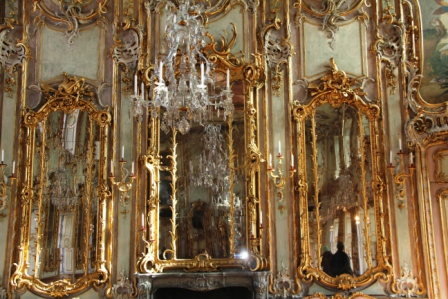
Jakob Fugger (1458 – 1525), a wealthy merchant (according to a guide, “he had more money than Bill Gates) put Augsburg on the map.  The Fugger family, in particular Jakob, was into finance and trade.  Jakob, known as the Empire’s banker, and  not unlike Bill Gates, had a social conscience.  He founded the Fuggerei, a section of the city for the town’s poor, the world’s oldest social housing which still exists with 140 apartments.  Rent is 1 euro per year.  We followed a fascinating tour of the area, and also visited a dazzling Rococo banquet hall, the Schaetzler Palais (1767), as well as other local attractions.

The Munich visit focused on food with visits to the city’s legendary outdoor market, the Viktualienmarkt, its classy food emporiums, Dallmayr and Käfer, as well as the food empire of Alfons Schuhbeck who has a collection of shops, including a Michelin starred restaurant, in the Platzl near the Hofbräuhaus.  Friend Heti clued me in on Schuhbeck who is huge on the German food scene.  It was at his incredible spice shop where she purchased the Tonka beans which come from South America for that exotic dessert.

Our visit wound up at the Starnberg Lake, one of several lovely lakes  south of Munich. All the sailboats which blanket the lakes in summer had been put to bed, but the region had plenty of charms for a fall visit.

A  must was a visit to the nearby Andechs Abbey above the Ammersee, another one of the regional lakes.  After admiring the Abbey’s church and its stunning Rococo stucco décor and frescoes,  we moved on to the terrace beer garden.  Monks have been brewing beer at Andechs since 1455.  These days seven different kinds of brew can be ordered, as well as Bavarian food favorites.

Other Starnberg highlights are the Baroque St. Mary’s Minister in the town of Diessen and  the lakeside Buchheim Museum noted for its collection of Expressionist works.  Last but not least, a wonderful bike ride following a cycle route along the Starnberg Lake with an outdoor lakeside lunch stop, as well as many breaks for postcard photos of the lake framed by distant Alpine peaks. (For more photos, see slide show to follow.  Comments are welcome. )

For more information:

www.diebergstrassse.de

www.augsburg-tourismus.de

www.munich-tourist.de

www.sta5.de

www.andechs.de

This slideshow requires JavaScript.

Family Fun in the US

Husband Bob’s family (he has eight brothers and sisters) was planning a big family reunion in Ohio this past summer.  Of course, we planned to attend.  What about my family?  Why couldn’t we also have a reunion?  I planted the idea with brother Steve who lives in Boulder, Colorado, a location which seemed the best for such a gathering.

Majestic Colorado scenery

He was not overly enthusiastic, but agreed.  Of course, brother Tom from San Francisco would attend.  Then we sent out word to cousins, many of whom I had not seen since we were children some 40 – 50 years ago.   From Florida, South Dakota, and New Mexico they came, as well as a nephew and his wife from Kentucky.  Unfortunately brother David, his wife Joan and son Dan from Kentucky could not join the party, nonetheless it was a smashing success with 22 in attendance.

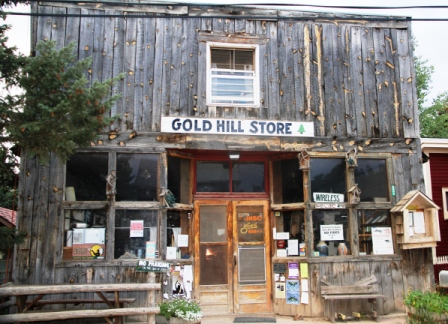
Everyone was in awe at the classy cocktail party cousin Sean and his partner Jerry hosted at their gorgeous home in Boulder. Another fun event was a chartered bus ride up in the mountains for dinner at the Gold Hill Inn in a funky old town by the same name.

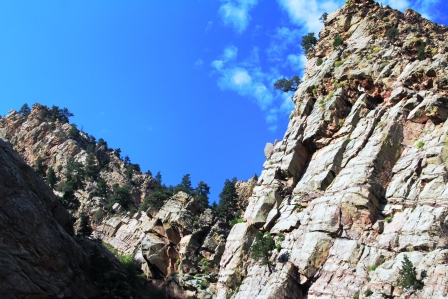
With Steve and his wife Yoshie and son Tai, some of us visited the Eldorado Canyon outside of Boulder where we watched climbers scale sheer walls of rock – a mind boggling spectacle.  We also toured Boulder and its farmers market.  For many (the Democrats in the group), an exciting bonus was attendance at an Obama speech at the University of Colorado.  Unfortunately it meant standing in line for hours before being admitted to the venue.  My new knee was not up to the wait, so Bob and I drove back into the mountains to the Rocky Mountain National Park.

On to Ohio for another remarkable event.  But first we spent a few days in Winchester, Virginia, where stepson Rob and his two children, Sam, 8, and Lang , 6, live.  Time there for me to do my Ami shopping (everything seems so much cheaper in the U.S.)   I always leave plenty of room in the suitcase for purchases.

Together we drove to Ohio.  We stayed with Bob’s brother, John, and sister-in-law Mickey, who always provide deluxe accommodations in their spacious and beautiful home in Wadsworth.  The reunion festivities got underway with a dinner at a restaurant Friday evening, followed by a slide show of the past.

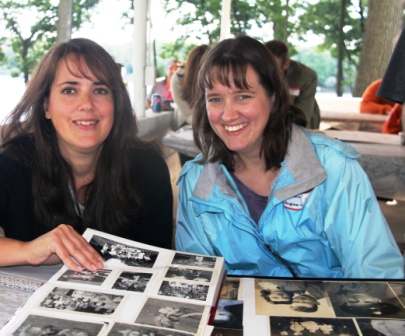
Cloudy, cool weather did not dampen the enthusiastic ambience for the main event the following day, a catered picnic at a lodge pavilion on the edge of a picturesque lake.  This was a major reunion with some 80 in attendance, many from California.  Some came with photo albums filled with memories.

Brothers, sisters, children, grandchildren, cousins – all ages.  It was amazing, and the pavilion was perfect with an adjacent playground for the kids, and plenty of space for the adults to wander around and chat with those they had not seen in years.  Thanks to diligent internet research, stepdaughter Kellie, who lives in New York City, tracked down some cousins who live in Pennsylvania.  They also came.

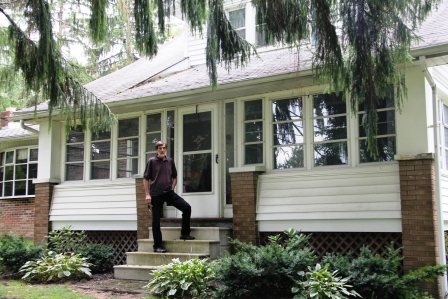
A visit to the family house where Bob and his brothers and sisters grew up was especially meaningful for the siblings.  Current residents were not home, but agreed that the family could walk around the property.  They toured the terrain, reminiscing about long gone chicken coops, fruit trees in the orchard, a small house still standing that Bob and his brother John had built.

We spent our last few days in the US in NYC with Kellie at her elegant apartment in Soho.  One can never tire of NYC.

It’s fun, gratifying and simply wonderful to reconnect with the past, to relive old memories, to become reacquainted with childhood companions.  Bravo for reunions!

See the photo album below for more reunion photos, and more of the US.  For a dip with a kick, see the recipe, “Spicy Peanut Dip,”  in the column at right.  If you’d like to read more of my tales and adventures, click on “Email Subscription” at top right of post.  Comments are welcome.  Click “Leave a Reply” 
This slideshow requires JavaScript.

New Zealand’s Extraordinary Fiordland

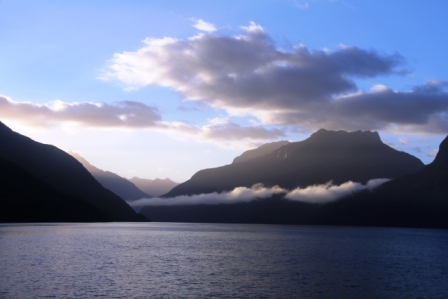
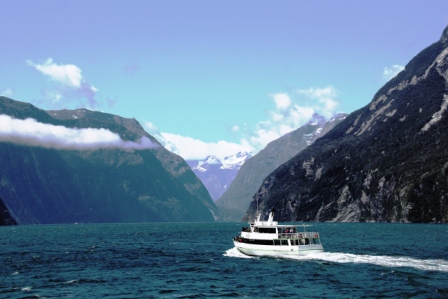
It’s all about scenery: dramatic, magnificent, mystical. We awoke on board a ship in Doubtful Sound, the largest of the area’s 14 fiords, to watch the sun creep over the towering cliffs which surrounded us, casting mirror images of the mountains on the sparkling water.  The only sound was a raging waterfall plunging from high above into the deep inlet. Waterfowl flew above.

We were in awe, mesmerized by the splendor of nature, the beauty all around in this desolate paradise.  Every day during our five-day visit to the region last November was filled with more overwhelming, spectacular sights.

On New Zealand’s South Island, Fiordland National Park is a World Heritage area and the country’s largest national park. The fiords, narrow inlets with steep sides carved by glacial activity, indent Fiordland’s West Coast.  In addition to exploring the fiords by boat, you can hike legendary trails in the mountains, trek through primeval forests and enjoy thrilling views from a seaplane.

Husband Bob and I did a bit of all.  We also enjoyed an exciting boat adventure in a Glowworm Cave through eerie darkness to a grotto where thousands of tiny glowworms glimmered on the walls. It was hard to believe this was a natural phenomenon and not an amusement park attraction.

Our Fiordland base was the town of Te Anau from where we set off for our first fiord excursion to Milford Sound. Early European settlers who were not familiar with fiords called them “sounds” which are actually river valleys flooded due to land sinking below sea level.

A bus trip on the Milford Road through the National Park leads to the Sound. There’s grandiose mountain scenery en route, with stops for photos.   And, once on board the ship sailing through the fiord’s National Geographic scenery, it’s hard to put the camera down.

On the way back to Te Anau, we stopped for a hike led by a guide to a summit.  We crawled under fallen logs en route, jumped over streams, through woods to open spaces above the tree line with superb views in every direction. By the time we reached the top it was raining. Our guide pulled out a thermos from his backpack and served us tea and cookies in the drizzle.

More hiking, but at a lower elevation, was on the next day’s agenda, a nature walk along Lake Te Anu through a dense beech forest.  The guide provided fascinating commentary on the flora and fauna, including the illusive kiwi, the country’s flightless nocturnal bird and national symbol.

Moss thrives in this dark green paradise and can be a meter deep. Step off trail and onto the lush carpet which is like a sponge, squishy strange to sink into.  Along the trail all sizes and varieties of forest ferns grow in abundance.  Kiwis (the people) are passionate about the environment and especially their bird population.  Our guide pointed out many species, including ducks which nest in tree tops.

Fiordland, we learned, has 200 rain days per year, dumping between six to eight meters of water each year. During our Doubtful Sound cruise, we experienced some of that rain. But it not dampen the spirits of those on board who wanted to try sea kayaking.  After our miserable failure with this sport which plunged us into the icy sea (see previous post: Misadventures in New Zealand), we stayed safe and dry on board.

During our cruise through this remote and romantic fiord, we saw penguins, seals and dolphins.  We marveled at haunting dark skies and fantastic cloud formations.

A different but exciting boat ride ended our Fiordland visit. We boarded a speedy jet boat on the Upper Waiau River to Lake Manapouri.  From our craft we boarded a float plane – tricky to get on this plane which was bobbing in the water – for a thrilling aerial view of the stunning countryside.

Rudyard Kipling called Milford Sound “the eighth wonder of the world” I think the same could be said for all of Fiordland.

For more on Fiordland, see http://www.fiordland.org.nz

Watch the slide show below for more outstanding scenery.  For summer grilling, try my old standby: Grilled Pork Tenderloin with Mustard Cream Sauce.  See the Recipe list on the right.

If you’d like to read more of my tales and adventures, click on “Email Subscription” at top right of post.  Comments are welcome.  Click “Leave a Reply” 

This slideshow requires JavaScript.

Misadventures in New Zealand

 Swimming with dolphins, kayaking on the open sea, hiking along the shore, plus visits to wineries and fabulous meals.  My kind of trip.

It was the Marlborough Nelson pre-trip on our voyage to New Zealand last November to attend the convention of the Society of American Travel Writers.

The food and wine were over the top.   Dolphins and kayaks – another story.

“These are very sturdy kayaks.  No one has ever capsized on one of my trips,” our perky kayak guide assured us as we prepared to put the boats in the frigid Pacific.   Maladroit Bob and Leah had obviously not been on one of her trips.

We were the retards in the group of six  or so kayaks – always way behind the others.  He (Bob)  kept yelling  at me to switch the paddle to the other side, to dig the oar deeper into the water.   I must admit, I was not adept with the blasted paddles.   And, I was always a bit nervous as I feared we were holding the others back, so I constantly tried to paddle faster and faster which was exhausting  and left my arms throbbing.  The scenery, however, was stupendous.

We held our own until we had to round a point to get back to shore. The winds were strong, so strong we weren’t moving, even though we were paddling hard.  The guide explained how we could use the paddle as a sail – just hold it up and the wind would blow us forward.  Bob was screaming at me, “Paddle left,  Paddle left.”  As I switched to the left, a gust caught the paddle and over we went.

A rude  shock.  12 degrees C. ( 54 degrees F.)  water is none too pleasant, but I popped right up and out of the kayak.  Where was Bob?  I was concerned as he does not know how to swim.  Fortunately he popped up instantly too. Nonetheless  I panicked.  My camera, my precious new Canon Rebel?  It was in one of those waterproof bags strapped to the boat, but I was devastated, convinced  it had drowned.

How to get back in the kayak which had righted itself?  The guide, no doubt eating her words, arrived at the scene of disaster and told us to turn the kayak upside down to empty it of water.  I refused, certain this would spell death for my camera if in fact it had survived.  I told her to help Bob, and that I could swim to shore which  did not seem that far off.  She was adamant – no way should I swim.  So, she gave us instructions and somehow, but with great effort and none too gracefully, we managed to manipulate our soaked and freezing bodies into the boat.  Then, she instructed  us  to pump the water out.  We pumped and paddled, but we were trembling with cold and making little progress.  Finally another guide came and towed us to shore (farther away than I thought – good I did not swim).

I  could not stop shivering, but once on shore I ripped open the bag with the camera. Unbelievable.  It was OK.  Bob’s expensive sunglasses did vanish to the bottom of the sea.  My prescription sunglasses, which I had been wearing, managed to stay on my head.  Another miracle.

We had been toId to bring an extra set of clothing.  Certain that it would not be required, I only brought a pair of jeans  — better than nothing, but more was needed.  Others in the group lent us T-shirts and sweaters.  Nonetheless, we quivered from the cold for what seemed like ages… (This kayak catastrophe brought back memories of our failed attempt at dancing lessons.  There, too, we were the duds in the group.  We best stick to bicycling.)

Then there was the boat excursion to swim with dolphins.   The lovely creatures were sure to appear, we were told.  Those in the group who planned to plunge into the freezing water, this time about 14 degrees  C ( 57 degrees F.) , were given wet suits.  Bob, not a swimmer, passed on this adventure.

The boat trip was scenic, and eventually we spotted dolphins.  The playful creatures followed right alongside the boat, jumping and soaring out of the water at times. Watching them was thrilling.  Swimming with them would be even better.

The boat captain maneuvered the craft  to get ahead of the dolphins, then we were told to jump in.  As dolphins are said to be curious and like humans, they were supposed to come and join us in the water.  We were told to make noise, to sing, through the snorkel mouth piece. This would surely attract the dolphins.

Nine bodies swimming around in frigid waters emitting bizarre sounds.  It was comical.  The wet suit did help, but after awhile, the cold penetrated.   We swam and sang, but the dolphins did not show up, so one by one we’d get back on board.  This ritual was repeated four different times as the captain tried yet again and again to position the boat where he thought the dolphins would be. And, time after time, we plunged into the icy water for naught.

The dolphins were nearby.  Why didn’t they join us? According to one of the guides, they were probably mating, and sex was more exciting than a bunch of crazy humans.  Can’t say I blame them.

Not all was amiss on our excursion in the Marlborough and Nelson regions which are at the top of New Zealand’s South Island.  Marlborough is the country’s largest wine-growing region, especially known for sauvignon blanc.  We visited several beautiful wineries where we tasted and savored some excellent vintages.

We also enjoyed a delicious boat excursion to mussel beds   Lunch was on board – a feast of succulent greenshelled mussels, the best I’d ever tasted.

And, we had a delightful overnight stay at the Lochmara Lodge Wildlife Recovery Center.  The lodge is accessible only by boat.  Hiking trails lead up in the hills above the cluster of buildings, offering super views, as well as interesting outdoor art and sculptures en route.  www.lochmaralodge.co.nz

Watch the slide show below for more photos of New Zealand.  And, try the recipe for “Two Cheese Spinach and Mushroom Casserole” listed in the column at right.  It’s a winner – and easy to prepare.

If you would like to continue to read Tales and Travel posts, please click the “Subscribe” bottom in  the upper right corner. Comments are welcome. See “Leave a Reply” below.

This slideshow requires JavaScript.