Source: Humanity is Lost
This is the latest post from a blogger I follow. I think it’s worth a read. Just click on the title to open it . . .
Source: Humanity is Lost
This is the latest post from a blogger I follow. I think it’s worth a read. Just click on the title to open it . . .
The crowds are fierce in this Riviera hot spot in August. And, of course during its famous film festival when the world focuses on all the stars who pose on the red carpet at the Palais des Festivals.

But, you can escape the masses and find tranquility amidst Mediterranean splendor just a short boat ride (20 minutes) away. We visited Cannes again this year to watch outstanding fireworks which are part of an international competition held every summer in Cannes. Fireworks are shot from numerous boats in the harbor and synchronized to music. Worth a trip!
So too is a visit to the off shore islands (Îsles de Lérins): Île Sainte Marquerite and Île Saint Honorat. Last summer we hiked around Ste. Marquerite, the larger island, and savored an excellent lunch on the shore. This time, Saint Honorat, the monks’ island.
Splendid. The tiny island has no cars, no hotels, just one restaurant, two shops –and monks. In 410 AD, Honoratus, a Roman noble who became saintly and sought isolation, is said to have chosen the island, then full of snakes and scorpions and thought to be haunted, as an ideal retreat. Visitors followed. A monastic order was established.

The monastery grew to become one of the most powerful in Christendom. Alas, peace and quiet did not last. Raids by Saracens and pirates in the 8th century took their toll, then later attacks by Spaniards. The monastery was closed in 1788, but reborn in 1859 when Cistercians took it over.
Today 20 monks live on Saint Honorat. In addition to praying, they cultivate grapes, eight hectares of vineyards, five for red wine, and three for white.

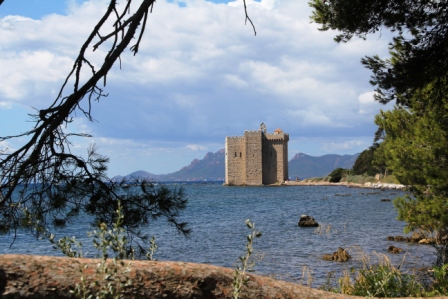
We followed the mostly shaded trail along the island’s craggy coastline, past rocky coves, ancient chapel ruins, an 11th century fortress and cannonball ovens. These curious structures were used in the 18th century to heat cannonballs so they would wreck further destruction on the ships they hit.

Signs along the way remind you to keep quiet and to respect the religious ambience – no bare chests. Mediterranean vegetation – pines, herbs, eucalyptus – borders the trail and makes for interesting photos. Other paths lead through the island interior, past the vineyards.

It is truly another world: beautiful, peaceful and quiet. It was hard to fathom that those noisy masses on La Croisette, Cannes renowned boulevard, were not far away.
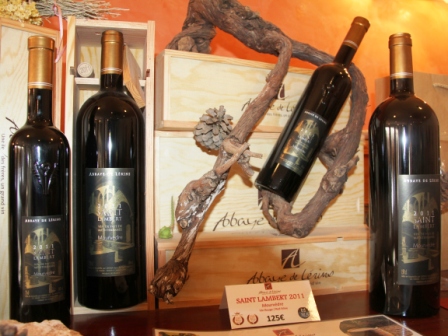
We stopped to visit the current abbey church and the shop which sold mainly wine. According to a brochure on the island wine, it is “full of spirituality.” All the vintages are named after saints, but you will pay dearly for spiritual wine. The cheapest we found was 26 euro, but most were far more expensive.

At La Tonnelle , the island restaurant, we each ordered a glass of the monk’s brew to accompany our lunch. A glass of Sainte Cesaire (Chardonnay) for me at 8 euro; a glass of Saint Honorat (Syrah) for VR at 11.80 euro. I found my wine too oaky and too Chardonnay. Vino Roberto’s was good, very robust. To take a bottle home: 33 euro. VR reasoned he could buy several good bottles back in the Luberon for that amount.
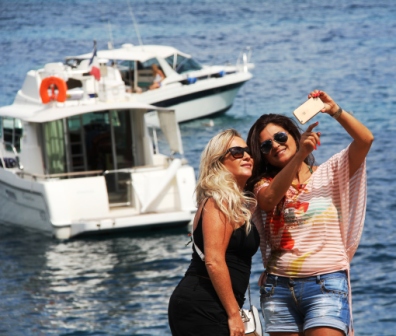
The lunch (we each ordered fish) was delicious. People watching at this seaside eatery also gets high marks. Pleasure boats cast anchor off shore. A tender ferries passengers to the restaurant, a constant parade of the yachting crowd.
Travel Tips:
Trip Advisor led me to the Hotel l’Olivier in Cannes, a small, family-run (22 rooms) hotel on a hillside overlooking the Med. Our room was tiny, but our terrace with a superb view was perfect. The hotel personnel were all very warm, welcoming and helpful. It was a bit of a walk to the town center, but good exercise. The hotel has a small pool, flowered terrace for al fresco breakfast, and it’s quiet – a great escape from the chaos of La Croisette. A beach is also nearby. http://www.hotelolivier.com

Another Trip Advisor find, the Bistrot Saint-Sauveur in Le Cannet, a town above Cannes, where we had an excellent lunch. www.bistrotsaintsauveur.fr
La Tonnelle, restaurant on the island, www.tonnelle-abbayedelerins.com
A leisurely saunter around the island takes about 1 ½ hours. Boats to both islands run about every hour during summer months. Round-trip ticket to Saint Honorat, 14 euro (price for seniors). More information www.cannes-ilesdelerins.com

Don’t miss Today’s Taste in column at right: DILLY POTATO SALAD, my favorite potato salad.
If not already a Tales and Travel follower, sign up (upper right) so you will not miss future posts. Your address is kept private and never shared.
Like my blog? Tell your friends. Please leave a Reply below. Feedback is welcome. I love to know what my readers think about my posts.
Follow Tales and Travel on Facebook: http://www.facebook.com/talesandtravel
Follow me on twitter: @larkleah
This was my favorite of the recent visit to France’s mid-Atlantic coast. See previous post, “Discovering more of France,” June 2015. 
Islands are intriguing. These chunks of land surrounded by water are a curiosity, and much more. They inspire and captivate our imagination, offering a unique way of life, a different state of mind.
The miniscule French island of Aix off the country’s mid-Atlantic coast is indeed an island pearl. Step off the ferry from the mainland and enter an enchanted world – no cars, little commerce, just one hotel. Aix has not been gussied up for tourists. It’s authentic with many buildings in need of a coat of paint. Its few shops seem to have changed little in decades. There are no fancy restaurants, no classy cafes – just a small number of simple eateries.
About 240 residents live on the island which is 1.8 miles long and .4 miles wide. Of the permanent inhabitants, only 100 remain on the island in winter. In summer, between 4,000 and 5,000 tourists arrive each day to bike, walk, swim, fish and soak in the beguiling island ambience. Most leave in the evening. The nights are silent, magic.
“I come here every chance I get. It’s a little paradise,” said Christine Lacaud who lives in Rochefort, a city in the Poitou-Charentes region adjacent to the ferry departure point in Fouras.
Island resident and historian Pierre Antoine Berniard sums it up: “When you take the boat and arrive here, there’s something different… Kids can play everywhere. There are no cars to hurt them. It’s really a privilege.”
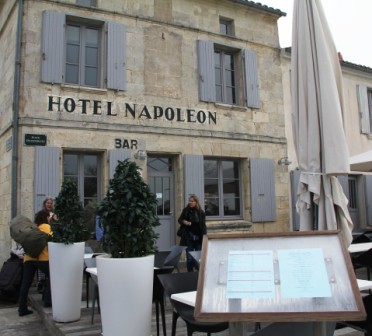
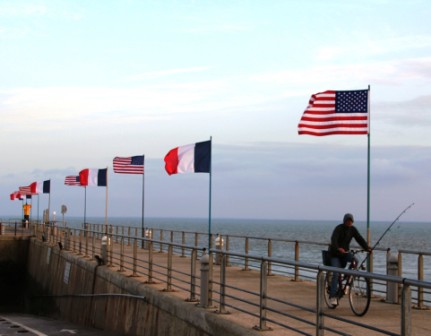
I spent a night at Aix’s Hotel Napoleon, a charming abode with just 18 rooms and an excellent restaurant, Chez Josephine. Our group had come to admire the replica of the frigate Hermione anchored off shore before its April departure for an amazing journey to the U.S., duplicating a voyage of 235 years ago. During that epic voyage, the ship ferried Marquis de Lafayette across the Atlantic to help General George Washington and the rebels in the fight for American independence. (See previous post, “Hail Hermione,” May 2015)

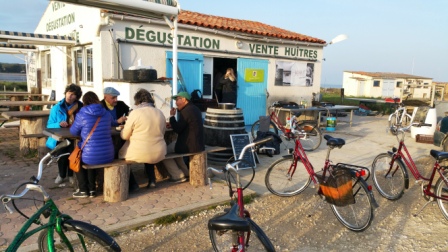
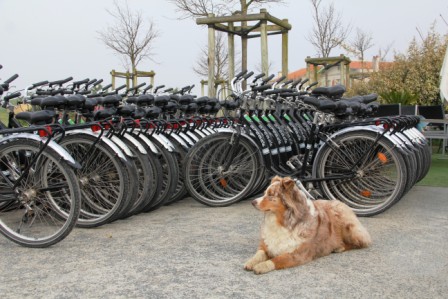
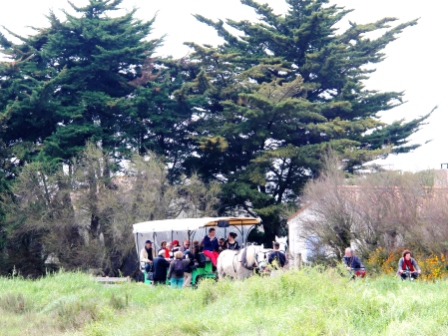
The magnificent ship was just one attraction. We also biked. You can walk around the island in two to three hours, or take a leisurely horse-drawn carriage ride, but discovering Aix by bike seems to be the most popular. There are several bike rental depots. Ride through lush forests, marshlands, along a rocky coast, past pristine beaches and hidden coves. It’s tranquil, peaceful — and flat. Pedaling is fun and easy.

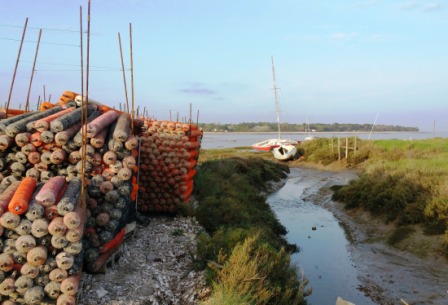
Stop for an oyster break. Aix’s one weather-beaten oyster shack should be on a movie set – the perfect oyster shack stereotype. Oysters are shucked on the spot. Order a bottle of white wine; sit outside surrounded by stacks of oyster-growing paraphernalia, bikes and the sea. Oysters have never tasted better.
Aix’s deputy mayor, Jean Claude Poisson, told me the island doctor, who lives there year round, does big business in summer thanks to oysters. Tourists comb the shore looking for the mollusks and cut their feet on the razor sharp rocks. The doctor is kept busy stitching wounded feet.
A wealthy American, Eva Gebhard Gourgaud, gets credit for Aix’s revival in the 1920s. The island, initially settled by monks in the Middle Ages, played an important role in France’s military history throughout the 18th and 19th centuries. During the Napoleonic period, several thousand troops were lodged in forts and barracks on the island. Napoleon even requested reinforcements of Aix’s fortifications after an island visit in 1808.

But by the beginning of the 20th century, the military presence was on the decline. The island was dying. A French journalist wrote a report on the island’s imminent demise. Eva, wife of Baron Napoleon Gourgaud who was a descendant of Napoleon’s aide, read the article, visited, and fell in love with Aix. ”She decided to buy everything.” Berniard said. She opened the island to culture and
tourism.
A tourist favorite is the house where Napoleon surrendered to the English in 1815, and where he spent his last three days on French soil before being exiled to St. Helena in the South Atlantic. This year marks 200 years since Napoleon returned to France after nine months of exile on the island of Elba.
The house, which has displays on the Napoleonic era, is open to visitors, as is Aix’s Mother of Pearl House where proprietor Herve Gallet will tell you the fascinating story about the island and mother of pearl.
His parents moved to Aix in 1948, hoping to grow grape vines and sell wine. That failed, so they started making objects of shells collected on the beach to sell to tourists. That enterprise took off, and they expanded to make products of mother of pearl. “There are 148,000 varieties of sea shells,” Gallet said, “but only 16 can be used for mother of pearl.” Mother of pearl was imported from India, Mexico, Polynesia and other countries, since shells from Aix are not suitable.

Between 1720 and 1980, mother of pearl was a major industry in France, Gallet explained, with some 30,000 workers in the country producing buttons. On Aix, however, mother of pearl was used to make souvenirs and decorative items, not buttons. These are still made by Gallet. In his workshop he demonstrates the process of extracting and polishing mother of pearl from shells. His Mother of Pearl house is a type of museum where an audio guide and videos explain the biology and chemistry of sea shells. His shop offers an extensive range of mother of pearl products, from reasonably priced jewelry items to a mirror with a price tag of 1,750 euros. I bought two pairs of earrings — a pearl souvenir from a pearl of an island.
Hotel Napoleon, http://www.hotel-ile-aix.com
Les Paillotes, island restaurant, http://www.restaurantlespaillotes.fr
In addition to the Hotel Napoleon, Aix offers numerous bed and breakfast accommodations. www.Iledaix.fr
More on Aix: www.iledaix.fr/?lang=en
The Ile de Ré and Ile d’Oléron are two other, much larger French islands off the country’s west coast. Both also offer beaches, biking, hiking, boating, fishing – plus more hotels. http://www.holidays-iledere.co.uk/and oleron-island.com
Try my aioli — the recipe featured in Today’s Taste in column at right.
If not already a Tales and Travel follower, sign up (upper right) so you will not miss future posts. Your address is kept private and never shared.
Like my blog? Tell your friends. Leave a Reply below. Feedback is welcome.
Follow Tales and Travel on Facebook: http://www.facebook.com/talesandtravel
Follow me on twitter: @larkleah
Chicago is definitely my kind of town. My visit to this dynamic city where I studied and worked for several years long ago was, for me, a highlight of our recent U.S. voyage. Husband Bob (Bicycle Bob/Vino Roberto) and I also enjoyed visits with friends and family in Virginia and New York City, attended a reunion in Maryland, shopped, ate good food — and had a grand time.

A former college roommate, Beverly, was my guide extraordinaire in the Windy City. Bev and I, both French majors, roomed together in the French corridor of a dorm in our senior year at Northwestern University in Evanston just north of the city. We were supposed to speak only French. (I think we broke that rule.) Bev went on to get a PhD in French, taught at Yale, but eventually moved back to Chicago. She lives in Lincoln Park, not far from where I lived when I worked in the city, and now works part time as a Chicago guide, giving tours in French. She knows – and loves – the city, and gave me an outstanding tour – in English.
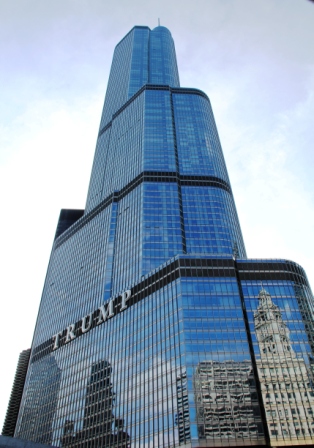
So much has changed, and it’s all overwhelming, fabulous. Chicago, the third largest city in the U.S., has always been known for its bold architecture. The first skyscraper was erected in the city in 1885. Today its sky is the background for a
myriad of innovative and beautiful tall buildings, including the Willis Tower, formerly the Sears Tower and the second tallest building in the U.S. With 105 buildings at least 500 feet (152 m) tall, Chicago is said to have the tallest skyline in the country and the third-tallest in the world. A great way to see these buildings, and learn more about the city’s architectural history, is the architecture tour by boat on the Chicago River. As our boat wended its way past one magnificent building after another, Bev’s friend and exuberant guide Judith provided fascinating commentary.
Bev drove me through Hyde Park and parts of south Chicago, regions of the city I had never explored. I wanted to take a photo of Obama’s house, but there is not much to see. It is hidden behind lots of trees and bushes, and there are security barricades all around, as well as guards. We stopped at Frank Lloyd
Wright’s Robie House, built in his Prairie style between 1908 and 1910 and now a National Historic Landmark. We stopped at another National Historic Landmark, a Henry Moore sculpture on the University of Chicago campus marking the site of the first self-sustaining nuclear reaction on Dec. 2, 1942.
That’s what brought Bev’s late father, Ralph Livingston, a post-doc in physical chemistry, to Chicago. I asked Bev for the details. “The code name for the research effort of what would become the Manhattan Project was the Metallurgical Laboratory (“MetLab”) and that’s where my dad worked doing experiments on radium, uranium, etc. He was in the “loop” in that he knew that they were working on an atomic bomb; many working on the Manhattan Project did not know the true nature of this “war effort.”
“In July 1945 when the first atomic test blast took place in Nevada, a number of scientists signed a petition addressed to President Truman, NOT to use it on a civilian population. I have a copy of this petition which has my dad’s signature. Hiroshima was bombed on Aug. 6, 1945; Nagasaki on Aug. 9.”
This explains Bev’s ties to Hyde Park, where she was born, and the University of Chicago, where she did her graduate studies.

She led me on another excursion to the site of our undergraduate studies — Evanston and the Northwestern campus. Progress there is also monumental, with many new buildings, many built on land that was once Lake Michigan. The campus can only expand in the direction of the lake, so more of the lake has been filled to provide needed terrain. We walked by many old buildings which brought back many memories. We found the dorm where we originally met long, long ago.
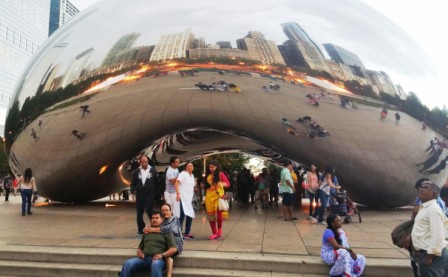
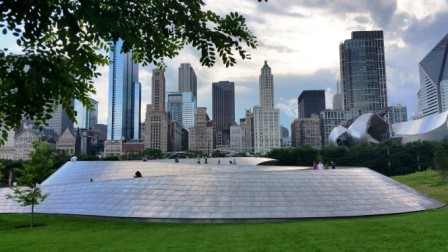
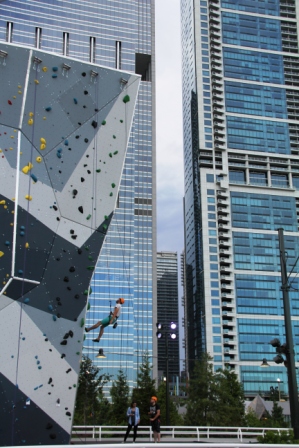
Millennium Park, a park in the city center like no other city park, is my Chicago favorite, a showcase for state of the art architecture, lush landscaping and outdoor art. It’s fun with some surprising and amazing sights. Cloud Gate,
commonly known as “The Bean,” is an elliptical sculpture which reflects the skyline and intrigues visitors who walk underneath and all around to take photos, often reflections of themselves.
Crown Fountain is another winner. Spanish artist Jaume Plensa is the genius behind two 50-foot glass block towers at opposite ends of a reflecting pool. Gigantic faces of Chicago citizens are projected on LED screens on the towers, changing continually, with water flowing from open mouths. You can be mesmerized for hours.

We walked up the BB Bridge in the park to the Jay Pritzker Pavilion, a venue for outdoor concerts, both cutting edge architecture designed by Frank Gehry. We had hoped to take in a free concert, but rain drove us away after the first selection. Another day we walked a section of The 606, an elevated trail for hikers and bikers similar to New York’s High Line. It was built on a section of the Bloomingdale rail line no longer in use.
When I lived in Chicago, I loved the Art Institute, the second-largest art museum in the United States after the Metropolitan Museum of Art in New York. It has expanded, with a new wing designed by Renzo Piano. I did not have time to visit, a reason for a return to Chicago.
Time to join BB/VR in Winchester, Virginia, where he was visiting his son Rob and grandsons Samuel and Lang. I left Bev’s townhouse at 11 a.m. and did not arrive at Dulles Airport outside of Washington, D.C., until 11:30 p.m. that night. I was traveling by air – not car – although a car may have been faster. I spent most of the day in airports or in a plane that never took off. Delays due to bad weather and mechanical problems, I was told. Give me the TGV (France’s fast train) any day!

In Virginia we took the boys on a delightful but short hike in the Virginia State Arboretum, following a trail bordered by grandiose trees. We encountered few others in this peaceful wonderland of nature. It’s another place that merits a return visit.

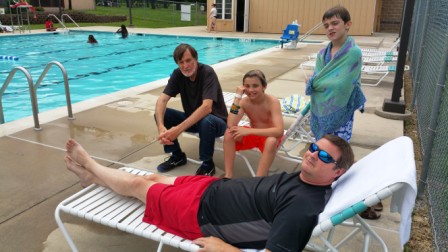
Next stop Adamstown, Maryland, where my Peace Corps training group, Brazil 1966-68, was holding a reunion at a camp and retreat center. Rob and the boys joined us and, when the rain stopped, had fun in the pool. I met old friends, attended some interesting lectures and presentations, including one on the Peace Corps today which, like Brazil, is not the way we knew it 49 years ago.

En route to the reunion, we made a detour to La Vale, Maryland, the home of German Life, a magazine I write for. At long last I was able to meet the editor, Mark, in flesh. Ours has been an email and occasional phone call relationship for at least 12 years. Mark went overboard and treated us all to lunch for making the trip. Thank you, Mark.

I left the reunion site for a lunch break to reunite with a high school friend, Marian, who divides her time between residences in Bethesda and Annapolis, Maryland. She filled me in on news of other classmates.
Visits to New York City

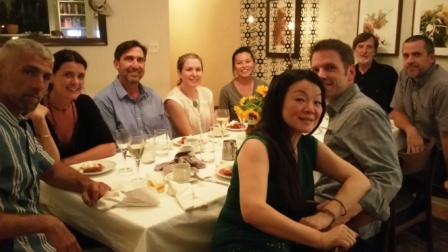
are always superb. There we have the good fortune to stay in step-daughter Kellie’s beautiful apartment in Soho. Kellie had a dinner party one evening so we could meet some of her friends, and see BB’s nephew Joe and his wife Hsinn,
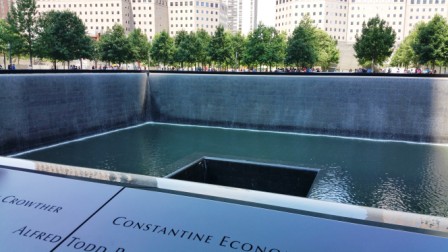
The 9/11 Memorial was a must on our New York agenda. Names of the 2,977 victims of this horrific tragedy are emblazoned on bronze plates attached to parapets of the walls that surround two rectangular pools, one for each tower destroyed in the attack. It is a beautiful, but chilling monument. Looming above the memorial is the new One World Trade Center (Freedom Tower), the tallest building in the U.S. We passed on a visit to the Memorial Museum as the entrance waiting lines were very long.
No lines at the new Whitney Museum of American Art, an interesting structure with intriguing outdoor spaces, and amazing art. I conquered the subways and went to the Metropolitan Museum of Art. So much to see, and all terrific. Must go back there, too.

We joined Kellie and a friend for Shakespeare in the Park (Central Park) and a performance of The Tempest. I met Michaela from Switzerland Tourism for lunch. Thanks to Michaela, I have been on many wonderful press trips to Switzerland.
A closing word on food in the U.S. We have often complained about the high costs of almost everything in France. No more. The dollar’s recent surge has, of course, made things cheaper for us here. We were shocked at some U.S. prices: $14 and up for a glass of wine in NYC; $10 for 2 cups of coffee. Restaurant prices vary, of course, but eating definitely seems cheaper on this side of the Atlantic. In the U.S., a restaurant bill is just the beginning. You need to figure another 20 percent for tip, then a percentage for tax. On the positive side, we found some clothing bargains, and BB came home with a new toy, a MACbook.
A wonderful trip, great to see family and old friends, but it’s good to be home. We just wish this heat wave would end.
For more photos of my U.S. trip, keep scrolling down.
For a super architecture tour of Chicago by boat: Chicago Cruise Line.
If not already a Tales and Travel follower, sign up (upper right) so you will not miss future posts. Your address is kept private and never shared.
Like my blog? Tell your friends. Leave a Reply below. Feedback is welcome.
Follow Tales and Travel on Facebook: http://www.facebook.com/talesandtravel
Follow me on twitter: @larkleah






Poitou-Charentes? I live in France, but had never been to this region on the country’s mid-Atlantic coast. When invited to join a press trip there last April, I quickly said yes.

The pièce de résistance of the trip was the frigate Hermione, the replica of a French warship that ferried Marquis de Lafayette across the Atlantic in 1780 to help General George Washington and the rebels in the fight for American independence. Our group joined festivities celebrating the ship’s April departure for the US, duplicating that voyage of 235 years ago. (See previous post, “Hail Hermione”).
That was exciting, but so too was discovering this part of France which is not on most visitors’ travel agenda. Islands, beaches, canals, pleasant cities, incredible seafood – and Cognac. Poitou-Charentes offers all, and the price is right – less than in those tourist havens such as the Riviera. Following are highlights of my trip.

The miniscule island of Aix was the trip favorite. It is so special it deserves its own blog post. I’ll be writing all about this petite paradise in the future, so be sure you are a Tales and Travel subscriber so you don’t miss it. (Sign up – upper right hand corner)
Marais Poitevin. It was like being lost on a jungle river, even though the trees on shore are poplars and ash, not tropical varieties. We were on a flat bottomed boat gliding through this marshland known as Green Venice. “People do get lost. Even boat drivers get lost,” said our boat pilot as he maneuvered our craft through the confusing maze of canals. There are 40 kilometers of navigable waters in the Marais, and there are signs along the canals, nonetheless it is
daunting. In April, it was a green haven of tranquility with the only sounds those of birds or the splash of a frog jumping into the water. The canals were built by monks in the 12th century to drain the marshes for agriculture. Today they are popular for tourist excursions. You can row your own boat and test your navigation skills. Or, try to punt. The boats can be propelled by a long wooden pole – not easy. Boats with guides who do the work are also available.

La Rochelle. I could not stop taking photos of this seaside city whose Vieux Port or Old Port is perfect subject matter with two ancient towers guarding the entrance. The Saint Nicolas Tower and the Chain Tower were built in the 14th century and served as key defensive bastions to the city for centuries. A third
tower, the Lantern Tower, is the oldest lighthouse on the Atlantic coast. There are splendid photo opps from the rooftops of the towers which can be visited, as well as along the broad walkway around the harbor where everyone likes to stroll and where outdoor tables at restaurants and cafes are popular.
La Rochelle was known as a rebel city. It was Protestant in the 16th century when the rest of the country was mainly Catholic. The historic old town’s medieval houses, private mansions from the 17th and 18th century and vaulted stone arcades are also worthy of photos. And, all those fish in the city’s Aquarium, rated France’s best aquarium by Trip Advisor.
Jarnac and Cognac. We sank into oversized soft leather chairs in the dimly lit room whose décor spoke of ancient wealth. We were given blindfolds, told to cover our eyes, relax and concentrate on the scent being sprayed around us.

Then, take a sip of cognac and identify the flavor that matched the aroma. Three sprays. Three aromas: vanilla, candied orange and Iris flower. They were all pleasant, but my taste buds failed. However, I loved the cognac, Courvoisier XO which sells for 135 euro per bottle.
The sensory tasting experience at the Courvoisier Chateau in Jarnac, home of the eponymous cognac, was a treat. We learned all about cognac production, from the grapes and soil, to barrels and aging to the double distillation process that results in this potent elixir. We toured the cellars whose treasures include a bottle from 1789, and one valued at 6,900 euro.

Three major cognac houses (Hennessy, Martell, Rémy Martin) are located in the nearby town of Cognac. Courvoisier, a smaller company whose major market is the United States, is known as the brand of Napoleon. The emperor visited a wine and spirit company in Paris owned by Emmanuel Courvoisier and an
associate in 1811 and is said to have taken several barrels of cognac with him to exile on the island of St. Helena. The English officers on board the ship transporting him to the island enjoyed imbibing the brew and named it “the cognac of Napoleon.” Much later, in 1869, Napoleon III granted Courvoisier the title “Official supplier to the Imperial Court.”
The Napoleon museum at the chateau has a hat of Napoleon’s, as well as a strand of his hair in a frame.
Rochefort is a pleasant city on the Charente river 20 miles from the Atlantic whose 17th century shipyard is where the ship Hermione was reconstructed and where she will reside when she returns from the US voyage in August. Louis XIV, France’s Sun King, wanted supremacy on both land and sea. His adviser and prime minister, Colbert, chose Rochefort as the site of a shipyard. Through the years, some 550 ships were built there.
We visited the Corderie Royale, the royal rope factory, an astonishing structure, 374 meters in length, where we learned how rope was made. The super long building was purpose built to manufacture the vast quantities of rope needed for the rigging of sailing vessels. Its length enabled it to produce rigging for the length of the frigate’s anchor cable. Because it was constructed during the same time as the Palace of Versailles, it is called “Versailles of the Sea.”
In addition to the Corderie and naval dockyards, Rochefort has a bizarre bridge, the Transporter. The aerial structure, a metallic platform on pillars high above
the river, was built in 1900 and designed to be raised so ships could pass underneath. Only two dozen transporter bridges were ever made, with eight remaining. This is the only one in France still functioning.
Poitiers. Our visit to the regional capital of Poitou-Charentes was brief, but we did get a look at its outstanding church, Notre Dame la Grande and its elaborately sculpted façade. And, the Baptistery of Saint Jean which dates back to the beginning of Christianity and is one of 80 town buildings classified as historical monuments. The wall paintings from the 12th an 13th centuries are remarkable.
Poitou-Charentes has miles of golden sand beaches as well as miles of bike routes. More on the region at www.visit-poitou-charentes.com
Many excellent hotels in the region, with some offering double rooms for less than 100 euro per night. Hotels I can recommend:
Hotel Le Ligaro in Jarnac whose owner is Irish: http://www.hotel-ligaro.com/
Hotel des bains, Fouras (adjacent to Rochefort): http://www.grandhotel-desbains.fr
Hotel Champlain, La Rochelle, (lots of old world flavor, beautiful gardens): http://www.hotelchamplain.com

Hotel Mercure Poitiers Centre (church converted into ultra modern, trendy hotel): See web site for Accor hotels, http://www.accorhotels.com
Poitou-Charentes seafood is sensational —especially the oysters.

Courvoisier offers a variety of tours and tastings, www.courvoisier.com

Try my raspberry tart — the recipe featured in Today’s Taste in column at right.
If not already a Tales and Travel follower, sign up (upper right) so you will not miss future posts. Your address is kept private and never shared.
Like my blog? Tell your friends. Leave a Reply below. Feedback is welcome.
Follow Tales and Travel on Facebook: http://www.facebook.com/talesandtravel
Follow me on twitter: @larkleah