Bellissimo Bellagio

Instead of moving to France from Germany eight years ago, I tried to convince my husband to consider Italy as our future home.  It seems such a happy, fun, cheerful place.  I love the language, the people, the food, the countryside.  But, Bob finds it all a bit too chaotic, so France won and life here is fine (see previous blog post, All about Life in France).  But, I still adore Italy and am always thrilled with visits.

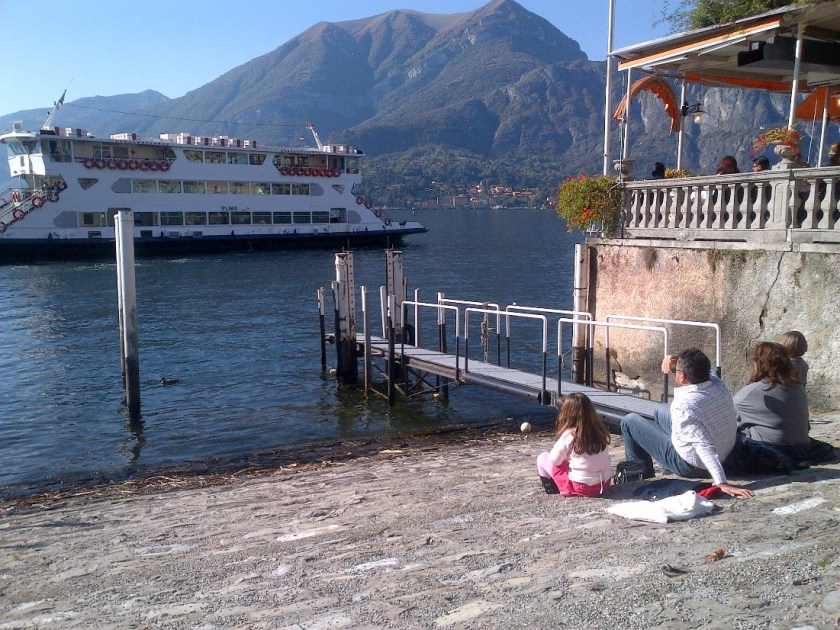
Watching the boats go by.

On the way home from our recent trip to Germany we spent three joyful days in Bellagio on the shores of Lake Como.  Friend Trina, whom we visited later in nearby Comerio, suggested the perfect hotel, Silvio, www.bellagiosilvio.com, just outside of town where we had a room with a balcony overlooking the lake and the distant Alps.  We’d been to Bellagio twice before, once with my mother who was also a fan of bella Italia and loved Bellagio.

View from our balcony at the Hotel Silvio.

The ancient village is perched on the shores of this idyllic lake ringed by mountains.  Steep steps climb skinny alleys lined with intriguing shops.  Sightseeing ships and ferries blow their horns as they pull in and out of the harbor.  It’s the perfect place to hang out and enjoy il dolce far niente (the sweetness of doing nothing)

Our journey began with a car ferry ride at sunset from Colico on the northern end of the lake to Bellagio which sits on the promontory jutting into the water at the junction between the Como and Lecco legs of the lake.  Unfortunately the lens on my Canon Rebel camera froze on our last stop in Germany, so my photos were limited to my Blackberry.  I was amazed.  Not too bad.  And, there were

Lake Como at sunset.

scenic, spectacular photo opps all around —  splashes of coral and orange across a dark sky streaked with wisps of clouds, rays of light dancing on the rippled water, postcard villages hugging the shore — all framed by deep blue silhouettes of mountains.

We did more than lounge on that lovely hotel balcony and ponder the Bellagio scenery.  Walk.  Down to the shore and through the perfectly manicured gardens of the Villa Melzi along the lake.  The English garden is enhanced with

October at the Villa Melzi Gardens.

sculptures, small ponds, a stream, exotic plants and ancient trees.  The complex, including the neoclassical villa, was built between 1808 and 1816 for Francesco Melzi d’Eril, Duke of Lodi, and vice president of the Italian Republic under Napoleon. www.giardidivillamelzi.it

The  garden walk led us to the village where we wandered in and out of the shops and found the perfect souvenir – an olive wood basket.  It was pricey, almost beyond our budget.  I tried to bargain, but the proprietor and craftsman, who had his workshop on the premises, would not budge.  He explained that it was a very time consuming process to create this piece.  We splurged – and are happy we did.  It’s a sensation on our table.Basket

Bellagio is known for another villa on a hill above the town, the Villa Serbelloni, owned by the Rockefeller Foundation.  It is used mainly for conferences.  On a previous visit we toured its gardens which are open for guided tours from April to October.  In town the Grand Hotel Villa Serbelloni is the address of class where Churchill and John F. Kennedy stayed.

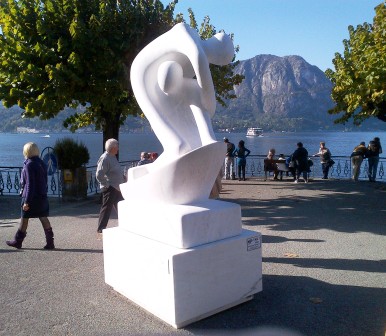
Along the shore in Bellagio.

Another day we walked up a hill and along a road to Pescallo which I had remembered as being a quaint fishing village.  My memory failed.  It was not much.  No fishing boats.  We did find a lakeside restaurant where we had an expensive but disappointing lunch.  The next day we set out by car for a hair raising ride along the all- too-narrow- winding coastal road (well suited to the Honda S2000) to Lezzeno and a fabulous lunch at the restaurant of the Hotel Villa Aurora adjacent to the lake.  www.hotelauroralezzeno.com   There, as well as at the restaurant in the Hotel Silvio, we enjoyed fresh fish from Lake Como.  Twenty-eight different species are said to thrive in its waters.  Lavarello is a favorite.

On the way back home to France, we stopped first to visit the major town on the lake, Como, and its majestic cathedral, then to Comerio to visit Trina in her gorgeous apartment overlooking Lake Varese.  I met Trina years ago in an Italian class in Germany (she was the star of the class).  Her husband Ian, who used to work in Italy, now works in London. Trina, who teaches English, and her faithful companion, Lucky, a precious 16-year-old Bichon Frisé, are holding down the fort in Italy.bellagio17

We arrived on the evening of Bob’s birthday.  Trina prepared a delicious mussels pasta dish for our dinner – and there was a tart with a candle for the birthday boy.

See slideshow below for more photos. For a holiday brunch, try the Puffed Apple Pancake, recipe in column at right. Comments on blog post and recipes are welcome. See “Leave a Reply” below under Comments. Subscribers also welcome.  Don’t miss future posts.  Click on Email Subscription at top right.

This slideshow requires JavaScript.


Back to Germany

Germany was my home for 28 years. Good times, wonderful memories – and fabulous friends.  Husband Bob and I recently returned to reconnect with many of those friends,  to visit old haunts, as well as other destinations that I will be writing about for the magazine German Life. (www.germanlife.com).

Maybe we’ve lived in the boondocks of rural France too long (since 2004).  Here life is tranquil, serene, quiet.  This time we found Germany a bit chaotic with monstrous traffic jams on the autobahns, construction sites  almost everywhere and  crowds of people in the city centers.  It’s hard to imagine that anyone could be unemployed in Deutschland with so much building in progress.

We spent several  nights with friends Klaus and Dagmar who live in Gerlingen just outside of Stuttgart. They urged us to take the U-bahn downtown to see the massive and controversial construction site for Stuttgart 21, the city’s  new railway and urban development project  which involves  57 kilometers of  new railways, including some 30 kilometers of  tunnels and 25 kilometers  of high-speed lines. Protesters still demonstrate at the site every Monday.  The project, which is estimated to  cost as much as six billion Euros, won’t be completed until 2020.  Another attraction adjacent to the site is the  new library, a modern and dazzling wonder in white by architect Eun Young Yi which has been likened to a Rubik’s cube puzzle.

Dagmar invited several of our friends for an excellent dinner, an antipasti of grilled vegetables, followed by  a  Swabian favorite,  stuffed breast of veal, all topped by  our very favorite German dessert, Rote Grϋtze, a yummy compote of red fruits.  Friend  Heti also entertained us with an amazing meal of Peruvian delicacies:  ceviche (fish  marinated in lime juice) and veggies, gallina picante parmesana (chicken with aji -hot yellow pepper), quinoa risotto with veggies, and for dessert, coconut flan and Tonka bean mousse.  All over the top.  More on those beans to follow.

Heti is an inspiration, and not just in the kitchen.  She recently lost 14 kilos on the Dukan diet combined with an hour of aqua jogging every day in the nearby Sindelfingen indoor pool.  When I lived  in the area, I frequently swam there year round.  There are also several outdoor pools for summer months.  Sadly, France is lacking in these first-class swimming facilities.

Klaus and Marianne, other friends from the Stuttgart area who frequently housesit for us in France, treated us to a delicious pasta lunch and a homemade Swabian apple pie at their new apartment.

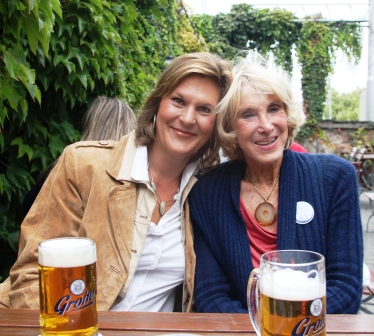
We took a trip north to the Darmstadt area to see more friends.  For years I worked for the military newspaper Stars and Stripes which was previously headquartered just outside the city.  A group of former colleagues met us at an Italian restaurant for a fun evening.  Special pal Andrea, whom I consider a surrogate step-daughter, and her husband Thiemo, joined us at Darmstadt’s famous brewery, Grohe, where we sat outside in the sunshine savoring the brew.  Another Darmstadt friend, Wilma, invited us for a delicious salmon dinner and stimulating conversation with her friend Erik.

Our travels also  took us to the Bergstrassee south of Darmstadt, Kaiserslautern, Augsburg, Munich and the Starnberg Lake district south of Munich.

For many years while I worked at Stars and Stripes, I lived in Jugenhiem at the northern end of the Bergstrasse in an apartment I called the “Treehouse.”  It was the top two floors of a former seniors’ home at the edge of a forest  and surrounded by tree tops.  We stopped for a visit, and it’s still the same – an idyllic hideaway in a jungle of green.

The best of the visit to the Bergstrasse, which extends 70 kilometers south from Darmstadt  to Heidelberg, and where many an ancient castle and castle ruins crown hilltops, was wine  The Bergstrasse wine region is divided into two parts, vines in the south in the state of Baden Württemberg, and those in the north in Hessen.  The former is Germany’s smallest wine region. German wines, as well as wines everywhere, have improved thanks to up-to-date knowledge and techniques, an expert told us.

For years German wines had a bad rep because “we exported the wrong wines, “ such as the  sweet Blue Nun, explained Maria Zimmermann of the regional tourist board.   Today German vintners are also well-educated, studying viniculture, not just learning the trade from their parents. We tasted some fine wines, and  Bob  made several purchases.

In the town of Weinheim, we toured a lovely garden followed by the best restaurant meal of the trip, an amuse bouche of scallops topping  a pumpkin salad sprinkled with mandarin oil, and a Hirsch (venison) medallion with an elderberry sauce and Steinpilze (boletus),  plus  parsley root puree. It was perfection.

Heppenheim is the quintessential Bergstrasee town with a market place of well-preserved half-timbered houses.  We joined an after-dark tour up and down the ancient streets and stairways, following a costumed story teller and her lantern carrying assistant.  Periodically they stopped with the story teller relating charming tales and fables of the region, most translated from old German into an English that rhymed.  Very impressive and a delightful, unusual experience.

The greatest number of Americans outside of the U.S., some 50,000 who are military or civilians working for the military, makes their home in the Kaiserslautern area. There I interviewed Wolfgang Tönnesmann, director of the Atlantic Academy, who had a life-size cardboard replica of Obama in his office. Like me, he is no doubt thrilled with the recent election results.

My quest to try local food specials in Kaiserslautern led us to the town’s only half-timbered building and the restaurant Spinnrädl. We were in the Rhineland Pfalz area and the restaurant served up  Pfälzer dishes written in the local dialect on the menu:  Brotworscht, Saumaa, Lewwer (Bloodwurst, potatowurst so named because it is stuffed into a pig’s stomach or Saumaa) and liverwurst. Hearty fare accompanied by Grumbeerstampes   (mashed potatoes).

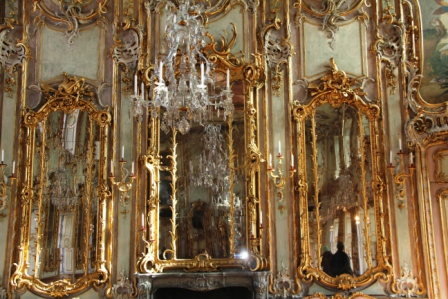
Jakob Fugger (1458 – 1525), a wealthy merchant (according to a guide, “he had more money than Bill Gates) put Augsburg on the map.  The Fugger family, in particular Jakob, was into finance and trade.  Jakob, known as the Empire’s banker, and  not unlike Bill Gates, had a social conscience.  He founded the Fuggerei, a section of the city for the town’s poor, the world’s oldest social housing which still exists with 140 apartments.  Rent is 1 euro per year.  We followed a fascinating tour of the area, and also visited a dazzling Rococo banquet hall, the Schaetzler Palais (1767), as well as other local attractions.

The Munich visit focused on food with visits to the city’s legendary outdoor market, the Viktualienmarkt, its classy food emporiums, Dallmayr and Käfer, as well as the food empire of Alfons Schuhbeck who has a collection of shops, including a Michelin starred restaurant, in the Platzl near the Hofbräuhaus.  Friend Heti clued me in on Schuhbeck who is huge on the German food scene.  It was at his incredible spice shop where she purchased the Tonka beans which come from South America for that exotic dessert.

Our visit wound up at the Starnberg Lake, one of several lovely lakes  south of Munich. All the sailboats which blanket the lakes in summer had been put to bed, but the region had plenty of charms for a fall visit.

A  must was a visit to the nearby Andechs Abbey above the Ammersee, another one of the regional lakes.  After admiring the Abbey’s church and its stunning Rococo stucco décor and frescoes,  we moved on to the terrace beer garden.  Monks have been brewing beer at Andechs since 1455.  These days seven different kinds of brew can be ordered, as well as Bavarian food favorites.

Other Starnberg highlights are the Baroque St. Mary’s Minister in the town of Diessen and  the lakeside Buchheim Museum noted for its collection of Expressionist works.  Last but not least, a wonderful bike ride following a cycle route along the Starnberg Lake with an outdoor lakeside lunch stop, as well as many breaks for postcard photos of the lake framed by distant Alpine peaks. (For more photos, see slide show to follow.  Comments are welcome. )

For more information:

www.diebergstrassse.de

www.augsburg-tourismus.de

www.munich-tourist.de

www.sta5.de

www.andechs.de

This slideshow requires JavaScript.

Down Under Delights – and Disappointments

“Be sure to climb the Sydney Bridge.  It’s amazing,” friends advised.  So, on our visit Down Under last November, we did —and are $524 Australian dollars poorer.  (The Australian dollar is about at par with the U.S. dollar.)

Yes, $212 per person for this “once in a lifetime” experience.   Who could afford to do it twice?

Our conclusion: A rip off.  Not that the experience was without thrilling moments.  And, the views are dynamite.  But, think of the gourmet meals that $524 could have purchased.

We joined a group of 12 others for the 3 ½ hour adventure.  The first hour was spent getting attired:  a loose fitting protective body suit with a belt from which a carabiner dangled, a head set, a baseball cap. Then, practice. We had to climb and descend a ladder, attaching and releasing the carabiner to a cable.  For security, climbers are attached to a cable throughout the climb.  We listened to safety briefings, warnings etc.  The adrenalin was in high gear.

At last we were off – a single file behind the guide who kept up a commentary heard on the head set. The first part in the guts of the mammoth steel structure was not too exciting, just lots of steps and long stretches across cat walks.  Once we started climbing outdoors, precariously  on the edge of the bridge,  a strong wind whipped around  us.  We were so high, it seemed as if we could touch the sky, and the water below appeared to be miles and miles away.  It was all  exhilarating with spectacular views in every direction.

We stopped for photos.  But, not with our cameras.  Personal cameras are not permitted – too dangerous.  An official bridge photographer was on the scene.  Each couple or individual was photographed with the appropriate spectacular background. This took time, too much time. There were five of these stops, each with a slightly different background.  And, we usually had to wait for the group ahead to finish before our group moved up to the perfect photo slot.

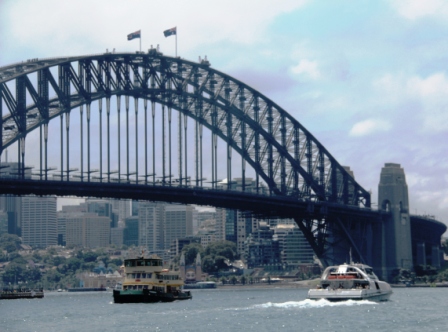
Plenty of time to ponder the scenery, and to look down. The Sydney Harbour Bridge, at 440 feet from top to water, is the world’s tallest steel arch bridge.  That’s a huge drop, and scary to view. The guide added to the fright factor with tales of those who plunged to their deaths.  Sixteen workers died during construction which was completed in 1932. The sight that amazed me during the climb was a lonely bird in his nest built on steel beams that had to be higher than any tree.

The finale of the “climb of your life” was aggravating.  After we had changed back into our street clothes, we proceeded to a room with pretty young girls sitting behind computer monitors.  Here’s where we could get those photos, we thought.  We were right.  Give your name and your individual photos pop up on the screen. For a mere extra $25.95 per photo, you could purchase a picture souvenir.  We passed, content with the one complimentary group shot.

Others in the group (the elderly gentleman from Chicago, the honeymoon couple, the couple celebrating a birthday…) eagerly parted with the extra cash for the pricey souvenirs.  They all seemed happy with their costly climb.  Perhaps we’re jaded?

After the experience, we headed to a nearby pub for a much needed beer.  We related our disappointment to the bartender.  “I wouldn’t do it.  You can walk across the bridge for free.  It’s not worth it,” he said.  We agree.
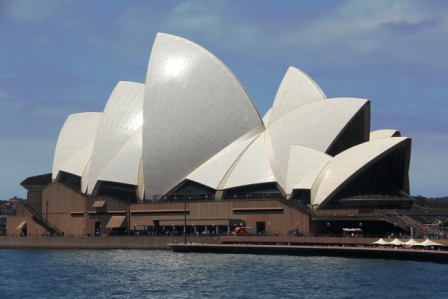
While the bridge climb left us somewhat underwhelmed, we were overwhelmed with the Sydney Opera House.  During a guided tour, we learned the fascinating background to this iconic structure. Both inside and out, it seems so ultra modern.  Yet, it was constructed between 1959 and 1973.  Glass for the gigantic windows came from France.  The ceramic tiles on the exterior are from Sweden.  Its exotic shape of undulating sails permits self-cleaning by the rain.  The acoustics in the large auditoriums are such that no microphones are needed….

Danish architect Jorn Utson designed the incredible structure.   Building costs far exceeded original projections.  In 1966 due to a conflict over finances with a new minister of public works, Utson resigned, vowing never to return to Australia.  He died in 2008 without seeing his completed masterpiece, which was declared a UNESCO World Heritage site in 2007.

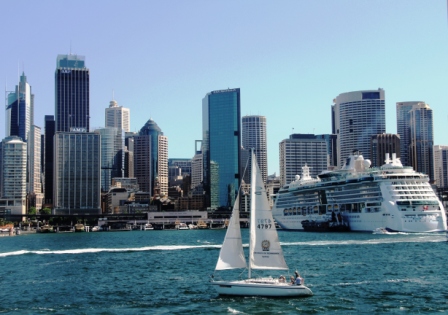
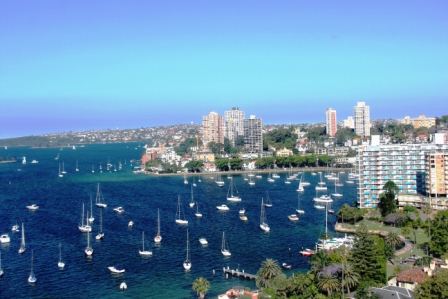
Other delights of the Sydney visit included the city’s bustling fish market, a ferry excursion to Manly where we watched surfers – and our reasonable room ($135 per night) with an exceptional harbor view at the Macleay Apartment Hotel (www.themacleay.com).

We found Sydney – actually all of Australia – expensive.  Here we had a mini kitchen so we could save on meal costs.  The hotel location in Potts Point was ideal with both delis and a super market nearby for purchase of take-home, ready-to-eat meals.

Well-traveled friends also advised that we visit the Great Barrier Reef during our sojourn in Australia. Many, many year ago, I took the required course and earned scuba diver certification.  I’ve only been on a few dives, but as the Great Barrier is said to be one of the world’s best diving sites, I had to experience it.

We flew from Sydney to Cairns where we rented a car for a 1 ½ hour drive north to Port Douglas, an inviting seaside town of restaurants, quaint shops – and excursion boats to the Great Barrier Reef.  Husband Bob is not a diver, but he joined the party, 80 tourists, on the dive/snorkel boat.
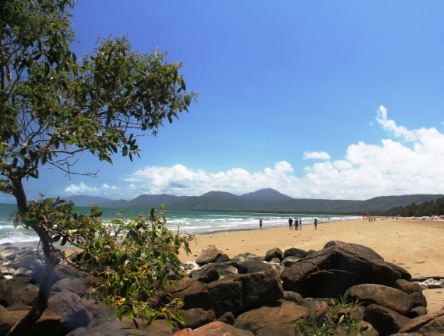
I was nervous since I had not been diving in so long.  I joined a “beginners” group and once in the water, my confidence returned.  The coral formations were intriguing, even mystifying.  But, they were dull — beige and bland in color.  A far cry from the vivid colors of the postcards.  And, the fish were not as plentiful as the postcards depict.  I did see a gigantic clam, a ray glued to the bottom, some bright yellow fish.    I submerged three different times, but each time returned to the surface a bit disillusioned.

I was not the only one.  Several on board expressed the same feelings.  One diver said there were too many of us.  We scared the fish away.  Later someone said the coral had been killed by El Nino. (According to an article on the web, El Nino bleaches the coral.)   Jakob, the friendly proprietor of our Port Douglas hotel, said you need to get accustomed to the underwater surroundings, to adjust your eyes, and then you will see color.  “All those postcard photos are made with strobe lights,” he explained.

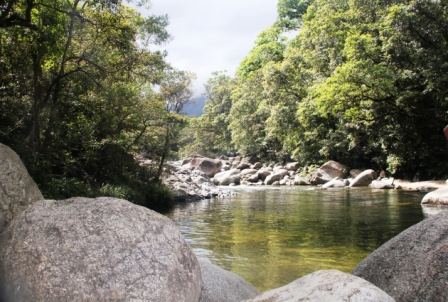
I am still happy I had the chance to dive again, but what really made me happy was a swim in an idyllic pool at the Mossman Gorge in the Daintree National Park not far from Port Douglas.  For me, swimming is right up there after skiing.  This body of clear, cool water with huge granite boulders along the sides, as well as in the middle, surrounded by lush jungle, was a bit of paradise.  The pool is in a section of the Mossman River, touted as  “without crocodiles.”  But, there were lots of birds, including a wild turkey poking among the picnickers along the shore.

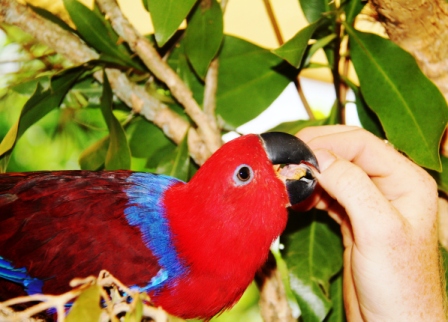
We saw more feathered friends at Habitat, a fun place where you can dine in a large enclosed area among birds, small and large and brightly colored,  who fly above, prance around on the ground, squeak, chirp, sing, and screech.  A caretaker walks by and gladly perches a bird on your shoulder.  Habitat also has more wildlife: kangaroos, koalas, wallabies, crocodiles.

We rented bikes for the trip to Habitat, just outside of Port Douglas, and rode back along the beach, which, except for a jogger or two, was deserted, even though it was a hot, sunny day.  Jelly fish, we learned.

The Palm Villas, our home in Port Douglas, was ideal – reasonable, excellent location, lovely pool, helpful proprietor.  We paid about $95 per night for a spacious studio apartment with kitchen and balcony on a quiet street. www.palmvillas.com.au

In case you’re tempted, more on Sydney Bridge climb at www.bridgeclimb.com  More on diving excursions in the Great Barrier Reef: www.poseidonpcruises.com.au

Have you been to Australia, climbed the bridge, been diving at the Great Barrier Reef?  Share your views. Click on “Leave a Reply” after the slideshow below.

If you’d like to read more of my tales and adventures, click on “Email Subscription” at top right of post.    New Zealand’s magnificent Fiordland  coming soon.  And, a new recipe appears with each new post.

Learn about the famous melons of Provence.  Try a tasty melon salad.   See “Melon Salad with Feta and Pine Nuts” under recipes at right.


This slideshow requires JavaScript.
 

Bicycling with Battery Power

Press a button on the bicycle handlebar.  Whee…, you soar full speed ahead.  It’s like magic, a thrilling sensation.

The power of electric bicycles.  I was excited.  Husband Bicycle Bob (BB), a hardcore macho cyclist, less so. Yet, we enjoyed our recent all-day excursion on these fun bicycles in the Luberon hills of France’s Provence.

Electric bicycling seems to be surging in popularity.  Baby boomers getting too old and out-of-shape for demanding pedaling?  More folks wanting a bicycle excursion without stress and sweat?   Serious cyclists who want to cover many miles, including some steep ascents where a power boost would be welcome?

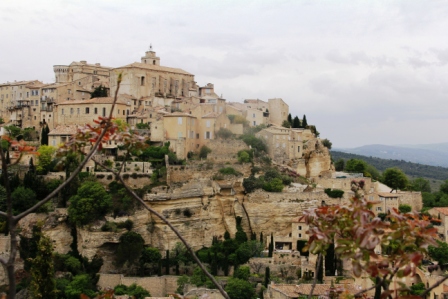
Whatever the reasons, electric bicycles offer an enjoyable and easy alternative to conventional pedaling.  We rented these sturdy monsters for a day in the Provence town of Gordes with the company Sun-E-Bike which just started renting the bikes, valued at 1,300 euros each, at Easter.

Florian Machayekhi, who spoke English, gave us a briefing. You must pedal for the motor to be in operation, he explained.   There are three settings for different levels of motor power.  For steep hills, for example, you may wish to select the highest.  When going downhill, or in the flats, you can press a button to switch off the motor and pedal as with a regular bike.  Sun-E-Bikes have seven speeds.

We have done a lot of bicycling and did not intend to pedal with auxiliary power all the time.  However, these bikes are heavy, 25 kilos, therefore not quite like your bike back home.  I always shut the power off for downhills, and, lest being a real wimp, tried to keep it off in the flats. But, as this is Provence where the winds often blow, I was happy to press the power button to offset those nasty gusts produced by the Mistral.  And, I was no martyr in the hills, loving the easy and effortless climbs.  BB, of course, had to do it the hard way most of the time.  For the first time on cycle trips, I beat him to the top.  So, I cheated…it was still fun being first.

Florian had given us a map with a 40-kilometer itinerary through some Provence highlights: Fontaine de Vaucluse, Saumane de Vaucluse, Isle sur la Sorgue…  He suggested we have lunch at the latter where we could exchange the batteries.  The bike battery will last for 35 kilometers.  When we arrived at Les Terrasses du Bassin, the restaurant/battery exchange point, our batteries still registered full – all four battery lights still glowing.

We enjoyed lunch on the restaurant terrace where the river forms a large pool of crystal water popular with hungry ducks, but did not bother to get a new battery.  Almost a mistake.  Several hours later when we neared Gordes, the quintessential perched village and our destination, my bike was down to one battery light.  And, the last part was five kilometers all up hill.  I kept the motor setting on the lowest, thus using less power, and said a prayer that it would get me all the way back to the rental station.  I did not want to pedal that weighty bike up this killer ascent.  Luck was with me.  I made it back under battery power.

We cycled on May 8, a holiday in France, so the walkway through the forest to the scenic source of the Sorgue River at Fontaine de Vaucluse was crowded with strollers.  Riding became too risky, so we pushed the bikes up the path along the raging river.  Not easy, but the sounds and sights of the water below charging over rocks and boulders detracted from the effort.

Isle sur la Sorgue, known as the Venice of Provence, is a pleasant spot for a lunch break.  The Sorgue River splits into numerous streams flowing through the town not unlike Venetian canals.    Pedestrian bridges decorated with flower boxes and mossy waterwheels add to the picturesque ambience.

Between the towns on our itinerary we cycled past acres of vineyards, orchards, fields ablaze with wildflowers and weathered stone farm houses, all with the Luberon hills as a backdrop.

Pascal Hernoult welcomed us and the bikes back in Gordes.  The new electric bike venture is “encouraging,” he said.  “People return with big smiles.  They say it’s ‘formidable.’  They are not tired.”

Count me among those happy electric bicyclists.  Even BB admitted he was glad for the battery power to get back up that last long hill.

Watch the slideshow below for more photos.  Enjoy a tasty treat of the season: Hsin’s  Strawberry Cake.  See recipe in column at right.   Next blog post to focus on French health care — a first person account based on my upcoming knee replacement surgery.  Don’t miss it.  Click on “Email Subscription” at top of right column.

This slideshow requires JavaScript.

Sun-E-Bike has 200 electric bicycles for rent at three different sites in Provence: Gordes, Bonnieux and Lauris.  Cost for rental per day is 35 euros which includes a helmet and yellow safety vest.  Half-day rental (9 a.m. to 1 p.m. or 2:30 p.m. to 7 p.m): 22 euros.  Insurance: 2 euros per day.  A deposit of 200 euros or an ID card such as passport or driver’s license is required. Maps with suggested itineraries and battery exchange points are provided. Baby seats, baby trailers and panniers can be rented for an extra charge.

SuneE-Bike also offers bike rental for longer periods with hotel overnights and luggage transfer provided.  See the web site for details: www.sun-e-bike.com

Meandering around Melbourne

This was the best part of our visit to Australia.  It’s all due to the warm and generous hospitality of our friends Meg and Brendan Downie who took great pains to show us the sights and treat us to excellent meals and superb wines, not to mention comfortable accommodations at their attractive home in Donvale outside the city.

We met Meg and Brendan years ago when we lived in Germany where we were members of the Porsche Club.   I had a Porsche 944 (considered by many not to be a real Porsche), but it was my baby, my pride and joy, which I drove for 17 happy years.  Brendan had both a Porsche 356 and 911.  He still has these, and a 1936 Ford.  Attendance at a Porsche event was a highlight of our visit.

Plus, a spectacular drive through the Mornington Peninsula, the Yarra Valley, a visit to an animal sanctuary, an aborigine art gallery and more.

During a visit downtown, I had the opportunity to talk to John McGaw, senior business development manager with Destination Melbourne.  “I’ve worked in the tourism and wine industry for years,” he said.  “I’ve lived in Syndey, Adelaide and now Melbourne.  I prefer Melbourne.  It’s such a friendly city.  Everything is easy here…We’re a shopping and dining capital.”    The city has 80 different kinds of ethnic restaurants, he pointed out.

According to John, Melbourne, a city of almost four million, was just voted “the world’s most livable city.”  “It’s as safe a city as you’ll find anywhere,” he boasted.   Tourism is important to the multi-cultural city, with China considered the largest future market, followed by India.  Then there’s Greece.  John said that Melbourne has the second largest population of Greeks after Greece.  “They’ve been coming here for 40 years.”  The city’s Greek Quarter, as well as Chinatown, is fun to visit.  For Vietnamese fare, there’s Victoria Street lined with noodle shops and grocery stores.

The downtown is lively, vibrant, with street entertainers, hucksters, and plenty to admire, including 50 shopping arcades, the oldest, the Black Arcade, dating to 1892.  John recommended we visit an old world Victorian tea shop whose window was filled with luscious pastries.   The place is so popular, we had to stand in line to wait for a seat.

Federation Square is an innovative mix of glass and steel structures with shops, cafes, restaurants, and bars — and the venue for some 2,000 events every year.  Docklands on Victoria Harbor offers more shopping and dining opportunities.  The Queen Victoria Market is food paradise.  Meg and Brendan shop there every Saturday, visiting favorite stands for fruits and veggies, as well as delis and bakeries.

Within just 90 minutes of the city center, stunning scenery awaits.  We made many photo stops on our drive through the Mornington Peninsula. The Yarra Valley, a wine growing region, is also picturesque with wineries where you can stop to taste fine chardonnays, pinot noirs and more.  Our drives took us though areas devastated by the Black Saturday bushfires of 2009 which ravaged southeastern Australia   —— past slope after slope of still barren trees.

Wildlife is a major attraction in Australia. Meg took time from her duties as ward councilor for a visit to friend  Neil Abbott, a jovial farmer with 100 acres where 70 – 80 kangaroos usually hang out.  As luck would have it, the beasts were missing the day we visited.  The day before there had been a major fire drill with helicopters hovering over the area.  The noise drove the kangaroos away, but we did spot one or two during a tour with Neil in his four-wheel drive vehicle  through the hilly terrain.   And, we learned about kangaroos.

“The aborigines used to eat them.  The dingoes (Australian wild dog) used to eat them.  But now they have no natural enemies,” Neil said.  So, they proliferate and become pests, destroying trees and fences.  They sharpen their claws on the tree bark.  “Their claws are longer than your finger,” he explained.   Some people shoot them, but this is an outrage.  “People are up in arms about those who shoot our national emblem,” he said.  He can no longer farm due to the kangaroo population on his land, but he won’t shoot the animals.

“The kangaroos are a wild animal.  They should be in the bush.  It’s cruel to have them in these areas where they are chased by dogs, where they ruin fences, and are a danger to cars and people… I believe there are a lot of accidents, people killed, veering to avoid hitting a kangaroo,” he said.

During our drive through his farm, Neil said he had a surprise for us.  He knew where a wombat lived and would take us there.  He got out and went ahead down a hill.  “Be quiet…he’s here,” he told us.  We crept behind, me with camera ready.  Voila, I focused on a furry brown head.  Wait, something seemed amiss. It did not move. It looked a bit suspicious.  No wonder.  It was a stuffed wombat Neil had buried under leaves – a joke he often plays on naïve visitors.

We saw more wildlife on a visit to the Healesville Sanctuary where demonstrations and lectures on the various critters are scheduled throughout the day.    The Koalas drew big crowds.

Colin McKinnon is another friend Meg took us to visit.  His Mia Mia Gallery features an amazing collection of beautiful aboriginal art.  The gallery is owned by aborigines, and the profits are returned to aborigine communities.  Colin, himself an aboriginal artist, explained the symbolism of many of the intricate and colorful works, and he generously gave me a print which now hangs in our living room, a treasured souvenir of our memorable visit to Melbourne.

More on the Mia Mia Gallery at www.miamiagallery.com

More on Melbourne at www.destinationmelbourne.com.au

More on the Healesville Sanctuary at www.zoo.org.au

For more views of Melbourne and surroundings, watch the following slideshow.  For a taste of  Greece, whose  influence is prominent in  Melbourne, try Meg’s Baklava, recipe in column at right.

This slideshow requires JavaScript.