Christmas markets are everywhere these days. But none can compare with the original version in Germany. I miss the real thing, those romantic, storybook holiday markets: tiny twinkling lights (usually white or golden – not a jumble of gaudy colors), hot glϋhwein, savory sausages, spicy cookies, church bells, Christmas carols – all basking in German gemϋtlichkeit.
Grambois tree and Christmas cat.
Since I am usually disappointed with French Christmas markets, I rarely visit them. Grambois was an exception. I read that this nearby perched town would
Santa arrives in Grambois.
start the holiday season early with a Christmas market this weekend, Nov. 16 and 17. And, an American, the Provence head of a charitable organization, Calcutta Rescue, would be there with a stand selling items made by poor Indians.
There are plenty of Brits, Dutch, Belgians, and some Germans, living among the French in this picturesque part of France. But, very few Americans. I wanted to meet him and learn more about Calcutta Rescue.
Glen Kendall, originally from Grand Junction, Co., lives with his Dutch wife in this burg of 1100 citizens. He had been working for a software company in London when he saw an ad for an administrator for the Calcutta based charity. He got the job and was off to Calcutta for a year. He said he’s been to other parts of India, but nothing prepared him for Calcutta. “It’s full of energy 24 hours per day, chaotic, filthy, polluted.” He lived in a Muslim slum where the electricity worked about two thirds of the day. The people made the job. “The poor people have a joie de vivre that’s inspirational. It makes you happy to be alive. It’s hard to believe they live under a piece of plastic.”
Kendall in Calcutta
Calcutta Rescue (www.calcuttarescue.org) helps the indigent of Calcutta, most of whom live on less than one euro per day. The organization runs three medical clinics and supports more than 600 poor children, most living in the streets, providing them with funds to go to school, clothes, two meals per day and medical care. A handicrafts project was started to teach former clinic patients how to sew. They learn a skill which can help them survive. They make clothes and handicraft items (cards, bags, embroidered napkins, etc). The latter are offered at the Grambois Christmas market. I especially liked the small embroidered bags containing Indian spices.
Kendall saw that I had a camera. “Let me show you something most visitors to Grambois don’t see, “ he said. He led me outside of the old village, down some steps to an incredible tree, a multi-trunked oak thought to be more than 300 years old. And, he told me where to wander for more photos.
We frequently drive on the main road below ancient Grambois. One time we followed the twisty road uphill to the village, but did not get out to explore. Now was my chance. It’s worth a trip. The town’s origins date to the 11th century. Vestiges of 14th century walls still stand. There’s a Romanesque church, a bell tower, a fountain, and meandering stone alleys – all restored. Plus, lovely views of the Luberon hills.
Those hills were alive with a rainbow of fall colors glowing in the strong Provencal sunshine. It was warm – not at all like Christmas. But I am glad I visited this holiday market and discovered Glen Kendall, Calcutta Rescue and inviting Grambois.
I am happy to hear from readers. See “Leave a Reply” below under Comments. Subscribers also welcome. Don’t miss future posts. Click on Email Subscription at top right.
Stay tuned. Post on Wild and Wonderful Corsica coming very soon.
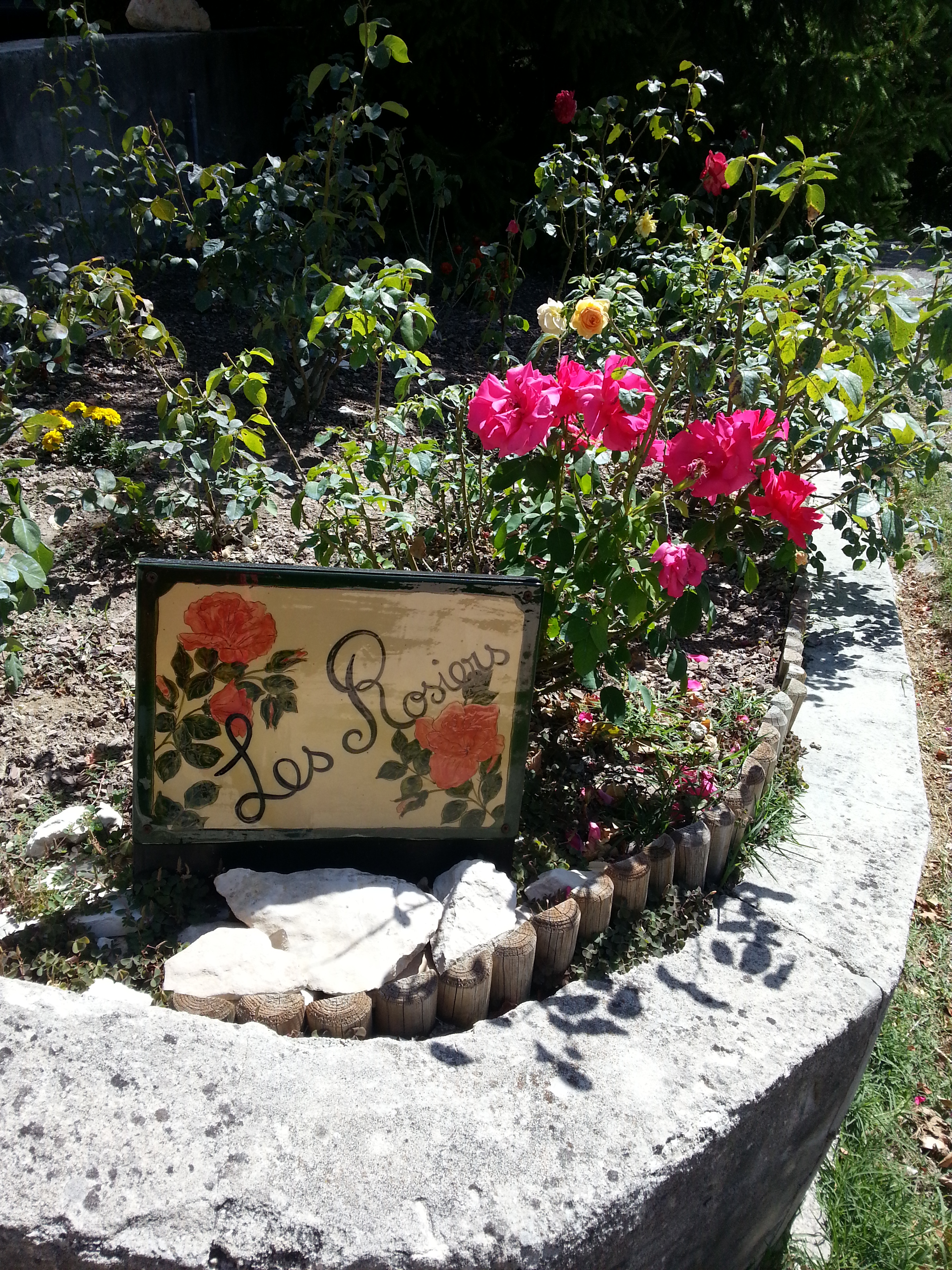
The pool at Les Rosiers, our home, did not turn ghoulish green as it has in past summers. None of the precious roses died. We had wonderful tenants in our studio rental apartment, plus fun family visits. The crumbling pergola was replaced (but that’s another story, see previous post, “Pergola –or State Park Picnic Shelter”). We enjoyed a terrific visit to Antwerp, tasty meals at local festivals and parties with friends. Summer 2013 was better than good: Super
It kicked off in June with the arrival of Klaus, an Austrian from Graz. He and his wife Eva have been staying in our gite (French for vacation rental) for a month every year since 2010. Klaus arrives first, by car, roof rack loaded with supplies, including Austrian beer and food staples. On the way home, a large supply of wine takes the place of those goodies. Eva is a legal secretary. She comes by plane a week after Klaus arrives.
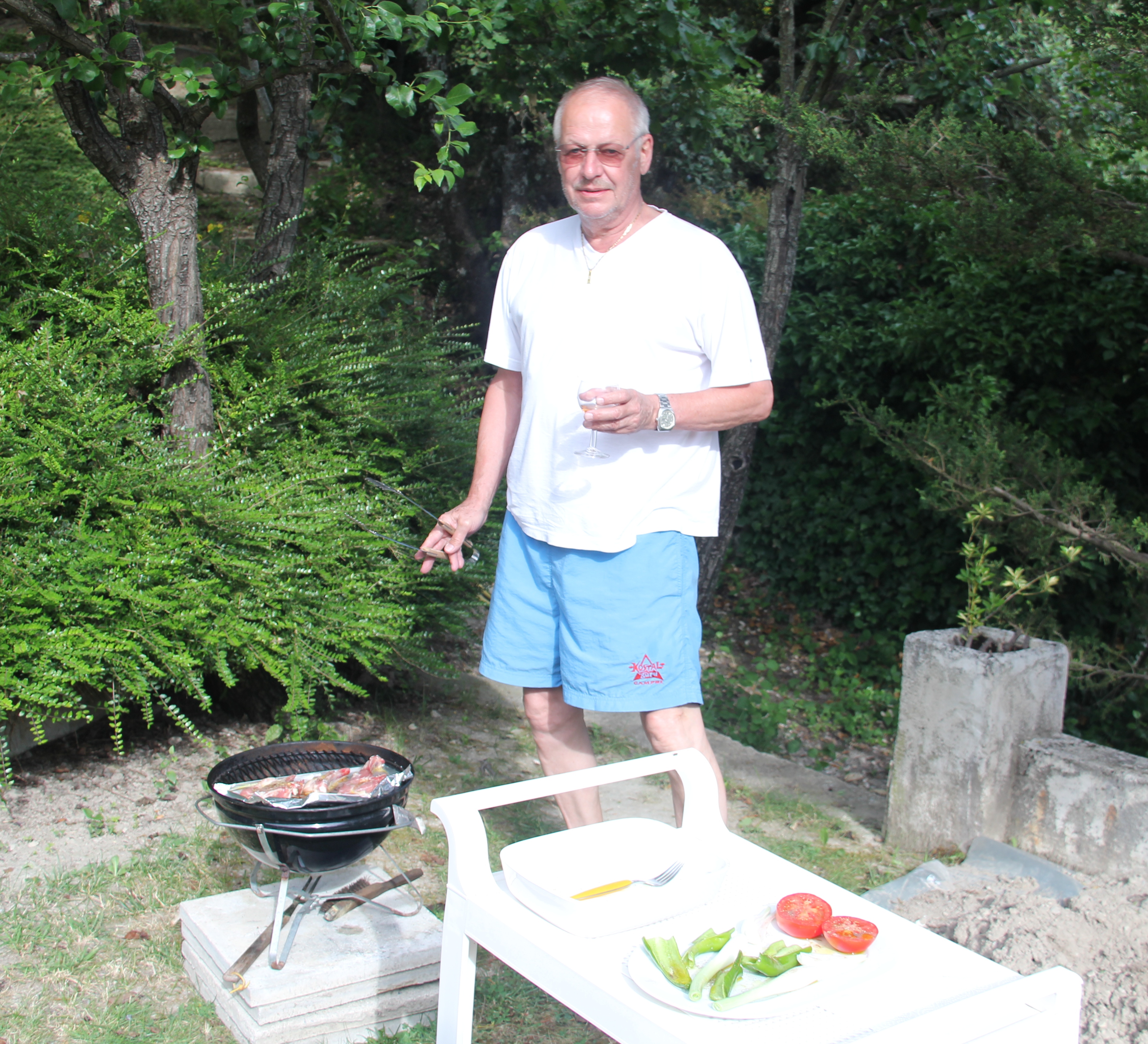
Klaus
They know the area well, have friends here, enjoy revisiting favorite places and hanging out poolside. Klaus loves to cook. He brought his own knife sharpener this year. The one I supplied was not up to snuff. And, he loves to grill – lamb and sausages are his favorites. This year his grilling almost led to disaster. The morning after a previous day’s use of the grill, he emptied the ashes which he assumed were dead in the wooded area of dried leaves behind and adjacent to our house. That afternoon I was in the pool. I noticed smoke, but I assumed he was grilling again. Suddenly BB (husband Bicycle Bob) came flying down the steps from our balcony. He had seen flames. Indeed, the ashes had sprung to life and a fire had started. It was frightening. But, all to the rescue with hose and buckets of water. Catastrophe was averted.
Filippo kept our tenants entertained.
Eva is a walker, often up at 7 a.m., setting out on a trek in the area for two to three hours. Klaus also hikes and gathers herbs and berries (juniper) and other treasures from the forests and fields. He left me with a supply of bay leaves which I have dried. Another of his favorite pastimes is visiting flea markets. During summers here, there are many on the agenda. He always finds interesting bargains.
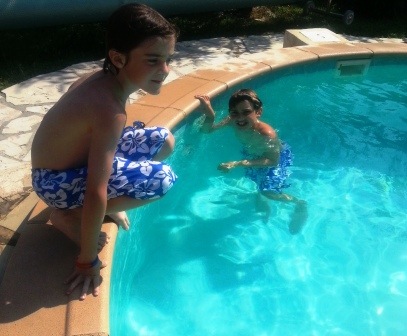
Lang and Samuel
Stepson Rob and his boys, Samuel and Lang, followed Klaus and Eva. The boys, both swimmers, loved the pool, as well as jaunts on foot to the bakery every morning with their dad. They could not get their fill of croissants. According to Rob, Samuel still asks when he can come back and get more of those croissants, which he called “amazing.”
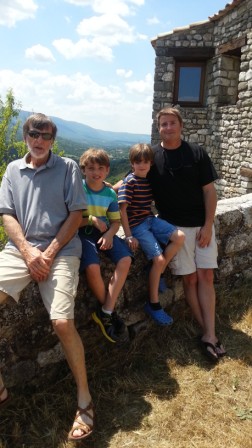
Bob, Samuel, Lang and Rob
The Gorges du Verdon, the Abbey of Senanque and Colorado Provencal were highlights for Jean and Alex, a charming couple who stayed for a week. He is French, lives and works in Colmar. She is German, originally from Leipzig, and now working for an international organization in Geneva. They both are multi-lingual, and, like many of our visitors, especially enjoyed the “calm” at Les Rosiers.
They were followed by a couple we felt were a bit strange, if not unpleasant. He always had a scowl on his face, never a smile, and once complained that the refrigerator was not cold enough (easy to fix – just turn up the dial.) They went off sightseeing and came back to lounge by the pool, but barely said a word to us. I assumed they were not happy with our accommodations. I dared not ask them to write in our guest book. Wonders never cease. They did write: “Thanks to your hospitality we have discovered the pleasures of Haute Provence…we have appreciated the coolness of your gite, the refreshing swimming pool and the calm of the surroundings.”
Roberto and Francoise from Fribourg, Switzerland, are fantastic. She is a teacher for handicapped adults – and a cat lover . She was smitten with Filippo, my rambunctious male cat. Roberto, originally from Uruguay, came with hisbicycle.
Roberto and Francoise
Unfortunately Francoise fell in our new pergola/State Park Picnic Shelter (SPPS) and broke her foot. They took it in stride, did not complain, and continued their stay.
As her mobility was limited after the accident, Francoise was content to sit in the yard, often with Filippo at her side, and read while Roberto rode his bike. Like Klaus, she was into wild herbs: garlic, fennel, rosemary, thyme. And oils – lavender, almond and olive. She gave me instructions on treatments using lavender oil.
Elaine and Paul
Time for the British, Elaine and Paul from southeast London, who kept on the move and visited sites near and far (Arles, Pont du Grad, Gorges du Verdon, Bonnieux, Gordes). Elaine is an assistant for children with special needs at a secondary school. Paul is a quantity surveyor for a construction company. They also enjoyed Filippo’s shenanigans. Paul said Les Rosiers is “the quietest place we’ve ever been to.”
Elizabeth and Igor from Normandy stayed two weeks. They overwhelmed us with dinner invitations. Igor also likes to grill. While I was away, he invited Bob for grilled sausages. When I returned we were invited for grilled beef. And, yet again for an apero. We expected the usual chips- nuts- and- olives apero. But this was an “apero dinotoire,” something new to us, a multi-course meal: crackers and tomatoes, then grilled lamb with a rice/tuna salad, a potato salad, and fruit.
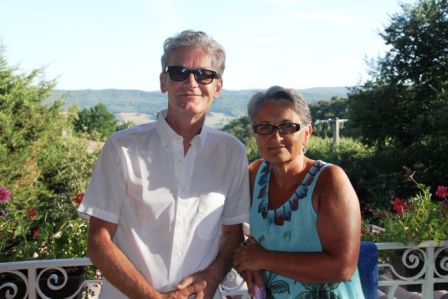
Igor and Elizabeth
Igor arrived with easel and paints. He set up in the yard and created lovely scenes. We received one as a going-away present. He is a financial consultant in Paris, and commutes home to Rouen on weekends. Elizabeth, who was recovering from breast cancer surgery, said she came to the Luberon to “relax.” They did visit some neighboring towns. “We like typical, tranquil, original villages,” she said, mentioning nearby Viens and Vacheres. They also raved about an attraction we have yet to visit, the Ganogobie Abbey.
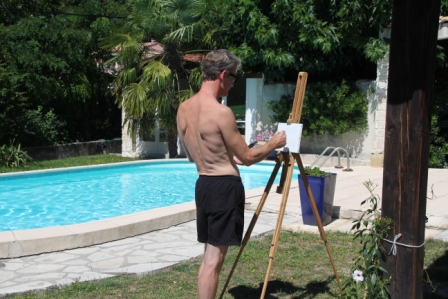
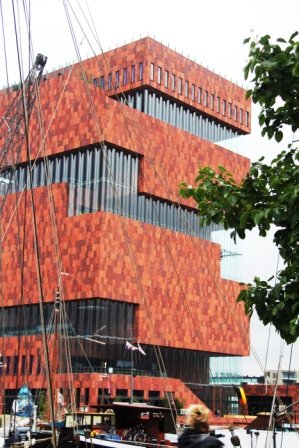
Summer wound down with the visit of stepdaughter Kellie. She gave BB a chance to live up to his name. They bicycled a few times before her boyfriend arrived for a week. We all set off to Marseille together and were in awe of the new architectural masterpieces.
It’s still warm in Provence, but the pool waters have chilled. We’ll put the pool to bed for winter soon. But, I can look forward to starting swimming early next spring. We’ve purchased a heat pump for the pool. Summer 2014 may top summer 2013.
I’m happy to hear from readers. See “Leave a Reply” below under Comments. Followers also welcome. Don’t miss future posts. Click on Email Subscription at top right.
According to the French proverb, “A day without wine is a day without sunshine.” There’s no lack of liquid sunshine in our lives, nor in the lives of most of the French, as wine is an essential part of life here. Not far from our abode in the Luberon area of Provence are numerous wineries. BB (husband Bicycle Bob) and I enjoy treks to visit and taste and buy.
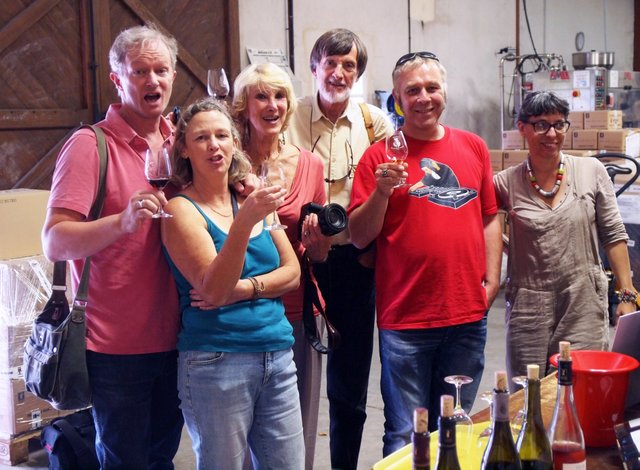
Last week’s all-day excursion to sample Côtes du Rhône wines in the department of the Gard northwest of Avignon was over-the-top. Four wineries, lots of delicious reds and whites – plus the famous Tavel Rosé.
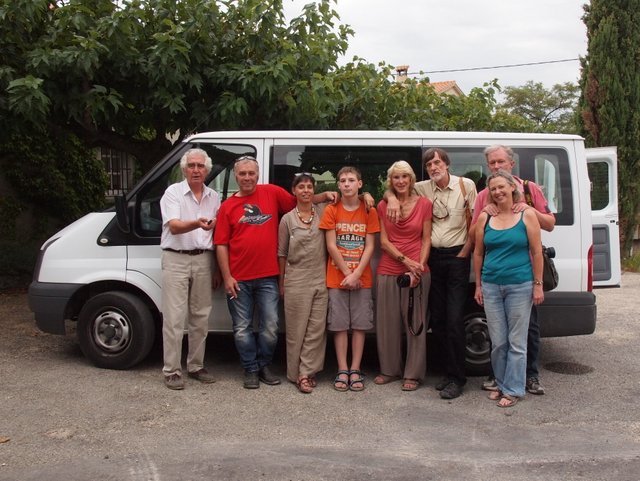
Happy Wine Tasters–photo by David Regan
French friends Anne and Pascal organized the jaunt, rented a van, and invited us, plus our friends David, Martine and George. (David’s wife Mollie was sick and had to miss the event.) Pascal hails from the region, and is a fan of its red wine. He had prepared documentation on the area, as well as each of the wineries we would visit. Very impressive and professional.
Pascal, Gard wine afficionado
The Gard, as opposed to other wine areas we have visited, is relatively flat. Vines grow on level ground in chalky soil covered by layers of flat stones which act as heat storage – similar to the terrain of the prestigious Châteauneuf- du- Pape vineyards. Winters are warm and dry. Spring is warm and wet, while summers, very hot and dry, precede warm and rainy autumns. Mistral winds blow away the risk of disease. It all makes for excellent wine.
Chartreuse de Valbonne,an ancient monastery founded in 1203 with its own vineyards, www.chartreusedevalbonne.com, was our first stop. Pascal’s mother was a teacher there, teaching the children of the doctors who worked at the hospital for lepers formerly housed in the monastery. His mother’s family moved from northern France to the Gard, which was a Zone Libre (free zone), during World War II.
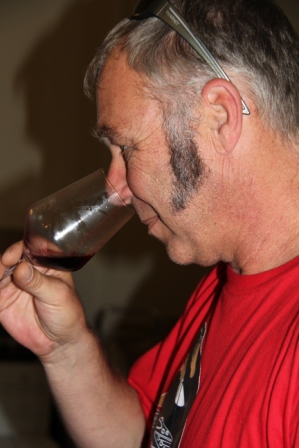
We sipped three reds and two whites. Martine and I, both fans of white wine, especially liked Terrasse de Montalivet, Côtes du Rhône Village 2011, 100% Viognier. Pascal said he prefers the white wines of Burgundy, but for red wine, these Côtes du Rhône are his favorites. He explained that the combination of the terrain and the expertise of the vintners in the region who blend different grapes result in “wines with a special character.” And, the price is right, not as expensive as other, better known Côtes du Rhône.
The wine connoisseur chose the perfect lunch stop: Goudargues, “Venice Gardoise,” a delightful town with a canal bordered by giant Plane trees right smack in its middle. We sat outdoors above the clear water where we’d spot an occasional trout. Moules (mussels) were a restaurant special. I chose the version in curry sauce, while BB opted for mussels with a chorizo sauce. Both served with frites and scrumptious.
Delicious (photo by David).
George and David are serious, professional photographers. Martine, Anne and I also like taking photos. We all found plenty of photo opps in this pretty, pleasant town.
Martine gets the perfect grape shot.
More wine awaited at Domaine Pélaquié, www.domaine-pelaquie.com, a family winery dating back to the 16th century with 85 hectares of vineyards. Some of its wines have the appellation Côtes du Rhône Village Laudun.
Laudun is one of about 20 villages that are permitted to add their names to the Côtes du Rhone Villages appellation. These vineyards are noted to produce higher-quality wines distinctive of the regional style. Wines with the Côtes du Rhône Village appellation are a step up in quality from those of the Côtes du Rhône title.
Serious tasters BB and David
The winery brochure states that from father to son, generation after generation, the secrets and knowledge of the soil and the grape vines have been passed on. But each generation makes its own discoveries to create elegant wines with the distinctive character of this domaine.
My wine of choice here was the white Côtes du Rhône Villages Laudun 2012, a blend of Grenache blanc, Clairette, Viognier and Roussanne grapes, € 8.50 per bottle. BB liked the Luc Pélaquié Côtes du Rhône 2010, a red wine, 100 % Mourvèdre, at € 13 per bottle.
Anne is not a big fan of wine, but she loved that grape juice.
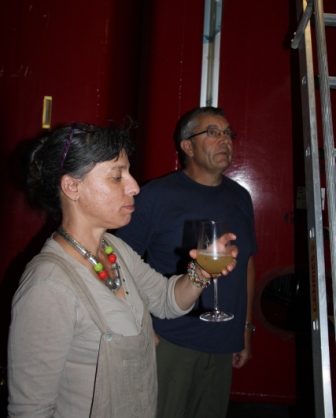
Proprietor Luc Pélaquié led us back into the “cave” to taste grape juice. He filled our glasses from a 6,000 liter steel tank containing liquid from grapes that had been pressed only a few days prior and was just beginning to ferment. All rated it very tasty and refreshing.
There was plenty of action to observe at the next stop, a co-op winery, Caves des Vins de Cru de Lirac, www.cavelirac.fr The commune of Lirac has 715 hectares of vineyards producing wines, predominantly red, of an exceptional quality.
Grape harvest was in full swing in the region. Truck after truck pulling trailers brimming with grapes arrived at the co-op to dump their contents into a vat where they were instantly crushed by revolving blades. The aromas, musty and fruity, were heavenly.
Christiane Bouzige, the winery’s “chef d’exportation,” explained that 60 vintners bring their grapes to the co-op. Harvest lasts about three weeks when all involved in the business of wine production work seven days a week, almost round the clock. She predicts that this year’s wine in the Gard will be “very good, but with a small harvest…The grapes are very small…It was very cold in April.” The co-op sells 36 different wines, ranging in price from € 4 to € 37,50 per bottle.
At Domaine Lafond, www.roc-epine.com, our last stop, we got to taste a Châteauneuf- du- Pape 2009/2010 as this winery has vineyards in the Châteauneuf -du- Pape region. The wine’ s name dates back to 1305 when the Pope moved to Avignon. Clement V, pontiff at the time, was an avid wine lover. We all relished the pope’s wine (80% Grenache, 10% Syrah, 10% Mourvèdre), but at € 25.50 per bottle, a bit too pricey for our budgets.
We also tasted a Tavel Rosé, which vintner Pascal Lafond said is a “very different style of rosé than the rosé of Provence. You can drink it year round, not just in summer around the pool.”
Lafond, another old family wine estate, produces “bio” wines. Pascal Lafond mans the winery while his 83-year-old father Jean-Pierre keeps the books. “I have to check to see if he has made any mistakes, “ said Jean-Pierre.
To our surprise, we began our tasting here with a red wine, followed by the rosé, then the white. We had assumed the order should be the reverse, but Pascal explained that in this order the true flavors of the white wine are appreciated. We did appreciate his excellent white, Lirac Blanc 2012, € 9,20 per bottle.
Wines of southern France are richer and more complex in taste, he said.
Some of Lafond’s wines are aged in oak barrels for several months. He proudly showed us his “cave” with long rows of beige colored barrels which looked new. He prefers French and Russian oak for his wine storage. American oak, he finds, gives “too much taste.”
On our way out we walked past stacks of boxes ready for shipping. Several were labeled “Cascher” (Kosher). Two rabbis work at the winery in the production of this special wine which is shipped to Jewish communities in France as well as in the US.
Photo by David
That was a healthy dose of delectable sunshine. All returned with several boxes of wine to be assured of sunny days in the winter ahead. Merci, Pascal and Anne.
I’m happy to hear from readers. See “Leave a Reply” below under Comments. Followers also welcome. Don’t miss future posts. Click on Email Subscription at top right.
A recipe to try: Duck Breasts in Balsamic Vinegar. It’s very good and very easy and comes from my Australian friend Meg. Scroll down recipe column at right.
“Everywhere you look; it’s a feast for the eyes. It’s a magical place.”
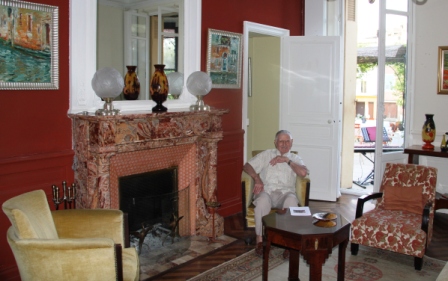
We were sitting around the fireplace in a stylish salon of exquisite furnishings enjoying an apero when a friend made that comment. It was our first time at the Villa Augustine shortly after it opened in April 2012.
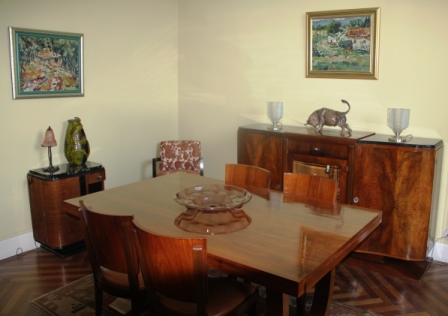
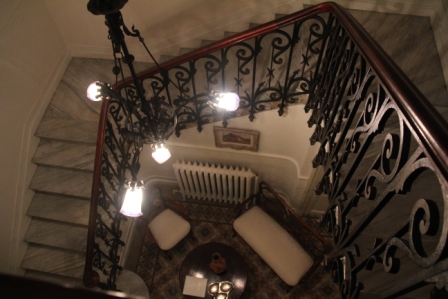
The turn-of-the- century mansion in the Vaucluse city of Apt, the capital of the Luberon, was originally owned by a wealthy family, proprietors of ochre mines. Their fortune plunged in the 1930s. The splendid home was abandoned for many years and in a dreadful state. Along came two Parisians, Guy and Christophe, to rescue the magnificent structure. Restoration took three years. Tracking down the furnishings and objets d’art took even longer. Guy and Christophe, both fans of 20th century arts décoratifs, combed France and neighboring countries to find original Art Nouveau pieces to enhance the interior in keeping with the period. Signed objects by Majorelle, Ruhlmann, Leuleu, Royere and others are among the treasures.
Today Villa Augustine is a sanctuary of calm and beauty in the midst of busy Apt just above the river Calavon. There are five chambres d’hote (B&B) rooms and gorgeous gardens planted with Italian inspiration. A more than 200-year-old cedar of Lebanon, classified as one of the most beautiful trees in the Luberon, is the pièce de resistance amidst flowers, cypress and olive trees. An inviting pool on a terrace above the villa is a delightful surprise offering stunning views of Apt and the Luberon hills. Not to forget – food, which is Guy’s realm. The ex-banker has always been passionate about cooking. Here he has the opportunity to indulge in his favorite pastime and prepare gourmet cuisine several evenings per week. His cuisine, he says, is influenced by his Spanish origins and Algeria, where he was born. And, the flavors of Provence, of course. There is a set menu, and reservations are a must as he can serve no more than 20 diners, but up to 40 for special events. During warm weather months, the spacious terrace in front of the villa is often a venue for the latter – concerts, fashion shows, art and photo exhibits.
During our first visit we had a complete tour and admired each unique bedroom with adjoining baths, many delightfully retro. A mirror from a buffet is the headboard for the double bed in one room. One bedroom is done in the style of the ‘50s, and another reflects the ‘40s.
Dinner – either outdoors under trellises on the terrace where huge pots of plants in bloom create an upscale ambience of greenery, or indoors in the dining room with its precious décor, is special. So is the food. Our first dinner in 2011 featured Noix de Saint-Jacques a l’artichaut et l’andouillette, jus de
crustaces, (scallops à l’ artichoke and sausage with the juice of crustaceans).
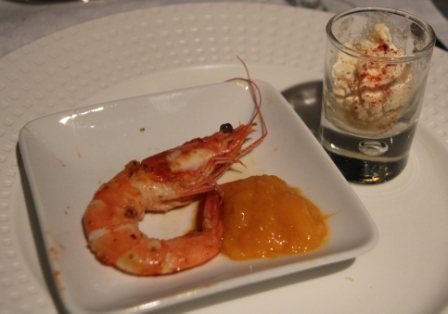
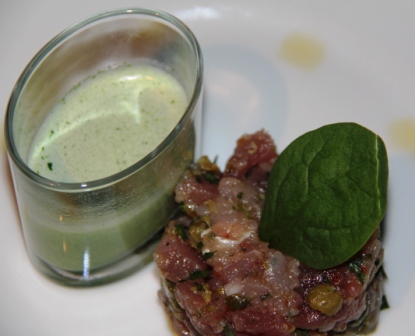
Last week we savored an excellent meal – a belated birthday treat for step-daughter Kellie and her friend Luka visiting from New York City. It began with a “mise en bouche” (pre-starter), a healthy gamba with a puree of mango and a mini glass filled with chantilly (whipped cream) of chevre (goat cheese). The entrée, carpaccio of tuna with a spinach sauce, was very flavorful – my favorite. Cod with ratatouille creatively stuffed in mini peppers accompanied the perfectly cooked fish surrounded by a coulis of tomato and juice of palourde (tomato sauce made with the juice of the clam perched on top of the cod). Dessert: roasted figs in fig liqueur with vanilla ice cream. Wine: a bottle each of an excellent Burgundy white and a Burgundy red suggested by Christophe. A fitting birthday meal in a magical place!
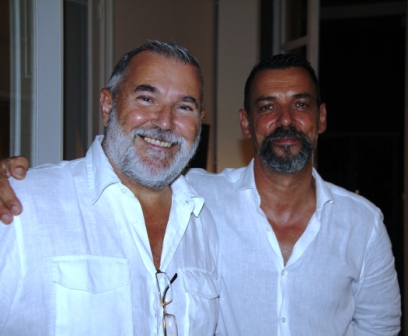
Guy and Christophe, who had the distinction of being the first gay couple married in Apt after the recent change in French law which now legalizes gay marriage, are overjoyed with the success of their endeavor.
Guy, left, and Christophe
“We are very happy with the speed in which we have succeeded to develop a faithful clientele,” says Guy. The chambre d’hote has been fully booked since April this year, he added. “Normally this would take four or five years.”
Rooms range in price from 100 to 150 euros per night. Three course dinners with two mise-en-bouches at 40 euros per person. Villa Augustine is open from mid March through the end of October. More information at www.lavillaaugustine.com
Have you dined at Villa Augustine? Share your view. I love to hear from readers. See “Leave a Reply” below under Comments. Followers also welcome. Don’t miss future posts. Click on Email Subscription at top right.
A recipe to try: Linguine with Shrimp, Tomatoes and Feta Sabraw. Scroll down recipe column at right.
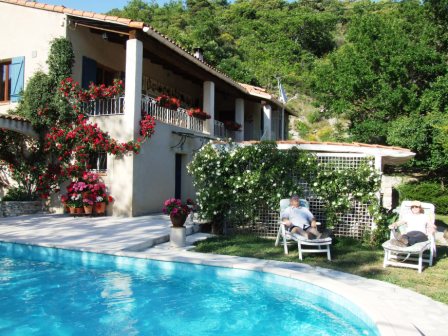
Owning a house is a constant source of stress and expense – especially an older house in the boondocks of southern France. Something always needs to be replaced. Things stop working. Leaks, cracks…it never ends. Finding experts to do the necessary work is a challenge. The next hurdle—will they show up? …the $64 question.
Our house is probably 30 -35 years old—not an ancient ruin that we restored. God Forbid! We’d have never survived that ordeal. But, we have lived through gutting a dreadful kitchen and having a beautiful new one installed, replacing the insulation which we learned had been installed backwards, (no wonder we froze during those early winters) , then installing heat pumps . A fire place is not enough to keep you warm in winters when temperatures dip to below 10 degrees F. And, it can be dangerous. We’ve experienced a chimney fire – scary, but fortunately the house was not in flames and by the time the volunteer “pompiers” (firemen) arrived, all was under control. Just lots of smoke everywhere.
First septic tank crisis
We’ve had extensive roof repairs and major septic tank work. More of the latter, very complicated and costly, lies ahead. The system must be “recanalized” or some such, but first an expert soil tester must come to see how best to install new “canals.” She’s already warned us this project would cost “many thousands of euros.” The latest crisis: the hot water tank needs to be replaced. No wonder I have headaches
However, the biggest, most recent (and controversial) project has been replacing the pergola – a lovely white wooden structure just adjacent to the pool which provided shade, shelter and a pleasant place to sit. It was covered in climbing white roses when we bought the house, a thing of spectacular beauty. Alas, those roses have died, as have most of the other gorgeous roses on the property — but that will be the subject of yet another blog.
I must admit, the old structure was crumbling. One of those mighty gusts of Mistral winds that are a too frequent occurrence here could have had it crashing to pieces.
What kind of a new structure did we want? Who would do the work? BB (he doesn’t deserve to be called Bicycle Bob these days as it’s been ages since he’s been on a bike, but I have hopes that he’ll get back to pedaling, so BB he shall remain) had ideas. I was not so sure. The easiest and cheapest would have been to find a ready-made structure, buy it and assemble it. We did not like any we saw – not in stores, nor on the Internet.
So, friends of ours recommended a friend, a British builder – great! BB could communicate with him. Attempting to translate building, plumbing and electricity terms into French when you don’t even understand them in English does a number on the brain. Yet another source of stress! So, I was more than happy to bow out and let the”boys” move on with the project.
First was demolition. BB was determined to save all the wood for the fireplace, but friends cautioned that the paint would be toxic and we should trash it. That meant numerous trips to the dump. Poor BB. Of course, the dump is only open on certain days, and at certain hours. They are also not averse to changing those times and days with little forewarning. Too often he’d come back with the Toyota still full. Dump Closed!
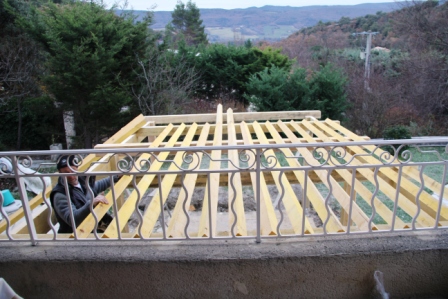
The construction project got underway in November. We rent the downstairs apartment n the summer, so the new structure had to be finished by spring. The British worker showed up on time, worked diligently, and slowly a new structure emerged.
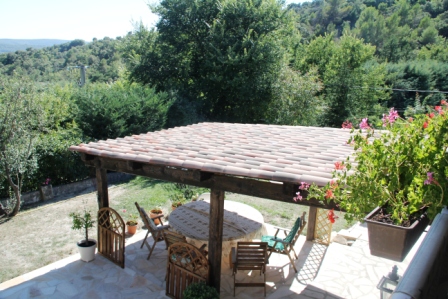
As I watched it grow, I grew skeptical, nervous. What the hell was happening? This was no pretty, delicate pergola. Massive posts were erected to support a tile roof. The roof connected to our house – BB wanted that. It is practical, I must admit, as those downstairs can walk right out the door under shelter in case of foul weather. But, it was mammoth. And, in my mind, not attractive. It’s a State Park Picnic Shelter (SPPS), I declared. A sturdy picnic table and a sign directing one to the toilet was all that was needed to make it an official state park structure.
Friends came for a viewing and were complimentary. One pointed out that from our balcony the sloping roof directed one’s eye to the gorgeous view we have of the Luberon hills. Several said it was a great improvement. I was suspicious. They are just being nice, I assumed. French neighbor Nicole just took a long, cold stare and said nothing. It was obvious she did not approve. Finally one comment: “There is no protection from the wind.”
True, but I wanted to leave the sides open. The view of the pool is lovely. And it’s nice not to feel closed in. During those blistering summer days (we have many), breezes provide welcome relief.
But, it needs help. Sections of trellis would be perfect, we thought. We combed the countryside, checking out building supply stores – in nearby Manosque and Apt, then on to Avignon and Marseille. We decided the best option was skinny trellis panels we had seen in Manosque. We set off to make the purchase, only to learn that they had sold out and would get no more. Fini! Back to square one.
Meanwhile, input from an expert: Glamorous Gloria, a California decorator who is a friend of our friend Lynne, and who visits every year. “It’s too leggy,” she said. “You need to soften it.” She proposed a rather grandiose landscape scheme, or so it seemed. Plants with paths or borders in between…flower beds…I told her the last thing we needed was more garden work and flowers and plants to water. In the summer, we have week after week with no rain. Every evening something must be watered. I’d rather be sipping a glass of rosé on the balcony than traipsing through the yard with a hose in my hand every night. Not to forget – the cost of all that water! And, flowers need more than water. Gloria assured me that what she proposed would require little maintenance. No doubt it would be a sensation and make us eligible for a Landscape Architecture Magazine cover. However, at this stage we need to keep things simple. But, thank you, Gloria,
.
Of course, we do intend to plant climbing vines, perhaps some roses, at the base of the monster “legs.” Our wise and wonderful gardener Bernard said best wait until November for planting, with November 25, the feast of St Catherine, being the optimal day. “Nothing can go wrong on that day,” he assured me. With St. Catherine’s blessing, we will plant on Nov. 25.
Friend David, a computer whiz and Internet sleuth, came to the rescue, forwarding several web sites with a great selection of trellises, including the ones we had originally decided to purchase. And, we could get them in Marseille. Last week we embarked on the trek to that fabulous city (see my blog post,”A Taste of Marseille”) , convinced this time we could come home with the needed décor for the naked SPPS. No way. The store, Leroy Merlan, carries them, but they must be specially ordered. Waiting time: 3 months. Merde Alors! We were devastated,
These would be perfect
but then the salesman mentioned another one of their stores located in Marseille Littoral (wherever that is) that stocks them. Yesterday we made the nerve wracking trek (driving in Marseille is not for sissies and requires nerves of steel) to this giant shopping center. And, the mother of all “bricolage” (handyman) stores, a gargantuan Leroy Merlan. The selection of trellises was overwhelming. We found something we liked even better than what we had planned to buy, and loaded two in the car.
We’ve learned that not only is the SPPS in need of decorating elements, it needs to be hazard-proofed. The builder installed two sets of mini steps as a way to access the structure both from the garden side and the apartment. They are attractive, but… Our first renters this summer, who come every year, said the steps were frightening. Both BB and I have tripped on them . Nicole called them “mortel,” (lethal). Alas, a lovely Swiss guest recently fell on the nasty steps and broke two bones in her foot. Fortunately for us, she was nice about the accident and did not blame us. But, it could have been far worse.
We’re working on a solution to that problem. Meanwhile I consulted Webster on the true definition of a pergola, still convinced we were stuck with a SPPS, not a garden pergola: “ A structure usually consisting of parallel colonnades supporting an open roof of girders and cross rafters.” ?? Even the original structure did not fit that definition, but perhaps the SPPS comes closer.
Lynne with new puppy Koa testing the SPPS.
For a delicious and easy first course, see recipe in column at right for “Grilled Scallops with Melon and Avocado Salsa.”
What do you think? Is it a pergola, SPPS, or does it merit a new designation? I love to hear from readers. Please share your views. See “Leave a Reply” below under Comments. Subscribers also welcome. Don’t miss future posts. Click on Email Subscription at top right.