Once upon a time, high in the Italian hills overlooking azure Mediterranean waters, a local gardener decided he would like to become a prince. But, he needed a kingdom – or at least a patch of land to rule. No problem. He did some research and figured a small portion of this mini paradise did not legally belong to Italy. (That is all a bit complicated.) He convinced the local population of his claim and managed to have them vote to give him the title of Prince. That was in 1963, and Giorgio Carbone, His Supreme Highness, ruled the micro nation Seborga until his death in 2009, when Prince Marcello I assumed the throne.
So, all 2,000 citizens of the fairytale-like kingdom have been living happily ever after? More or less, but with some political intrigue to muddy the waters from time to time.
I had never heard of Seborga. When the American Club of the Riviera sponsored an event in the principality, a gala dinner following festivities for the national holiday, the feast of Saint Bernard, I signed up. And, did some Seborga research.
A gala dinner to commemorate Seborga’s national festival.
Perhaps I exaggerated the part about Giorgio wanting to become prince. Who knows? For details on Seborga history, see Wikipedia. In brief, from the 10th century, monks ruled the principality. They sold it to the King of Sardinia in 1729, a sale Giorgio and his followers claim was invalid. Italy, they maintained, annexed Seborga “illegitimately and unilaterally.”
The Principality of Seborga (14 square kilometers) calls itself a separate state within Italy’s borders, similar to Vatican City and San Marino.
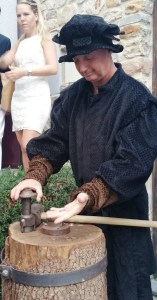
A demonstration to show how Seborga’s currency was made in days gone by.
Italy ignores these claims and has jurisdiction over the territory. . Nonetheless Seborga has its own army, flag, royal family and currency. The latter, as well as passport stamps, are popular with tourists.
Prince Marcello, a 38-year-old former professional speedboat racer, is protected by his eight-member, blue-bereted Corpo della Guardia who were on duty for the national day festivities. To the delight of spectators, the Prince and Princess made a ceremonial entrance to the town in a horse-drawn carriage following a parade of costumed locals and guards.
Princess Nina and Prince Marcello
Marcello’s German born wife, Nina, serves as foreign minister of Seborga. The couple were formally received by Queen Elizabeth in 2011. On the world stage, Burkina Faso recognized Seborga as an independent state in 1998. According to one source, some 20 other nations also recognize the tiny nation’s independence. The U.S. has an ambassador to Seborga who attended the national festivities.
That is not enough, says Nicolas Mutte, described by the Wall Street Journal as “a shadowy, possibly French figure whose occupation is unknown.” He posted an online video this spring proclaiming himself “His Serene Highness Nicolas I,” Seborga’s new ruler. Mutte, who says he is a descendent of Napoleon, seeks a split from Italy and accuses Marcello of only promoting tourism and folklore.
Although the Prince, a local real-estate entrepreneur, was elected on promises to fight for independence, secession has taken a back seat as Seborga and its traditions have become a tourist magnet. Marcello does not seem threatened by Mutte. “Seborga is a free and sovereign principality that has elected me as its prince,” he told the Wall Street Journal. “Mr. Mutte has no rights over Seborga.”
Even Giorgio had to fend off pretenders to his throne. In 2006, a woman calling herself “Princess Yasmine von Hohenstaufen Anjou Plantagenet” stated that she was the rightful heir to the Seborga throne. Giorgio dismissed her claims, calling her the “internet princess.”
All of this intrigue adds to the fascination of this secluded fairytale sovereignty snuggled aside a long and twisty road above the coastal city of Bordighera on the Italian Riviera. Throngs of visitors conquered the challenging journey to attend the August festivities. Flags, hundreds of the principality’s blue and white banners, set the scene for a parade, music, flag throwing demonstrations, costumes, dancing – and the dinner. ( I only hope Seborgans have better food than the definitely-not-delicious offerings we were served at this repast. At least there was no shortage of wine.)
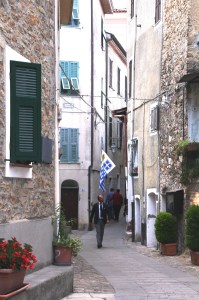
Seborga, the eponymous capital city of the principality with a mere 337 inhabitants, is one of those ancient hilltop villages of skinny, cobbled streets that climb and descend, past old stone dwellings decorated with flower boxes. Views of the Med and distant peaks from the town terraces are splendid. A visit to its privately owned gramophone museum is mind boggling.
So, too, is the Seborga story. Could I overthrow Nina and become Princess Leah (think Star Wars ) ?
We wore our finest for Seborga.
If not already a Tales and Travel follower, sign up (upper right) so you will not miss future posts. Your address is kept private and never shared.
Members of the prince’s Corpo della Guardia were happy to pose with guests for photos.
Like my blog? Tell your friends. Please leave a Reply below. Feedback is welcome. I love to know what my readers think about my posts.
Like tomatoes? Click here for Today’s Taste, a tasty tomato dessert.
Hindus, Muslims, Buddhists, Sikhs, Christians – all are found in Incredible India.
“In religion, all other countries are paupers, India is the only millionaire,” wrote Mark Twain in Following the Equator.
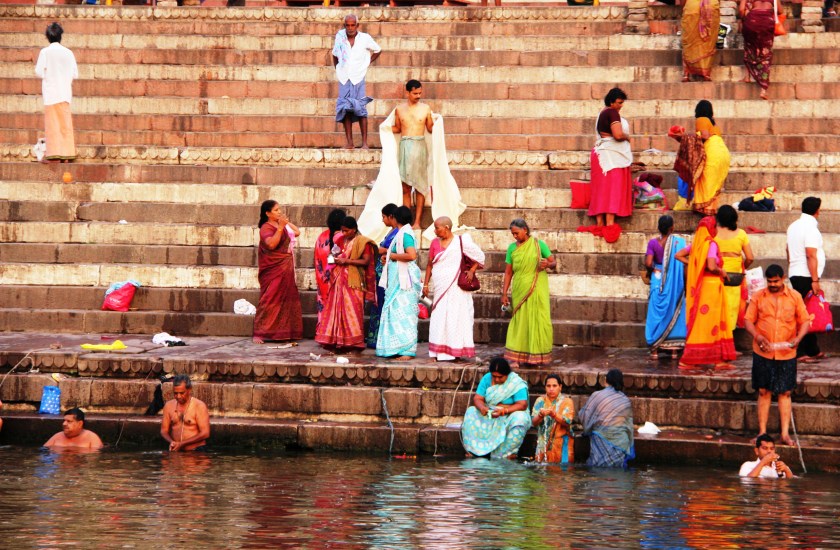
Bathing in the sacred Ganges.
The majority, 80 percent, are Hindus. In Varanasi on the banks of the Ganges we witnessed the early morning Hindu bathing ritual, hundreds plunging into the non-too clean water which they believe is holy and will wash away all sins. At night, the banks of the river are a smoldering mass, fires and smoke from cremations. Many come to die in Varanasi. Death in the holy city is said to free one from the cycle of birth and death.
Cremations on the banks of the Ganges at Varanasi.
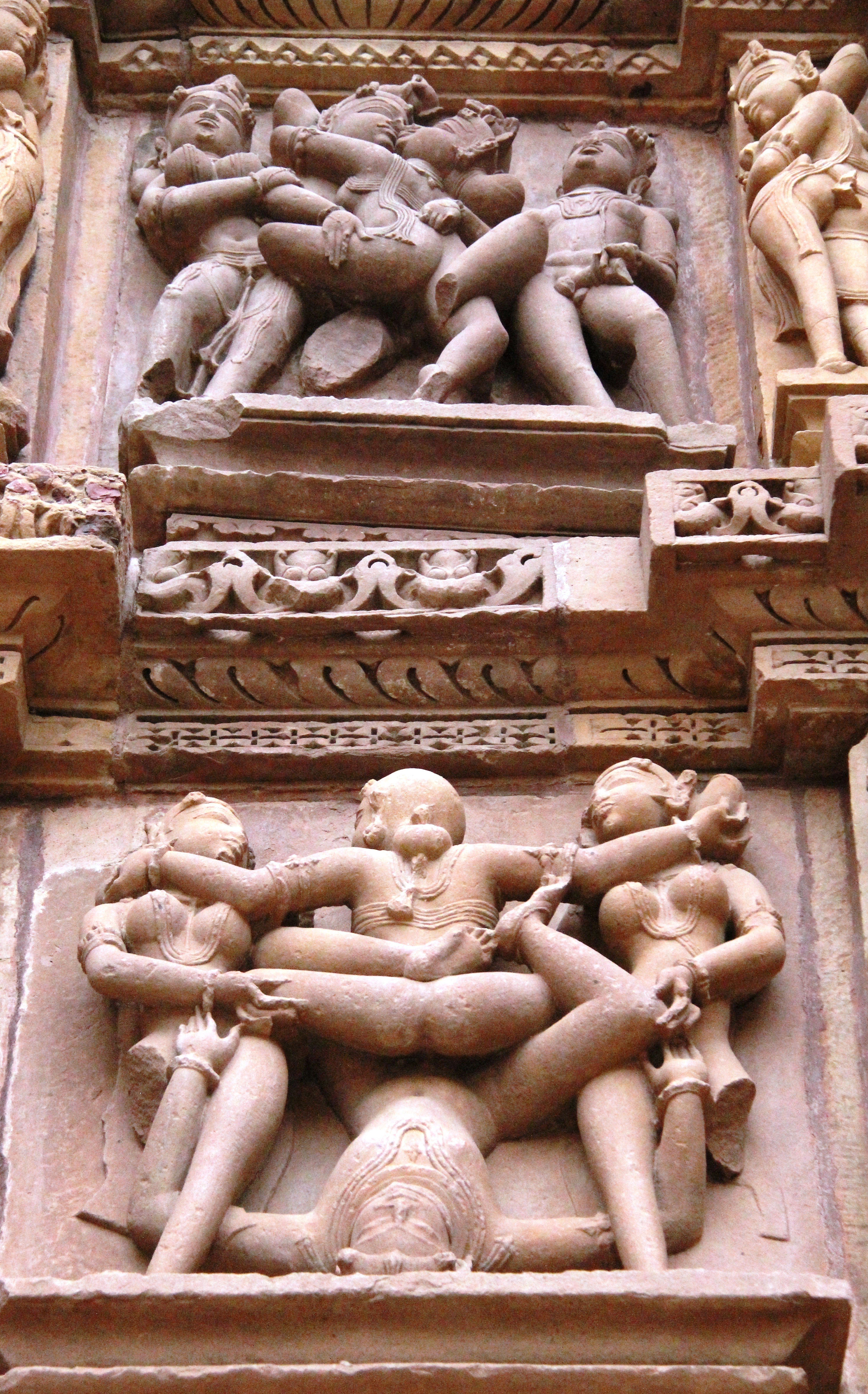
Khajuraho, a wondrous place with numerous Hindu temples, is a popular site, more for the erotic sculptures on one of its temples than the stunning temple architecture.
Khajuraho, site of many temples, is one of the “seven wonders” of India.
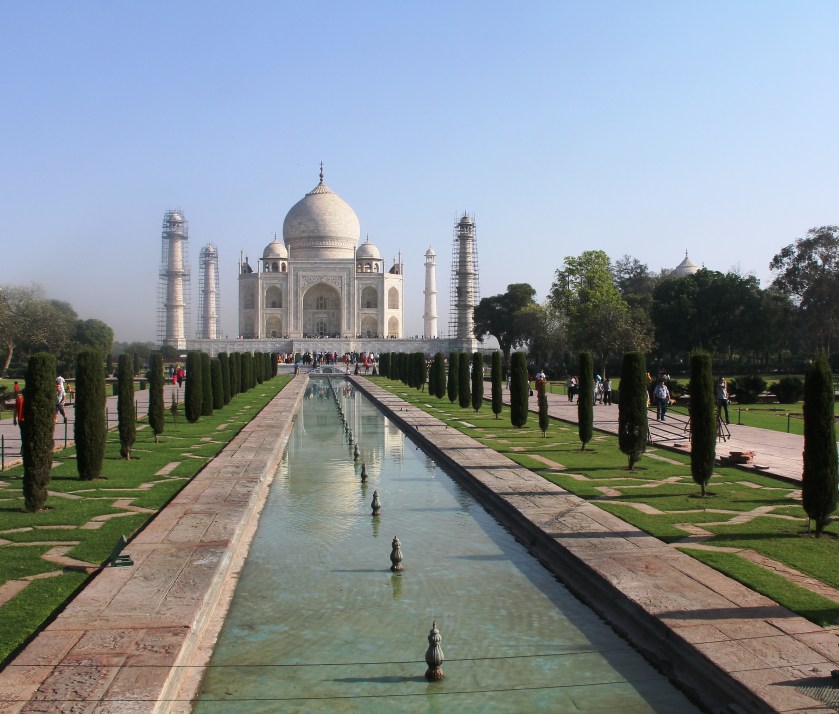
The Taj Mahal – India’s architectural treasure, the dazzling white marble mausoleum built by Emperor Shah Jahan for his second wife who died in childbirth in 1631, is a Muslim monument decorated with carefully inlaid Koranic verses.
And Amritsar, home to the Golden Temple, the spiritual and cultural center for the Sikh religion, is yet another fascinating religious shrine. Sikhs compose only two percent of the Indian population, yet Sikhism is the fifth largest among the world’s major religions.
Sikhs congregate at the Golden Temple day and night.
The religion was founded in the early 16th century by Guru Nanak and gurus who followed him. Nanak preferred the pool at Amritsar (“Pool of Nectar” in Punjab and Sanskrit) for his meditation and teaching. The site in northern India, today not far from the Pakistan border, became a pilgrimage center where a great temple was built. Perhaps more than the temple, it is the Holy Book, Guru Granth Sahib, the sacred scriptures of the Sikhs, enshrined inside which draws many pilgrims today.
Flowers cover the holy book.
Twice per day an amazing ceremony focused on the book takes place at the temple. Thanks to guide Alok, we witnessed the lively and curious evening ceremony when the book is carried to its bedroom. Behind golden doors, it spends its night on a bed under an elaborate canopy.
We joined others in a long waiting line to view the book before the evening procession. While waiting, I had the chance to talk to a friendly Sikh who moved from Amritsar to London 17 years ago. London, where the gentleman has a fish and chips shop, has a large community of Sikhs. He was with his son. They, like many others, had a gift to lay near the book where a holy man, surrounded by other holy men sitting cross-legged on the floor, reads sacred verses.
Evening procession transferring the book to its bedroom for the night.
After viewing the book, worshipers, all singing, line up behind ropes to view the ceremonial procession. The book, much like statues in Christian processions, is carried on a golden platform festooned with garlands of flowers. A group of holy men follows behind, chanting. A trumpet blower announces the arrival of the book. There are stands where worshippers can take communion. It is a joyous, festive spirituality.
At 4 a.m. the same ceremony is repeated when the book is taken from its bedroom back to the temple.
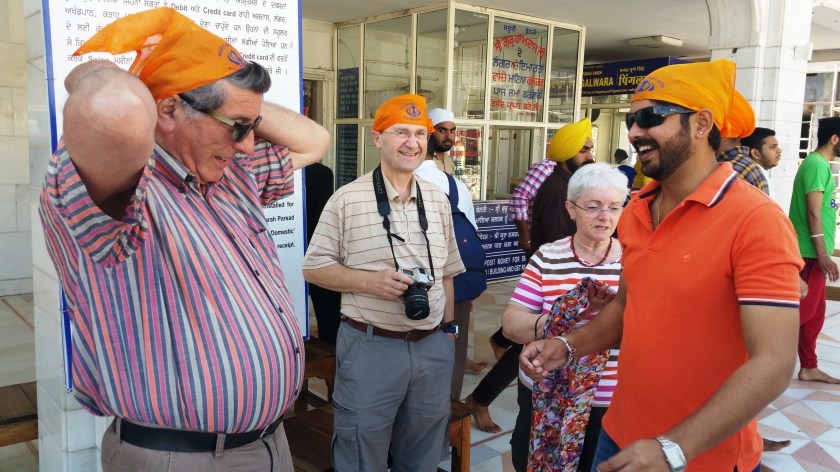
We returned to the holy site the following day and were free to wander around this mystical place after leaving our shoes near the entrance and covering our heads. Vendors sell souvenir bandanas. Sikh men are not permitted to cut their hair and are easily recognized by their beards and colorful turbans. Sikh women wear either a turban or cover their head with a scarf.
Heads must be covered at the Golden Temple. Mini scarves can be purchased.
Before entering the sacred grounds, feet are washed by wading through a shallow pool.
All are welcome to a free meal at the Golden Temple.
The complex is large. It’s a delight to slowly stroll and enjoy the scene, the people, the peaceful ambience, the shimmering golden temple. Selfie photos in front of the temple are popular. Families walk around the lake, taking pictures of one another. Some tired souls just lie down and rest in shady spots. An underground spring feeds the sacred lake where some pilgrims immerse themselves to cleanse their souls. The complex also includes enormous pilgrims’ dormitories and dining halls where all, irrespective of race, religion, gender, are lodged and fed for free.
Feeding the hungry is a tradition among people of many faiths, but Sikhs may get first prize for generosity. The Golden Temple serves 80,000
80,000 free meals are served every day.
simple vegetarian meals every single day of the year – all paid for by donations. Anyone can partake. Volunteers cook, serve meals and wash the dishes.
Groups sit on the floor rolling dough for naans (Indian flatbread). Nearby other groups smoother naans with a type of butter. Enormous vats of various concoctions simmer on stoves.
Some who eat at the temple volunteer to help out to “pay” for the food and assist the permanent volunteers. Sikhs who live in other countries often come and stay at the temple for several months to help in the kitchen.
Volunteers do all the food prep.
The Golden Temple’s past is not all peace and love. In June 1984, Indian Prime Minister Indira Gandhi ordered an attack on armed Sikh militants holed up there. Over 500 people were killed in the ensuing firefight. Sikhs around the world were outraged at the desecration of their holiest site. Four months after the attack, Gandhi was assassinated by her two Sikh bodyguards, leading to a massacre in which thousands of Sikhs lost their lives.
Most of the damage has been repaired by the Sikhs themselves who refused to allow the central government to take on the task.
More on India soon—Dharamshala and the Tibetan refugees. If not already a Tales and Travel follower, sign up (upper right) so you will not miss this and future posts. Your address is kept private and never shared.
Like my blog? Tell your friends. I love to know what my readers think about my posts – feedback is welcome.
Erotic sculptures at Khajuraho.
It’s summer and melon season – perfect time for a light, refreshing dessert. I brought Chilled Melon with Lime and Ginger to a recent pot luck. All loved it. Click HERE for recipe and scroll down for more of my tried and true recipes.
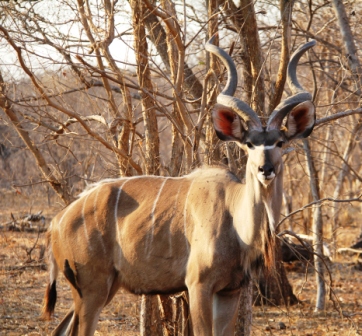
The Big Five – almost. The leopard, the most secretive and elusive of cats, escaped us, however we were hot on a leopard trail more than once. Sightings of lions, elephants and Cape buffalo were plentiful. We even saw one rhino. Impala, giraffes, zebra, various antelopes, crocodiles, warthogs, hyenas and lots of birds were also captured on our cameras.
Birds eat blood-sucking parasites found on may animals.
(A previous post was devoted to gorillas in Rwanda, “Gorillas in our Midst,” truly the most outstanding animal experience during our African adventures.) Subsequent visits to Botswana, Zambia and Zimbabwe were nonetheless rich, rewarding, often exciting, and always educational. Following are highlights of our animal encounters.
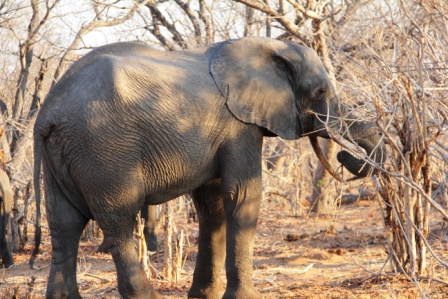
ELEPHANTS: These massive creatures are a source of wonder. We spotted them in all three countries, and learned much about them. Botswana, specifically Chobe National Park, is home to 65,000 elephants. They eat 18 hours per day, as much as 150 kilos of food per day. In Chobe, most all the trees are bare, stripped clean by hungry elephants. During a Learning and Discovery session, we were told that one elephant requires about one square kilometer of space.
Elephants strip the trees bare.
Chobe encompasses 11,000 square kilometers – clearly not enough for such a large elephant population. It is a dilemma. Sterilization or translocation is too expensive for the country. Furthermore, translocation does not usually work as elephants, no matter how far from their original home, will head back. Culling has been considered but would generate negative publicity that would surely cut down on tourism. “What can we do?” our lecturer asked. Anyone have any ideas?
Super large elephants with gigantic tusks are rare. Most have been taken out by poachers and/or hunters. In Botswana, guards “shoot to kill” poachers. The country has fewer poaching problems than many other countries, and has banned safari hunting.We marveled at solitary elephants munching on trees, large groups marching to rivers and mothers with babies in tow. Elephants can communicate for great distances with a rumbling sound, and other sounds not audible to humans. They can run at speeds up to 25 mph. If you happen to be charged by an elephant, do not run. “Stop and clap and shout.”
The lion is not the King of Beasts as he is easily killed by elephants, Cape Buffalo, even Honey Badgers.
LIONS: None of our safari group was charged by an elephant , but one angry lion did charge an open safari vehicle. The driver saved the day and raced away at great speed. We had numerous lion sightings – magnificent, astonishing, brutal, gruesome. More than once we witnessed lion sex . No wonder. They are champion copulators, we learned, — up to 100 times in 24 hours. A male and female can be at it more or less nonstop for three to five days – without Viagra.
Lions have no need of Viagra.
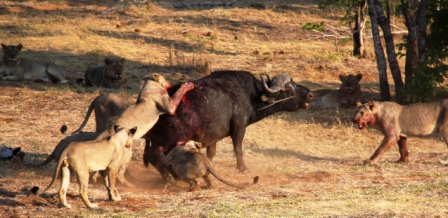
“This is National Geographic stuff,” our guide Abiot commented after we had watched a mating couple. Later that day, more National Geographic – too much for some. The Kill. Along the side of a road, a group of eight female lions was in the process of attacking and eating a live Cape Buffalo. It was bloody. It was fascinating. It was agonizing.
The poor beast struggled to stand up, only to fall down and groan in pain. The killer team took turns. A few would lunge and bite, while others rested and observed. We watched and photographed for at least 20 minutes, but had to move on to our next camp. We later learned from the bus driver who passed the scene many times that the buffalo’s suffering went on for three hours before he succumbed.“This is a training session,” Abiot said. “These lionesses are young. They are not skilled at killing.”
I had naively assumed that when killing lions went for the jugular to put the prey out of its misery. That is far too dangerous with Cape Buffalo due to the horns. For this reason, Cape Buffalo, considered the most dangerous of African animals, are rarely attacked by lions.
He looks sweet, but the Cape Buffalo is the most dangerous of African animals.
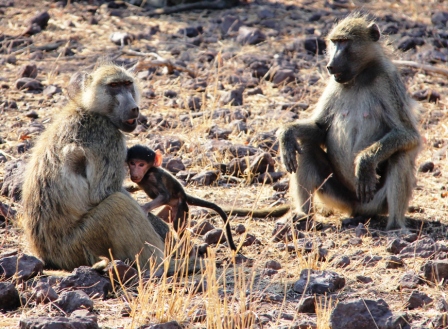
Elephants are also not normally targets for lions. “Most lions are afraid of elephants,” a guide said. Even lions have enemies. Honey badgers – small but fierce – can kill a mighty lion. “They are very clever. They go for the private parts. If you ever encounter one, back off,” we were warned. We did see one along a safari track. The driver floored for a close-up view. The petite creature stopped and bared his teeth at us, as if daring us to get any closer.A group of baboons can also kill a lion. They have very sharp teeth. They are also mischievous. Several broke into the tent of a couple in our group. No real damage was done, but all their belongings were helter skelter.
Hippos can stay submerged for six minutes.
HIPPOS: It is rare to see more than the heads of these giants which spend most of their days submerged. They do emerge from the water at night in search of food, eating up to 45 kilos per night. During the day they must stay under water because the sun cracks their skin, and they have no sweat glands. They are fast and can run at speeds up to 34 mph. Because of the weight of the male, hippos mate under water. Babies are born in shallow water and stay with their mother for up to eight years. A canoe guide in Zambia where we spotted hippos on a game viewing boat excursion complained that business was down due to an erroneous report on Facebook that hippos are the most dangerous animal in Africa. Not true — the Cape Buffalo as mentioned above.
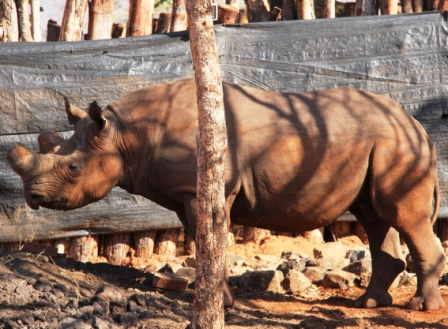
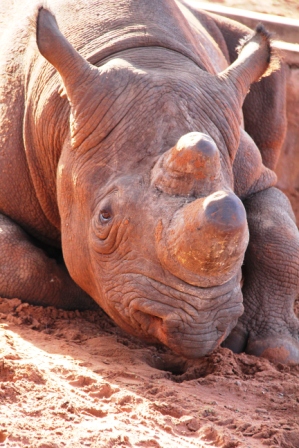
RHINOS: It was at a private game reserve in Zimbabwe where we saw one rhino. Three rhinos were introduced to the reserve in 2000 and six more have been born since. The reserve has an anti-poaching team who live on the grounds. Rhinos are dehorned every two to three years to discourage poachers, but they are often killed nonetheless. Poachers don’t want to waste time tracking a rhino only to learn it has no horns, so they eliminate all. Horns do grow back.
Horns are sold to powerful criminal syndicates who ship them to Asian countries, including Vietnam and China where their weight is valued at more than gold due to the erroneous belief that Rhino horn can cure everything from cancer to hangovers.
It’s a thrill viewing these creatures up close and leaning so much about them. As fascinating and wonderful as the animals are the people. Coming soon: Adventure Africa: The People. If not already a Tales and Travel follower, sign up (upper right) so you will not miss future posts. Your address is kept private and never shared.
Our 16-day safari was organized by Overseas Adventure Travel, www.oattravel.com We paid $4,495 each for the all-inclusive package (lodging, all meals, most tips, land and air transport within Africa).Like my blog? Tell your friends. Please leave a comment – if you can’t see the Recent Comments list below, use the link on the right-hand menu (below “Recipes”). Feedback is welcome. I love to know what my readers think about my posts.
In my next life, I want to be Dian Fossey. Well, not quite. I’d rather not be mysteriously murdered as she was in the jungles of Rwanda where she studied and lived with mountain gorillas.
After observing, photographing and admiring these magnificent beasts in the dense bamboo forests high in the mountains of Rwanda, I was smitten. It is easy to understand Fossey’s fascination with the human-like gorillas which share 98 percent of our DNA.
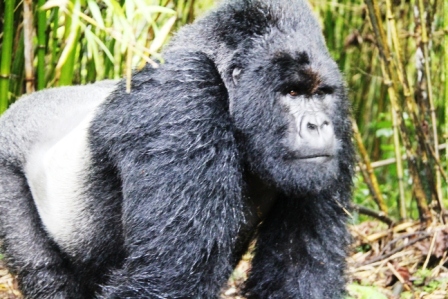
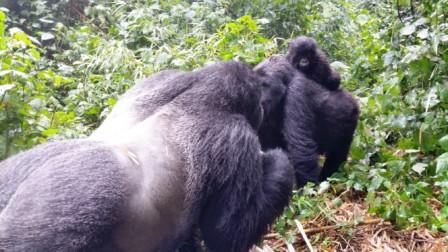
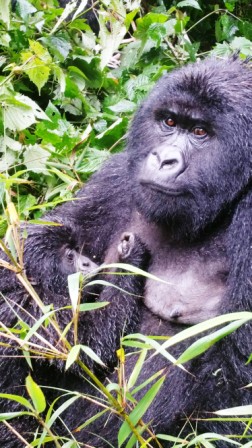
Children romp and play, chasing one another through the thick brush. Toddlers cling to mothers, often piggy-back. Mothers nurse babies. And Big Daddy, the awesome silverback, keeps a vigilant eye over all.
“Watch out! One coming on your left….Look up, one in the tree… Be careful. The silverback is just ahead.”
They were in our midst, the 22 member Kwitonaa gorilla family. One youngster raced by and grabbed the hand of a member of our trekking group. Another trekker was punched – lightly — by a teenager whose path he accidentally blocked. I was captivated by a nursing mother, no more than a foot in front of me. I could have easily touched her, but I dare not. We had been warned not to get closer than 10 feet to the beasts. Impossible. They were all around us, up close, and obviously accustomed to this parade of curious creatures who snapped away with all manner of cameras.
Mountain gorillas are “about as dangerous as pet lambs,” Fossey once told Alfred Hitchcock, apparently to his disappointment.
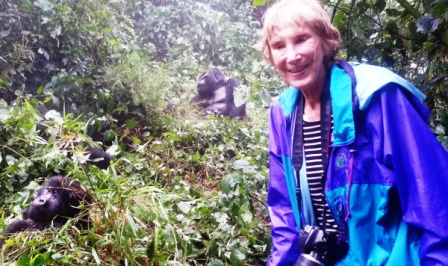
Mama occasionally cast me a stern glance as if to say, “Oh no, you guys again.” Not far behind her, higher up on an incline, sat the silverback, a picture of majestic power, like a king with his subjects at his feet. He seemed disinterested, but weighing in at close to 400 pounds; I did not want to upset him.
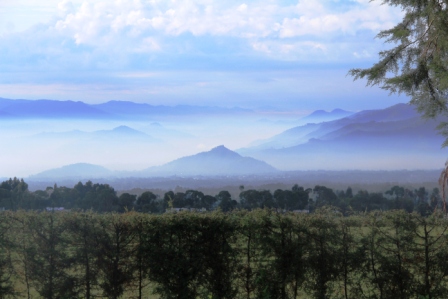
The Virunga Massif, volcanic peaks usually shrouded in mist along the borders of Rwanda, Uganda and the Democratic Republic of Congo, are home to 10 gorilla families visited regularly by tourists.
Treks to observe the gorillas are strictly controlled and organized by officials in Rwanda’s Volcanoes National Park. Eager tourists arrive at park headquarters at 7 a.m. where they are divided into groups of eight, supposedly according to the difficulty of the hike ahead. Each group (a maximum of 10 groups or 80 tourists per day) is accompanied by a guide, trackers carrying machetes to blaze a trail, a gun-toting guard (in case of attack by Cape buffalo) and porters. Guides are in radio contact with other trackers stationed in the mountains who monitor the gorillas and advise them of the various gorilla family locations.
No longer young and fit, we asked to be in an “easy” trekking group since we had heard the hikes to locate the gorillas can take up to four hours, one way, over difficult terrain. I had been very nervous, not certain we were up to the challenge. My fears were assuaged when I met the others in our party: Fran (66) and John (76), seasoned hikers from Scotland; Selma (72) and Barry (a bit older) from D.C., and a mother- son couple from Germany. Annette, who appeared to be in her 70s, was on her fifth gorilla trek. “I’m addicted,” she said.
Selma announced to the guide that she had had two knee replacements and could only hike if the terrain was flat. She explained that a woman in her hotel had seen the gorillas the previous day after an easy, 37-minute hike. She expected the same.
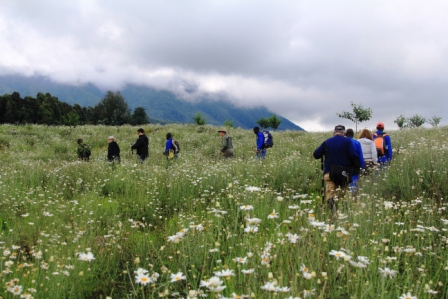
Poor Selma…close to three hours later, soaked to the bone, we finally found our gorillas. The hike started out as a pleasant walk in sunshine through farm fields. The sun soon disappeared and we started to climb, over rugged, rocky, slippery terrain. Up and up. Steeper and steeper. We were at an elevation of 8,500 feet. I was frequently out of breath, but there were rest stops.
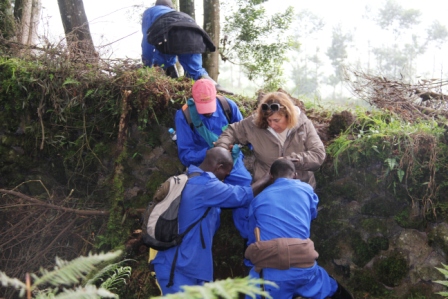
Porters help with the ascent.
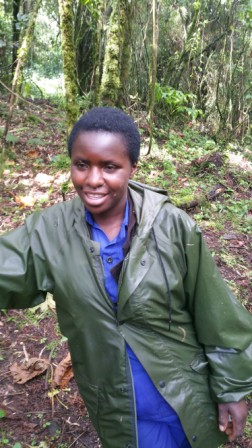
Fortunately I had hired a porter, Peragie, a tiny woman half my size but my savior. I had little to carry, just a small backpack with a water bottle and my camera. But, for only $10 (the standard charge for a porter), I figured it might be useful. She could hold my camera if I wanted to take photos with the phone and vice versa.
This mini power house did far more. On the steep sections, she took my hand and literally pulled me up. When the rains came, soon into the trek, she wiped my face and glasses. She tucked my pants into my boots – to keep the red ants away. She spoke no English, but I learned that she was 30 years old, a widow and mother of two young children. Her calm, gentle, caring demeanor was an inspiration and kept me going.
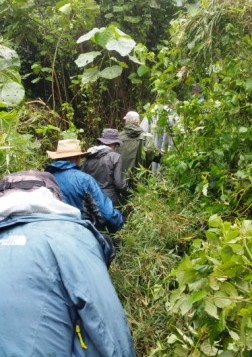
“My knees are wobbly. I can’ go any farther. I won’t make it,” announced Selma, not far into the hike. Our guide assured her she could – would – make it. When we came to a high rock wall separating the fields from the forest, several porters lifted her over the obstacle. We charged on, but the going in the tangle of jungle vines, roots and branches was a challenge. Rain did not help. “How much farther?” Selma asked time and time again. However, we all were beginning to wonder if we would ever find the gorillas.
Over and over, guide Ignacie assured us they were not far ahead. “They’ve been here,” he explained as he surveyed the terrain. Of course, they were not waiting for us, but continually on the move, higher and higher, searching for more tasty bamboo.
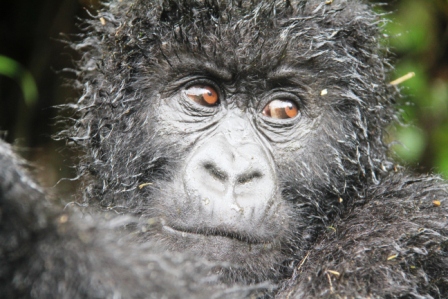
Playful baby
At last – a big patch of black lumbering through the jungle green ahead. We stopped. We could hear bamboo branches breaking. Suddenly more masses of matted black fur, on the right, left, ahead –all in motion. We were awestruck. After the grueling trek, it seemed miraculous.
Ignacie told us the youngest member of the family was a seven-day old baby. We came up behind the mother, cradling the infant in her arms. Unfortunately the 22-year-old silverback was ahead and she moved on to dutifully follow him before I could get a photo. The kids – all ages – were frolicking all around. Two teenagers got into a spat. “They are drunk,” Ignacie said. Apparently overdosing on bamboo has the same effect as too much booze.
The rain stopped. We moved about, each of us zeroing in on different family members for close up photos. It was thrilling, amazing, and beyond our expectations to be so close to these intriguing creatures.
Trekkers are supposed to spend no more than one hour observing the gorillas. Perhaps because our journey had been so long and arduous, Ignacie was generous. We were with them a bit longer, but not long enough. You cannot get bored watching gorillas.
The trek down was worse than the ascent. It started to pour. This was the rainy season, and these rains were like no others I have known. The trackers decided to find a shorter route back through even denser jungle growth. The lead man thrashed a path with his machete. If it hadn’t been for my guardian angel, I surely would have slipped or tripped.
Selma survived. “I am glad it’s over,” she said as we reached the end. Had Ignacie not insisted, she obviously would have quit. We later learned that rather than sending a participant back, the guides call for a stretcher. Trekkers are carried to the gorillas at an extra cost of $200. And, it is not uncommon for handicapped tourists to hire porters with a stretcher to take them to marvel at this wonder of nature.
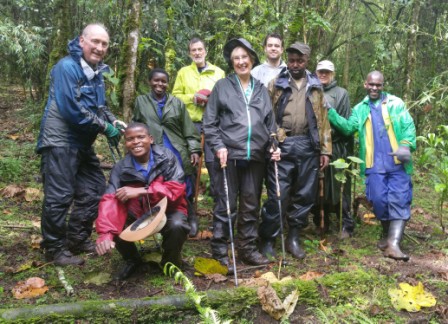
Group photo while we waited for Selma and Barry who were far behind.
The gorilla experience is costly, $750 per person for the required permit. This includes the guide, trackers, guard, but not the porters. There is no shortage of visitors, however. Since 2004, the number of gorilla customers has almost tripled: 20,000 in 2014. Much of the revenue helps fight poachers, as well as contributes to the country’s efforts to develop a high end tourist industry and continue its recovery from the horrific genocide of 1994.
Back in the early ‘80s when Fossey came to Rwanda, there were only about 240 mountain gorillas in the wild. They cannot survive in captivity. Today the number is estimated at about 900, with some 300 in the Volcanoes National Park.
Annette, our intrepid trekker from Germany, was planning to set off again the next day for another gorilla trek – her 6th. She said she had never been so close to the gorillas as she had on our trek, nor had she ever been on such a difficult trek.
Finding the Kwitonaa family did take far longer than anticipated, but only Selma complained. It is very rare that guides do not find the gorillas. If that happens, trekkers are offered the chance to try again the next day. Prosper Uwengeli, the park’s chief warden, told a New York Times reporter that in more than 30 years, guides have never had to shoot a gorilla and no visitor has ever been harmed by one.
In a research report, Fossey wrote that mountain gorillas are “dignified, highly social, gentle giants with individual personalities and strong family relationships.” Like Fossey and countless others who have watched them in the wild, I am enamored of these gentle giants and, if it weren’t so costly, would gladly endure another trek for another visit.
Gorilla visitors can show up at the park at 7 a.m. with hopes of buying a permit for a trek that day, but that is risky as permits may be sold out. Most tourists book a package tour which includes the gorilla trek. We booked a 3-day package with Africa Adventure Safaris, an African company which also organizes tours in Uganda. Total for both of us was $3,250 which included a full-time driver/guide, three nights lodging and most meals, the gorilla permits, a permit and trek to visit endangered golden monkeys the day after the gorillas, city tour of Kigali and airport transfers. We were more than satisfied. www.rwandagorillassafari.com
Bad – very bad — hair day
From Rwanda, BB and I traveled south for more Adventure Africa: Botswana, Zambia, Zimbabwe and South Africa. Future posts will highlight our amazing experiences. But first, a bit more on Rwanda. Coming soon, “Rwanda — More than Gorillas.”
If not already a Tales and Travel follower, sign up (upper right) so you will not miss these exciting future posts. Your address is kept private and never shared.
Like my blog? Tell your friends. Please leave a Reply below. Feedback is welcome. I love to know what my readers think about my posts.
It’s time for a hearty soup. East German Soljanka, a recipe from my friend and food writer Sharon Hudgins, is perfect to warm both body and soul. See Today’s Taste, column at right.
In a word, it was HOT. Week after week of temperatures in the upper 90s (Fahrenheit), even reaching 100 and above a few times. My roses, geraniums and petunias had to be watered continually. The grass (what little we have) turned brown. The pool water has never been so warm – too warm for me, but finally warm enough for delicate BB/VR* who was brave enough to jump in. This was only the fifth time he has been in the pool in the 10 years we have lived here. (Thanks to my dear mother who insisted my brothers and I all learn to swim at an early age, I am a swimmer and love the water. BB was not so lucky.)
Fall arrived too soon and too abruptly – for me… One will never be content.
Despite the heat, we enjoyed some fun activities and the wonderful folks who rented our guest apartment at Les Rosiers.
Klaus and Eva
The season kicked off with the arrival of Klaus from Austria, his car loaded with Austrian delicacies and beer. He always brings us a generous gift of goodies, too. This was the fifth season that Klaus and his wife Eva have spent a month in our rental studio. She is still working as a legal secretary in Graz, arrives a week later by plane and only spends two weeks here. Klaus likes to cook and grill – lamb is his favorite. They know the area well, take long walks, swim, and visit friends and flea markets. They have become friends, and it’s always a delight to have them here.
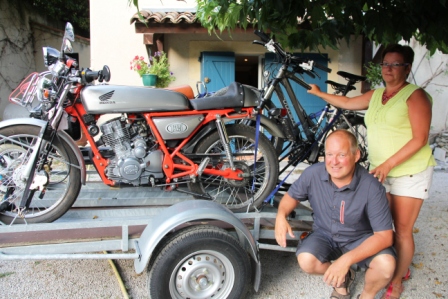
Patrick, Chantal and their bikes
Then came the Belgians, Patrick and Chantal, with two motorcycles and two bicycles towed behind their car. We were amazed. Due to the heat, they spent most of their time on the motorcycles. One of the bicycles was electric, but since the terrain here is anything but flat, they preferred their motorcycles. They took long excursions, almost every day during their two-week sojourn.
Chantal said they have been vacationing in southern France every summer, but always camping. They especially enjoyed the tranquility at Les Rosiers. Camp sites can be very noisy, she said. And, they loved our town, Reillanne.
Sunday market in Reillanne
“It’s an authentic village, not a Disney village like so many in the Luberon,” said Patrick. “There are not that many tourists, not that much traffic.” They like to visit the village cafes and talk to the locals. And, they especially liked the Bar restaurant de la Place where they dined many times.
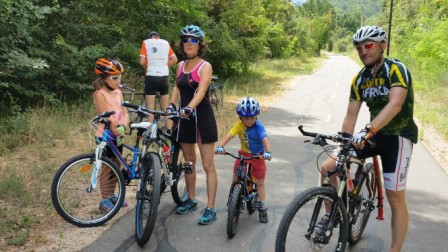
Czech cyclists: Lara, Katarina, Luka and Jakub
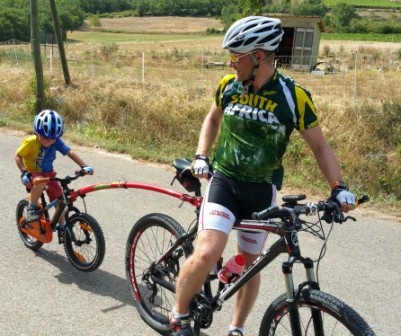
More bicycles next – a Czech family of four with five bikes. Jakub and Katarina and children Lara, 9, and Luka, 5, were back for the second time. We were overwhelmed with their bicycle prowess two years ago when they set out day after day, all day on bikes, albeit Katarina towing Luka in a carriage and Lara’s bike sometimes attached to her father’s bike. Lara now rides on her own, and Luka rides the bike that can be attached to Jakub’s . We rode with them one day – lots of fun.
Luka behind Daddy Jakub
They arrived a day late after participating in an orientation competition in the Jura where Jakub took first place in one category. Here he conquered Mont Ventoux for the fifth time. That was the reason for five bikes – a super bike for the challenging climb.
“We always like to come back to Provence, the terrain, the living historic villages that are not just for tourists,” said Jakub. We were happy to have them back.
The hardy cyclists enjoyed the pool after those rides in the blazing Provence sun.
Wine was the focus for Patricia and Serge, visitors who come from Brittany. They traveled far and wide to buy Provence wine, driving 1,700 kilometers in the region, visiting six wineries and ending up with 14 cases of wine to take home.
Serge and Patricia
Each evening when they returned from a buying trek they shared their adventures and raved about places they visited – some we had not known about. Serge says they always buy the wine of the regions they visit. They live in an area of vineyards near the Loire where he helps harvest the grapes.
Serge’s Provence souvenirs
They presented us with a bottle of Grand Reserve Muscadet Sevre et Maine sur Lie which we tasted when they invited us to a super fish dinner Patricia prepared. She served the fish with beurre blanc, a well known sauce for fish in Brittany. She shared her recipe which I have tried to master. Mine could not hold a candle to hers, but I will keep trying. When I am successful, we will open the precious bottle of Muscadet.
Niki came to visit from Athens. We met on a student ship 50 years ago!.
We visited the US this summer (see previous post, “USA: Summer 2015,” July14) and the Mediterranean coast (previous post: “Cannes: Far from the Madding crowd,” Aug. 20).
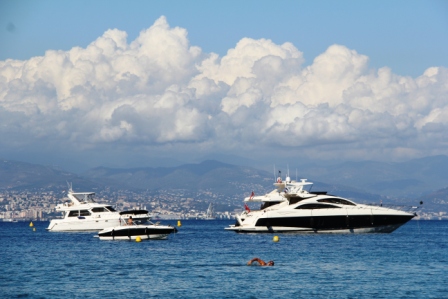
We recently went back to the coast for a gala evening at the Hotel Belles Rives in Juan les Pins/Antibes. Our Finnish friends, Terttu and Mikko, have a rental apartment which they generously offered us. In addition to dining and dancing, I swam in the Med which sure beats a pool, and we took a short but scenic hike around Cap d’Antibes.
La Dolce vita.The Med at Juan les Pins
We are not sorry the heat has subsided, but sorry that summer is over. The days are getting too short. Some restaurants will soon close for the season. No more concerts and village festivals. Winter can be bleak here, and it’s a long wait for spring.
Photos of other summer activities follow.
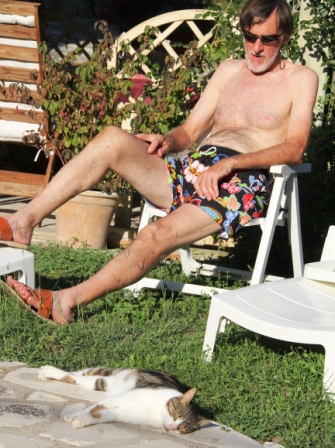
BB/VR* and Filippo chill out poolside.
*Bicycle Bob/Vino Roberto
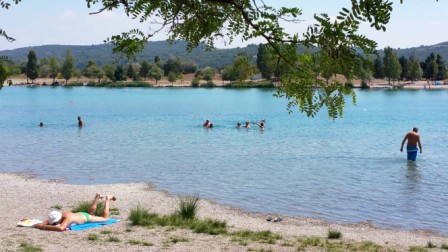
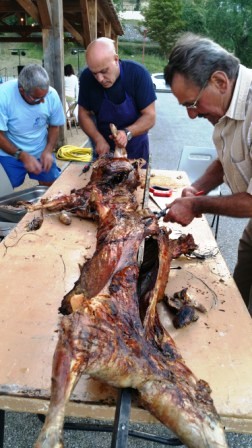
Lake Vanades near Manosque where I enjoyed a real swim A Bastille Day Mechoui– lamb grilled on an open fire.
If not already a Tales and Travel follower, sign up (upper right) so you will not miss future posts. Your address is kept private and never shared.
The Med at Cap d’Antibes
Like my blog? Tell your friends. Please leave a Reply below. Feedback is welcome. I love to know what my readers think about my posts.
The lavender must like the heat. The color was especially vibrant this summer.
 Once upon a time, high in the Italian hills overlooking azure Mediterranean waters, a local gardener decided he would like to become a prince. But, he needed a kingdom – or at least a patch of land to rule. No problem. He did some research and figured a small portion of this mini paradise did not legally belong to Italy. (That is all a bit complicated.) He convinced the local population of his claim and managed to have them vote to give him the title of Prince. That was in 1963, and Giorgio Carbone, His Supreme Highness, ruled the micro nation Seborga until his death in 2009, when Prince Marcello I assumed the throne.

 That is not enough, says Nicolas Mutte, described by the Wall Street Journal as “a shadowy, possibly French figure whose occupation is unknown.” He posted an online video this spring proclaiming himself “His Serene Highness Nicolas I,” Seborga’s new ruler. Mutte, who says he is a descendent of Napoleon, seeks a split from Italy and accuses Marcello of only promoting tourism and folklore.
 sovereign principality that has elected me as its prince,” he told the Wall Street Journal. “Mr. Mutte has no rights over Seborga.”
 flag throwing demonstrations, costumes, dancing – and the dinner. ( I only hope Seborgans have better food than the definitely-not-delicious offerings we were served at this repast. At least there was no shortage of wine.)




















 We charged on, but the going in the tangle of jungle vines, roots and branches was a challenge. Rain did not help. “How much farther?” Selma asked time and time again. However, we all were beginning to wonder if we would ever find the gorillas.








 Tales and Travel