Vacation Fiascos

Not every trip is paradise perfect.   I’ve had my share of travel mishaps. In Buenos Aires, three gold chains were ripped from my neck (my fault for wearing them).  I missed out on an excursion to the Brazilian side of Iguaçu Falls because I did not have a Brazilian visa.
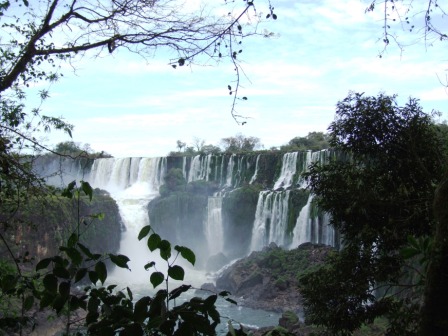
I never made it to the Brazilian side.  No one told me I needed a visa.
I never made it to the Brazilian side. No one told me I needed a visa.

The trip had been prepaid, but the travel operator failed to tell me that as an American I needed a visa, and there was no time to get one.  $100 out the window.  In New Zealand, I was so excited about the chance to swim with dolphins – something I’ve always wanted to do.  Alas, I swam in frigid water, but nary a dolphin to be seen.  (I’ve written about these catastrophes in previous posts. “Misadventures in New Zealand,” Apr.27, 2012;  “Cry for me Argentina,” Oct. 30, 2010; “Iguaçu Falls,” Nov. 19, 2010 )

Last fall husband Bob and I had some frustrating experiences thanks to GPS.  We are slow to get on the technical bandwagon, but finally decided to purchase a GPS gadget for this drive trip.  All went well in Germany.  Without it, we might still be driving around looking for some of those off-the- beat- and -track hotels I had booked.

When we got to northern  Italy and were trying to find my friend Trina’s apartment on Lake Varese, another story.  Suddenly we were crossing the border into Switzerland as directed by our GPS mentor.  (She’s British, and her pronunciation of Italian, French and German  street names is abominable, but good for a laugh.)

GPS got us to Bellagio on Lake Como, but failed us thereafter.

This can’t be right?   What’s with this wacko woman directing us?  What’s with GPS?  We stopped at the nearest gas station, and were told she was all wrong.  Reverse directions and go back to Italy.  We eventually found Trina, but with a map.

After the Italian/Swiss mishap, I verified GPS instructions with a map.  Until we were driving back to France on the autostrada in northern Italy, a stretch we had driven many times.  I relaxed. All seemed well.  Then out of the blue  we ended up at the toll booth for the Frejus Tunnel, 39 euros, no turning back.  Strange.  We had not remembered going through this tunnel before. Perhaps our GPS genius  knew a shorter route?  We had no choice but to continue.

It’s a long, long tunnel.  When we emerged, I checked the map.  Holy S—!  Where are we?  We had driven far out of our way to get home.  And, that GPS crackpot was leading us farther astray.  So much for advanced technology.

Time for another gas station inquiry. I was obviously distraught,  thinking about all those extra miles and hours lost.  The kind woman in the gas station took pity on me and explained that we had two choices, one route via Grenoble, much longer but all on the speedy autoroute, and one over the Col du Galibier, a slow but scenic mountain pass.  We opted for scenery. It was an adventure, up and up a twisty road into the wilds of mountain tops with no civilization in sight, but incredible views.  It was getting dark and this was not a road for sissies, so we took no time to stop and ponder the surrounding beauty. But, it’s a drive to repeat.  Sometimes bad leads to good.

Lots of gold shops in Singapore, but it was in a camera shop where I made my mistake..

And, sometimes, as with the jewelry theft in Argentina, you learn from the disasters.  Such was the case in Singapore.  I needed a few accessories for my new camera.  This was the beginning of a long trip, so best make the purchases here.  We paid a visit to a camera shop in Singapore’s Chinatown where a very eager and fast-talking salesman convinced me to buy, not only the needed accessories, but a few other items – including a very costly filter, which, he cleverly demonstrated, would do wonders for my photos.  I was taken in and made the purchases – over $400 worth.

As we ate lunch, I pondered the purchase.  Something did not seem right.  Should they have been that expensive?  I went back to the hotel and checked the items on Amazon.  I had been royally ripped off—the total for the items at Amazon prices would have been no more than about $50.  How stupid I was.

Not to be outdone, I printed out copies of all the Amazon data and marched back to the photo shop for a confrontation. I was all smiles and friendly and took photos of our chatty salesman before presenting the evidence of his deceit. I threatened to put his photo and the shop on Facebook with a warning if he did not give me a refund. The manager, another slick operator, appeared.  He was wary and not about to risk bad publicity.  I could have the refund, but first he wanted to delete the incriminating  photos on my camera.  I obliged, took my money and ran.

Back at the hotel, I related the experience  to the desk clerk who had helped with the copies.  Never do business in Chinatown, he said.  And, never be so dumb and shell out big bucks for items if you have no idea of the going price.

Tour of the wondrous Sydney Opera House was a trip highlight. But, it was downhill after that.

No trip is without some minor aggravations.  In Sydney, when we purchased our tickets for an opera house tour, we were given coupons for a free cup of coffee valid until 5 p.m. at the opera house café.  We showed up at 4:40 pm.  “Sorry. Too late.  We had to close early today.”  No big loss.  Back to the hotel, but by bus as it was raining. We waited and waited.  Finally bus number 53 came.  We proceeded to pay the driver for our passage.   ”Sorry.  No tickets sold on buses after 5 p.m. “  They must be purchased ahead at a ticket office, he explained, but we weren’t about to track down the office, which, by then, probably would have been closed anyway.  O.K.  We’ll take a taxi.  We wandered from street corner to street corner and hailed many a taxi.  All full.  Distressed and soaked, we gave up and trekked in the rain back to the hotel – a good hour’s walk.

Not our lucky day, but far worse could happen. It’s all part of the adventure that can make travel a challenge – and an educational experience.

Black Bean Pumpkin Soup was the overwhelming favorite at a lunch I recently prepared for friends. Several requested the recipe which is listed in the column at right.

Comments on blog post and recipes are welcome. See “Leave a Reply” below under Comments. Subscribers also welcome.  Don’t miss future posts.  Click on Email Subscription at top right


Our Vacation Renters

From Germany, Belgium, France, England, the U.S., Australia, Canada, Switzerland, Austria, the Czech Republic, Sweden, Wales, Northern Ireland, the Netherlands, Argentina — even Romania and the Ukraine —  they’ve come. To spend a week, two weeks, or sometimes longer in the guest studio apartment  (known as a “gite” in French) on the first floor of our home, Les Rosiers,  that we rent to tourists in summer.

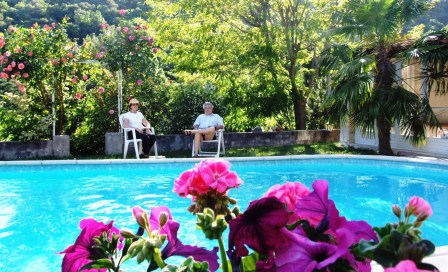
Les Rosiers pool.
Les Rosiers pool.

It’s been fun and fascinating to meet and talk to our tenants.  And, an experience.

Our first guests several years ago were a German couple, he a baker, who came for a week’s get away from their three young children.  It was the end of February, but the Provence sun shone.  They bundled up in blankets and lounged by the pool, which was all closed up, soaking up the rays.

We’ve found that Belgians and French, all from the north, especially like lounging by the pool in the summer.  No doubt they already know the region, so they are content to chill out, relax, and hang out.  Not so for most of our other guests who often set out for day-long excursions to sights – near and not-so-near.

Anne and Jean Luc from Brussels enjoy the sun.,

“We have really enjoyed our relaxing stay in your lovely gite, we loved this area of the Luberon and having this comfortable, quiet little home to come back to at the end of a day’s sightseeing just made the holiday.” – Pauline and John, N. Ireland, July 2010.

Last summer was the season of cyclists, starting with a couple from North Carolina who had top quality rental bikes delivered from a bike shop in Isle sur la Sorge – about an hour away.  They rode every day.  Then came  a couple from Brugge, also dedicated riders.  They brought their own bikes, and after a day’s outing, were happy to come back and cool off in the pool.  Francis, a physical therapist, loved to practice his English, which was excellent.

Bethan from Wales in the Luberon.

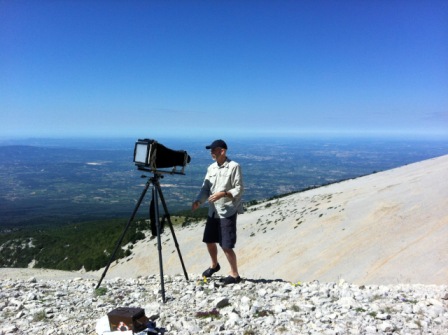
Aled, a Welshman, who came with his wife, Bethan, took the pedal prize. They come to Provence every year, and every year he pedals up Mount Ventoux.  Last summer was his fifth ascent. He also intrigued us with his photography.

Aled and his super camera. www.aledrhyshughes.co.uk
Aled and his super camera. http://www.aledrhyshughes.co.uk

Aled is a professional who shoots with an Ebony (google it), an incredible large format camera.  After their arrival, we heard them speaking and were intrigued.  It was not English.  They are among the 562,000 of a population of about three million who speak Welsh.

Close behind Aled for pedal prowess  was Jakob from Prague.  He did Ventoux for the third time. But, more amazing than his skill, was the family bicycle entourage.  Jakob, wife Katarina, daughter Laura, 6, and baby Lukas, 1 ½, arrived with five bicycles (two for Jakob), plus a baby trailer, a baby bed and a baby carriage.

Super cyclists: Katarina, Lukas, Laura and Jakob from Prague.

And, they pedaled – often all day, the entire family.  After Laura got tired, her bike could be attached to Jakob’s.  Katarina towed Lukas in the baby trailer.  As the terrain here is anything but Holland flat — lots of long and often steep climbs — their stamina and fitness were mind-boggling.

We’re looking forward to our most dedicated guests in June – Klaus and Eva from Graz, Austria.  This will be their fourth summer with us, and they stay for a month.  Klaus comes first, his car loaded down with plenty of food supplies and Austrian beer.  He always brings us generous gifts of delicacies one can’t find here.roses

Klaus is a gourmet cook and often shares his creations with us.  The first summer he gave me a list of supplies needed in the apartment kitchen, including a knife sharpener, kitchen timer, vegetable peeler.   Other guests have also made special kitchen requests.  The Brits wanted a tea kettle (we boil water in a regular pan).  One French couple wanted espresso coffee cups, yet another requested bowls for their morning coffee.    All items now in place.

Our apartment has two double beds.  German couples always occupy both beds.  Not so with French, Belgians and most other nationalities who prefer togetherness and cuddle together in one bed.

“Thank you for sharing your bit of paradise with us….  Your apartment is wonderfully equipped, definitely a home away from home.  This was my seventh trip to Provence, but it was by far the most relaxing and satisfying.”  Lynne, Columbia, MO, April, 2011. sign

We’ve been surprised to find how many of our guests comment on the peace and quiet of our surroundings.  Many must live in or near big cities.  They love the tranquility of Les Rosiers.  But, last summer that quiet was scathed one dreadful night.  The house across the street is also sometimes rented to vacationers. Last August there was an entire wedding party and a wedding celebration  with loud, blasting rock music that went on until 5 a.m. I finally called the police, and the noise stopped soon after.

Our tenants at the time, Jean Luc and Anne from Brussels, were most understanding.  We felt dreadful – mainly because that was not the only disaster to mar their stay.   They were without television the first week – a problem that required a repairman who, because it was a holiday week, could not come immediately.    Then the gas ran out in the kitchen, but we did remedy that in a timely fashion.

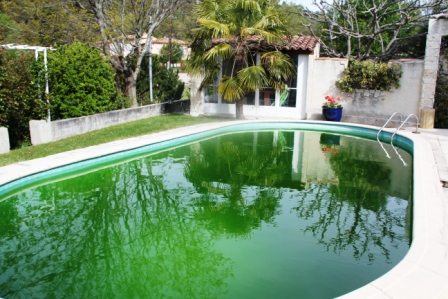
Nasty algae can wreck havoc with a pool.

We went off to the states in September, leaving our dear and trusty German friends Klaus and Marianne to house sit and mind Les Rosiers where a German couple, Detlef and Susanne from Hamburg, were staying.   They became friends, and all was well until the pool turned green. It’s happened before – algae attack.  Klaus, with the help of our friend Alan, got things back in order and our guests, again fortunately, were more than tolerant.

Detlef and Susanne from Hamburg.

“The whole set up here is warm, welcoming and comfortable…Loved the bright garden and rural setting.  ..So much to see and do in this area of Provence, and Les Rosiers is an ideal base.” — Janeen and Jon, Australia, May, 2012.

The pool is a Les Rosiers highlight.  But never has anyone enjoyed it as much as a German family with two young children who visited several years ago.  They were in the water every minute they were not out visiting sights.  Playing “fussball”  — water soccer.  Every time someone scored, the father, louder than the kids,  yelled “Tor.”   Children, we’ve found, seem to need to scream with delight  when they are in the pool.  We’re happy to see them have fun, but life is more peaceful with adults.

We love to invite our tenants for an apero, an evening drink and snacks, and a chance to get to know them.  We’ve had stimulating and educational conversations with Belgians on the divisive politics in their country, a first-hand account of life behind the Iron Curtain from East Germans, and a lesson in political history from N. Irelanders.  We also like to hear about their adventures in the area, the places they have visited, what they especially like.  Our guests  enjoy the lovely view of the Luberon hills from our balcony.

View of Luberon hills from our balcony.

As one guest wrote in our guestbook: “Leben wie Gott in Frankreich (live like God in France)..We experienced this here. We’ve found Eden with God as our neighbor.”

For more about Les Rosiers, see www.les-rosiers.compool.blog

 Comments on blog post and recipes are welcome. See “Leave a Reply” below under Comments. Subscribers also welcome.  Don’t miss future posts.  Click on Email Subscription at top right.

Bake a delicious cake.   See recipe in column at right for Lemon Ginger Pound Cake. 

Aled and Bethan, photo by Aled


NICE: Enchantment on the Riviera

I wrote the following for the newspaper Stars and Stripes three years ago after a visit to Nice.  I’ve been back several times, most recently after Christmas.  This time we lounged on the beach, enjoyed delicious food, and soaked up that seductive ambience of the Cote d’Azur.  Nice — it’s my kind of town..niceb11

After many, many years in Germany, my husband and I and our two cats (we now have three) left Deutschland behind and moved to the hinterlands of Provence in southern France. We’ve been here five years (now eight), and it’s lovely. We don’t regret the move. But I’ve found a corner of this part of the world I like even more: Nice.

Our quiet life in the countryside has its pluses, but I miss the vibrancy and excitement of a city.  Nice offers that, as well as the sea and beaches, museums, markets, intriguing old town, excellent restaurants, lush parks and outstanding architecture, all wrapped in an enchanting ambience.niceb4

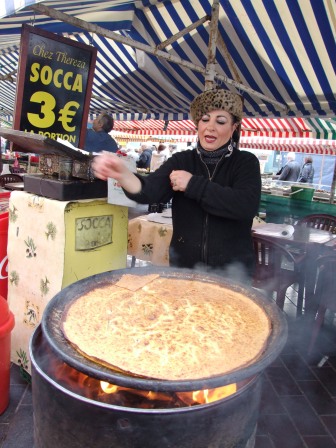
France’s fifth largest city is the capital of the glamorous French Riviera.  There’s plenty of elegance along the Promenade des Anglais, its seaside boulevard lined with palms and turn-of-the-century hotels and grand apartments.  There are traces of North Africa in the tangle of dark alleys of Vieux Nice, (old Nice). The outdoor markets and restaurants, as well as the numerous street stands, capture the flair of neighboring Italy. It’s an irresistible mélange.niceb15

Nice’s roots go back thousands of years to prehistoric times. By the 4th century it was settled by Greeks, followed by Romans, then Saracens. Nice was part of the House of Savoy (Italy) from 1388 until 1860 when citizens voted to join the Second French Empire.

The English discovered its charms in the 18th century, followed by those from other countries, especially Russians.  The Cathedral of Saint Nicholas, commissioned by Czar Nicholas II and inaugurated in 1912, is the largest Russian religious edifice outside Russia, and a top tourist attraction.

By the 19th century Nice had become a favorite winter haunt for the British.  It was an Englishman, Reverend Lewis Way, who is responsible for widening a former water front footpath in 1820 at his expense which was dubbed “Chemin des Anglais” (road of the English). In 1931 it took its final form, two roads with a palm-planted center strip, and became known as the Promenade des Anglais.niceb16

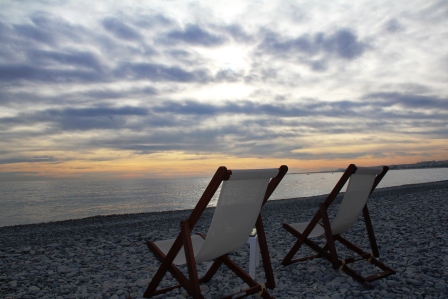
On one side of the famous avenue are Belle Époque buildings. On the opposite side are miles of beaches.  Thanks to Nice’s microclimate, even in winter you can sit at a beach café and soak in the rays.  You may even see brave souls who spread their towels in the sand and sunbathe in bathing suits.  In summer, of course, the beaches are crowded with both tourists and locals.niceb13

During our winter visit, after a stroll along the beach we climbed the steps to Castle Hill where a citadel once stood.  It’s now a maze of greenery, perfect for getting some exercise and enjoying superb views of Nice, its beaches and harbor, with the backdrop of hills and the distant Alps.

We took the easy way down, riding an Art Deco lift which deposited us on the edge of Vieux Nice. I love taking pictures at the flower market on the Cours Saleya in the heart of the old town.  I also love wandering in the labyrinth alleys in this part of the city, checking out funky boutiques, admiring Baroque churches, taking more pictures. One place that has become a favorite is Oliviera, a shop with 17 different kinds of olive oil where owner Nadim Berouti is happy to offer tastings.  The shop also has a mini-restaurant.

“When I understood that every morning I would see again this light, I could not believe how happy I was,” artist Henri Matisse wrote about Nice.  The light of the Riviera has inspired numerous artists, not just Matisse who lived in the city from 1917 until his death in 1954. A Nice museum devoted to his works is a must.Nice beach

We rode a bus up the hill to the Cimiez district where the museum is located in a 17th century Genoese villa.  Works from every period of the artist’s life are on display, including early paintings, the famous gouache cut-outs, studies (drawings etc.) for his renowned chapel in Vence, even personal effects such as Venetian furniture and Oriental wall hangings.niceb2

It was a long hike back to the center, but worth the trek to admire great pillared houses and rows of cypress trees along the route.

The Museum of Modern and Contemporary Art in the heart of the city is another gem with a collection of 400 works including sculptures and canvases by New Realists, Pop artists including Andy Warhol,  whimsical creations by one of my favorites, Niki de Sainte-Phalle, and more.  The avant-garde building with glassed-in ramps around an atrium is a sensation, as are the great views from its roof terrace.niceb19

We ran out of time and postponed a visit to Nice’s Chagall museum for another trip when we rode the Nice hop-on, hop-off tourist bus to the museum where I was in awe.  The 17 huge, colorful paintings depicting Biblical scenes are amazing.  Also to marvel are mosaics, stained glass windows and tapestries.

The bus stops at other tourist highlights, including the Russian church.  It’s a great way to take in the city, its neighborhoods and seaside panoramas, as well as travel to the sights. Head sets offer fascinating commentary in numerous languages.

When we get too old for life in the country, maybe we can move to Nice.nice.b1

TIPS FOR TOURING NICE:

Le Grand Tour, Nice’s hop-on, hop off tourist bus with 14 stops www.nicelegrandtour.com

Nice’s flower market on the Cours Saleya takes place everyday from 6 a.m. until 5:30 p.m. except Monday when it is replaced with an antiques market.niceb9

Oliviera for olive oil and small meals. 8 bis, rue du Collet in Vieux Nice, www.oliviera.com

Museum of Modern and Contemporary Art, Promenade des Arts, open daily from 10 a.m. until 6 p.m. except Mondays and some holidays.  Entrance is free. www.mamac-nice.org

Matisse Museum, 164 avenue des Arènes de Cimiez, open daily except Tuesday from 10 a.m. until 6 p.m.  Entrance is free. www.musee-matisse-nice.org

Marc Chagall National Museum, avenue du docteur Ménard, open daily except Tuesday and some holidays from 10 a.m. to 6 p.m. from May to October. From November to April from 10 a.m. to 5 p.m. Admission: 7,50 euros.  http://www.musee-chagall.frniceb18

Excellent centrally located accommodations at the 4-star Hotel Le Grimaldi, 15, rue Grimaldi.  Rates vary with season, from 99 euros for a double in low season. www.le-grimaldi.comniceb3

Favorite restaurant: La Zucca Magica (the magic pumpkin), a vegetarian restaurant run by Italians.  The decor is pumpkins, gourds and squash — hanging from the ceiling, on the tables and window sills, depicted in paintings and photos on the walls.  It’s dimly lit with flickering candles, cozy and inviting.  There is no menu.  You take a seat, order some wine, and food starts arriving — five different dishes, one after another. www.lazuccamagica.com

More information on Nice at www.nicetourisme.com

 Gingered Butternut Squash Soup with Spicy Pecan Cream was a winner at my recent dinner party.  Recipe listed in column on right. Comments on blog post and recipes are welcome. See “Leave a Reply” below under Comments. Subscribers also welcome.  Don’t miss future posts.  Click on Email Subscription at top right

Bellissimo Bellagio

Instead of moving to France from Germany eight years ago, I tried to convince my husband to consider Italy as our future home.  It seems such a happy, fun, cheerful place.  I love the language, the people, the food, the countryside.  But, Bob finds it all a bit too chaotic, so France won and life here is fine (see previous blog post, All about Life in France).  But, I still adore Italy and am always thrilled with visits.

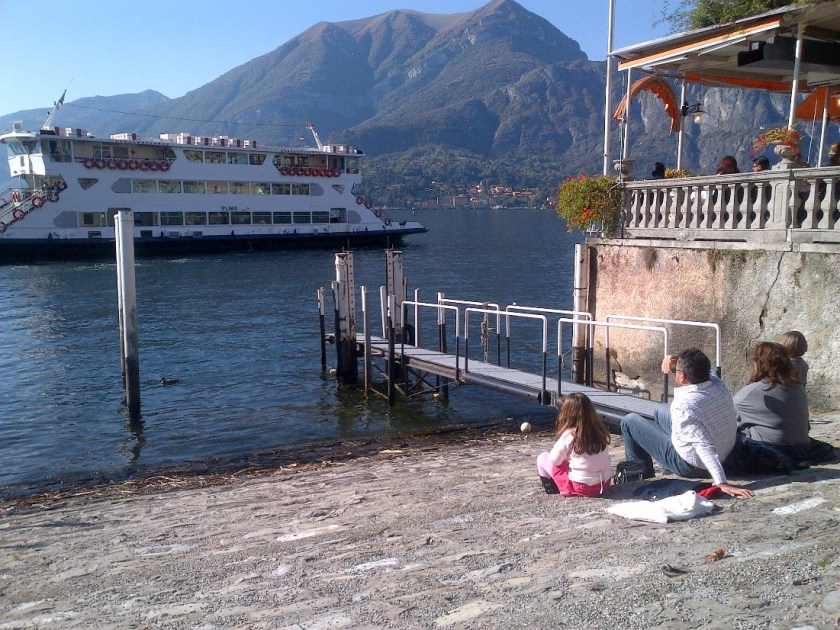
Watching the boats go by.

On the way home from our recent trip to Germany we spent three joyful days in Bellagio on the shores of Lake Como.  Friend Trina, whom we visited later in nearby Comerio, suggested the perfect hotel, Silvio, www.bellagiosilvio.com, just outside of town where we had a room with a balcony overlooking the lake and the distant Alps.  We’d been to Bellagio twice before, once with my mother who was also a fan of bella Italia and loved Bellagio.

View from our balcony at the Hotel Silvio.

The ancient village is perched on the shores of this idyllic lake ringed by mountains.  Steep steps climb skinny alleys lined with intriguing shops.  Sightseeing ships and ferries blow their horns as they pull in and out of the harbor.  It’s the perfect place to hang out and enjoy il dolce far niente (the sweetness of doing nothing)

Our journey began with a car ferry ride at sunset from Colico on the northern end of the lake to Bellagio which sits on the promontory jutting into the water at the junction between the Como and Lecco legs of the lake.  Unfortunately the lens on my Canon Rebel camera froze on our last stop in Germany, so my photos were limited to my Blackberry.  I was amazed.  Not too bad.  And, there were

Lake Como at sunset.

scenic, spectacular photo opps all around —  splashes of coral and orange across a dark sky streaked with wisps of clouds, rays of light dancing on the rippled water, postcard villages hugging the shore — all framed by deep blue silhouettes of mountains.

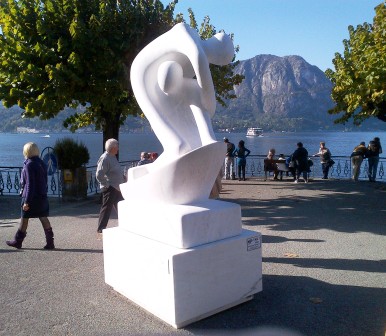
We did more than lounge on that lovely hotel balcony and ponder the Bellagio scenery.  Walk.  Down to the shore and through the perfectly manicured gardens of the Villa Melzi along the lake.  The English garden is enhanced with

October at the Villa Melzi Gardens.

sculptures, small ponds, a stream, exotic plants and ancient trees.  The complex, including the neoclassical villa, was built between 1808 and 1816 for Francesco Melzi d’Eril, Duke of Lodi, and vice president of the Italian Republic under Napoleon. www.giardidivillamelzi.it

The  garden walk led us to the village where we wandered in and out of the shops and found the perfect souvenir – an olive wood basket.  It was pricey, almost beyond our budget.  I tried to bargain, but the proprietor and craftsman, who had his workshop on the premises, would not budge.  He explained that it was a very time consuming process to create this piece.  We splurged – and are happy we did.  It’s a sensation on our table.Basket

Bellagio is known for another villa on a hill above the town, the Villa Serbelloni, owned by the Rockefeller Foundation.  It is used mainly for conferences.  On a previous visit we toured its gardens which are open for guided tours from April to October.  In town the Grand Hotel Villa Serbelloni is the address of class where Churchill and John F. Kennedy stayed.

Along the shore in Bellagio.

Another day we walked up a hill and along a road to Pescallo which I had remembered as being a quaint fishing village.  My memory failed.  It was not much.  No fishing boats.  We did find a lakeside restaurant where we had an expensive but disappointing lunch.  The next day we set out by car for a hair raising ride along the all- too-narrow- winding coastal road (well suited to the Honda S2000) to Lezzeno and a fabulous lunch at the restaurant of the Hotel Villa Aurora adjacent to the lake.  www.hotelauroralezzeno.com   There, as well as at the restaurant in the Hotel Silvio, we enjoyed fresh fish from Lake Como.  Twenty-eight different species are said to thrive in its waters.  Lavarello is a favorite.
On the way back home to France, we stopped first to visit the major town on the lake, Como, and its majestic cathedral, then to Comerio to visit Trina in her gorgeous apartment overlooking Lake Varese.  I met Trina years ago in an Italian class in Germany (she was the star of the class).  Her husband Ian, who used to work in Italy, now works in London. Trina, who teaches English, and her faithful companion, Lucky, a precious 16-year-old Bichon Frisé, are holding down the fort in Italy.bellagio17

We arrived on the evening of Bob’s birthday.  Trina prepared a delicious mussels pasta dish for our dinner – and there was a tart with a candle for the birthday boy.

See slideshow below for more photos. For a holiday brunch, try the Puffed Apple Pancake, recipe in column at right. Comments on blog post and recipes are welcome. See “Leave a Reply” below under Comments. Subscribers also welcome.  Don’t miss future posts.  Click on Email Subscription at top right.

This slideshow requires JavaScript.


Back to Germany

Germany was my home for 28 years. Good times, wonderful memories – and fabulous friends.  Husband Bob and I recently returned to reconnect with many of those friends,  to visit old haunts, as well as other destinations that I will be writing about for the magazine German Life. (www.germanlife.com).

Maybe we’ve lived in the boondocks of rural France too long (since 2004).  Here life is tranquil, serene, quiet.  This time we found Germany a bit chaotic with monstrous traffic jams on the autobahns, construction sites  almost everywhere and  crowds of people in the city centers.  It’s hard to imagine that anyone could be unemployed in Deutschland with so much building in progress.

We spent several  nights with friends Klaus and Dagmar who live in Gerlingen just outside of Stuttgart. They urged us to take the U-bahn downtown to see the massive and controversial construction site for Stuttgart 21, the city’s  new railway and urban development project  which involves  57 kilometers of  new railways, including some 30 kilometers of  tunnels and 25 kilometers  of high-speed lines. Protesters still demonstrate at the site every Monday.  The project, which is estimated to  cost as much as six billion Euros, won’t be completed until 2020.  Another attraction adjacent to the site is the  new library, a modern and dazzling wonder in white by architect Eun Young Yi which has been likened to a Rubik’s cube puzzle.

Dagmar invited several of our friends for an excellent dinner, an antipasti of grilled vegetables, followed by  a  Swabian favorite,  stuffed breast of veal, all topped by  our very favorite German dessert, Rote Grϋtze, a yummy compote of red fruits.  Friend  Heti also entertained us with an amazing meal of Peruvian delicacies:  ceviche (fish  marinated in lime juice) and veggies, gallina picante parmesana (chicken with aji -hot yellow pepper), quinoa risotto with veggies, and for dessert, coconut flan and Tonka bean mousse.  All over the top.  More on those beans to follow.

Heti is an inspiration, and not just in the kitchen.  She recently lost 14 kilos on the Dukan diet combined with an hour of aqua jogging every day in the nearby Sindelfingen indoor pool.  When I lived  in the area, I frequently swam there year round.  There are also several outdoor pools for summer months.  Sadly, France is lacking in these first-class swimming facilities.

Klaus and Marianne, other friends from the Stuttgart area who frequently housesit for us in France, treated us to a delicious pasta lunch and a homemade Swabian apple pie at their new apartment.

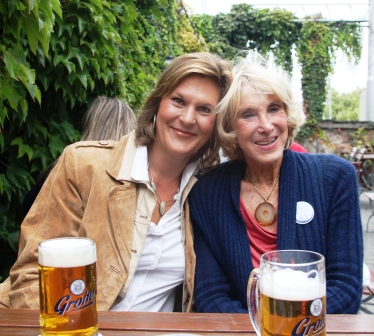
We took a trip north to the Darmstadt area to see more friends.  For years I worked for the military newspaper Stars and Stripes which was previously headquartered just outside the city.  A group of former colleagues met us at an Italian restaurant for a fun evening.  Special pal Andrea, whom I consider a surrogate step-daughter, and her husband Thiemo, joined us at Darmstadt’s famous brewery, Grohe, where we sat outside in the sunshine savoring the brew.  Another Darmstadt friend, Wilma, invited us for a delicious salmon dinner and stimulating conversation with her friend Erik.

Our travels also  took us to the Bergstrassee south of Darmstadt, Kaiserslautern, Augsburg, Munich and the Starnberg Lake district south of Munich.

For many years while I worked at Stars and Stripes, I lived in Jugenhiem at the northern end of the Bergstrasse in an apartment I called the “Treehouse.”  It was the top two floors of a former seniors’ home at the edge of a forest  and surrounded by tree tops.  We stopped for a visit, and it’s still the same – an idyllic hideaway in a jungle of green.

The best of the visit to the Bergstrasse, which extends 70 kilometers south from Darmstadt  to Heidelberg, and where many an ancient castle and castle ruins crown hilltops, was wine  The Bergstrasse wine region is divided into two parts, vines in the south in the state of Baden Württemberg, and those in the north in Hessen.  The former is Germany’s smallest wine region. German wines, as well as wines everywhere, have improved thanks to up-to-date knowledge and techniques, an expert told us.

For years German wines had a bad rep because “we exported the wrong wines, “ such as the  sweet Blue Nun, explained Maria Zimmermann of the regional tourist board.   Today German vintners are also well-educated, studying viniculture, not just learning the trade from their parents. We tasted some fine wines, and  Bob  made several purchases.

In the town of Weinheim, we toured a lovely garden followed by the best restaurant meal of the trip, an amuse bouche of scallops topping  a pumpkin salad sprinkled with mandarin oil, and a Hirsch (venison) medallion with an elderberry sauce and Steinpilze (boletus),  plus  parsley root puree. It was perfection.

Heppenheim is the quintessential Bergstrasee town with a market place of well-preserved half-timbered houses.  We joined an after-dark tour up and down the ancient streets and stairways, following a costumed story teller and her lantern carrying assistant.  Periodically they stopped with the story teller relating charming tales and fables of the region, most translated from old German into an English that rhymed.  Very impressive and a delightful, unusual experience.

The greatest number of Americans outside of the U.S., some 50,000 who are military or civilians working for the military, makes their home in the Kaiserslautern area. There I interviewed Wolfgang Tönnesmann, director of the Atlantic Academy, who had a life-size cardboard replica of Obama in his office. Like me, he is no doubt thrilled with the recent election results.

My quest to try local food specials in Kaiserslautern led us to the town’s only half-timbered building and the restaurant Spinnrädl. We were in the Rhineland Pfalz area and the restaurant served up  Pfälzer dishes written in the local dialect on the menu:  Brotworscht, Saumaa, Lewwer (Bloodwurst, potatowurst so named because it is stuffed into a pig’s stomach or Saumaa) and liverwurst. Hearty fare accompanied by Grumbeerstampes   (mashed potatoes).

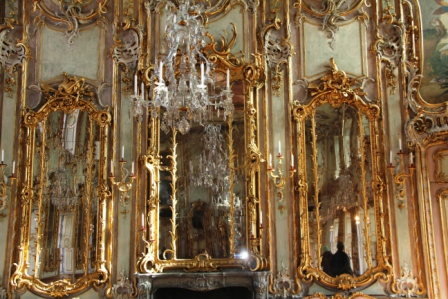
Jakob Fugger (1458 – 1525), a wealthy merchant (according to a guide, “he had more money than Bill Gates) put Augsburg on the map.  The Fugger family, in particular Jakob, was into finance and trade.  Jakob, known as the Empire’s banker, and  not unlike Bill Gates, had a social conscience.  He founded the Fuggerei, a section of the city for the town’s poor, the world’s oldest social housing which still exists with 140 apartments.  Rent is 1 euro per year.  We followed a fascinating tour of the area, and also visited a dazzling Rococo banquet hall, the Schaetzler Palais (1767), as well as other local attractions.

The Munich visit focused on food with visits to the city’s legendary outdoor market, the Viktualienmarkt, its classy food emporiums, Dallmayr and Käfer, as well as the food empire of Alfons Schuhbeck who has a collection of shops, including a Michelin starred restaurant, in the Platzl near the Hofbräuhaus.  Friend Heti clued me in on Schuhbeck who is huge on the German food scene.  It was at his incredible spice shop where she purchased the Tonka beans which come from South America for that exotic dessert.

Our visit wound up at the Starnberg Lake, one of several lovely lakes  south of Munich. All the sailboats which blanket the lakes in summer had been put to bed, but the region had plenty of charms for a fall visit.

A  must was a visit to the nearby Andechs Abbey above the Ammersee, another one of the regional lakes.  After admiring the Abbey’s church and its stunning Rococo stucco décor and frescoes,  we moved on to the terrace beer garden.  Monks have been brewing beer at Andechs since 1455.  These days seven different kinds of brew can be ordered, as well as Bavarian food favorites.

Other Starnberg highlights are the Baroque St. Mary’s Minister in the town of Diessen and  the lakeside Buchheim Museum noted for its collection of Expressionist works.  Last but not least, a wonderful bike ride following a cycle route along the Starnberg Lake with an outdoor lakeside lunch stop, as well as many breaks for postcard photos of the lake framed by distant Alpine peaks. (For more photos, see slide show to follow.  Comments are welcome. )

For more information:

www.diebergstrassse.de

www.augsburg-tourismus.de

www.munich-tourist.de

www.sta5.de

www.andechs.de

This slideshow requires JavaScript.