Down Under Delights – and Disappointments

“Be sure to climb the Sydney Bridge.  It’s amazing,” friends advised.  So, on our visit Down Under last November, we did —and are $524 Australian dollars poorer.  (The Australian dollar is about at par with the U.S. dollar.)
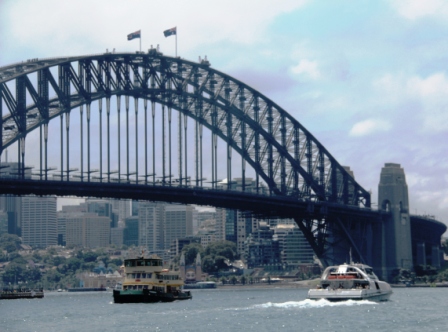
Yes, $212 per person for this “once in a lifetime” experience.   Who could afford to do it twice?

Our conclusion: A rip off.  Not that the experience was without thrilling moments.  And, the views are dynamite.  But, think of the gourmet meals that $524 could have purchased.

We joined a group of 12 others for the 3 ½ hour adventure.  The first hour was spent getting attired:  a loose fitting protective body suit with a belt from which a carabiner dangled, a head set, a baseball cap. Then, practice. We had to climb and descend a ladder, attaching and releasing the carabiner to a cable.  For security, climbers are attached to a cable throughout the climb.  We listened to safety briefings, warnings etc.  The adrenalin was in high gear.

At last we were off – a single file behind the guide who kept up a commentary heard on the head set. The first part in the guts of the mammoth steel structure was not too exciting, just lots of steps and long stretches across cat walks.  Once we started climbing outdoors, precariously  on the edge of the bridge,  a strong wind whipped around  us.  We were so high, it seemed as if we could touch the sky, and the water below appeared to be miles and miles away.  It was all  exhilarating with spectacular views in every direction.

We stopped for photos.  But, not with our cameras.  Personal cameras are not permitted – too dangerous.  An official bridge photographer was on the scene.  Each couple or individual was photographed with the appropriate spectacular background. This took time, too much time. There were five of these stops, each with a slightly different background.  And, we usually had to wait for the group ahead to finish before our group moved up to the perfect photo slot.

Plenty of time to ponder the scenery, and to look down. The Sydney Harbour Bridge, at 440 feet from top to water, is the world’s tallest steel arch bridge.  That’s a huge drop, and scary to view. The guide added to the fright factor with tales of those who plunged to their deaths.  Sixteen workers died during construction which was completed in 1932. The sight that amazed me during the climb was a lonely bird in his nest built on steel beams that had to be higher than any tree.
The finale of the “climb of your life” was aggravating.  After we had changed back into our street clothes, we proceeded to a room with pretty young girls sitting behind computer monitors.  Here’s where we could get those photos, we thought.  We were right.  Give your name and your individual photos pop up on the screen. For a mere extra $25.95 per photo, you could purchase a picture souvenir.  We passed, content with the one complimentary group shot.

Others in the group (the elderly gentleman from Chicago, the honeymoon couple, the couple celebrating a birthday…) eagerly parted with the extra cash for the pricey souvenirs.  They all seemed happy with their costly climb.  Perhaps we’re jaded?

After the experience, we headed to a nearby pub for a much needed beer.  We related our disappointment to the bartender.  “I wouldn’t do it.  You can walk across the bridge for free.  It’s not worth it,” he said.  We agree.
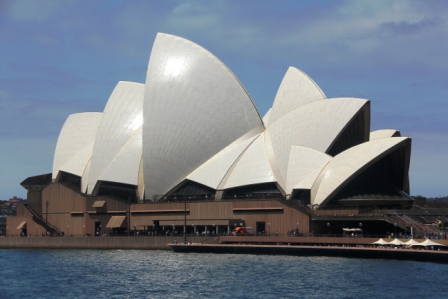
While the bridge climb left us somewhat underwhelmed, we were overwhelmed with the Sydney Opera House.  During a guided tour, we learned the fascinating background to this iconic structure. Both inside and out, it seems so ultra modern.  Yet, it was constructed between 1959 and 1973.  Glass for the gigantic windows came from France.  The ceramic tiles on the exterior are from Sweden.  Its exotic shape of undulating sails permits self-cleaning by the rain.  The acoustics in the large auditoriums are such that no microphones are needed….

Danish architect Jorn Utson designed the incredible structure.   Building costs far exceeded original projections.  In 1966 due to a conflict over finances with a new minister of public works, Utson resigned, vowing never to return to Australia.  He died in 2008 without seeing his completed masterpiece, which was declared a UNESCO World Heritage site in 2007.

Other delights of the Sydney visit included the city’s bustling fish market, a ferry excursion to Manly where we watched surfers – and our reasonable room ($135 per night) with an exceptional harbor view at the Macleay Apartment Hotel (www.themacleay.com).
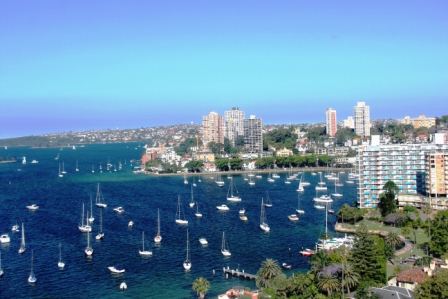
We found Sydney – actually all of Australia – expensive.  Here we had a mini kitchen so we could save on meal costs.  The hotel location in Potts Point was ideal with both delis and a super market nearby for purchase of take-home, ready-to-eat meals.

Well-traveled friends also advised that we visit the Great Barrier Reef during our sojourn in Australia. Many, many year ago, I took the required course and earned scuba diver certification.  I’ve only been on a few dives, but as the Great Barrier is said to be one of the world’s best diving sites, I had to experience it.

We flew from Sydney to Cairns where we rented a car for a 1 ½ hour drive north to Port Douglas, an inviting seaside town of restaurants, quaint shops – and excursion boats to the Great Barrier Reef.  Husband Bob is not a diver, but he joined the party, 80 tourists, on the dive/snorkel boat.

I was nervous since I had not been diving in so long.  I joined a “beginners” group and once in the water, my confidence returned.  The coral formations were intriguing, even mystifying.  But, they were dull — beige and bland in color.  A far cry from the vivid colors of the postcards.  And, the fish were not as plentiful as the postcards depict.  I did see a gigantic clam, a ray glued to the bottom, some bright yellow fish.    I submerged three different times, but each time returned to the surface a bit disillusioned.

I was not the only one.  Several on board expressed the same feelings.  One diver said there were too many of us.  We scared the fish away.  Later someone said the coral had been killed by El Nino. (According to an article on the web, El Nino bleaches the coral.)   Jakob, the friendly proprietor of our Port Douglas hotel, said you need to get accustomed to the underwater surroundings, to adjust your eyes, and then you will see color.  “All those postcard photos are made with strobe lights,” he explained.
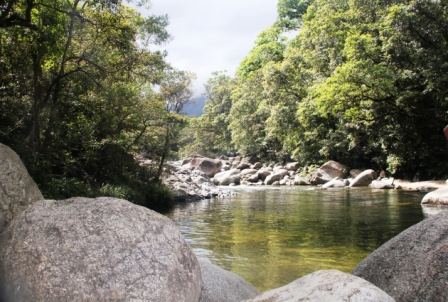
I am still happy I had the chance to dive again, but what really made me happy was a swim in an idyllic pool at the Mossman Gorge in the Daintree National Park not far from Port Douglas.  For me, swimming is right up there after skiing.  This body of clear, cool water with huge granite boulders along the sides, as well as in the middle, surrounded by lush jungle, was a bit of paradise.  The pool is in a section of the Mossman River, touted as  “without crocodiles.”  But, there were lots of birds, including a wild turkey poking among the picnickers along the shore.

We saw more feathered friends at Habitat, a fun place where you can dine in a large enclosed area among birds, small and large and brightly colored,  who fly above, prance around on the ground, squeak, chirp, sing, and screech.  A caretaker walks by and gladly perches a bird on your shoulder.  Habitat also has more wildlife: kangaroos, koalas, wallabies, crocodiles.
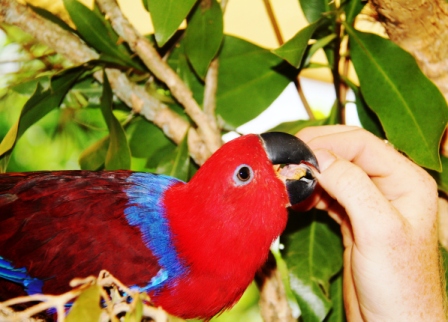
We rented bikes for the trip to Habitat, just outside of Port Douglas, and rode back along the beach, which, except for a jogger or two, was deserted, even though it was a hot, sunny day.  Jelly fish, we learned.

The Palm Villas, our home in Port Douglas, was ideal – reasonable, excellent location, lovely pool, helpful proprietor.  We paid about $95 per night for a spacious studio apartment with kitchen and balcony on a quiet street. www.palmvillas.com.au

In case you’re tempted, more on Sydney Bridge climb at www.bridgeclimb.com  More on diving excursions in the Great Barrier Reef: www.poseidonpcruises.com.au

Have you been to Australia, climbed the bridge, been diving at the Great Barrier Reef?  Share your views. Click on “Leave a Reply” after the slideshow below.

If you’d like to read more of my tales and adventures, click on “Email Subscription” at top right of post.    New Zealand’s magnificent Fiordland  coming soon.  And, a new recipe appears with each new post.

Learn about the famous melons of Provence.  Try a tasty melon salad.   See “Melon Salad with Feta and Pine Nuts” under recipes at right.


This slideshow requires JavaScript.


Meandering around Melbourne

This was the best part of our visit to Australia.  It’s all due to the warm and generous hospitality of our friends Meg and Brendan Downie who took great pains to show us the sights and treat us to excellent meals and superb wines, not to mention comfortable accommodations at their attractive home in Donvale outside the city.

We met Meg and Brendan years ago when we lived in Germany where we were members of the Porsche Club.   I had a Porsche 944 (considered by many not to be a real Porsche), but it was my baby, my pride and joy, which I drove for 17 happy years.  Brendan had both a Porsche 356 and 911.  He still has these, and a 1936 Ford.  Attendance at a Porsche event was a highlight of our visit.

Plus, a spectacular drive through the Mornington Peninsula, the Yarra Valley, a visit to an animal sanctuary, an aborigine art gallery and more.

During a visit downtown, I had the opportunity to talk to John McGaw, senior business development manager with Destination Melbourne.  “I’ve worked in the tourism and wine industry for years,” he said.  “I’ve lived in Syndey, Adelaide and now Melbourne.  I prefer Melbourne.  It’s such a friendly city.  Everything is easy here…We’re a shopping and dining capital.”    The city has 80 different kinds of ethnic restaurants, he pointed out.

According to John, Melbourne, a city of almost four million, was just voted “the world’s most livable city.”  “It’s as safe a city as you’ll find anywhere,” he boasted.   Tourism is important to the multi-cultural city, with China considered the largest future market, followed by India.  Then there’s Greece.  John said that Melbourne has the second largest population of Greeks after Greece.  “They’ve been coming here for 40 years.”  The city’s Greek Quarter, as well as Chinatown, is fun to visit.  For Vietnamese fare, there’s Victoria Street lined with noodle shops and grocery stores.

The downtown is lively, vibrant, with street entertainers, hucksters, and plenty to admire, including 50 shopping arcades, the oldest, the Black Arcade, dating to 1892.  John recommended we visit an old world Victorian tea shop whose window was filled with luscious pastries.   The place is so popular, we had to stand in line to wait for a seat.

Federation Square is an innovative mix of glass and steel structures with shops, cafes, restaurants, and bars — and the venue for some 2,000 events every year.  Docklands on Victoria Harbor offers more shopping and dining opportunities.  The Queen Victoria Market is food paradise.  Meg and Brendan shop there every Saturday, visiting favorite stands for fruits and veggies, as well as delis and bakeries.

Within just 90 minutes of the city center, stunning scenery awaits.  We made many photo stops on our drive through the Mornington Peninsula. The Yarra Valley, a wine growing region, is also picturesque with wineries where you can stop to taste fine chardonnays, pinot noirs and more.  Our drives took us though areas devastated by the Black Saturday bushfires of 2009 which ravaged southeastern Australia   —— past slope after slope of still barren trees.

Wildlife is a major attraction in Australia. Meg took time from her duties as ward councilor for a visit to friend  Neil Abbott, a jovial farmer with 100 acres where 70 – 80 kangaroos usually hang out.  As luck would have it, the beasts were missing the day we visited.  The day before there had been a major fire drill with helicopters hovering over the area.  The noise drove the kangaroos away, but we did spot one or two during a tour with Neil in his four-wheel drive vehicle  through the hilly terrain.   And, we learned about kangaroos.

“The aborigines used to eat them.  The dingoes (Australian wild dog) used to eat them.  But now they have no natural enemies,” Neil said.  So, they proliferate and become pests, destroying trees and fences.  They sharpen their claws on the tree bark.  “Their claws are longer than your finger,” he explained.   Some people shoot them, but this is an outrage.  “People are up in arms about those who shoot our national emblem,” he said.  He can no longer farm due to the kangaroo population on his land, but he won’t shoot the animals.

“The kangaroos are a wild animal.  They should be in the bush.  It’s cruel to have them in these areas where they are chased by dogs, where they ruin fences, and are a danger to cars and people… I believe there are a lot of accidents, people killed, veering to avoid hitting a kangaroo,” he said.

During our drive through his farm, Neil said he had a surprise for us.  He knew where a wombat lived and would take us there.  He got out and went ahead down a hill.  “Be quiet…he’s here,” he told us.  We crept behind, me with camera ready.  Voila, I focused on a furry brown head.  Wait, something seemed amiss. It did not move. It looked a bit suspicious.  No wonder.  It was a stuffed wombat Neil had buried under leaves – a joke he often plays on naïve visitors.

We saw more wildlife on a visit to the Healesville Sanctuary where demonstrations and lectures on the various critters are scheduled throughout the day.    The Koalas drew big crowds.

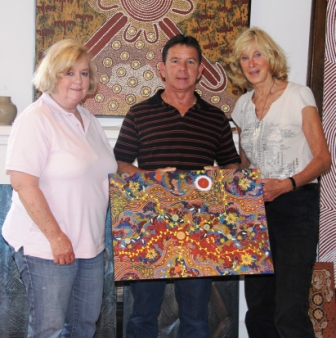
Colin McKinnon is another friend Meg took us to visit.  His Mia Mia Gallery features an amazing collection of beautiful aboriginal art.  The gallery is owned by aborigines, and the profits are returned to aborigine communities.  Colin, himself an aboriginal artist, explained the symbolism of many of the intricate and colorful works, and he generously gave me a print which now hangs in our living room, a treasured souvenir of our memorable visit to Melbourne.

More on the Mia Mia Gallery at www.miamiagallery.com

More on Melbourne at www.destinationmelbourne.com.au

More on the Healesville Sanctuary at www.zoo.org.au

For more views of Melbourne and surroundings, watch the following slideshow.  For a taste of  Greece, whose  influence is prominent in  Melbourne, try Meg’s Baklava, recipe in column at right.

This slideshow requires JavaScript.


Turkey: from Istanbul to the ski slopes

Masses of people. Pouring through the squares. Walking four and five abreast on the sidewalks. Strolling almost body to body on the popular, wide pedestrian street, Istiklal Avenue, on a Saturday evening.

Istanbul 2012, home to 17 million and booming. I’d been to the city twice before, but long ago. The changes, the vibrant pulse of round the clock activity, choking traffic, five-star hotels and designer shops –all overwhelming.

My recent visit was with the Ski Club of International Journalists (SCIJ, www.scij.info). We were en route to our annual meeting, this year held on the slopes towering above the city of Erzurum in far eastern Turkey. Some 200 skiing journalists from 30 countries met to ski, race, party, and learn about this dynamic country from distinguished speakers.

Some of the facts:

• Fifty percent of the Turkish population of 75 million is under 30.

• There are more than 25 universities in Istanbul.

. • One million people visited Turkey last year – the country ranks 7th in the world in number of visitors.

• Turkey has been a model for the Arab Spring, a secular democracy with a Muslim population.

• In 1980, the country’s exports totaled $3 billion. Last year that figure was $130 billion.

• Turkey is the sixth largest economy in Europe, 16th largest in the world.

The  media are thriving with some 1,000 daily newspapers, 100 television channels and two billion Internet users.

• But, all is not rosy. Freedom of the press is a hot issue.  Between 50 and 100 journalists are said to be in jail for being critical of the government.

• 69 percent of the population wants Turkey to join the EU.

As one of our speakers said, “Turkey is the new kid in town.”

I arrived in Istanbul a day early and spent an afternoon at the Grand Bazaar, a shopper’s Mecca with hundreds of shops and stands offering gleaming gold jewelry, silver jewels, carpets, scarves, ceramics and more.  Before setting off to the mountains, the group  visited Istanbul’s star attractions: Hagia Sophia  Museum, the Blue Mosque and Topkapi Palace.  A Bosphorus  cruise is a must

On the Bosphorus.

for an Istanbul visit.  We were blessed with warm sunshine for our boat trip on this 30-kilometer stretch of water which connects the Black Sea and the Marmara Sea and separates Europe from Asia.

We savored excellent cuisine. Turkish  Meze, small plates served as appetizers, are different and delicious, often seasoned cold vegetables, such as eggplant, zucchini, peppers… as well as stuffed grape leaves, cheese and a yogurt-garlic sauce for dipping.   Kebabs of beef or lamb are a frequent main course.  Baklava is a favorite dessert.

Not only a fabulous dinner, but over-the-top entertainment,  was a highlight when we dined beneath the streets of Istanbul in an ancient cistern which was constructed in the 5th century and is now used as a venue for special events.  A well-known Turkish clarinet player and his band played non-stop for more than an hour and a half – an incredible performance.  Then came the country’s famous belly dancer, Asena, whose sexy slithering  and amazing body movements were mind boggling.

For me, the best of Istanbul was the hamman or Turkish bath,  a soothing multi-step ritual which leaves you feeling ultra clean and relaxed.   For the bath, we visited the historic Hurrem Sultan that dates back to the 16th century but was restored in the 1950s.  There are separate sections for men and women.

The surroundings are opulent – all white marble under a  domed ceiling pierced with tiny windows to let in light.  Each bather is assigned an attendant who first pours warm water over your naked body.  The water is scooped from a basin under bronze faucets into embossed bowls –very classy.    This goes on for some time, then you are led to a large room where bodies lie on towels in a circle under the grandiose ceiling.  The attendants whirl a large cloth bag though the air, then, starting at the top of the bag, squeeze it until soap suds come out the  open end at the bottom— mountains of white foam.  The bodies soon look like mummies buried under mounds of cotton candy.  The attendant  gently massages the suds into the body from head to toe.  It’s glorious.  This is followed by an entire body scrub down with a rough mitt to  remove dead skin.  Then, more pouring of water, all ending with relaxation in a chaise lounge and a glass of rose hip tea.  I liked it so much, I went for a repeat performance at our hotel in the mountains.  There the surroundings were not quite as posh, but the experience was equally as  heavenly.

For most of our group, the best part of the trip was no doubt the skiing – and theobligatory races (giant slalom and cross country). But, as I have a knee which is worn out  (replacement surgery scheduled for May), I spent almost no time on the slopes.  I had relaxing days at the hotel, and, in addition to the hamman, took advantage of the swimming pool.

Nation’s Night is a SCIJ tradition.  Participants bring delicacies from their countries to share with the others.  Airline restrictions make this more and more challenging, nonetheless the variety of food and drink offered is a tribute to the determination and innovation of these skiing journalists.  Foie Gras from France.  Raclette from Switzerland.  Pasta from Italy… and Thanksgiving turkey  for a meeting in Turkey from the US.

The turkey was the idea of the U.S. team captain, Risa Wyatt.  Customs regulations prevented bringing turkey from the U.S., but the hotel did a commendable job of roasting two large birds.  I made and brought cranberry chutney to serve with it.  The beverage:  Wild Turkey.   It was a sensation.

We even had one bird leftover which we served at the end of the cross-country race, along with the legendary Dutch pea soup,  the latter a popular tradition prepared every year, with much difficulty, on site by our colleagues from Holland.

Unfortunately the trip ended on a sad note for my  Irish friend and roommate Isabel who broke her arm on a bad fall the last afternoon.  She had to have surgery in the hospital in Erzurum. The Turkish organizers of our meet, the hospital staff and Turkish Airlines treated her like royalty.  But,  now that she’s back home in Belgium, she has learned that mistakes were made during the operation and it must be redone.

She’s depressed and says she won’t ski again.  Skiing has been my passion, and  I am worried that a new knee may not permit me to get back on the slopes.  I told Isabel we must both give it a try – maybe sticking to the gentle slopes.  Next year SCIJ will celebrate its 60th anniversary in the Italian Dolomites – something not to miss.

For more on Turkey, see www.goturkey.com.  For more on the Ski Club of International Journalists, see www.scij.info.    See  “Poached Chicken Breasts with Arugula Pesto Sauce” for  a chicken recipe with a bit of green for St. Patrick’s Day.    Watch the slide show to follow.

This slideshow requires JavaScript.

Fine Dining à la Française

One of the reasons we were happy to move to France is food.  The cuisine here is hard to beat.  When we lived in Germany and were both working, hence a better income, we loved to make eating excursions to nearby Alsace.  The dollar was stronger back then, too.  Sometimes we would splurge and eat in a Michelin starred restaurant.

Since moving here and living on a fixed income, we’ve been happy with local restaurants, most of which are reasonable.  But, since the dollar is faring better these days, and since it was Valentine’s Day, I wanted to try a Michelin one-star restaurant, La Petite Maison, in nearby Curcuron.  I called and learned they had a special multi-course menu for Valentine’s Day – 120 euros ($159) per person.  That did include wine and champagne, but nonetheless way beyond our budget.  On regular days they offer a three-course menu for 46 euros ($61) per person, excluding wine.

We decided to celebrate Valentine Day’s in a more economical fashion, but try La Petite Maison a few days later.  On February 14 we lunched at the restaurant at Lycée des Métiers Louis Martin Bret in the town of Manosque.  This is a professional school with a department where aspiring chefs and restaurant personnel are trained.  Several days per week at the school restaurant they offer lunches and dinner.  The menu is fixed – few choices—but good and reasonable.  The ambience is pleasing – fresh roses on the table, the young waiters and waitresses all looking spiffy in black jackets and pants, white shirts and baby-blue ties.  This time there were two choices offered for each course.  We chose the following.  Our average rating on a scale of 1 – 10 (10 is tops)  follows.

First course: Profiteroles à la mousse de foie gras sur roquette.  Three rounds of chou pastry, each filled with a different type of foie gras mousse, attractively arranged around a mound of arugula, with threads of spun sugar on top for added flair.  One was decorated with stripes of chocolate sauce. The others were accompanied by tiny mounds of chutneys. Yummy.  In my opinion, you can never go wrong with foie gras.  Rating: 8.5

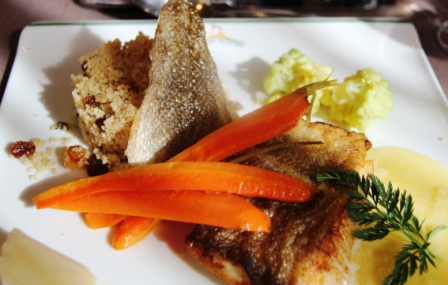
Main course: Dos de cabillaud, semoule aux raisins, carrots fanes glacées.  A slice of cod with a piece of the fried skin as decoration, served with a semolina/raisin mixture and glazed carrots. Tasty, but unfortunately we found the fish overcooked, which is too often the case with fish. Rating: 5.25

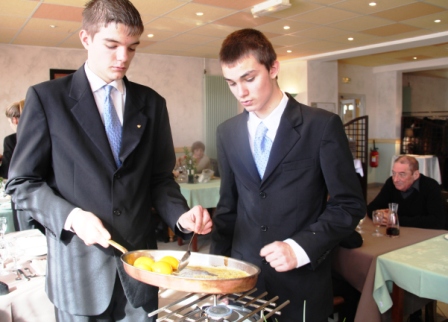
Dessert:  Pêches flambêes sur glaces. Flambéd peaches served on ice cream.  It was fun watching our young waiters, Nicolas, 15,(left)  and Jimmy, 15, undertake the flaming procedure. They handled it like pros, and the result was delicious – the vanilla ice cream full of flavor and obviously homemade. Rating; 7.5

We began the meal with an ”apéro,”  a before dinner drink that is de rigeur in France.   We ordered the cocktail of the day, a concoction of rum, orange juice, coconut milk and sugar.  With the meal, we drank a half liter of open white wine.  After dessert, we each had a coffee.  Total tab for two: 40 euros ($53).

Two days later we went for broke and had lunch in Curcuron at the renowned La Petite Maison with our friends Gayle and Ralph.  We economized on the apéro – a pre-dinner drink at the village café next door.  For two glasses of champagne, a beer and a Pastis, the bill was 14 euros ($18.50)  La Petite Maison charges the same for one glass of champagne.

Two fixed menus were offered, at 46 and 68 euros each. We all selected the less expensive one. Beef was the main course. Bob is not big on beef, so he was permitted to substitute fish.

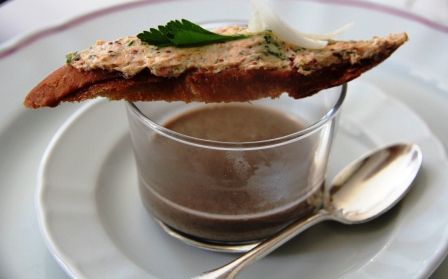
At this classy place, we were given an amuse-bouche ( appetizer )  a velouté de lentil et une tartine avec rillette de saumon.  A creamy lentil soup topped with a toasted wedge of bread spread with a salmon pâté.   Gayle thought it was outstanding.  I wasn’t that overwhelmed. Rating: 7.8

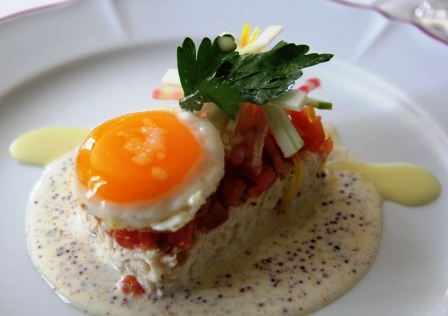
First course:  Céleri et pomme verte rémoulade rehaussé de dés de saumon fumé, oeuf au plat coulant.  A colorful combination of diced celery and green apple topped with tiny morsels of smoked salmon, all crowned with the yellow of an egg.   Definitely a work of art to admire, and it was good, but perhaps not as flavorful as it looked. Rating: 6.5

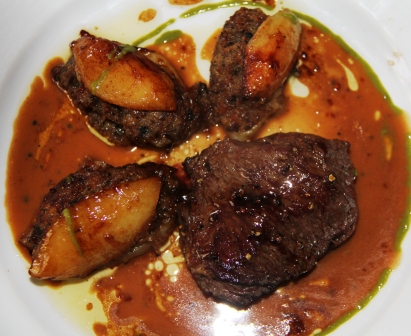
Main course;  Pièce de filet de boeuf d’origine européenne poêlée au poivre, pommes de terre fondantes.  Filet of beef ( European origin)  pan fried with pepper and served with interesting potatoes. (fondant means ‘‘melted,” but there was nothing melted about these potatoes.  Maybe this is just fancy restaurant vocabulary).  We were not asked how we wanted the beef cooked. It was served rare, a tad on the bloody side. This is the way French gourmets prepare beef.  I love beef, and this is just the way I like it, so I was happy.  Bob, who went for the fish substitute, was horrified at the bloody meat and very glad he chose monkfish served on a mousse of cauliflower.  Sharing the plate with the beef were sliced potatoes topping a tasty crumb melange which reminded Gayle of turkey stuffing. She noted that this dish would have been better with an added portion of vegetable – perhaps something green for color.  Rating: 7.4

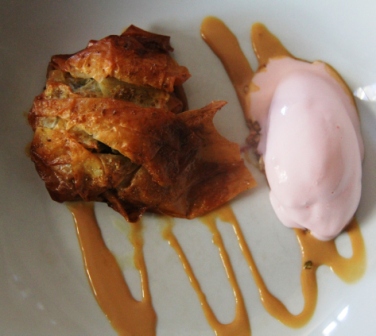
Dessert:  Croustade aux pommes et figues aux parfums d’orient, glace à la rose. A crusty concoction of phyllo pastry filled with Oriental flavored apples and figs  next to a scoop of rose ice cream.  Bob is a dessert fan and this was his favorite.  I thought it was good, although I did not detect any Oriental flavors and the rose ice cream did not send me.  Rating: 7.75

With the dessert a plate of small pots of a lemony-creamy liquid surrounded by mini cakes was placed on the table for us to share.  A nice touch.

The restaurant is in an old house in the center of a charming village opposite a pond.  The dining room, all wood-paneled, is a bit on the bare side – no décor, just tables with white table cloths. Our waitress, all dressed in black, was pleasant – she even corrected my French.  That I appreciated.  Chef and owner, Eric Sapet, has impressive credentials in the world of cuisine.

We ordered the cheapest bottle of red wine on the menu: a 2007 Vin de Pays de Vaucluse, Domaine Hugues, Vendage des Chefs, 35 euros ($46).  Total cost per couple, about $144.

Moral of the story: Forget the stars and save your money. We all agreed that we’ve had better food at la Table du Bonheur (see previous blog, “Table of Happiness”) for much less money.

www.lyc-bret.ac-aix-marseille.fr

www.lapetitemaisondecurcuron

A Dentist and his Jungle Haven

He’s known as the “jungle dentist.” Danish oral surgeon Peter Bloch began coming to Bali 43 years ago. During visits he realized the need for his skills among the local population living in rural areas.  He equipped a boat to be a dental clinic on water, then sailed around the island, making stops at remote villages and offering his services to those in need.

“Having a toothache is the worst pain,” says the dedicated dentist.  “You can’t sleep.  You can’t eat. You can only cry.”  Without dental care, decayed teeth can become infected.  Sepsis can set in and can lead to death, he explained.  ”It’s a common way of death here.”

Bloch, who had a practice in Fort Myers, Fla., for 19 years, as well as a part-time practice in Denmark, would spend two to three months a year as a volunteer “jungle dentist,” seeing as many as 60 – 70 patients per day.  “We used an upside down canoe as a dental chair,” he says.

He now lives at his magnificent resort, Tanah Merah (red earth), four kilometers outside of the Bali town of Ubud, but still practices jungle dentistry several months of the year.  He also gets patients from Ubud where he operates under the slogan “No Pain, No Pay.”

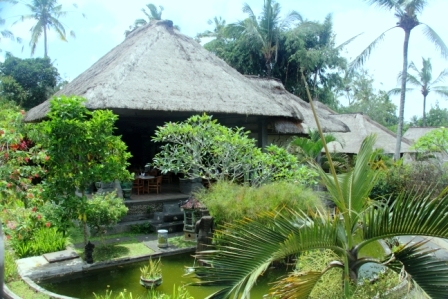
But these days most of his energies are directed to Tanah Merah, a secluded paradise in a luxuriant tropical setting.  Our stay there was the highlight of our recent six-week trip which took us on to Australia and New Zealand.

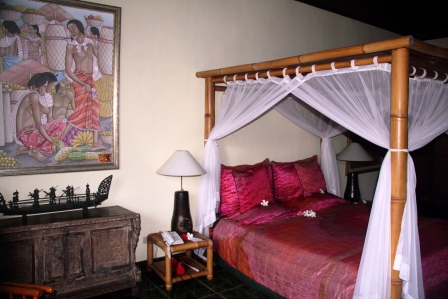
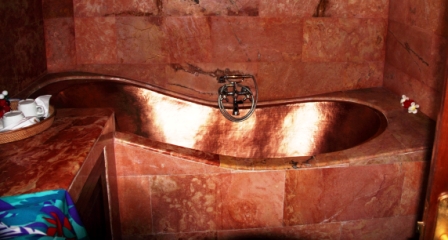
Bloch bought the land on a hillside above the Petanu River and began construction in 2000.  There are now 17 rooms, including some individual cottages and luxurious villas.  The latter have private plunge pools, some even with waterfalls.  We had a deluxe studio with a canopied bed, private terrace and enormous bathroom with a giant, gleaming copper bathtub.  We visited several other rooms and villas.  Bloch, who designed all the rooms himself, did not stint on the bathrooms – all lavish and spacious.  Fascinating art objects and paintings from his private collection add elegance to the guest rooms.

Collecting these treasures is the jovial Dane’s passion.  “I am constantly collecting.  It’s terrible. It’s a disease,” he says. Because of his work on Bali and his hobby of collecting, Bloch is well known on the island.  Owners of palaces who are in need of funds contact him when they have treasures to sell.  Museum directors also know he is interested in art objects.

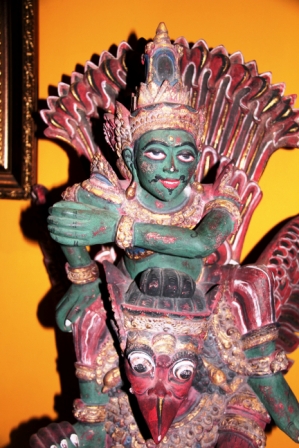
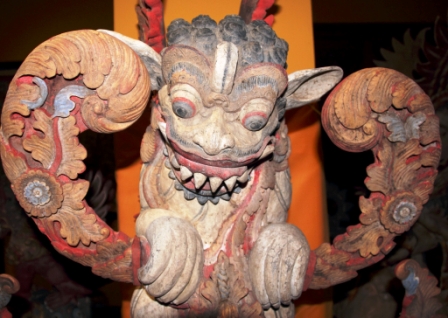
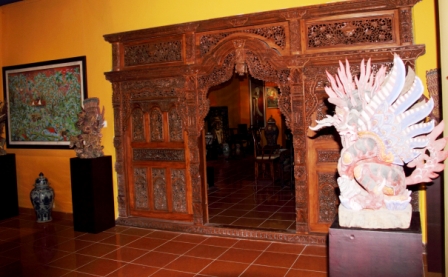
He recently opened a museum at the resort, nine rooms, each behind heavy, elaborately carved wooden doors, and all underground in a temperature-controlled environment.  The contents —  priceless, amazing and unusual objects — include paintings, weavings, objects of gold, daggers, masks and carved furniture.

One room features a large collection of Chinese porcelain from the Yuan dynasty (1271 – 1368) all recovered from a shipwreck.  The star attraction in another room is gigantic tusks.  According to Bloch, the former president of Indochina, Suharto, wanted a set of tusks from a mammoth. He got them from Russia and sold them to Bloch after he lost his presidency and was in financial need.  The tusks have been tested and are said to be 28,000 years old.

The highlight of the Bali room is a 400-year-old Indonesian structure which he had reassembled.  From Europe, there’s his mother’s dining room recreated from furnishings from the family home in Denmark, complete with a lavish table setting.

“It’s fun.  It’s a beautiful atmosphere.  I like to sit here and read’’ he says of the museum.

He also likes to wander the grounds of his resort.  Steps lead up and down the verdant hillside with its colorful blossoms and lush foliage.  There’s an infinity

pool at the edge of a cliff with fabulous views of the surroundings.  Exotic birds live in cages around the area of the individual cottages.  Noisy frogs thrive in a spring-fed pond adjacent to one of the resort’s three restaurants.

A staff member told me Bloch likes to get up early and make the rounds of the bird cages, talking to his feathered friends. He might be accompanied by his dogs, three very friendly Rottweilers.

The resort complex is large so you rarely see other guests.  On most occasions I had the pool to myself. Even husband Bob, a non-swimmer who normally avoids pools, could not resist a dip in the inviting water. For a jungle experience, you can trek down to the river and swim in a pool under a waterfall.  Unfortunately I saved this for our last day when it rained, making the descent to the river too slippery.

The many stone statues of gods and spirits throughout Tanah Merah add to the almost mystical, enchanting ambience of this romantic resort.  Young Balinese women clad in vibrant sarongs place fresh offerings of flowers at the statues each morning.  I’m not a big fan of massages, but I indulged at Tanah Merah for the best massage of my life.  The breakfasts, the English version with eggs and meat, as well as fresh fruit and croissants, are the perfect way to start the day at the open restaurant Petanu, half way down the hillside amidst the jungle greenery.

The town of Ubud with shops, restaurants and a thriving market, is about a 15-minute drive from the resort.  Tanah Merah offers guests free shuttle service to town, but if the resort cars are not available, you can hop on the back of a staff member’s motorcycle for a fun trip.

Bloch likes to mingle with his guests and can communicate in numerous languages: Danish, English, French, German, Swedish, Swahili, Indonesian and Balinese.  He has lived in Singapore, and Africa where he opened a dental clinic in Nairobi.  He is divorced with two children and a grandchild who live in the U. S.   In addition to dentistry and collecting art works, he writes and is especially proud of his recently published book, “Mads Lange, The Bali Trader and Peacemaker,” the story of this Danish expatriate who lived in Bali in the 19th century and was influential in the island’s history.

Before leaving, I decided to ask the jungle dentist about a dental problem and related headaches.  He invited me to his private villa at the resort where I lay on a couch on the porch with lots of pillows behind my head.  His houseboy held a surgical light above my mouth while the dentist took a look at my teeth and gave his advice which I’ve since heeded with good results.

Our deluxe studio at Tanah Merah in October was $100 per night, including breakfast.  For more on the resort, see   www.tanahmerahbali.com

Hungry for Tex Mex?  In the recipe column at far right, see “Enchilada Pie.”