Off to Myanmar

We took off our shoes at least 565 times.  We climbed 6,899 steps.  We admired 22,576 Buddhas.

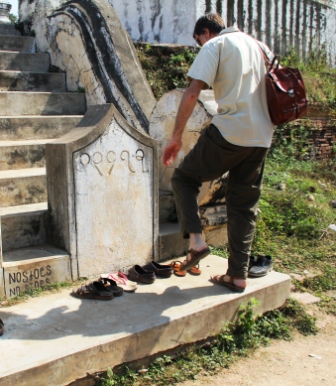
I made up the numbers, but they may not be far off.  A trip to Myanmar, a fascinating land in the throes of long overdue changes, is much about about temples (you cannot enter wearing shoes), all adorned with countless statues of Buddha.    And, many of those temples are accessed only by long climbs up steep steps.blog.lede

“This is Burma.  It is quite unlike any place you know about,” wrote poet and novelist Rudyard Kipling after a visit to the county more than a century ago. Today the country is known as Myanmar, but his words still echo true.blog.3

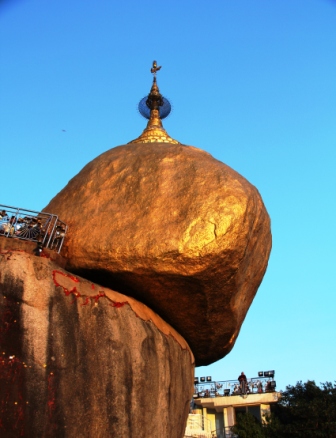
During our travels we were overwhelmed with mind boggling sights: a cave with 8,700 Buddha statues, a giant golden rock miraculously clinging to the edge of a chasm . . .

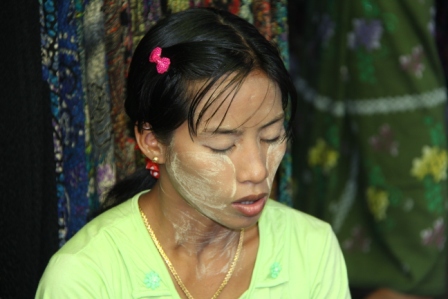
blog.2. . . parades of monks draped in burgundy colored robes lined up to receive food offerings, women whose faces appeared to be smeared with mud….  We visited big, chaotic cities (Yangon and Mandalay).Women smear their faces with a paste made from logs. It acts as a sun block and moisturizer.

Women smear their faces with a paste made from logs. It acts as a sun block and moisturizer.

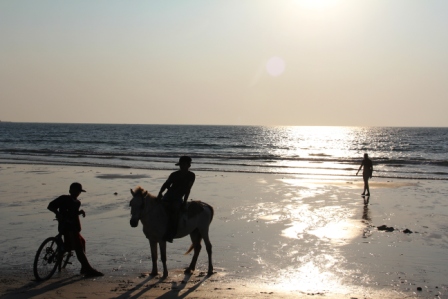
During drives through the countryside we witnessed the simple, primitive way of life of farmers, and often suffered bouncing over rutted roads.   We chilled out at a perfect beach resort, not yet spoiled by hordes of tourists.  I loved the colorful markets, the tasty food, and learning about the people and their staunch devotion to Buddha.  More about all will follow in several blogs.

blog.4

First, a word about the shaky start of this incredible voyage.  Facebook Friends have seen posts on what follows, but many Tales and Travel readers are not on FB.

Crisis Number One: Before landing in Frankfurt where we boarded the plane for the long flight to Singapore, I asked BB (husband Bicycle Bob and long suffering travel companion) if he had the credit card.  We had agreed that only one of us needed to take a card.  “No, you have it,” he said. “No, you are supposed to have it,” I answered.  Major misunderstanding. Bottom line:  No credit card and not an auspicious beginning to a five-week long trip.  Panic.  Stress.  Anger. We only had a brief layover in Frankfurt, but we had plenty of time between planes in Singapore before flying on to Yangon.  We made numerous calls back to our friends and house sitters, Dee and Allan, in France.  They researched methods of getting a credit card to us.  French Chronopost came to the rescue.  Other services, such as DHL, would not deliver to Myanmar.   That was on Friday.  Monday afternoon in Yangon we had the card. A miracle!  Cost for this amazing service, just 58 euros.blog.7

We were fine at the onset of the trip without the card.  Cash, new US dollars (issued after 2006) and not folded, is currently the recommended currency for travelers in Myanmar.  Some places do take credit cards, but charge a hefty fee.  We had an ample supply of dollars ordered from our bank, so even without the plastic, we could enjoy meals without washing dishes.  But, we would need the card before the end of the trip. We were saved by Dee and Allan and Chronopost.

Crisis Number Two:  My tooth.  The day the credit card arrived, I woke up with a toothache.  Surely it will go away, I thought.  No such luck. It only got worse, and worse, and my cheek began to look as if I had a tennis ball in my mouth.  Our guide took me to a dentist recommended by our first rate tour blog.5company, Asian Trails.   He spoke some English, and his office appeared clean.  He wore gloves, a mask, and had many pretty and very young assistants. He said it was a wisdom tooth, gave me pain pills and antibiotics, and cautioned me to avoid the “odors of hot oils” ??  If it did not get better, I could come back and he would extract the tooth.

The medication helped for one day only. However, I had fears of letting this dentist pull my tooth, especially when the guide told me the dentist had told him it would be better to wait and have the tooth extracted when I got back to France as complications could arise.  He obviously did not want the job.  Our return to France  was five weeks down the road.  I could not live with this pain for five weeks.

As mentioned, I had posted our troubles on Facebook.  One friend wrote that the trip was “doomed.”  World travelers Dee and Allan advised not to have a tooth extracted in Myanmar where hygiene and sanitary conditions are dicey.  A young woman I met, a 21-year-old pediatric dental assistant in Connecticut traveling with a group of Jehovah Witnesses for a conference,  said I definitely needed to get rid of the tooth.  It is probably infected, she said, and the infection would only spread… and could even lead to death.  Sacre Bleu!  If a Jehovah Witness advises a medical procedure, you know action is required.

Now what?  Perhaps the trip was doomed. I was a wreck and could not enjoy the sights.   Fortunately in the middle of the night I had a bright idea:  Call the

BB waits in dentist office number 2. Shoes must come off, but instead they covered his. Fear of stinky feet? BB waits in dentist office number 2. Shoes must come off, but instead they covered his. Fear of stinky feet?

American Embassy.  They recommended Dr. Aung Myint who saved the trip, and, who knows,  maybe my life. I was relieved just entering his classy office with certificates from Denmark and  Paris posted on the walls of the waiting room where  copies of Fortune, Newsweek and Reader’s Digest were offered as reading material.  His equipment was  state of the art  –far more up to date than many dentist offices I have seen in southern France.

We had been to our dentist before departing as a security check.  No problems.   Why did this tooth suddenly go bad?  Could be stress, the super dentist replied.  Aha — blame it all on the forgotten credit card.    He pulled the tooth and all was well.  X-ray, tooth extraction and stitches:  $70. We found many more bargains during our travels, but that was the winner.

As mentioned,  food in Myanmar is  good and different.  We had many versions of a delicious avocado salad. See recipe column on right for the versison made at the cooking school we attended while at the beach. 

The Cordon Bleu is was not -- our The Cordon Bleu it was not — our “cooking school” kitchen.
Don’t be put off by appearances. Food was delicious.

Following,  a photo gallery of Myanmar as a preview of coming blog posts.

Comments are appreciated.  So are new subscribers.  Don’t miss coming Myanmar blogs. Click on Email Subscription, top right or the “Follow” button at the bottom of the screen.

Souvenir sellers on the beach where mother of pearl items are popular. Souvenir sellers on the beach where mother of pearl items are popular.
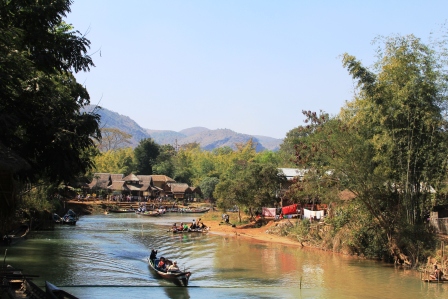
Inle Lake Inle Lake
Ngapali Beach Ngapali Beach

gallery.21

At work in the fields. At work in the fields.
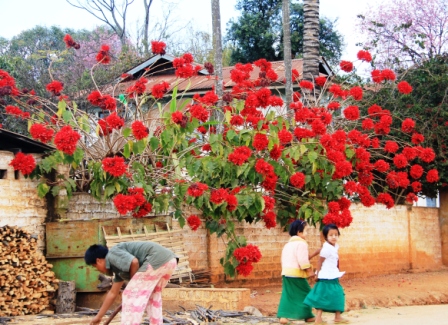
Poinsettia blooming along the road. Poinsettia blooming along the road.

gallery.18

Shoes -- and socks-- must come off before entering temples. Shoes — and socks– must come off before entering temples.
Buddha statues are often golden. Buddha statues are often golden.
Sunset on Irrawaddy River. Sunset on Irrawaddy River.
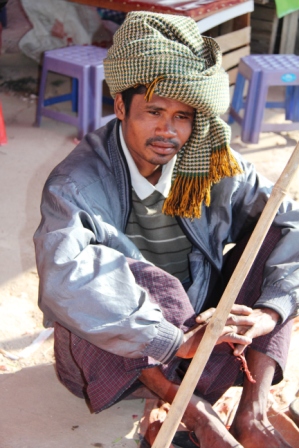
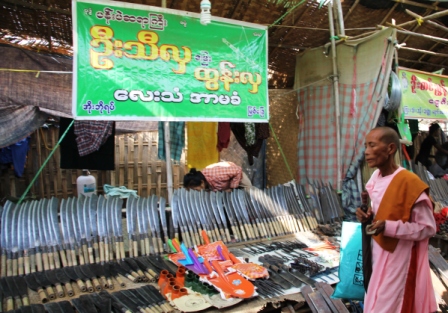
Nuns, seen here at market knife stand, wear pink. Nuns, seen here at market knife stand, wear pink.
Temple in Bagan, the Angkor Wat of Myanmar. Temple in Bagan, the Angkor Wat of Myanmar.
Temple decor Temple decor
Too many homeless dogs in Myanmar. Most all look like this fellow. Too many homeless dogs in Myanmar. Most all look like this fellow.
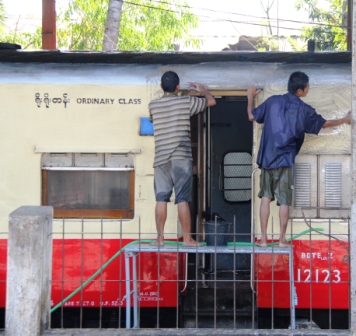
Cleaning a train car at Yangon station. Cleaning the “ordinary class”  train car at Yangon station.
Monks and Buddha. Monks and Buddha.
Temple workers take a siesta break under the watchful eyes of Buddhas. Temple workers take a siesta break under the watchful eyes of Buddhas.
Reclining Buddha. 235feet long. Reclining Buddha. 235 feet long.


Wild and Wonderful Corsica

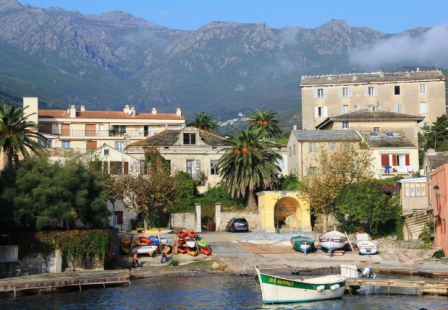
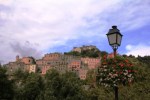
Bonifacio ,
Bonifacio
,

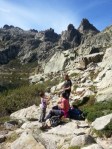
According to the sign posted at the beginning of the hiking trail in the Corsican mountains, it was a one-hour trek to Lac de Melu.  Piece of cake, I figured, and a good test for my new knee.corsica.55,

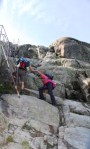
Two hours later we were still huffing and puffing, scrambling over rocks —   even a few times on all fours for me.  No lake in sight. We had conquered the challenging, extra steep sections of chains and ladders.  But, the trail of all rocks went on and on, up and up.  At times it was frustrating to figure out which way to proceed over this stony sea.  The trail was marked by yellow slashes on the rocks, but often they were hard to spot.

Find the yellow slash -- the trail marker.
Find the yellow slash — the trail marker.

I was about to give up when we encountered a group on their way down.  “How much farther?” I asked.  “It’s not that far.  Will you make it?  If you want I can accompany you,” answered the mountain guide who was leading the others.   I must have looked near death, which is about the way I felt, but there was no way I would ask for assistance.  Now I was more determined than ever to conquer this trail.

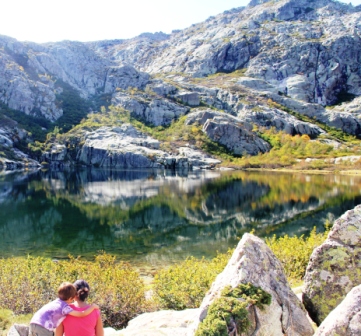
After two hours and 10 minutes we reached the lovely lake.  How could anyone make it here in one hour?   We are old, but not decrepit. That sign was meant for Himalayan sherpas.corsica.36b

Getting down was no easy task.  The rocks, all sizes, were demanding.  You had to keep your eyes on the trial below at all times to figure out where to put your foot next, on top of which boulder, into which crevice.  I was petrified of falling, of breaking a leg, screwing up my knee.  How would I be rescued?  No helicopters could land anywhere near this surface of rugged rocks. I did fall once, but fortunately I had given my camera to BB (husband Bicycle Bob) who was more steady a foot.  I ended up with a badly bruised leg, but nothing broken, including my precious camera.

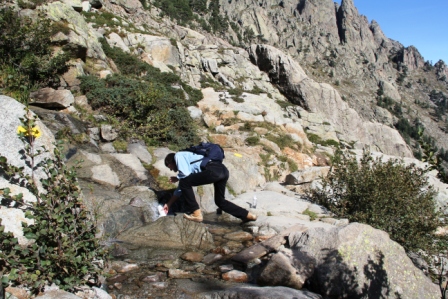
Refilling the water bottles.

In our younger days, BB and I did some long and tough mountain hikes in the Swiss Alps – several days on the trail with backpacks.  We loved it.  This was different.  “Most hikes are strenuous, but enjoyable,” he remarked. “This was work, labor intensive.”

What a relief to get the work over with, to reach the hut at the bottom – and to enjoy that satisfying sense of accomplishment after conquering a mountain.  O.K.  This was just a lake, not a mountain, and we were slow.  But, we did it.  My knee passed the test.corsica.14b

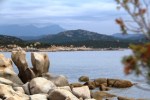
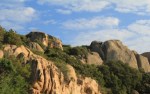
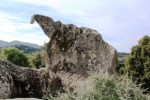
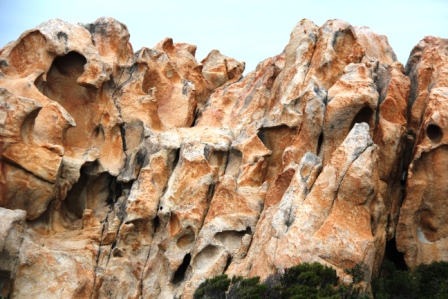
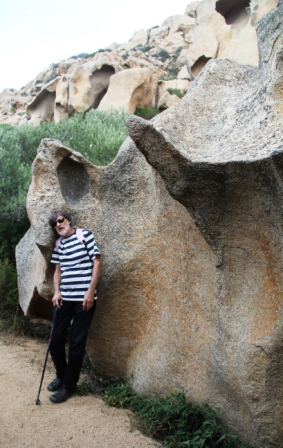
Rocks abound in Corsica—not just on mountain trails.  Along the coast.  On the beaches.  In the sea.  Rocks in the shape of animals, human faces, surrealistic

Natural rock.
Natural rock.

sculptures.

Not long after we disembarked from our all-night ferry ride to this island in the Med (Toulon to Ajaccio); we stopped to visit the archeological site, Filitosa, on our way south.  Incredible rocks there. We followed the path through the site where artifacts dating to as early as 3,300 have been found.  Ancient civilizations lived in caves here.  During the megalithic period they erected menhir statues, granite monoliths, carved to represent human faces or entire figures.  They are intriguing, as are the natural rock formations in the area.

Menhir
Menhir

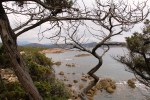
Onward to the coast and the tiny town of Tizzano for five nights at the Hotel du Golfe, which advertises that it has its feet in the sea. The Mediterranean waters were right below the balcony of our room.  Awake to the soothing sounds of the sea gently slapping the rocks. The hotel beach is just a miniscule patch of sand surrounded by those rocks. Getting in and out of the sea was a bit tricky maneuvering over the hurdles, but the water was perfect. I swam and swam and swam with no one in sight.

Mini beach on a windy day --too dangerous to swim
Mini beach on a windy day –too dangerous to swim

During our October visit to this island utopia we enjoyed still warm weather and mostly blue skies – and tranquility.  The tourist season was over.  On the plus side, no crowds anywhere and the highways to ourselves.  On the down side, many shops, hotels and restaurants had already closed for the season.  All four of the restaurants in Tizzano were boarded shut.

There is just one winding road down the mountain from the inland town of Sartène leading to our mini burg and the sea. Winter Tizzano population:

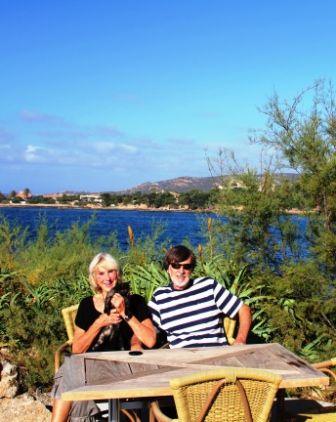
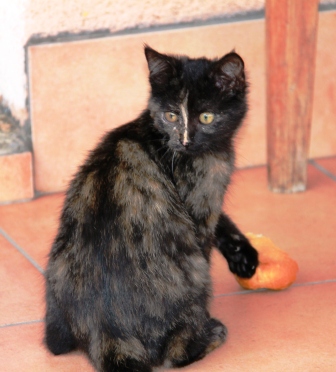
Chopinette, my favorite Corsican,

30 humans and lots of felines.   In the summer:  3,000 tourists.  In October:  us, the locals, a few other tourists and the friendly cats.  I was in heaven.

Since BB is not a swimmer and we wanted to see more than Tizzano, we set out on excursions every day, to Ponte Vecchio on the eastern coast, to Bonifacio in the far southwestern corner of the island, and on foot one day for a hike along corsica.15bthe shore.  No leisurely stroll along a sandy beach was this, but a demanding trek through coastal bush –and yet more boulders.  The scenery was splendid with more fantastic rock formations to photograph.

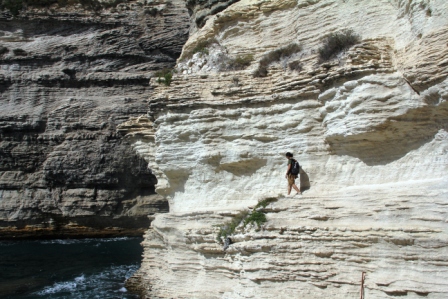
Ponte Vecchio is basically a resort town with lots of sailboats in the harbor, narrow streets with cute boutiques (most closed) and restaurants (also most closed).  Not too exciting.  Bonifacio is different, a two-level, lively town.  The haute ville, an amazing sight, perches precariously atop a cliff on a thin peninsula.  Skinny streets twist past ancient buildings, including numerous churches.   We followed the advice of the woman in the tourist office and set off to the Escalier du Roi d’Aragon – 187 steps from a corner of the town’s citadel plunging to the sea.  Scary, steep steps. Descending them is an exhilarating adventure.  They plummet straight down and at times involve big jumps – one step where there should be two.corsica.20b

The winds were ferocious on the day of our Bonifacio visit. Mammoth waves roared and crashed into the rocks. We had been told the best view of the city is from the water, but due to the wind velocity, tourist boats were not running.

So, let’s splurge on lunch. Food is always a highlight of our travels.  Since so many restaurants were closed, our choices were limited.  We had few memorable meals in Corsica, including one we’d like to forget — the $98 (72 euro) fish at a harbor restaurant in Bonifacio.  We like fish and craved a fresh Mediterranean corsica.26catch.  The waiter brought out a tray of specimens and recommended a “Sar.”  We had never heard of this fish, but were game to try, not bothering to ask the price.  Bad move. The astronomical bill  –the fish had been priced at nine euros per 100 grams –was a  shock.   Our Sar was a big fellow, tasty, perhaps not that tasty, but it did come with some veggies and potatoes.

Corte's citadel
Corte’s citadel

Cap Corse, the island finger at the northern tip, was our destination for three days before boarding the ferry in Bastia for the trip back to Toulon.  En route we spent a night at the interior town of Corte so we could do the lake hike.  Hiking is just one of numerous outdoor activities offered in Corsica – all kinds of water sports plus mountain adventures:  canyoning, rock climbing, zip line etc.corsica.3

The drive through the interior is spectacular – miles and miles of rugged nature over excellent roads.   Although Corsica is a vacation paradise, it has not been scarred by mass tourism.  There are vast pristine sections in both the interior and along the coast — no towns, no hotels, no commerce.

Erbalunga
Erbalunga

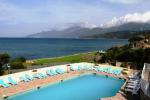
Our hotel in the coastal town of Erbalunga was not on the beach, but it did have a large heated pool — my private pool – no other swimmers.

We drove along the Cap coast with many photo stops.  We drove through the middle of the peninsula over roads that averaged more than a dozen curves per kilometer.  Along the route:  stops for wine tasting and buying.  Wine is the island’s principal export.  According to my guidebook bible, Lonely Planet corsica.38bCorsica, the wines “are not necessarily the most distinguished of wines.”   Some of the grape varieties (Niellucciu for one) are unique to Corsica.  As BB seems to like wine more than bicycles these days, we bought a supply.

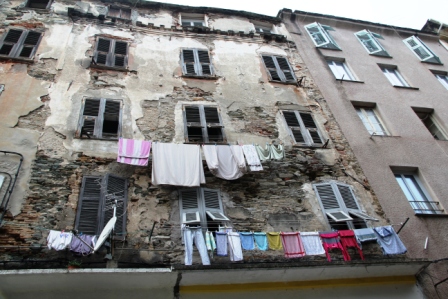
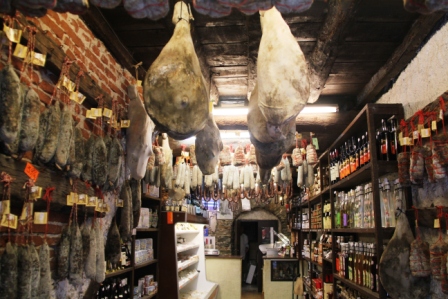
corsica.47Bastia, a town of crumbling splendor, is fun to explore: a busy harbor, imposing citadel, intriguing hillside park, ancient churches – and shops that were open.  Throughout the trip I had been searching for stores where I could purchase Corsican delicacies – cheese, sausage, honey, jams.  No luck. In Bastia’s thriving shopping district, I found my treasures at last.corsica.48b

I hope to return to Corsica, but in late September before so much shuts down for winter.  And, I’d go back to Tizzano and the Hotel du Golfe.  Gil Chopin, the hotel proprietor, told me he was born in the town but moved on to work in Paris and other cities.  “I missed nature, the sea.”  He came back.  “We live in harmony with nature here.  Each day is different.  Each day I am astonished.  For me, this is paradise.”  It was paradise for me, too.
Hotel du Golfe,Tizzano.  A perfect coastal retreat. The simple but comfortable rooms all have balconies above the Med.  Idyllic location. http://www.hoteldugolfetizzano.com
On the terrace at Hotel du Golfe

Hotel Castel Brando, Erbalunga, Cap Corse. Spacious accommodations including rooms with private terraces, lovely garden for breakfast  (ample, including do-it-yourself eggs and pancakes) and a super heated pool.  http://www.castelbrando.com

I’m happy to hear from readers. See “Leave a Reply” below under Comments. Followers also welcome. Don’t miss future posts. Click on Email Subscription at top right.


Super Summer 2013

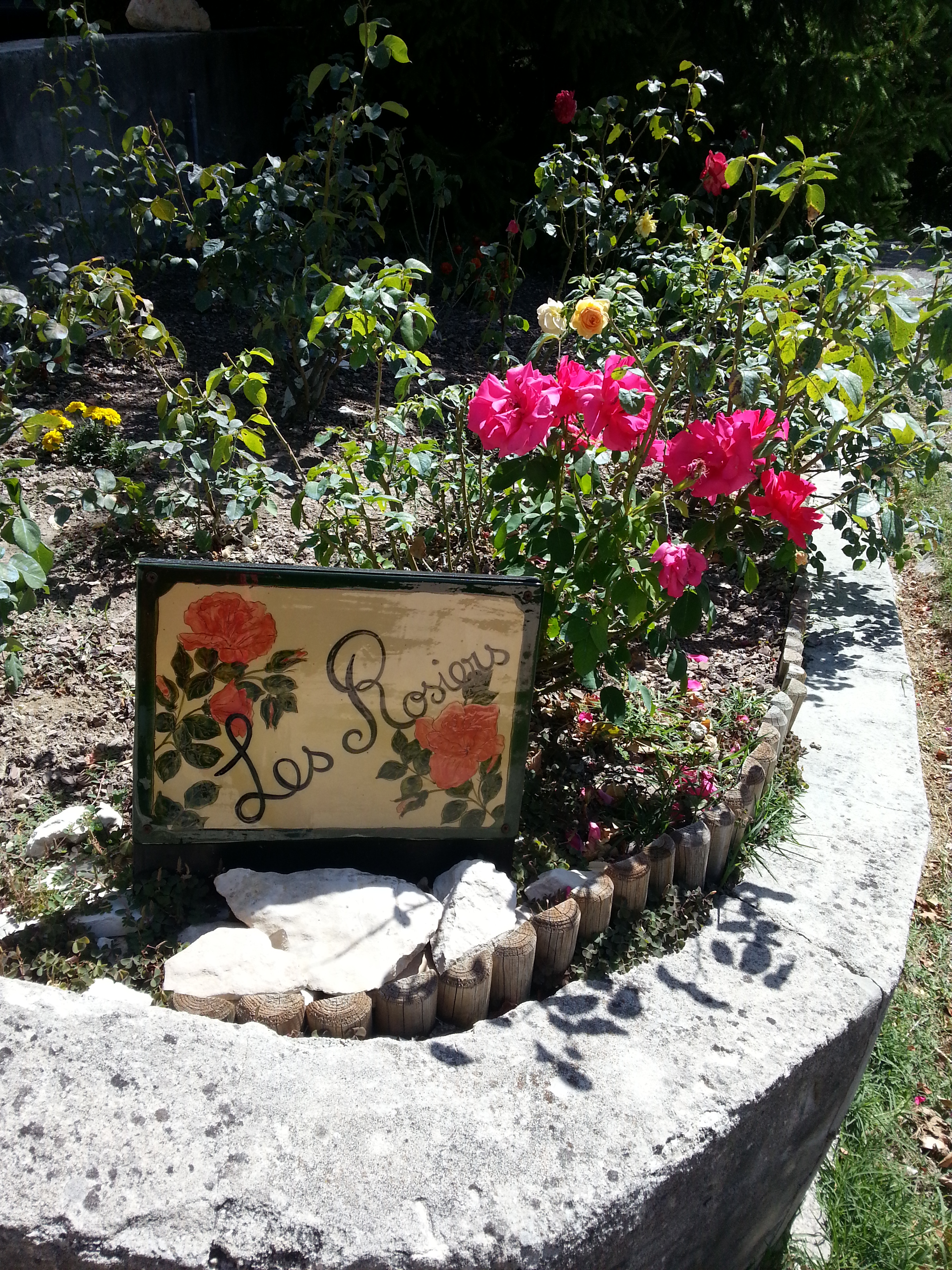
The pool at Les Rosiers, our home, did not turn ghoulish green as it has in past summers.  None of the precious roses died. We had wonderful tenants in our rosiersstudio rental apartment, plus fun family visits.  The crumbling pergola was replaced (but that’s another story, see previous post, “Pergola –or State Park Picnic Shelter”).  We enjoyed a terrific visit to Antwerp, tasty meals at local festivals and parties with friends.  Summer 2013 was better than good: Super

It kicked off in June with the arrival of Klaus, an Austrian from Graz.  He and his wife Eva have been staying in our gite (French for vacation rental) for a month every year since 2010.   Klaus arrives first, by car, roof rack loaded with supplies, including Austrian beer and food staples. On the way home, a large supply of wine takes the place of those goodies.    Eva is a legal secretary.  She comes by plane a week after Klaus arrives.

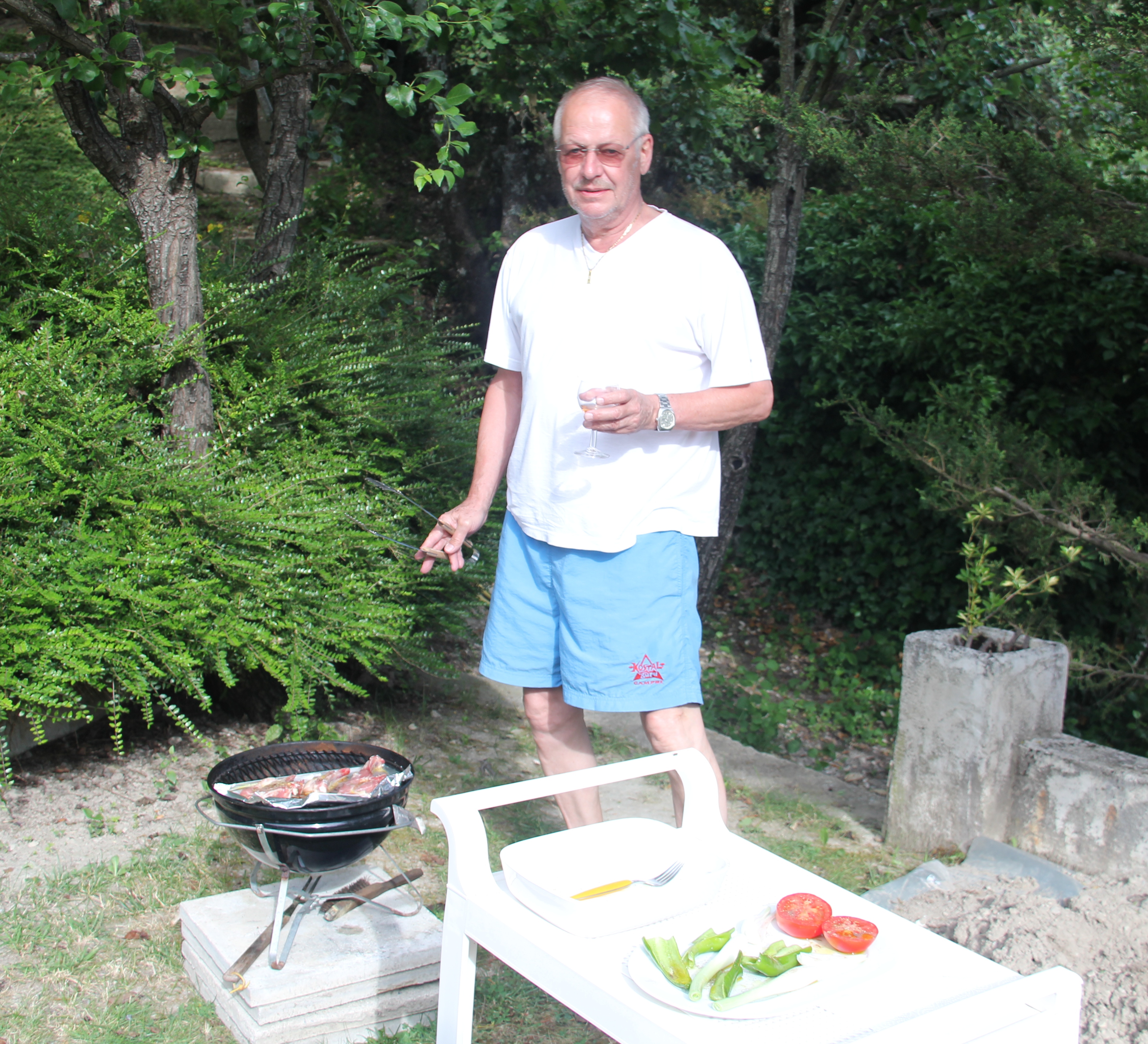
Klaus
Klaus

They know the area well, have friends here, enjoy revisiting favorite places and hanging out poolside.  Klaus loves to cook.  He brought his own knife sharpener this year.  The one I supplied was not up to snuff.  And, he loves to grill – lamb and sausages are his favorites. This year his grilling almost led to disaster.  The morning after a previous day’s use of the grill, he emptied the ashes which he assumed were dead in the wooded area of dried leaves behind and adjacent to our house.  That afternoon I was in the pool.  I noticed smoke, but I assumed he was grilling again.  Suddenly BB (husband Bicycle Bob) came flying down the steps from our balcony.  He had seen flames.   Indeed, the ashes had sprung to life and a fire had started.  It was frightening.  But, all to the rescue with hose and buckets of water.  Catastrophe was averted.

Filippo kept our tenants entertained.

Eva is a walker, often up at 7 a.m., setting out on a trek in the area for two to three hours. Klaus also hikes and gathers herbs and berries (juniper) and other treasures from the forests and fields.  He left me with a supply of bay leaves which I have dried. Another of his favorite pastimes is visiting flea markets.  During summers here, there are many on the agenda.  He always finds interesting bargains.

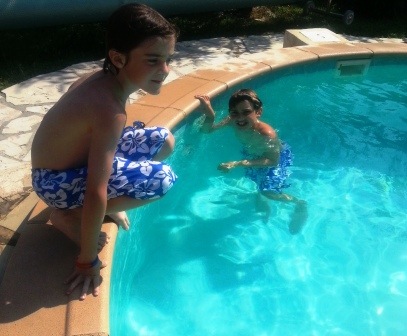
Lang and Samuel
Lang and Samuel

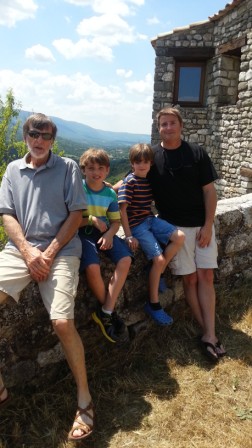
Stepson Rob and his boys, Samuel and Lang, followed Klaus and Eva. The boys, both swimmers, loved the pool, as well as jaunts on foot to the bakery every morning with their dad.  They could not get their fill of croissants.  According to Rob, Samuel still asks when he can come back and get more of those croissants, which he called “amazing.”

Bob, Samuel, Lang and Rob

The Gorges du Verdon, the Abbey of Senanque and Colorado Provencal were highlights for Jean and Alex, a charming couple who stayed for a week.  He is French, lives and works in Colmar.  She is German, originally from Leipzig, and now working for an international organization in Geneva.  They both are multi-lingual, and, like many of our visitors, especially enjoyed the “calm” at Les Rosiers.

They were followed by a couple we felt were a bit strange, if not unpleasant. He always had a scowl on his face, never a smile,  and once complained that the refrigerator was not cold enough (easy to fix – just turn up the dial.)  They went off sightseeing and came back to lounge by the pool, but barely said a word to us.  I assumed they were not happy with our rosesaccommodations.  I dared not ask them to write in our guest book.  Wonders never cease.  They did write:  “Thanks to your hospitality we have discovered the pleasures of Haute Provence…we have appreciated the coolness of your gite, the refreshing swimming pool and the calm of the surroundings.”

Roberto and Francoise from Fribourg, Switzerland, are fantastic. She is a teacher for handicapped adults – and a cat lover .  She was smitten with Filippo, my rambunctious male cat. Roberto, originally from Uruguay, came with hisbicycle.

Roberto and Francoise

Unfortunately Francoise fell in our new pergola/State Park Picnic Shelter (SPPS) and broke her foot. They took it in stride, did not complain, and continued their stay.

As her mobility was limited after the accident, Francoise was content to sit in the yard, often with Filippo at her side, and read while Roberto rode his bike.   Like Klaus, she was into wild herbs:  garlic, fennel, rosemary, thyme.  And oils – lavender, almond and olive. She gave me instructions on treatments using lavender oil.

Elaine and Paul
Elaine and Paul

Time for the British, Elaine and Paul from southeast London, who kept on the move and visited sites near and far (Arles, Pont du Grad, Gorges du Verdon, Bonnieux, Gordes).  Elaine is an assistant for children with special needs at a secondary school. Paul is a quantity surveyor for a construction company. They also enjoyed Filippo’s shenanigans.  Paul said Les Rosiers is “the quietest place we’ve ever been to.”

Elizabeth and Igor from Normandy stayed two weeks.  They overwhelmed us with dinner invitations. Igor also likes to grill. While I was away, he invited Bob for grilled sausages. When I returned we were invited for grilled beef.  And, yet again for an apero.  We expected the usual chips- nuts- and- olives apero.  But this was an “apero dinotoire,” something new to us,   a multi-course meal:  crackers and tomatoes, then grilled lamb with a rice/tuna salad, a potato salad, and fruit.

Igor and Elizabeth
Igor and Elizabeth

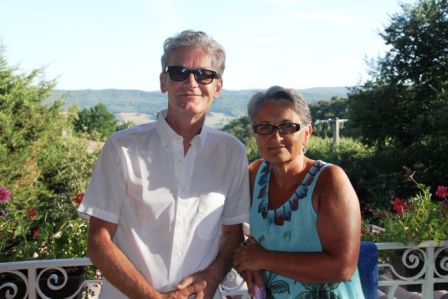
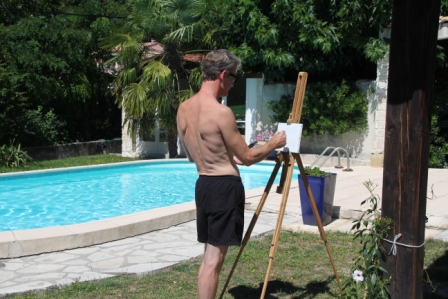
Igor arrived with easel and paints.  He set up in the yard and created lovely scenes. We received one as a going-away present.  He is a financial consultant in Paris, and commutes home to Rouen on weekends.  Elizabeth, who was recovering from breast cancer surgery, said she came to the Luberon to “relax.”  They did visit some neighboring towns.  “We like typical, tranquil, original villages,” she said, mentioning nearby Viens and Vacheres.  They also raved about an attraction we have yet to visit, the Ganogobie Abbey.gite.3

Summer wound down with the visit of stepdaughter Kellie.  She gave BB a chance to live up to his name.  They bicycled a few times before her boyfriend arrived for a week.  We all set off to Marseille together and were in awe of the new architectural masterpieces.mrs.5

It’s still warm in Provence, but the pool waters have chilled. We’ll put the pool to bed for winter soon.  But, I can look forward to starting swimming early next spring.  We’ve purchased a heat pump for the pool.   Summer 2014 may top summer 2013.

For more about Les Rosiers, see www.les-rosiers.com

I’m  happy to hear from readers.  See “Leave a Reply” below under Comments. Followers also welcome.  Don’t miss future posts.  Click on Email Subscription at top right.

Villa Augustine: Fine French dining, turn-of-the-century elegance

“Everywhere you look; it’s a feast for the eyes.  It’s a magical place.”villa.12

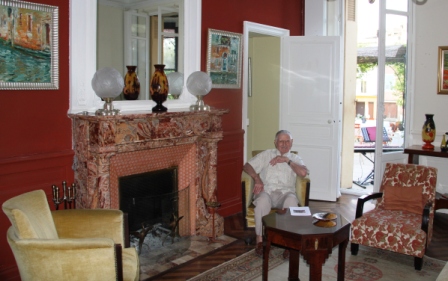
We were sitting around the fireplace in a stylish salon of exquisite furnishings enjoying an apero when a friend made that comment.  It was our first time at the Villa Augustine shortly after it opened in April 2012.villa9a

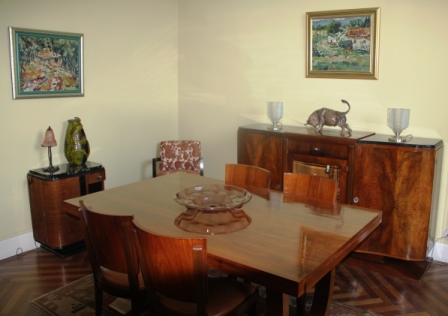
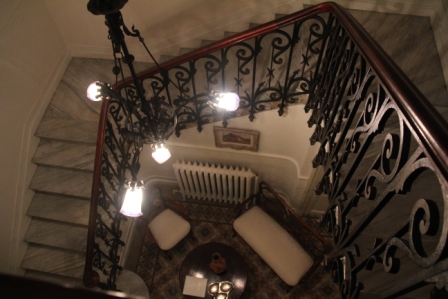
The turn-of-the- century mansion in the Vaucluse city of Apt, the capital of the Luberon, was originally owned by a wealthy family, proprietors of ochre mines.  Their fortune plunged in the 1930s. villa.3 The splendid home was abandoned for many years and in a dreadful state. Along came two Parisians, Guy and Christophe, to rescue the magnificent structure.   Restoration took three years.  Tracking down the furnishings and objets d’art took even longer. villa.11 Guy and Christophe, both fans of  20th century arts décoratifs, combed France and neighboring countries to find original Art Nouveau pieces to enhance the interior in keeping with the period. Signed objects by Majorelle, Ruhlmann, Leuleu, Royere and others are among the treasures.

Today Villa Augustine is a sanctuary of calm and beauty in the midst of busy Apt just above the river Calavon.  There are five chambres d’hote (B&B) rooms and gorgeous gardens planted with Italian inspiration.  A more than 200-year-old cedar of Lebanon, classified as one of the most beautiful trees in the Luberon, is the pièce de resistance amidst flowers, cypress and olive villa.7trees.  An inviting pool on a terrace above the villa is a delightful surprise offering stunning views of Apt and the Luberon hills.  Not to forget – food, which is Guy’s realm.  The ex-banker has always been passionate about cooking.  Here he has the opportunity to indulge in his favorite pastime and prepare gourmet cuisine several evenings per week.  His cuisine, he says, is influenced by his Spanish origins and Algeria, where he was born.  And, the flavors of Provence, of course. There is a set menu, and reservations are a must as he can serve no more than 20 diners, but up to 40 for special events.  During warm weather months, the spacious terrace in front of the villa is often a venue for the latter – concerts, fashion shows, art and photo exhibits.villa.8

During our first visit we had a complete tour and admired each unique bedroom with adjoining baths, many delightfully retro.  A mirror from a buffet is the headboard for the double bed in one room.  One bedroom is done in the style of the ‘50s, and another reflects the ‘40s.villa.10

Dinner – either outdoors under trellises on the terrace where huge pots of plants in bloom create an upscale  ambience of greenery, or indoors in the dining room with its precious décor, is special.villa.1  So is the food.  Our first dinner in 2011 featured Noix de Saint-Jacques a l’artichaut et l’andouillette, jus de
crustaces, (scallops à l’ artichoke and sausage with the juice of crustaceans).

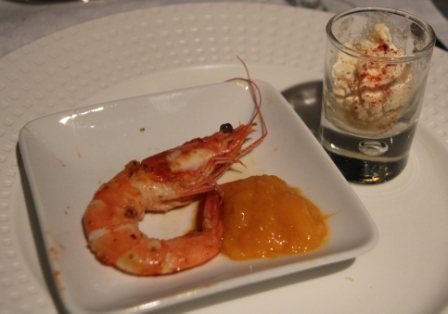
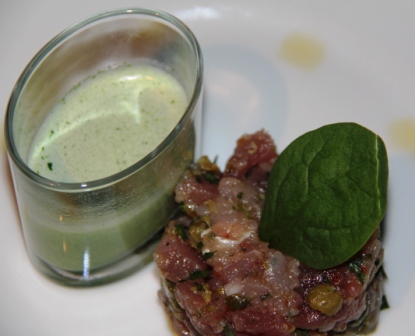
Last week we savored an excellent meal – a belated birthday treat for step-daughter Kellie and her friend Luka visiting from New York City.  It began with  a “mise en bouche”  (pre-starter), a healthy gamba with a puree of mango villa.14and a mini glass filled with chantilly (whipped cream) of chevre (goat cheese).  The entrée, carpaccio of tuna with a spinach sauce, was very flavorful – my favorite.villa.15  Cod with ratatouille creatively stuffed in mini peppers accompanied the perfectly cooked fish surrounded by a coulis of tomato and juice of palourde (tomato sauce made with the juice of the clam perched on top of the cod).  villa.16Dessert:  roasted figs in fig liqueur with vanilla ice cream.  Wine:  a bottle each of an excellent Burgundy white and a Burgundy red suggested by Christophe.  A fitting birthday meal in a magical place!villa.18

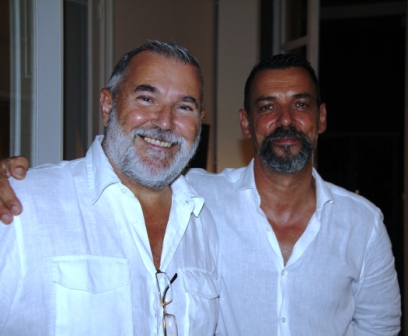
Guy and Christophe, who  had the distinction of being the first gay couple married in Apt after the recent change in French law which now legalizes gay marriage, are overjoyed with the success of their endeavor.

Guy, left, and Christophe

“We are very happy with the speed in which we have succeeded to develop a faithful clientele,” says Guy.  The chambre d’hote has been fully booked since April this year, he added.  “Normally this would take four or five years.”villa.4

Rooms range in price from 100 to 150 euros per night.  Three course dinners with two mise-en-bouches  at 40 euros per person. Villa Augustine is open from mid March through the end of October. More information at www.lavillaaugustine.comvilla.13

Have you dined at Villa Augustine?  Share your view.  I love to hear from readers.  See “Leave a Reply” below under Comments. Followers also welcome.  Don’t miss future posts.  Click on Email Subscription at top right.

A recipe to try:  Linguine with Shrimp, Tomatoes and Feta Sabraw.  Scroll down recipe column at right.

Antwerp: A Gem of a City

Antwerp’s City Hall dominates the Grote Markt.

Thanks to the generosity of my step-daughter Kellie who gave us tickets for a Leonard Cohen concert in Antwerp,  BB and I recently hopped on the fast train (TGV) for a trip to that lovely city. A shorter version of the following appeared in the newspaper Stars and Stripes, www.stripes.com

It could have been a scene from a James Bond movie. Two shiny black limousines crept down the narrow street.  Then came a monster white armored truck, followed by a smaller version of the same, and then more limos. Several  stern, black-suited men walked alongside the vehicles.  It was all very eerie, mysterious.

The white truck stopped in front of a non-descript building.  Three hulks (you would not want to fool with these brutes) jumped out.  A woman with a wad of papers surveyed the scene, as well as more of those ominous looking men and a small crowd of curious on-lookers.  The muscled trio dashed to the back of the truck, opened it, and rapidly tossed out large canvas bags, at least a dozen.   These were rushed inside the building.

I wanted to take pictures but was firmly warned, “No photos.”  I asked the woman about the contents of the bags. “Diamonds” — obviously millions of the precious gems.  Wow! I asked the value of the contents.  No answer.  She remained silent to that and my many other questions.

An everyday delivery in Antwerp’s diamond district where Jewish men, wearing long, black coats  and wide-brimmed black hats, rush up and down the heavily guarded streets, many with cell phones to their ears.Antwerp.3

Antwerp, Belgium’s second city, has been associated with diamonds since the 15th century. “By 2007 more than half of the world’s consumption of rough as well as polished industrial diamonds is traded in Antwerp realizing an annual turnover of $42 billion,” explained Sylvie Van Craen of the city’s tourist office.  She said 1,800 diamond companies have their headquarters in the city, including four diamond exchanges, special diamond banks, security and transport firms, brokers and consultants.  While the business of the glittering stones was originally associated with the Jewish community, today it’s run by people of numerous nationalities, including Jews, with Indians in the majority.

I did not come to Antwerp to purchase a diamond, although shops whose windows are brimming with diamond rings, bracelets, necklaces, earrings and more abound.  Husband Bob and I came to attend the Leonard Cohen concert (amazing), visit the city and my Irish friend Isabel who lives there with her Dutch husband, Carlo.  She was our guide extraordinaire.

Jackie, Isabel and Carlo.

“You’re seeing Antwerp at its absolutely worse,” Isabel  lamented as we strolled by café after café whose outdoor tables were deserted.  “Normally at this time of year people are sitting outside.”  It was mid-June, and like in much of Europe, summer had yet to appear.  It was cool, dreary, rainy, but the weather did not dampen her enthusiasm for the city.  “We like Antwerp,”  she said.  “It has culture.  There’s always a holiday atmosphere.  The Belgians enjoy food and drink.”  Antwerp is the capital of Flanders, the part of Belgium where Flemish, a language much like Dutch, is spoken.

We walked down the main shopping street, the bustling Meir, with a quick glance inside the Stadsfeestzaal (Festival Hall), a luxurious indoor shopping mall with a glass iron vault, marble staircase, gold leaf décor and a champagne bar.  Antwerp.8Then a mouth watering stop next door at one of Antwerp’s numerous chocolate shops,  The Chocolate Line in the Paleis op de Meir which offers chocolate pralines with 60 different fillings:  wasabi, Sake, cabernet-sauvignon, Earl  Grey

You can even find Chocolate Pills at the Chocolate Line.

tea,  cannabis,  to name a few.   For 45 euros you can buy a “Chocolate Shooter,” a snifter with three different flavors of cocoa powder to shoot up your nose for a nonaddictive jolt to “maximize the chocolate experience.”

One of Isabel’s favorite Antwerp nooks is the Botanical Garden  Plantentuin, a small but lush patch of green in the midst of the city with unusual plants, blossoms, and a pond where over-sized, colorful carp swim.  A park regular stopped to chat with us– another Antwerp plus.  “It’s easy to get into a conversation with people here, having lunch, sitting on a bench.  They are very chatty,”   Isabel said.

And generous, as we found out at our next stop.  In the food realm, Belgium is noted, not just  for chocolate, but also waffles.  I have never been a waffle fan, but BB loves them and misses those U.S. waffle houses.  In that case, we must go to the “only place to eat waffles,”  Isabel insisted,  Désiré de Lille.  And, we Antwerp.30must order a Wafel warme Noorse Krieken (cherry waffle).  “I bring everyone who visits here.  You have to have a waffle if you come to Belgium.”

If every waffle was like this light, luscious confection with a mound of cherries and whipped cream, I’d be a waffle convert.  Exquisite.  And, there was more.  An elderly woman sat next to us and was served a large bowl of donut balls dusted with powdered sugar.  We eyed them with envy.  She graciously offered us each one – another tasty treat called Smoutebollen.

Back to sightseeing and  the Grote Markt,  a triangular public space that is the Antwerp.27heart of the city with its restored gabled guildhalls dating to the 16th and 17th centuries and the flamboyant renaissance town hall.  For fair weather days, there are plenty of cafes with terraces where you can relax surrounded by the stunning architecture.

Nearby is the city’s architectural pièce de résistance, the Cathedral of Our Lady, a gothic temple whose towering spire dominates the city skyline.  Inside are awe-inspiring masterpieces by Antwerp’s most famous son, Peter Paul Rubens, and other noted artists of the  16th and 17th centuries.

Workers restore  a statue in the cathedral.
Workers restore a statue in the cathedral.

Waffles and chocolate…but what about beer and frites (French fries), two other Belgian specialties?  In the same ancient square as the cathedral, Handschoenmarkt,  is Abbey No 8, a beer store with “100 of the best beers out of 2,400 brewed in Belgium,” boasted salesman John. The shop also has 100 different kinds of beer glasses, as every beer demands its own type of glass. The most popular Antwerp beer is De Koninck, an amber colored brew  served in  a Antwerp.14bolleke, a goblet shaped glass.  According to Isabel, the best frites in the city are to be had at Fritkot Max, easy to spot with a large replica of fries in front.

We met Isabel’s husband for lunch at their favorite restaurant, Dock’s Café.  Antwerp,  located on the  River Schelde just 50 miles from the North Sea, is known for fish and seafood dishes, both of which are favorites at Dock’s.   I relished six scrumptious oysters, followed by very fresh flounder.

Next on our tour guide’s agenda was the city’s newest sensation, the Mas, a striking and unusual edifice along the river which houses a five-story museum  illustrating the story of the city, the port, and their  connection to the rest of the world. Bad  luck for us – closed on Monday, the day we were in Antwerp. There is a boulevard walkway around the building to the top where the views are said to be “extraordinary.”  It too was closed.Antwerp.1

However, we found “extraordinary”   views in the nearby Schipperskwartier (Seamen’s Quarter), the red light district where sex goddesses ply their trade (prostitution is tolerated in Belgium), posing in doorways and windows with little covering their bodies.  Men “shoppers” stroll by, stopping now and then to converse, perhaps  negotiate a price.

The district’s church, St. Paul’s,  owes the salvage of some of its treasures to the prostitutes.  During a huge fire in 1968 which destroyed much of the structure, the ladies of the night helped save valuable paintings.  The church is a treasure trove of the latter,  50 paintings by notables such as Rubens and Van Dyck .Antwerp.13  We were lucky during our visit.  A volunteer guide provided  fascinating facts and insights on the church and its masterpieces.  The adjacent Calvary Garden is intriguing, if not bizarre, enticing visitors to put their cameras to work.

Rear facade of the elegant Rubens house fom the gardens.
Rear facade of the elegant Rubens house from the gardens.

We saved Antwerp’s most popular attraction, the Rubens house, until  last.The prolific artist obviously did well.  His home for 24 years (1616-1640) is an elegant palatial residence with a lovely garden, room after room where his paintings hang, and a few pieces of exquisite furniture.  Rent the head set to learn more about the artist and his work.

Our visit to Antwerp ended where it had begun, at the city’s impressive central train station which was constructed in 1902 and recently renovated.  Newsweek called it “the fourth most beautiful station in the world.”Antwerp.20

“I went to several cities looking for a place for a business,”’ a young Nepalese woman named Beauty told me.  She now has a shop in the city where she sells crafts from Nepal.  “I liked Antwerp.  It’s not too big, not too small. It has a cozy feeling and nice people.”  And,   interesting sights to admire, good food, great beer.  I, too, like Antwerp.

TRAVEL TIPS

Park Inn by Radisson, ideal location adjacent to the train station.  Ample Antwerp.28breakfast buffet.  Rates vary depending on season and promotions available.  Doubles from 89 euros.  www. parkinn.com/hotel-antwerpen

The Chocolate Line, Meir 50, www.thechocolateline.be  (Fun place to visit – in the back you can watch chocolates being made.  However, I was disappointed with the expensive box of exotic chocolates I purchased.)

Désiré de Lille, Schrijnwerkersstraat 16, www.desiredelille.be

Friktot Max, Groenplaats 12.  While Isabel recommended this, she confesses she does not eat fries.  Some Trip Advisor followers gave it a poor review.   One said the best fries are at Frituur Kattekwaad, Verbondstraat 112.Antwerp.2

Abbey No 8, Handschoenmarkt 8, www.belgianbeersandbrews.be

Dock’s Café, Jordaenskaai 7, Two course lunch special, 18 euros. www.docks.be

COMING IN SEPTEMBER:  Red Star Line Museum opening Sept. 28 will tell the story of this shipping company which carried some 2.6 million fortune hunters, businessmen, and wealthy travelers to America between 1873 and 1935. Museum located at the Rijnkaai next to where the ships used to dock.  www.redstarlineorg.

Masterpieces by Rubens abound in Antwerp.

Antwerp.18I love to hear from readers. Please share your views. See  “Leave a Reply” below under Comments. Subscribers also welcome.  Don’t miss future posts.  Click on Email Subscription at top right.