“Everywhere you look; it’s a feast for the eyes. It’s a magical place.”
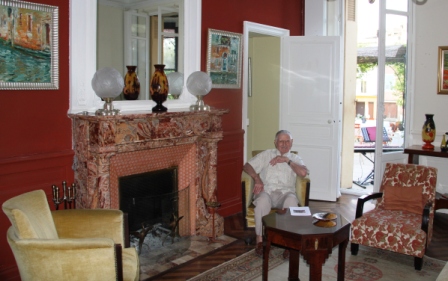
We were sitting around the fireplace in a stylish salon of exquisite furnishings enjoying an apero when a friend made that comment. It was our first time at the Villa Augustine shortly after it opened in April 2012.
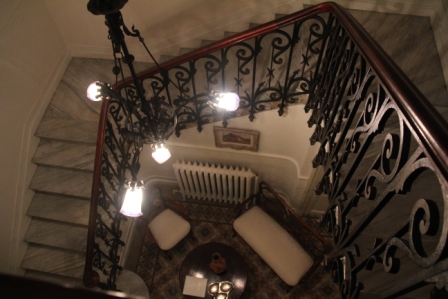
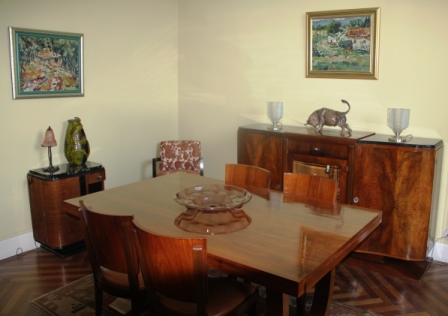
The turn-of-the- century mansion in the Vaucluse city of Apt, the capital of the Luberon, was originally owned by a wealthy family, proprietors of ochre mines. Their fortune plunged in the 1930s. The splendid home was abandoned for many years and in a dreadful state. Along came two Parisians, Guy and Christophe, to rescue the magnificent structure. Restoration took three years. Tracking down the furnishings and objets d’art took even longer. Guy and Christophe, both fans of 20th century arts décoratifs, combed France and neighboring countries to find original Art Nouveau pieces to enhance the interior in keeping with the period. Signed objects by Majorelle, Ruhlmann, Leuleu, Royere and others are among the treasures.
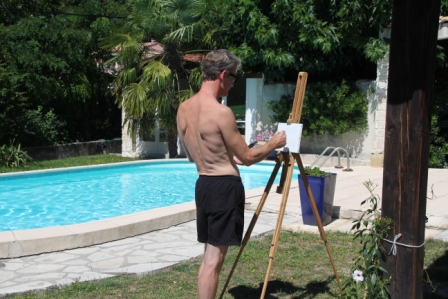
Today Villa Augustine is a sanctuary of calm and beauty in the midst of busy Apt just above the river Calavon. There are five chambres d’hote (B&B) rooms and gorgeous gardens planted with Italian inspiration. A more than 200-year-old cedar of Lebanon, classified as one of the most beautiful trees in the Luberon, is the pièce de resistance amidst flowers, cypress and olive trees. An inviting pool on a terrace above the villa is a delightful surprise offering stunning views of Apt and the Luberon hills. Not to forget – food, which is Guy’s realm. The ex-banker has always been passionate about cooking. Here he has the opportunity to indulge in his favorite pastime and prepare gourmet cuisine several evenings per week. His cuisine, he says, is influenced by his Spanish origins and Algeria, where he was born. And, the flavors of Provence, of course. There is a set menu, and reservations are a must as he can serve no more than 20 diners, but up to 40 for special events. During warm weather months, the spacious terrace in front of the villa is often a venue for the latter – concerts, fashion shows, art and photo exhibits.
During our first visit we had a complete tour and admired each unique bedroom with adjoining baths, many delightfully retro. A mirror from a buffet is the headboard for the double bed in one room. One bedroom is done in the style of the ‘50s, and another reflects the ‘40s.
Dinner – either outdoors under trellises on the terrace where huge pots of plants in bloom create an upscale ambience of greenery, or indoors in the dining room with its precious décor, is special. So is the food. Our first dinner in 2011 featured Noix de Saint-Jacques a l’artichaut et l’andouillette, jus de
crustaces, (scallops à l’ artichoke and sausage with the juice of crustaceans).
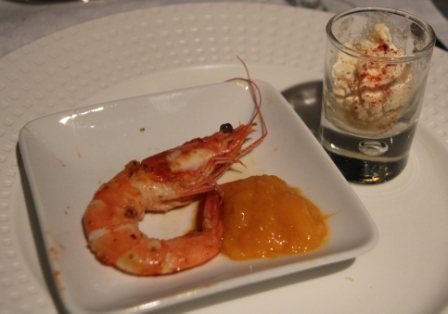
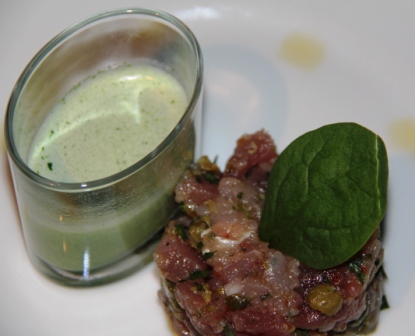
Last week we savored an excellent meal – a belated birthday treat for step-daughter Kellie and her friend Luka visiting from New York City. It began with a “mise en bouche” (pre-starter), a healthy gamba with a puree of mango and a mini glass filled with chantilly (whipped cream) of chevre (goat cheese). The entrée, carpaccio of tuna with a spinach sauce, was very flavorful – my favorite. Cod with ratatouille creatively stuffed in mini peppers accompanied the perfectly cooked fish surrounded by a coulis of tomato and juice of palourde (tomato sauce made with the juice of the clam perched on top of the cod). Dessert: roasted figs in fig liqueur with vanilla ice cream. Wine: a bottle each of an excellent Burgundy white and a Burgundy red suggested by Christophe. A fitting birthday meal in a magical place!
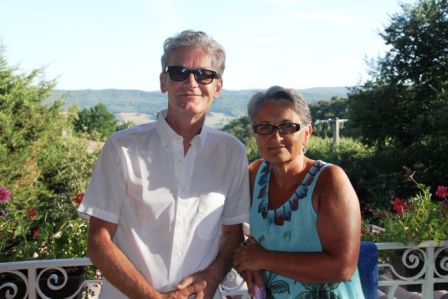
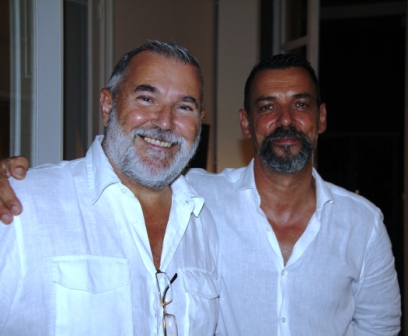
Guy and Christophe, who had the distinction of being the first gay couple married in Apt after the recent change in French law which now legalizes gay marriage, are overjoyed with the success of their endeavor.
Guy, left, and Christophe
“We are very happy with the speed in which we have succeeded to develop a faithful clientele,” says Guy. The chambre d’hote has been fully booked since April this year, he added. “Normally this would take four or five years.”
Rooms range in price from 100 to 150 euros per night. Three course dinners with two mise-en-bouches at 40 euros per person. Villa Augustine is open from mid March through the end of October. More information at www.lavillaaugustine.com
Have you dined at Villa Augustine? Share your view. I love to hear from readers. See “Leave a Reply” below under Comments. Followers also welcome. Don’t miss future posts. Click on Email Subscription at top right.
A recipe to try: Linguine with Shrimp, Tomatoes and Feta Sabraw. Scroll down recipe column at right.
Thanks to the generosity of my step-daughter Kellie who gave us tickets for a Leonard Cohen concert in Antwerp, BB and I recently hopped on the fast train (TGV) for a trip to that lovely city. A shorter version of the following appeared in the newspaper Stars and Stripes, www.stripes.com
It could have been a scene from a James Bond movie. Two shiny black limousines crept down the narrow street. Then came a monster white armored truck, followed by a smaller version of the same, and then more limos. Several stern, black-suited men walked alongside the vehicles. It was all very eerie, mysterious.
The white truck stopped in front of a non-descript building. Three hulks (you would not want to fool with these brutes) jumped out. A woman with a wad of papers surveyed the scene, as well as more of those ominous looking men and a small crowd of curious on-lookers. The muscled trio dashed to the back of the truck, opened it, and rapidly tossed out large canvas bags, at least a dozen. These were rushed inside the building.
I wanted to take pictures but was firmly warned, “No photos.” I asked the woman about the contents of the bags. “Diamonds” — obviously millions of the precious gems. Wow! I asked the value of the contents. No answer. She remained silent to that and my many other questions.
An everyday delivery in Antwerp’s diamond district where Jewish men, wearing long, black coats and wide-brimmed black hats, rush up and down the heavily guarded streets, many with cell phones to their ears.
Antwerp, Belgium’s second city, has been associated with diamonds since the 15th century. “By 2007 more than half of the world’s consumption of rough as well as polished industrial diamonds is traded in Antwerp realizing an annual turnover of $42 billion,” explained Sylvie Van Craen of the city’s tourist office. She said 1,800 diamond companies have their headquarters in the city, including four diamond exchanges, special diamond banks, security and transport firms, brokers and consultants. While the business of the glittering stones was originally associated with the Jewish community, today it’s run by people of numerous nationalities, including Jews, with Indians in the majority.
I did not come to Antwerp to purchase a diamond, although shops whose windows are brimming with diamond rings, bracelets, necklaces, earrings and more abound. Husband Bob and I came to attend the Leonard Cohen concert (amazing), visit the city and my Irish friend Isabel who lives there with her Dutch husband, Carlo. She was our guide extraordinaire.
Jackie, Isabel and Carlo.
“You’re seeing Antwerp at its absolutely worse,” Isabel lamented as we strolled by café after café whose outdoor tables were deserted. “Normally at this time of year people are sitting outside.” It was mid-June, and like in much of Europe, summer had yet to appear. It was cool, dreary, rainy, but the weather did not dampen her enthusiasm for the city. “We like Antwerp,” she said. “It has culture. There’s always a holiday atmosphere. The Belgians enjoy food and drink.” Antwerp is the capital of Flanders, the part of Belgium where Flemish, a language much like Dutch, is spoken.
We walked down the main shopping street, the bustling Meir, with a quick glance inside the Stadsfeestzaal (Festival Hall), a luxurious indoor shopping mall with a glass iron vault, marble staircase, gold leaf décor and a champagne bar. Then a mouth watering stop next door at one of Antwerp’s numerous chocolate shops, The Chocolate Line in the Paleis op de Meir which offers chocolate pralines with 60 different fillings: wasabi, Sake, cabernet-sauvignon, Earl Grey
You can even find Chocolate Pills at the Chocolate Line.
tea, cannabis, to name a few. For 45 euros you can buy a “Chocolate Shooter,” a snifter with three different flavors of cocoa powder to shoot up your nose for a nonaddictive jolt to “maximize the chocolate experience.”
One of Isabel’s favorite Antwerp nooks is the Botanical Garden Plantentuin, a small but lush patch of green in the midst of the city with unusual plants, blossoms, and a pond where over-sized, colorful carp swim. A park regular stopped to chat with us– another Antwerp plus. “It’s easy to get into a conversation with people here, having lunch, sitting on a bench. They are very chatty,” Isabel said.
And generous, as we found out at our next stop. In the food realm, Belgium is noted, not just for chocolate, but also waffles. I have never been a waffle fan, but BB loves them and misses those U.S. waffle houses. In that case, we must go to the “only place to eat waffles,” Isabel insisted, Désiré de Lille. And, we must order a Wafel warme Noorse Krieken (cherry waffle). “I bring everyone who visits here. You have to have a waffle if you come to Belgium.”
If every waffle was like this light, luscious confection with a mound of cherries and whipped cream, I’d be a waffle convert. Exquisite. And, there was more. An elderly woman sat next to us and was served a large bowl of donut balls dusted with powdered sugar. We eyed them with envy. She graciously offered us each one – another tasty treat called Smoutebollen.
Back to sightseeing and the Grote Markt, a triangular public space that is the heart of the city with its restored gabled guildhalls dating to the 16th and 17th centuries and the flamboyant renaissance town hall. For fair weather days, there are plenty of cafes with terraces where you can relax surrounded by the stunning architecture.
Nearby is the city’s architectural pièce de résistance, the Cathedral of Our Lady, a gothic temple whose towering spire dominates the city skyline. Inside are awe-inspiring masterpieces by Antwerp’s most famous son, Peter Paul Rubens, and other noted artists of the 16th and 17th centuries.
Workers restore a statue in the cathedral.
Waffles and chocolate…but what about beer and frites (French fries), two other Belgian specialties? In the same ancient square as the cathedral, Handschoenmarkt, is Abbey No 8, a beer store with “100 of the best beers out of 2,400 brewed in Belgium,” boasted salesman John. The shop also has 100 different kinds of beer glasses, as every beer demands its own type of glass. The most popular Antwerp beer is De Koninck, an amber colored brew served in a bolleke, a goblet shaped glass. According to Isabel, the best frites in the city are to be had at Fritkot Max, easy to spot with a large replica of fries in front.
We met Isabel’s husband for lunch at their favorite restaurant, Dock’s Café. Antwerp, located on the River Schelde just 50 miles from the North Sea, is known for fish and seafood dishes, both of which are favorites at Dock’s. I relished six scrumptious oysters, followed by very fresh flounder.
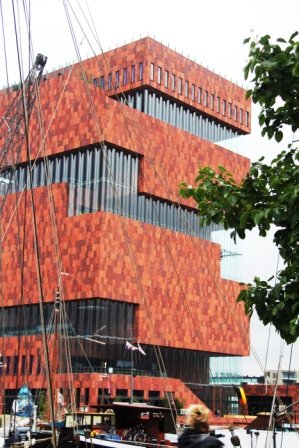
Next on our tour guide’s agenda was the city’s newest sensation, the Mas, a striking and unusual edifice along the river which houses a five-story museum illustrating the story of the city, the port, and their connection to the rest of the world. Bad luck for us – closed on Monday, the day we were in Antwerp. There is a boulevard walkway around the building to the top where the views are said to be “extraordinary.” It too was closed.
However, we found “extraordinary” views in the nearby Schipperskwartier (Seamen’s Quarter), the red light district where sex goddesses ply their trade (prostitution is tolerated in Belgium), posing in doorways and windows with little covering their bodies. Men “shoppers” stroll by, stopping now and then to converse, perhaps negotiate a price.
The district’s church, St. Paul’s, owes the salvage of some of its treasures to the prostitutes. During a huge fire in 1968 which destroyed much of the structure, the ladies of the night helped save valuable paintings. The church is a treasure trove of the latter, 50 paintings by notables such as Rubens and Van Dyck . We were lucky during our visit. A volunteer guide provided fascinating facts and insights on the church and its masterpieces. The adjacent Calvary Garden is intriguing, if not bizarre, enticing visitors to put their cameras to work.
Rear facade of the elegant Rubens house from the gardens.
We saved Antwerp’s most popular attraction, the Rubens house, until last.The prolific artist obviously did well. His home for 24 years (1616-1640) is an elegant palatial residence with a lovely garden, room after room where his paintings hang, and a few pieces of exquisite furniture. Rent the head set to learn more about the artist and his work.
Our visit to Antwerp ended where it had begun, at the city’s impressive central train station which was constructed in 1902 and recently renovated. Newsweek called it “the fourth most beautiful station in the world.”
“I went to several cities looking for a place for a business,”’ a young Nepalese woman named Beauty told me. She now has a shop in the city where she sells crafts from Nepal. “I liked Antwerp. It’s not too big, not too small. It has a cozy feeling and nice people.” And, interesting sights to admire, good food, great beer. I, too, like Antwerp.
TRAVEL TIPS
Park Inn by Radisson, ideal location adjacent to the train station. Ample breakfast buffet. Rates vary depending on season and promotions available. Doubles from 89 euros. www. parkinn.com/hotel-antwerpen
The Chocolate Line, Meir 50, www.thechocolateline.be (Fun place to visit – in the back you can watch chocolates being made. However, I was disappointed with the expensive box of exotic chocolates I purchased.)
Friktot Max, Groenplaats 12. While Isabel recommended this, she confesses she does not eat fries. Some Trip Advisor followers gave it a poor review. One said the best fries are at Frituur Kattekwaad, Verbondstraat 112.
COMING IN SEPTEMBER: Red Star Line Museum opening Sept. 28 will tell the story of this shipping company which carried some 2.6 million fortune hunters, businessmen, and wealthy travelers to America between 1873 and 1935. Museum located at the Rijnkaai next to where the ships used to dock. www.redstarlineorg.
Masterpieces by Rubens abound in Antwerp.
I love to hear from readers. Please share your views. See “Leave a Reply” below under Comments. Subscribers also welcome. Don’t miss future posts. Click on Email Subscription at top right.
In our not-so-much younger days, Bob (once known as Bicycle Bob) and I did lots of serious pedaling. Weekend bike trips loaded down with panniers in Germany. Longer treks in Austria, and even over the Swiss Alps several times. The Swiss rides, no doubt the most challenging, were our favorites.
Since we’ve settled down in southern France, we seem to do less and less cycling. A pity, as there is great riding in these parts. Mt. Ventoux for one. I’d never attempt that climb, but Bob long ago said he would… He’s still thinking about it.
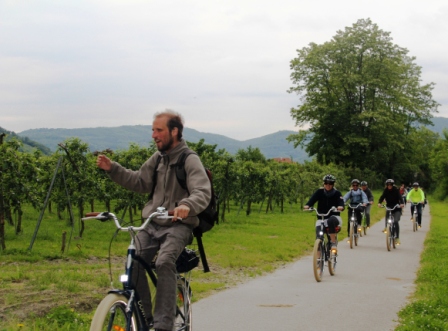
On our recent trip to Austria, we had a chance to get back in the saddle – a Grape Grazing tour by bicycle through the Wachau Valley. Wine and Biking. The perfect combination.
The scenery was superb along a meandering river bordered by cliffs, forested hills, vineyards and picture-perfect villages. The pedaling was easy, just 25 kilometers on mainly flat terrain along the Danube and never more than about 25 minutes on the bikes before a stop. The bikes were easy- to- ride cruisers with extra comfortable wide seats. And, the wines were excellent with informative commentary by our helpful guide, Endre Barz, a Hungarian who told us to call him Andy.
Only the weather did not cooperate. It was cold, gray, dismal, although we never had to use the rain ponchos provided by the tour company. But, neither did we get to swim in the Danube as the tour literature described.
Our first stop after a ride along the bike trail that is part of the popular Donau Radweg (Danube Bike Route) was the Domȁne Wachau, a cooperative on the edge of the medieval town of Dϋrnstein where we sampled four different white wines. In the Wachau Valley, a 21 mile stretch between the towns of Krems and Melk also known as the Danube River Valley, 85 percent of the wines are white.
A 2012 Gelber Muskatteller was first on the agenda, dry, fruity, a “popular summer wine.” “Austrians prefer young wine. They drink it immediately,” Andy explained.
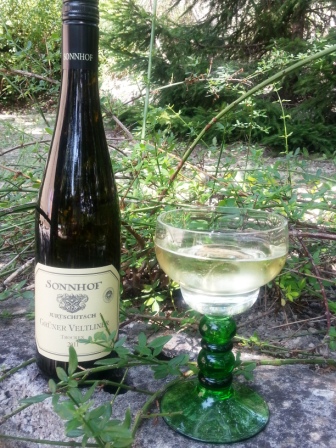
Then came Katzensprung 2012 from the indigenous Grϋner Veltliner grape, a dry, light wine. Andy told us that there are between 700 and 800 wine producers in the Wachau Valley, mainly small, family farms, with a total of 1,400 hectares of vineyards.
He went on tell us the importance of the Katzensprung wine in the country’s history. After World War II, Austria was divided into four zones: British, French, Soviet and American. The seat of government was in Vienna surrounded by the Soviet zone. ”In 1955 the Austrian president gave visiting Soviet leaders this wine. He got them drunk and convinced them to let Austria become a neutral nation,” Andy related.
We tasted two Rieslings before a visit to the winery shop where most of the wines were reasonably priced, from seven euros per bottle. “It’s amazing in Europe. Austria produces high quality wines but at a lower price than in other countries,” Andy said.
The charming town of Dϋrnstein where we had a lunch break sits at the foot of terraced vineyards and castle ruins. Richard the Lionheart, King of England, was a prisoner in the fortress during the Third Crusade.
From the town, a footpath leads to the ruins where a remarkable view awaits. The town’s Parish Church with a Baroque tower is also worth a visit. Most of our fellow cyclists (we were 12, from Sweden, Norway, Singapore, Chicago, and Bob and I), preferred to peruse the town’s shops where all sorts of products made from Marille, an apricot variety grown in the Wachau Valley, are big sellers (jams, soaps, schnapps, mustard, chutney, chocolate). The Marille strudel Bob ordered to finish off his lunch of a hearty goulash and dumplings was fabulous.
We pedaled on through picturesque countryside, often with vineyards on both sides of the bike path, to Weissenkirchen for a tasting at Weingut Hermengled Mang, a family winery which also has a restaurant, a Heuriger, a special Austrian eatery attached to a winery that serves the season’s new wines and simple, local food.
As we sipped and swirled a Grϋner Veltliner, then a Riesling and lastly a Chardonnay, Andy told us about the wine scandal that almost finished the wine business in Austria. Prior to the 1980s, Austria produced mainly sweet wines. The country had a good rapport with Germany which did not produce enough grapes to satisfy the demand of its thirsty citizens. It bought Austrian wine which it sold as German wine. But in 1985, Austria did not have enough sweet wine to fulfill its contract for the German market. Vintners could not add sugar to the wine as it would be detected. Instead, they added antifreeze which the Germans discovered. Although only three or four companies were involved, “It destroyed 80 percent of the Austrian wine production,” Andy said.
When the wine business was revived, it was decided to focus on dry wine of a high quality and to avoid mass production. Today “small is beautiful” best describes Austrian wine, most of which is white. The crisp, dry vintages are appreciated by wine experts around the world.
VIENNA WINE
Back in Vienna, we learned more about Austrian wine with a tasting at the Christ Winery and Heuriger in the Vienna community of Jedlersdorf.
Vienna is the only world capital with vineyards in the city limits. Some 700 hectares on both sides of the Danube are devoted to grapes with 250 wine producers, most of whom produce their own wine, although some sell their grapes to other vintners.
Rainer Christ took over his father’s winery in 2004, aiming to breathe new life into the more than 400 -year- old company. He is most enthusiastic about his renowned Gemischter Satz, a Vienna white wine made from different varieties of grapes and his “biggest seller.” After World War II most vintners used one grape variety to produce one wine, he explained. However, historically several grape varieties were often combined into one wine. “This had been forgotten in Vienna, but it’s become popular in the last 10 to 15 years, “ he said.
Some producers use from eight to ten different grapes varieties in Gemischter Satz, but usually it’s from two to four . We tasted his 2012 Wiener Gemischter Satz which sells for 7,90 euros and is a combination of Grϋner Veltliner, Weissburgunder (Pinot Blanc), Riesling and Welsch Riesling (an Austrian grape variety). Christ termed it “elegant, refreshing.” It has a maximum of 12.5 percent alcohol and is “ not too rich,” he added. We loved it. If the trip back to the hotel hadn’t involved a Strassenbahn trek, followed by a ride on the S bahn and finally U bahn, we would have purchased a case.
Christ has studied oenology and worked in the wine business in many different countries, including the U.S., France, Italy and Germany. Within the past 20 years, there’s been more science involved in wine production, he explained. “It’s more and more professional, yet knowledge of the past is very important. Theory and new techniques do not make a good wine. You need to be out in the vineyards, get ideas and the participation of your parents.”
Christ, like most vintners, experiments with growing techniques. His Weiss Burgunder der Vollmund is one result, a wine made from grapes harvested during a full moon. “We learned that the moon makes a difference.” Grapes harvested one day before or one day after the full moon had a different character, he explained. The full moon wine is “richer in aroma, more massive, longer on the tongue.”
We also tried a 2012 Bisamberg Alte Reben, Wiener Gemischter Satz, made from grapes grown in a 75- year old vineyard. The wine, named “white wine of the year in Austria,” goes well with richer foods. “Austrians like to combine heavier dishes with full bodied white wines,” he said. And, Austrians drink white wines with all types of food –meat, fish, poultry, cheese, etc.
Platter of hearty food at the Christ Heuriger
HELPFUL SITES
Grape Grazing Bicycle Wine tour of the Wachau Valley with Vienna Explorer, 59 euros, http://www.viennaexplorer.com/tours/grape-grazing-tour/
Vienna Heurigen Express, Hop on, Hop off sightseeing tour through the Vienna wine region and villages. Trip ends with a visit to a Heuriger, but you can get off en route to see more at leisure. www.heurigenexpress.at
See column at right for recipe: Baked Salmon Fillets with Goat Cheese and Coriander requested by friend Sue. Comments on blog post and recipes are welcome. See “Leave a Reply” below under Comments. Subscribers also welcome. Don’t miss future posts. Click on Email Subscription at top right.
I felt I should have been reporting for Bon Appétit magazine. It was one of those fabulous food and people spreads – a multi-course meal in the huge, homey kitchen of a 500-year-old house in a tiny Italian village shared by Italians and Americans. And, I was lucky enough to be part of it. Too good to be true.
Thanks to our friends Noel and Carol, whom husband Bob and I know from our days together in Germany, we were included in this memorable feast which went on for five fun-filled hours. Noel and Carol have retired to northern Italy where they enjoy la dolce vita. We were their houseguests.
Carol and Noel
The lunch hosts: Fabio and his American wife Victoria. Fabio is a vintner (www.policreti.it) with a passion for precious gems as well as grapes. He has been trading in gem stones since the age of 18, worked for the up market jeweler Bulgari in New York as well as in Italy, and is also dedicated to restoring his
Fabio
family’s ancient home, Palazzo Policreti Negrelli in Aviano, which has 47 rooms and has been in his family for more than 200 years. The original owner, engineer Luigi Negrelli , played a significant role in the construction of the Suez Canal.
Fabio met his warm and gracious wife Victoria in California. She is employed by a German construction company as a translator and much more. “I am lucky to have an American wife,” says Fabio. “Italian women often have headaches or give you headaches.”
The guests: In addition to me and Bob, Noel and Carol, seated at the table were Riccardo and Zeta, two jolly Italian characters who have known each other since the age of 3, met Fabio in Los Angeles years ago, and call themselves “professional travelers.” Riccardo said he “doesn’t belong to one place,” while Zeta calls himself “a man of the planet.” ”We can’t retire, we don’t work,” explained burly Riccardo, who says he has four wives, each in a different country, and claims his only possessions are “an old car and a bicycle.”
Riccardo
Zeta, a chef, does work six months out of the year at his brother’s restaurant in Greenville, S. C. “When Zeta visits us the first question is ‘what’s on the menu?’ His creations are famous at our hose,” says Fabio. “Instead of making a grocery list, he just looks in the refrigerator and his imagination begins to spin. He can literally put together a feast by using all the various items which have been abandoned in our frig. Needless to say, I like to work around him as there is always something to learn or a new taste to discover.”
Zeta
The food: Zeta was the coach, Fabio the student who made a big patch of Ligurian pesto with guidance from the chef. They wanted to share their creation with friends, hence the lunch party.
The French are obsessed with food — Italians perhaps even more so. Most Italian men cook, Fabio told us, as he checked the boiling pasta for texture. “A big part of the day is based on food,” he said. And, it is essential that ingredients be of top quality, he explained. He claims that Victoria is “thankful to me for showing her the true secrets of Italian cooking improvisation.”
A refreshing cocktail, a combination of Campari, white wine, Prosecco, and Schweppes, got the afternoon of to a festive start.
The meal began with fresh ricotta, so creamy and delicate, served with homemade mango chutney and caramelized figs with balsamic vinegar. The cheese was locally produced, and it was exquisite with the tangy chutney and figs. There was a platter of prosciutto from the local butcher who cures it himself, we learned. And a salad — greens, tomatoes and luscious mozzarella di Bufala with pungent olive oil from Puglia and black salt from Cypress. The main course: trofiette, a Ligurian pasta, with the pesto which had been prepared with pecorino. “Never use parmesan,” insisted Fabio.
This was followed by a bowl of spaghettini with the same pesto. The flavor of the pesto changes with the different type of pasta, we learned. It seemed hard to believe, but it was true. I preferred the pesto on trofiette, others liked the spaghettini version. This initiated an animated discussion of the difference between trofiette and trennette, another type of pasta… Food is definitely serious business in Italy.
For dessert, aged Sardinian pecorino and pears. “It’s hard to get good pears…these are organic from Trentino… Never tell a farmer he has good cheese. Then he will eat it all, ” said Riccardo. The cheese was knock-your-socks- off strong. I loved it, but it was too much for Bob. He had several helpings of the perfectly diced fresh strawberries that followed. This prompted Fabio to tell of his grandmother’s fantastic crop of strawberries in 1986, the year of the Chernobyl disaster. A boost from radiation?
He went on to relate more engaging tales of his grandmother, a remarkable woman who “was a very special person to me.” She lived through two great wars, suffered the tragic deaths of several family members, but was always a positive and smiling person, Fabio recalled. “She was the oldest car rally driver in 1996 at the age of 95. I was the only person brave enough to be her co-pilot.”’
Fabio and his grandmother in 1996.
We drank Fabio’s Pinot Grigio, followed by a strong red wine called Stroppolatini, then a Sud Tyrol Kerner as an after dinner wine. Some indulged n a rare 45-year–old herb Grappa to top off the meal. There were also chocolates, courtesy of Riccardo who brought them from a special shop in the Dolomites.
All the ingredients for a magical afternoon: lively ambience, fascinating personalities, excellent food and amusing, entertaining, educational conversation covering everything from religion and politics, to the economy, movies — and food of course.
“Italians lose interest in politics,” Victoria said. “That’s the problem. They’d rather discuss food.”
Just in time for summer picnics, Super Slaw. See recipe in column at right. Comments on blog post and recipes are welcome. See “Leave a Reply” below under Comments. Subscribers also welcome. Don’t miss future posts. Click on Email Subscription at top right
My article on Marseille which follows was recently published in the newspapers Stars and Stripes and the Houston Chronicle. A slightly different version will soon appear on the dynamite travel web site: www.travelsquire.com Check it out for a wealth of travel info. Marseille is hot — this year named a European Capital of Culture. Read on — and plan a visit.
It’s a tiny place, all decked out with souvenirs of the sea: shells and stuffed fish in nets dangling from the ceiling, a bench with bold orange life vests as cushions around a big corner table, a wall plastered with small sardine cans. Perfect décor for La Bôite à Sardine, a popular Marseille eatery. A few regulars down pastis, the licorice flavored drink of Provence, at a mini bar while chef Celine is busy on the other side with lunch preparations.
Outside proprietor Fabian arranges freshly caught fish on a sidewalk table. Another display of creatures that had been swimming in the Mediterranean a few hours earlier greets us at the entrance.
My husband and I had come to Marseille from our home in northern Provence to savor treats from the sea for which this port city is famous.
We were charmed with La Bôite à Sardine — and even more so when Fabian sat us at a table with two friendly women, Jeanne Feutren, 68, and her mother, Claire Gilormini, 93, who live nearby.
”We come here because the fish is fresh. It’s delivered every morning. That’s rare. We know,” said Feutren, who, like her mother, was born in France’s second city, is a retired English teacher, and, like most natives, a diehard fan of this fascinating city, the oldest in France.
They, and many others, began their meal with platters of oysters. I asked for Fabian’s recommendations, and he suggested we split an order of calamari, then move on to sole for the main course. “It’s the season for sole,” he explained. “They are full of eggs. The taste is the best.” The squid were in a tasty sauce with a side dish of panisse, a local specialty made with chickpea flour. The sole, lightly fried, was exquisite. Fabian made sure we did not miss the cheeks, the minute and delicate portion of flesh under the fish’s eyes.
“I love Marseille. It’s so cosmopolitan,” said Feutren. “You can meet the whole world here. We have the sea, the sand, hills, the calanques (dramatic coastline cliffs). People are so exuberant.” Her mother interjected. “It’s a wonderful town. We have sun year round. It’s January, but look at the weather.” (It was glorious. Marseille has 300 days of sunshine, the highest number of sunny days in France.)
Now is the time to visit. Marseille is the European Capital of Culture for 2013 with a wealth of activities on the agenda this year. The New York Times rated Marseille second in its list of “46 places to visit in 2013.”
Crime, drugs, violence, the Mafia – the city’s reputation was shrouded by all for years. Fortunately policing and public security have improved somewhat. Nonetheless, as in any big city, caution is advised.
What to See:
Vieux Port. The old port is the heart of this city that was founded by the Greeks six centuries before Christ. Every morning fishermen unload their catch at the tip of the port, the Quai des Belges, for the fish market where locals survey the specimens and tourists take photos. “Soles vivantes,” fish still flapping in a shallow pool of water, were a hot item recently, no doubt because it was the sole season as we had learned from Fabian. On one table, an octopus slithered back and forth in a tray. The 17th century Hotel de Ville, the centuries-old home of the city government, is on the right side of the quai facing the water.
New at the Vieux Port is Norman Foster’s Ombrière, a giant mirror hanging above the repaved waterfront. Slender columns hold a thin sheet of polished steel aloft. Reflected are all those passing underneath, from gnarled fishermen to strolling pedestrians.
Pavilion M. This temporary structure of wood and glass erected for Marseille 2013 in the Place Bargemon near the Vieux Port has exhibits on the city and its people. Visit the tourist office on the upper floor for information about special events this year. Tickets for events are also on sale here.
Chateau d’If. Take a boat from the Vieux Port to his legendary castle, France’s Alcatraz. King Francois I had it built in the 16th century as a fort outside the harbor. It never saw battle, but became a prison. Its most illustrious inmate was Edmond Dantès whom Alexandre Dumas immortalized in The Count of Monte Cristo.
Le Panier. Steep steps from the Vieux Port climb the hills of this district whose narrow, cobbled alleys are reminiscent of ancient Mediterranean cities like Naples and Lisbon. The Place des Moulins was once the home of 15 windmills where flour was milled. The name “panier” (basket) is thought to come from the baskets used to carry bread. Check out the boutiques on rue du Petit-Puits. The whimsical ceramics at number 7, Serge Mautarlier, are a delight.
Vielle Charité. This striking architectural masterpiece in Le Panier was a home for the city’s poor in the 17th century when Louis XIV decided poor folks on the streets were bad news. It housed up to 1,000 needy residents. The noted architect Le Corbusier recognized its beauty in the 1950s which led to renovation. The complex of columned arcades includes a Baroque domed chapel.
Notre Dame de la Garde. A golden statue of the “Bonne Mère” tops this Romanesque-Byzantine basilica at the highest point of the city, 500 feet above the harbor, majestically watching over Marseille’s 860,000 inhabitants. Hike up the hill, or take bus number 60 from the old port, and enjoy the best views of the city and nearby islands.
La Canebière. The grand boulevard of Marseille which leads from the Vieux Port. A bit shabby, the Champs Élysée it is not, although it was modeled after the Parisian avenue. Some of the buildings are worth admiring, such as the one with caryatides housing the store C&A at number 53
Calanques/Beaches. Sightseeing boats from the Vieux Port opposite the Hotel de Ville offer coastal tours to admire the stunning cliffs and deep fiord-like inlets between Marseille and Cassis. Marseille has 16 beaches along its 57 kilometers of coastline. The Plage des Catalans offers golden sand, while soft gravel covers the Plage du Prado. Both are crowded in summer.
Markets. In addition to the fish market, this vibrant city has numerous morning markets offering everything from clothing to spices, fruits and vegetables to hardware. The merchandise for sale reflects the diversity of the city’s population which includes 200,000 Italians, 150,000 Corsicans, and
Facade in Le Panier.
400,000 Muslims (mostly from Algeria). Arab specialties are found at the Marché les Noailles on side streets to the right at the end of Canebière just a few hundred meters from the Vieux Port, every morning except Sunday. Nearby is the Marché des Capucins for fruit and vegetables, also daily except Sunday. Everything imaginable is for sale at the huge Marché du Prado along the this main artery of the city. Tuesday through Saturday.
Bouillabaisse. Marseille is the capital of this legendary fisherman’s soup. It’s said to taste better there than anywhere else because of the variety and freshness of ingredients – several kinds of fish. It’s a hearty meal beginning with the fish broth served with aioli, garlic mayonnaise, and rouille, aioli with cayenne pepper. Smear the mayos on toast rounds which you submerge in the soup. Then comes a huge platter of the fish and potatoes. It’s a pricey dish, between 53 and 60 euros per person at these restaurants all known for authentic bouillabaisse: Le Rhul, chez Michel, Le Miramar and chez Fonfon. A less expensive but authentic version can be ordered ahead at Chez Madie Les Galinettes at the Vieux Port. Other restaurants along the Vieux Port also offer bouillabaisse for less, but it may not be the genuine version.
More new buildings to come. This area near the cathedral will house shops and restaurants.
New Attractions: Villa Méditerranée and Museum of European and Mediterranean Civilizations (MUCEM). Continue down the waterfront from the Vieux Port to an abandoned pier (J4) that is now all spiffed up and the site of avant-garde architecture. The Villa Méditerranée looks much like a supersized diving board with a vast exhibition hall jutting towards the sea and suspended above a pool of water. It will host exhibitions, but it is primarily a place to provide contact for all Mediterranean countries with the focus on cultural and artistic exchanges. There is no charge to enter and wander around, although there is a charge for exhibitions.
President Francois Hollande will inaugurate MUCEM on June 4. Doors open to the public on June 7. This striking structure, a squat glass building shielded from the harsh Mediterranean sun by a dark concrete filigree veil, echoes the architecture of North Africa. Exhibits from national museums will illustrate the theme of Mediterranean civilization.
The J4 area and the adjacent old Fort St. Jean are linked by a 130-meter walkway overlooking a dock. You can stroll in the public Mediterranean garden suspended on the heights of the Fort and lap up the stunning panoramic views over the sea and city.
Where to stay:
Hôtel Escale Oceania Marseille Vieux Port
The location does not get any better than this, just adjacent to the Vieux Port. The small (45 rooms) newly renovated hotel does not offer luxury, but it does have all you need, including free Internet access. Ask for a superior room with a balcony for superb views of the Vieux Port and Notre Dame de la Garde. 5 La Canebière, 04 91 90 61 61
Church tower and war monument at the upper end of La Canbiere.
Where to eat:
La Bôite à Sardine, fish restaurant as described in article, 7 Boulevard de la libération, 04 91 50 95 95, www.laboiteasardine.com
Le Café des Epices, gastronomic brasserie near the Vieux Port, a tiny but bustling place with innovative cuisine. There is a terrace in front of the restaurant for outdoor dining. Many of the customers are regulars who greet the talented chef with the obligatory air kiss on each cheek. 4 Rue du Lacydon, 04 91 91 22 69. Restaurant does not have a web site.
Facade in Le Panier
Pizzeria Jeannot. Much more than a pizzeria, this large restaurant offers all manner of seafood and grilled meats, in addition to a variety of pizzas. The location, tucked in a tiny fishing port just outside the heart of the city, is a delight. 129 Vallon des Auffes, 04 91 52 11 28. www.pizzeriachezjeannot.net
Chez Fonfon. If it’s authentic bouillabaisse you seek, try this well-known restaurant (mentioned in the article) located almost next door to Pizzeria Jeannot, but with a classy ambience on the second floor of a building with lovely views of the sea and the mini harbor full of boats. 140 Rue du Vallon des Auffes, 04 91 52 14 38, www.chez-fonfon.com
MORE MARSEILLE
For the best home made Italian ice cream, Le Glacier du Roi, 55/49 arret Place de Lenche, www.leglacierduroi.lesite.pro
Florence Bianchi offers a taste of her luscious ice cream.
For the city’s famous traditional cookies (Navettes – flavored with orange flower water ), Navettes des Accoules, 68 Rue Caisserie, http://www.les-navettes-des- accoules.fr
Travel throughout the city by bus and/or metro (two lines). A one-day City Pass at 22 euros ($28.50) includes use of both bus and metro for 24 hours, a roundtrip boat trip to Chateau d’If, a ride on the tourist train to Notre Dame de la Garde or through the Old Town and Panier, entrance to all museums, a guided tour, plus some discounts. Tickets at Pavilion M, the city tourist office at the Vieux Port or at resamarseille.com
Marseille also has Hop-on-Hop Off buses running between April 1 and Oct. 31 which stop at 13 different locations. Tickets for one or two days from 18 euros ($23) can be purchased on board.
Sightseeing boat trip of the calanques: two hour trip: 22 euros. ($28.50) Details at www.visite-des-calanques.com. Boats run daily from April through October.
Comments on blog post are welcome. See “Leave a Reply” below under Comments. Subscribers also welcome. Don’t miss future posts. Click on Email Subscription at top right