Gorillas in our midst

In my next life, I want to be Dian Fossey. Well, not quite. I’d rather not be mysteriously murdered as she was in the jungles of Rwanda where she studied and lived with mountain gorillas.gorilla.2b
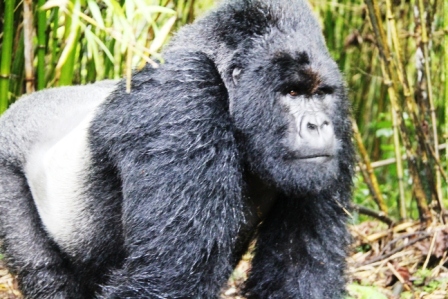
After observing, photographing and admiring these magnificent beasts in the dense bamboo forests high in the mountains of Rwanda, I was smitten. It is easy to understand Fossey’s fascination with the human-like gorillas which share 98 percent of our DNA.

gorilla.9b

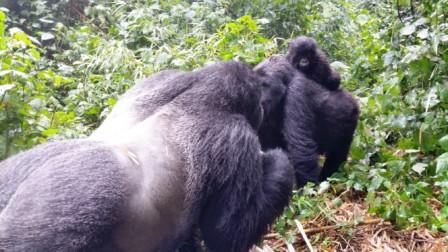
Children romp and play, chasing one another through the thick brush. Toddlers cling to mothers, often piggy-back. Mothers nurse babies. And Big Daddy, the awesome silverback, keeps a vigilant eye over all.

“Watch out! One coming on your left….Look up, one in the tree… Be careful. The silverback is just ahead.”
gorilla.5b

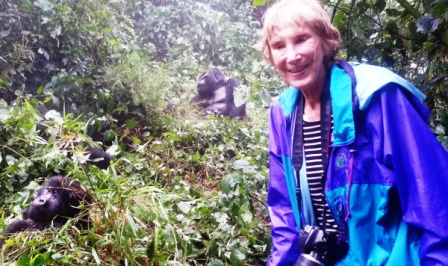
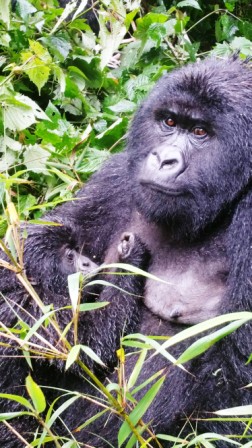
They were in our midst, the 22 member Kwitonaa gorilla family. One youngster raced by and grabbed the hand of a member of our trekking group. Another trekker was punched – lightly — by a teenager whose path he accidentally blocked. I was captivated by a nursing mother, no more than a foot in front of me. I could have easily touched her, but I dare not. We had been warned not to get closer than 10 feet to the beasts. Impossible. They were all around us, up close, and obviously accustomed to this parade of curious creatures who snapped away with all manner of cameras.
gorilla.7b

Mountain gorillas are “about as dangerous as pet lambs,” Fossey once told Alfred Hitchcock, apparently to his disappointment.

Mama occasionally cast me a stern glance as if to say, “Oh no, you guys again.” Not far behind her, higher up on an incline, sat the silverback, a picture of majestic power, like a king with his subjects at his feet. He seemed disinterested, but weighing in at close to 400 pounds; I did not want to upset him.

gorilla.b3

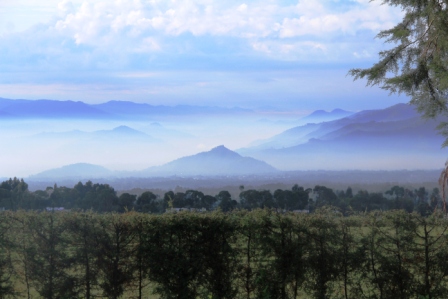
The Virunga Massif, volcanic peaks usually shrouded in mist along the borders of Rwanda, Uganda and the Democratic Republic of Congo, are home to 10 gorilla families visited regularly by tourists.gorilla.23b
Treks to observe the gorillas are strictly controlled and organized by officials in Rwanda’s Volcanoes National Park. Eager tourists arrive at park headquarters at 7 a.m. where they are divided into groups of eight, supposedly according to the difficulty of the hike ahead. Each group (a maximum of 10 groups or 80 tourists gorilla.27bgorilla.20bper day) is accompanied by a guide, trackers carrying machetes to blaze a trail, a gun-toting guard (in case of attack by Cape buffalo) and porters. Guides are in radio contact with other trackers stationed in the mountains who monitor the gorillas and advise them of the various gorilla family locations.

No longer young and fit, we asked to be in an “easy” trekking group since we had heard the hikes to locate the gorillas can take up to four hours, one way, over difficult terrain. I had been very nervous, not certain we were up to the challenge. My fears were assuaged when I met the others in our party: Fran (66) and John (76), seasoned hikers from Scotland; Selma (72) and Barry (a bit older) from D.C., and a mother- son couple from Germany. Annette, who appeared to be in her 70s, was on her fifth gorilla trek. “I’m addicted,” she said.

Selma announced to the guide that she had had two knee replacements and could only hike if the terrain was flat. She explained that a woman in her hotel had seen the gorillas the previous day after an easy, 37-minute hike. She expected the same.gorilla.25b
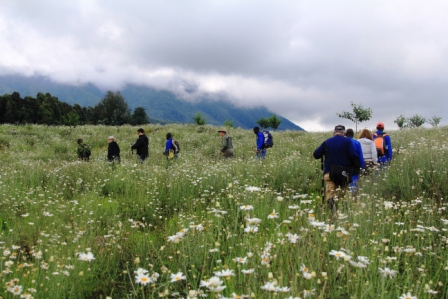
Poor Selma…close to three hours later, soaked to the bone, we finally found our gorillas. The hike started out as a pleasant walk in sunshine through farm fields. The sun soon disappeared and we started to climb, over rugged, rocky, slippery terrain. Up and up. Steeper and steeper. We were at an elevation of 8,500 feet. I was frequently out of breath, but there were rest stops.

Porters help with the ascent.

Fortunately I had hired a porter, Peragie, a tiny woman half my size but my savior. I had little to carry, just a small backpack with a water bottle and my gorilla.17bcamera. But, for only $10 (the standard charge for a porter), I figured it might be useful. She could hold my camera if I wanted to take photos with the phone and vice versa.
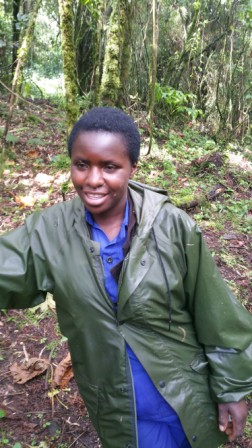
This mini power house did far more. On the steep sections, she took my hand and literally pulled me up. When the rains came, soon into the trek, she wiped my face and glasses. She tucked my pants into my boots – to keep the red ants away. She spoke no English, but I learned that she was 30 years old, a widow and mother of two young children. Her calm, gentle, caring demeanor was an inspiration and kept me going.

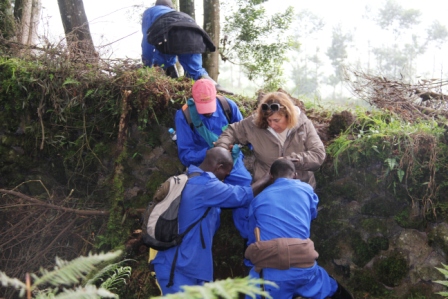
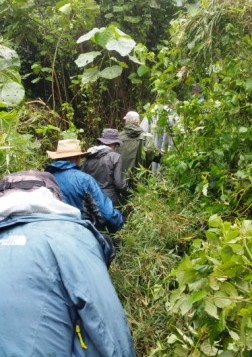
“My knees are wobbly. I can’ go any farther. I won’t make it,”   announced Selma, not far into the hike. Our guide assured her she could – would – make it. When we came to a high rock wall separating the fields from the forest, several porters lifted her over the obstacle.gorilla.29.bjpg We charged on, but the going in the tangle of jungle vines, roots and branches was a challenge. Rain did not help. “How much farther?” Selma asked time and time again.   However, we all were beginning to wonder if we would ever find the gorillas.
Over and over, guide Ignacie assured us they were not far ahead. “They’ve been here,” he explained as he surveyed the terrain. Of course, they were not waiting for us, but continually on the move, higher and higher, searching for more tasty bamboo.

gorilla.15a
Playful baby

At last – a big patch of black lumbering through the jungle green ahead. We stopped. We could hear bamboo branches breaking. Suddenly more masses of matted black fur, on the right, left, ahead –all in motion. We were awestruck. After the grueling trek, it seemed miraculous.

Ignacie told us the youngest member of the family was a seven-day old baby. We came up behind the mother, cradling the infant in her arms. Unfortunately the 22-year-old silverback was ahead and she moved on to dutifully follow him before I could get a photo. The kids – all ages – were frolicking all around. Two teenagers got into a spat. “They are drunk,” Ignacie said. Apparently overdosing on bamboo has the same effect as too much booze.

The rain stopped. We moved about, each of us zeroing in on different family members for close up photos. It was thrilling, amazing, and beyond our expectations to be so close to these intriguing creatures.

Trekkers are supposed to spend no more than one hour observing the gorillas. Perhaps because our journey had been so long and arduous, Ignacie was generous. We were with them a bit longer, but not long enough. You cannot get bored watching gorillas.

gorilla.31

The trek down was worse than the ascent. It started to pour. This was the rainy season, and these rains were like no others I have known. The trackers decided to find a shorter route back through even denser jungle growth. The lead man thrashed a path with his machete. If it hadn’t been for my guardian angel, I surely would have slipped or tripped.

Selma survived. “I am glad it’s over,” she said as we reached the end. Had Ignacie not insisted, she obviously would have quit. We later learned that rather than sending a participant back, the guides call for a stretcher.   Trekkers are carried to the gorillas at an extra cost of $200. And, it is not uncommon for handicapped tourists to hire porters with a stretcher to take them to marvel at this wonder of nature.
gorilla.19b.jpg
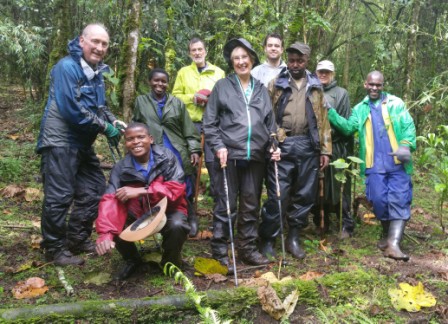
Group photo while we waited for Selma and Barry who were far behind.

The gorilla experience is costly, $750 per person for the required permit. This includes the guide, trackers, guard, but not the porters. There is no shortage of visitors, however. Since 2004, the number of gorilla customers has almost tripled: 20,000 in 2014. Much of the revenue helps fight poachers, as well as contributes to the country’s efforts to develop a high end tourist industry and continue its recovery from the horrific genocide of 1994.

Back in the early ‘80s when Fossey came to Rwanda, there were only about 240 mountain gorillas in the wild. They cannot survive in captivity. Today the number is estimated at about 900, with some 300 in the Volcanoes National Park.

Annette, our intrepid trekker from Germany, was planning to set off again the next day for another gorilla trek – her 6th.   She said she had never been so close to the gorillas as she had on our trek, nor had she ever been on such a difficult trek.gorilla.30b
Finding the Kwitonaa family did take far longer than anticipated, but only Selma complained. It is very rare that guides do not find the gorillas. If that happens, trekkers are offered the chance to try again the next day. Prosper Uwengeli, the park’s chief warden, told a New York Times reporter that in more than 30 years, guides have never had to shoot a gorilla and no visitor has ever been harmed by one.

In a research report, Fossey wrote that mountain gorillas are “dignified, highly social, gentle giants with individual personalities and strong family relationships.” Like Fossey and countless others who have watched them in the wild, I am enamored of these gentle giants and, if it weren’t so costly, would gladly endure another trek for another visit.gorilla.b1
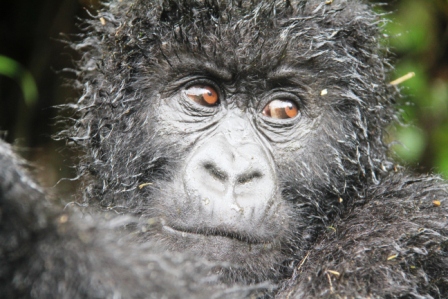
Gorilla visitors can show up at the park at 7 a.m. with hopes of buying a permit for a trek that day, but that is risky as permits may be sold out. Most tourists book a package tour which includes the gorilla trek. We booked a 3-day package with Africa Adventure Safaris, an African company which also organizes tours in Uganda. Total for both of us was $3,250 which included a full-time driver/guide, three nights lodging and most meals, the gorilla permits, a permit and trek to visit endangered golden monkeys the day after the gorillas, city tour of Kigali and airport transfers. We were more than satisfied. www.rwandagorillassafari.comgorilla.10b

Bad - very bad -- hair day
Bad – very bad — hair day

From Rwanda, BB and I traveled south for more Adventure Africa: Botswana, Zambia, Zimbabwe and South Africa. Future posts will highlight our amazing experiences. But first, a bit more on Rwanda. Coming soon, “Rwanda — More than Gorillas.”

If not already a Tales and Travel follower, sign up (upper right) so you will not miss these exciting future posts. Your address is kept private and never shared.gorilla.6b

Like my blog? Tell your friends.  Please leave a Reply below. Feedback is welcome. I love to know what my readers think about my posts.

It’s time for a hearty soup. East German Soljanka, a recipe from my friend and food writer Sharon Hudgins, is perfect to warm both body and soul. See Today’s Taste, column at right.

Follow Tales and Travel on Facebook:  http://www.facebook.com/talesandtravel

Follow me on twitter: @larkleah

I


Cannes: Far from the Madding crowd

The crowds are fierce in this Riviera hot spot in August. And, of course during its famous film festival when the world focuses on all the stars who pose on the red carpet at the Palais des Festivals.

View from the ferry
Cannes viewed  from the ferry

But, you can escape the masses and find tranquility amidst Mediterranean splendor just a short boat ride (20 minutes) away. We visited Cannes again this year to watch outstanding fireworks which are part of an international competition held every summer in Cannes. Fireworks are shot from numerous boats in the harbor and synchronized to music. Worth a trip!

?

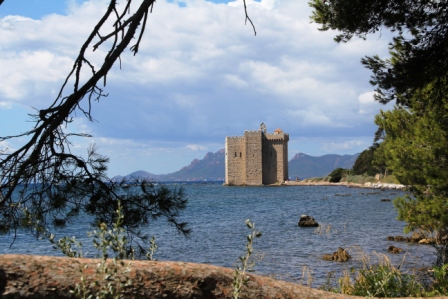
So too is a visit to the off shore islands (Îsles de Lérins): Île Sainte Marquerite and Île Saint Honorat. Last summer we hiked around Ste. Marquerite, the larger island, and savored an excellent lunch on the shore. This time, Saint Honorat, the monks’ island.cannes,14

Splendid. The tiny island has no cars, no hotels, just one restaurant, two shops –and monks. In 410 AD, Honoratus, a Roman noble who became saintly and sought isolation, is said to have chosen the island, then full of snakes and scorpions and thought to be haunted, as an ideal retreat. Visitors followed. A monastic order was established.

11th century fortress was connected to the original abbey by a tunnel.

The monastery grew to become one of the most powerful in Christendom. Alas, peace and quiet did not last. Raids by Saracens and pirates in the 8th century took their toll, then later attacks by Spaniards. The monastery was closed in 1788, but reborn in 1859 when Cistercians took it over.

Today 20 monks live on Saint Honorat. In addition to praying, they cultivate grapes, eight hectares of vineyards, five for red wine, and three for white.

The monks' grapes were looking good.,
Monastery grapes are looking good.

We followed the mostly shaded trail along the island’s craggy coastline, past rocky coves, ancient chapel ruins, an 11th century fortress and cannonball ovens. These curious structures were used in the 18th century to heat cannonballs so they would wreck further destruction on the ships they hit.

VR inspects a cannonball oven.

Signs along the way remind you to keep quiet and to respect the religious ambience – no bare chests. Mediterranean vegetation – pines, herbs, eucalyptus – borders the trail and makes for interesting photos. Other paths lead through the island interior, past the vineyards.

Monks have been living here for 16th centuries. REspect
Respect the monks and their silence.  Be decently attired.  T-shirts and shorts obligatory.

It is truly another world: beautiful, peaceful and quiet. It was hard to fathom that those noisy masses on La Croisette, Cannes renowned boulevard, were not far away.cannes.5

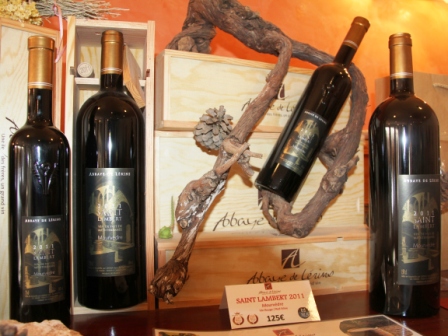
We stopped to visit the current abbey church and the shop which sold mainly wine. According to a brochure on the island wine, it is “full of spirituality.” All the vintages are named after saints, but you will pay dearly for spiritual wine.   The cheapest we found was 26 euro, but most were far more expensive.

No wine bargains here.

At La Tonnelle , the island restaurant, we each ordered a glass of the monk’s brew to accompany our lunch. A glass of Sainte Cesaire (Chardonnay) for me at 8 euro; a glass of Saint Honorat (Syrah) for VR at 11.80 euro. I found my wine too oaky and too Chardonnay. Vino Roberto’s was good, very robust. To take a bottle home: 33 euro. VR reasoned he could buy several good bottles back in the Luberon for that amount.canes.15
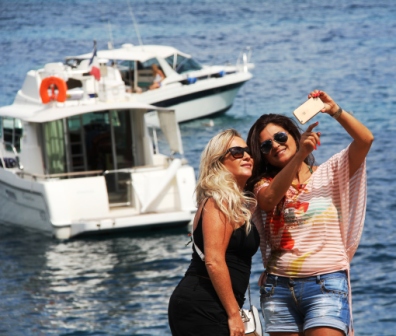
The lunch (we each ordered fish) was delicious.   People watching at this seaside eatery also gets high marks. Pleasure boats cast anchor off shore. A tender ferries passengers to the restaurant, a constant parade of the yachting crowd.cannes.8

Travel Tips:

Trip Advisor led me to the Hotel l’Olivier in Cannes, a small, family-run (22 rooms) hotel on a hillside overlooking the Med.   Our room was tiny, but our terrace with a superb view was perfect. The hotel personnel were all very warm, welcoming and helpful. It was a bit of a walk to the town center, but good exercise. The hotel has a small pool, flowered terrace for al fresco breakfast, and it’s quiet – a great escape from the chaos of La Croisette. A beach is also nearby. http://www.hotelolivier.com

Beach near the hotel

Another Trip Advisor find, the Bistrot Saint-Sauveur in Le Cannet, a town above Cannes, where we had an excellent lunch. www.bistrotsaintsauveur.fr

La Tonnelle, restaurant on the island, www.tonnelle-abbayedelerins.com

A leisurely saunter around the island takes about 1 ½ hours. Boats to both islands run about every hour during summer months. Round-trip ticket to Saint Honorat, 14 euro (price for seniors). More information www.cannes-ilesdelerins.com

Island olive tree
Island olive tree

Don’t miss Today’s Taste in column at right: DILLY POTATO SALAD, my favorite potato salad.

If not already a Tales and Travel follower, sign up (upper right) so you will not miss future posts. Your address is kept private and never shared.

Like my blog? Tell your friends.  Please leave a Reply below. Feedback is welcome. I love to know what my readers think about my posts.

Follow Tales and Travel on Facebook:  http://www.facebook.com/talesandtravel

Follow me on twitter: @larkleah

Celebrating Lemons and Bicycles

menton.9.aFruity floats, gigantic citrus creations, fabulous flowers. The annual Menton Lemon Festival (Fête du Citron) is an explosion of color, scents, and scenes in honor of the city’s prized small yellow fruit.menton..13

We were enthralled with it all during a visit many years ago, and returned a few weeks ago to survey the scene of dazzling orange and yellow sculptures once again.menton.15a

This Riviera city, the lemon capital of France on the border with Italy, has been celebrating the lemon with festivities every year since 1929. The festival attracts some 230,000 visitors who come to admire 145 tons of citrus fruits which make up the creations and exhibitions.

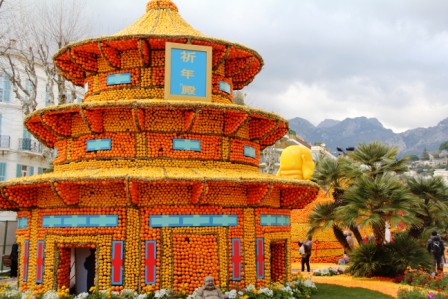
This year’s theme, the lemon in China, featured a mammoth dragon, a pagoda, a temple, animals and more all made of lemons and oranges.menton.2a

The exhibits are set up along the Jardin Biovès, a long promenade lined with the colossal fruit constructions. An elevated ramp in the middle is especially popular with the camera crowd who line the steps for overall shots of the scene. Stands selling the fruit, citrus liqueurs, soaps, jams and postcards do a brisk business.menton.17a

Menton’s microclimate with more than 300 sunny, temperate days per year is ideal for growing the tangy fruit. There are some 80 varieties of lemons, but it’s the Menton lemon that is prized by chefs for its perfume, distinctly flavored zest and pulp, and high sugar content. While the lemon gets top billing, oranges play a leading role in the gigantic creations.menton.16.a

We had previously visited Menton, my favorite coastal city, in January. See  post, “French Riviera: Magnifico Menton.” The city, which was originally part of Italy, became the property of Charles Grimaldi, Lord of Monaco, in 1346. In 1848 it broke away from Monaco, becoming a free city, and in 1860 it became part of France. By the late 19th century it was on the map as a popular tourist spot on the French Riviera.menton.1a

This time instead of staying in Menton, we crossed the border and spent three nights in Sanremo on the Italian Riviera. It’s just a 45 minute drive from Menton, and a lovely town on a coastal bike path. That was our plan – get back on the bikes.SR.5

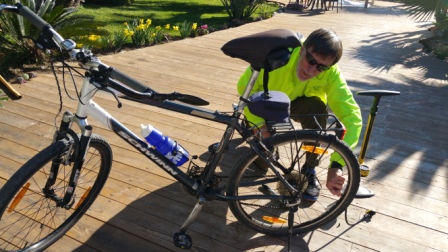
Husband, formerly known as Bicycle Bob (BB), was an avid cyclist. He seems to have lost interest in pedaling, even though he invested in a snazzy, expensive bicycle a few years ago. His passion has become wine, so I call him VR (Vino Roberto). I miss biking and the great rides we have taken over the years — in Switzerland, Austria, Germany, Holland and France.bobbike

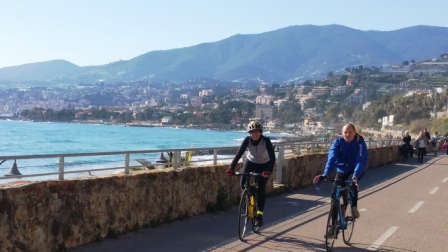
Let’s not give in to old age. Let’s get moving again. He agreed and we had a wonderful, easy ride on the bike route from Sanremo to San Lorenzo al Mare, about 18 kilometers, then back to Sanremo and another 4 kilometers in the other direction to Ospedaletti.SR.blog.7.ajpg

Old railroad tracks were converted into the wide coastal trail, used by walkers and roller bladers as well as bicyclists. It meanders through Sanremo then down the coast. No hills. No need to downshift. There are plenty of spots along the route complete with benches where you can rest and enjoy the scenery. And villages (Bussana, Arma di Taggia, Santo Stefano al Mare) for a refreshment stopover.bike

We had a fantastic and bargain lunch at Café Emy by the beach in San Lorenzo al Mare. The insalata frutti di mare (seafood salad) was huge – a meal in itself. My spaghetti frutti di mare was the best I have ever eaten (see photo).spaghetti

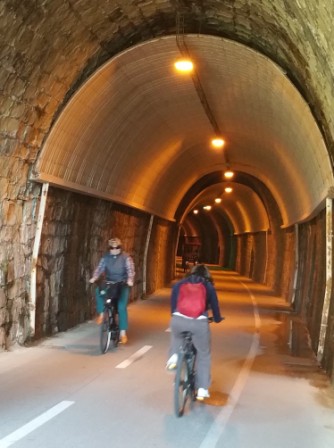
A unique aspect to this bike route is tunnels – several. The most famous and longest is the Capo Nero tunnel along the section Sanremo-Ospedaletti, 1.75 kilometers long. It has been converted into a memorial of sorts to Sanremo’s most famous sporting event, the cycling classic Milan-Sanremo. For more than 100 years, the race has been the first important contest of the cycling season. It will take place on March 22 this year.

Every bay of the tunnel is dedicated to a specific year in the history of the race, with some basic facts about that year’s event written on one side, with tidbits SR.blog.9.ajpgand anecdotes on the other, in both Italian and English. I was too busy pedaling to read it all, but did try to catch some phrases to break up the monotony of the dismal tunnel trek.

Total ride: 45 kilometers. It was a success. And, so was the hotel where we stayed. Fabulous. With just four rooms, the Villa Rita can’t really be called a hotel. The house sits just above the beach within walking distance of the town center. Our room had a large terrace and lovely views. I was in heaven, lying in bed, enjoying the sea view from the window while listening to the restful sounds of waves slapping the shore — and contemplating future bike rides.

breakfastVilla Rita: www.villaritasanremo.it

Menton Lemon Festival: www.fete-du-citron.com/ The festival takes place the last two weeks of February.

Ristorante Bar Emy, Via Al Mare 1, San Lorenzo al Mare, Italy, ++ 39 0183-91314SR.1a

If not already a Tales and Travel follower, sign up (upper right) so you will not miss future posts. Your address is kept private and never shared.

Like my blog? Tell your friends. Feedback is most welcome. Leave a Reply below.

Follow Tales and Travel on Facebook:  http://www.facebook.com/

Follow me on twitter: @larkleahSR.7.ajpg


Club Med St. Moritz: A winning combination

clubmed.8I love Club Med. The love affair started way back in the ‘70s when my friend Irene and I, both late 20-somethings, set off to the Club in Martinique. Fabulous. The next year we tried the Club in Cancun, Mexico. Even better.   Good times were had… even a tad on the wild side, but we were young.

Since living in Europe, I’ve been to several clubs in the Alps for skiing, most recently St. Moritz, Switzerland. Husband VR no longer wants to ski, so I joined my friend Gerlinde from Stuttgart and her son and daughter-in-law, all downhill skiers who have been coming to Club Med St. Moritz for several years.

Although much has changed with Club Med since its earliest days back in the 1950s when it was known as haven for swinging singles, much is the same.St. Moritz.fone 187

It’s the perfect all inclusive vacation – food, beverages (including wine and cocktails), lodging, use of sports facilities and lessons, evening entertainment – all for one price. Rental of ski equipment, however, is extra.

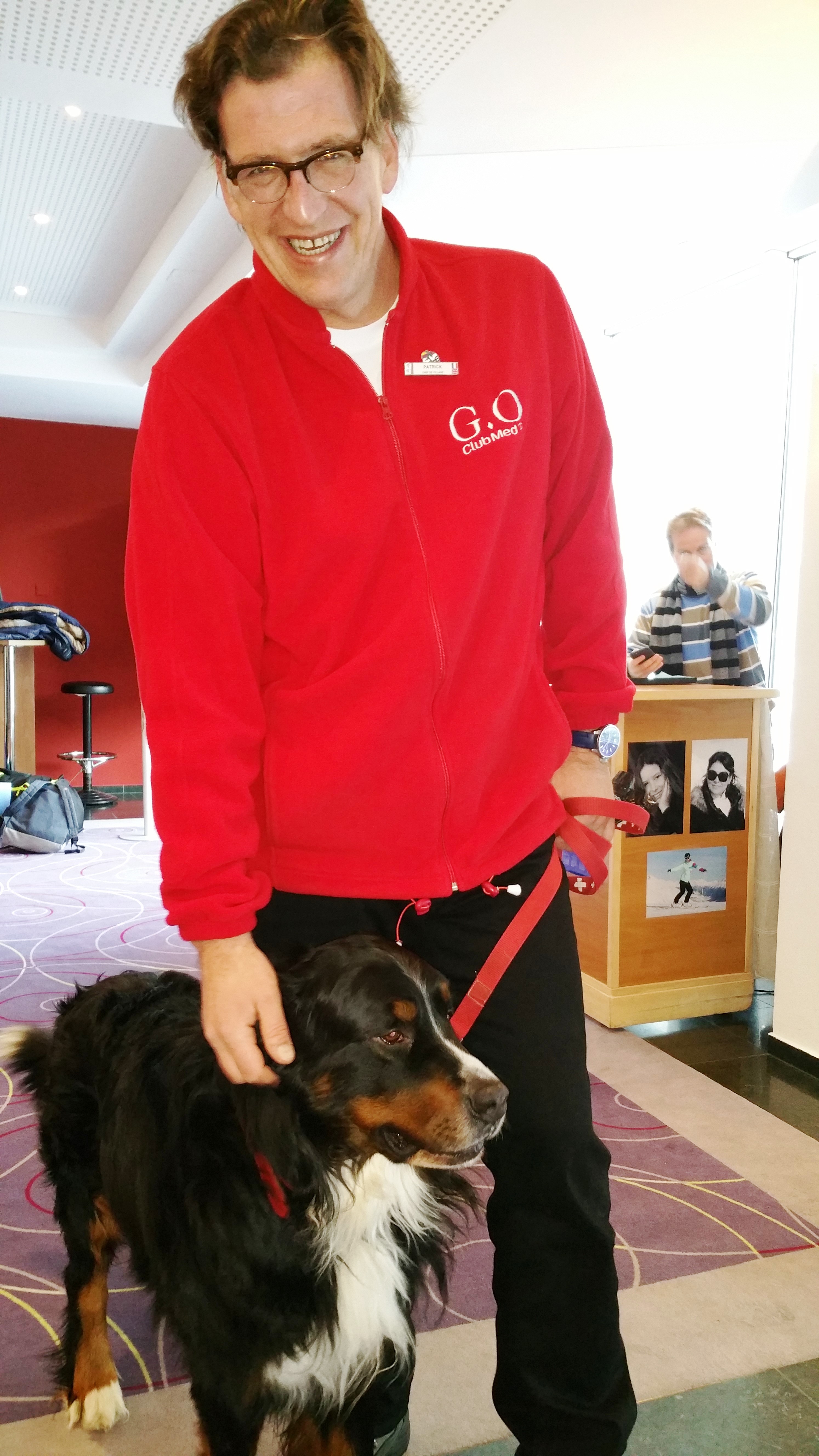
“You can be here for a whole week and not spend any extra,” said Patrick Franck Oberaspach, the chef du village (manager) of the St. Moritz Club. My only

Patrick and Basile
Patrick and Basile

additional expenses, not including ski and boot rental, were a few cups of coffee in the town, and some special bandages for a blister caused by my ski boots.

Clubs are now family oriented, with many clubs, including St. Moritz, having a Mini Club for children. The kids are entertained, taken to the slopes, given ski lessons. They, and their parents, love it.

And, Clubs are no longer just for the younger set. I was overjoyed to find so many older GMs (at Club Med, originally a French enterprise, guests are Gentils Membres or nice members). I may be old, but there were plenty even older than I. Most, like me, were Club Med repeats.

Patrick noted that during the week I spent there, 60 percent of the 540 guests were repeats. Colette, a woman from Nancy, said she has been coming to Club Med St. Moritz for 40 years. “I switched to cross country 10 years ago. Downhill skiing was too fast. Now I snowshoe,” she said.

Club Med offers rental equipment and instruction in all of the above. Since my new knee performed so well on the slopes last season, I signed up for downhill. Gerlinde, an excellent skier, and I chose group level 4. The Club divides skiers into 6 categories, with 6 being the top for those hard core, off-piste daredevils, i.e. her son Tobias.

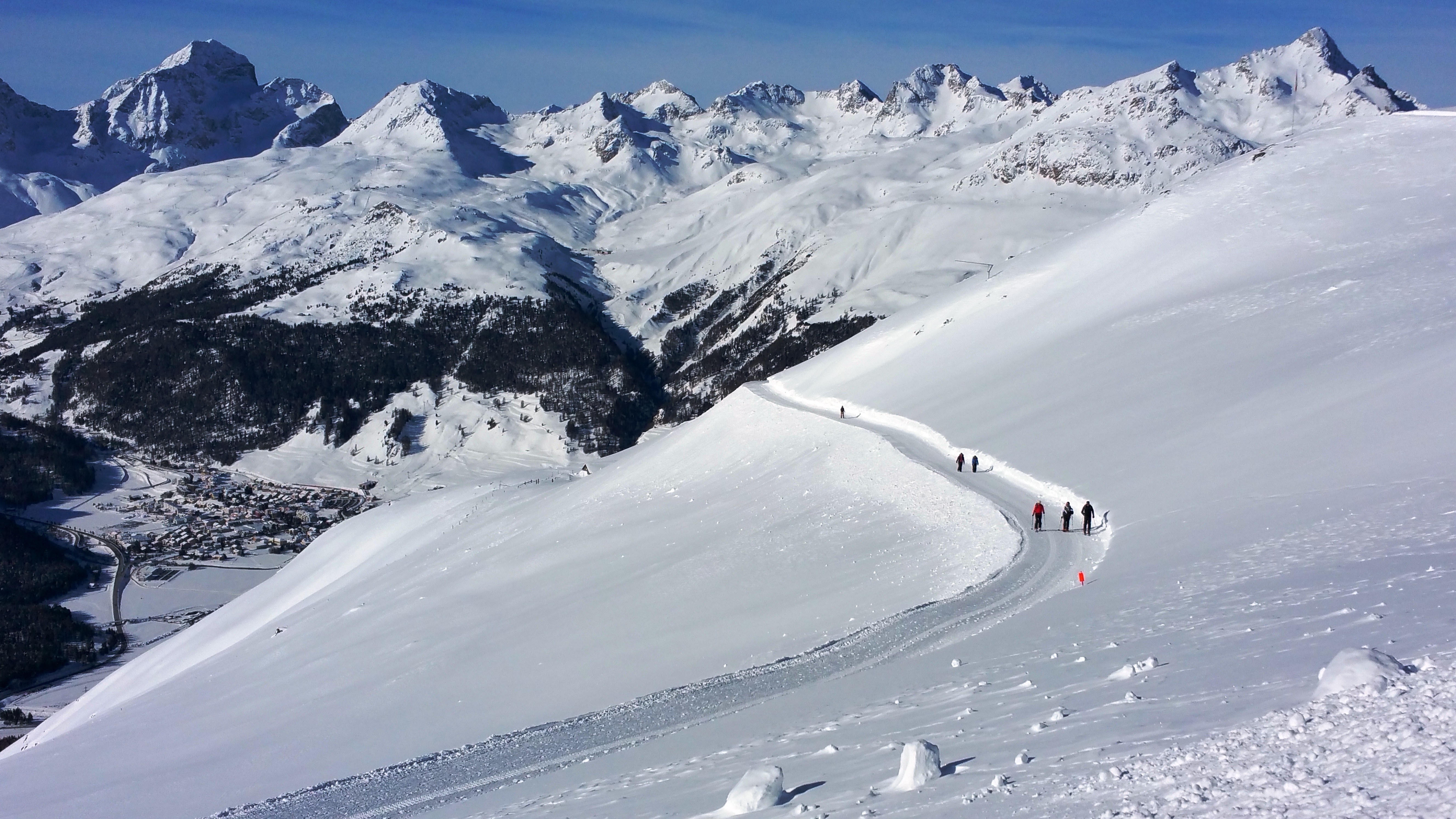
For non-skiers, there are plenty of high altitude trails in the snowy mts.

We started out with a group of about 10 others, all good skiers and mostly much younger. Our monitor, ski instructor and guide, led us down the perfectly groomed slopes at a fast pace. No breaks for hot chocolate, photos or admiring the scenery. I kept up, but was more than ready for the lunch break at the Club’s mountain restaurant.

After lunch, the monitor mentioned that a couple from the group (older like me) was switching to a slower group 4. Lest I expend all my energy on the first day, I followed. A wise move as the new group 4, all good skiers but most in my age range, did ski a bit slower. A few days later Gerlinde also joined the slower group of senior citizens.

After lunch rest at the Club's mt. restaurant.
After lunch rest at the Club’s mt. restaurant.

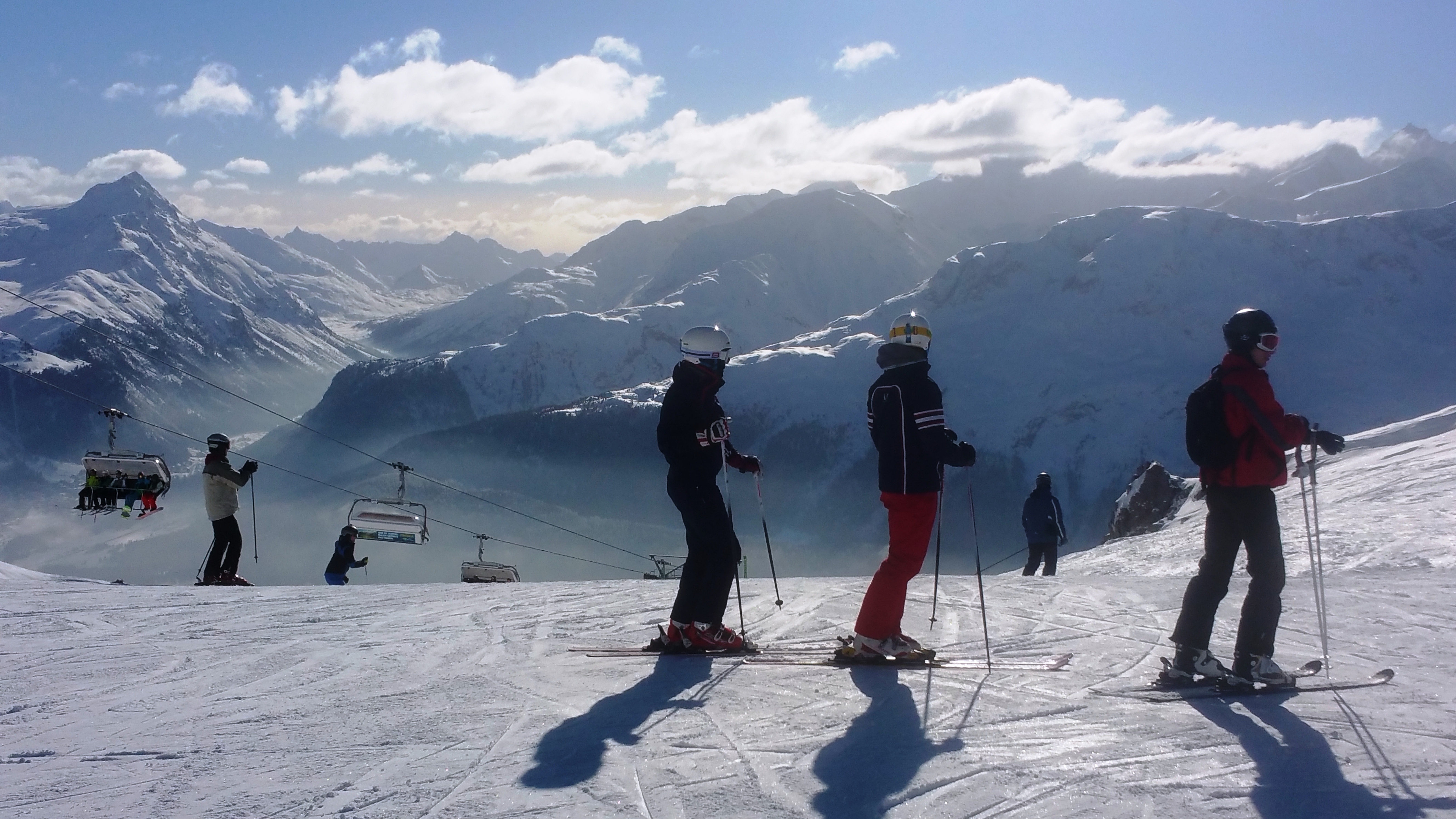
But, we were hardly a group of turtles on the blue, baby slopes. We kept on the move, whizzing down red slopes and even an occasional black run. Our fellow skiers were all very fit. Joggers. Serious cyclists. Cross country as well as downhill skiers.

All had been to Club Med St. Moritz many times. It’s the slopes, as well as the Club, which draws them back. “It’s a very empty ski area which is fantastic in the Alps,” said Patrick. “You usually queue half of the ski day, but not here.” He’s right. No lift lines during my visit. Others praised the meticulous grooming of the slopes.   A cross country skier, who has been coming back for 20 years, called St. Moritz “the best in Europe” for that sport. “The Swiss keep the trails in beautiful condition.”

No crowds on St. Moritz slopes

Gerlinde loves the area for skiing.   “No beginners on the slopes. Few snow boarders. No young, crazy skiers.”

Our ski group was German speaking. However, the club has multi-lingual monitors. In addition to German, there were French, Italian and English language ski groups.

People contact is another Club plus. In addition to skiing with others, you may sit with them at meals, socialize after skiing, join them at après-ski entertainment. Club Med staff, Gentils Organisateurs (GOs) or nice organizers, mingle with guests, dine and party with them.

Gerlinde, who came alone to St Moritz for her first few visits, said, “Even if you come alone you will find friends.”

Snow polo on St. Moritz's frozen lake.
Snow polo on St. Moritz’s frozen lake.

Back when Irene and I went to Martinique, we quickly found friends and more. Irene signed up for sailing. I went for scuba. We joined a Yoga group. We played volley ball. I participated in a French conversation group. We met interesting people from distant lands. We had fun, so much that we extended our stay for an extra three days.

Club Med is no longer a French company having recently been purchased by a Chinese conglomerate. Patrick does not expect big changes. He pointed out that Club Med has been partners with the Chinese firm for some 10 years. “They guarantee that we can continue as before,” he said.

Admiring the scenery on the trail at Muottas Muragl.

There are now 70 Club Med villages around the world, including three in China. Future plans call for opening three new resorts each year as well as closing some that are no longer profitable.

Patrick, 42, began his Club career as a ski teacher many years ago on the St. Moritz slopes. “I gave ski lessons to kids who now come with their kids,” he said.

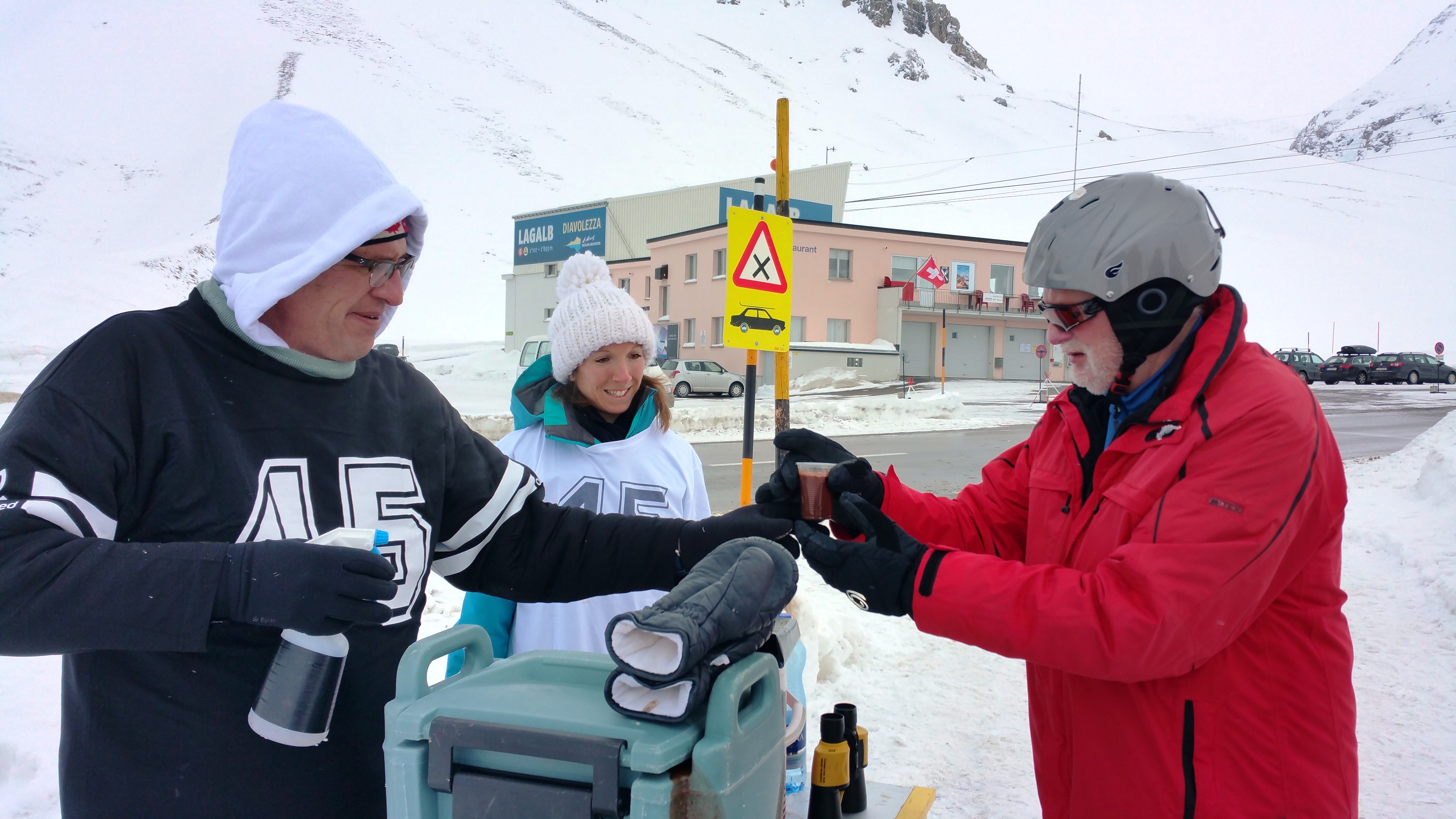
clubmed.1As chef du village, one would expect he’d be busy, but I had to wonder if he ever slept. One frigid morning we bused to an adjacent ski area. Patrick was on hand dispensing hot chocolate — with a shot of schnapps if desired. He greeted guests as they filed into the dining room at dinner each evening. He was the MC and sometimes an actor as well in the after-dinner shows, a Club Med tradition.

After dinner fun.
After dinner fun.

What keeps him with Club Med? He has always enjoyed mixing with the clientele. “The Club Med staff don’t stay apart. You discover lots that you would not normally discover. You have lots of interesting conversations. It’s quite enriching to work in this environment.”clubmed.6

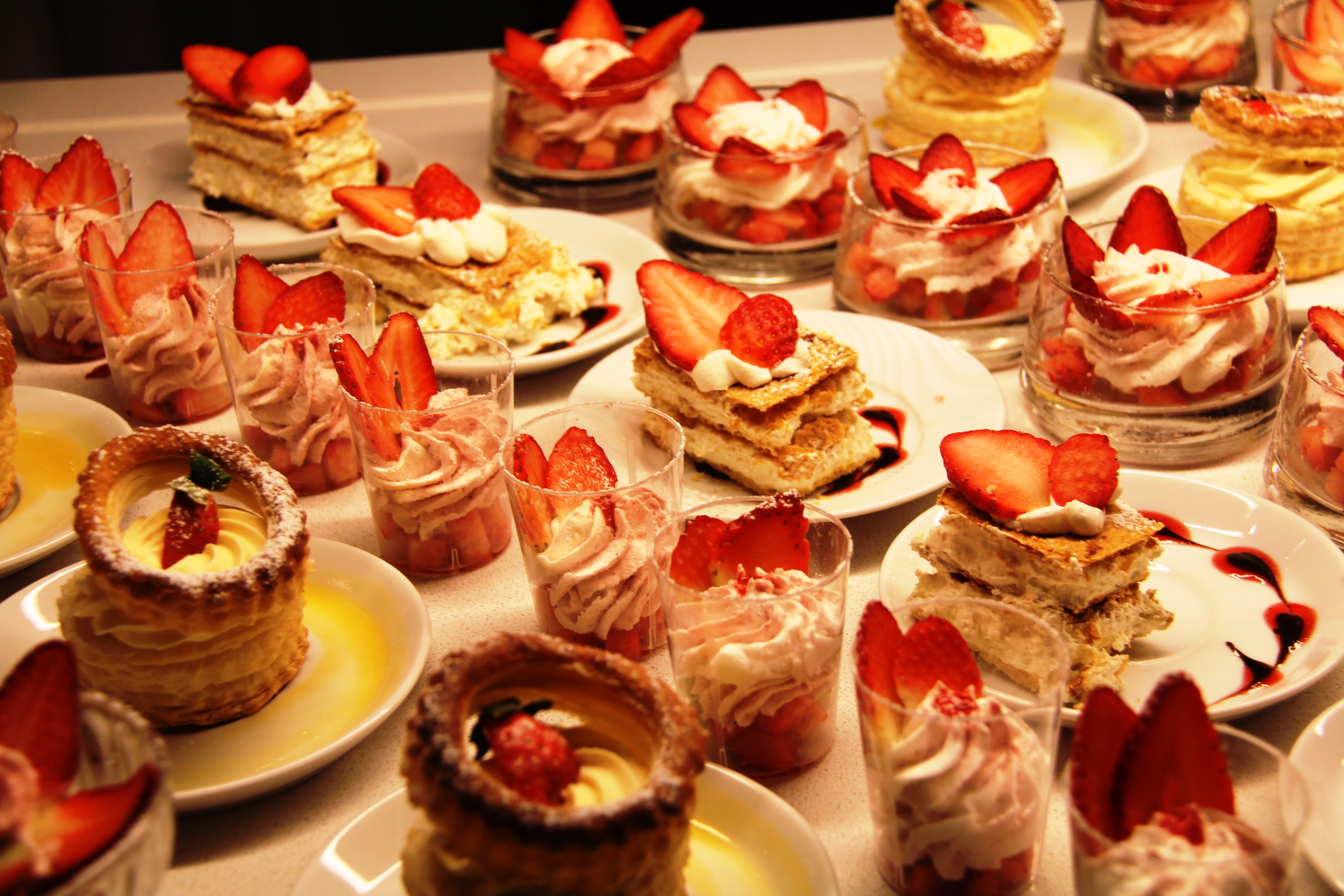
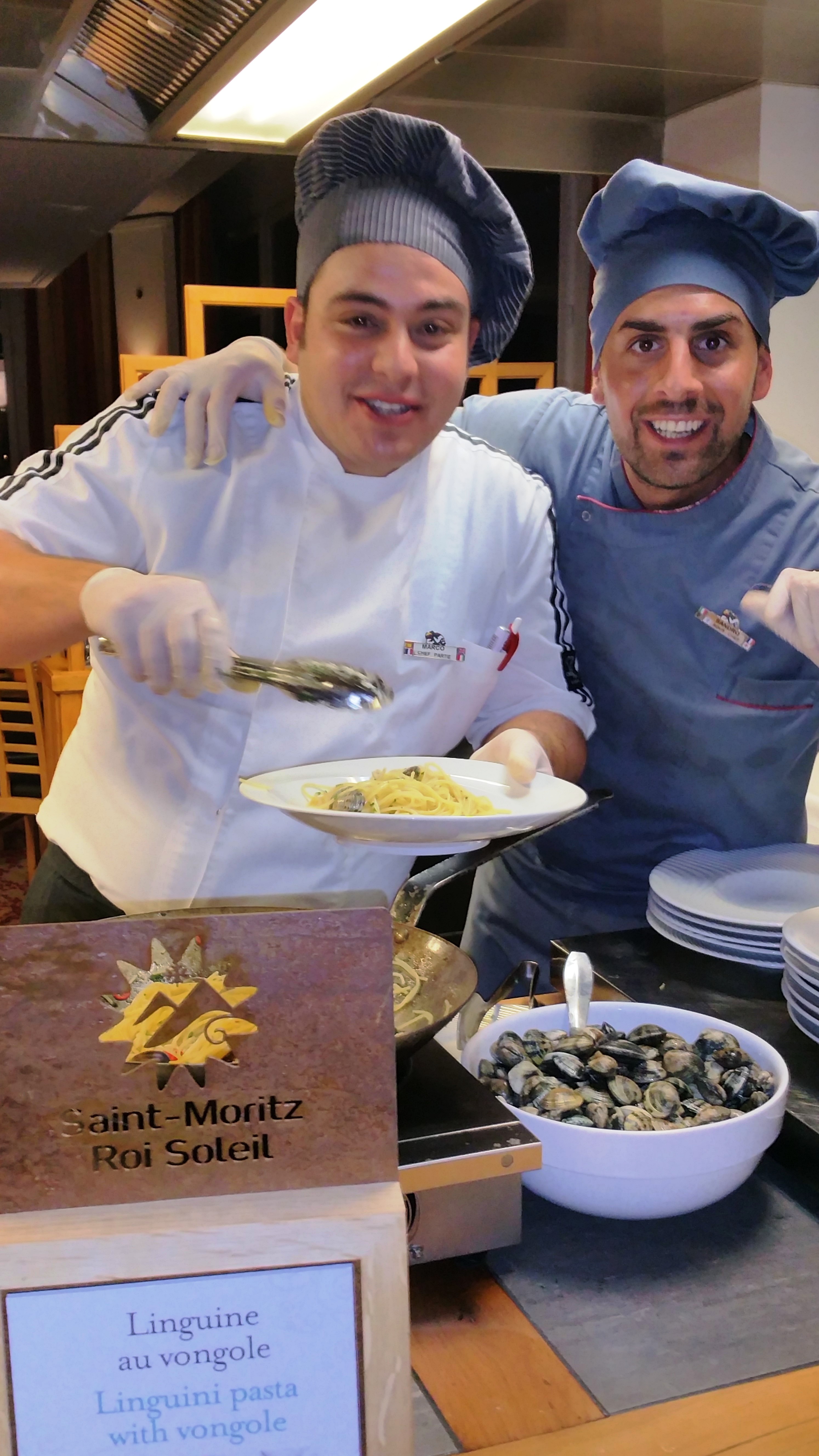
And delicious. Be it a summer or winter Club Med, the food is fantastic, and yet clubmed.9another reason the Club has so many fans. St. Moritz cuisine was amazing. It deserves its own blog post. Stay tuned.

My all-inclusive ski week at Club Med St.Moritz cost 1,141 euro. Ski and boot rental extra. Gerlinde and I shared a room.

More on Club Med: http://www.clubmed.com. More on St. Moritz: www.stmoritz.ch

Today’s Taste features that spicy North African dish, Tagine. Click on photo at upper right to see recipe.

If not already a Tales and Travel follower, sign up (upper right) so you will not miss future posts. Your address is kept private and never shared.

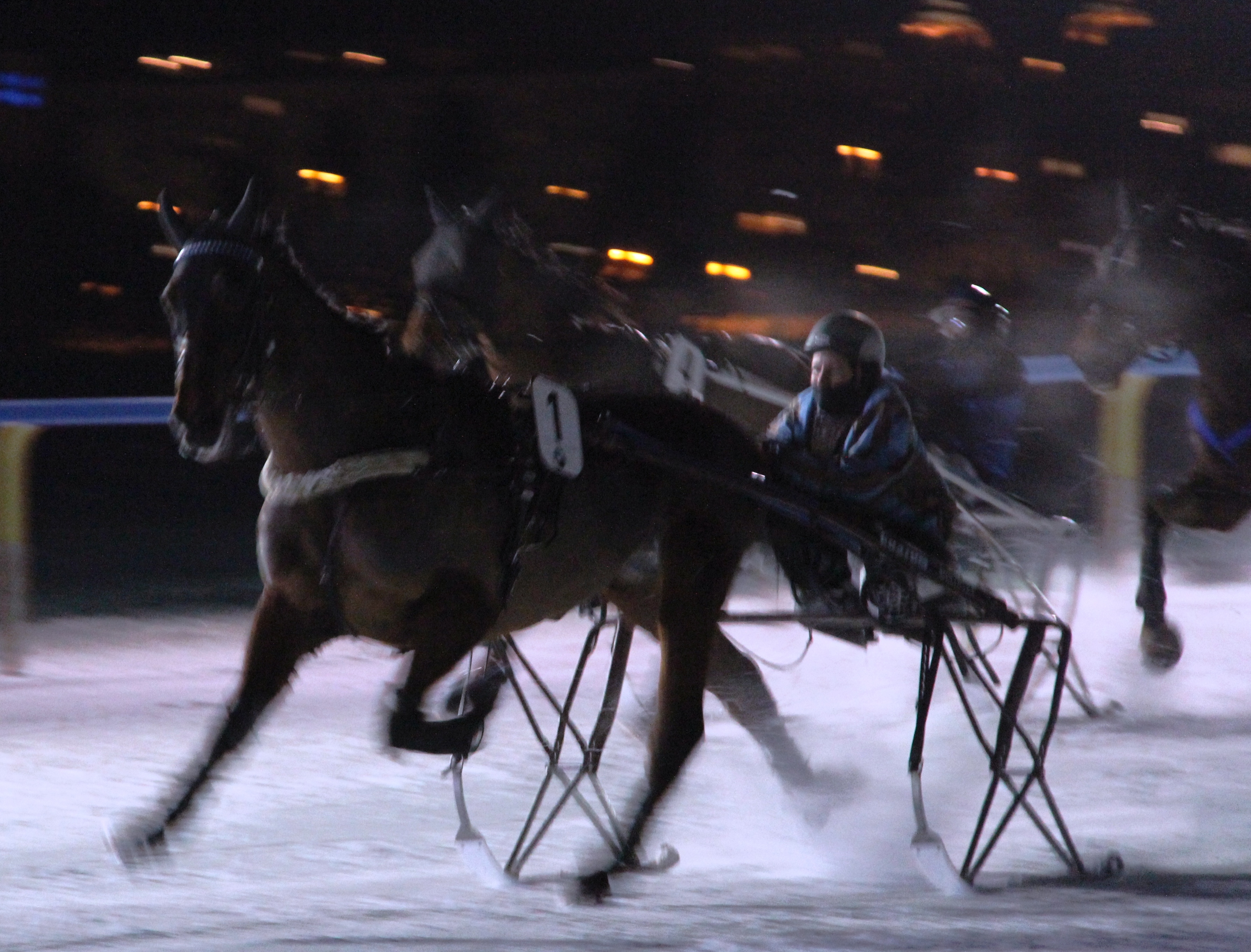
More horse racing on the lake. The "carriage" behind the horse is on skis.
More horse racing on the lake. The “carriage” behind the horse is on skis.

Like my blog? Tell your friends.  Leave a Reply below. Feedback is welcome.

Follow Tales and Travel on Facebook:  http://www.facebook.com/talesandtravel

Follow me on twitter: @larkleah


Incredible Iceland Part II

 Merry Christmas to Tales and Travel fans. For all about Christmas in southern France, see my previous post, “Noel en Provence,” Dec. 2010. And, just in time for holiday reading, more Iceland:blog2.16

“Of Horses and Men,” a strange but captivating movie about Iceland, piqued our curiosity about the country.   We saw the movie several weeks before departure for our Icelandic adventure. The horses were sensational. I knew I would have to ride an Icelandic horse.

I did earn a Girl Scout badge in horsemanship at the age of 12. Too, too long ago. But, I have always been enamored of horses and have ridden off and on (mostly off) since my childhood.   I am definitely not an accomplished rider, but riding an Icelandic horse seemed so easy in the film.blog2.1

It’s the tölt, the fifth gait of these small, sturdy horses which were originally imported by the Vikings.   A trot? A running walk? Whatever, the tölt is amazing to watch. The horse moves at a gentle speed, precisely, rhythmically moving legs up and down, while the rider seems frozen to the saddle. No bouncing, jolting, posting.   “You can drink a glass of champagne while the horse tölts,” it is said.blog2.17

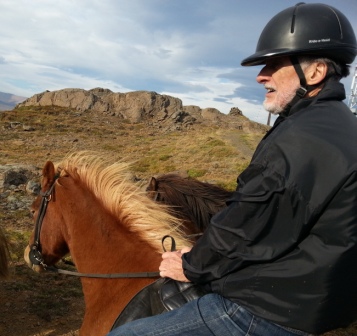
Forget the champagne, let’s just ride. And, we did, with Andres and Luka, a young couple who have 25 horses at their riding company in northern Iceland.    Husband VR (Vino Roberto) is (or was) dedicated to a bicycle saddle. He is not thrilled about riding a horse, but he put up a brave front and joined me and Karen, a woman from our conference group. We followed our leaders up and blog2.19down rocky hills, through fields, with superb views of the non-too distant sea. VR was not at ease. Those steep downhills freaked him out. He was all too happy to dismount so Andres could take Karen and me to flat land for at try at tölt.

We charged along, but I was bouncing, painfully jerking up and down, to and fro. I tried to post. No go. This can’t be the tölt. After about just 10 minutes of this agonizing experience, we gave up. Apparently it takes skill to get the horse to switch to this gait. Even Karen, who is a riding instructor in the US, was only briefly successful.

I am still happy that I rode an Icelandic horse. It is one of the many adventures touted in the tourist brochures.blog2.8

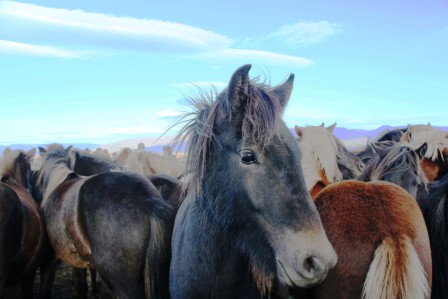
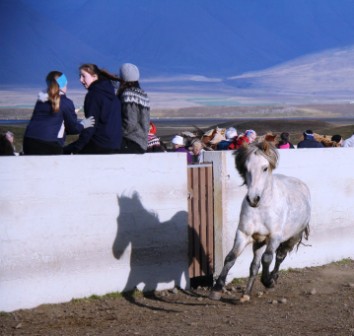
Along our drive in the north country we encountered more horses, a roundup – exactly like the scene in the movie. Icelandic horses are driven up to mountain pastures where they roam freely during the summer. In the fall they are driven back to the lowlands. We stopped to watch the horses, corralled in different pens, being claimed, and then separated, by their respective owners. All the horses are micro chipped, we learned. Many wanted no part of leaving their summer friends and gave their owners a challenge, resisting attempts to move into different pens. It was an exciting spectacle.blog2.3

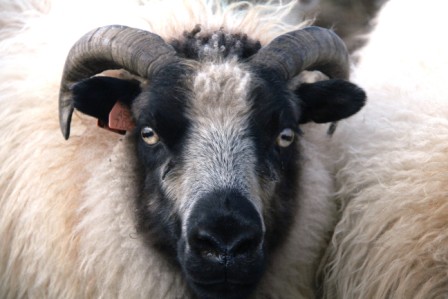
A few sheep were held in other pens . Sheep are as prevalent in Iceland as pigeons in Venice. They, too, spend the summer in the mountains. Most had been rounded up earlier. Those we saw were stragglers left behind who joined the horse procession to the valleys.blog2.2

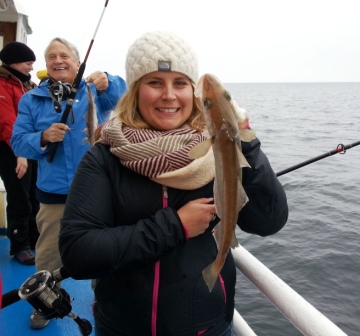
Horses and sheep are important to the Icelandic economy. But, not nearly as important as fish. Today the fishing industry accounts for about half of the country’s GDP. We joined a whale watching cruise but saw only a few tails of distant whales for nano seconds. Fishing was offered on board. It did not excite me, but I did brave the cold winds on deck to take photos of the fishermen and women.blog2.21

Incredible! Almost as soon as they would throw a line into the choppy sea, a bite. They hauled in fish after fish, sizeable critters, mainly haddock but some mackerel. One woman caught six in less than a half hour. This did excite me. I had to give it a try. Too late. All the hungry fish had been caught, or the word had spread underwater that this was a dangerous offering. No matter. A chef on board instantly cleaned and grilled the fish – fabulous.blog2.10

A word about whales. Iceland, despite global condemnation, is engaged in commercial whaling. The country did respond to diplomatic pressure in 2012 and renounced hunting of fin whales. Minke whale hunting continues, mainly for export to Japan. I did see whale on some restaurant menus, but Icelanders are said to eat little whale.

“It’s all emotional. The countries who criticize us are doing far worse,” said a worker at a fish factory.blog2.11

We had another fishy outing, joining a “Sea to Table” excursion. First stop, a smelly factory where fish are prepared for export. We were suited up for the tour – white plastic coats, blue hair nets, shoe cover-ups. A perfect Halloween costume.blog2.12

Much of the fish processing is automated, but we did watch skillful employees undertake the initial step – off with head, out with the guts – at record speed.

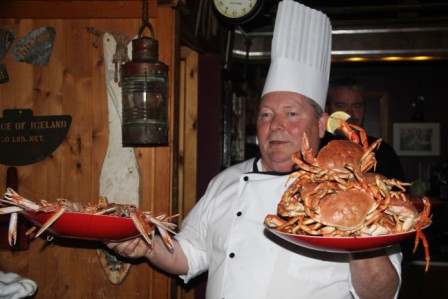
The best part followed, a “grand crab feast” at a nearby restaurant, Vitinn, where mussels and other sea creatures are kept in live holding tanks. The restaurant’s claim to fame is rock crab, a marine delicacy found only in Icelandic waters and off the east coast of North America. The meal began with an exquisite crab soup, then a buffet of an overwhelming assortment of shell fish.blog2.13

In the town of Höfn, I savored another sea delicacy, what Icelanders call “ lobster,” but is actually langoustine. Pricey, but delicious.

VR is not a vegetarian, but much prefers fish to meat. He was in his element in Iceland where fish is on every restaurant menu, usually many different kinds. Atlantic char is a favorite and tasty. What about all those sheep? Lamb, too, is on many a menu. Because the lamb graze freely all summer, chowing down on chemical-free grass and herbs, the meat is extra tender. We met an American woman, a frequent Iceland visitor, who takes large quantities of vacuum packed lamb home with her.

blog2.22Fish and lamb aside, my favorite Icelandic food is skyr, a yogurt like concoction made from skimmed milk. It’s extra creamy , rich, decadent – but low in fat. It is often mixed with fruit flavors. Since food in Iceland is very expensive (see previous post “Incredible Iceland”) we often bought containers of skyr to have in the room for our after dinner dessert.

Iceland is paradise for adventure seekers with a laundry list of offerings: glacier hikes, trips inside volcanoes, scuba diving and snorkeling, caving, rafting…. We went for an ATV (All Terrain Vehicle) outing. These were heavy, monstrous vehicles. Again, a uniform was required: Bright orange coveralls, boots, gloves and helmet. The how-to briefing was that — brief. I let VR take the wheel, but had intended to give it a try during the ride.blog2.14

I quickly changed my mind. We were a large group, about 18 vehicles, with a leader in the front vehicle and another bringing up the rear. Just 10 minutes into the ride, an abrupt stop.  We waited and waited, then got off and walked ahead to investigate what the holdup was.

A vehicle was overturned at the bottom of a cliff. Fortunately the driver and passenger had been thrown off and were lying on the ground above the crashed ATV.   It took time for assistance and medical personnel to arrive. The victims were taken to a hospital. Both suffered severe injuries, complicated bone breaks. After a stay in a hospital in Iceland, they returned to the U.S. for surgery.

The ride continued. My desire to drive was quashed.  VR said it was fun, but I found the journey too long and too cold. The scenery, like much of Iceland, was barren, bleak. It quickly became monotonous.blog2.15

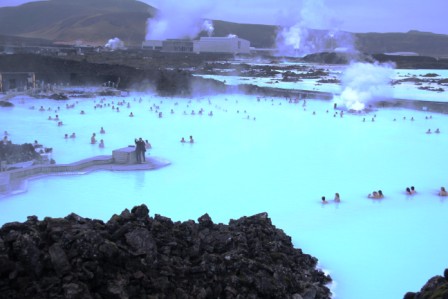
Never mind, we all went on for a soothing afternoon at Iceland’s number one tourist attraction: the Blue Lagoon, an enormous outdoor pool of geothermal water. There is even a bar in the center offering cocktails. And, a station with silica mud deposits to smear on your face – good for the skin and wrinkles.

I am a swimmer. I like to move in the water. These warm spa pools bore me after about 10 minutes. But, one cannot visit Iceland without a soak in the Blue Lagoon. A fitting way to end our two-week journey in Incredible Iceland.blog2.7

Horseback riding with Andres and Luka, a delightful couple who invited us for refreshment in their home after the ride, www.Icelandhorsetours.com

Whale watching and fishing: Elding Whale Watching, www.elding.is

Vitinn Seafood restaurant, www.vitinn.isblog2.4

No new recipe this time. But, the grape salad (top right) is fabulous, a perfect accompaniment to a holiday dinner.

blog2Like my blog? Tell your friends. Feedback is most welcome. Leave a Reply below. Sign up (upper right) to become a Tales and Travel follower so you will not miss future posts. Your address is kept private and never shared.

Follow Tales and Travel on Facebook:  http://www.facebook.com/talesandtravel

Follow me on twitter: @larkleah