It’s easy to understand why artists, film stars, royalty, politicians, Russian oligarchs – and plain old folks like us –are enamored of the French Riviera. The scenery, that seductive combination of mountains and sea, is the stuff of glamorous coffee table books. Add to that plenty of sunshine, good food and happy faces.
VR and I would like to join those happy faces someday, downsize and move closer to the sea. With that long range goal in mind, we set off to Menton last week. It is the last city in France on the coast before the Italian border. At times, you’d think you were in Italy. Lots of Italian spoken, restaurants featuring Italian specials, more joie de vivre. Even though that’s a French term, the Italians seem to have lots more of it than the too-often dour French – in my opinion.
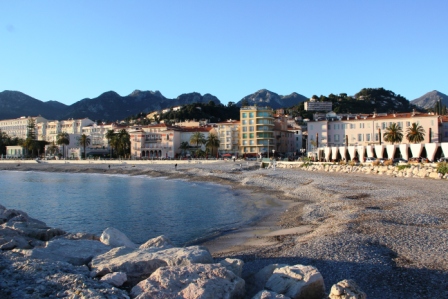
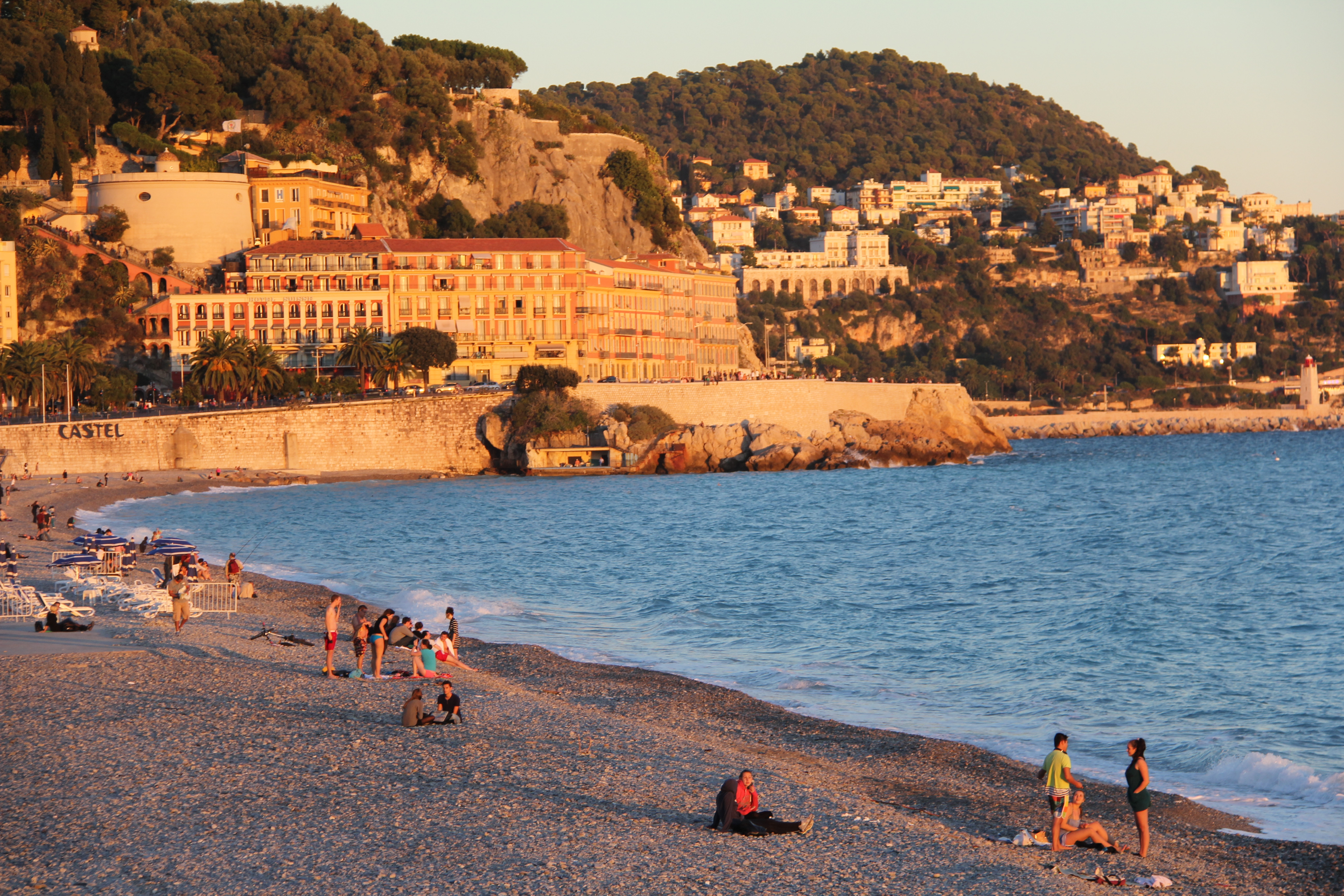
Menton has a lovely stretch of beach (stones not sand) bordered by many turn of the century mansions, not unlike Nice, just smaller. Skinny streets in the Old Town, as well as long sets of pebbled steps, climb to an imposing Italian Baroque church, then onwards to a chapel and even higher to a cemetery. There’s a busy pedestrian shopping street, an old covered market hall, and a well known museum dedicated to the works of artist Jean Cocteau. The city is also known for its gardens which we will visit next time.
We found many restaurants closed for the season in January, but thanks to the advice of a woman at the tourist office, we had a wonderful fish dinner (Branzino sotto sale). Sea bass baked under a mound of salt which locks in all the moisture. Owners of the Coquille d’Or restaurant, the chef and his wife, are Italian. Our waiter was Italian. The fish – maybe it came from the Italian Med.
Ventimiglia, the town just across the border in Italy, has an enormous Friday market, a source of fashion bargains and more. Parking is always a nightmare, but our Menton hotel desk clerk suggested we take the train. Perfect and only 11.20 euros round trip for both of us. This time the market was a disappointment, perhaps because it’s too early for spring fashion, too late for winter?? I did find a few cheap treasures.
Then, a return to a waterfront restaurant we had found on a previous visit for another amazing meal. VR went for grilled fish. I chose spaghetti frutti di mare, chuck full of mussels, clams, a few shrimp and some unknown critters.
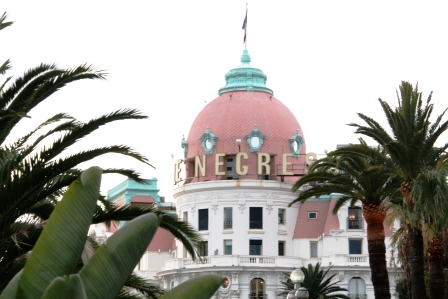
Before heading back to our abode in the hinterlands, we joined members of the American Club of the Riviera for an outing in Nice. A guided visit of the Musée Masséna preceded a gourmet lunch at the Hotel Negresco. The museum, a sumptuous Belle Époque villa on the Promenade des Anglais, was built between 1898 and 1901 by Victor Masséna, grandson of one of Napoleon’s marshals, and a collector of precious objets d’art.
More opulence next door at the Hotel Negresco, another Belle Époque gem (1912). According to a guidebook, it is “one of the great surviving European palace-hotels.” I was delighted to see a gigantic Niki de Saint Phalle Nana adding a whimsical touch under the Baccarat chandelier hanging from the dome in the Salon Royale which was built by Gustav Eiffel’s workshops.
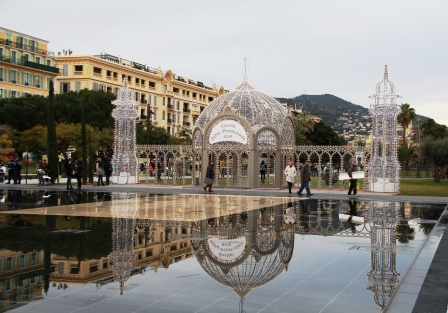
By the time our excellent lunch (gazpacho, lamb and apple crumble) ended, clouds put an end to the sun’s rays. No chance for good photos of Nice’s new addition, the Promenade du Paillon, a strip of parkland between the city center and Vieux Nice (Old Town). We did saunter down the Promenade des Anglais, along the sea, then crossed over for a walk to the giant Ferris wheel at the end of the new reflecting pool.
We’ll be back in Menton at the end of February for its Lemon Festival (14 Feb.-4 March) www.fete-du-citron.com
American Club of the Riviera: americanclubriviera.com
Restaurant Coquille d’Or: xx 33 (0) 4 93 35 80 67
More on Nice www.nicetourisme.com Nice’s Carnaval celebration, lots of fabulous flowers on parade and more, takes place from 13 Feb. – 1 March. See my previous posts: “Nice Carnaval,” Feb. 23, 2009 and “Nice- Enchantment on the Riviera,” Jan. 12, 2012
Since I am in an Italian mood, and since a hearty soup is perfect for these cold winter days, Today’s Taste features one of my favorites, Minestrone. See Recipe column at top right.
Like my blog? Tell your friends. Feedback is most welcome. Leave a Reply below. Sign up (upper right) to become a Tales and Travel follower so you will not miss future posts. Your address is kept private and never shared.
With its gorgeous landscapes and numerous attractions, Provence is a Mecca for tourists. French. British. Dutch. Belgians. Asians. Russians, and many more.
Hilltop Gordes — the quintessential Provence perched village.Friends and relatives who come to visit us in the Luberon hills also enjoy the allure of Provence. Carol and Noel, friends from Germany who have retired to northern Italy, arrived in early October. Soon after came John and Mickey, VR’s (husband Vino Roberto’s) brother and sister-in-law from northern Ohio.
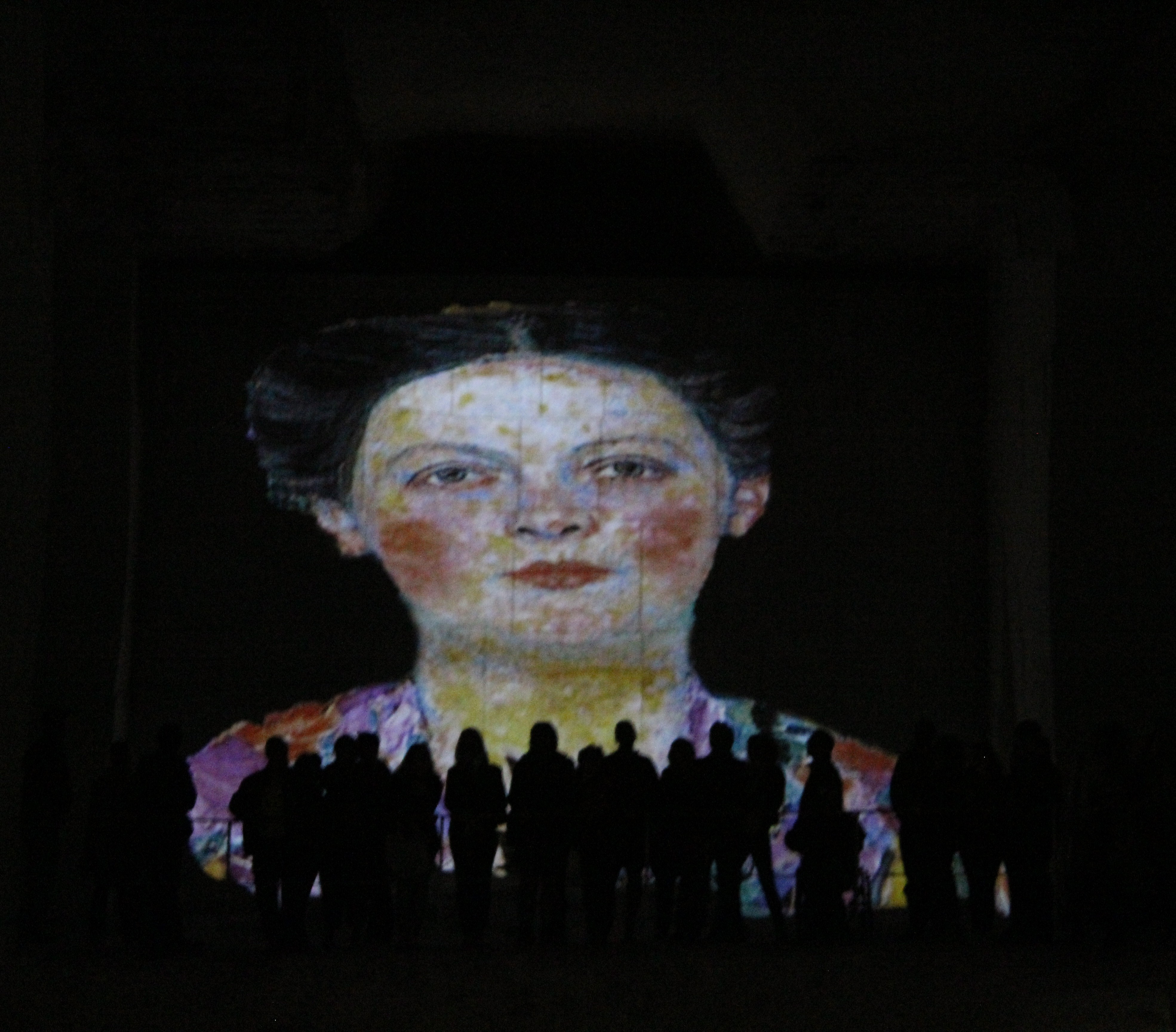
We kept on the move and had fun showing off our Provence favorites. A hit with all was Carrières de Lumières in Les-Baux-de-Provence. Words fail to describe this amazing place –vast caverns, formerly quarries, where a unique multimedia presentation enthralls all. The show changes every winter.
“Klimt and Vienna” is this year’s show, ending Jan. 4, which features the works of turn-of-the-century artists Gustav Klimt and Egon Schiele, plus Fritz Hundertwasser, projected on the walls and floors. Wander through the immense space, engulfed by the gigantique tableaux. Enjoy the mesmerizing musical background.
“Klimt is now one of my favorites. The show is awesome. I could have just sat there all day looking at the images,” said Carol. We, too, are overwhelmed with the production and return every year to see the new show.
The ancient town, Les-Baux-de-Provence, with its medieval château, spectacular views and boutique lined cobblestone streets, is also captivating. ”I’ve been to a million of those cutesy towns that have become little more than amusement parks. Les Baux seemed, to me, to have retained some of its soul,” commented Noel.
Mickey was especially intrigued with the site where the ruins of an 11th century citadel dominate a plateau perched on a rocky spur. She listened to the explanations on an audio headset at each numbered stop throughout the historic site. “I love castles,” she said.
Carol and Noel were also impressed with Roussillon, a touristy town whose attraction is its Sentier des ocres (ochre footpath). A trail descends into a gorge of orange/yellow walls, then winds through the woods bordered by these exotic, colorful cliffs. The area was also formerly a working quarry.
Carol and Noel and Bouillabaisse.Noel had made a special request . He remembers a scene in the movie, “In Like Flint” with James Coburn, during which Coburn savors Bouillabaisse, Marseilles’ signature dish. He had to eat this legendary fish soup in Marseille. I did some
Bouillabaisse is much more than fish soup. A plate brimming with different kinds of fish comes with the soup. Carol ordered the deluxe version with lobster.restaurant research to find a place serving authentic Bouillabaisse. Many restaurants have a version for tourists. My find, Le Ruhl, has a perfect setting on a hillside just adjacent to the Mediterranean. Great views – but the food? OK, but not great. Next time I’ll try another restaurant for Bouillabaisse
Selfie, of sorts, under the new, giant mirrored canopy at Marseille’s Vieux Port.Before lunch we had hoped to take a boat ride of the calanques (dramatic fjord like inlets in the limestone cliffs between Marseille and Cassis), but due to the fierce Mistral which blows too frequently in these parts, the boats were not running. We braved the winds and took a long walk through the Vieux Port, then on to the J4 Esplanade, Marseille’s swanky new addition for 2013 when the city was the European Capital of Culture. I never tire of admiring the dazzling architecture of the new Villa Méditerranée and MuCem ( museum of Mediterranean and European culture).
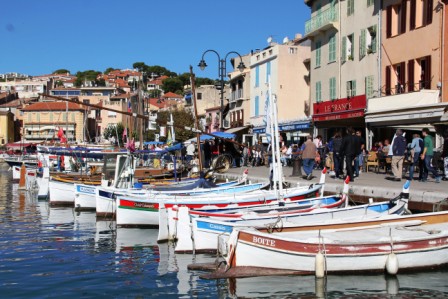
Mickey and John did get to see the calanques. On a delightfully calm day we boarded the sightseeing boat in the enchanting port town, Cassis, for the excursion through parts of this dramatic coastline. It was market day in Cassis with vendors selling clothing, food, purses and all manner of souvenirs.
Markets are a major Provence attraction. Mickey accompanied me to Forcalquier, a town near our home known for its big Monday market. “I loved the shopping you did at the outdoor market,” she later said. “ I really liked that you were able to purchase fresh fruit, vegetables, produce, eggs, fish and sausages direct from the farmers the same morning they were picked. I enjoyed listening to you get a better price for the shawl/cape you purchased, especially after the seller informed you this would be the last time he was going to be at the market with his items.” (It was a coat I could have done without. But when my bargaining was successful, I could not resist.)
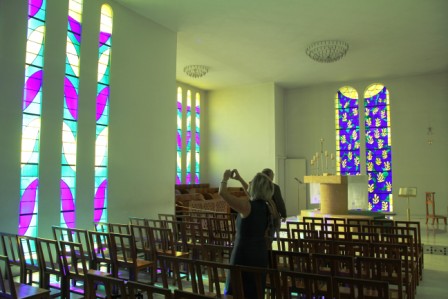
Although photos are “interdit” at the Vence chapel, many manage to get a shot.VR and I recently joined the American Club of the Riviera. Their October agenda included an event during Mickey and John’s visit I knew we should not miss – a tour of the Henri Matisse Rosary chapel in hillside Vence above the Riviera. A documentary, basically an interview by American Barbara Freed with the late Sister Jacques Marie, the nun who played a major role in the realization of this unique structure, preceded the tour. Freed has translated the nun’s book about her relationship with Matisse into English and served as director of the documentary. She was on hand with more fascinating commentary. It’s an unbelievable story – the deep friendship between this renowned artist who was not religious and the Dominican nun, and how she influenced, inspired and encouraged him on the chapel project.
An overnight stop in Nice, my Riviera favorite, preceded our trek to Vence. We strolled along the seaside Promenade des Anglais and wandered through Old Nice.
John, Mickey and VR.Then back into the hills to Sospel, a town VR and I had visited many times. We had even considered moving there. We became friends with Marie Mayer who
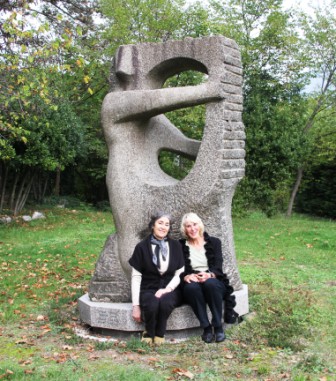
Marie and I with one of her father’s sculptures.runs a chambre d’hote (bread and breakfast), Domaine du Paraïs, where we always stayed. Her late father, Marcel Mayer, was a well known sculptor. She invited us for an aperitif in her living room filled with some of her father’s remarkable art works.
Noel and Carol are foodies like VR and I. ”Food, of course, is always high on our list,” Noel said. “The afternoon at the Dutch guy’s place was unforgettable… everything about that afternoon was wonderful – the intimate setting, the company and the food, which really was excellent.”
He was referring to Table du Bonheur, a special eatery in the hinterlands where we had an excellent lunch. (See previous post, Table of Happiness, Sept. 2, 2011)
Noel and Carol treated us to lunch and some fine wines at Le Bistrot de Lagarde which now has a Michelin star.Our food extravaganza with John and Mickey was an over-the-top meal in Italy – a lunch of multi courses at an agriturismo (farm inn), La Locanda degli Ulivi, hidden up a very long, very narrow, very windy road in the hills above Dolceacqua, a small, picturesque town just north of Ventimiglia. This was a first for me and VR. We will return, but VR said I can drive up that taxing hill next time. We must have had at least six different antipasti before two different types of pasta followed by the main course, rabbit, and the dessert. Not gourmet cuisine, but a fun experience in a livey, cozy – and very Italian — ambiance .
Clean plates after an Italian feast.Throughout our drives, Mickey, who is very interested in vegetation, often asked me the names of different trees. I failed . All the lavender fields fascinated her. She’d like to come back to see them in bloom (usually July). Olive trees were another favorite. ”The olive orchards were amazing to see. It might be interesting to see the trees when in bloom or when the farmers are harvesting the olives. I noticed olives were served at all the meals.”
DolceacquaI asked her what was most memorable about her visit. “The view of the mountains was unbelievable, and the winding roads took our breath away. What a wonderful trip and fantastic weather! The sight reminded me of what heaven must be like. Not a lot of noise, heavy traffic, or trucks unloading but just a peaceful, restful vacation place.”
Not quite heaven, but Provence has its charms.
Like my blog? Tell your friends. If you are not a Tales and Travel follower, please sign up with your email address at upper right. Your address is kept private and never shared. Please comment, Leave a Reply below. I love feedback. Coming next: Incredible Iceland Part II –horses, fish, food, adventure. And, for a taste of fall, try my recipe for Spaghetti Squash Gratin — above right.
Luberon weather during summer 2014 was not the stuff those vacationers from the north expect. The glorious sun that normally blazes every day in July and August, and most days in June, was too often on holiday, taking a rest behind massive clouds. Nonetheless those who rented the apartment at Les Rosiers, our home, did not complain. When the sun appeared, they were happy to plunge into the pool. They also hiked, biked, explored the region and discovered interesting sights. The season got off to an early start with our first renters who arrived in late April for a week, a young French family: Anne, Armand and precious Clement, a veritable model baby. We never heard a whimper. We rarely saw them as they set off early each morning and returned in the evening after a full day of sightseeing. Clement was no problem, his mother told me, as he was accustomed to being in the car for long periods. Amazing! Back for the fifth season, Austrians Klaus and Eva again spent four weeks with us, from early June to early July. Eva is a legal secretary, so Klaus, who is retired, arrives for the first week with his car and roof rack packed to the brim with beer and Austrian delicacies. He always presents us with generous gifts of the latter. Eva flies in for the middle two weeks. They lounge poolside, read, walk in the countryside, revisit favorite places and friends. Klaus also likes to do battle with those nasty wasps that like to drink from the pool and zap you with a painful sting if you are in the way. While in the water, he often walks around, fly swatter in hand, striking the enemies with vengeance. And, he loves to grill. He treated us to a fabulous meal of his specials one evening. Before leaving, he gave me a list of items needed in the apartment, something he has done in the past. This time he said we needed a fire extinguisher, salad spinner, and quality clothes hangers. He showed me one of the metal hangers from the apartment closet. “These are Alcatraz hangers,” he announced, and then explained that at home they use wooden hangers. Rest assured Klaus, all have been purchased. No more Alcatraz hangers. Machteld and John from the Netherlands arrived for three weeks in July. They were content to rest and relax poolside. Machteld came with 20 books. She read 16. John was often on his computer, or photographing butterflies. They raved about Bacchus, a restaurant in nearby Pierrevert that John had found on Trip Advisor. It was so good, they went three times. And, they shopped. Machteld loves to cook. She went home with a car full of French goodies, including plenty of wine. “We love France, the food, the wine, the people,” she said. They spend a summer holiday in a different part of France each summer. This was their first time in the Luberon. Fortunately, they and the other summer renters like cats. We have three, as well as many feline visitors. Machteld showed me photos of her two, one a Maine Coon, and we shared cat stories. Marco and Mireille from Alsace joined us for two August weeks. Marco was smitten with Filippo, a feisty feline who amuses with his antics, often chasing imaginary butterflies. A DJ in the evening, by day Marco manages his clothing stores. In his younger days he was a ski instructor at Val d’Isere. We had some serious ski talk. Mireille works with the elderly in a hospital. Their passion: hiking. They drove to different areas each day from where they set off on long, long treks. Wynand and Evelyn, another Dutch couple, began everyday with a poolside breakfast and swim. They were lucky — there was morning sun. Then, on to the bikes, which they had brought with them, for cycle excursions. ”We enjoyed having a coffee everyday at the Reillanne (our village) cafes,” Evelyn said. They also vacation in France every year, but usually camp near Mont Ventoux, the legendary mountain Wynand has conquered on his bicycle five times. Stef, Ninon and adorable Lise, 1 1/2 years old, came from Lyon where Ninon works as a “chef de cuisine” in a restaurant and Stef is in the communications industry. They did not venture too far, but did walk into Reillanne almost every day, about a 25-minute jaunt, at first up a very steep hill on a bumpy road. Stef pushed Lise in her baby carriage. She was another model infant — always smiling or laughing, a joy to admire. “Thank you for the welcome, the cats for their company, the flowers for their colors, the pool for its freshness and the road for its sweat, “ Ninon wrote in our guest book.
Like my blog? Please let me know. Feedback is most welcome. Leave a Reply below. Coming soon: Incredible Iceland. Don’t miss it. Sign up to become a Tales and Travel follower, upper right. And, see Today’s Taste for the latest recipe.
Strains of “The House of the Rising Sun” reverberated through the massive edifice. This was not a rock concert. No one was singing.
The sounds came from a powerful organ played by a monk in the abbey church of Ste. Foy. The Animals 1964 hit about a brothel in New Orleans seemed a strange choice of music in this religious shrine.
It was electrifying, and the perfect background for a nighttime tour of this Romanesque temple in Conques, a picture-perfect village in southwestern France.
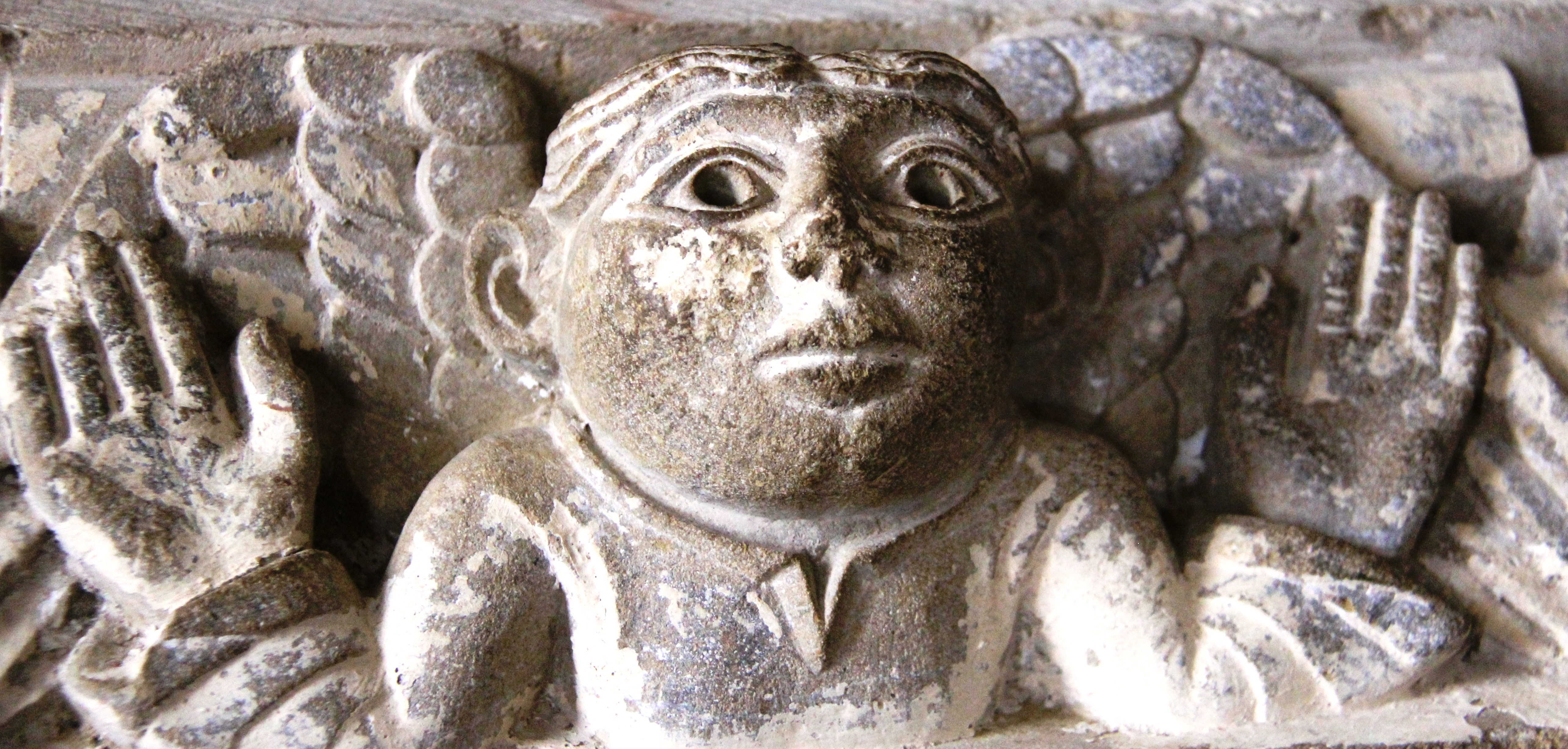
Every evening from May through September at 9:30 p.m., visitors are permitted to wander freely around the upper galleries of the church, normally off limits, to look down at the vast nave, to study the unique windows, to look up at the sculpted capitals of columns, each a magnificent work of antique art. Spot lights grow dim and then brighter, highlighting architectural details. Shadows move. The music entrances. Even for the non-religious, this is a spiritual experience, a sound and light show like no other.
Conques was my favorite of the many places visited on a recent tour of the Midi-Pyrénées region in this corner of France. It’s easy to understand why it was named one of the “plus beaux villages de France,” (one of the most beautiful villages in France). The tiny burg of Romanesque fountains and half-timbered houses is nestled in a valley surrounded by green.
The abbey church’s roots go back to the eighth century when a Benedictine monastery was established at the site in the wilderness. Relics were needed to give the new monastery clout. In the ninth century a monk set off to Agen and came back with part of the skull of Saint Foy, a Christian who had been martyred in the town in 303 AD. Miracles were soon attributed to the relic, and Conques became a pilgrimage site, a holy place to visit on the road to Santiago de Compostela, the well-known pilgrimage destination in northwestern Spain.
Today about 13,000 pilgrims per year visit Conques, a town with just 90 year-round residents. Most visit the Treasury as well as the church. Lavish, bejeweled gold and silver reliquaries are displayed in glass enclosed cases. The most elaborate is said to contain the foreskin of Christ. “How do you know it’s the foreskin of Christ?” asked a doubting visitor. “I don’t know. I was not present at the Circumcision,” quipped the guide.
The Conques abbey Church has another attraction – windows designed by the French contemporary artist Pierre Soulages. These bear no resemblance to the usual church stained glass windows, but were designed to let light penetrate the grandiose yet somber structure. The Soulages windows, geometric shapes of glass of varying density, change color depending on the exterior light.
Models of Soulages windows in the Rodez museum.
Soulages was born in 1919 in Rodez, a Midi- Pyrénées town now a must for contemporary art fans. In May, the Soulages Museum opened with some 500 works of the renowned abstract artist who is known for his devotion to the color black.
Another artist, born some 150 years ago, was the reason for a visit to Chateau du Bosc. As a young boy, the famous post-impressionist painter, Henri de Toulouse-Lautrec who hails from nearby Albi, spent summers in the chateau. Today a distant relative gives fascinating tours of the grandiose medieval house which is her home. Nicole-Berangere Tapie de Celeyran, 89, tiny, frail, and slightly hunch backed, charges up the long staircases with the vitality of a teenager, visitors following behind. From the kitchen where she points out Lautrec’s sketches on the wall, she continues upstairs to a lavish salon and dining room, a bedroom, hallways, and then into the garden.
“I love to talk. I want to preserve this house, the spirit of the family,” she says. She also wants to show Lautrec mementoes and correct misconceptions about the legendary artist.
She embellishes the tour with stories passed on from her grandmother and other ancestors who knew the artist. Lautrec’s father and uncles often went hunting, I learned. They’d come back after an outing and relate tales of their adventures. Young Lautrec sat on the floor, using coal from the fireplace to make drawings of their exploits, she said. In his bedroom, the floor scattered with toys, she pointed out a boat Lautrec had made after his accident.
At ages 13 and 14, Lautrec had two bad falls resulting in broken legs which never healed properly. He stopped growing, reaching only 4 feet 9 inches. He developed an adult size torso, but child size legs and was unable to participate in sports. He immersed himself in art instead.
The chateau visit was ideal background for a visit to the Toulouse-Lautrec Museum in Albi.
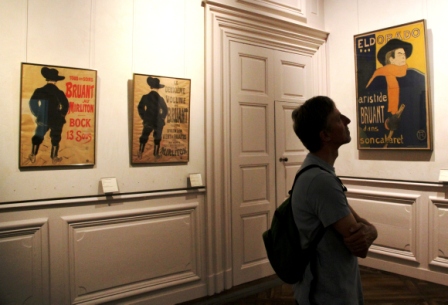
Lautrec’s cabaret posters have become synonymous with Paris and Montmartre, the area of Paris famous for its bohemian lifestyle and the haunt of artists, writers, and philosophers in the late 1800s. More than 1,000 of his works – paintings, lithographs, drawings, as well as the famous posters — are on display in the Albi museum which has the largest collection of his works in the world.
“What is important in a painting is the person. Landscape is secondary. That was his philosophy,” a museum guide said. He painted psychological portraits, and he understood advertising, hence the posters, she explained. Lautrec was an alcoholic and died at the age of 37 due to complications of alcoholism and syphilis.
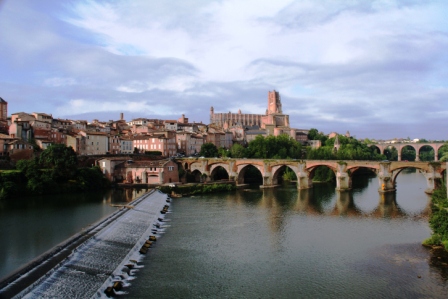
Albi, a UNESCO World Heritage site, hugs the banks of the Tarn River where it is spanned by an ancient bridge. The spires of the city’s mighty cathedral dominate the skyline for a scene almost too picture-perfect. The cathedral, Sainte Cecile, is the only cathedral in France that is still completely painted with the original 15th century paint still intact. During the Middle Ages, church interiors were painted although the paint on most has long since vanished. It survived here because the cathedral is very dark.
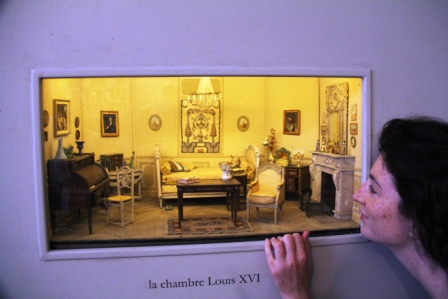
Albi’s museum of miniatures is curious if not incredible. It houses 55 miniature rooms all made by a 79-year-old woman who started the project 40 years ago. As a child she wanted a dollhouse, but she never got one. So, at the age of 39 she set out to make her own, room by room. The museum curator told us that it takes her from six months to a year to make one room. She is now busy making a miniature church.
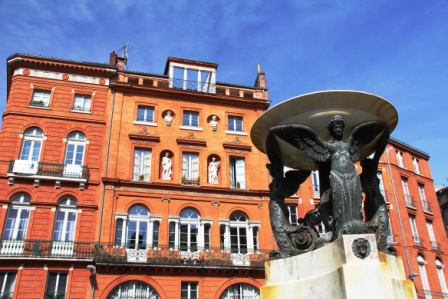
Toulouse, the capital of the Midi-Pyrénées and France’s fourth largest city, is also the European capital of aeronautics and the home of Airbus. The university city, often called the “ville rose” (pink city) due the bricks it produces which have been used in the construction of many of its buildings, is vibrant and attractive with magnificent churches, lively markets and excellent restaurants.
Saint Sernin Basilica, the largest complex of Romanesque buildings in the world, is listed as a UNESCO World Heritage site because it was a major stop en route to Santiago de Compostela.
The Jacobin Monastery, stark on the outside, is a marvel inside with famous and unique palm tree arches.
The heart of Toulouse is the Capitole, the city hall and its courtyard with a statue of Henry IV. The 18th century neo-classical façade of the elongated building dominates a large square that is always a hub of activity. Seats at one of its outdoor cafes are in demand.
The cuisine of southwestern France is legendary. For more about it, as well as well-known restaurants in the Midi-Pyrénées, see previous post, “Fabulous French Dining, a Post for Foodies.” I love to know what readers think about my posts, so please comment. See Leave a Reply below. And, don’t forget Today’s Taste, a recipe for Thai Green Beans, column at upper right. If you go…
Chateau du Bosc is located in Naucelle, 30 minutes by car from Albi. Madame Tapie de Celeyran gives guided tours only in French, but guided tours in English by other staff members who know all about Lautrec are offered year round from 10 a.m. until 7 p.m. If you visit, you are sure to meet Madame who loves to welcome visitors. + 33 (0) 5 65 69 20 83
The Hotel Mercure Albi Bastides on the banks of the Tarn has the perfect location for admiring – and photographing – Albi. Moulins Albigeois, 41 rue Porta, 8100 Albi, + 33 (0) 5 63 47 66 66 www.mercure.com/Albi
The Hotel Restaurant Hervé Busset, in a wooded setting on the banks of the lively Dourdou River just outside Conques, is a true delight. An old mill was transformed into an inn with a lovely riverside terrace for relaxing and/or dining. And, the food – fabulous. Busset has earned one Michelin star with his cuisine which makes use of plants and flowers from his garden. Domaine de Cambelong, 12320 Conques, +33 (0)5 65 72 83 91 www.moulindecambelong.com
Location, Location, Location – Toulouse’s Grand Hotel de l’Opera can’t be beat. Facing the heart of town, the Place du Capitole, the charming boutique hotel is located in a former convent of the 17th century. Place du Capitole, 31000 Toulouse, +33 (0) 61 21 82 66 www.grand-hotel-opera.com/uk
Joyeux Noel! In France, the main holiday event is the Réveillon, “un grand festin,” the big feast on Christmas Eve.
I invited British friends Mollie and David with their daughter Jenny and her partner Chris who had arrived from England at 3 a.m. on Christmas Eve after a long and harrowing drive.
The house is appropriately festive, decorated with some of my favorite treasures. David and Chris took these outstanding photos. I had to concentrate on cooking.
Food – a bit of a challenge as David and Jenny are vegetarians and Mollie, recovering from recent surgery, has certain dietary restrictions. I scoured the Web for some new recipes, and also relied on some old favorites.
Our meal, with a few exceptions, was more like an American Thanksgiving, BB’s favorite. Since I was in the hospital this Thanksgiving (nothing serious), he missed out. So, turkey it was with plenty of trimmings.
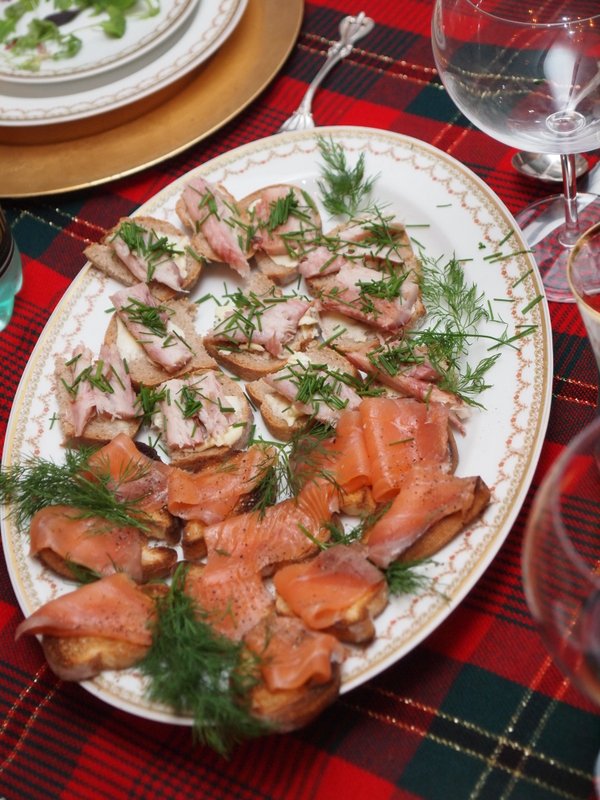
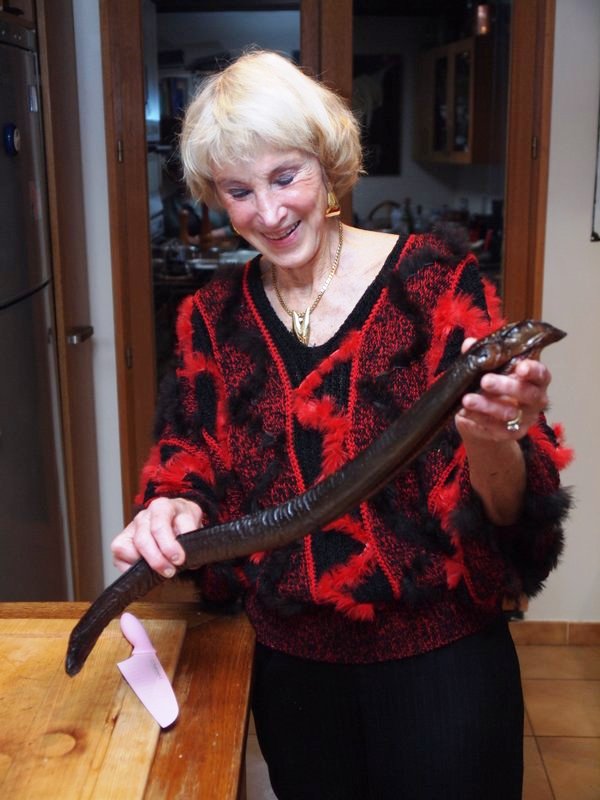
In France oysters and shell fish are the standard first course of this repast. Instead, we had smoked salmon and smoked eel, both ordered from a fishery in Denmark. The eel (cute fellow) had to be skinned and sliced. I delegated that task to BB. According to the instructions that came with the Scandinavian delicacy it is best consumed with a shot of icy akavavit. None in our liquor supply, so we drank champagne supplied by our guests. The vegetarians had baked camembert with pears. All were happy.
The next course would most likely be foie gras in France. I love it and usually prepare my own rather than buying the ready- to- eat version. It can be a culinary challenge. I took the easy road and served Harvest Bisque, a Christmassy butternut squash soup served with a scoop of vanilla ice cream. It is usually a hit. The recipe is listed under recipes in column on right.
Harvest Bisque and family heirloom: Great grandmother’s Haviland (Limoges) china.
Next the bird. No Butterballs in France. My friend Lynne, cook extraordinaire, turned me on to brining the turkey several years ago. The result: a moist turkey.
We had numerous (perhaps too many) side dishes:
Creamed Spinach and Parsnips (recipe from Food & Wine web site)
Broccoli and Cheddar Casserole with Leeks (another Food & Wine recipe)
Red Cabbage with Ginger (combination of a German recipe and the recipe of my friend food writer Sharon Hudgins, www.sharonhudgins.com). Germans serve this with Christmas goose. David tells me the British also serve it with goose. It’s not found on the French table, but I like it and it goes well with turkey, too.
Mashed Potatoes with Horseradish (an old Bon Appetit recipe – but his time the potatoes came out too runny)
Helen’s Brandied Sweet Potatoes (my mother’s recipe – a family tradition). This is also listed under Recipes in the column on right.
Classic Sage and Onion Stuffing (Web recipe from The Kitchen). I usually make stuffing with dried fruit and/or sausage. Those would not do this year. This concoction did not send me.
Gravy
Preiselbeeren (German/Austrian berry, like a tiny cranberry). Austrians Klaus and Eva who rent our guest apartment for a month every summer, always bring us a jar of this treat. They gather the berries in the forest and then preserve them.
David and Mollie brought a magnum of an excellent red wine, Gigondas 2011, La Font Boissière, and a white, Laure, Côtes du Rhône 2012, Domaine Rabasse Charavin. BB added an American vintage, Gnarly Head Old Vine Zinfandel 2006.
Desserts: Tiramisu au Pain D’Epices (spice bread). I frequently watch a French morning show, Télé Matin. The recipe was given during a food segment last week. Tiramisu is always a winner. With the spice bread, I thought it would be perfect for Noel. A disaster. It was tiramisu soup. The taste was not bad, but texture, a miserable failure. I should have relied on Sharon Hudgins’ excellent recipe, my tiramisu favorite.
Pumpkin Pie. I know. It’s usually a Thanksgiving dessert, but BB craves it. It was interesting to see the British reaction to this all American favorite. Irish friend Martine once said she “just did not get it.’ Chris said it was not sweet enough. David liked it. Jenny – not sure.
Cookies – Five different kinds I baked the week before Christmas.
The finale: Christmas crackers and hats
Not only did they bring the champagne and wine, but our guests came with Christmas crackers (not edible). For the British, a Christmas meal is not Christmas without the crackers, paper gizmos with two ends. You pull one end and the person next to you pulls the other. Pop! It explodes and a small Christmas present falls out.
For those of you who still have a holiday meal to savor, Bon Appetit. And, Happy New Year to all. Tales and Travel will take a break until February. We’re off on an exciting adventure to Myanmar soon, followed by a return to the paradise we discovered in Bali two years ago. See previous post, A Dentist and his Jungle
My childhood Christmas stocking and a prized gift from my mother, a Santa trimmed with mink.
Haven, Feb. 14, 2012.
Comments are always welcome. Tell us about your holiday meal. See “Leave a Reply” below under Comments. Subscribers also welcome. Don’t miss future posts. Click on Email Subscription at top right.


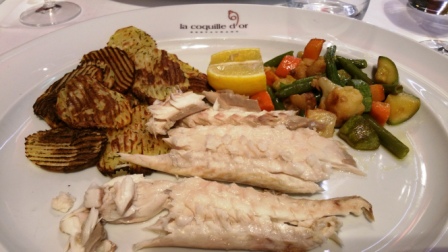
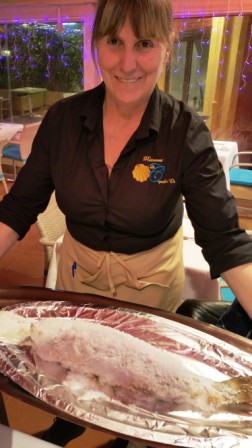 moisture. Owners of the Coquille d’Or restaurant, the chef and his wife, are Italian. Our waiter was Italian. The fish – maybe it came from the Italian Med.



















 Tales and Travel