NICE: Enchantment on the Riviera

I wrote the following for the newspaper Stars and Stripes three years ago after a visit to Nice.  I’ve been back several times, most recently after Christmas.  This time we lounged on the beach, enjoyed delicious food, and soaked up that seductive ambience of the Cote d’Azur.  Nice — it’s my kind of town..niceb11

After many, many years in Germany, my husband and I and our two cats (we now have three) left Deutschland behind and moved to the hinterlands of Provence in southern France. We’ve been here five years (now eight), and it’s lovely. We don’t regret the move. But I’ve found a corner of this part of the world I like even more: Nice.

Our quiet life in the countryside has its pluses, but I miss the vibrancy and excitement of a city.  Nice offers that, as well as the sea and beaches, museums, markets, intriguing old town, excellent restaurants, lush parks and outstanding architecture, all wrapped in an enchanting ambience.niceb4

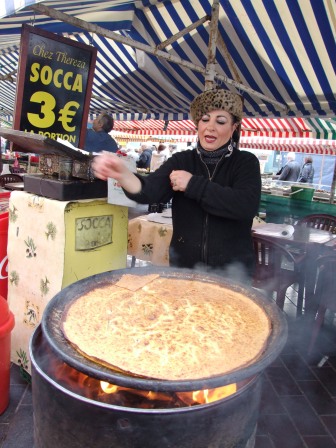
France’s fifth largest city is the capital of the glamorous French Riviera.  There’s plenty of elegance along the Promenade des Anglais, its seaside boulevard lined with palms and turn-of-the-century hotels and grand apartments.  There are traces of North Africa in the tangle of dark alleys of Vieux Nice, (old Nice). The outdoor markets and restaurants, as well as the numerous street stands, capture the flair of neighboring Italy. It’s an irresistible mélange.niceb15

Nice’s roots go back thousands of years to prehistoric times. By the 4th century it was settled by Greeks, followed by Romans, then Saracens. Nice was part of the House of Savoy (Italy) from 1388 until 1860 when citizens voted to join the Second French Empire.

The English discovered its charms in the 18th century, followed by those from other countries, especially Russians.  The Cathedral of Saint Nicholas, commissioned by Czar Nicholas II and inaugurated in 1912, is the largest Russian religious edifice outside Russia, and a top tourist attraction.

By the 19th century Nice had become a favorite winter haunt for the British.  It was an Englishman, Reverend Lewis Way, who is responsible for widening a former water front footpath in 1820 at his expense which was dubbed “Chemin des Anglais” (road of the English). In 1931 it took its final form, two roads with a palm-planted center strip, and became known as the Promenade des Anglais.niceb16

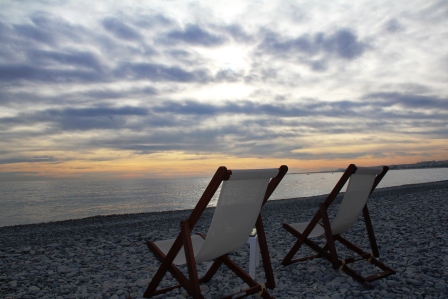
On one side of the famous avenue are Belle Époque buildings. On the opposite side are miles of beaches.  Thanks to Nice’s microclimate, even in winter you can sit at a beach café and soak in the rays.  You may even see brave souls who spread their towels in the sand and sunbathe in bathing suits.  In summer, of course, the beaches are crowded with both tourists and locals.niceb13

During our winter visit, after a stroll along the beach we climbed the steps to Castle Hill where a citadel once stood.  It’s now a maze of greenery, perfect for getting some exercise and enjoying superb views of Nice, its beaches and harbor, with the backdrop of hills and the distant Alps.

We took the easy way down, riding an Art Deco lift which deposited us on the edge of Vieux Nice. I love taking pictures at the flower market on the Cours Saleya in the heart of the old town.  I also love wandering in the labyrinth alleys in this part of the city, checking out funky boutiques, admiring Baroque churches, taking more pictures. One place that has become a favorite is Oliviera, a shop with 17 different kinds of olive oil where owner Nadim Berouti is happy to offer tastings.  The shop also has a mini-restaurant.

“When I understood that every morning I would see again this light, I could not believe how happy I was,” artist Henri Matisse wrote about Nice.  The light of the Riviera has inspired numerous artists, not just Matisse who lived in the city from 1917 until his death in 1954. A Nice museum devoted to his works is a must.Nice beach

We rode a bus up the hill to the Cimiez district where the museum is located in a 17th century Genoese villa.  Works from every period of the artist’s life are on display, including early paintings, the famous gouache cut-outs, studies (drawings etc.) for his renowned chapel in Vence, even personal effects such as Venetian furniture and Oriental wall hangings.niceb2

It was a long hike back to the center, but worth the trek to admire great pillared houses and rows of cypress trees along the route.

The Museum of Modern and Contemporary Art in the heart of the city is another gem with a collection of 400 works including sculptures and canvases by New Realists, Pop artists including Andy Warhol,  whimsical creations by one of my favorites, Niki de Sainte-Phalle, and more.  The avant-garde building with glassed-in ramps around an atrium is a sensation, as are the great views from its roof terrace.niceb19

We ran out of time and postponed a visit to Nice’s Chagall museum for another trip when we rode the Nice hop-on, hop-off tourist bus to the museum where I was in awe.  The 17 huge, colorful paintings depicting Biblical scenes are amazing.  Also to marvel are mosaics, stained glass windows and tapestries.

The bus stops at other tourist highlights, including the Russian church.  It’s a great way to take in the city, its neighborhoods and seaside panoramas, as well as travel to the sights. Head sets offer fascinating commentary in numerous languages.

When we get too old for life in the country, maybe we can move to Nice.nice.b1

TIPS FOR TOURING NICE:

Le Grand Tour, Nice’s hop-on, hop off tourist bus with 14 stops www.nicelegrandtour.com

Nice’s flower market on the Cours Saleya takes place everyday from 6 a.m. until 5:30 p.m. except Monday when it is replaced with an antiques market.niceb9

Oliviera for olive oil and small meals. 8 bis, rue du Collet in Vieux Nice, www.oliviera.com

Museum of Modern and Contemporary Art, Promenade des Arts, open daily from 10 a.m. until 6 p.m. except Mondays and some holidays.  Entrance is free. www.mamac-nice.org

Matisse Museum, 164 avenue des Arènes de Cimiez, open daily except Tuesday from 10 a.m. until 6 p.m.  Entrance is free. www.musee-matisse-nice.org

Marc Chagall National Museum, avenue du docteur Ménard, open daily except Tuesday and some holidays from 10 a.m. to 6 p.m. from May to October. From November to April from 10 a.m. to 5 p.m. Admission: 7,50 euros.  http://www.musee-chagall.frniceb18

Excellent centrally located accommodations at the 4-star Hotel Le Grimaldi, 15, rue Grimaldi.  Rates vary with season, from 99 euros for a double in low season. www.le-grimaldi.comniceb3

Favorite restaurant: La Zucca Magica (the magic pumpkin), a vegetarian restaurant run by Italians.  The decor is pumpkins, gourds and squash — hanging from the ceiling, on the tables and window sills, depicted in paintings and photos on the walls.  It’s dimly lit with flickering candles, cozy and inviting.  There is no menu.  You take a seat, order some wine, and food starts arriving — five different dishes, one after another. www.lazuccamagica.com

More information on Nice at www.nicetourisme.com

 Gingered Butternut Squash Soup with Spicy Pecan Cream was a winner at my recent dinner party.  Recipe listed in column on right. Comments on blog post and recipes are welcome. See “Leave a Reply” below under Comments. Subscribers also welcome.  Don’t miss future posts.  Click on Email Subscription at top right

Happy Holidays

Twinkling lights on trees, houses and buildings are as much a part of Christmas as Santa and reindeer.  In a tiny hameau in the hills of Provence there’s an illumination extravaganza this holiday season that is a wonder to behold.cars4

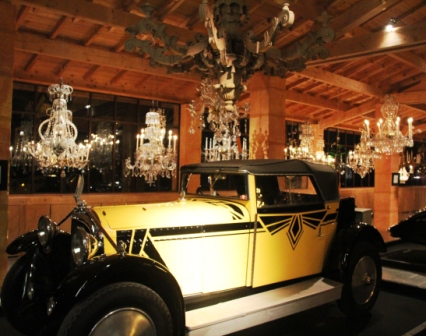
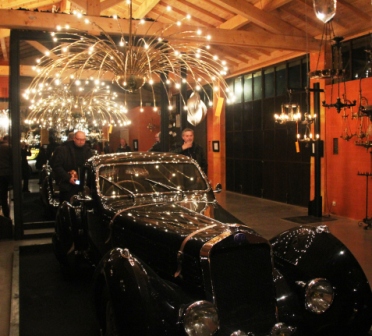
Cars – French classics – gleam under the lights of magnificent chandeliers, most of which are antique.   The exhibition brings together his two passions, “cars and chandeliers,” says chandelier designer Regis Mathieu.  His company, Mathieu Lustrerie, creates high-end lights, as well as restores and replicates antique chandeliers.

At their showroom  numerous  glittering antique treasures, as well as some contemporary versions,  cast their lights on priceless automobiles – most of which you have probably never heard of:  1937 Delage, 1938 Delahaye, 1926 Hispano-Suiza…  There’s also a dazzling 2012 Bugati.cars7

It’s a delightfully different – and fascinating – take on holiday lights.

The nighttime exhibit runs daily, except on holidays, until Jan. 13,  from 5 p.m. until 9 p.m.  (Hameau des Sauvans, Gargas)  www.mathieulustrerie.com

Wishing all a very Merry Christmas, Joyeux Noel, Frohe Weihnachten.cars16

For more on French Christmas, see my guest blog, “Christmas Feasting in France,” posted on Rantings of an Amateur Chef,  http://rantingchef.com  Special thanks to Lynne for the perfect accompanying food photos. 

See slideshow below for more cars and chandeliers. Blog subscribers also welcome. Don’t miss future posts. Click on Email Subscription at top right

This slideshow requires JavaScript.


All about Life in France

The Germans have a saying, Leben wie Gott in Frankreich, (Live like God in France). After living and working in Germany for more than 25 years, I moved to southern France eight years ago to see just how God lived.  Not too shabby.  Life is good, very good, but not quite paradise.  Read on for my observations.

Topping off the list of pluses is Health Care.  Americans can criticize socialized medicine all they want, but I’m thrilled with the French system, universal care, which even covers home visits, taxi trips to doctors for those unable to drive, weeks in a rehab facility after some surgeries and much more.  For details, see my previous blog post,  “My New French Knee, “ all about my recent experience with knee replacement surgery.

Filing Taxes. My husband does ours.  Since our retirement income comes from the U.S., we file and pay U.S. taxes.  There is a reciprocal agreement between the U.S. and France, so we pay no income tax here. Nonetheless, as residents in France, we must fill out French tax forms.  My husband spent many long days on the computer, fighting with form after form, to file the U.S. taxes.   The French form, even for citizens, is short and simple.  I did it in minutes.

Elections.  During the French presidential campaign this spring, there were televised debates among candidates, as well as spot commercials.  But, each candidate was given the same amount of air time.  No matter how much money a candidate had, he/she could not buy extra television time.    The issues, the candidates’ positions and record, determined the outcome – not their wallet.

Food/Wine.   Both hard to beat.  Crusty baguettes, flaky croissants, sinful pastries… and, my downfall, all the fabulous cheeses.   Restaurant meals are generally excellent, and the wine is reasonable and good.  A glass of wine at our neighborhood café, 3 Euros, ($3.65).   As my husband and I like to imbibe with dinner at home, we buy table wine in five-liter boxes (almost seven bottles), from 13 Euros or $16 per box.  And, we love to visit the numerous wineries in these parts for tasting and purchasing.

Tips Included.  No need to get out your calculator and figure out what 15 or 20 percent of the total is for your tip.  Service is included in French restaurants.  If you are happy with the meal and service, you can leave a few extra Euros.

Politeness.  The French, including children, are extremely polite and courteous.  When entering a shop, a doctor’s waiting room, an office… they greet everyone with a “Bonjour Mesdames, Monsieurs.”   They also kiss a lot, but more on that to follow.

Laissez-Faire.   Life here is not over regulated.  If you visit a tourist site at the edge of a high cliff, for example, there will be no fences or walls at the edge obstructing your view and keeping you from falling. It’s up to you to use caution and control your children.

Leisurely meals. The French appreciate good food and conversation.  Meals, which consist of several courses, are not eat and run affairs. They can go on for hours.  It’s enjoyable and relaxing.

There’s more I love about life here: the beautiful view of the Luberon hills from our balcony, the bounteous markets, colorful local festivals in the summer, poppies in the spring, lavender and sunflowers in the summer, the sunshine, the pool…

But, not all is perfect.  At the top of my list of pet peeves are Business Hours  which drive me crazy.  Every shop, office, restaurant… has its own schedule.  You need a spread sheet to keep track of it all, but be prepared for changes.

Here in southern France, almost everything closes for a long lunch hour, but how long? The bakery and grocery store in my small village are closed every afternoon between 12:30 and 4 p.m. The post office only closes between noon and 1:30 p.m. The pharmacy is closed from 12:30 to 3 p.m., plus Saturday afternoon and Monday morning.  Restaurants are usually closed one or two days a week, but that varies with seasons.  How to remember which one is closed which day during which season.?

What really gets me is “Fermeture Exceptionelle” (exceptional closing). Too often  I have  made a special trip to the bank in a nearby town only to see this sign at the door.  No explanation. Go home and come back another day.

Driving Expenses.   Gasoline is very expensive here – about 1.6 Euros per liter (about $7.80 per gallon). Tolls on the autoroute are also expensive.  But this can be an advantage.  Only during peak travel seasons (certain summer weekends for example) are there traffic jams on these super highways.  You can usually sail along at a maximum speed of 130 km per hour, just over 80 mph.

Hunting Dogs.  As an animal lover, it grieves me to see how these dogs are neglected and abused.  Hunting is a popular sport in these parts, and most dedicated hunters keep several hunting dogs penned up year round. They are not treated as pets and are only released for the hunt.  Many get lost and end up homeless.  We once found a lost, friendly hunting dog wandering along a country road. We put him in the car and called the number on the collar it was wearing, then  met the owner in a nearby town.  Instead of being happy to see the animal, he grabbed it by the collar and tossed it into the back of his pick-up with several other sorry beasts.  I was devastated,  and regretted returning the poor dog to a miserable existence.

Punctuality.  This is strange.  If you invite French to your home, they generally show up on time.  But, go to an event, be it a concert, a performance, or a community dinner, and be prepared to sit and wait at least a half hour, and more often up to an hour, before the show gets on the road.   If it’s a performance, you may need to stay an extra half an hour for curtain calls.  The French are overly enthusiastic and reward performers with endless clapping and cheering.

Much about the French lifestyle is neither bad nor good, but  curious to an American.  I’ll start with la bise (the kiss).  It’s known that the French greet one another with an air kiss on the check, usually both cheeks, and sometimes more depending on which region of France they live in.  I live in the department of Les Alpes de Haute Provence,  just 20 minutes from the border of the department of Vaucluse. On our turf, it’s one kiss on each cheek.  But, in Vaucluse, it’s three kisses, both cheeks, then back to the starting point for a final kiss.  I invariably forget when I visit friends in Vaucluse and pull away after two kisses, only to have the friend, cheek turned, waiting for number three.  Then there’s dilemma of which side first.  How many times have I knocked heads with someone as we both turned in the same direction and crashed?  The good ole American hug is easier.

August This is a mystery to me, but it seems everyone, and not just folks with school aged children, takes a vacance  (vacation) in this hot summer month. Doctors’ offices are often closed for the month.  Many businesses and offices, including the electric company, close during August.  For those of us in the sunny south, August, as well as July, means an invasion:  Parisians, Dutch, Belgians.  Too many drive huge campers which clog the two-lane roads in this hilly region. Parking places in towns are at a premium. Lines at the bakery snake out the door and  down the sidewalk.  We’re happy when these tourists go home and life settles back to quiet normalcy.

Apero,  short  for aperitif and the French preferred way of entertaining.   They often invite guests for apero, which can be potato chips, peanuts, and several glasses of wine or pastis (the favored anise drink of Provence) or an array of elaborate snacks which can be a meal.   In general, dinner parties are for close friends and family.

I could ramble on, but suffice it to say that God could do worse, much worse.

If you’d like to read more of my tales and adventures, click on “Email Subscription” at top right of post.  Comments are welcome.  Click “Leave a Reply” 

What to do with all that summer produce?  Check out my recipe for Great Gazpacho, my summer favorite.  Scroll down the recipe column at far right.

My new French knee

Ah, quelle belle cicatrice!”  (Oh, what a beautiful scar/incision!).  Every time a nurse came to change the bandage, it  was the same remark,  both at  the hospital in Marseille (2 ½  hours away) where I had total knee replacement surgery on May 14, then later at the rehabilitation hospital where I spent 2 ½ weeks.

Are they crazy, I wondered?  Nothing beautiful about this long (8 inches) red and puffy line on my hugely swollen knee.  When it was first uncovered, I was horrified.  It seemed enormous.   Then they showed me an x-ray of my new knee – more panic.  It, too, seemed gargantuan.  How would I ever walk with those chunks of metal (titanium) inserted in my leg?  A plastic substance (the knee cap) is between the two  pieces of titanium.

It did not take long to realize I could walk.  The day after surgery, a therapist had me on my feet walking (limping) up and down the hall on crutches.  He, too, admired the “beautiful”  incision.

It was the work of Dr. Jean-Pierre Franceschi, Marseille’s famous orthopedic surgeon who is the team doctor for the city’s soccer team.  One nurse referred to him as “a star.”  Tall, dark and handsome, he looks as if he belongs in Hollywood,  not bent over an operating table inserting new knees and hips in France’s second city.

When I finally made the decision to proceed with this drastic operation, I wanted the best doctor, a surgeon whose proficiency would get me back on the ski slopes.  It had to be the celebrated Franceschi.  The surgery report I received after the operation stated that the duration of the procedure was a mere 35 minutes.  Amazing, but I hope the renowned doctor did not rush.

Franceschi’s skills are in demand, so it takes months to get on his surgery schedule.  I made the May appointment in early January, and fretted off and on from then until the operation.     What if I ended up worse instead of better?

It’s been a month since surgery, and, according to medical personnel, I am doing very well.  I can bend the new knee leg to an angle of 120 degrees.   A therapist at the rehab hospital told me 130 degrees is what they aim for.  I am almost there.

I’ve also been fortunate as I have had very little serious knee pain.  Discomfort, yes, but that’s to be expected.  The dreadful part for me has been headaches and insomnia, said to be nasty effects from the anesthesia, but that’s another story.

Fabulous French health insurance

I feel very fortunate to live in France and be covered by the French national health insurance.  My husband and I also have a supplemental insurance since the national insurance does not cover everything 100%.  For both, we pay €4,520 (about $5,650) per year.    

The benefits may make some Americans cry.  My 11-day stay in the Marseille orthopedic hospital,  the surgeon’s and anesthetist’s  basic fees,  a transfer by ambulance to the rehabilitation hospital in Forcalquier (about  1 ½ hours from Marseille),  2 ½ weeks at the live-in rehabilitation hospital, all medications, plus 20 follow up sessions of physical therapy now that I am home – all completely covered.

Not covered:  Dr. Franceschi’s additional fee (you pay for his fame) €500 (about $625), and the extra charge for a private room at the hospital in Marseille, €75 per day or $94.   Some of this may be reimbursed by the supplemental insurance.

In France, the standard fee paid by the national insurance to the surgeon for knee replacement is between €400 and €500 ($500 – $625).    According to the July 2012 issue of Consumer Reports, a knee replacement in the U.S. costs between  $17,800 and $42,750.  These figures  also include the anesthetist’s fee and hospitalization, nonetheless they indicate that medical costs in the states are clearly over the top.  An American friend who lives in Aix en Provence recently paid €140 (about $175) for an MRI of his back.  Consumer Reports states than an MRI in the U.S. costs between $504 and $2,520.  Yet many Americans still vehemently oppose mandatory national health insurance?

Hospital Stay

Care at the Marseille hospital was fine. The food was not great, but perhaps a bit better than standard hospital fare.  Lots of healthy fish and spinach. One fish dish with a tomato/caper sauce was excellent , and I plan to try and duplicate it.

The French are fanatics about pre-surgery disinfection. Both the night before the surgery, and again the morning of the operation, you have to take a shower washing with a special red disinfectant.  There are even instructions in the shower as to how to proceed to disinfect the entire body – including hair.  Husband Bob (dubbed Mr. Clean by one of his daughter’s previous boyfriends as he is obsessed with order and cleanliness) was horrified when he saw that the tiles on the lower part of the shower were black with mold.  How sanitary can that be?

Shower mold aside, the room was spacious with an extra bed for a family member to spend the night with the patient if desired.  Mr. Clean is a dedicated husband, but I dared not ask to him to spend nights in the hospital with me.  However, my days were long and lonely as Marseille was too far for most friends to visit.

Every morning therapist Philippe, a jovial type who liked to kid, came to put my new knee leg on a contraption which bends the leg. Each day he increased the bend angle.  I also walked the hall several times a day –and in the middle of the night when sleep escaped me.

I had a favorite nurse: Monika Kiss, an angel from Hungary who was extra kind and caring.  She and her husband, a builder, are out to see the world.  They have lived and worked in Russia, Austria, the Netherlands, England and now France.  Monika speaks at least five languages, and is now studying Spanish as she hopes for a job in Spain next.  Her favorite job was at the Cambridge University  Hospital in England where she termed working  conditions “the best.”

Vanessa, a perky nurse’s aide in training, loved to talk about the U.S.  She’s never been, but dreams of visiting  ”California, New York,  Brooklyn.”   She says most everyone in France thinks Americans are crazy, but her father reminds her, “If it weren’t for the Americans, we’d be Germany today.”

The ambulance ride (my first)  to the rehab hospital was an amusing experience.  A bossy, chatty, 51-year-old woman sat next to me (I was on a stretcher).  Between shouting orders to the driver and talking on her cell phone, she told me her life story:  born in Portugal, six children, divorced, lives with boyfriend.  I heard about the problems with the ex, some of the children, her philosophy of life…    I had mentioned that I was a journalist.  “I’ve been looking for a journalist to write the story of my life. It’s very interesting.”  I did not volunteer.

Rehabilitation

When I arrived at the  Saint Michel rehabilitation hospital in Forcalquier, I thought I had entered paradise.  The hospital is  surrounded by green, with spectacular views of the chapel, Notre Dame de Provence (1875), atop a hill above the town.  Spotlessly clean (no mold in bathroom), a large room which I shared with another patient, a huge window next to my bed offering a lovely view, and an adjoining balcony.  Friend Lynne who visited several times called it   “your hotel.”

There I had lunch and dinner in a dining room with other patients, an entertaining group with whom it was interesting to trade stories about  surgeries, doctors, hospitals, etc.   Gilles, a retired chef, brought his own jars of sauces and condiments to season the food.  Jacques, a retired baker, was used to getting up in the wee hours and also had trouble sleeping.   Fanny, a rail thin woman with a tan that would put Coppertone to shame, sported cute mini dresses and claimed she was born with skin this amazing color.  Suzanne, who often dominated the table conversation,  told us this surgery, hip replacement, was her 17th operation.  Michelle, an artist, spent her days painting the surrounding scenery.

The food was much better than that in Marseille, including an excellent seafood paella and a tasty lamb tagine.  In French fashion, each meal was several courses:  entrée, main course, cheese and dessert.  I had heard that wine was also served with dinner at this hospital, but unfortunately that practice had been discontinued.  The nurse who admitted me explained that  “too many patients were getting drunk.”

Therapy, both morning and afternoon sessions, was excellent.  My first therapist, Carlos from Spain,  liked to chat and joke with those in the therapy room.  The lively conversation took my mind off the pain of bending the knee back and forth.  Carlos went off to another job and was replaced by Sara, a gorgeous young woman, also from Spain.  By my last week at the hospital, the “beautiful “  incision had healed and the stitches had dissolved.  I could join others in the therapy pool for water exercise.  Sara taught me numerous pool exercises which I am continuing in our pool.

There I was closer to home, so I did enjoy visits from friends, as well as their gifts of magnificent  flowers .

The rehabilitation facility was better than I ever expected, but, after almost four weeks of hospitalization, it’s wonderful to be home.

My discharge papers from Forcalquier described the “beautiful” incision as “perfect.”  I hope the new knee will be perfect, too.

Comments welcome.  Please share your thoughts.  Click on “Leave a Comment” at beginning of article.

For a taste of Provence, try the recipe just added in column at right, Chevre Au Gratin (Baked Goat Cheese), a delicious and easy spread for bread or crackers.

More photos follow in the slide show.

This slideshow requires JavaScript.

Sam’s Saga

It’s a feline fairytale come true,  a rags to riches story. From life as a stray cat wandering in the alleys of Cereste, a Provencal village in the Luberon, to that of a pampered pet in a posh apartment in Paris.  And, not just any apartment.  Sam’s new home is with the famed pianist and conductor Philippe Entremont and his wife.

There must be millions of homeless cats in France. How did this husky gray tomcat get so lucky?

The saga began last December when I decided to adopt Sam. Friends Marten and Jessica had been feeding him, but they have four other cats.  Sam was especially friendly and affectionate, however he was becoming a nuisance, fighting with their cats.  They needed to find a home for him.

I was in mourning at the loss of Buddy, my big black male cat, whom I had to have euthanized due to cancer.  Sam seemed to be the answer to cure my sorrow. He was a delight with people, loved to be petted, purred loudly. But, he quickly decided he must be king.  He made life hell for my two female cats.  This would not work.   I called friends, sent emails, put up posters.  I was determined to find him a home.  All to no avail.  Some friends, including cat experts, said the kindest thing would be to have him euthanized.  I could not bring myself to take this step.  Since he had been surviving as a street cat in Cereste for years, a town where kind souls do feed strays, I took him back to the village with great remorse and feelings of guilt.

Sam was born under a lucky star.  Along came Anne to the rescue. Shortly after his return to the streets, this kind English woman arrived to spend the winter in the apartment upstairs from Marten and Jessica. Anne and her friend Martine came to Cereste from Ireland with their dogs and horses.  They have been spending the winter training for a 500 kilometer charity ride on horseback across France to raise money for the Program for Assistance Dogs for Families of Children with Autism.  http://thewanderlywagons.blogspot.fr/

Anne took to Sam, who was hanging around and hungry.  He soon moved in with her and her canines: Fionn, a huge lab/Rottweiler cross, and Roxy, a lab/retriever mix.  Sam detests cats, but dogs are his pals.  All became friends, even sleeping together.  When Anne walked the dogs, Sam would follow.

But, Sam’s time was running out.  Anne would soon be starting her horse trek, then return home to Ireland where she has two cats – no hope for Sam there. Once again I started the search.  Friend David, a photographer with expert computer skills, made beautiful professional posters with Sam’s photo which I distributed to numerous vet offices and shops in the area.  Again no response.

I also told my friend Jude Reitman about my plight with Sam.    Jude is an award winning journalist and author – and devoted animal rescuer – who has been living part time in France.  www.judithreitman.com  She put me in touch with Amelia Tarzi, a lawyer born in Afghanistan who gave up law to work as an interpreter, the latter allowing her more time for her passion:  animal rescue.

Amelia has lived in the states and Switzerland, but is now at home in Paris.  However, she spends as much time as possible at an animal shelter in central France, DPA-Refuge de Thiernay, www.refuge-thiernay.com

I sent photos of Sam to Amelia who soon announced that she had found a home for the fortunate feline — but it was in Paris, some 610 kilometers away.  A friend of Amelia’s is a friend of Mme. Entremont,  wife of the noted musician Philippe Entremont.  She had just lost a cat.  The friend quickly put her in touch with animal rescuer  Amelia who sent photos of many cats needing homes to Mme. Entremont.  She zeroed in on Sam because he looked like the cat she had just lost.

How to get Sam to Paris?  Amelia said she would pick him up at the TGV train station in Aix en Provence en route back to Paris after a job in Nice.

Sam needed to be vaccinated, micro-chipped and tested for disease before departing for the City of Lights.  The first attempt to cage him for the trip to the vet failed. (See Anne’s blog at the above address for more on this fiasco.)  The next morning Anne succeeded, and I took Sam to  the vet where he was a prince, a surprise to all.  Then, husband Bob (a dog person and a saint to put up with my cat capers),  drove me and caged Sam to the train station, more than a hour away.  This normally very vocal cat was amazingly subdued during the journey.

Shortly after 1 p.m. Amelia met us in the train station café, and soon street cat Sam was on his way to a new life in high-class surroundings.  Released from his cage in the Paris apartment, he ran to hide behind a bookcase.  During the night he emerged and, according to Amelia, got the shock of his life when he walked across the keys of his esteemed owner’s piano.  He’s adjusting to life with the upper crust, and Mme. Entremont is “thrilled” with her pet rescued from Provence, says Amelia.

Jude Reitman has recently started a company, La Bedouine, specializing in skin care products handmade by Berber women in Essaouira, Morocco.  http://www.labedouine.com  She has moved back to her home in North Carolina where she is active in finding homes for abandoned dogs.