Celebrating Lemons and Bicycles

menton.9.aFruity floats, gigantic citrus creations, fabulous flowers. The annual Menton Lemon Festival (Fête du Citron) is an explosion of color, scents, and scenes in honor of the city’s prized small yellow fruit.menton..13

We were enthralled with it all during a visit many years ago, and returned a few weeks ago to survey the scene of dazzling orange and yellow sculptures once again.menton.15a

This Riviera city, the lemon capital of France on the border with Italy, has been celebrating the lemon with festivities every year since 1929. The festival attracts some 230,000 visitors who come to admire 145 tons of citrus fruits which make up the creations and exhibitions.

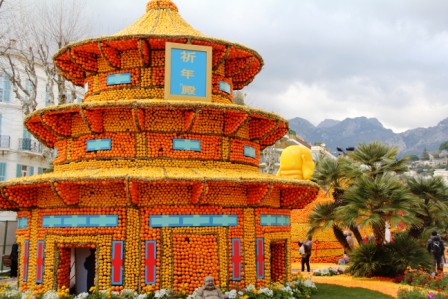
This year’s theme, the lemon in China, featured a mammoth dragon, a pagoda, a temple, animals and more all made of lemons and oranges.menton.2a

The exhibits are set up along the Jardin Biovès, a long promenade lined with the colossal fruit constructions. An elevated ramp in the middle is especially popular with the camera crowd who line the steps for overall shots of the scene. Stands selling the fruit, citrus liqueurs, soaps, jams and postcards do a brisk business.menton.17a

Menton’s microclimate with more than 300 sunny, temperate days per year is ideal for growing the tangy fruit. There are some 80 varieties of lemons, but it’s the Menton lemon that is prized by chefs for its perfume, distinctly flavored zest and pulp, and high sugar content. While the lemon gets top billing, oranges play a leading role in the gigantic creations.menton.16.a
We had previously visited Menton, my favorite coastal city, in January. See  post, “French Riviera: Magnifico Menton.” The city, which was originally part of Italy, became the property of Charles Grimaldi, Lord of Monaco, in 1346. In 1848 it broke away from Monaco, becoming a free city, and in 1860 it became part of France. By the late 19th century it was on the map as a popular tourist spot on the French Riviera.menton.1a

This time instead of staying in Menton, we crossed the border and spent three nights in Sanremo on the Italian Riviera. It’s just a 45 minute drive from Menton, and a lovely town on a coastal bike path. That was our plan – get back on the bikes.SR.5

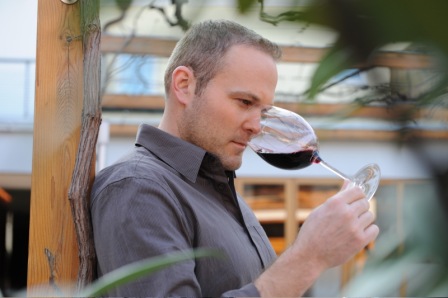
Husband, formerly known as Bicycle Bob (BB), was an avid cyclist. He seems to have lost interest in pedaling, even though he invested in a snazzy, expensive bicycle a few years ago. His passion has become wine, so I call him VR (Vino Roberto). I miss biking and the great rides we have taken over the years — in Switzerland, Austria, Germany, Holland and France.bobbike
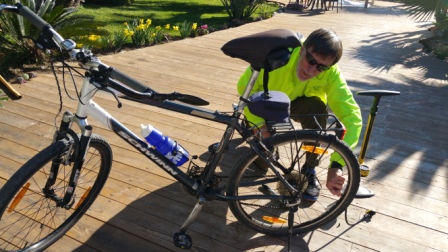
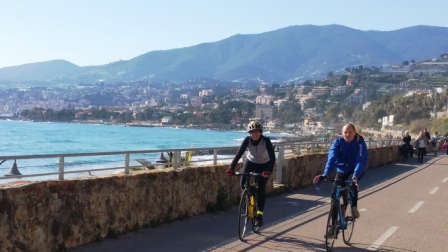
Let’s not give in to old age. Let’s get moving again. He agreed and we had a wonderful, easy ride on the bike route from Sanremo to San Lorenzo al Mare, about 18 kilometers, then back to Sanremo and another 4 kilometers in the other direction to Ospedaletti.SR.blog.7.ajpg

Old railroad tracks were converted into the wide coastal trail, used by walkers and roller bladers as well as bicyclists. It meanders through Sanremo then down the coast. No hills. No need to downshift. There are plenty of spots along the route complete with benches where you can rest and enjoy the scenery. And villages (Bussana, Arma di Taggia, Santo Stefano al Mare) for a refreshment stopover.bike
We had a fantastic and bargain lunch at Café Emy by the beach in San Lorenzo al Mare. The insalata frutti di mare (seafood salad) was huge – a meal in itself. My spaghetti frutti di mare was the best I have ever eaten (see photo).spaghetti

A unique aspect to this bike route is tunnels – several. The most famous and longest is the Capo Nero tunnel along the section Sanremo-Ospedaletti, 1.75 kilometers long. It has been converted into a memorial of sorts to Sanremo’s most famous sporting event, the cycling classic Milan-Sanremo. For more than 100 years, the race has been the first important contest of the cycling season. It will take place on March 22 this year.

Every bay of the tunnel is dedicated to a specific year in the history of the race, with some basic facts about that year’s event written on one side, with tidbits SR.blog.9.ajpgand anecdotes on the other, in both Italian and English. I was too busy pedaling to read it all, but did try to catch some phrases to break up the monotony of the dismal tunnel trek.
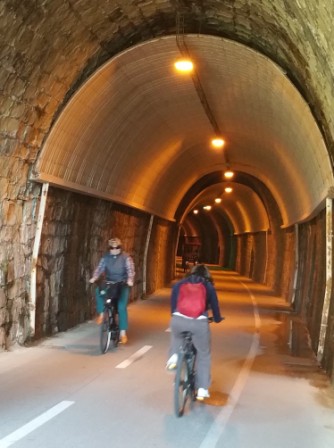
Total ride: 45 kilometers. It was a success. And, so was the hotel where we stayed. Fabulous. With just four rooms, the Villa Rita can’t really be called a hotel. The house sits just above the beach within walking distance of the town center. Our room had a large terrace and lovely views. I was in heaven, lying in bed, enjoying the sea view from the window while listening to the restful sounds of waves slapping the shore — and contemplating future bike rides.

breakfastVilla Rita: www.villaritasanremo.it

Menton Lemon Festival: www.fete-du-citron.com/ The festival takes place the last two weeks of February.

Ristorante Bar Emy, Via Al Mare 1, San Lorenzo al Mare, Italy, ++ 39 0183-91314SR.1a

If not already a Tales and Travel follower, sign up (upper right) so you will not miss future posts. Your address is kept private and never shared.

Like my blog? Tell your friends. Feedback is most welcome. Leave a Reply below.

Follow Tales and Travel on Facebook:  http://www.facebook.com/

Follow me on twitter: @larkleahSR.7.ajpg


Myanmar Beach Adventure
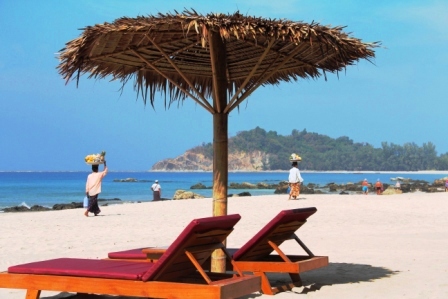
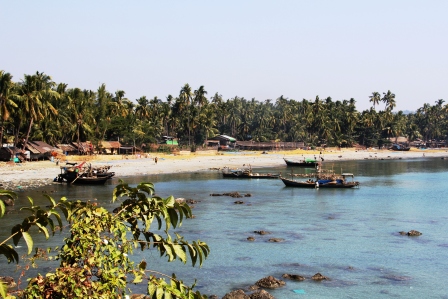
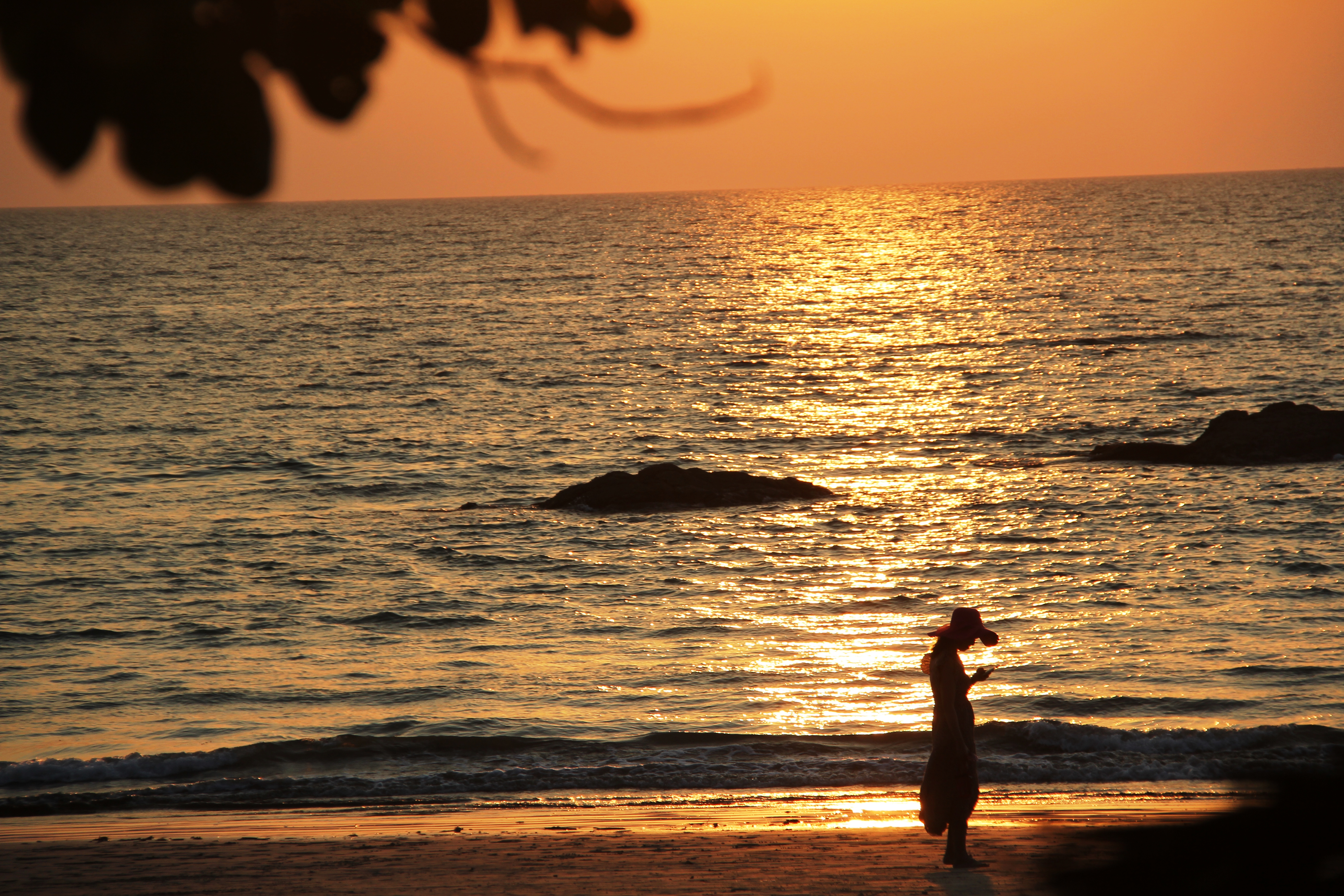
beach.9A long, broad strip of sand, a calm sea, a few lonely swimmers, a few more sunbathers lounging in beach chairs, tranquility: Myanmar’s Ngapali Beach is unspoiled splendor.

After our two-week sightseeing tour of this fascinating land (see previous posts: Burma Background and Myanmar’s Astonishing Sights), we sought seaside relaxation.

Our beach hotel, one of many luxury resorts here, offered a spacious sea-front room, pool, outdoor dining on a terrace above the beach – all in a perfectly manicured verdant setting.

luxury beach hotel--but not ours. luxury beach hotel–but not ours.

This is Myanmar for tourists. Just outside the hotel grounds is reality: rutted, dusty roads, primitive shacks, broken down temples, wild tropical vegetation. Plus, lots of motorcycles, women walking with burdens balanced on their heads, noisy kids, homeless dogs, monks draped in burgundy, nuns in pink…beach.36

While the hotel world was paradise perfect, we left the sanctuary several times to explore the real world. First, a trip by “bus,” a rickety tuck-tuck type vehicle beach.5with two parallel hard wooden benches for seats, passengers crammed together. The “bus” sped over the ruts, passengers holding on to anything for support while bouncing up and down, jolting to and fro. There were many stops, and not just for passengers to get on and off.

We stopped to pick up a few huge sacks of ice at an ice factory where a vintage machine crushed big ice blocks. The sacks were piled in the middle of the two rows of bus passengers. Then a gas station for a wee bit of petrol. And, stops for giving donations. In Myanmar, a country of devout Buddhists, it’s common to see folks along the roads with large silver colored bowls. These are for offerings for monks. Passers-by often stop and throw in some money.  The bus stopped to oblige those wanting to contribute.

Nuns wear pink. Nuns wear pink.

A woman with a bucket of live squid sat next to me. Another had a few eels on top of a pail of ice. Most had large parcels. Young men jumped on and off at random, hanging out the back of the vehicle. I was intrigued by the scene, but, BB (husband Bicycle Bob) seemed in agony and was all too happy to finally reach our destination, the inland town of Thandwe, after a 45-minute painful ride. I wanted to visit the town’s market in search of souvenir bargains. Alas, this was just a huge, chaotic, smelly market of produce, clothing, hardware. We did buy some fruit, a bathing suit for BB, some instant coffee, cookies, soft drinks and a couple of bottles of beer – all for less than $10.

Souvenirs for sale on the beach-- but not in town. Souvenirs for sale on the beach– but not in town.

There are no taxis in these parts. BB was not up for a return bus ride. We walked all over town, looking for someone we could persuade to give us a ride for cash. Finally the driver of an old and dirty station wagon agreed after his friend, who understood our request, translated.

Unfortunately the bus ride did a number on his BB’s butt. He is skinny – no padding, and ended up with rear end welts. The salty sea water only enhanced the pain. Since he is not a swimmer, he did not seem to miss forays into the water.beach.30

I did myself in with a bargain priced all-body Myanmar massage. Huts whose proprietors offer all kinds of massages for less than $10 are profuse at one end of the beach. My masseur, a slight fellow with the power of an Olympic weight lifter, pounded, stretched and jerked my body for an hour.   Not pleasant, especially since I had sore ribs. On the last day of the sightseeing trip I fell, my ribs landing on my hard camera. The massage finished off the rib injury. Moving my arms was agony. I could no longer swim – my second favorite sport after skiing.beach.16

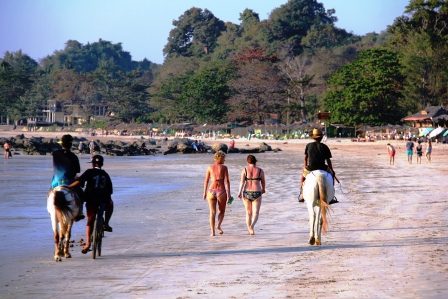
So, we walked along the beach, went to a “cooking school,” and rented bikes. BB, a bicycle aficionado, was not happy with the bikes, simple, ancient models, but there was no choice. The ride – even more ruts than on the bus ride. We pedaled to a nearby town, a wreck of a fishing village. We saw where much of the factory ice ended up. Trucks loaded down with the heavy bags pulled up to a wharf of sorts. Men loaded as many as five of the bags on their shoulders and headed down a jetty to the boats.beach.15

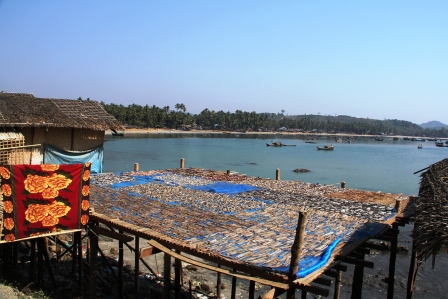
Along our bike route we passed areas blanketed with plastic sheets upon which fish baked in the sun. Dried fish are a staple in much of Myanmar cuisine. While we love fish — the fresh variety which was plentiful and delicious here — the stench of the dried fish was a bit much.beach.17

BB’s butt was still sore, so he passed on a snorkeling trip. I gave it a try since more leg than arm movement is involved in snorkeling. I was the only passenger in a simple motor boat driven by a man and his young son. The snorkeling was a disappointment – few fish. But, the ride was interesting, with a stop at a

Mini island Mini island

miniscule island with a mini restaurant selling food and drinks at inflated prices.

The women who ply the beach selling fruit from the baskets on their heads have also learned to inflate prices. Why not? If the tourists are dumb enough to pay… But, when one wanted to charge me more than $2 for three small bananas and $3 for a mango, I refused.   Bananas are like peanuts in Myanmar – profuse, and I can buy a tropical mango in France for $3 or less.

Except for the soothing sounds of the sea slapping the shore, the only beach sound is these fruits sellers advertising their wares. They saunter up and down, past all the hotel lounge chairs, calling out in sing-song tone, “Ming guh la ba (hello), pineapple, banana, coconut.”   It was like a ritual chant.beach.13

On one of our walks we had seen a sign in front of a rundown restaurant advertising cooking lessons. We liked the food in Myanmar. Since I love to cook, why not sign up? The kitchen was a health inspector’s nightmare, but our two instructors, neither of whom spoke English, washed their hands frequently. They chopped, sliced and diced with professional skill. The resulting meal was excellent, especially the avocado salad (see recipe in column at right).blog.9

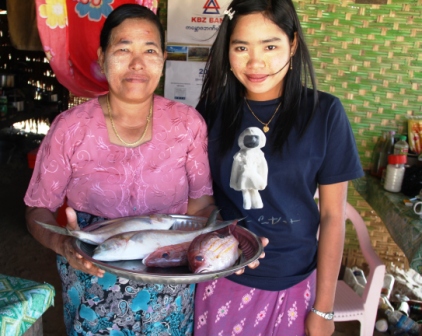
In addition to the beach massage “parlors,”   food shacks are lined up along one part of the beach with tables in the sand. We became regulars at one run by a couple and their niece, a friendly young girl who spoke a bit of English and helped me master a few words of Myanmar. I had befriended one of the numerous homeless dogs and wanted to buy some food for it. I tried several beach eateries. All refused to sell me chicken pieces for a dog, except this one, hence we gave them our regular business.beach.27

The man was the chef. I asked to watch him prepare fish over an open fire in his tiny, rustic kitchen and picked up a few tips. For a beach finale dinner, we splurged on lobster. Perfect, and my friendly dog even appeared to bid good-bye.beach.35

Myanmar is on the move, emerging from decades of isolation and repression. Tourism is booming. Roads, including the one to the Ngapali beach resorts from the nearest airport, are being improved. Soon there will be quality bikes to rent and Cordon-Bleu type cooking schools at the beach. Throughout the country, new hotels are under construction. People are learning new skills, including English, to qualify for jobs in the tourist industry. According to an official estimate, the hotel and catering industry could create over a half million jobs in Myanmar by 2020. Lives will improve. But, hopefully the rapid rise of tourism will not destroy the allure of Myanmar, a place Rudyard Kipling found “quite unlike any place you know about.”beach.2

See below for more photos. And, for a different take on ratatouille, try Lecso, a Hungarian version mentioned in my recent blog post, Swiss Slopes Welcome Journalists. Click on photo at right for the recipe. Comments and new subscribers welcome. Add your email address at top right to receive future posts.beach.19

Village school along our bike route Village school along our bike route

beach.21

Visiting monk from Thailand where monks wear orange. Visiting monk from Thailand where monks wear orange.

beach.31beach.26

Sand Art Sand Art

beach.24


Pedaling – and tasting—amongst Danube vineyards

In our not-so-much younger days, Bob (once known as Bicycle Bob) and I did lots of serious pedaling. Weekend bike trips loaded down with panniers in Germany.  Longer treks in Austria,  and even over the Swiss Alps several times.  The Swiss rides, no doubt the most challenging, were our favorites.

Since we’ve settled down in southern France, we seem to do less and less cycling.  A pity, as there is great riding in these parts.  Mt. Ventoux  for one.  I’d never attempt that climb, but Bob long ago said he would… He’s still thinking about it.blog.1

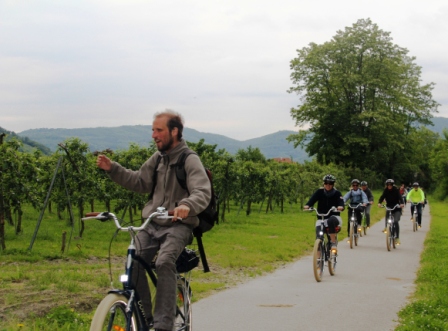
On our recent trip to Austria, we had a chance to get back in the saddle – a Grape Grazing tour by bicycle through the Wachau Valley.  Wine and Biking.  The perfect combination.blog.4

The scenery was  superb along a meandering river bordered by cliffs, forested hills, vineyards and picture-perfect villages.  The pedaling was easy, just 25 kilometers on mainly flat terrain along the Danube and never more than about 25 minutes on the bikes before a  stop.  The bikes were easy- to- ride cruisers with extra comfortable wide seats.  And, the wines were excellent with informative commentary by our helpful guide, Endre Barz, a Hungarian who told us to call him Andy.

Only the weather did not cooperate.  It was cold, gray, dismal, although we never had to use the rain ponchos provided by the tour company.  But, neither did we get to swim in the Danube as the tour literature described.blog.6

Our first stop after a ride along the bike trail that is part of the popular Donau Radweg (Danube Bike Route) was the Domȁne Wachau, a cooperative on the edge of the medieval town of Dϋrnstein where we sampled four different white wines.  In the Wachau Valley, a 21 mile stretch between the towns of Krems and Melk also known as the Danube River Valley, 85 percent of the wines are white.

A 2012 Gelber Muskatteller was first on the agenda, dry, fruity, a “popular summer wine.”  “Austrians prefer young wine.  They drink it immediately,” Andy explained.blog.5

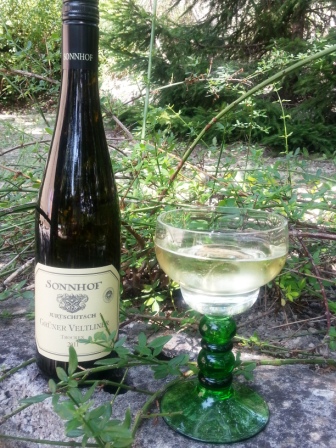
Then came Katzensprung 2012 from the indigenous Grϋner Veltliner grape, a dry, light wine.  Andy told us that there are between 700 and 800 wine producers in the Wachau Valley, mainly small, family farms, with a total of 1,400 hectares of vineyards.

He went on tell us the importance of the Katzensprung wine in the country’s history. After World War II, Austria was divided into four zones:  British, French, Soviet and American.  The seat of government was in Vienna surrounded by the Soviet zone.  ”In 1955 the Austrian president gave visiting Soviet leaders this wine.  He got them drunk and convinced them to let Austria become a neutral nation,” Andy related.

We tasted two Rieslings before a visit to the winery shop where most of the wines were reasonably priced, from seven euros per bottle.  “It’s amazing in Europe.  Austria produces high quality wines but at a lower price than in other countries,” Andy said.blog.9

The charming town of  Dϋrnstein  where we had a lunch break sits at the foot of terraced vineyards and castle ruins. Richard the Lionheart, King of England, was a prisoner in the fortress during the Third Crusade.

From the town, a footpath leads to the ruins where a  remarkable view awaits.  The town’s Parish Church with a Baroque tower is also worth a visit.  Most of our fellow cyclists (we were 12,  from Sweden, Norway, Singapore, Chicago, and Bob and I), preferred to peruse the town’s shops where all sorts of products made from Marille, an apricot variety grown in the Wachau Valley, are big sellers (jams, soaps, schnapps, mustard, chutney, chocolate).blog.12 The Marille strudel Bob ordered to finish off his lunch of a hearty goulash and dumplings was fabulous.

We pedaled on through picturesque countryside, often with vineyards on both sides of the bike path, to Weissenkirchen for a tasting at Weingut Hermengled Mang, a family winery which also has a restaurant, a Heuriger, a special Austrian eatery attached to a winery that serves the season’s new wines and simple, local food.

As we sipped and swirled a Grϋner Veltliner, then a Riesling and lastly a Chardonnay, Andy told us about the wine scandal that almost finished  the wine business in Austria.  Prior to the 1980s, Austria produced mainly sweet wines. The country had a good rapport with Germany which did not produce enough grapes to satisfy the demand of its thirsty wine.gv.blogcitizens.  It bought Austrian wine which it sold as German wine.  But in 1985, Austria did not have enough sweet wine to fulfill its contract for the German market.  Vintners could not add sugar to the wine as it would be detected.  Instead, they added antifreeze which the Germans discovered. Although only three or four companies were involved, “It destroyed 80  percent of the Austrian wine production,” Andy said.

When the wine business was revived, it was decided to focus on dry wine of a high quality and to avoid mass production.  Today “small is beautiful” best describes Austrian wine, most of which is white.  The crisp, dry vintages are appreciated by wine experts around the world.blog.8

VIENNA  WINE

Back in Vienna, we learned more about Austrian wine with a tasting at the Christ Winery and Heuriger in the Vienna community of Jedlersdorf.

Vienna is the only world capital with vineyards in the city limits.  Some 700 hectares on both sides of the Danube are devoted to grapes with 250 wine producers, most of whom produce their own wine, although some sell their grapes to other vintners.blog.2

Rainer Christ  took over his father’s winery in 2004, aiming to breathe new life into the more than 400 -year- old company.  He is most enthusiastic about his renowned Gemischter Satz, a Vienna white wine made from different varieties of grapes and his “biggest seller.”  After World War II most vintners used one grape variety to produce one wine, he explained. However, historically several grape varieties were often combined into one wine. “This had been forgotten in Vienna, but it’s become popular in the last 10 to 15 years, “ he said.

Some producers use from eight to ten different grapes varieties in Gemischter Satz,  but usually it’s  from two to four .  We tasted his 2012 Wiener Gemischter Satz which sells  for 7,90 euros  and  is a combination of Grϋner Veltliner, Weissburgunder (Pinot Blanc), Riesling and  Welsch Riesling (an Austrian grape variety).  Christ termed it “elegant, refreshing.”  It has a maximum of 12.5  percent alcohol and is “ not too rich,” he added.  We loved it.  If the trip back to the hotel hadn’t involved a Strassenbahn trek,  followed by a ride on the S bahn and finally U bahn, we would have purchased a case.

Christ has studied oenology and worked in the wine business in many different countries, including the U.S., France, Italy and Germany.  Within the past 20 years, there’s been more science involved in wine production, he explained. “It’s more and more professional, yet knowledge of the past is very important.  Theory and new techniques do not make a good wine.  You need to be out in the vineyards, get ideas and the participation of your parents.”blog.3

Christ, like most vintners, experiments with growing techniques.  His Weiss Burgunder der Vollmund is one result, a wine made from grapes harvested during a full moon.  “We learned that the moon makes a difference.”  Grapes harvested one day before or one day after the full moon had a different character, he explained.   The full moon wine is “richer in aroma, more massive, longer on the tongue.”

We also tried a  2012 Bisamberg Alte Reben, Wiener Gemischter Satz, made from grapes grown in a 75- year old vineyard.  The wine, named “white wine of the year in Austria,”   goes well with richer foods. “Austrians like to combine heavier dishes with full bodied white wines,” he said.  And, Austrians drink white wines with all types of food –meat, fish, poultry, cheese, etc.

Platter of hearty food at the Christ Heuriger

HELPFUL SITES

Grape Grazing Bicycle Wine tour of the Wachau Valley with  Vienna Explorer,  59 euros, http://www.viennaexplorer.com/tours/grape-grazing-tour/‎

Domȁne Wachau, www.domaene-wachau.at

Weingut & Heuriger Christ, www.weingut-christ.at

Vienna Heurigen Express, Hop  on, Hop off sightseeing tour through the Vienna wine region and villages.  Trip ends with a visit to a Heuriger, but you can get off en route to see more at leisure.  www.heurigenexpress.at

Excellent, reasonable hotel in Vienna, Hotel Daniel, http://www.hoteldaniel.comblog.7

More helpful web sites:

http://www.austrianwine.com

www.wienerwein.at

http://www.wien.info

See column at right for recipe:  Baked Salmon Fillets with Goat Cheese and Coriander requested by friend Sue. Comments on blog post and recipes are welcome. See “Leave a Reply” below under Comments. Subscribers also welcome.  Don’t miss future posts.  Click on Email Subscription at top right.

NICE: Enchantment on the Riviera

I wrote the following for the newspaper Stars and Stripes three years ago after a visit to Nice.  I’ve been back several times, most recently after Christmas.  This time we lounged on the beach, enjoyed delicious food, and soaked up that seductive ambience of the Cote d’Azur.  Nice — it’s my kind of town..niceb11

After many, many years in Germany, my husband and I and our two cats (we now have three) left Deutschland behind and moved to the hinterlands of Provence in southern France. We’ve been here five years (now eight), and it’s lovely. We don’t regret the move. But I’ve found a corner of this part of the world I like even more: Nice.

Our quiet life in the countryside has its pluses, but I miss the vibrancy and excitement of a city.  Nice offers that, as well as the sea and beaches, museums, markets, intriguing old town, excellent restaurants, lush parks and outstanding architecture, all wrapped in an enchanting ambience.niceb4

France’s fifth largest city is the capital of the glamorous French Riviera.  There’s plenty of elegance along the Promenade des Anglais, its seaside boulevard lined with palms and turn-of-the-century hotels and grand apartments.  There are traces of North Africa in the tangle of dark alleys of Vieux Nice, (old Nice). The outdoor markets and restaurants, as well as the numerous street stands, capture the flair of neighboring Italy. It’s an irresistible mélange.niceb15

Nice’s roots go back thousands of years to prehistoric times. By the 4th century it was settled by Greeks, followed by Romans, then Saracens. Nice was part of the House of Savoy (Italy) from 1388 until 1860 when citizens voted to join the Second French Empire.

The English discovered its charms in the 18th century, followed by those from other countries, especially Russians.  The Cathedral of Saint Nicholas, commissioned by Czar Nicholas II and inaugurated in 1912, is the largest Russian religious edifice outside Russia, and a top tourist attraction.

By the 19th century Nice had become a favorite winter haunt for the British.  It was an Englishman, Reverend Lewis Way, who is responsible for widening a former water front footpath in 1820 at his expense which was dubbed “Chemin des Anglais” (road of the English). In 1931 it took its final form, two roads with a palm-planted center strip, and became known as the Promenade des Anglais.niceb16

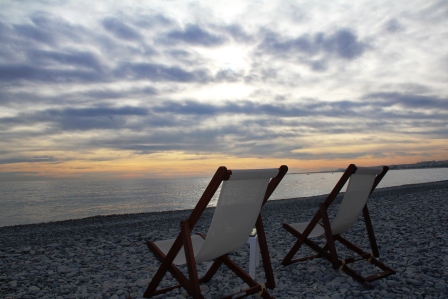
On one side of the famous avenue are Belle Époque buildings. On the opposite side are miles of beaches.  Thanks to Nice’s microclimate, even in winter you can sit at a beach café and soak in the rays.  You may even see brave souls who spread their towels in the sand and sunbathe in bathing suits.  In summer, of course, the beaches are crowded with both tourists and locals.niceb13

During our winter visit, after a stroll along the beach we climbed the steps to Castle Hill where a citadel once stood.  It’s now a maze of greenery, perfect for getting some exercise and enjoying superb views of Nice, its beaches and harbor, with the backdrop of hills and the distant Alps.

We took the easy way down, riding an Art Deco lift which deposited us on the edge of Vieux Nice. I love taking pictures at the flower market on the Cours Saleya in the heart of the old town.  I also love wandering in the labyrinth alleys in this part of the city, checking out funky boutiques, admiring Baroque churches, taking more pictures. One place that has become a favorite is Oliviera, a shop with 17 different kinds of olive oil where owner Nadim Berouti is happy to offer tastings.  The shop also has a mini-restaurant.

“When I understood that every morning I would see again this light, I could not believe how happy I was,” artist Henri Matisse wrote about Nice.  The light of the Riviera has inspired numerous artists, not just Matisse who lived in the city from 1917 until his death in 1954. A Nice museum devoted to his works is a must.Nice beach

We rode a bus up the hill to the Cimiez district where the museum is located in a 17th century Genoese villa.  Works from every period of the artist’s life are on display, including early paintings, the famous gouache cut-outs, studies (drawings etc.) for his renowned chapel in Vence, even personal effects such as Venetian furniture and Oriental wall hangings.niceb2

It was a long hike back to the center, but worth the trek to admire great pillared houses and rows of cypress trees along the route.

The Museum of Modern and Contemporary Art in the heart of the city is another gem with a collection of 400 works including sculptures and canvases by New Realists, Pop artists including Andy Warhol,  whimsical creations by one of my favorites, Niki de Sainte-Phalle, and more.  The avant-garde building with glassed-in ramps around an atrium is a sensation, as are the great views from its roof terrace.niceb19

We ran out of time and postponed a visit to Nice’s Chagall museum for another trip when we rode the Nice hop-on, hop-off tourist bus to the museum where I was in awe.  The 17 huge, colorful paintings depicting Biblical scenes are amazing.  Also to marvel are mosaics, stained glass windows and tapestries.

The bus stops at other tourist highlights, including the Russian church.  It’s a great way to take in the city, its neighborhoods and seaside panoramas, as well as travel to the sights. Head sets offer fascinating commentary in numerous languages.

When we get too old for life in the country, maybe we can move to Nice.nice.b1

TIPS FOR TOURING NICE:

Le Grand Tour, Nice’s hop-on, hop off tourist bus with 14 stops www.nicelegrandtour.com

Nice’s flower market on the Cours Saleya takes place everyday from 6 a.m. until 5:30 p.m. except Monday when it is replaced with an antiques market.niceb9

Oliviera for olive oil and small meals. 8 bis, rue du Collet in Vieux Nice, www.oliviera.com

Museum of Modern and Contemporary Art, Promenade des Arts, open daily from 10 a.m. until 6 p.m. except Mondays and some holidays.  Entrance is free. www.mamac-nice.org

Matisse Museum, 164 avenue des Arènes de Cimiez, open daily except Tuesday from 10 a.m. until 6 p.m.  Entrance is free. www.musee-matisse-nice.org

Marc Chagall National Museum, avenue du docteur Ménard, open daily except Tuesday and some holidays from 10 a.m. to 6 p.m. from May to October. From November to April from 10 a.m. to 5 p.m. Admission: 7,50 euros.  http://www.musee-chagall.frniceb18

Excellent centrally located accommodations at the 4-star Hotel Le Grimaldi, 15, rue Grimaldi.  Rates vary with season, from 99 euros for a double in low season. www.le-grimaldi.comniceb3

Favorite restaurant: La Zucca Magica (the magic pumpkin), a vegetarian restaurant run by Italians.  The decor is pumpkins, gourds and squash — hanging from the ceiling, on the tables and window sills, depicted in paintings and photos on the walls.  It’s dimly lit with flickering candles, cozy and inviting.  There is no menu.  You take a seat, order some wine, and food starts arriving — five different dishes, one after another. www.lazuccamagica.com

More information on Nice at www.nicetourisme.com

 Gingered Butternut Squash Soup with Spicy Pecan Cream was a winner at my recent dinner party.  Recipe listed in column on right. Comments on blog post and recipes are welcome. See “Leave a Reply” below under Comments. Subscribers also welcome.  Don’t miss future posts.  Click on Email Subscription at top right

Back to Germany

Germany was my home for 28 years. Good times, wonderful memories – and fabulous friends.  Husband Bob and I recently returned to reconnect with many of those friends,  to visit old haunts, as well as other destinations that I will be writing about for the magazine German Life. (www.germanlife.com).

Maybe we’ve lived in the boondocks of rural France too long (since 2004).  Here life is tranquil, serene, quiet.  This time we found Germany a bit chaotic with monstrous traffic jams on the autobahns, construction sites  almost everywhere and  crowds of people in the city centers.  It’s hard to imagine that anyone could be unemployed in Deutschland with so much building in progress.

We spent several  nights with friends Klaus and Dagmar who live in Gerlingen just outside of Stuttgart. They urged us to take the U-bahn downtown to see the massive and controversial construction site for Stuttgart 21, the city’s  new railway and urban development project  which involves  57 kilometers of  new railways, including some 30 kilometers of  tunnels and 25 kilometers  of high-speed lines. Protesters still demonstrate at the site every Monday.  The project, which is estimated to  cost as much as six billion Euros, won’t be completed until 2020.  Another attraction adjacent to the site is the  new library, a modern and dazzling wonder in white by architect Eun Young Yi which has been likened to a Rubik’s cube puzzle.

Dagmar invited several of our friends for an excellent dinner, an antipasti of grilled vegetables, followed by  a  Swabian favorite,  stuffed breast of veal, all topped by  our very favorite German dessert, Rote Grϋtze, a yummy compote of red fruits.  Friend  Heti also entertained us with an amazing meal of Peruvian delicacies:  ceviche (fish  marinated in lime juice) and veggies, gallina picante parmesana (chicken with aji -hot yellow pepper), quinoa risotto with veggies, and for dessert, coconut flan and Tonka bean mousse.  All over the top.  More on those beans to follow.

Heti is an inspiration, and not just in the kitchen.  She recently lost 14 kilos on the Dukan diet combined with an hour of aqua jogging every day in the nearby Sindelfingen indoor pool.  When I lived  in the area, I frequently swam there year round.  There are also several outdoor pools for summer months.  Sadly, France is lacking in these first-class swimming facilities.

Klaus and Marianne, other friends from the Stuttgart area who frequently housesit for us in France, treated us to a delicious pasta lunch and a homemade Swabian apple pie at their new apartment.

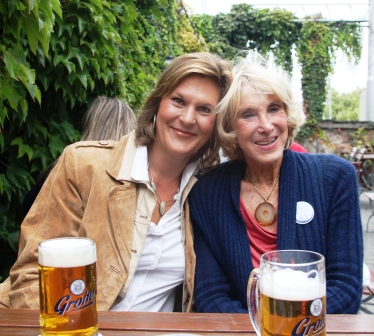
We took a trip north to the Darmstadt area to see more friends.  For years I worked for the military newspaper Stars and Stripes which was previously headquartered just outside the city.  A group of former colleagues met us at an Italian restaurant for a fun evening.  Special pal Andrea, whom I consider a surrogate step-daughter, and her husband Thiemo, joined us at Darmstadt’s famous brewery, Grohe, where we sat outside in the sunshine savoring the brew.  Another Darmstadt friend, Wilma, invited us for a delicious salmon dinner and stimulating conversation with her friend Erik.

Our travels also  took us to the Bergstrassee south of Darmstadt, Kaiserslautern, Augsburg, Munich and the Starnberg Lake district south of Munich.

For many years while I worked at Stars and Stripes, I lived in Jugenhiem at the northern end of the Bergstrasse in an apartment I called the “Treehouse.”  It was the top two floors of a former seniors’ home at the edge of a forest  and surrounded by tree tops.  We stopped for a visit, and it’s still the same – an idyllic hideaway in a jungle of green.

The best of the visit to the Bergstrasse, which extends 70 kilometers south from Darmstadt  to Heidelberg, and where many an ancient castle and castle ruins crown hilltops, was wine  The Bergstrasse wine region is divided into two parts, vines in the south in the state of Baden Württemberg, and those in the north in Hessen.  The former is Germany’s smallest wine region. German wines, as well as wines everywhere, have improved thanks to up-to-date knowledge and techniques, an expert told us.

For years German wines had a bad rep because “we exported the wrong wines, “ such as the  sweet Blue Nun, explained Maria Zimmermann of the regional tourist board.   Today German vintners are also well-educated, studying viniculture, not just learning the trade from their parents. We tasted some fine wines, and  Bob  made several purchases.

In the town of Weinheim, we toured a lovely garden followed by the best restaurant meal of the trip, an amuse bouche of scallops topping  a pumpkin salad sprinkled with mandarin oil, and a Hirsch (venison) medallion with an elderberry sauce and Steinpilze (boletus),  plus  parsley root puree. It was perfection.

Heppenheim is the quintessential Bergstrasee town with a market place of well-preserved half-timbered houses.  We joined an after-dark tour up and down the ancient streets and stairways, following a costumed story teller and her lantern carrying assistant.  Periodically they stopped with the story teller relating charming tales and fables of the region, most translated from old German into an English that rhymed.  Very impressive and a delightful, unusual experience.

The greatest number of Americans outside of the U.S., some 50,000 who are military or civilians working for the military, makes their home in the Kaiserslautern area. There I interviewed Wolfgang Tönnesmann, director of the Atlantic Academy, who had a life-size cardboard replica of Obama in his office. Like me, he is no doubt thrilled with the recent election results.

My quest to try local food specials in Kaiserslautern led us to the town’s only half-timbered building and the restaurant Spinnrädl. We were in the Rhineland Pfalz area and the restaurant served up  Pfälzer dishes written in the local dialect on the menu:  Brotworscht, Saumaa, Lewwer (Bloodwurst, potatowurst so named because it is stuffed into a pig’s stomach or Saumaa) and liverwurst. Hearty fare accompanied by Grumbeerstampes   (mashed potatoes).

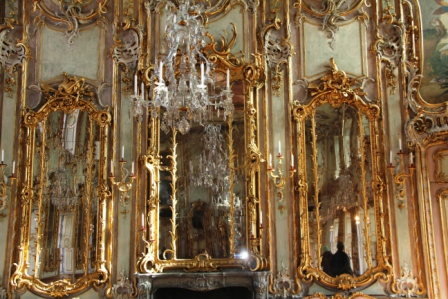
Jakob Fugger (1458 – 1525), a wealthy merchant (according to a guide, “he had more money than Bill Gates) put Augsburg on the map.  The Fugger family, in particular Jakob, was into finance and trade.  Jakob, known as the Empire’s banker, and  not unlike Bill Gates, had a social conscience.  He founded the Fuggerei, a section of the city for the town’s poor, the world’s oldest social housing which still exists with 140 apartments.  Rent is 1 euro per year.  We followed a fascinating tour of the area, and also visited a dazzling Rococo banquet hall, the Schaetzler Palais (1767), as well as other local attractions.

The Munich visit focused on food with visits to the city’s legendary outdoor market, the Viktualienmarkt, its classy food emporiums, Dallmayr and Käfer, as well as the food empire of Alfons Schuhbeck who has a collection of shops, including a Michelin starred restaurant, in the Platzl near the Hofbräuhaus.  Friend Heti clued me in on Schuhbeck who is huge on the German food scene.  It was at his incredible spice shop where she purchased the Tonka beans which come from South America for that exotic dessert.

Our visit wound up at the Starnberg Lake, one of several lovely lakes  south of Munich. All the sailboats which blanket the lakes in summer had been put to bed, but the region had plenty of charms for a fall visit.

A  must was a visit to the nearby Andechs Abbey above the Ammersee, another one of the regional lakes.  After admiring the Abbey’s church and its stunning Rococo stucco décor and frescoes,  we moved on to the terrace beer garden.  Monks have been brewing beer at Andechs since 1455.  These days seven different kinds of brew can be ordered, as well as Bavarian food favorites.

Other Starnberg highlights are the Baroque St. Mary’s Minister in the town of Diessen and  the lakeside Buchheim Museum noted for its collection of Expressionist works.  Last but not least, a wonderful bike ride following a cycle route along the Starnberg Lake with an outdoor lakeside lunch stop, as well as many breaks for postcard photos of the lake framed by distant Alpine peaks. (For more photos, see slide show to follow.  Comments are welcome. )

For more information:

www.diebergstrassse.de

www.augsburg-tourismus.de

www.munich-tourist.de

www.sta5.de

www.andechs.de

This slideshow requires JavaScript.