Discovering the marvels of MUD

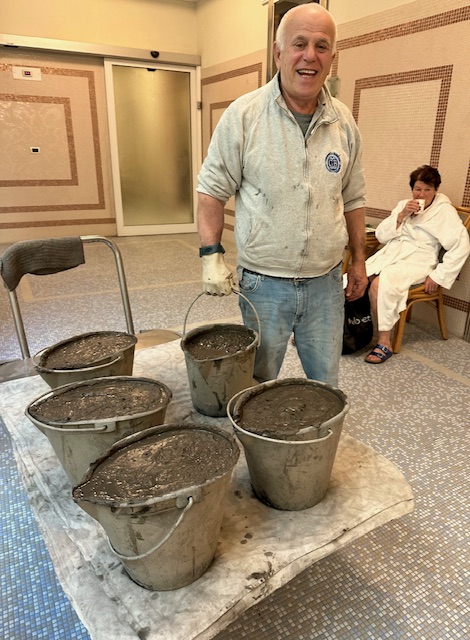
Five days a week, beginning in the wee hours, Askit is on the job, filling buckets with deep brown, slimy, gooey mud. Therapeutic mud.

The husky, jovial native of Albania then pulls a cart with six heavy buckets of the yucky substance to the treatment area at the Hotel Residence, a spa hotel in Abano Terme, Italy.  He has been doing this for 30 years, he tells me with a hearty grin, then dumps a pail of mud onto a therapy bed.

Vanni, his Italian colleague, takes over, spreading the mud into one or more puddles on a bed in a small therapy room.  The room also has a shower for hosing off the mud and a deep tub for après-mud soaking in warm thermal water. 

Vanni motions me into the room.  I shed the hotel robe.  Mud treatments are not for the prudish.  This is naked body treatment, however miniscule thong “undies “of a gossamer-like paper are available.  

Vanni checks the soaking tub.

Vanni is a joy, always smiling.  I stop trying to cover my sagging boobs with my arm and follow his instructions to  lie on the bed, back positioned on the big puddle. He lathers me with mud, covers me in plastic, puts a blanket on top and disappears. The mud is hot initially, but soon deliciously warm. I stay that way for 20 minutes.  Vanni returns midway to wipe my face with a cool, moist cloth.

He started working at the hotel in 1979, he says, and now calls himself “fango meister,” German for mud master.  Many Germans previously patronized this spa hotel.  Vanni has mastered the language in addition to the mud.

I am a water rat.  The mud is pleasant, but I adored the soak in the hot, bubbling thermal water.   According to the Abano web site (abano.it), the water makes a long, underground journey from the pre-Alps.  Rain enriches it with mineral salts.  It is transformed and “classified as salted-bromide iodic hypothermal water.” 

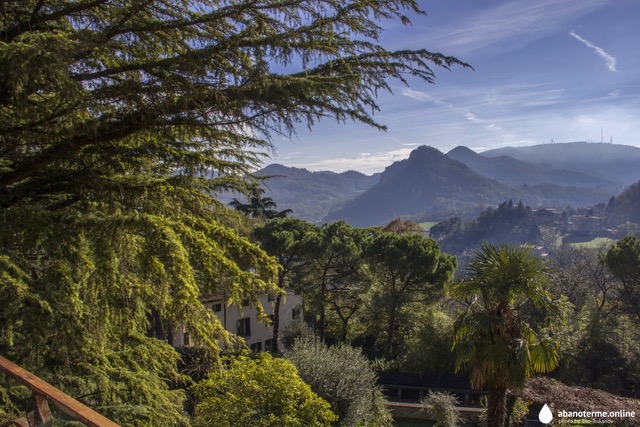
Euganean Hills, Abano Terme photo

The mineral rich water is the secret ingredient of the mud. Abano is at the feet of the Euganean Hills, a region of prehistoric volcanoes in northeastern Italy. Clay is extracted from lakes in the area, filtered and purified, then left to “ripen” for at least two months in special tanks with the hot thermal water.  Not just hot, but scalding water which emerges from the ground at 75-90 °C (167-194°F). For pool use, it travels through a piping system and is cooled to 30-35 °C (86-95°F). 

The final mud product is natural therapy with a healing, anti-inflammatory and analgesic action.  It is said to stimulate cartilage restoration, enhance the immune system, as well as restore vitality and a mineral balance of the body.

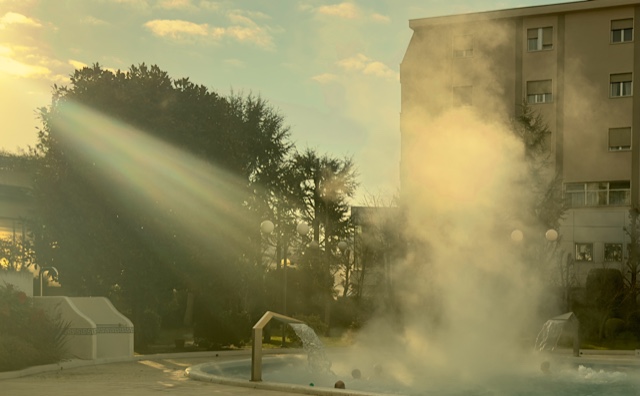
Pool at Hotel Residence

The tub soak is a delight, but even better are the thermal pools, large indoor-outdoor pools with warm thermal water and powerful water jets. They are not meant for swimming, just relaxing and enjoying the soothing water.  I could have spent hours at the pool, but learned from experience that was not a good idea.  The recommendation is for 30-40 minutes maximum per session.  Of course, I disobeyed the first time, and then was completely wiped out. 

Abano has been a wellness destination since ancient times.  According to legend, the first settlement in the territory was founded by Hercules who is said to have restored his strength and health here after his challenging feats.

Romans were fans of water treatments and appreciated the healing properties of hot springs and mud from the valley.  More than 2,000 years ago, they built villas and settlements whose ruins are still prevalent in the area.

Sun beams and steam at hotel pool

This was my third visit to Abano. The first was in the summer (not recommended). See my previous blog, “Taking the waters – and the mud” for more details.

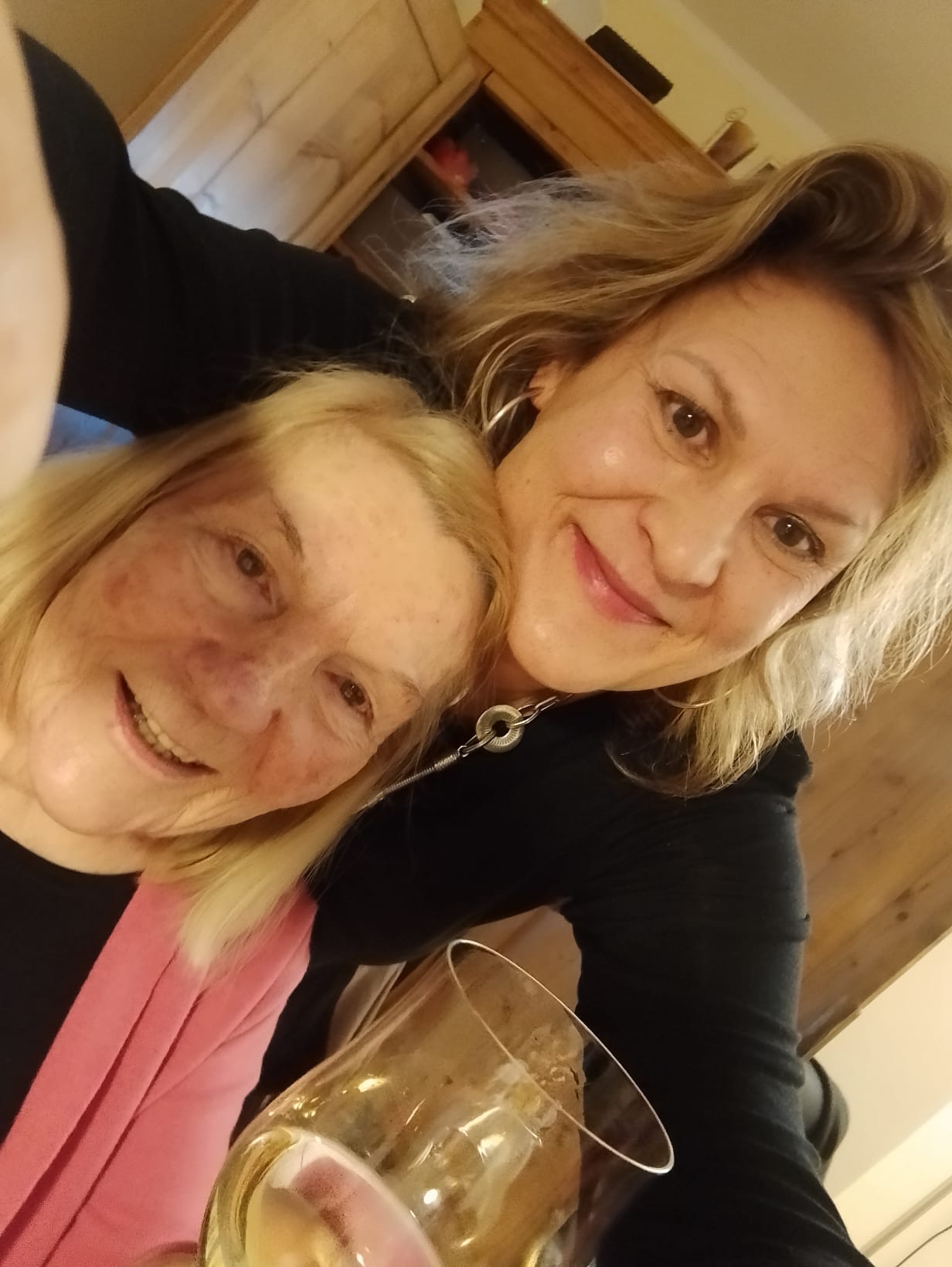
This past Christmas as well as Christmas 2023, I joined friend Angi for a 10-day visit to Abano.  Angi is a dedicated fan of the mud.  For years she lived in Rome and spent two weeks every year in Ischia, a volcanic island off the coast of Naples known for thermal springs and mud.  She had serious back pain following an auto accident which resulted in five fractured vertebrae.  The treatments “took away the pain and inflammation,” she says.

Friend Vera has been to Abano six times for “wellness, cooling out, relaxing… I enjoy it.  I enjoy the treatments,” she says.

I can’t say Abano made any difference with my numerous body infirmities following my disastrous fall and seven surgeries.   But it was sublime, a definite morale booster, a rewarding experience. For me, it did “restore vitality.”   I just may return next Christmas.

In addition to mud and water, I treated myself to massages and facials.  I spent an afternoon exploring nearby Verona.  I joined the excursion to Villa Selvatico, one of many villas, castles and abbeys in the surroundings.  I attended a church concert. And, I found bargains at the town’s weekly market. 

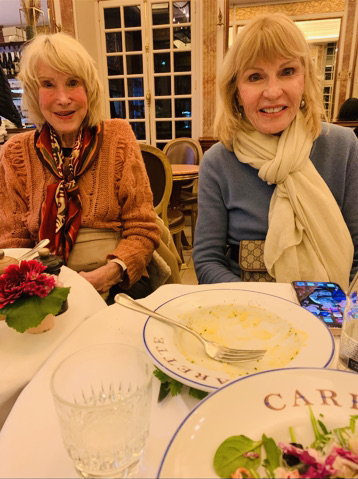
Food was another highlight – very good, varied, healthy.  Angi and I shared a table in the welcoming dining room. Fatima, an “angel” from Brazil, was our waitress. She brought us real cappuccino in the morning so we could skip the watery machine variety. She gave us advice on menu selections. Like most of the hotel staff, she was cheerful, helpful and fun to chat with.

Fatima

The town Abano Terme has a population of 20,000, but claims 250,000 visitors annually.  There are some 37 spa hotels of all categories offering pools and mud treatments, as well as other hotels and different accommodation possibilities.

My package included nine nights single room, three meals per day excluding drinks, unlimited pool and sauna use, plus bus transportation: 1,400 euros (about $1,500 at current exchange rate).  A doctor visit is required before beginning the program, 70 euros ($72). The doctor determines, recommends which treatments are best for each visitor.  I paid 35 euros ($36) for each mud wrap and tub soak; 70 euros ($72) for a heavenly detox facial; 75 euros ($77.50) for a 50-minute-deep tissue massage.   The latter were so exquisite, I had to have more — an anti-stress facial and another deep tissue massage.

Throughout the year, GB hotels, a group of five Abano spa hotels, organizes bus transportation from several  cities in southern France where I to Abano.

More information on Abano: www.abano.it.  More info on the four-star Hotel Residence and other Abano hotels at www.gbhotelsabano.it

If not a Tales and Travel follower, please sign up here. Trust me. It’s safe. Your address is not shared.

Check out my tried and true recipes — keep scrolling down on a phone, or, if on a /PC or tablet, up to the column on right then down to “Recipes.”  I will add new recipes soon.

Swedish holiday “orgy”

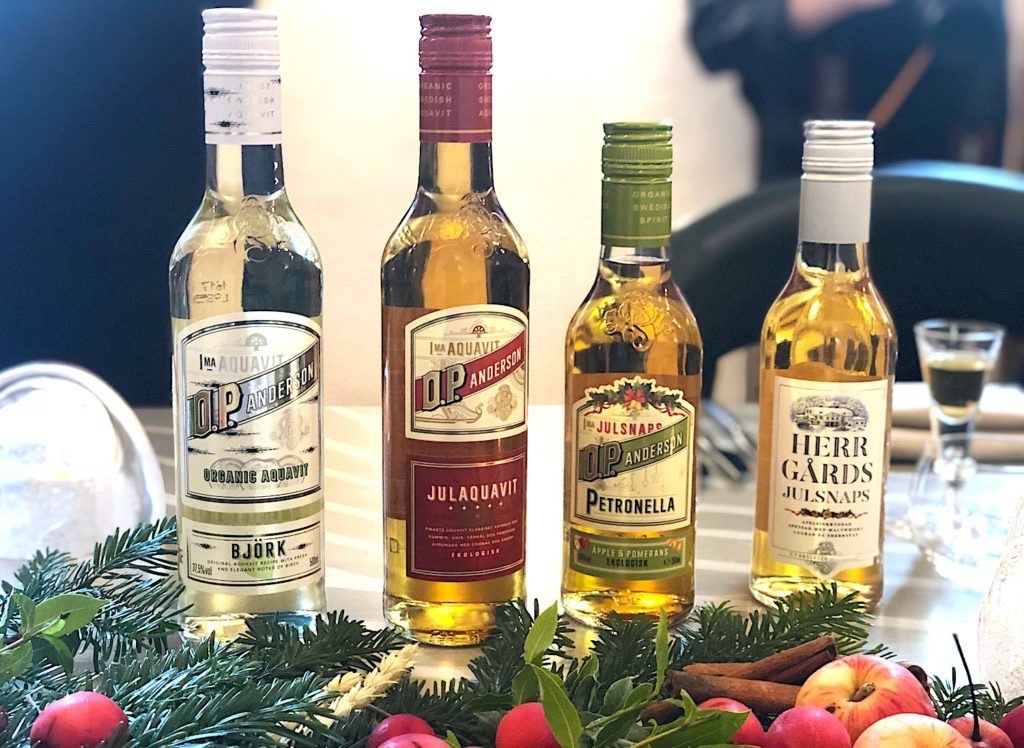
Following is a guest blog with photos by Swedish friend Lars who recently journeyed to his home country to celebrate his sister’s birthday. It was more than an over-the-top birthday party: the Julbord, a holiday overdose of food – and akvavit (a popular and strong Scandinavian spirit. See below for more on this beverage). The Julbord is a must at Christmas, but can be repeated during the festive season including on New Year’s Day. The eating can go on all day, Lars says. “It’s supposed to be drawn out. It’s an orgy. You need time to recover.” He recalls that housewives used to “slave for two weeks” to prepare the food, but many now celebrate in restaurants.

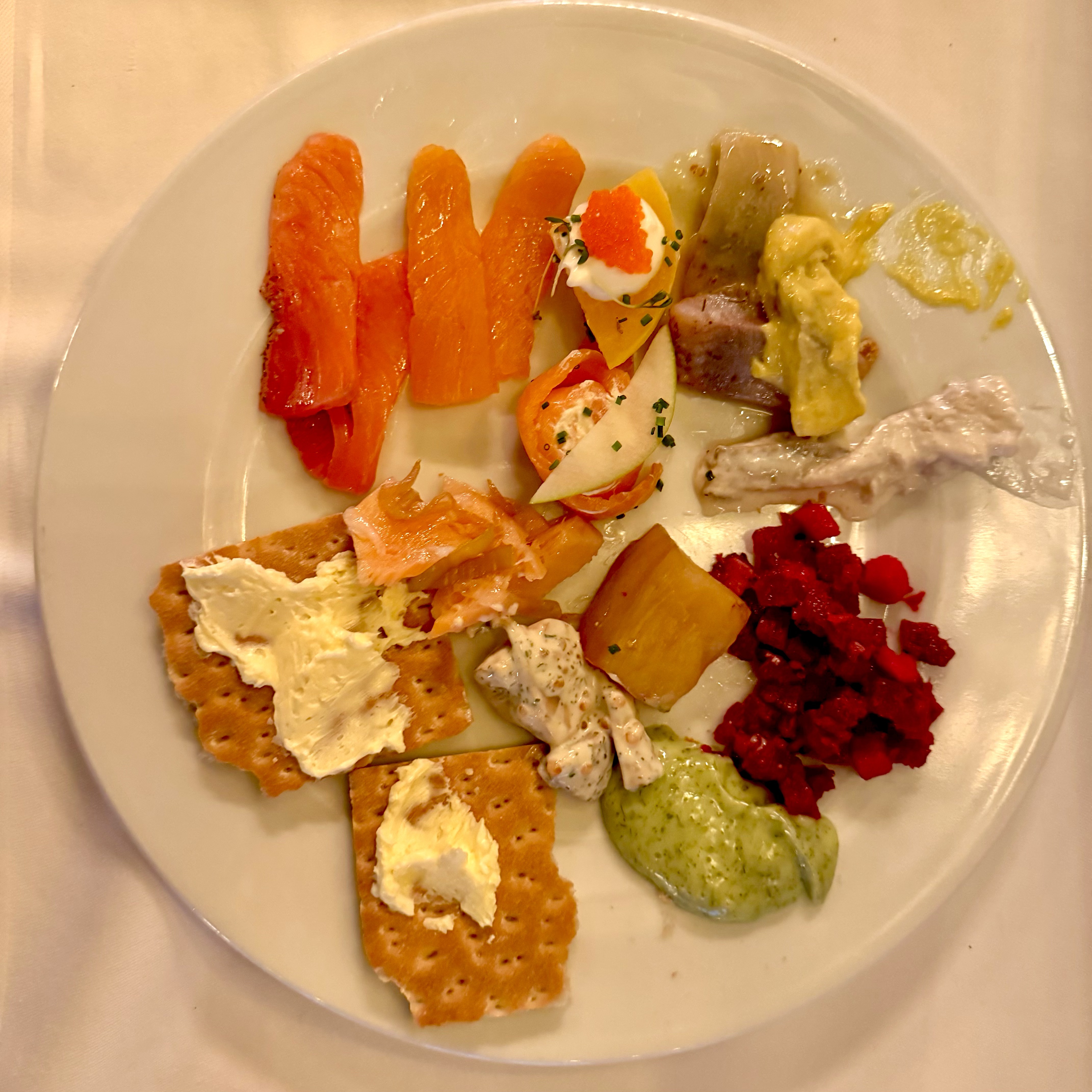
A small section of the Julbord

By Lars Sjöström

On the topic of Christmas food traditions, Sweden is in a league of its own when it comes to sheer opulence embodied in the institution of the Julbord, which is a king-sized jumbo version of the famous “smorgasbord” with extra bells and whistles and a bow on top.

The canonical way of eating your way through a Julbord is to start with a plate of cured salmon, several varieties of smoked salmon, and at least three — preferably 5-7 — different kinds of pickled herring , mackerel, smoked eel and various sauces eaten together with boiled potatoes and “special Christmas edition” crisp bread.

The first of several shots of akvavit is consumed in conjunction with communal singing of a snapsvisa — an often humorous ditty extolling the virtues of (heavy) drinking. There will be many more of these and they become naughtier as the evening progresses…

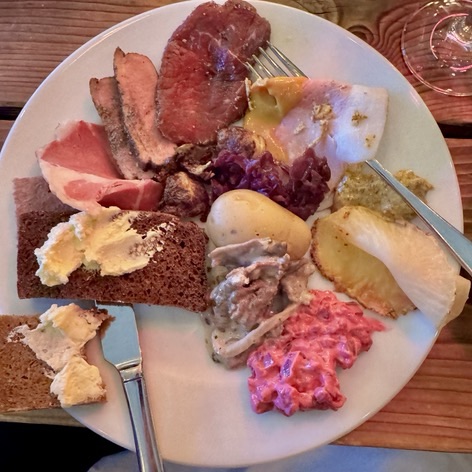
Next up is assembling a plateful of cold cuts, where the glazed ham is the centerpiece. There should be a minimum of ten, but usually many more different dishes ranging from sausages, patées and meats in jelly, to smoked reindeer and smoked lambs leg and whatever else is traditional in various parts of the country.

Another shot, another drinking song, and a swig of either Christmas ale or julmust, a nonalcoholic soft drink only available at Christmas time. 

The third round consists of hot dishes, and here is where the famous Swedish meatballs enter the scene. There should also be tiny hot dogs made from premium ingredients, spare ribs, different kinds of stews often based on game such as deer, moose or reindeer. At this point vegetables like red, green and brown cabbage, cauliflower and Brussel sprouts are introduced. 

Another shot, another song— you know the drill.

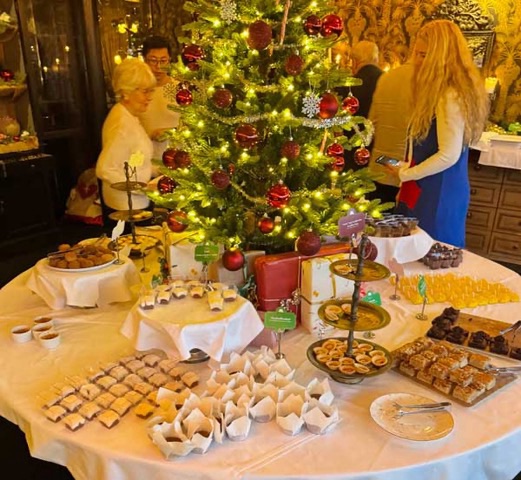
There is a cheese round, a dessert round and a Christmas sweets round, all with songs and shots.

If you are still able to function after all this, you can enjoy Julgröt — porridge made from rice boiled in milk and flavoured with cinnamon. There should be a single peeled almond hidden inside, and if you happen to find it, it will bring you luck in the new year.

Lars and his sister Anna.
Akvavit/Aquavit is a distilled spirit (at least 37.5 % in alcohol strength) produced in Scandinavia from grain or potatoes and flavoured with spices, especially caraway. Dill is also used in the Swedish version. The obligatory toast, Skål, precedes each shot.

Happy New Year! Let’s hope that the devastating wars ragging in too many parts of the world will come to an end. I especially grieve for Gaza that has and continues to be destroyed by US bombs, with some 45,000 lives lost. This has to stop. Let’s try to be optimistic and hope that somehow sanity and morality will prevail in the U.S.

If not a Tales and Travel follower, please sign up here. Trust me. It’s safe. Your address is not shared.

Check out my tried and true recipes — keep scrolling down on a phone, or, if on a /PC or tablet, up to the column on right then down to “Recipes.”  I will add new recipes soon.

FOOD:  GLORIOUS CHRISTMAS FOOD

Forget the tree and presents.  Of course, they are important. For foodies like me, however, it’s food that makes the holidays especially tantalizing, delicious, rewarding.

An overload of Christmas desserts in Portugal.

Eggnog, Christmas cookies, fruit cake, turkey, standing rib roast and baked ham are among American holiday treats. What about other countries? What do their citizens savour during the holidays? I asked several non-American friends about their Christmas food traditions.

GERMANY : “It must always be fish on the 24th,” says my German friend Andrea. She prefers salmon and roasted potatoes.  Andrea, an excellent cook, seasons the fish with salt, pepper, rosemary, a bit of wine, and rubs it with oil, then roasts it. Delicious, and not a lot of work. Her father went for carp on Christmas Eve. 

On the 25th, it’s venison goulash with priselbeeren (similar to cranberries) and dumplings for Andrea, husband Thiemo and her mother, Tekla. In many German households, roast goose is the Christmas highlight. When I lived in Germany, I tried it. Good, but tricky. It can easily dry out. The array of German holiday sweets is almost decadent: Stollen, homemade cookies galore, gorgeous cakes. Lebkuchen, a type of gingerbread cookie, are ubiquitous.  

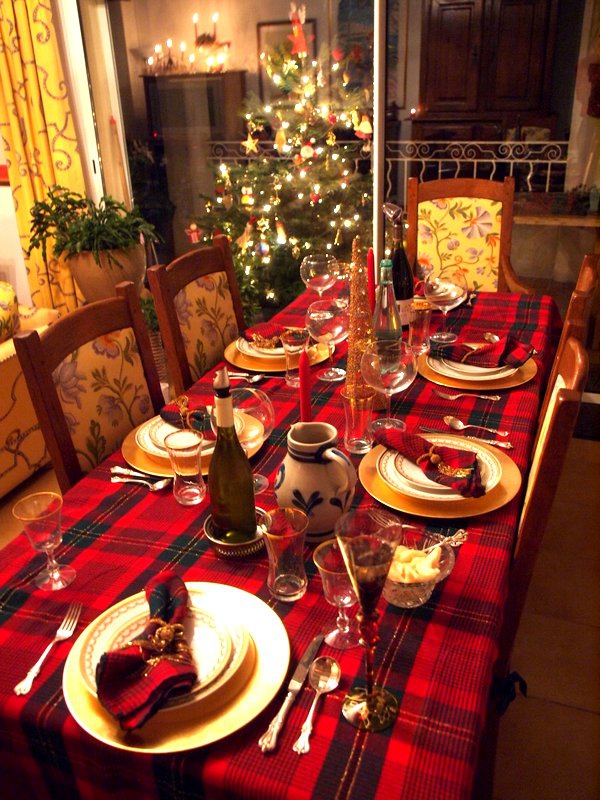
In FRANCE where I now live, the Christmas Eve Réveillon is the meal extraordinaire.  It could begin with champagne and oysters, although these are popular throughout the holiday season.  If not oysters, perhaps a mixture of shellfish or smoked salmon.

My Réveillon table – many years ago

Foie gras is also de rigeur, although controversial.  Geese or ducks are force -fed during the last weeks of their lives to yield extra-large livers. 

I love animals, but I also love foie gras.  Many years ago, for article research I spent a day working at a goose farm. The geese did not resist the force feeding.  Their owner insisted it was not cruel.  This was a beautiful farm.  The geese were free ranging until their last days.  However, not all geese and duck farms are like this. 
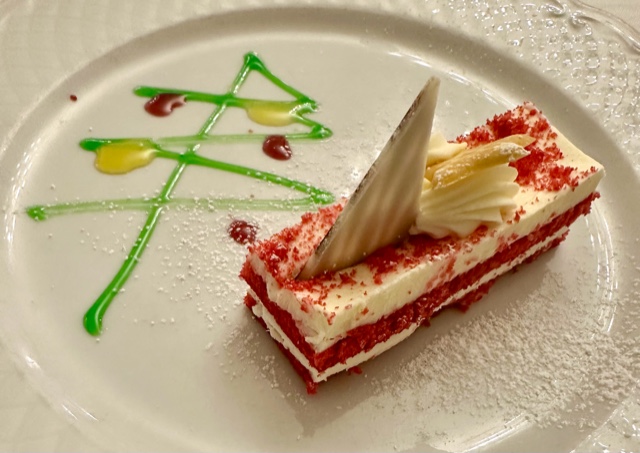
I even took a foie gras cooking course and learned to prepare the delicacy which I did for Christmas guests.  Those days are over.  Now I feel guilty eating foie gras, but I do indulge in a wee bit at Christmas.

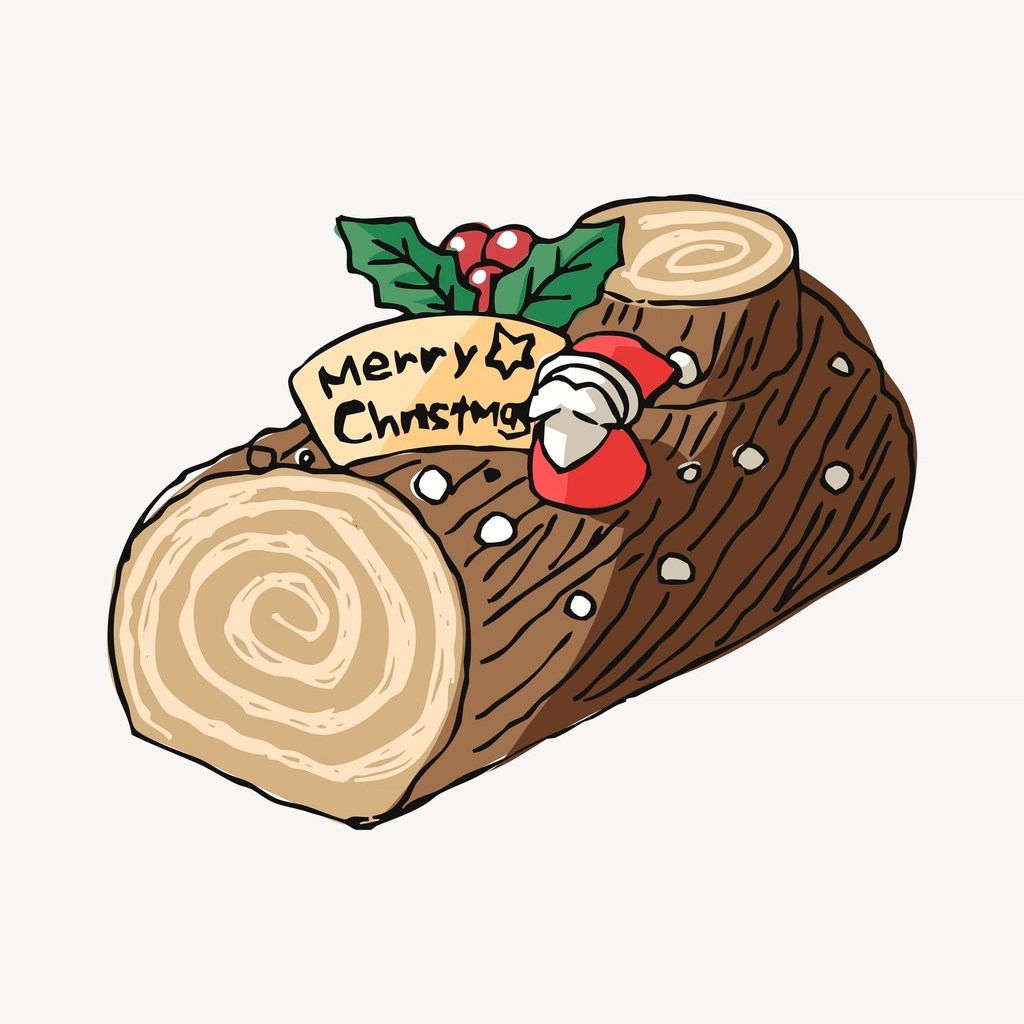
Turkey, or another bird such as capon or guinea fowl, can take the spotlight at the Reveillon dinner.   A Buche de Noel (Christmas log), a fancy cake in the shape of a log, caps off the meal. 

In ITALY, Cinzia tells me, after midnight mass on the 24th, all return home to open presents and enjoy Panettone, the Italian holiday cake, with a glass of sweet wine.

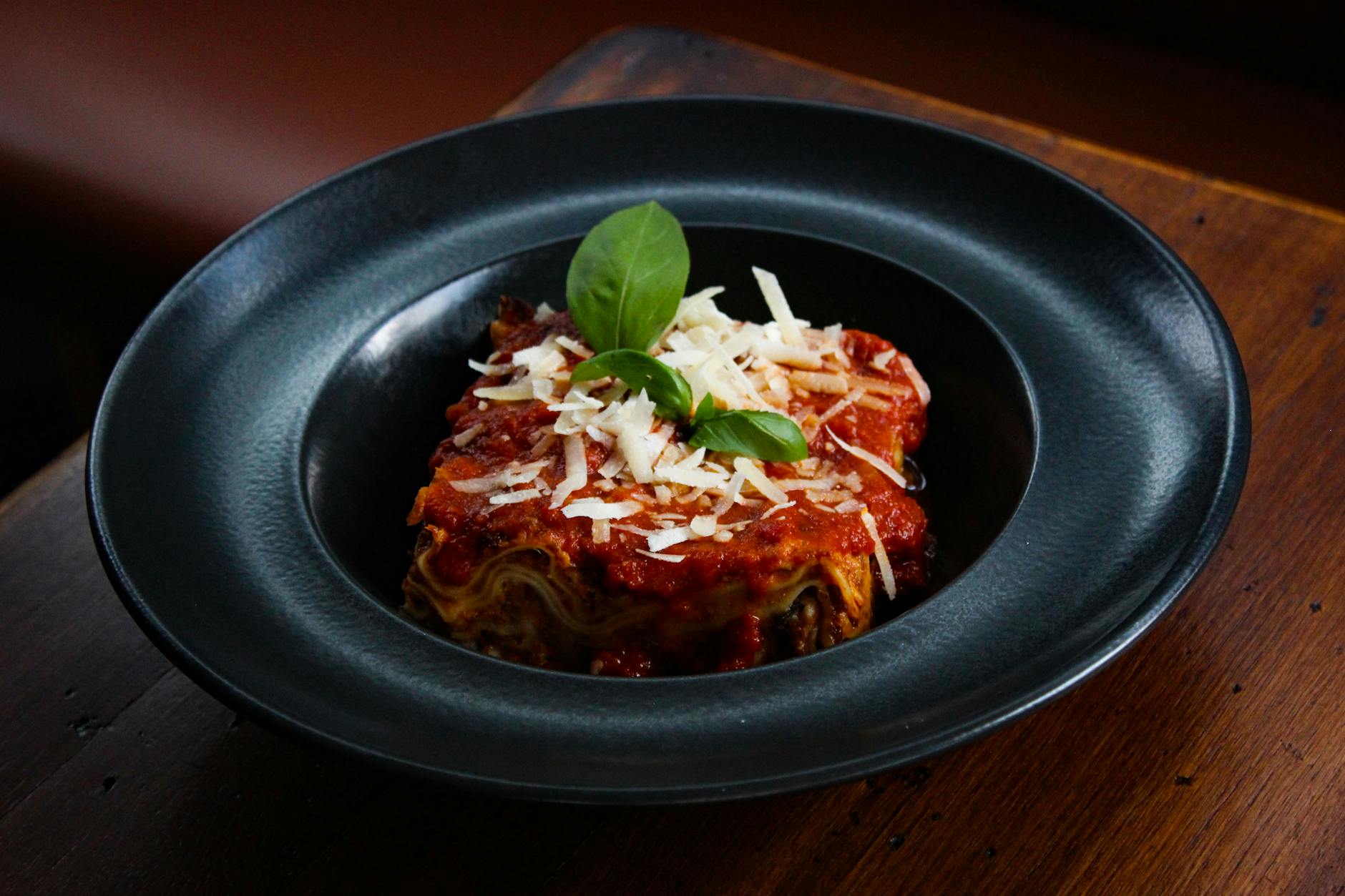
As in many countries, the customs can vary with regions.  She hails from Piedmont, the north, where Christmas lunch on the 25th is the major event. As this is Italy, there’s a pasta course which, at Christmas, is usually homemade stuffed pasta, such as tortellini or cannelloni.  Her favorite is her mother’s lasagna.  “Now people eat it all the time,” she says, but formerly it was reserved for Christmas and special occasions. Roasted lamb, beef or the holiday special, zampone  (stuffed pig’s feet) follow the pasta. 

For Cinzia, the Christmas meal represents “the fact of feeling part of a family which was there for you year after year, the (illusory) idea that, no matter what would come, every year the family tradition of eating what she was cooking would perpetuate, it’s about a sense of belonging and ‘safety'” 

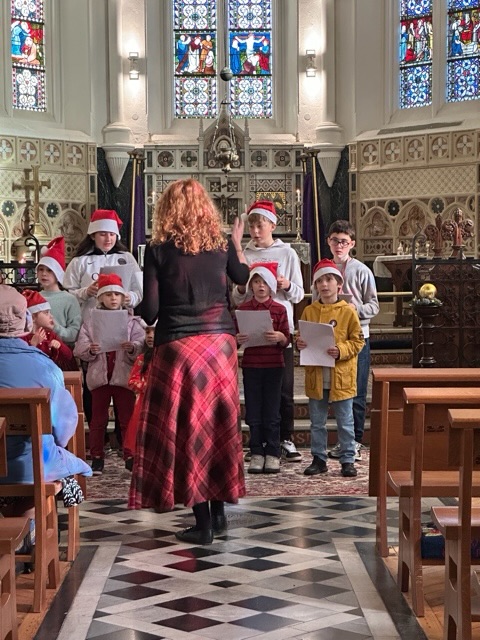
Arabella (back to camera unfortunatley) leads her pupils in Christmas carols

Like Cinzia, Italian Arabella says her favorite is Panettone.  But, at her house the major feast is on Christmas Eve featuring some type of meat. That’s fine for her husband and daughter. But, she’s a vegetarian and will also prepare ravioli stuffed with spinach and ricotta. She is also a big fan of an Italian Christmas chocolate, Cri Cri, with hazelnuts and praline.

ROMANIA: Romanian Florin remembers childhood Christmases in his country where carnati (smoked sausage) is a holiday must. Preparation in country villages begins on December 18 when neighbors gather outdoors to kill a pig, then cover it with hay and set it afire.  Gruseome! Florin even remembers killing the pig once. The cooked beast is divided into parts.  All work together to turn out the tasty sausage.

Killing the pig is illegal today, but Florin says it probably continues in some areas. Those who are not up to the carnati labor, not to mention killing a pig, can purchase the ready-made sausage. Other Romanian Christmas musts are sarmale (stuffed cabbage) and cozona, a light “puffy” holiday bread.

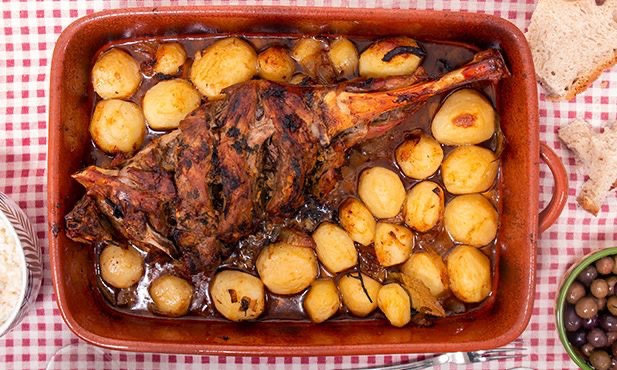
PORTUGAL:“We eat a lot at Christmas and Easter, a lot of different things,” Portuguese Catarina says. “We have a full table of food. It’s too much. We don’t eat it all.” For Christmas Eve dinner, potatoes, carrots, the famous Bacalhau (boiled, dried salted cod), and more fill the table. Her favorite, however, follows the next day, roasted octopus at lunch.  She hails from northern Portugal where roasted goat is also common on the 25th.

Roast goat takes center stage on many a holiday table in Portugal.

But it’s the desserts that shine – many, many different treats.  She admits they are very rich and sweet, and she is not fond of all.  “But I love to see and smell them.  That’s Christmas.”  

She’s right. It’s not just the taste, but the enticing aromas and beautiful presentations that enhance holiday food and make it special. And — friends and family. “Christmas is to be at the table with family,” Catarina adds. Enjoy.

Happy Holidays and Bon Appetit to all.

Scroll down for more holiday photos

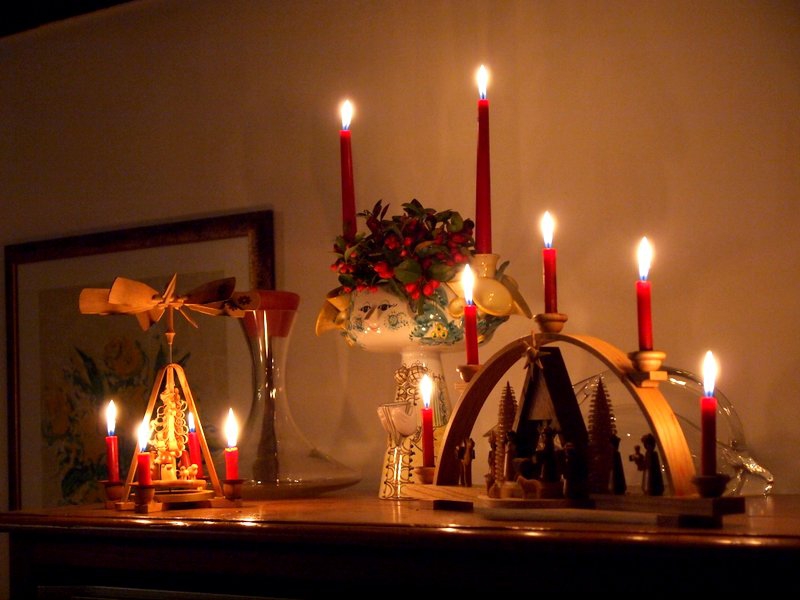
My German holiday decorations.

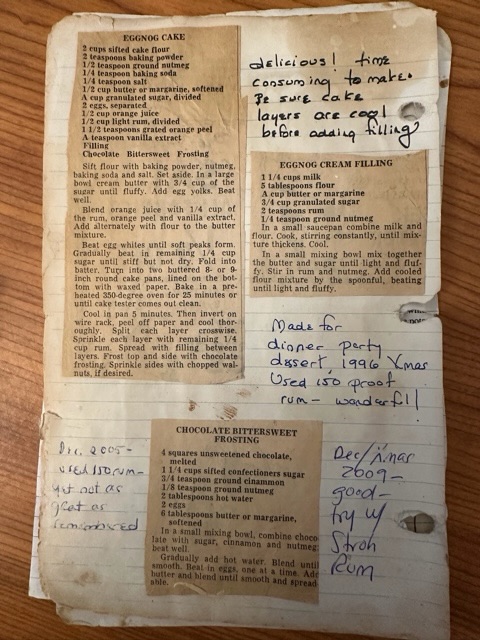
I’m old and so is this treasured Christmas recipe. Long ago I clipped recipes from newspapers and magazines. This one is a winner. Read my scribbled notes. I always go for recipes with a bit of booze. Rum makes this cake.

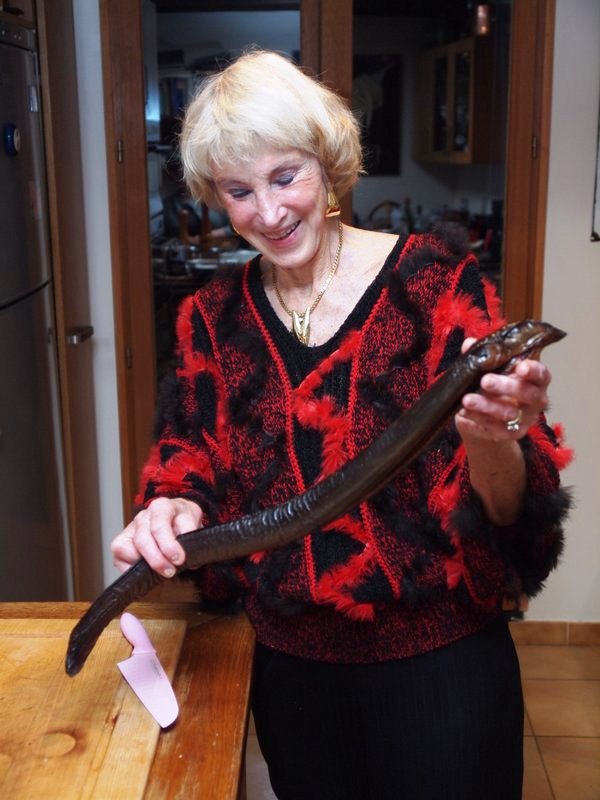
Smoked eel (exquisite) was a treat at one of my long-ago holiday dinner parties.
British friends brought “crackers” and hats to this holiday dinner years ago.
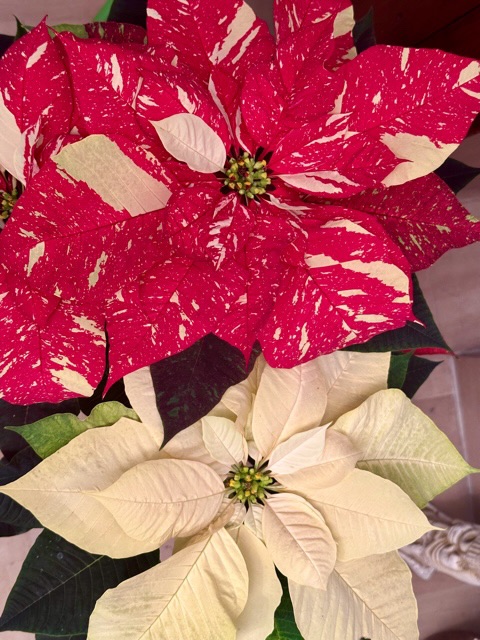
My poinsettia

Coming soon, a guest blog by Swedish friend Lars on the Julbord, “the king-sized jumbo version of the famous smorgasbord.” It’s a food orgy, a mind-boggling, lavish assortment of tastes -and plenty of vodka. Don’t miss it.

If not a Tales and Travel follower, please sign up here. Trust me. It’s safe. Your address is not shared.

Check out my tried and true recipes — keep scrolling down on a phone, or, if on a /PC or tablet, up to the column on right then down to “Recipes.”  I will add new recipes soon.

Intro to Europe 101

“It’s a blast.” He was enthusiastic, curious, at times in awe, and termed almost everything a “blast.” It was so much fun and gratifying to be with him, a blast for me too.

That’s my nephew, David Koester, who visited me recently, his first time to Europe.

David and Leah
Nephew David and Aunt Leah

“It was an eye-opening experience.  I’ve never experienced another culture before,” David told me during a recent phone conversation. “I’ve been raving about the trip ever since I got back.”

David, 39, is an account executive with Logicalis, an IT consulting firm. He lives with his wife Sabrina and 8-year-old son Jonah in Louisville, Ky.

 His buddy Matt had a business trip to Berlin.  They decided to meet in Switzerland for a few days.  He visited me in southern France prior to the Swiss rendezvous.

We had lunch here before David explored the old chateau in the Vieux Village of Roquebrune Cap Martin

His visit here was short, three days.  We were on the move.  First stop the Vieux Village (old village) of Roquebune Cap Martin. I live in the “new town.”

After an outdoor lunch in the town plaza, David explored, up to the old chateau, then up and down the skinny pedestrian alleys.  Since I am now walking with a cane, I stayed back.  “It’s so cool walking through these alleys, seeing the old architecture,” he remarked.

Old town Roquebrune Cap Martin

A favorite spot in the old village is the viewpoint overlooking Monaco.  Another day, a very rainy day, we ventured to the principality and opted for the hop-on, hop-off bus which gives a good overview of Monaco.  

Monaco

David, who is a financial wizard, informed me that Monaco’s Formula One makes more money than any other sporting event.   “It was cool driving over the starting line,” he said.

Roquebrune Cap Martin is adjacent to Menton, a Riviera town on the border with Italy.   It too has an old town, a maze of twisty alleys, as well as the imposing basilica of Saint Michael.  David visited all, as well as the city’s market, my favorite.  

The old town of Menton
David was impressed with Menton’s market hall. This is my bread stand where we bought some tasty goodies.

We crossed the border for an Italian snack at Grotta.  I love to stop there – Italian ambience, reasonable food and an enticing setting just above the coast.  

Another must is nearby Sainte Agnes, a medieval village classified as “one of the most beautiful villages in France.” Reaching the burg, said to be the highest coastal village in France at an altitude of 760 meters (2,493 feet), is not for the faint of heart. Follow a treacherous, narrow mountain road —  lots of hairpin turns and places where there is room for only one car.  Someone may need to reverse. Fortunately, David was behind the wheel. 

He drove my Suzuki Swift.  I was still recovering from the San Francisco broken wrist (see previous post, “I lost my money in San Francisco”) and could not yet drive.

He found driving in southern France “wild.”  He summed it up: “There are mopeds everywhere.  Everything is very tight.  You’ve got to be on our toes all the time…you need to be aggressive out there.” He did enjoy my humble car.  “I haven’t driven stick shift in ages,” he said. “It was fun.”

The views from Sainte Agnes are worth the trip. David trekked up a steep path to investigate the ruins of a chateau.

A steep path leads to the ruins of a 12th century chateau above Sainte Agnes
A medieval garden and cemetery are part of the chateau site.

Lunch was a treat, a multi course meal at a popular, rustic, local restaurant:  pork pate, followed by ravioli, and a main course of either wild boar stew or rabbit, all topped off with a slice of blueberry pie.  He ordered rabbit.  I went for the wild boar.  We shared.

For David, food in France is “phenomenal, awesome.”  He was impressed with the taste and presentation, and said it was much healthier than food in the U.S. 

The plan was to leave Sainte Agnes and continue up the mountain to Col de la Madonne, a mountain pass my super cyclist friend Bridget had raved about. The route is popular with serious riders on two wheels. 

We had three choices after leaving the village:  a road down to where we had come from, another with a sign to the town of Peille, and a third unmarked. GPS was no help.  We took the road less traveled – and too much adventure awaited.

No one has lived here recently — the only house we saw on our adventure into the hinterlands.

On and on we drove.  Nothing. No signs. Few other cars.  No civilization.  The road deteriorated.  Dirt. Bumps.  Pot holes.  Where were we?    We charged on until we came to a fork with a gate /barrier blocking  the road on the right.  Yet, according to David’s GPS (now working), we should take that road.  He got out and opened the gate.  

I was nervous.  This can’t be right. What if we get stuck?  We are alone in the boondocks.

 But on we went, deeper into nowhere. To my relief, my chauffeur decided to turn back and take the other road. There was little improvement, but it had to lead us out of this isolated back country.

Peille is another remote medieval village tucked in the mountains.

Hope: A sign to Peille, the town we had rejected when leaving Sainte Agnes.  We gleefully took it, and realized we were retracing much of the territory we had just covered. ??  This road was not much better than the others and nightfall was coming.  But, we were en route to civilization. 

Peille is old and picturesque, a cluster of stone buildings below the main road where we parked and then headed downhill to check it out.  Nothing was open except a funky, bar café.  Perfect. We loved the cozy ambience, the local vibe, and the well-earned beer.

Our salvation: A bar that was open.
Downtown Peille: old stone houses, vaulted passageways.

David was good natured about this fiasco.  He was a joy to be with – never complained and was thrilled with all. Mea Culpa.  I will not subject future visitors to the search for the Col de la Madonne. 
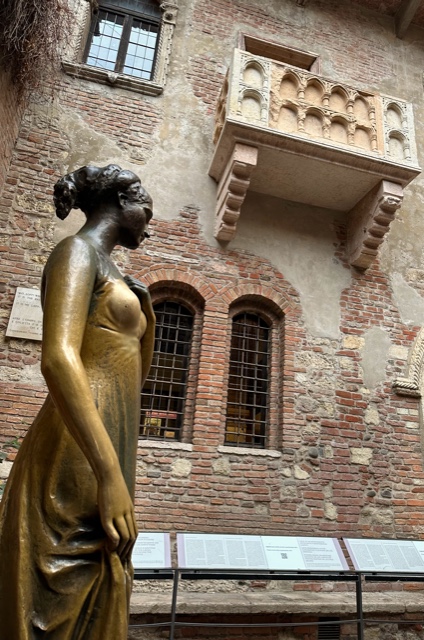
David continued to Switzerland where he spent a few days in the Grindelwald-Lucerne area with Matt.  He called the country “the most beautiful place I have ever been to.”  However, he found it very expensive.

The boys in Switzerland. Matt and David.

In an email after returning home, David wrote the following:

“I had such a great trip.  I think about it all the time.  It was so great to see you.  I’m so excited to come back.  I can understand why you made the life decisions you did.  Seeing the world is so much fun.  We are going to plan a family trip to Europe.”

I hope they will visit me.  I can’t wait.  I know it will be a blast.

David, Sabrina and Jonah

ALL PHOTOS ABOVE BY DAVID KOESTER

If not a Tales and Travel follower, please sign up here. Don’t miss future posts.

Check out my tried and true recipes — keep scrolling down on a phone, or, if on a /PC or tablet, up to the column on right then down to “Recipes.” 

MORE PHOTOS BY DAVID BELOW

David followed the coastal Corbusier trail near my apartment. The scenery is spectacular.
We split this veggie entree at a Menton restaurant. David found food here healthier than that in the U.S.
Peille by night
La Turbie, a town near Roquebrune.
Chateau in the old village of Roquebrune Cap Martin
Basilique Saint Michel in Menton.

I left my $ in San Francisco

Photo by Pixabay

It is an expensive, very expensive city.  Having lived in Europe for so many years, I was shocked.  I assumed that nothing – with the exception of Switzerland — could be more expensive than the French Riviera where I now live.

San Francisco proved me wrong. Following are some costs I found outrageous:      


1 small box of Tylenol 500mg (pain reliever like paracetamol) $8.  The equivalent here about 2 euros, $2.16

1 glass of house wine in a restaurant, $14. At restaurants I frequent here, usually from 5 to 8 euros, $5.40-$8.64.

In both San Francisco and southern France, prices vary from one locale to another. In most cases, however, San Francisco seems over the top. I was surprised to learn that prices in much of the US may not be significantly less. While walking through a supermarket with my brother Steve, I asked, “How can people afford these prices?”  “They can’t” he answered.  “That’s why Trump will become president.” Hope he’s wrong.

The above costs were bad enough, but the whopper for me was $16,700 for emergency room treatment and a night spent in “observation” at the University of California San Francisco hospital.

I tripped over a scooter parked half way on the sidewalk, fell, broke my wrist and smashed my face.  Hence the hospital.

Scooters are often parked on the sidewalk. I was looking across the street and did not notice the beast. Photo model: Steve Koester

I do not have Medicare, nor American health insurance.  In France I benefit from socialized medicine (most costs covered), but I have a travel/medical insurance. Let’s hope I get reimbursed.

The San Francisco visit was not vacation. I went to see my brother Tom who had been diagnosed with terminal cancer.  Sadly, he has since passed away, but I am grateful I had the opportunity to spend time with him. He was a special guy, very kind, generous and liked by all.

Fisherman’s Wharf. Tom’s apartment was not far from here.

Due to the accident, my stay in San Francisco was not as long as planned.  I had a cast from my wrist to my elbow and had been told to come back to the orthopedic clinic in two weeks.  Fortunately, after a week I returned to France and saw a specialist.  The wrist should have been operated on immediately after the accident, I learned.  The doctor was concerned that due to the time delay, the surgery might not be completely successful.  I am lucky. So far, all is on track.  

The surgery here has cost nothing.  I will need to pay the specialist his fee: 370 euros (about $400).  There would have been no extra charge for a regular hospital staff doctor.   Surgery in the US? That price tag would have added a heart attack to my woes.

The hospital bill was overwhelming.  Abby, the very caring intern assigned to me, insisted on numerous X-rays and cat scans. A cat scan of my head; $3,288; cat scan of spine, $4,734; shoulder X-ray, $402, plus other X-rays.  The charge for one night in observation, $6,780.  Not much happened.  I slept.  

There were plenty of other hefty charges. This was a simple broken wrist.  What happens to those in the US who have serious medical conditions and no medical insurance?  It’s criminal – both the exorbitant charges and the lack of insurance for all.

On the positive side, an aspect of the US I relish is people: friendly, helpful, smiling.   As I lay on the sidewalk with a bloody face and painful wrist, passers-by were eager to offer assistance. I was alone, in pain, in shock, not to mention somewhat frightened.  As readers of this blog know, I have recently had far more serious mishaps. I feared the worst. The concern from strangers was comforting.

One couple, nurses, determined I had broken my wrist.  The young woman gently wiped blood from my face.  Her partner called an ambulance.  Someone asked if I had been riding the scooter.  OMG! Had that been the case, I would not be writing this blog

View from Chinatown.

From taxi and Uber drivers to waiters and waitresses, from nurses to hotel personnel, I found people interesting, delightful, and not shy to converse and tell their stories.  A taxi driver from Vietnam, now a citizen, told me how he came to the US.  An Uber driver related the details of his job. A young Moroccan who pushed me in a wheel chair at the airport was happy with her job but missed her country.

They came from distant lands, not just those mentioned above.  Mexico. China.  Philippines. Ethiopia. Turkey. Nigeria…. Hard working folk, not drug addicts, rapists and criminals.  Immigrants make the US.  I can’t imagine how San Francisco would survive without them.  

As I read somewhere, the country is a quilt, far more interesting than a boring sheet. 

My San Francisco visit left little time for sightseeing.  If circumstances had been different and I had had time to experience the city’s attractions, perhaps I would have left my heart there too, not just my $.

Palace of Fine Arts. I enjoyed a walk in this beautiful area.

If not a Tales and Travel follower, please sign up here. Don’t miss future posts.

Check out my tried and true recipes — keep scrolling down on a phone, or, if on a PC or tablet, up to the column on right then down to “Recipes.” On