Insights on South Africa: View from locals

Travel is more than the places you visit, the sights you see and the experiences you enjoy.   It’s also the people you meet:  guides, shop keepers, drivers, hotel personnel, other travelers. 

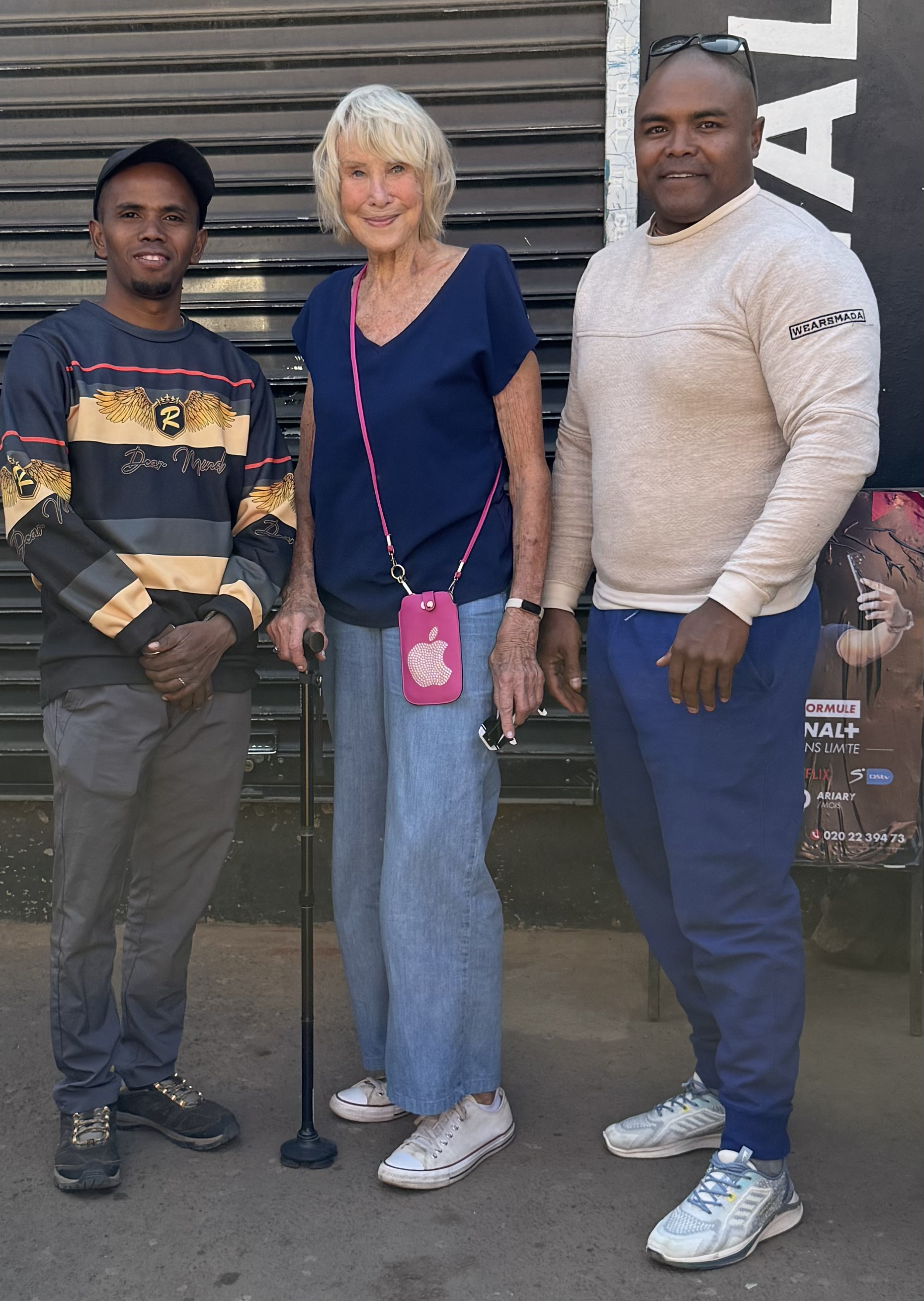
I relish talking to all. During my recent travels to South Africa and Madagascar, I asked folks about local customs, politics, food, travel and more.  

I found the South African marriage traditions intriguing.  Driver Stan filled me in. No matter where they live in the country, South Africans go back to their home village for matrimony.  But, before the big day a man must pay lobola to his fiancé’s family — at least five cows (about $500 each or more depending on the type and size of cow).    Stan has a fiancé, but so far only three cows. He’s lucky.  Educated brides go for much more, as many as 10 cows.

Cheryl, another driver, explained South African languages. The country has 11 official languages, mostly tribal languages, as well as English and Afrikaans, a Germanic language derived from Dutch. The Dutch were the original settlers in South Africa. Zulu is the most widely spoken tribal language.  Many South Africans, like Cheryl who speaks Xhosa, her tribal language and English, are multi lingual.

Politics is a topic I like to explore. What I learned about South Africa was surprising.  I talked to locals about life since the official end of apartheid in 1994.  Many were too young to remember the dark times, but knew all too well about the years of cruel segregation.

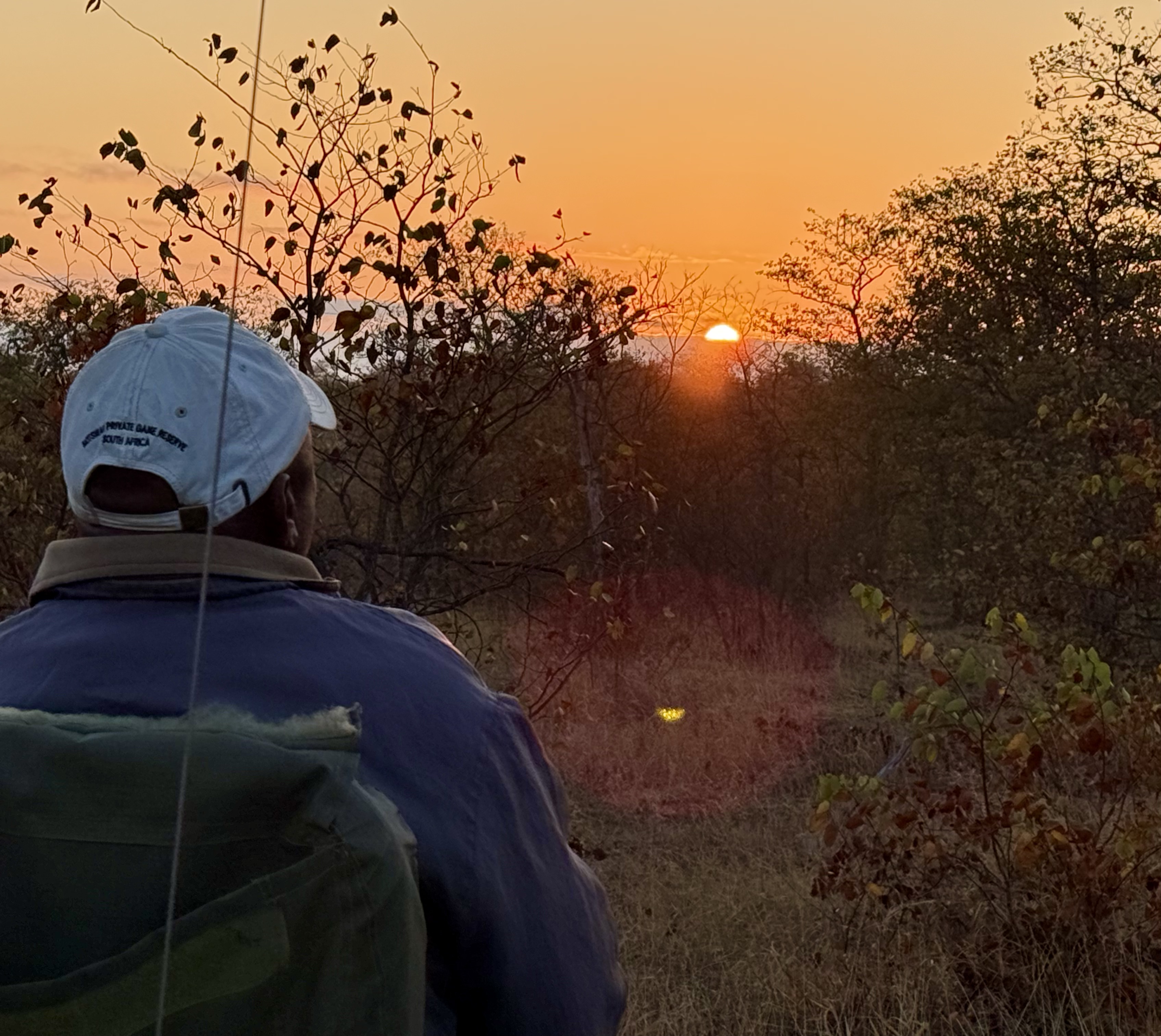
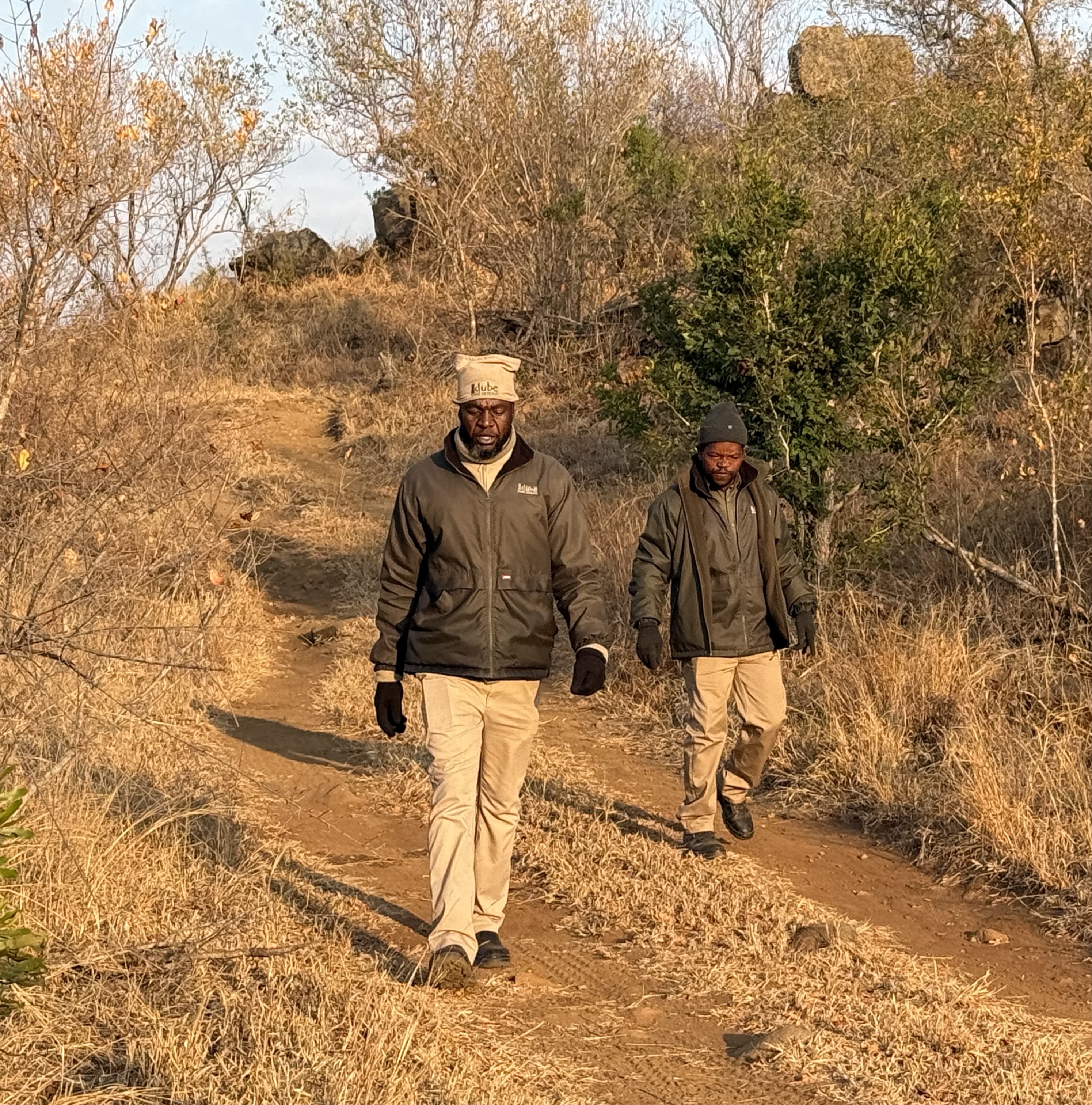
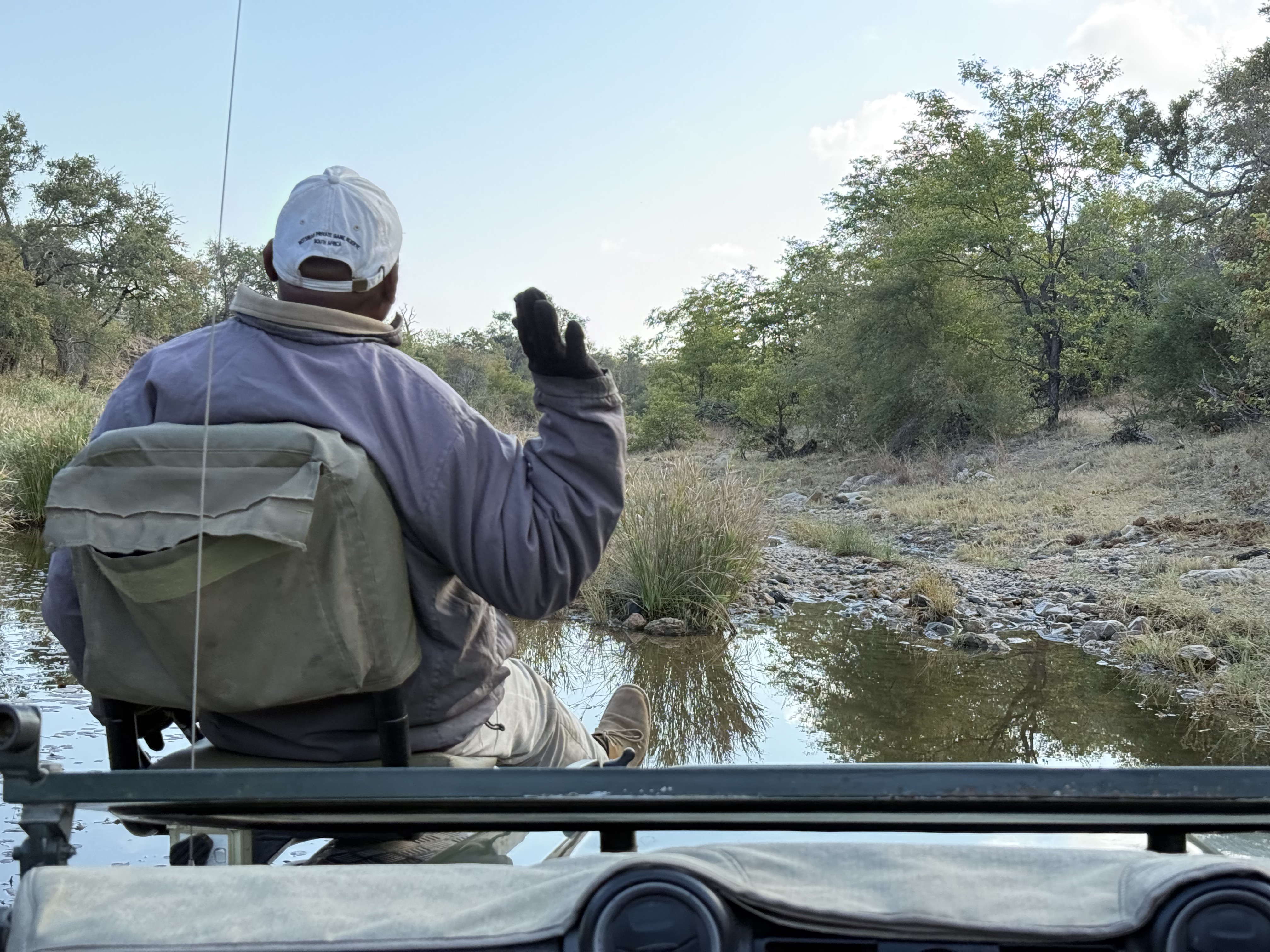
Safari driver and guide disembarked to follow tracks.

All those I spoke with lamented the crime, corruption and unemployment plaguing the country now.  Of course, it’s wonderful to be free, they said, but they claim that during apartheid these problems were not so drastic. 

“There’s nothing but corruption now,” said Jacky, an employee at a safari lodge. “The white government took better care of the people…. They (today’s government) promised us a new road four years ago.  Nothing has happened.    Now when it rains the road floods and the kids can’t go to school… the government promises everything but does nothing.” 

My contacts also said crime in the country has skyrocketed, especially in large cities.  There are places in Johannesburg where even South Africans do not venture.  “Yes, there’s crime,” said Jacky.  “But if people are unemployed and need to feed their children, what are they to do?” 

Apero break during afternoon game drive.

Andy, another lodge worker, does remember apartheid – separate toilets, long waits in line, always letting whites go ahead… “If I wanted to visit my father in Johannesburg, I had to apply for permission…  

“It’s difficult for me to say this as a South African,” he continued, “but the black rulers are corrupt. The older generation votes for them.  I hope in 10 years it will change. We (younger generation) need to take control.”

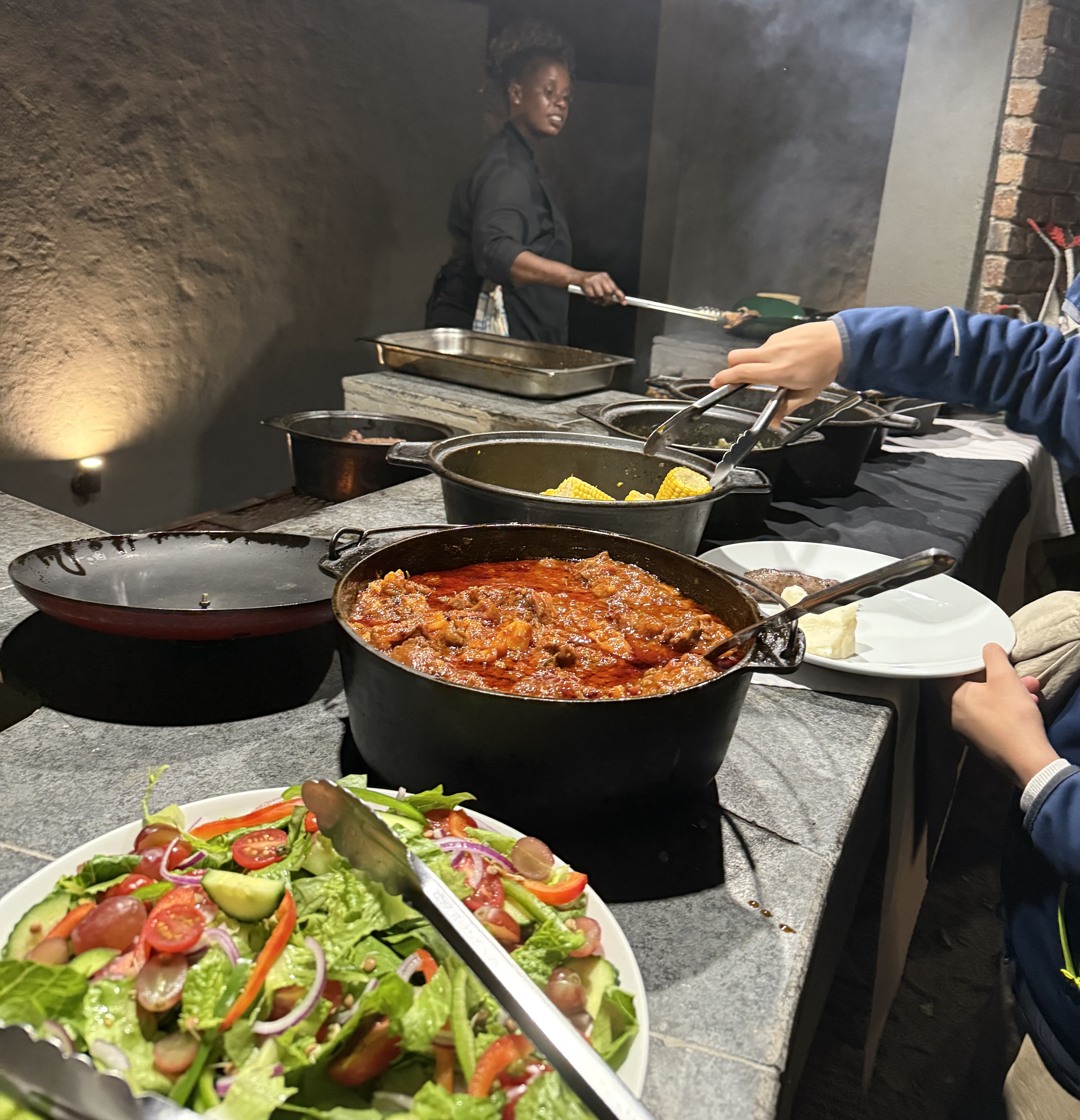
Food is another topic high on my list.  My meals at the safari lodges were all star quality and taste.  South African wildlife, I learned, is not just for tourists to admire. It’s also a good source of protein.  Popular game meat include impala, kudo, springbok, ostrich, etc. I was not overwhelmed with ostrich, but impala was delicious. 

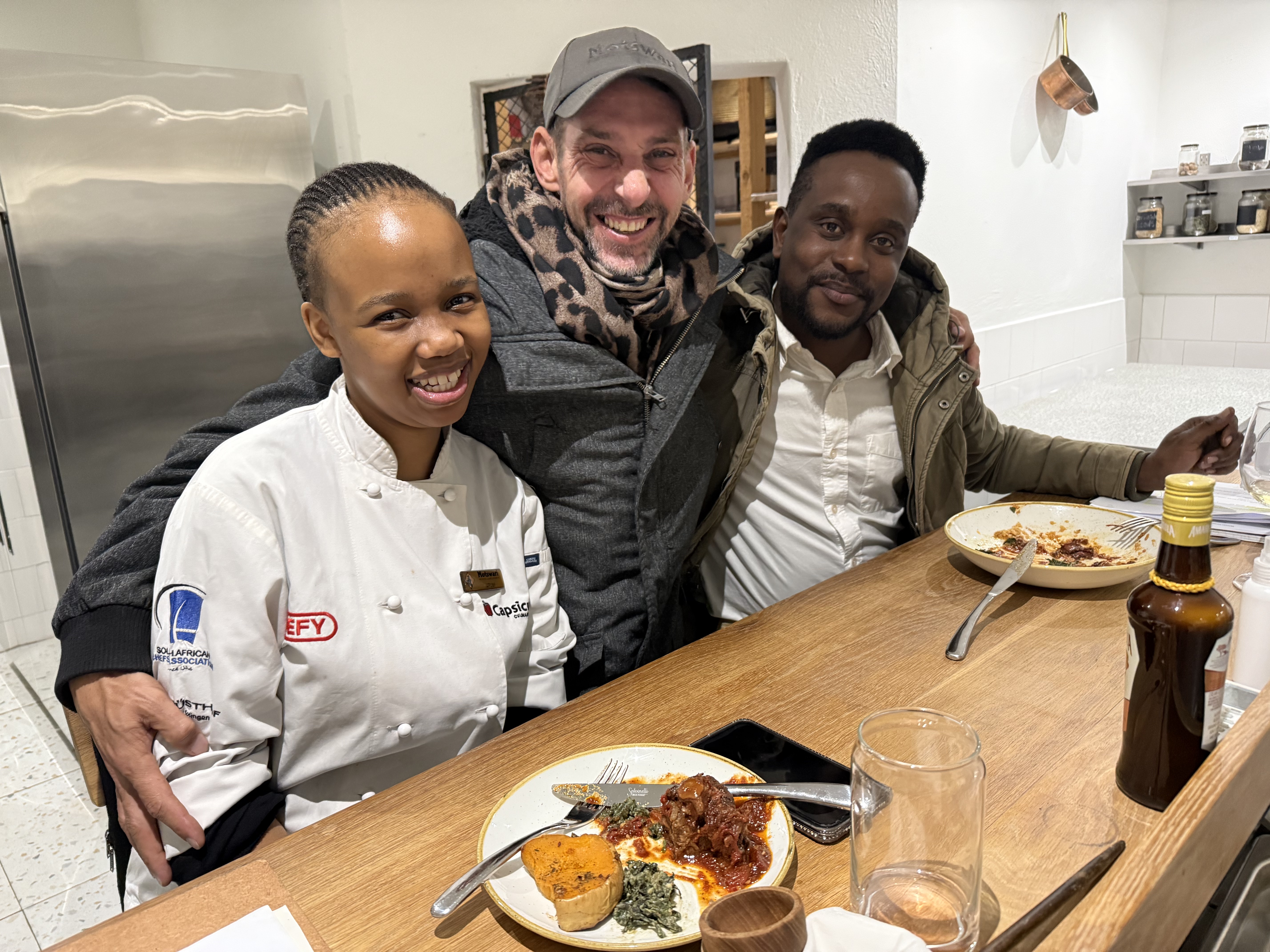
 One evening I had dinner with John, a food manager for several game lodges.  His oxtail stew was exquisite. I requested the recipe, although I am not sure I can find oxtail.  He assured me I could substitute beef, preferably chuck.  

John grew up in self-sustaining family. “My grandmother made the bread…We ate all animal parts.” His love of food and cooking took him to London where he worked as a chef in several restaurants.  He found it “stressful” and is happy to be back in South Africa, planning menus and ordering food for five different lodges.  

John, center, and kitchen staff at Motswari lodge.

Fellow travelers are also fun and interesting.  I was astonished at how well traveled so many of those I met were.  Working remotely gives folks the time and freedom to explore the world, and it appears many are doing just that. 

 At a hotel in Madagascar, I met a group of medical personnel and health workers en route to volunteer on the hospital ship Mercy docked on the country’s coast. It was fascinating to learn about their admirable work.  One volunteer from New Zealand, who has a handicapped daughter, gave me, a handicapped traveler, excellent advice.  “You need to push yourself, test your boundaries.  Use it or lose it.”

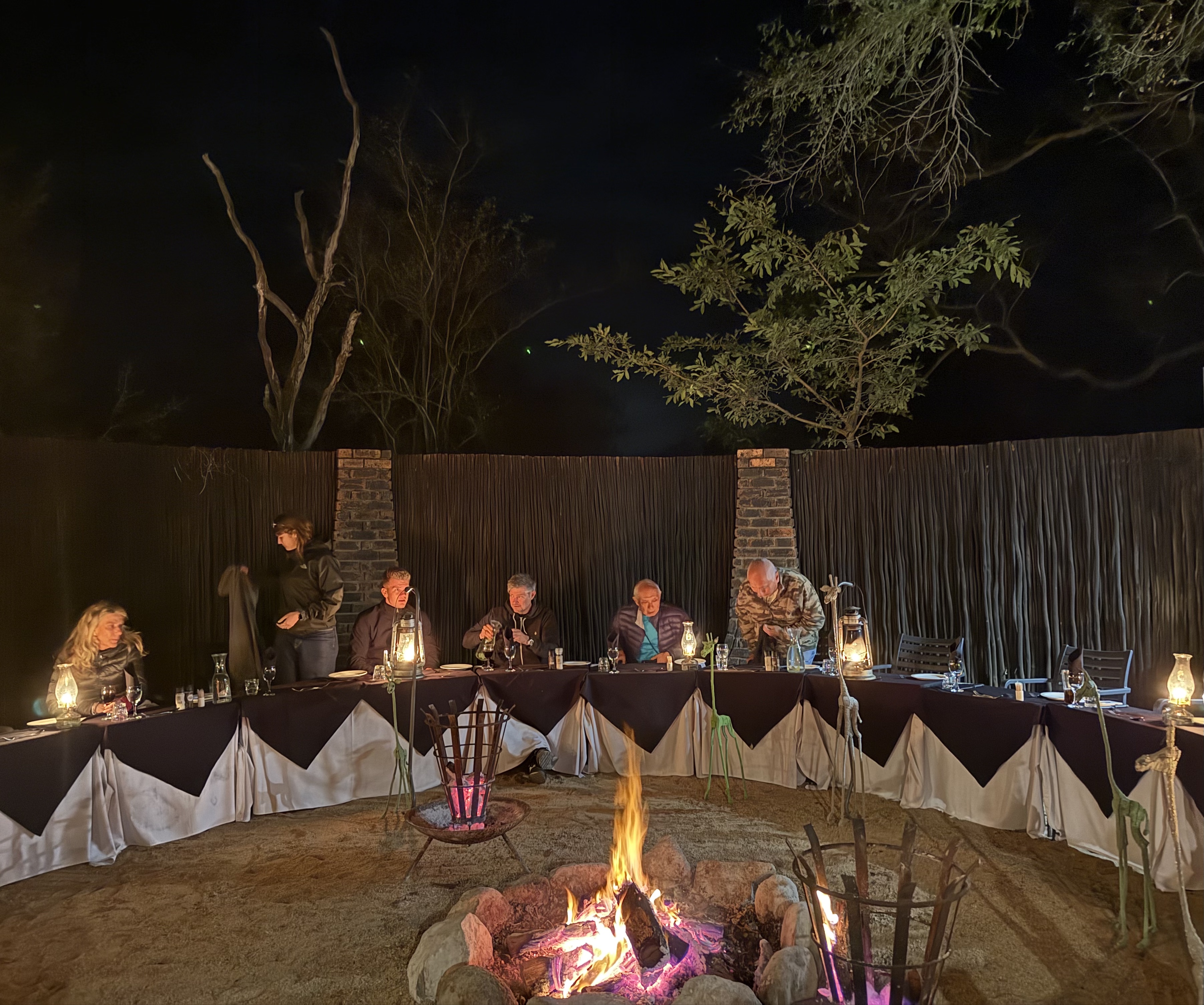
Favorite places visited was the topic of an after- dinner discussion at a safari lodge. This group had traveled far and wide. Thailand, Japan, South Korea, Brazil and Iceland were among favorite destinations.  

Fellow safari travellers with guide and tracker on the left.

 I asked about the most memorable travel experience.  My #1 unforgettable adventure was trekking to see the gorillas in Rwanda.  Canadian Christine, who had been to Rwanda and seen the gorillas, also put that on the top of her list, as did South African Matthew, although his gorilla trek was in Uganda.  

Australian John, whom I met at another lodge, was passionate about Africa and photography.  His high-tech gear was impressive.  It seemed he had been to most every African country, including Madagascar, my next destination.  He gave me some helpful advice.

Travel teaches us about different lands, cultures, religions… It enhances understanding and tolerance.  It is rewarding.  Talk to locals, listen and learn. It will enrich your journey.

I booked my African adventure, South Africa (Kruger) and Madagascar, with Worldwide Quest, http://www.worldwidequest.com

If not a Tales and Travel follower, please sign up here. Trust me. It’s safe. Your address is not shared. Don’t miss out. Big cats coming soon, plus the mysteries and marvels of Madagascar.

TODAY’S TASTE: Rum Raisin Carrot Cake

I recently invited friends for belated b’day cake. The Rum Raisin Carrot Cake is the one with the candle. It was yummy. Click on above title for recipe and for more recipes, click here.

4 responses to “Insights on South Africa: View from locals”

  1. We totally agree with your philosophy of travel. Interactions are a special part of being in another society. They can allow a traveler to make personal connections that can do much to counter prejudice, correct false conceptions of other people’s capabilities,, undo mistaken notions about the nature of their culture, and reduce unjustified arrogance about our own. Great blog!

    Liked by 1 person

    1. And a great comment. Thanks so much. The rewards and benefits of travel are transformative and immeasurable.

      Like

      1. hrector122

        Loved travel. Listening and absorbing places by osmosis. I am glad we travelled so much before the crowds of today. Cell phones and cruise ship. I loved Africa. Even when the baboons trashed our tent. Wonderful cheery people. Morocco was the best trip. But two safaris eere wonderful. Madagascar was somewhat of a bust. We got there on a small cruise ship. The staff arranging the land trips did a crap job. Yes we saw a few lemurs. And we were amazed by the empty spaces of the Indian Ocean. Glad you keep us informed. Travel on, Leah.

        Liked by 1 person

      2. We were fortunate to visit so many wonderful places before they were overrun with tourists. I still want to travel, but am seeking out the less popular, such as Madagascar. I am not ready to give up yet.

        Like

Comments, please!

Your email address will not be published. Required fields are marked *

ON SAFARI

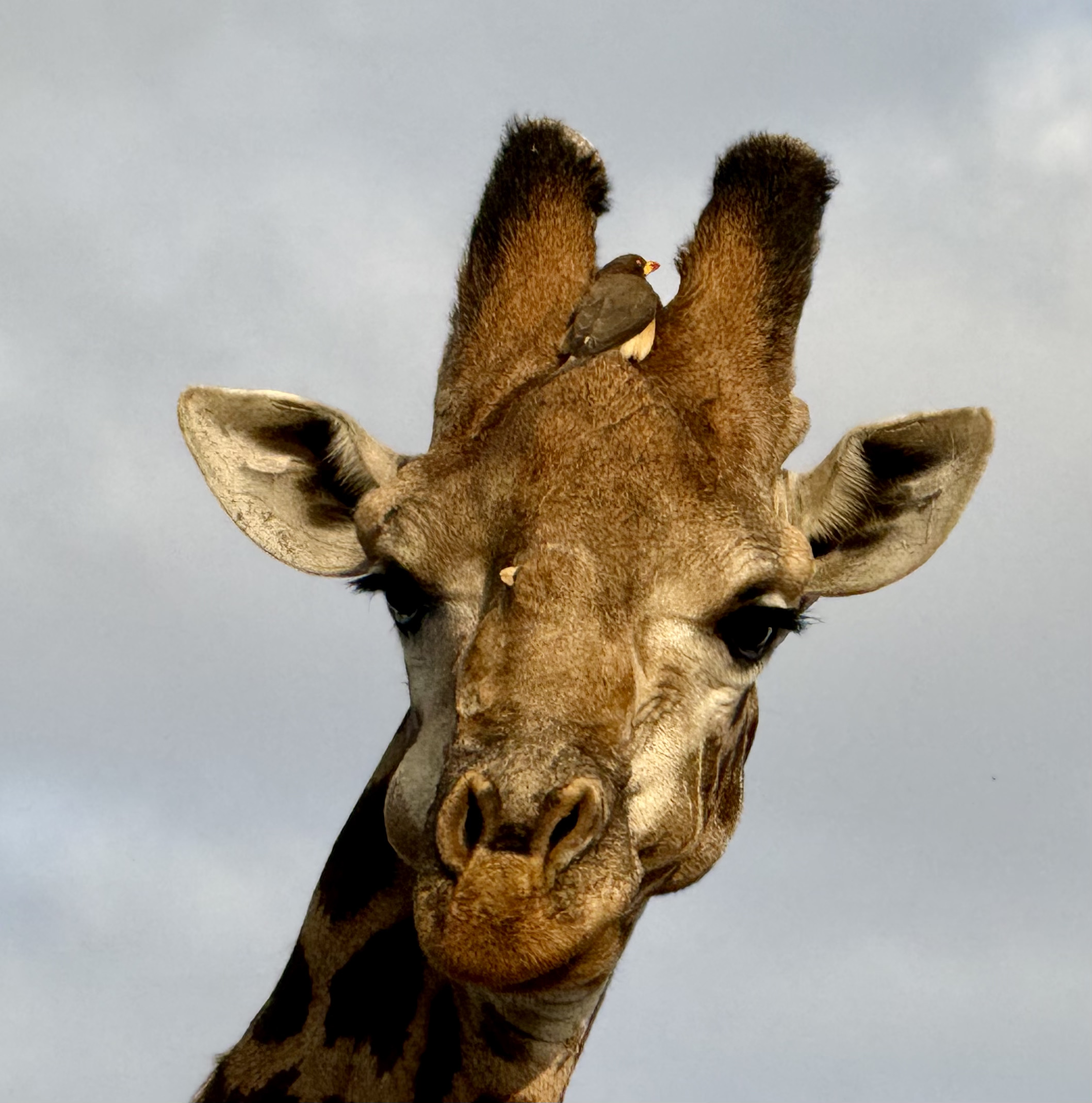
Elephants, giraffes, zebra, kudos, wildebeest, a hyena — I saw them all on my drive from the airport in Skukuza, South Africa, to the Idube safari lodge 3 1/2 hours away. I was excited and decided this was a good omen meaning lots more to come. I was right.

The highlight on the drive was a mother hyena with two tiny, lively puppies. Driver Cheryl said they were just a few days old, if that. Mom was worn out, sleeping soundly, not disturbed by one of her offspring who was chewing on her ear.

I spent the next two days at the Idube lodge and the following two days at the Motswari Game lodge. Both are vast private game reserves in Greater Kruger, an area with unfenced boundaries outside but adjacent to the Kruger National Park.

Game drives begin in the wee hours, about 6 a.m.  It was winter in South Africa, coal black and cold, freezing, at that hour.  Hot water bottles and blankets are provided, but still frosty until the sun pops up.  At 9 we returned to the lodge for a hearty breakfast, setting out again about 3 p.m. for an afternoon drive.

A tracker sits on a special elevated seat in the front of the safari vehicle, his eagle and trained eyes searching for tracks, movement, listening for sounds, any sign of animal life.  The driver/field guide is an encyclopedia of info, as well as a fearless driver, charging off road at Formula 1 speed to reach a site before the animal moves on. Duck under branches, bounce over bumps and ruts, hold onto your seat — more thrills than an amusement park ride.
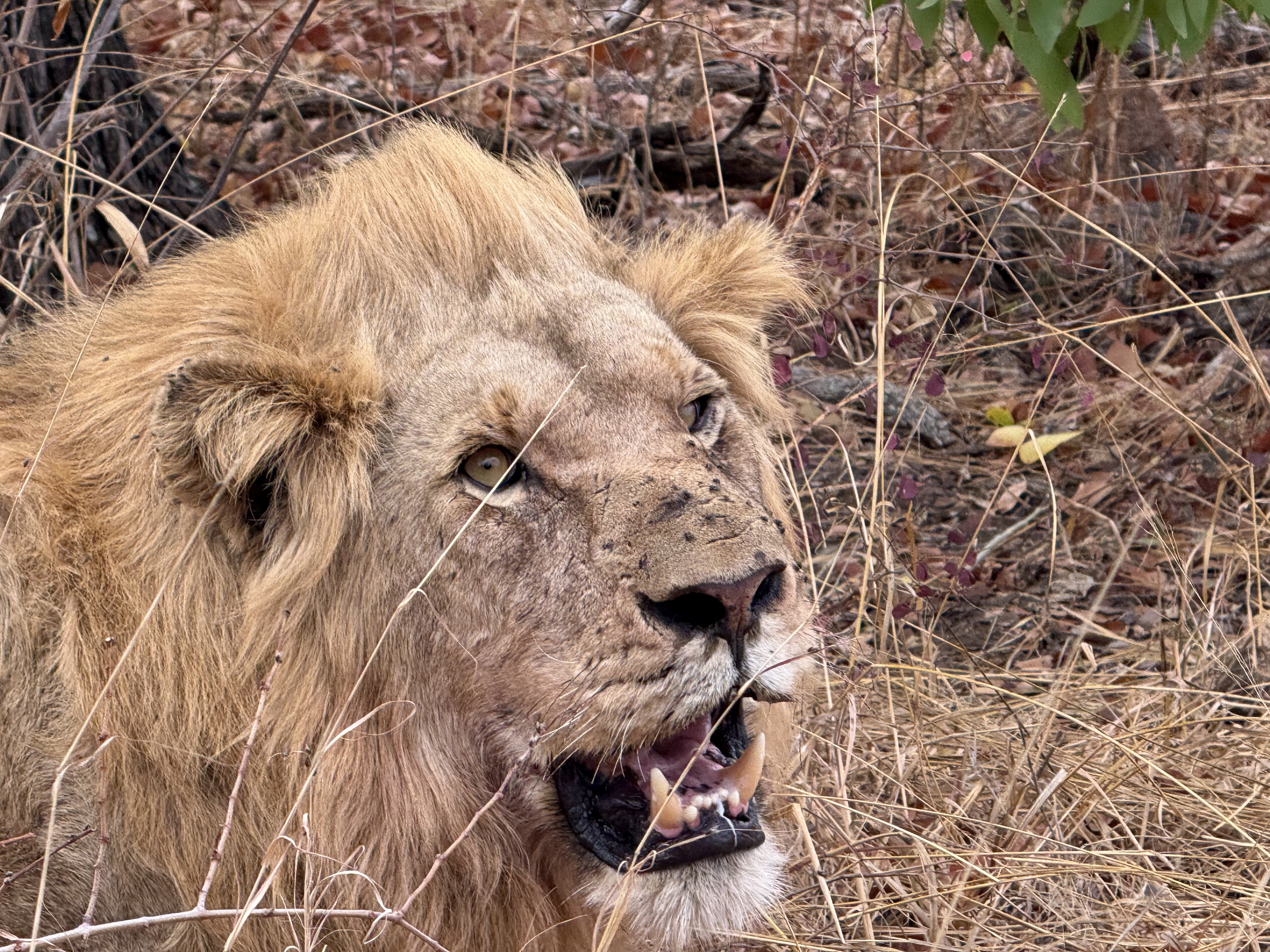
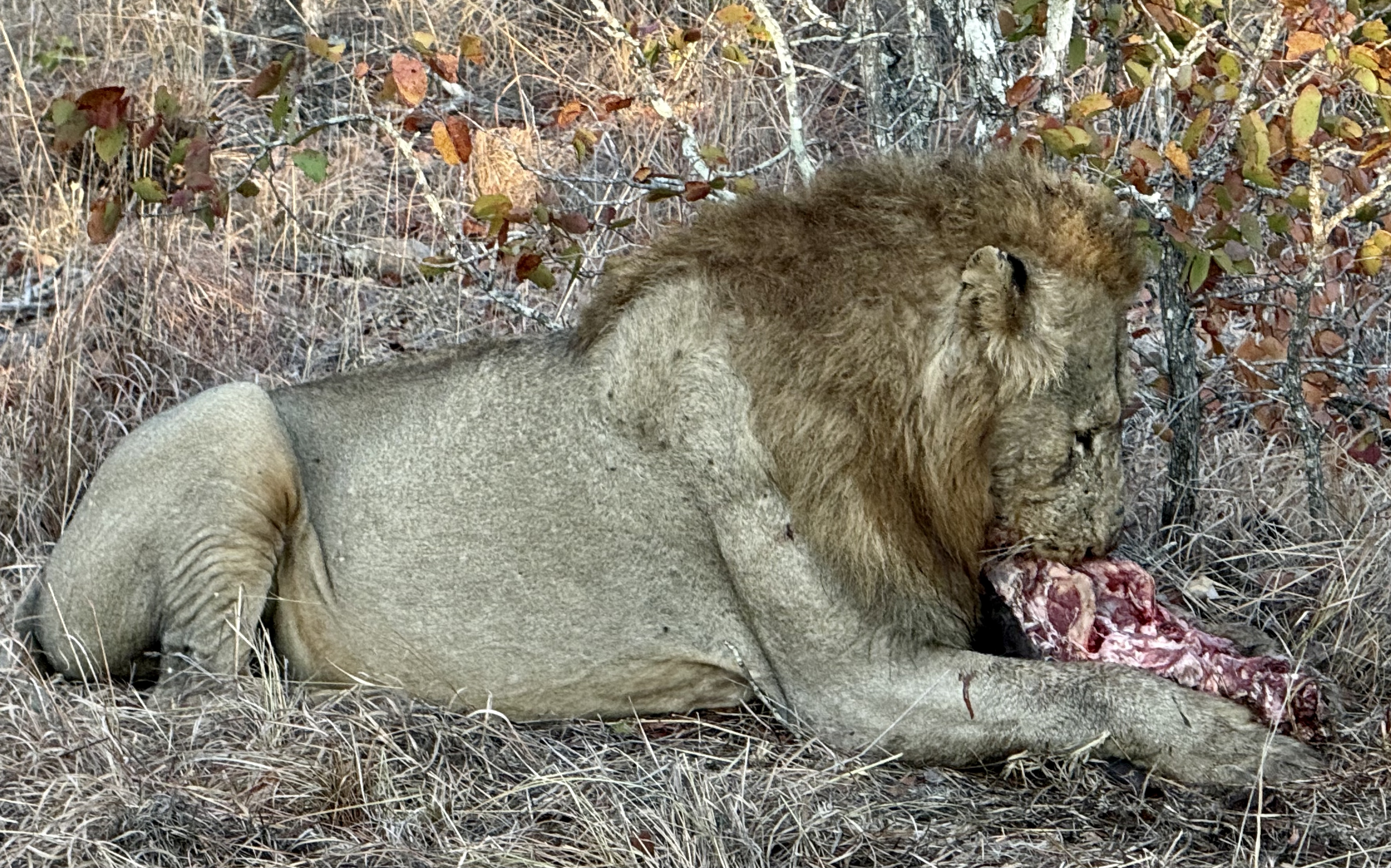
An abrupt halt. There — right in front of us — is the Lion King, gnawing on a bloody piece of carcass. A thrilling, awesome, incredible sight. You almost need to pinch yourself to be sure it’s real.

As in this instance, it is astonishing how close the vehicles get to the animals which completely ignore the visitors. They are accustomed to human intruders and definitely not camera shy. Even with a phone camera you can get decent photos (I used an I-phone 16 pro). For perfection, however, serious gear is best.

 Following are photos of my “sightings.” Since I am a “childless cat lady” who adores cats, large and small, I will devote a separate post to cats.  I saw many, all magnificent.  Watch this space.
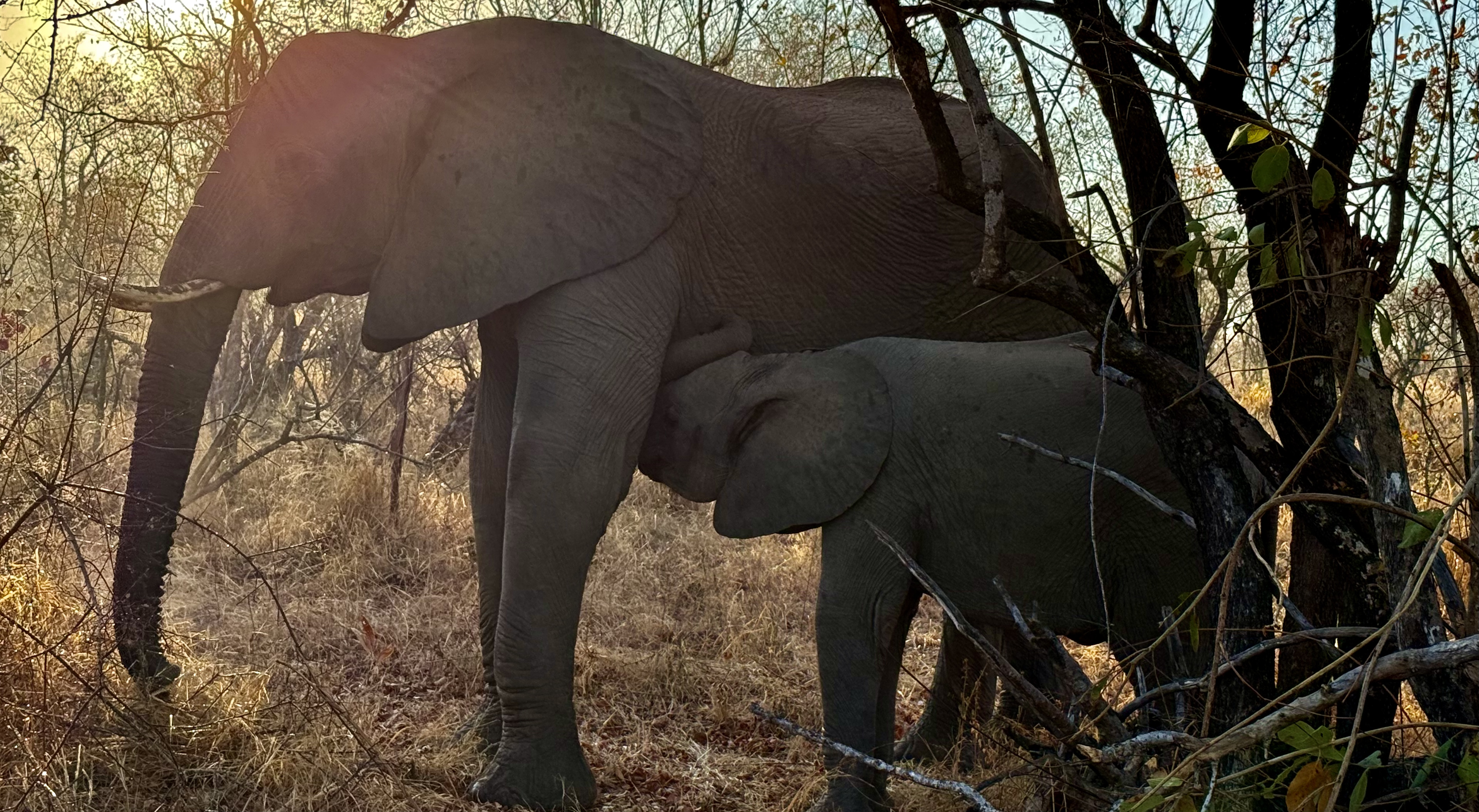
No shortage of elephants on the game drives: majestic males, families, youngsters. These mammoth creatures can live to be 60 to 80 years old. If they manage to survive that long, they die of starvation as their teeth wear out, making it impossible to chew food.  The elephant gestation period is 22 months and “babies” nurse for three to four years.  Elephants can eat for up to 18 hours per day. 

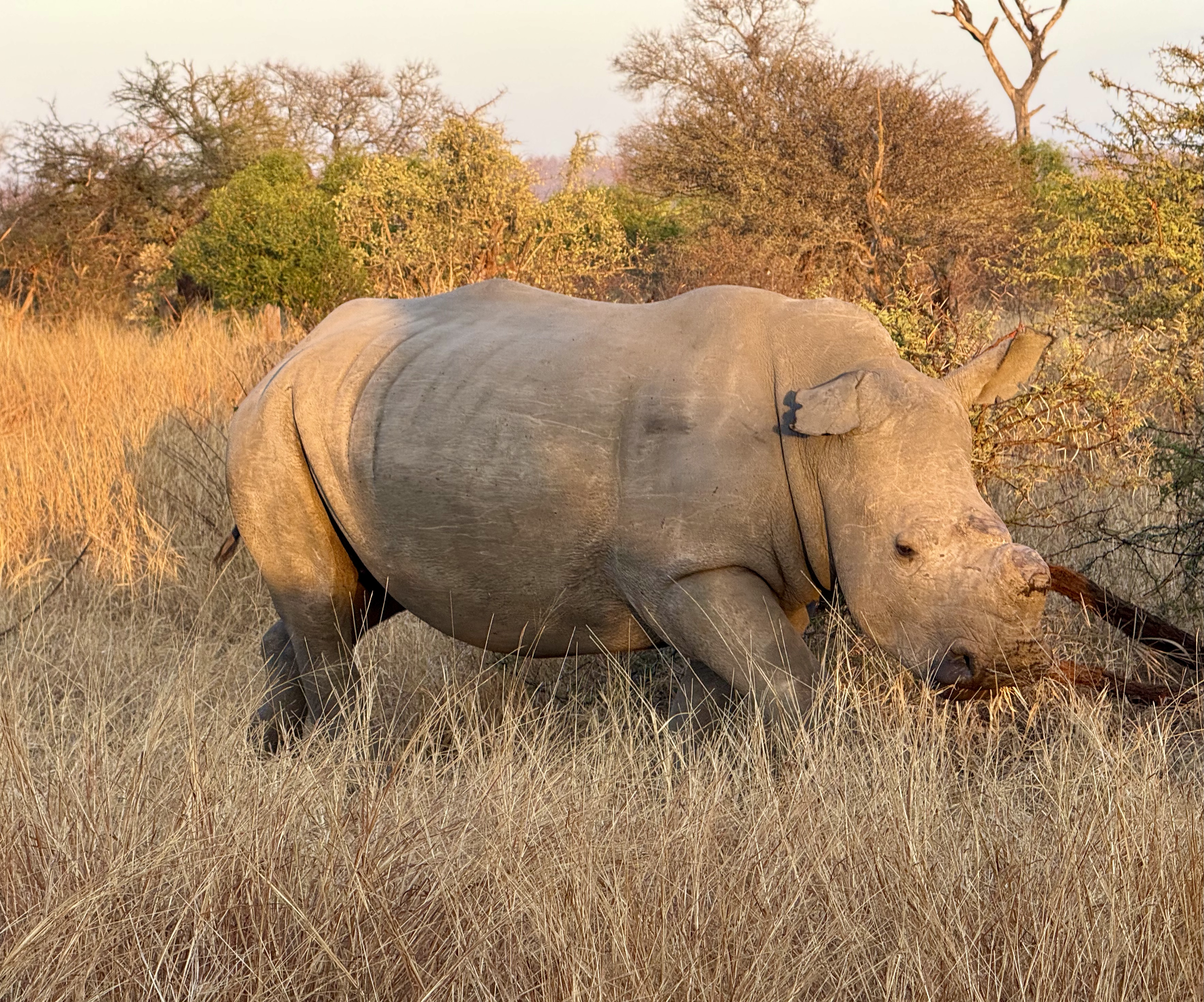
Rhinos, with and without horns.  The horns are treasured in many Asian countries for medicinal properties, although there is no scientific evidence that the horns have medicinal value. In some countries, namely Vietnam, the horns are a luxury item and status symbol.

Hence, poachers kill for the valuable horns.  In the Idube reserve, rhinos are de-horned at the age of two to dissuade the poachers.   Not so in the Timbavati private reserve where the Motswari lodge is located.      

There guide Landon told us that dehorned rhinos are defenseless against predators and in territorial disputes with other rhinos.  Poachers may still kill them to avoid tracking the same rhino again.  And, the dehorning procedure must be repeated every 12-24 months, expensive and labor intensive.  It can also alter natural behavior, leading to social disruption.  Rhinos in Timbavati keep their horns.

The buffalo, one of Africa’s most dangerous animals, is one of the Big Five of African wildlife (elephant, lion, leopard, rhino and Cape or African buffalo). We were lucky and saw not just a few of these aggressive beasts, but hundreds crossing a lake.  

Foreground, hippos.

We never spotted a hippo out of the water, but we did see lots of hippo heads up for air in various lakes.  Hippos can stay under water for six to seven minutes, we learned, and they eat grass not meat.

Ian, the guide in Idube, told us the hippo is the number two killer in South Africa, following malaria, number one.  Number three is the buffalo. Landon at Motswari disagreed on number two.  He said number two is the crocodile, not the hippo which is number three.  Both put malaria as the number one killer.

Male kudo

An African safari is a thrilling, rewarding, unforgettable experience. In addition to being awed by the wildlife, I was intrigued with the country and its citizens. I talked to South Africans about their languages, tribal customs, problems in the country and life since the official end of apartheid in 1994. A look beyond safari in the next post.

Below, more photos.

Another hyena mom with puppies, one with his neck in her mouth. Guide Landon said the adorable hyena puppies are his favorite baby animal.
Wild dog puppies. The guide said two nearby packs were having a territorial dispute. The fight did not interest the playful puppies, but our vehicle did.
These fellows, nyala and a wildebeest, hung out in the front yard of my room at Idube. All were very tame, including the wildebeest. I thought I could try to pet him, but suddenly I heard screams. I was warned that he might decide I was not so friendly and turn those horns on me. I retreated.
Impalas are more numerous than other African antelopes.

I booked my African adventure, South Africa (Kruger) and Madagascar, with Worldwide Quest, http://www.worldwidequest.com

If not a Tales and Travel follower, please sign up here. Trust me. It’s safe. Your address is not shared. Don’t miss out. More about my travels in future posts:   South Africa beyond safari, Big cats, the mysteries and marvels of Madagascar.

Big cats coming soon.

No new recipe this time. But, it’s not too late to take advantage of those summer tomatoes and try this delicious Savory Tomato Tarte Tatin. For more recipes, click here.

Comments, please!

Your email address will not be published. Required fields are marked *

Back on the Road Again

“Madame, vous êtes à la fin, » (Madame, you are at the end (of life), she announced as she massaged my ancient body.   I had to chuckle, thinking to myself, “Yes, I know. But did you need to remind me?”

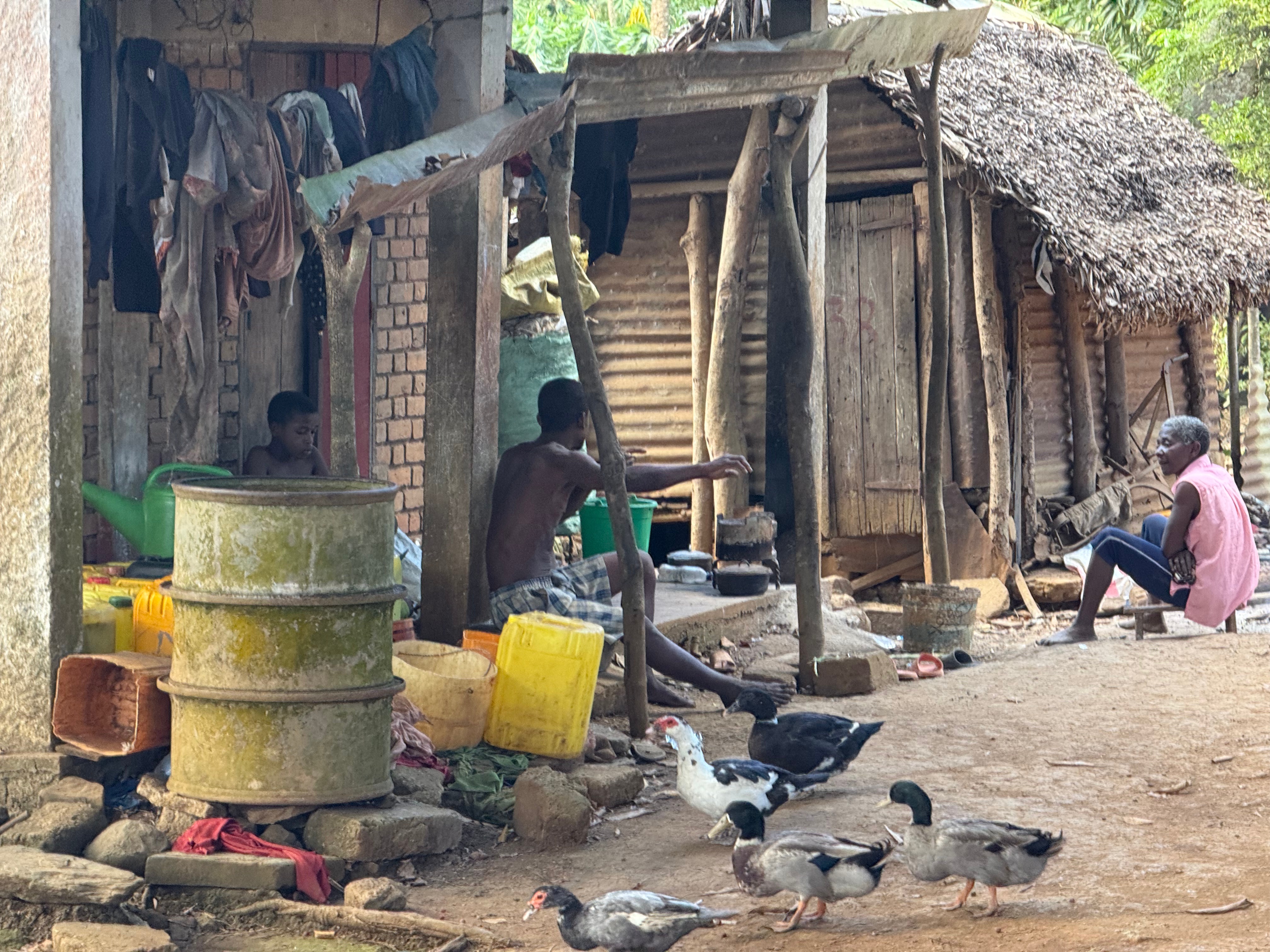
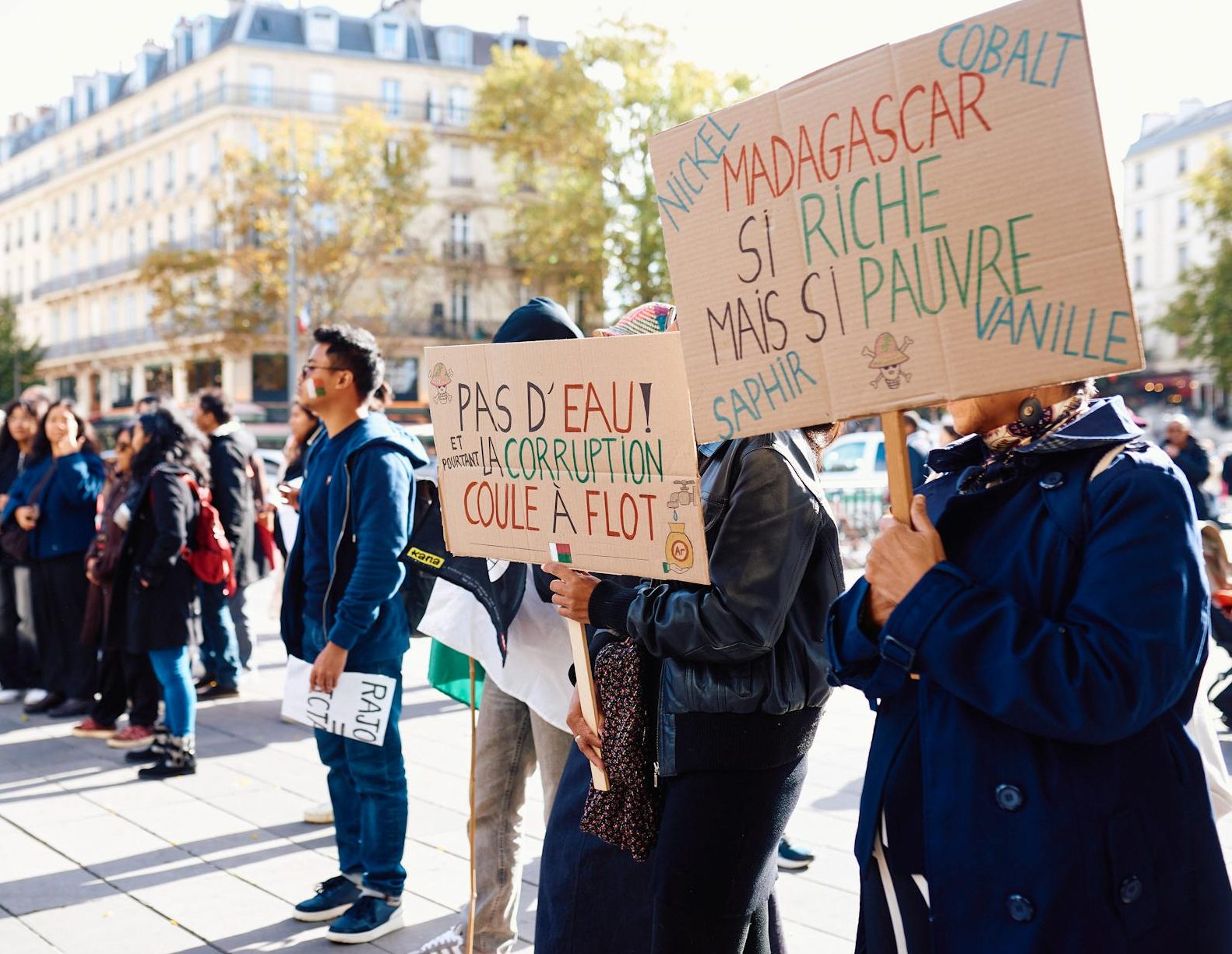
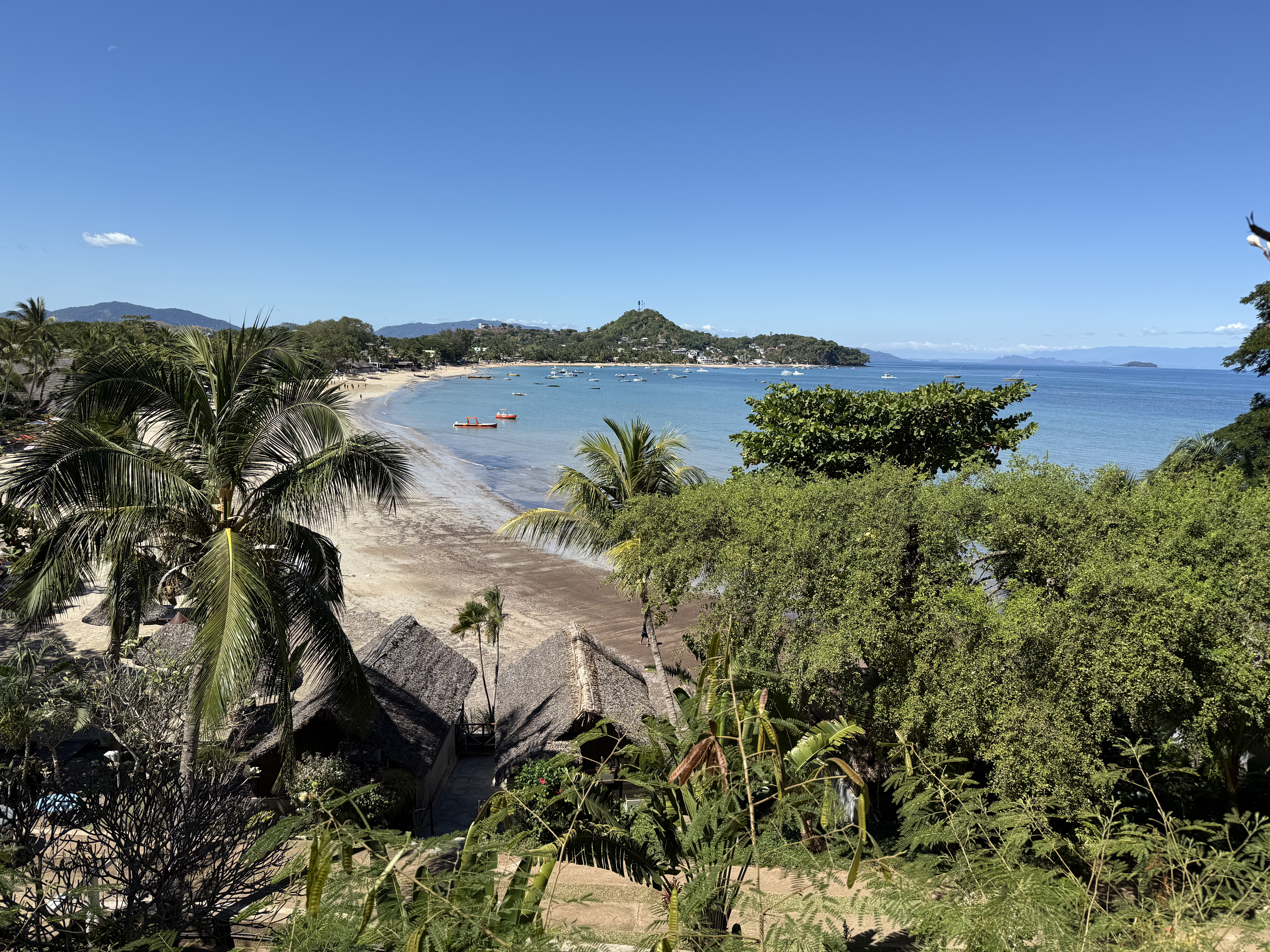
I had treated myself to a massage at an upscale hotel in Nosy Be, Madagascar, Part II of my solo voyage to South Africa and Madagascar (Mada), the world’s fifth poorest country.

With guides Emanuel and John

Why would a handicapped old lady traveling alone (me) come to Madagascar? It was obvious those I met on the journey were surprised, if not baffled.  I did not fit the profile of the typical Mada tourist.

Nosy Be, Madagascar

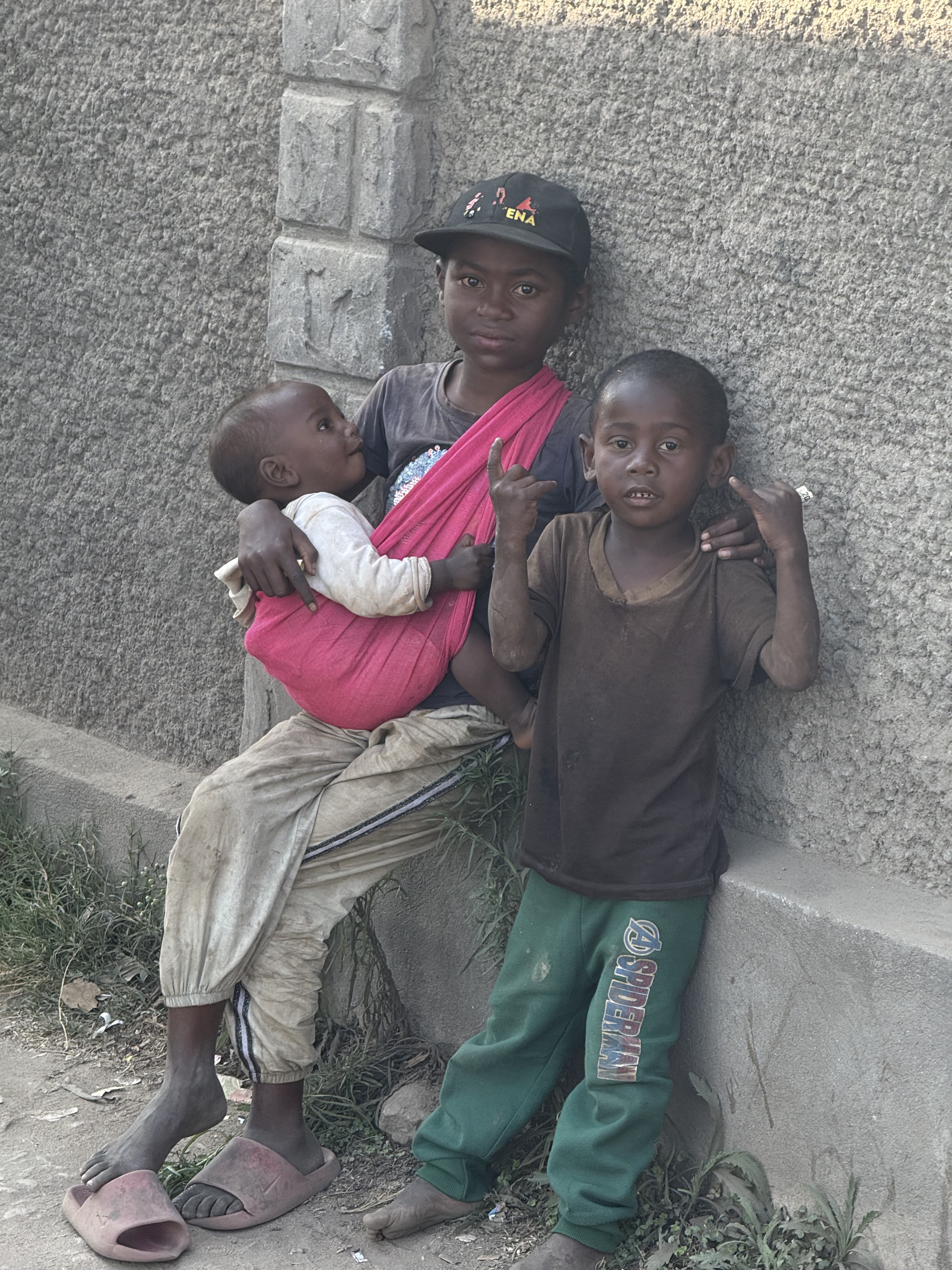
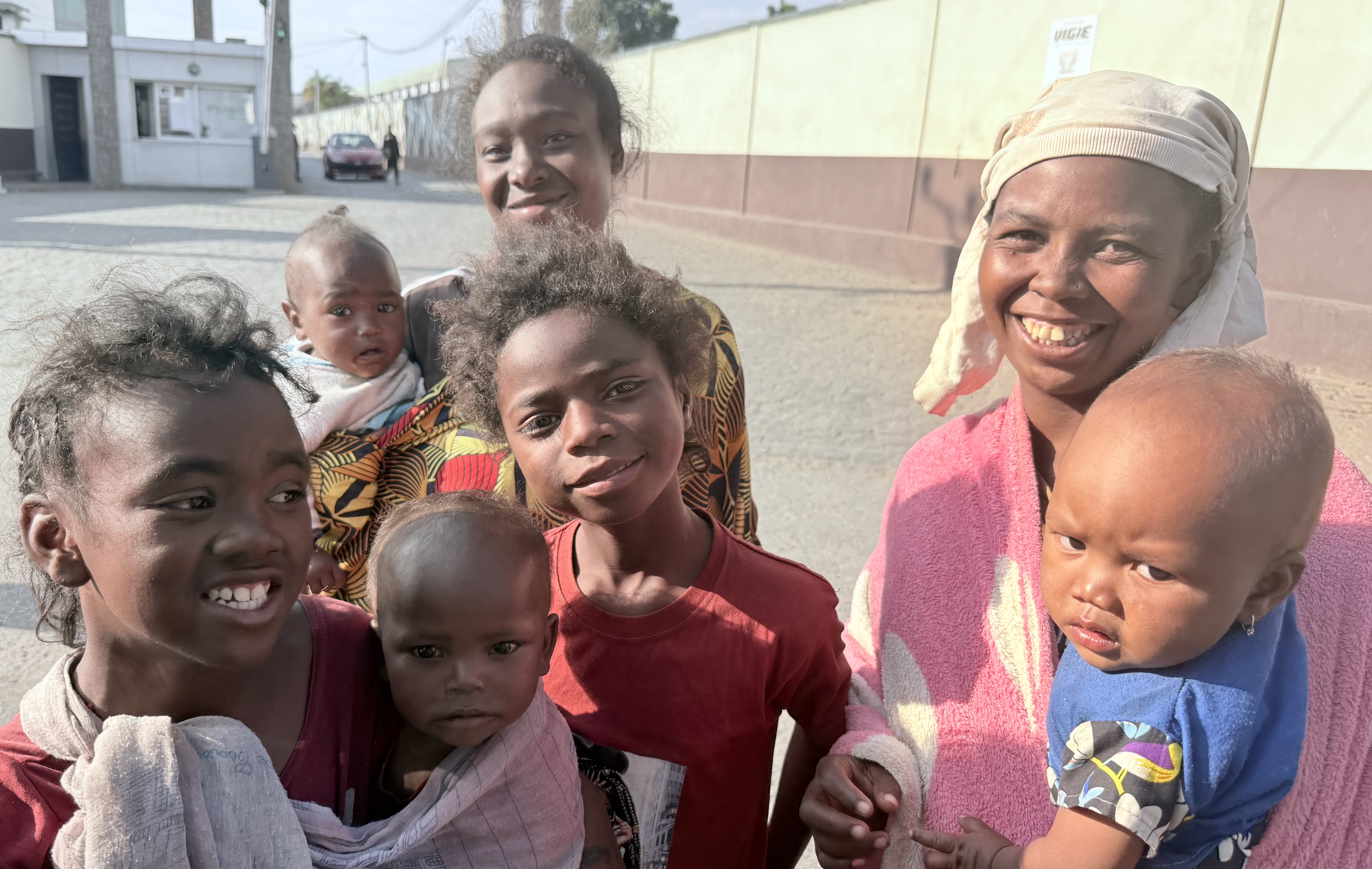
Madagascar is a fascinating, gorgeous country, but crime ridden and poor – very poor. Most visitors are young and fit or older and fit, exploring Mada’s rich biodiversity and incredible landscapes which involve long, rigorous journeys over mainly dirt roads.  Mada is huge, the world’s fourth largest island. Distances are great.   Due to my disability, my excursions were near cities and mainly on paved roads with a private driver/guide – nonetheless challenging at times.  

I was apprehensive, if not nervous, prior to departure.  Had I taken a step too far?  I was petrified of falling again.  But I charged ahead.

Madagascar is home to 112 species of lemur, all endangered.

A woman I met my first night at a hotel in Mada gave me some words of wisdom.  She is a health care worker who has a daughter with disabilities.   “You need to push yourself, test your boundaries.  Use it or lose it.’’

I reflected on those words many times in Mada – when faced with uneven, stony or dirt terrain to navigate, steep steps with no railings, hills with no steps.  “You can do it.  Slowly. Carefully,” I told myself.

Steps were often challenging..

Travel has been my lifelong passion. I relish learning about different lands, cultures, traditions.  I love talking to locals.  You learn so much.   It is enriching.  It can change who you are. Travel adds perspective to life and understanding of the world.

My late husband Bob shared my passion for travel and adventure.  We traveled near and far.  After several difficult years suffering from Alzheimer’s, he passed way two years ago. About the same time, I had a horrendous fall – a complicated femur break and a broken shoulder. Despite numerous surgeries, I have limited mobility and need a cane to walk. And, I don’t have full motion of my left arm following the injury. 

Bob and Leah in the Oman desert

I am à la fin, handicapped, but still alive. I can walk, albeit slowly. I no longer have a travel partner.  What to do?  Sit on the couch, watch TV ad wait to die?

NO.  NO.  Get up.  Get going. Get back on the road again.   I did.  It was invigorating.  I felt alive again.  I loved it. 

As Saint Augustine said, “The world is a book, and those who do not travel read only one page.”  I want to read all the pages.  

If not a Tales and Travel follower, please sign up here. Trust me. It’s safe. Your address is not shared. Don’t miss out. More about my travels in future posts:  Sensational wildlife in South Africa, the mysteries of Madagascar.

See below for a new recipe just in time for all those ripe tomatoes.

Comments, please!

Your email address will not be published. Required fields are marked *

TODAY’S TASTE Savory Tomato Tarte Tatin

Savory Tomato Tarte Tatin

Click below photo for recipe. For more recipes, click here.

Return to Germany

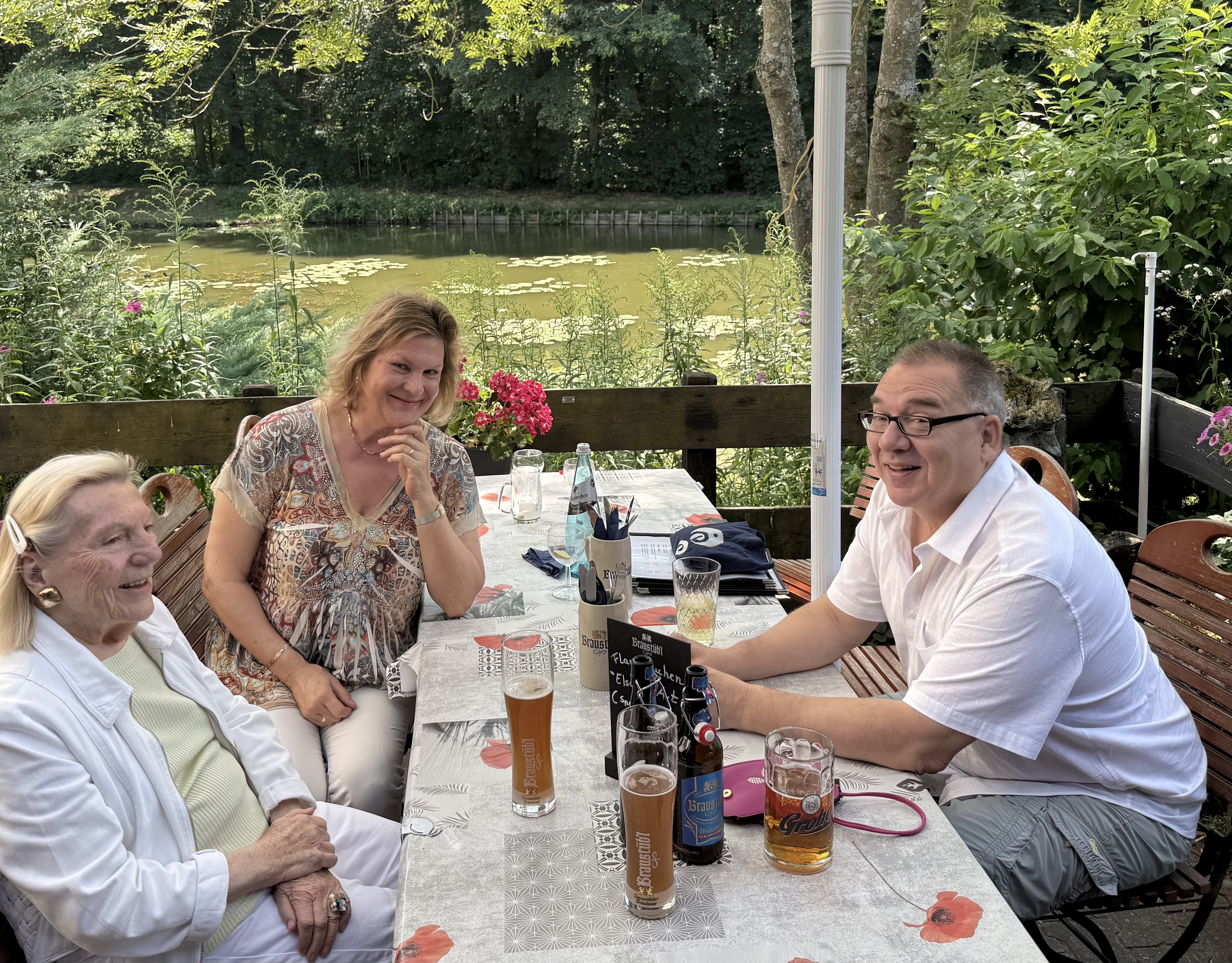
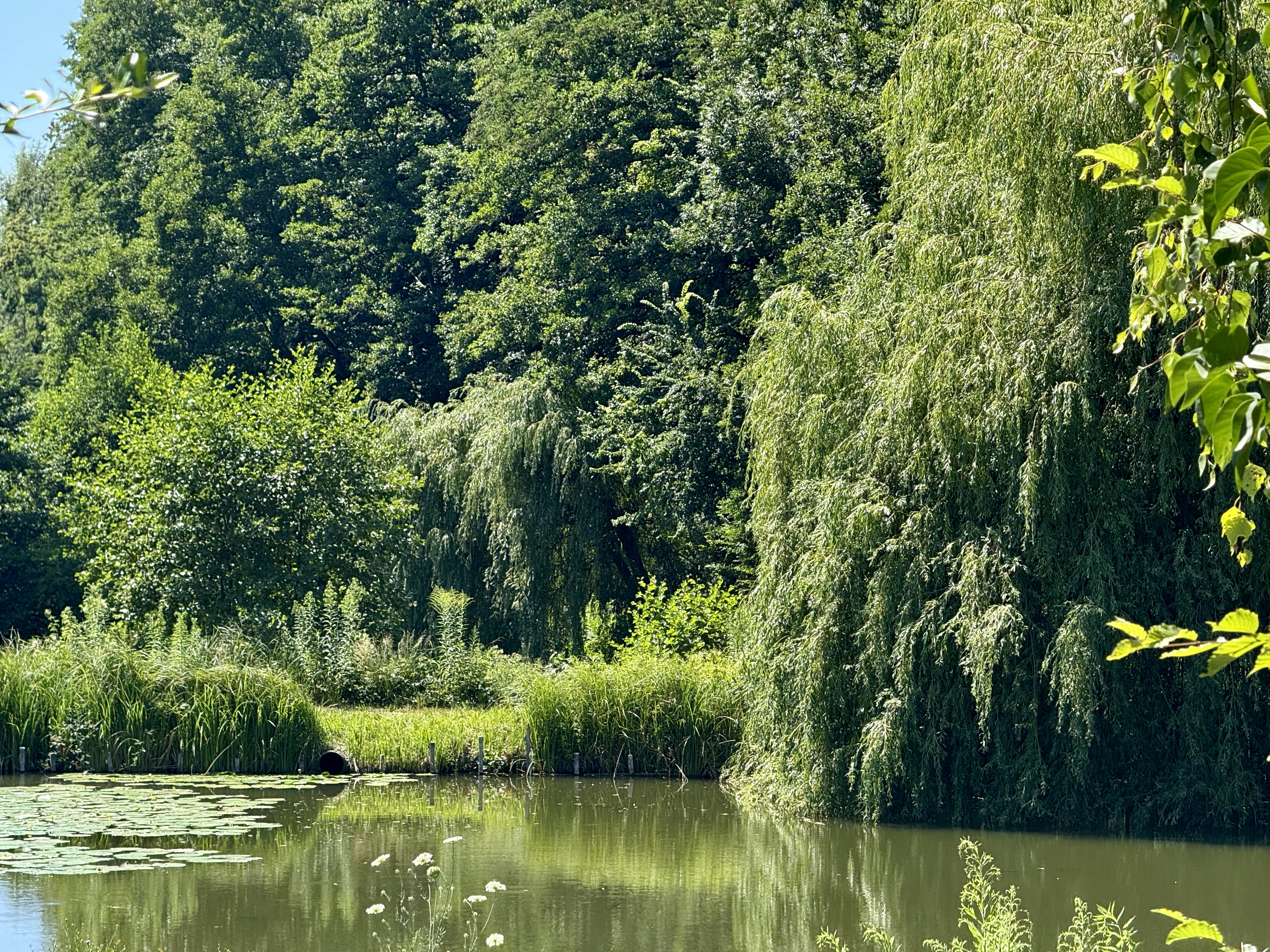
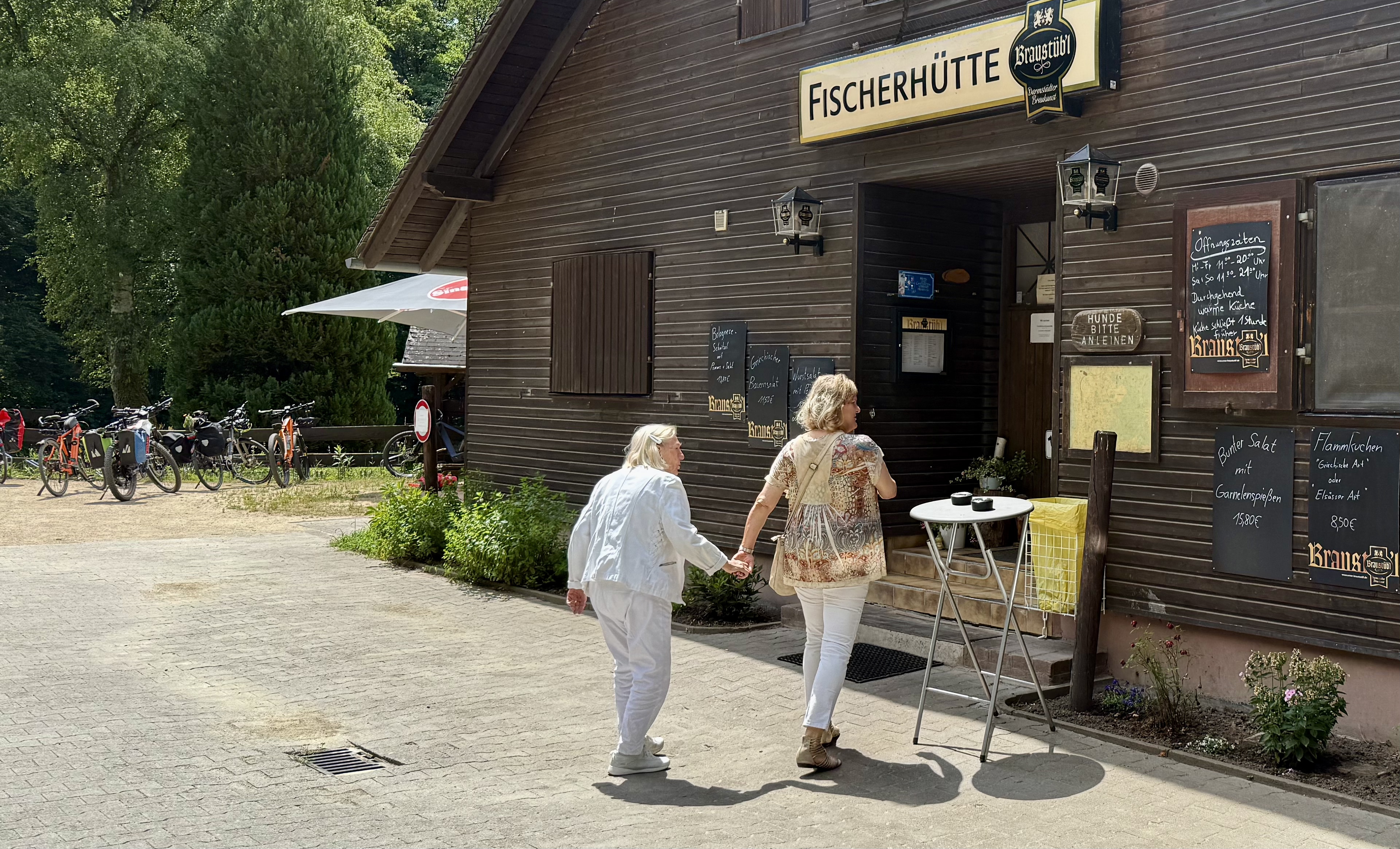
Like I remembered.  Idyllic.  We were surrounded by green, pure nature, at the Fischerhütte near Darmstadt, Germany.

Thekla, Andrea and Thiemo at the Fischerhuettte

Many, many years ago when I worked as a journalist at the newspaper Stars and Stripes, I lived not so far away.  I remember hikes to the hütte in the forest. I remember treks to secret places in that forest in search of the coveted steinpilze (boletus, cepes, porcini – whatever the name, the king of mushrooms). I remember the tranquility, the beauty of those woods.

It was wunderbar to return to Germany after so many years. I have missed Deutschland – old friends, favorite foods, the lush forests.

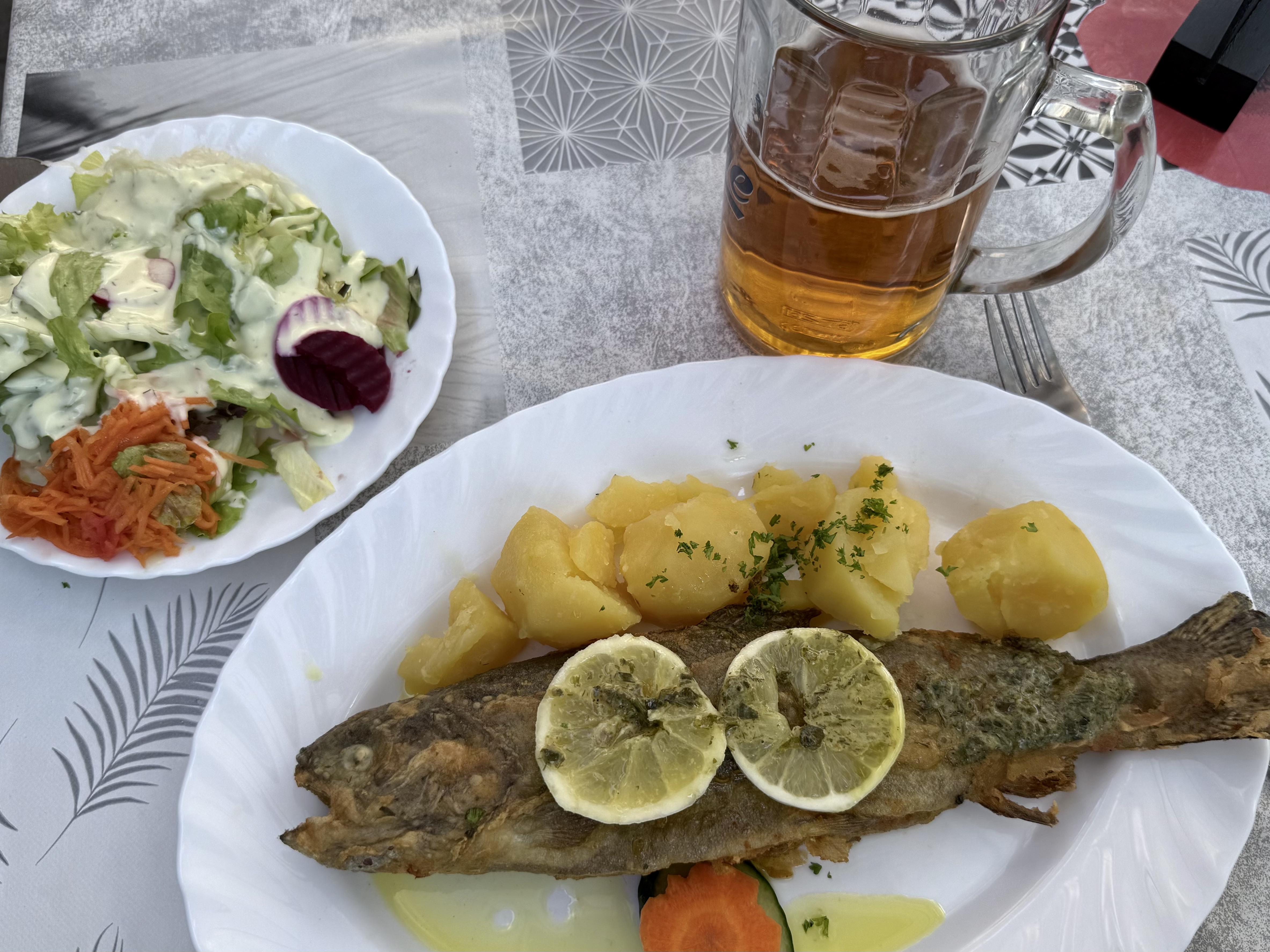
Trout for lunch at the Fischerhuette, and the best German beverage, beer.

Andrea, the daughter of an old friend, her husband Thiemo and her sweet mother, Thekla, led me down memory lane, not just to the Fischerhütte, but other special spots.  It was magical.

Many more memories were rekindled with friends in the Stuttgart area where I lived with husband Bob (RIP) for many years.

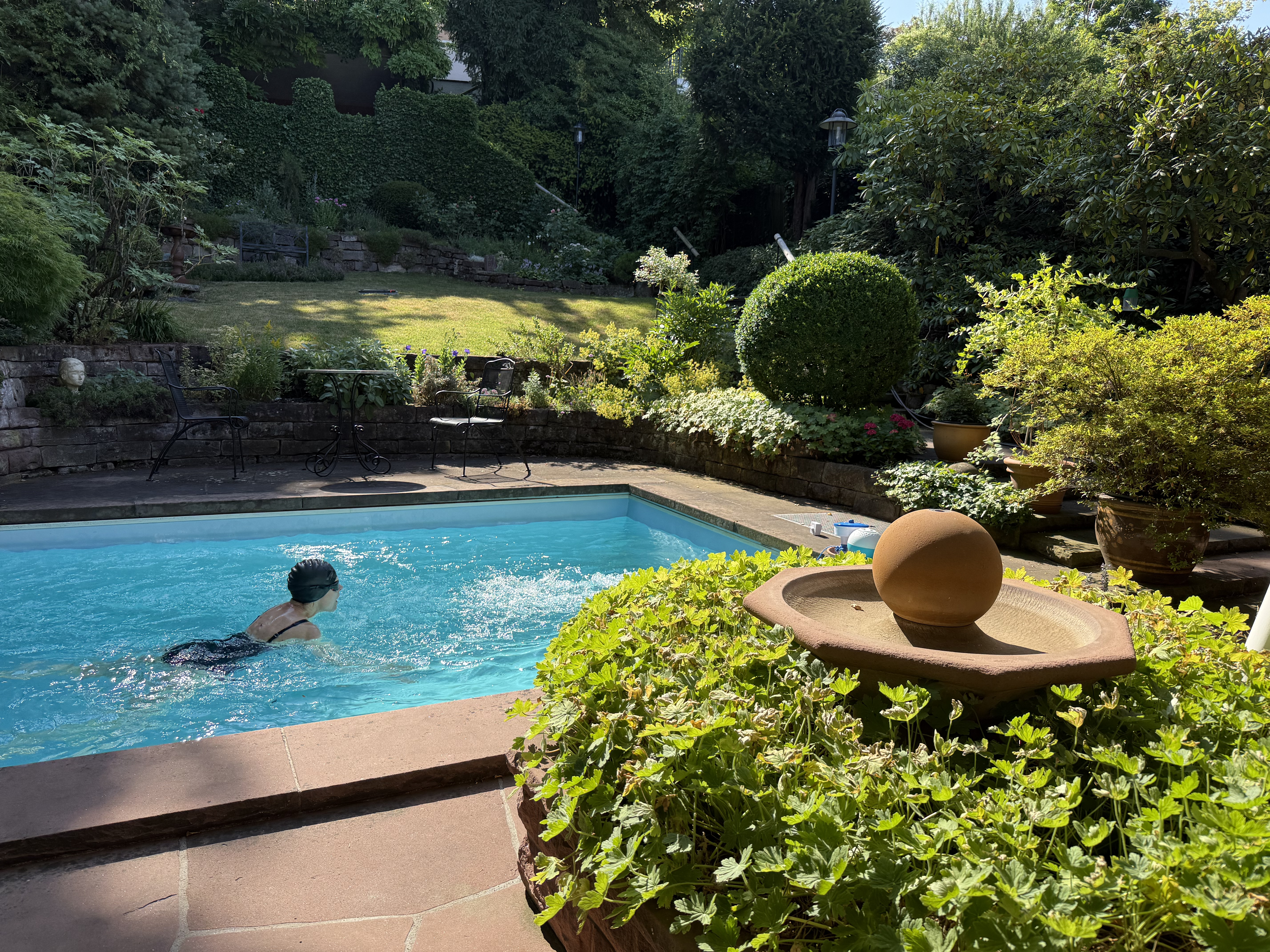
Gerlinde welcomed me in her Stuttgart home.  Like many of my friends, she is a foodie par excellence, even making her own yogurt and ice cream. She is also devoted to fitness and swims against the jet stream in her pool for 20 minutes every day.   I just swam, minus the jet stream.  

Gerlinde swims daily against a powerful water jet — Impressive.

We drove to Steinenbronn, past the apartment where Bob and I lived for 11 happy years. At a nearby restaurant, I indulged in my very favorite Swabian special, Zwiebelrostbraten (onion steak) with homemade Spaetzle.

I can’t complain about food on the Mediterranean coast where I now live, yet there is a shortage of ethnic eateries.

Not so in Germany where, among others, Turkish restaurants abound.  I miss those, too. Marianne treated me to lunch at her friendly neighborhood Turkish restaurant.  I wanted to bring those flavors back to France.

Then, that de rigeur German ritual, afternoon Kaffee und Kuchen (coffee and cake) at her apartment.   

Fun conversation and memories of good times enhanced all those luscious tastes. 

Marianne and Turkish delight

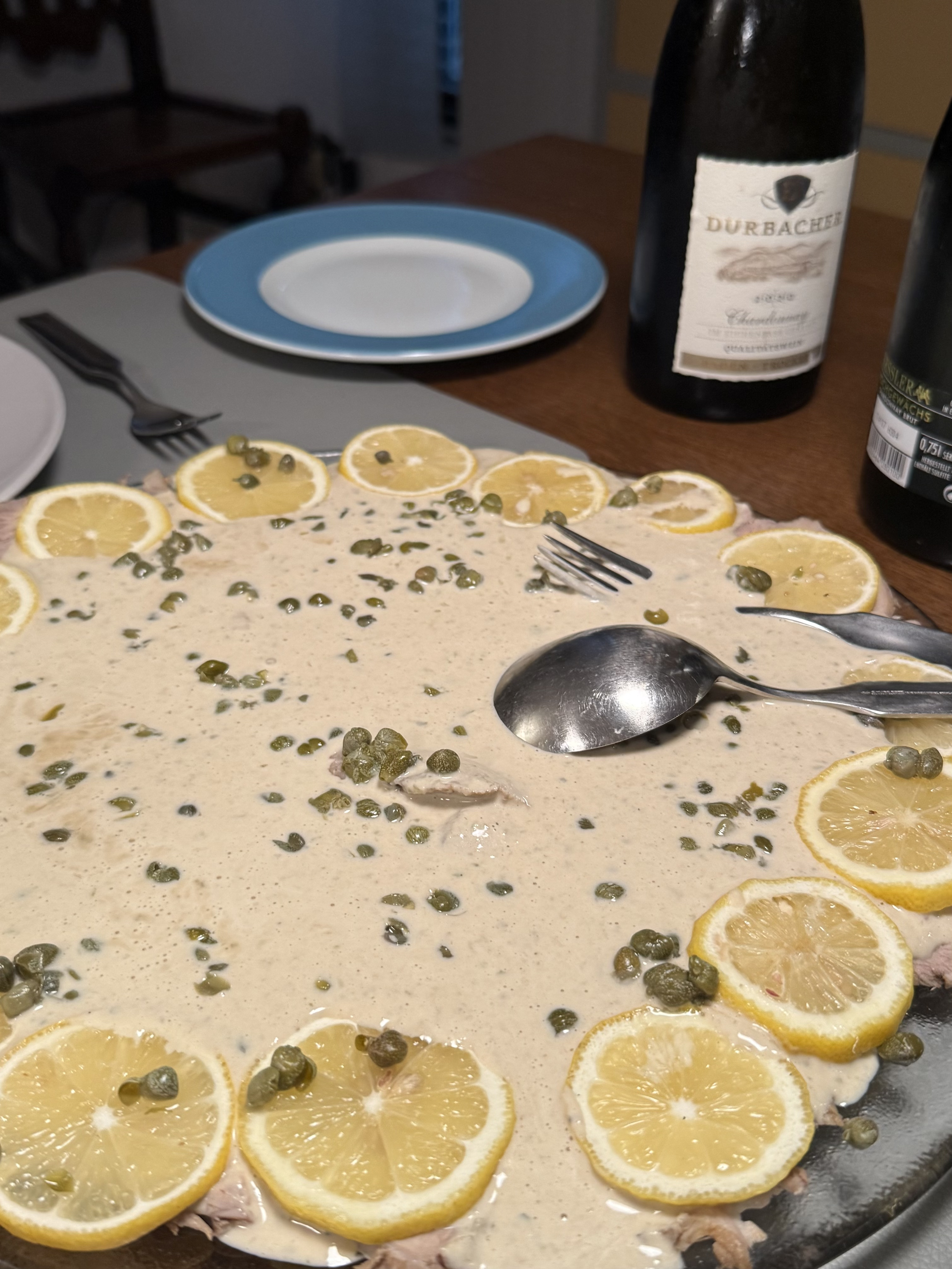
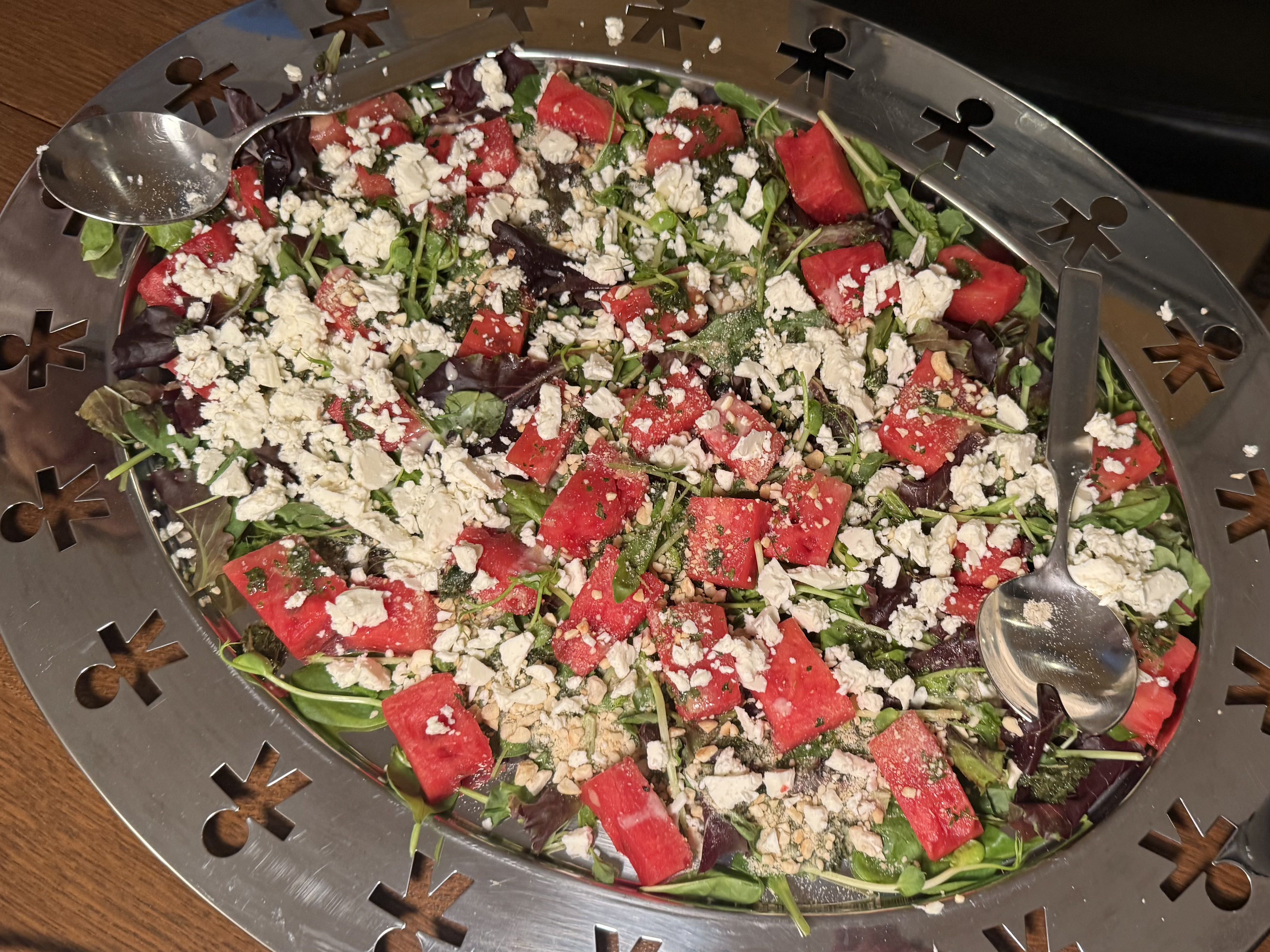
My friends indeed lavished me with generous and delicious hospitality.   Dagmar invited me and other friends to her home for a tasty lunch with a scrumptious raspberry cream dessert.  And, Heti invited us to a multi-course dinner of exquisite delicacies, each worthy of a magazine photo (photos below). This was especially remarkable as she had fallen and broken her wrist the day before.

On my last day we met in Bebenhausen. Bob and I were avid cyclists.  We liked to pedal from Steinenbronn to this tiny burg with an ancient monastery and an excellent restaurant.  It is still charmingly picturesque.  My last treat before heading home, another German delicacy:  Rehrücken filet (venison filet).  Delectable.

Living on the Mediterranean coast, I have the sea, palm trees, the Maritime Alps, tropical gardens – but no dense, enchanting forests.   I had not realized that I was forest deprived.  I was in awe of all the fabulous German greenery.

I mentioned this to Andrea, so we visited yet more. “I’ve never been to so many forests in one day,” she said.  Gerlinde told me that Stuttgart has more green space than any other German city.

“The woods are lovely, dark and deep…,” and a treasure.

Thank you, dear friends, I loved my return to Germany –especially seeing all of you.

Below: Heti’s superb creations. Each was mouthwatering.

I will add a new recipe next time. Meanwhile, for an easy, tasty dessert, try my recent discovery, RUM-SOAKED MANGOES. Sinfully delicious.

If not a Tales and Travel follower, please sign up here. Trust me. It’s safe. Your address is not shared. Don’t miss out. Thrilling adventure coming: South Africa, Madagascar and Mauritius.

Comments welcome. Scroll down and share your thoughts. To read previous comments, scroll way down.

Comments, please!

Your email address will not be published. Required fields are marked *

Rambling along the Riviera

Emmy and Anne came to visit.  They are sisters,  my cousins whom I have not seen in too many years.

Cousins then: me, Emmy, Anne

Emmy is a year older than Anne.  Anne is 5 days older than I.   As children, we saw each other frequently.  With time and moves,  all that changed. (Thank you, Emmy, for above photo. )

And cousins now: Anne, me and Emmy. We celebrated Derby Day with mint juleps.
As a young reporter I worked for the Louisville Courier-Journal and was assigned to cover the elegant Derby “balls.”

Neither cousin had been to my turf in southern France. I wanted to show them my favorites and the must-sees of the area.  We were on the move during their week-long visit, rambling along the Riviera.

I asked them to send me impressions, comments, etc. after their return. Continue reading for photo highlights and their comments.

We ventured up in the hills on day #2 of their visit, a stop for meditation and reflection at the place where my Bob’s ashes have been dispersed. Husband Bob and I were avid cyclists. He loved challenging climbs. We attacked this road and its numerous hairpin turns many times.

Pilgrimage chapel along the road between Sospel and Moulinet where I dispersed Bob’s ashes.

“I loved seeing the remote and serene place where you gave Bob a final resting place. What a beautiful place to commune with nature and to be part of a sacred pilgrimage like so many before us,” Anne said.

We were on the border with Italy. I felt they should have a taste of my preferred country, so we continued up the mountain and returned to the coast via Italy. Bob and I had cycled some – but not all of this terrain. It was a long, long way down.

Anne’s comment: “You complained about the day with the too long drive but that was one of my favorite days. You are a fearless driver! The hairpin turns, the cyclists, the sheer drop offs were terrifying to me but didn’t seem to faze you.”  …Driving in the Mediterranean hinterland is not for the faint of heart.

Markets are de rigueur around here. The Saturday morning market in nearby Menton is enticing with clothes (Italian bargains) in addition to tempting produce. Cousins were impressed, and each found a garment souvenir. “The market in Menton was lots of fun,” noted Emmy.

A market of a different sort was also high on their list of favorites. Conad, an Italian supermarket on the border, is like no other, the antithesis of a sanitized, huge, beautiful American supermarket. It’s cluttered, chaotic, always crowded. French love the cheaper prices. I love the prices too, but mostly the crazy ambiance and the Italian products.

For Anne, this was her “upfront favorite experience… both disorienting and fascinating.” Emmy commented that she was glad she had the experience “in the store with anything and everything one might want. ” Pots and pans, socks and underwear, plants and flowers — all are stuffed in those narrow Conad aisles.

Outstanding art museums are a major attraction on the Riviera, including the Picasso museum in Antibes where I found lots of photo opps.

But for me the museum piece de resistance is the Fondation Maeght in St. Paul de Vence. On my first trip to the Riviera moons ago, I visited the Fondation. I was overwhelmed then and overjoyed recently with our visit. The art museum on a hill overlooking the medieval town features a superb collection of modern art including large sculptures in gardens and on terraces.

Since we were in the area, we stopped to visit the Matisse chapel in nearby Vence. A nun inspired the artist to create the chapel whose vibrant colors are dazzling.

Emmy summed up her take on the trip: ” I loved each and every excursion. Was especially intrigued by Dolceacqua with its historic bridge and unique and ancient tunnel structure leading up to the castle. Loved the trip to Eze with its beautiful gardens perched on the hilltop.”

Dolceaqua with its castle and ancient bridge

Food is a travel highlight. My dear cousins are easy to please and liked everything. We avoided expensive eateries. Sitting outdoors at a Vence resto, Anne ordered coffee as her lunch beverage. I explained that in France coffee is a breakfast drink, definitely not ordered as liquid refreshment with a noon or evening meal. However, after the meal, a “petit ” espresso is in order. It was all in fun. One can drink whatever whenever, but I thought they should learn a bit about the local customs.


Anne with her coffee americano


“One of my favorite moments was when I ordered coffee at lunch and you gave me a startled look and told me that was a gauche thing to do. Or perhaps I am gauche, your country bumpkin, too-American cousin! That struck me as so amusing, so familial in a way,” she recalled. BTW: Anne is delightful, definitely not gauche.

Because we were on the move, I did not prepare at- home dinners, except for their arrival, my all-time favorite, Shakshuka. Click for the recipe. I had made a rum carrot cake in advance of their arrival. We had a slice every day — too much and it wore thin (but not on the waistline). We never did finish it.

It was heartwarming, fun and gratifying to reunite with my cousins. A few months ago my nephew visited – his first time in Europe. We had a “blast.” Read about that adventure: Intro to Europe 101.

I hope all my kin will come back. And, so does Simba who bonded with Emmy.

Emmy knits. Simba cuddles.

If not a Tales and Travel follower, please sign up here. Trust me. It’s safe. Your address is not shared. Comments welcome. Scroll down and share your thoughts. For Today’s Taste and recipes, keep scrolling.

Comments, please!

Your email address will not be published. Required fields are marked *

TODAY’S TASTE: Rum-soaked mangoes (a winner)

Click on Mangoes for recipe and for more recipes, click here.

Search previous posts by category

Search