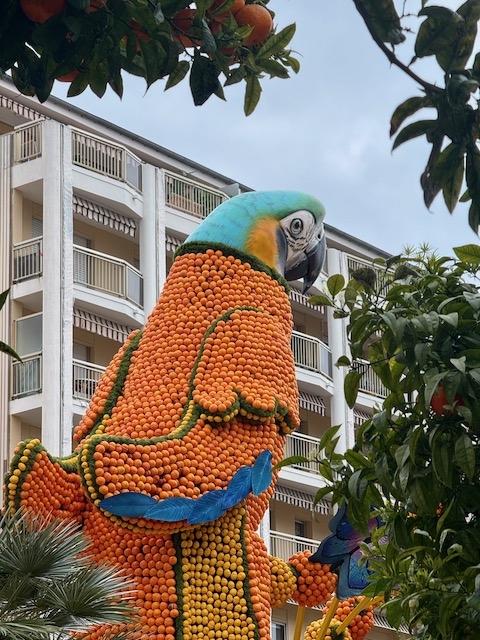
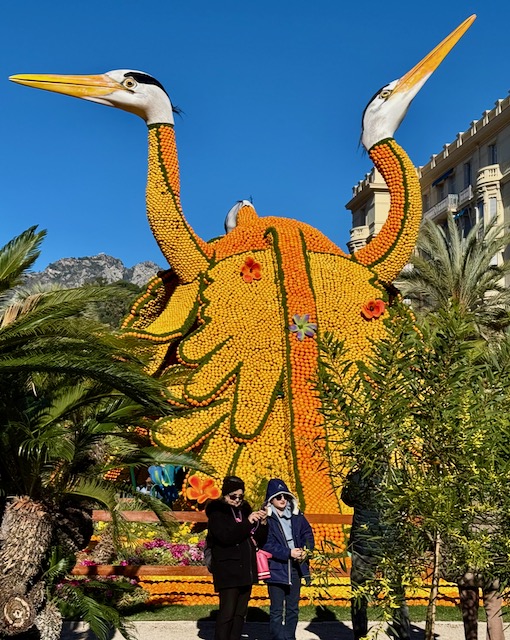
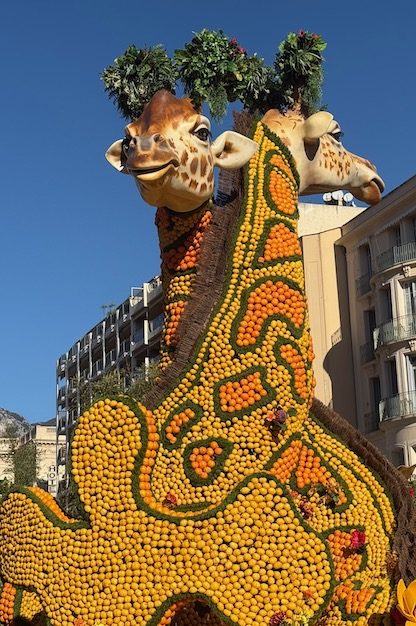
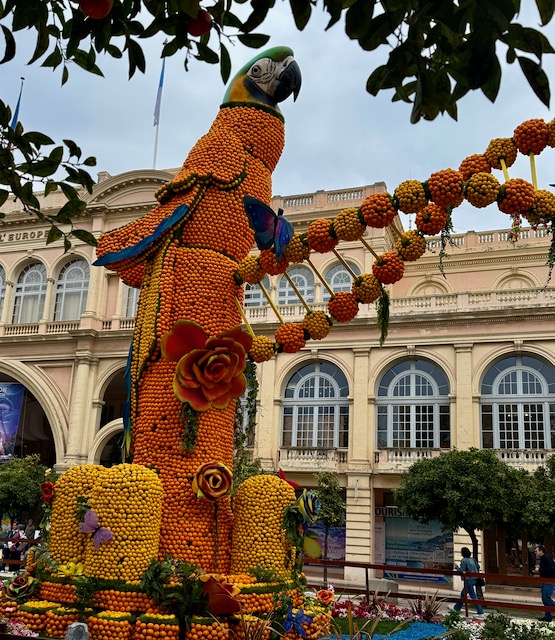
Lemons. Oranges. Tons and tons of citrus fruit for sale at bargain prices. Some 140 tons were used to decorate huge, elaborate creations in Menton, the French city of lemons. Fruit is attached to metal sculpture frames, some reaching 9 meters or 30 feet in height, with about a million rubber bands.
The town’s annual two-week long lemon festival (Fête du Citron) starring the fruit masterpieces just ended. Usable leftovers can be purchased at a special market.
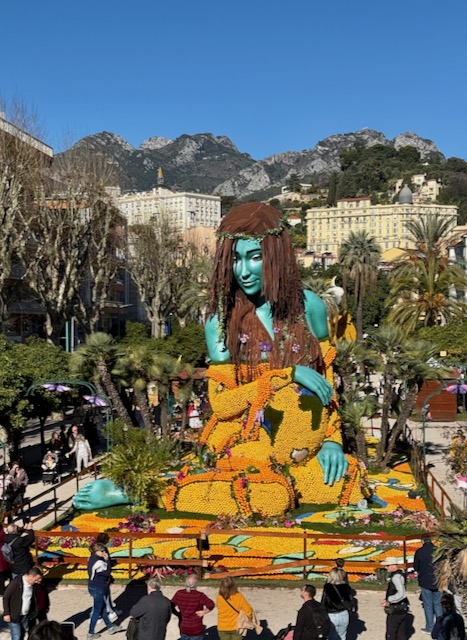
“Wonders of life” was the theme of the 2026 lemon festival.Above, Mother Earth.
The festival is a windfall for the Mediterranean town of 30,000. Tourists, about 300,000 this year, come from near and far. When the orange and yellow sculptures are dismantled, the parade stands torn down, and inner-city streets open again, locals breathe a huge sigh of relief. Menton is theirs again.
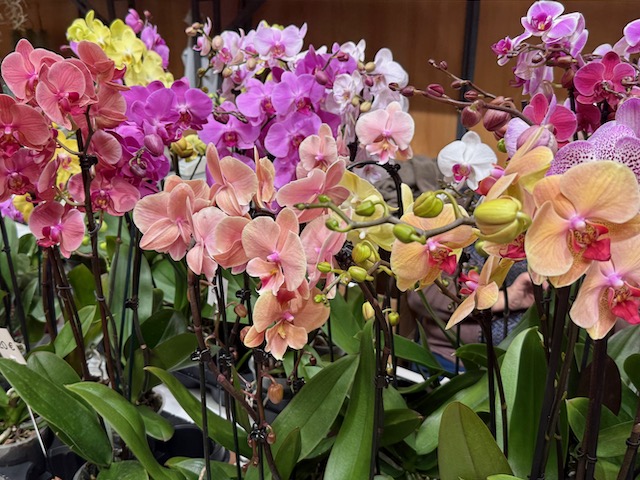
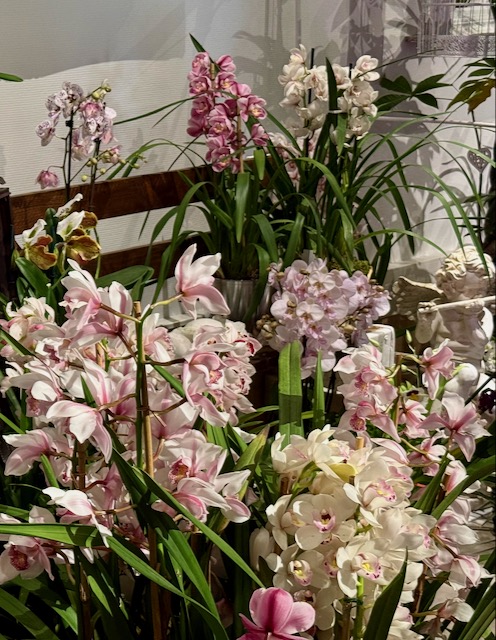
But they too enjoy the festivities. The Fête du Citron is much more than the awesome citrus constructions. Parades, a crafts market, orchard and garden tours, bands – all are on the festival agenda. And, orchids. The Palais de l’Europe, just adjacent to the gardens with the sculptures, houses a lavish orchid exhibit.
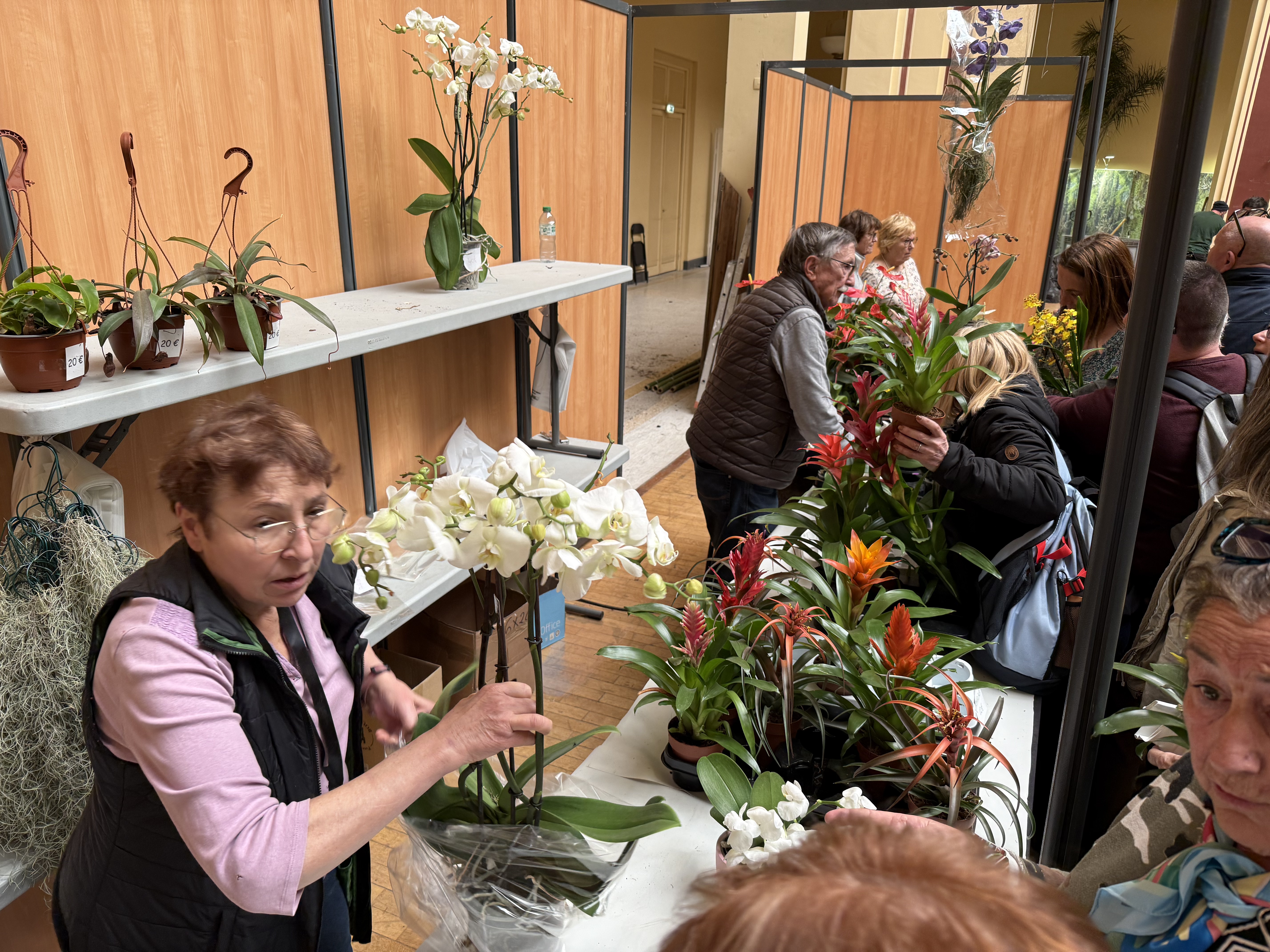
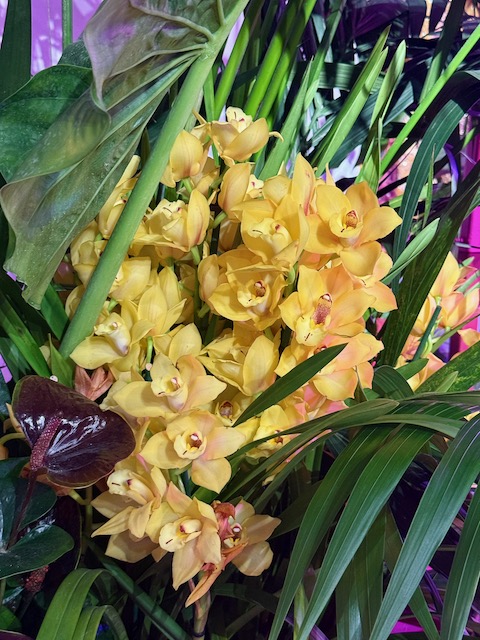
Orchids too are offered at reduced prices after the festival. I stood in line outside waiting for the sale to open, then followed the crowd to the long table where the beauties were offered.
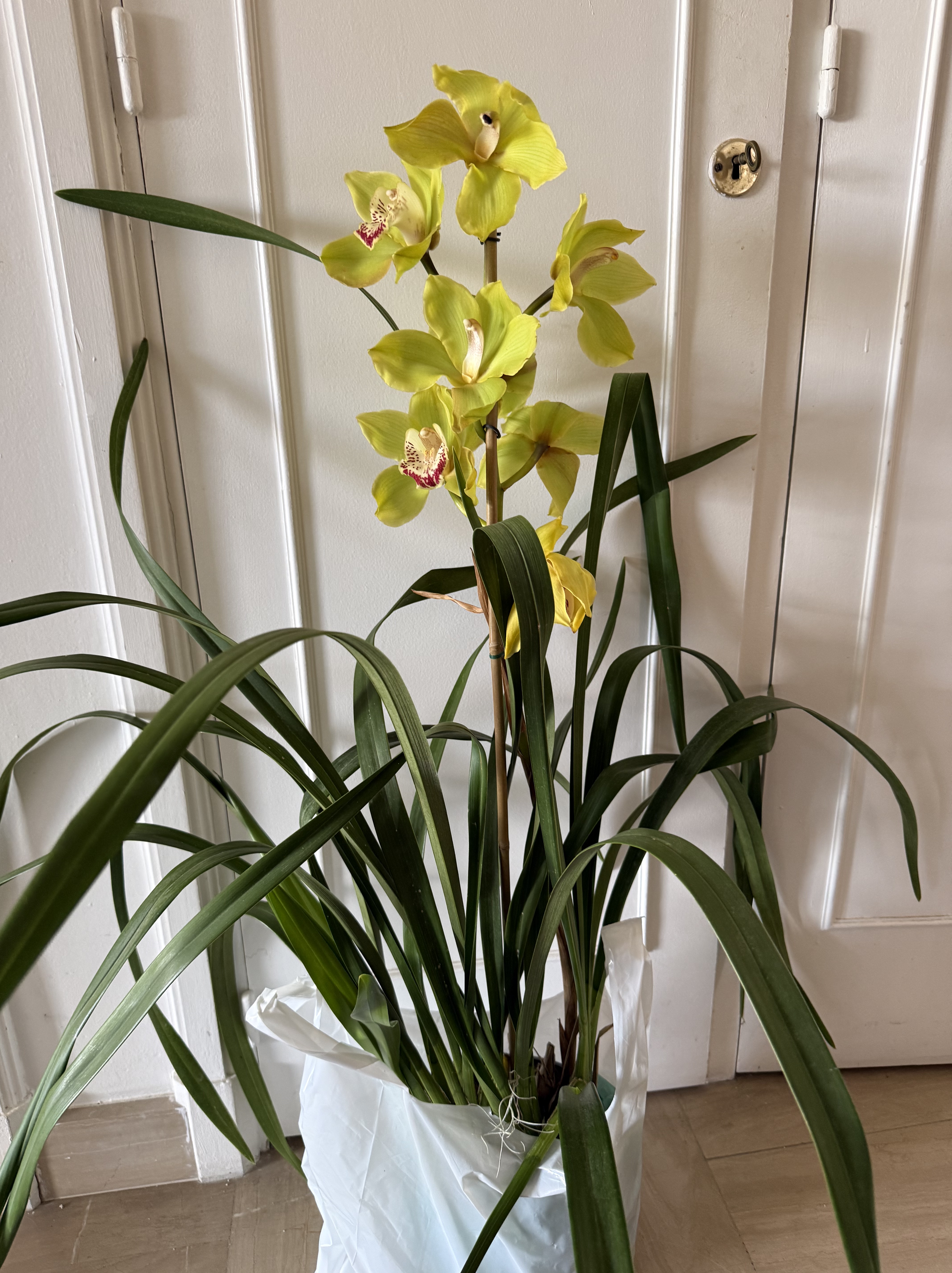
Orchid sale and my prize, “Sunshine.”
Too many people. Too few orchids. Many must have been offered to staff before the public sale. Nonetheless I came home with a large specimen. I was told the blossoms won’t last much longer. My challenge – to get my treasure, whom I have named “Sunshine,” to bloom again next year. (Orchid tips welcome)
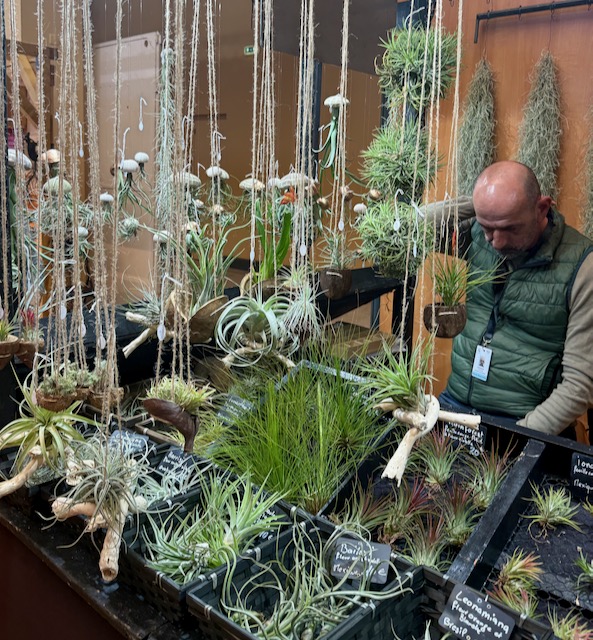
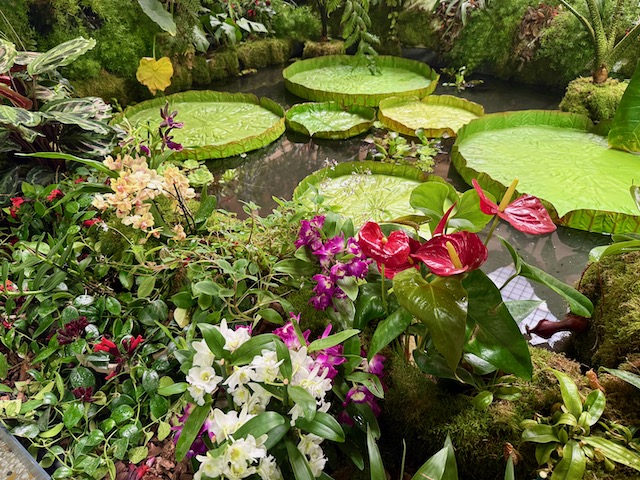
All manner of orchids, including air orchids, to admire. Those circles are an aquatic plant from the Amazon.
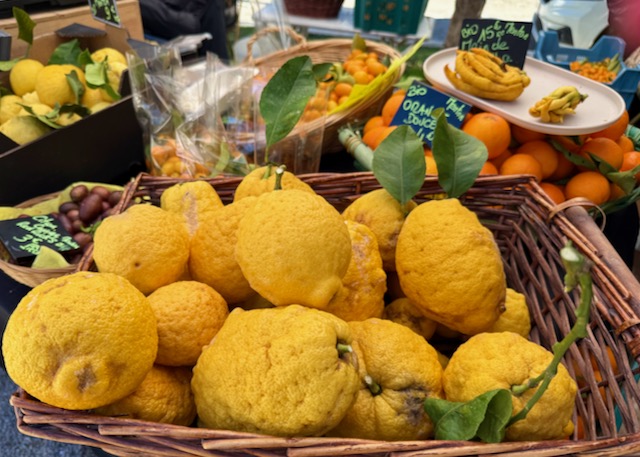
But it’s lemons, nor orchids for which Menton is famous. Not your ordinary grocery store lemons. Menton lemons are a protected, high-quality variety — too valuable and production too limited for display construction. Neighbor Spain is the source.
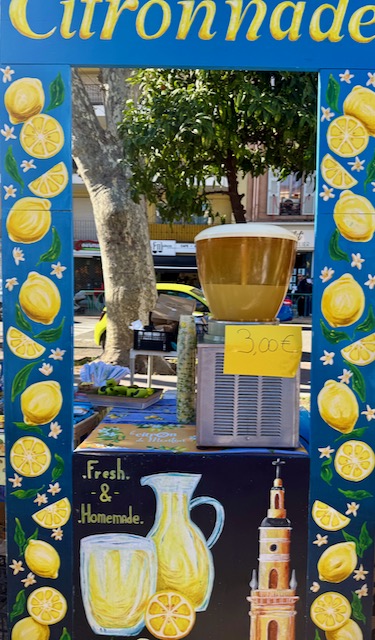
Mentonlemons and lemonade.
Lemon fame dates back centuries. The town’s mild microclimate made its lemons famous throughout Europe in the 19th century. The fruit was an important addition to the economy. And, since 1933 the yellow fruit has been honored with a Fête du Citron.
“In Menton, the sea is blue, the sun is gold, and the lemons shine like lanterns.”
If not a Tales and Travel follower, please sign up here. Trust me. It’s safe. Your address is not shared.
Food is a hot topic in travel these days. More and more destinations offer food tours with samplings of tasty street goodies.
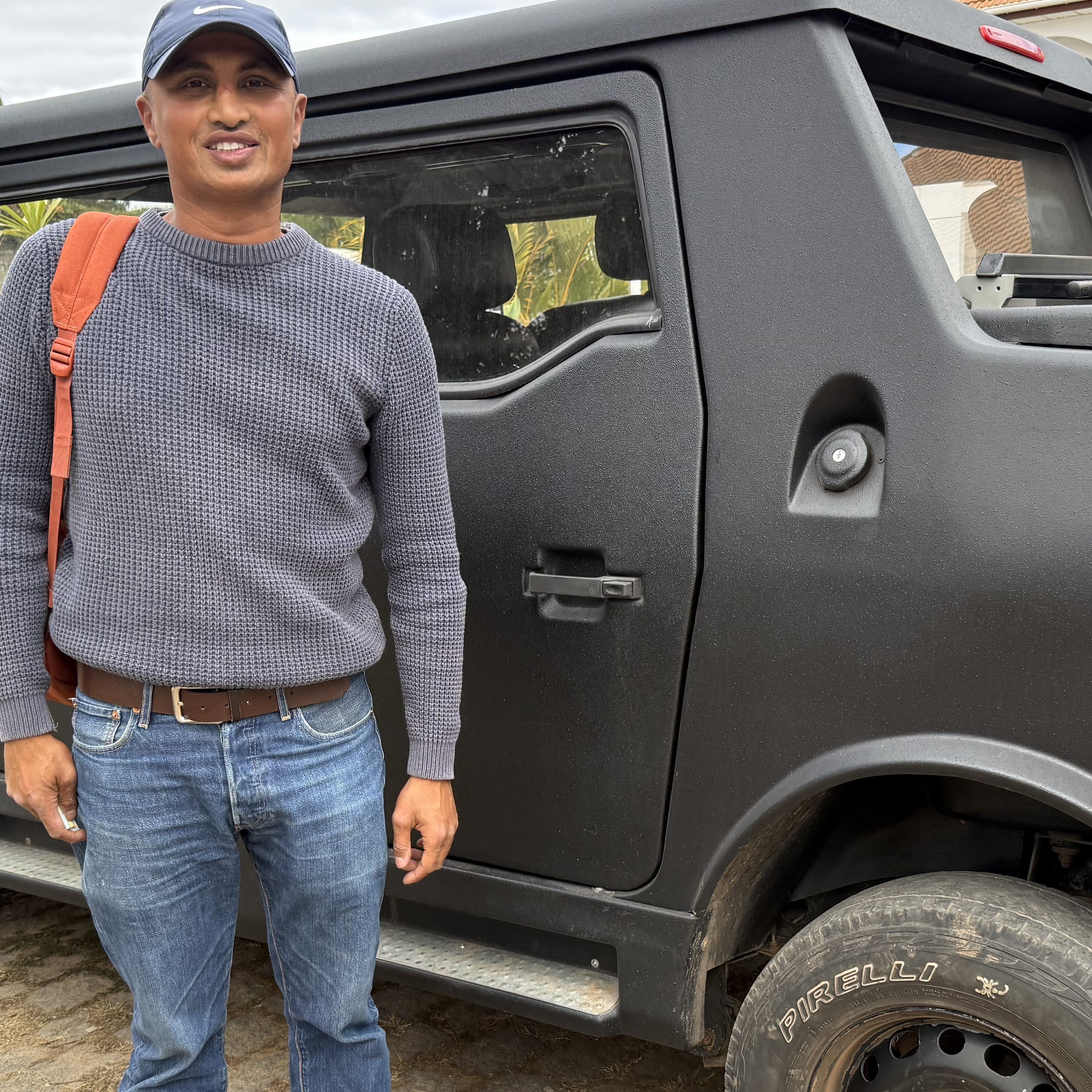
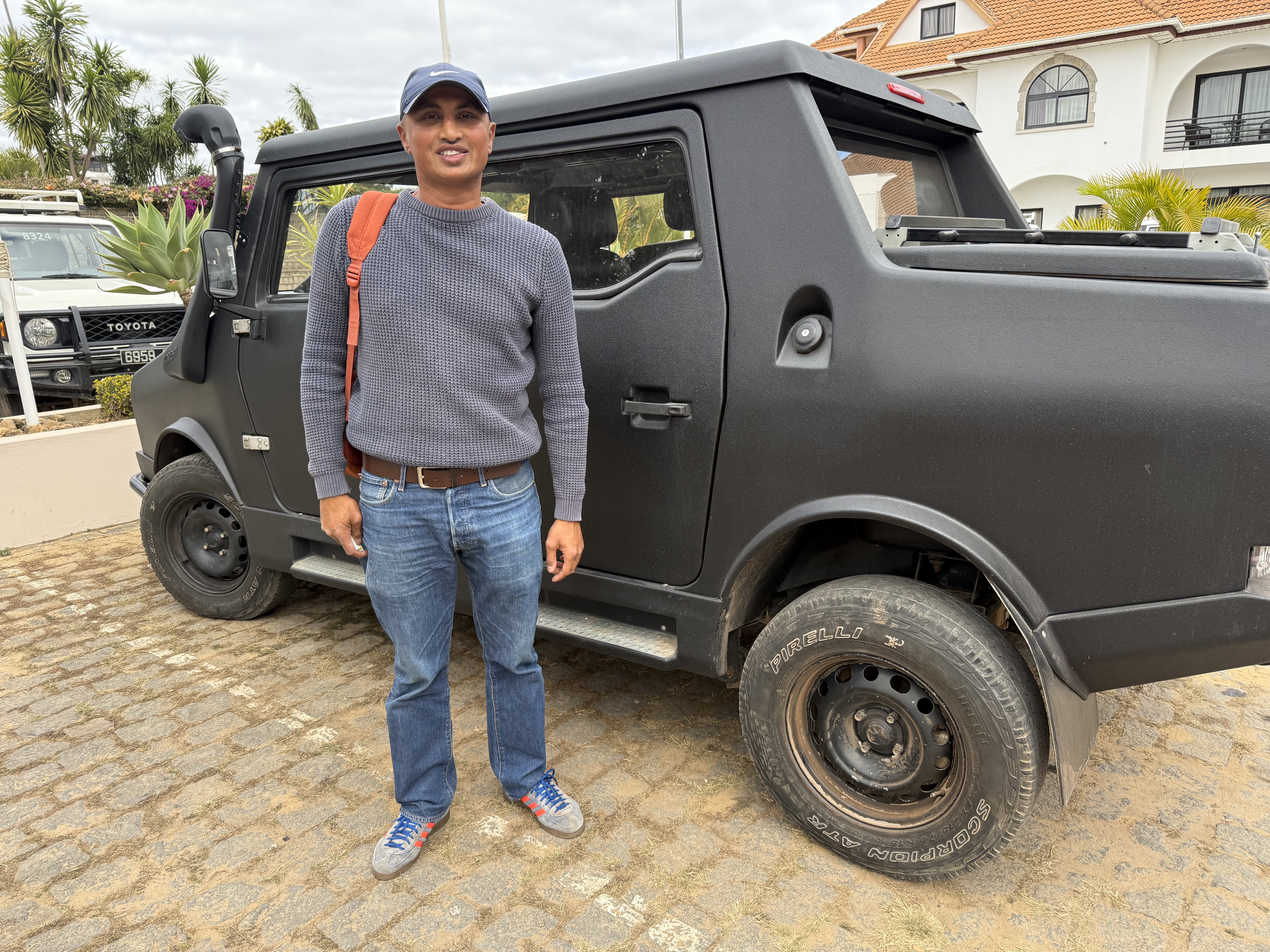
Being a dedicated foodie, upon arrival in Madagascar (Mada) last summer, I naively inquired about a food tour. “Not here,” announced Ravi, a guide and driver. “People get sick. They reuse the cooking oil.”
Forget street food, as well as haute cuisine and Michelin star restaurants. I did, however, enjoy some delicious dining during my stay in the country, the fifth poorest in the world.
Food prep starts early in Madagascar
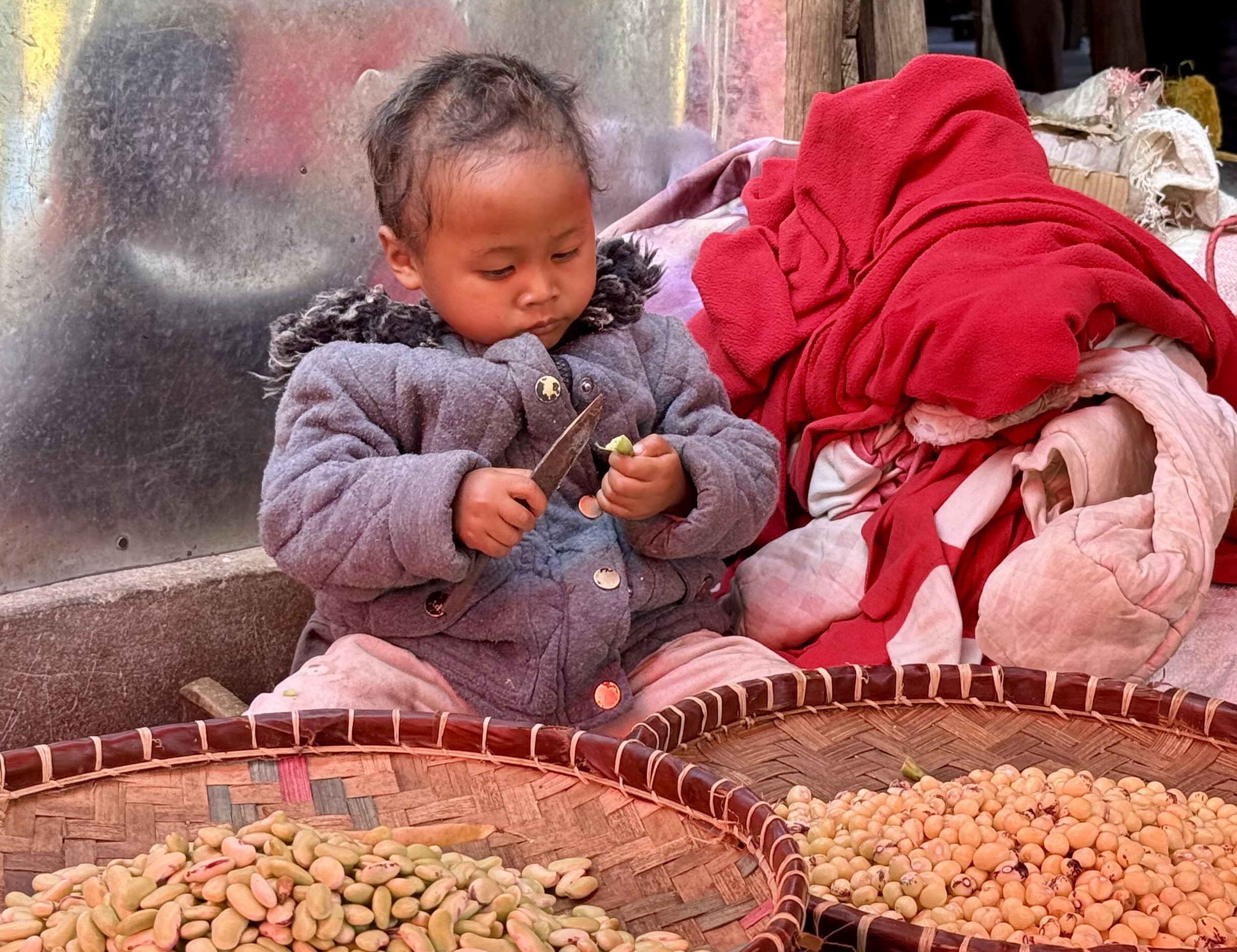
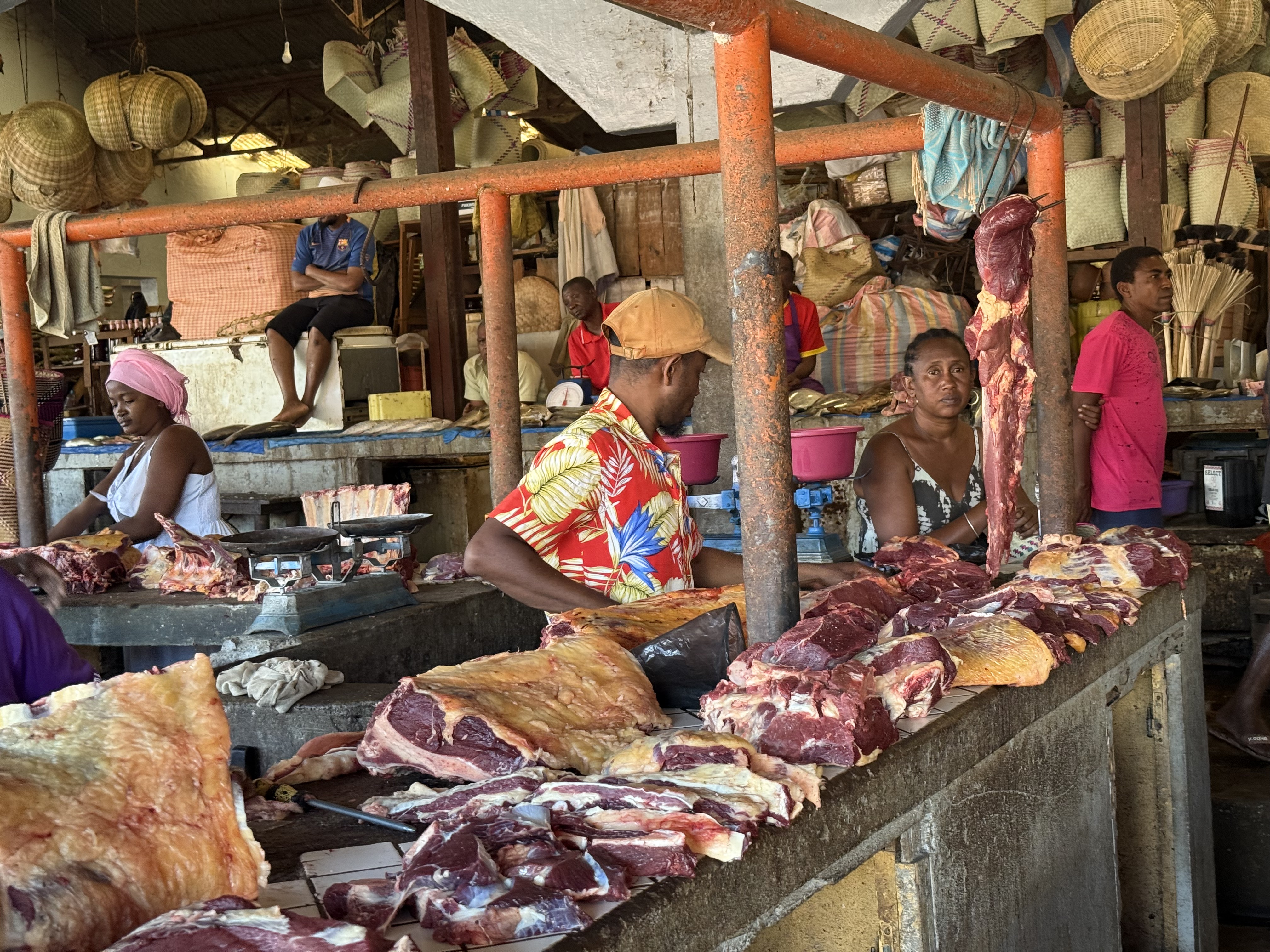
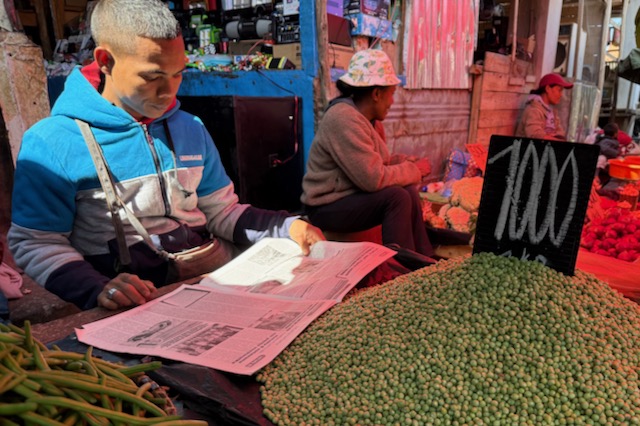
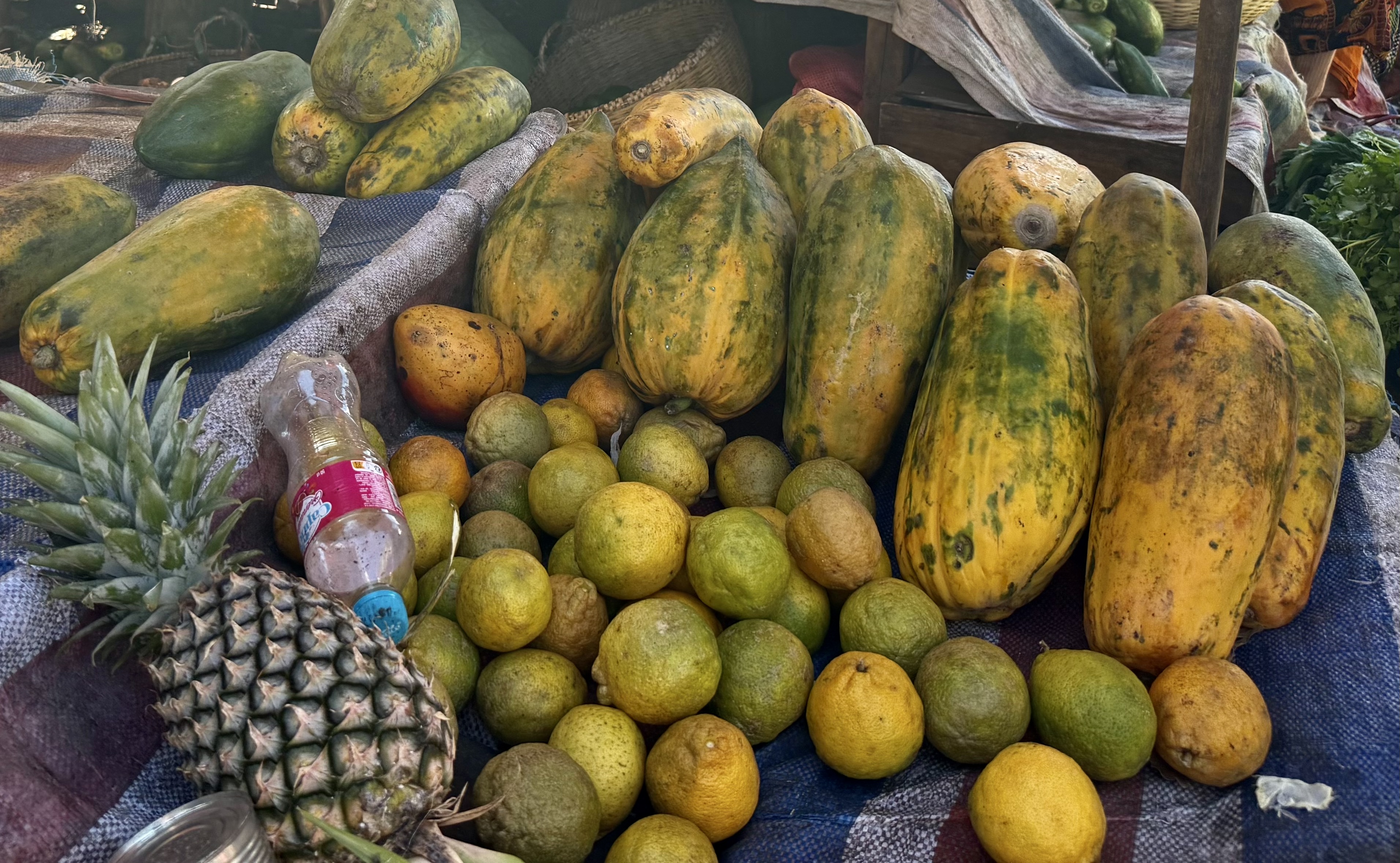
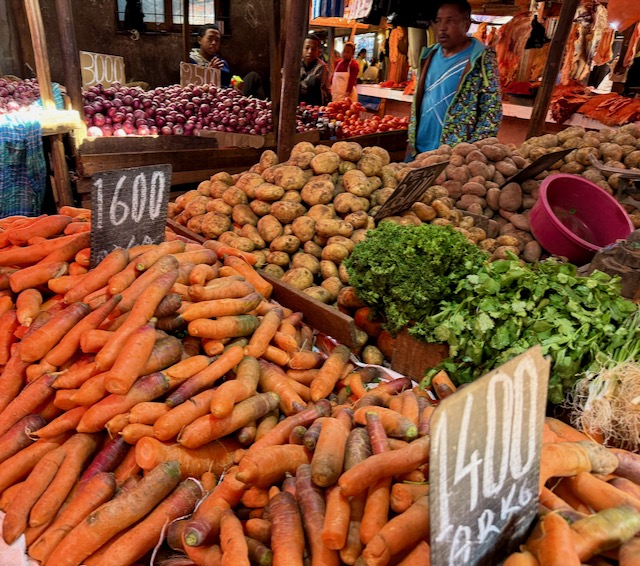
I loved visiting the markets, taking photos of the friendly vendors, and learning about Mada food.
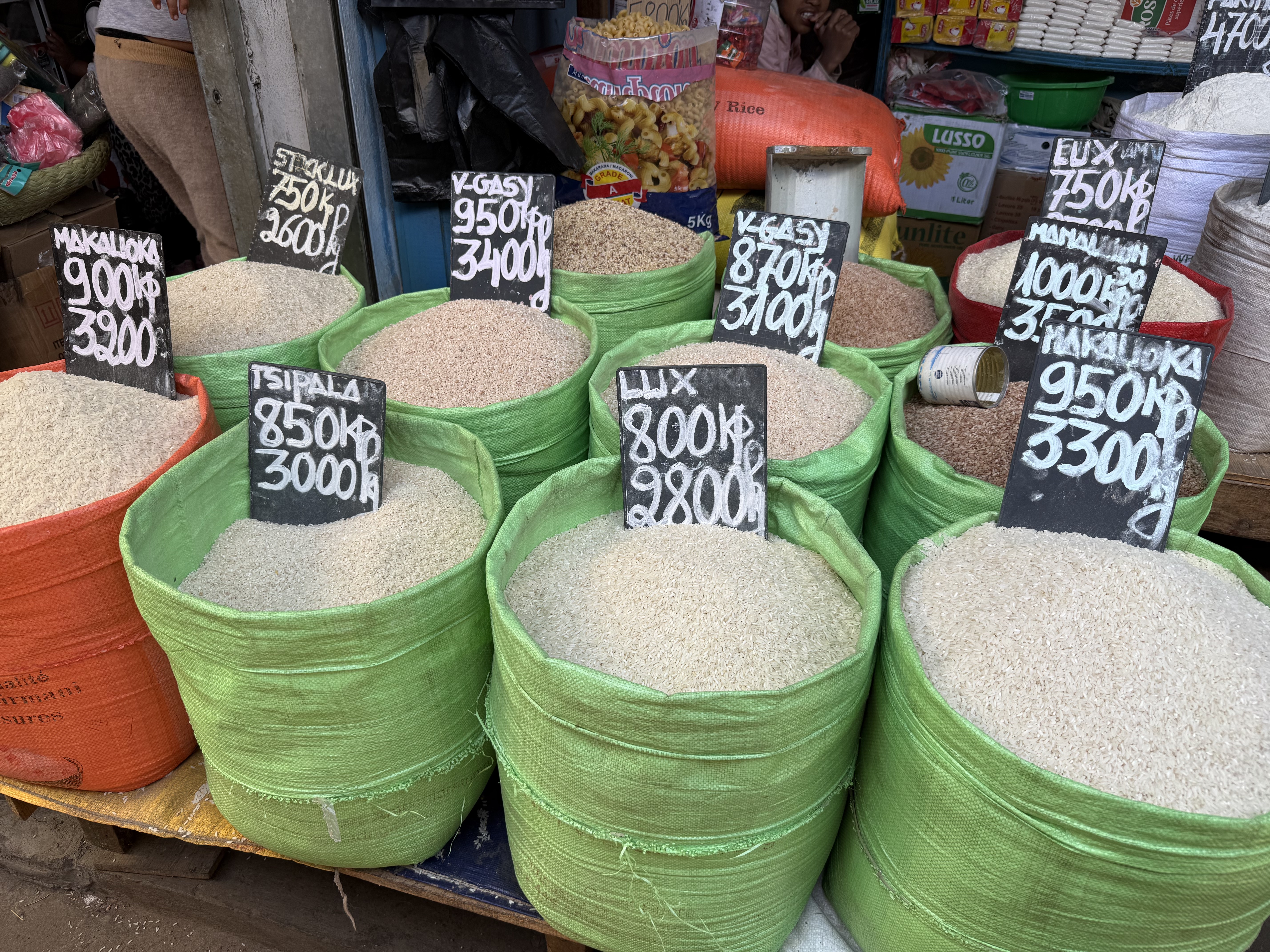
Let’s start with rice. “We must eat rice three times per day,” declared Emanuel, my guide at a market in Antananarivo (Tana), the country capital. We passed numerous rice stands with numerous kinds of rice. “But this is not enough. We also import rice from China and India,” he added.
Hard to believe. During my first excursion in Mada, to a lemur park about 25 kilometers from Tana, we passed miles of rice paddies. However, on another excursion we passed brick factories on the river banks. Bricks replaced rice; I was told. “You can make more money with bricks.”
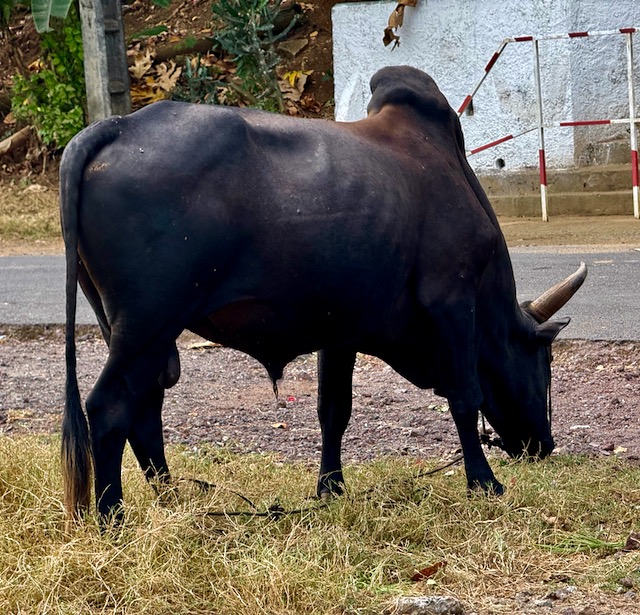
Zebu
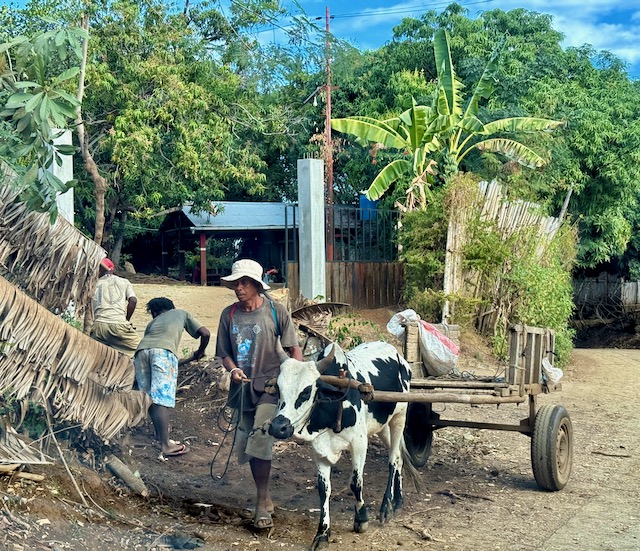
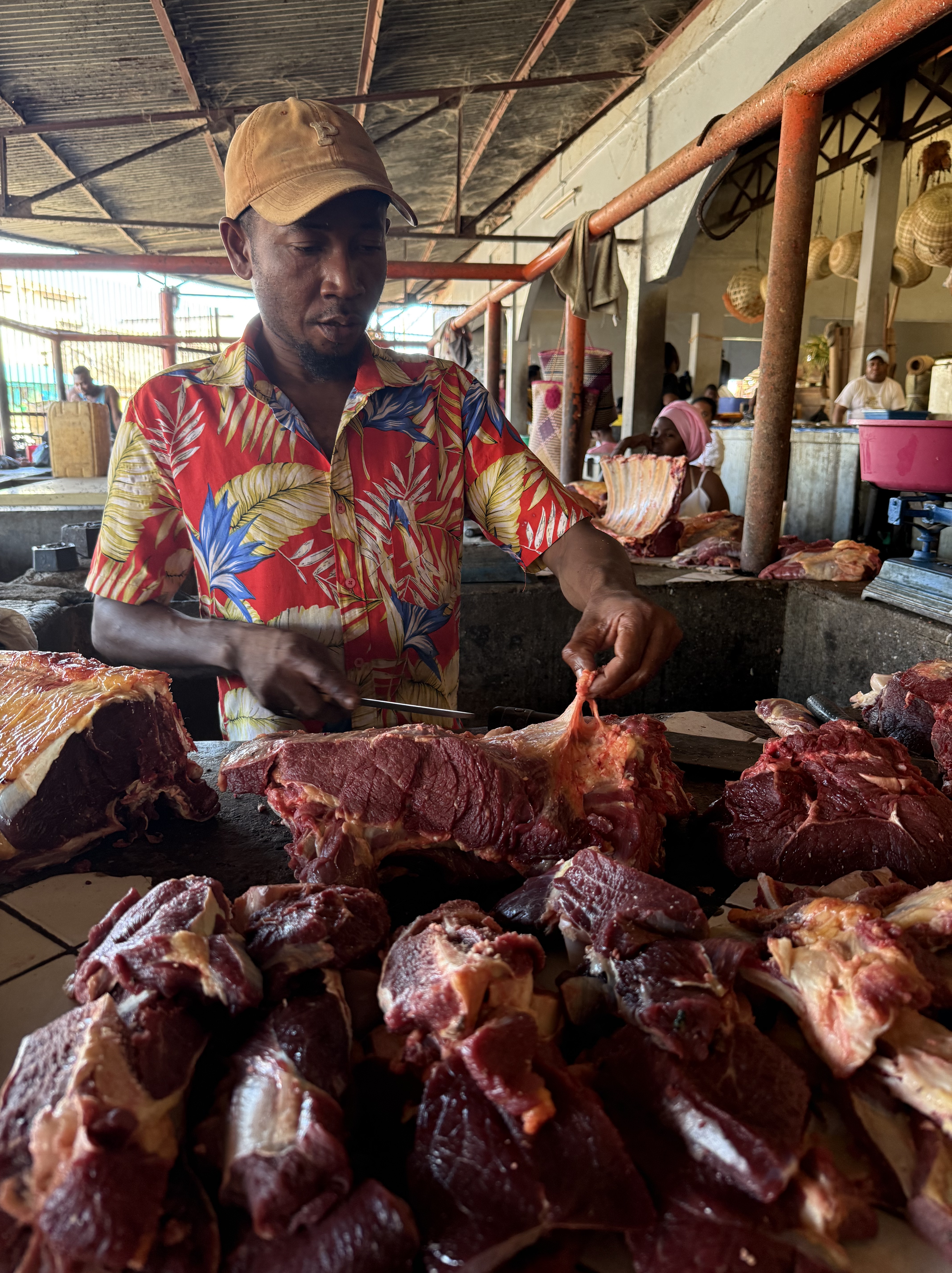
Zebu are to Madagascar what reindeer are to Norway. The island’s domestic cattle originally came from South Asia. They serve as a source of meat, as well as a beast of burden. The humped cattle are a symbol of wealth and status, and play an essential role in ceremonies and sacrificial rituals (see previous post, Madagascar’s Intriguing Ancestor Rituals) Popular souvenirs – jewelry, salad tongs, bowls, decorative objects – are made of zebu horns. The color and grain of the horns vary, so each piece has a distinct pattern.
I am not a hearty meat eater, but twice I savored zebu filet. Exquisite. Filet is not on the menu at market food stalls, but zebu stomach and feet are, both considered delicacies.
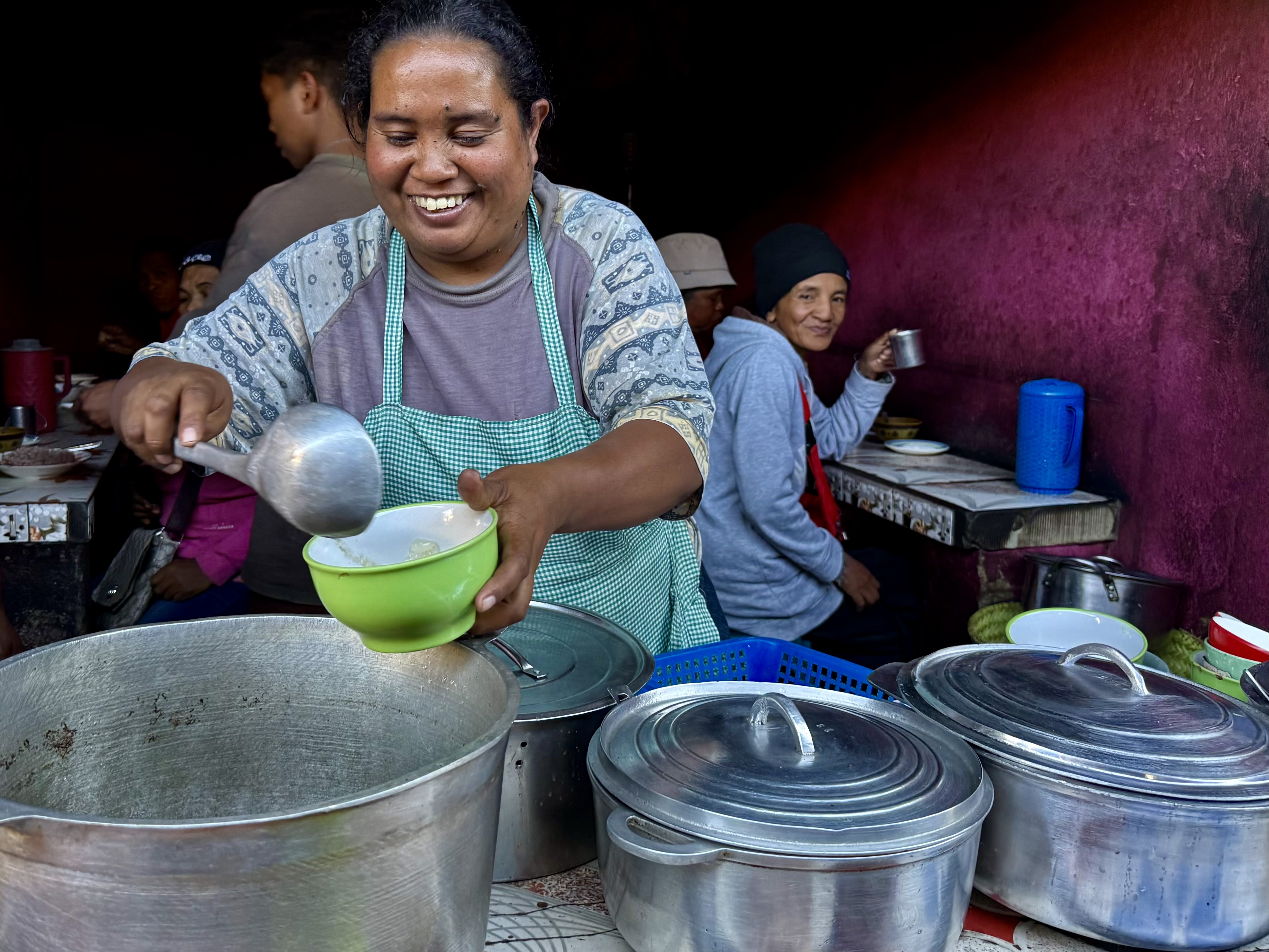
Many market stands are “fast food” depots, offering a variety of prepared dishes at reasonable prices. Shoppers stop for a meal at the markets. “We like to eat here. It’s easier than going home to cook,” I was told.
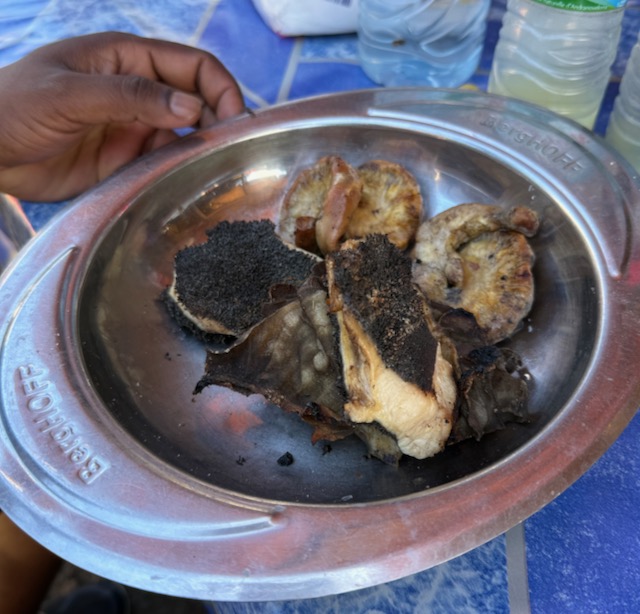
Zebu feet and stomachTempting melange
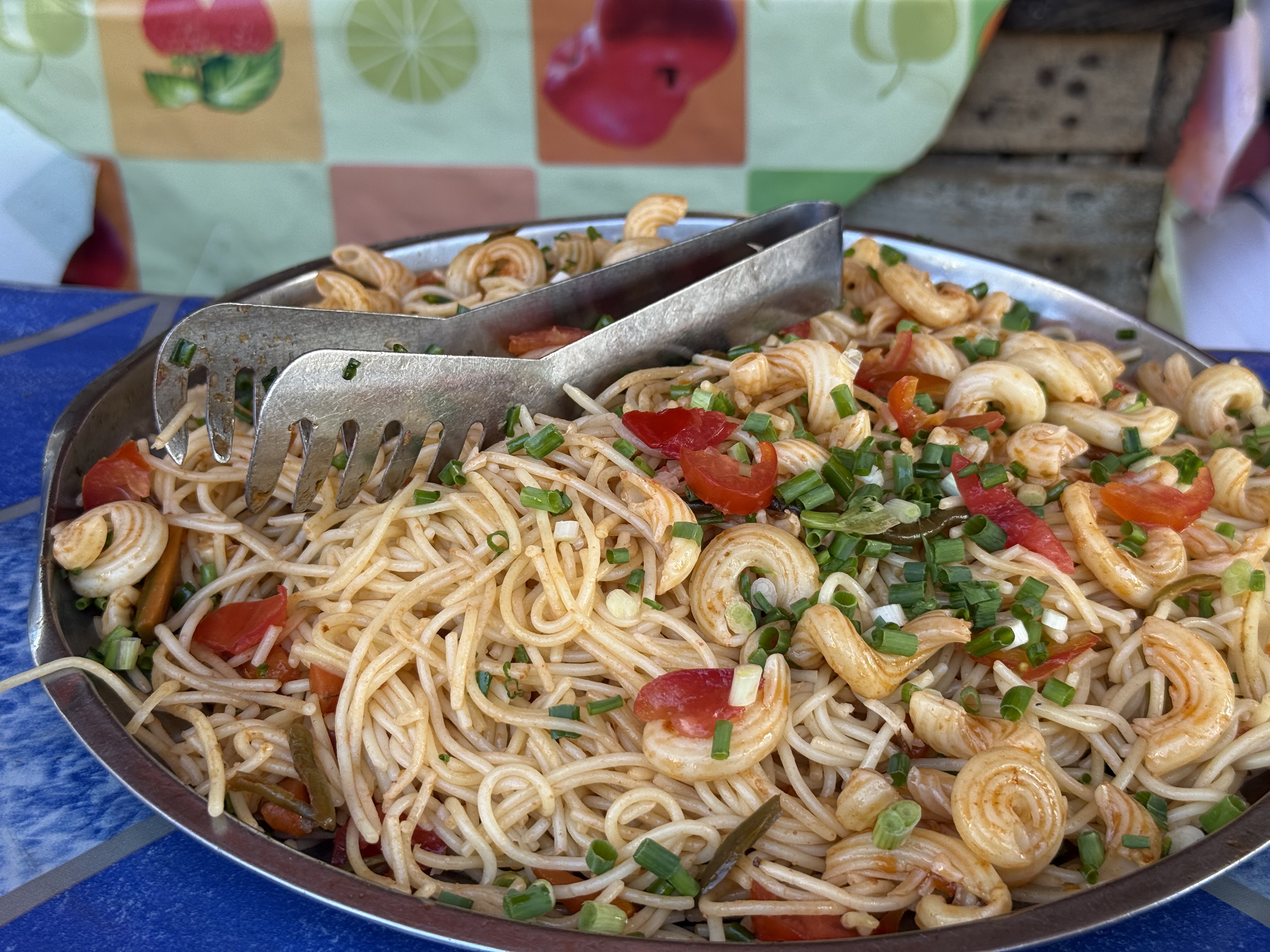
My guide went for the stomach and feet. I was tempted by a colorful concoction of pasta and veggies.
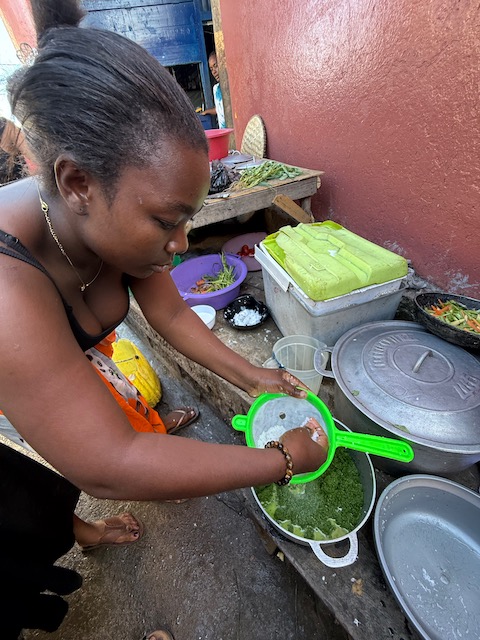
Cassava leaves are an essential ingredient in many Malagasy dishes, especially the national favorite, ravitoto. Leaves can be purchased pre ground at the market.
I watched as women mixed the leaves with coconut milk, grated coconut, water, and then squeezed it all dry, before mixing it with meat and vegetables for cooking. This was one of many ready-to-eat offerings at the market.
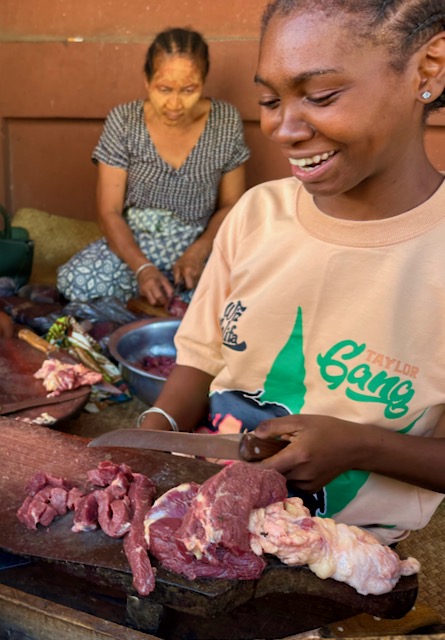
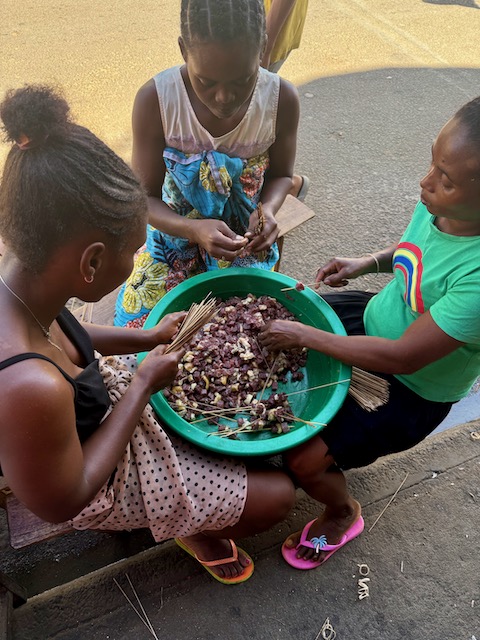
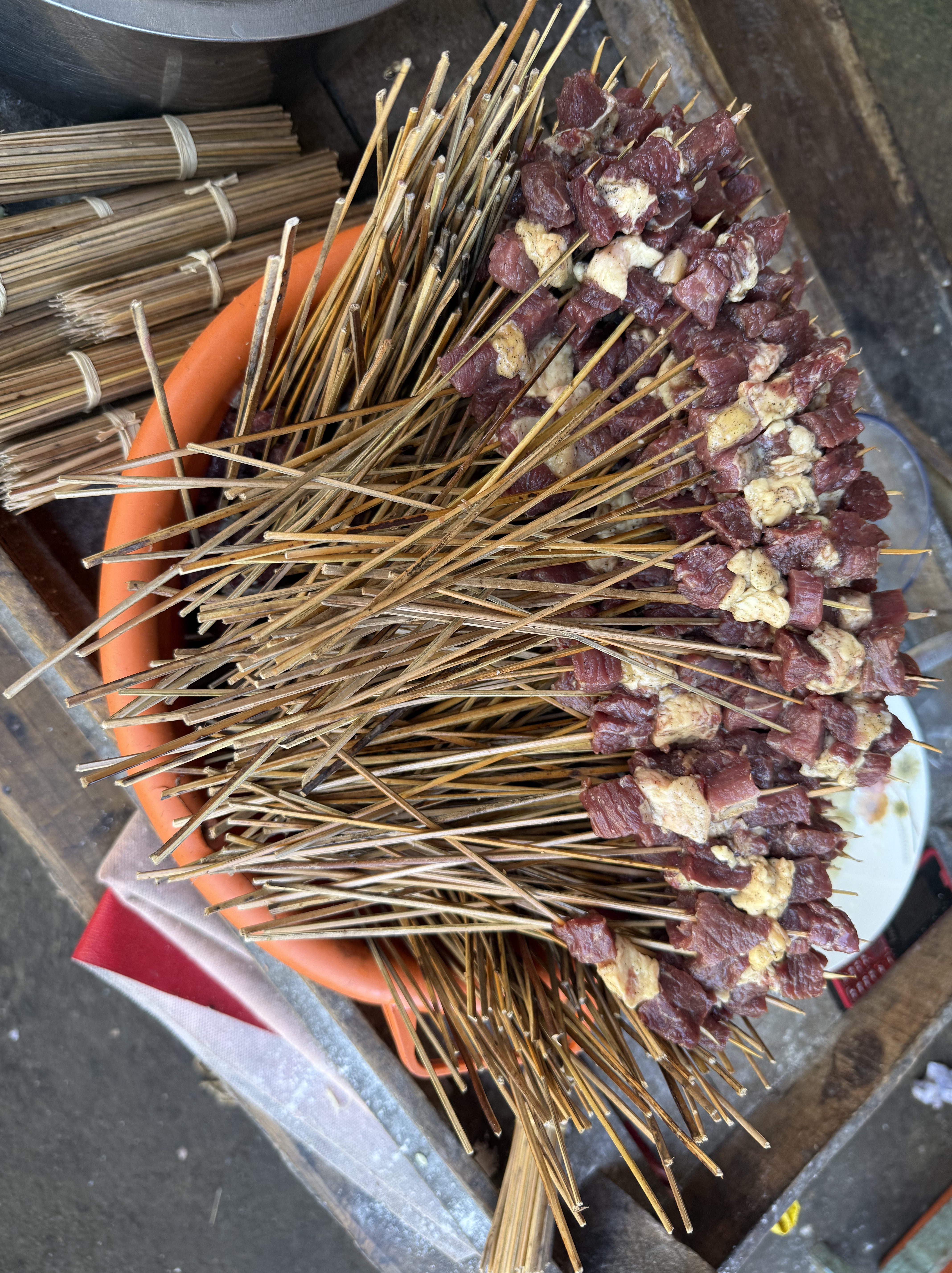
In Nosy Be, the Mada resort town where I spent several days, a brochette stand is a sensation. Customers line up in the evening for take-home brochettes, about 11 US cents each. The tiny stand was started by the mother of some of the workers years ago. It’s grown into a thriving family business, employing daughters, granddaughters and cousins, all at work cutting up 25 kilos of zebu every day, then assembling the brochettes with the meat, green papaya, and more.
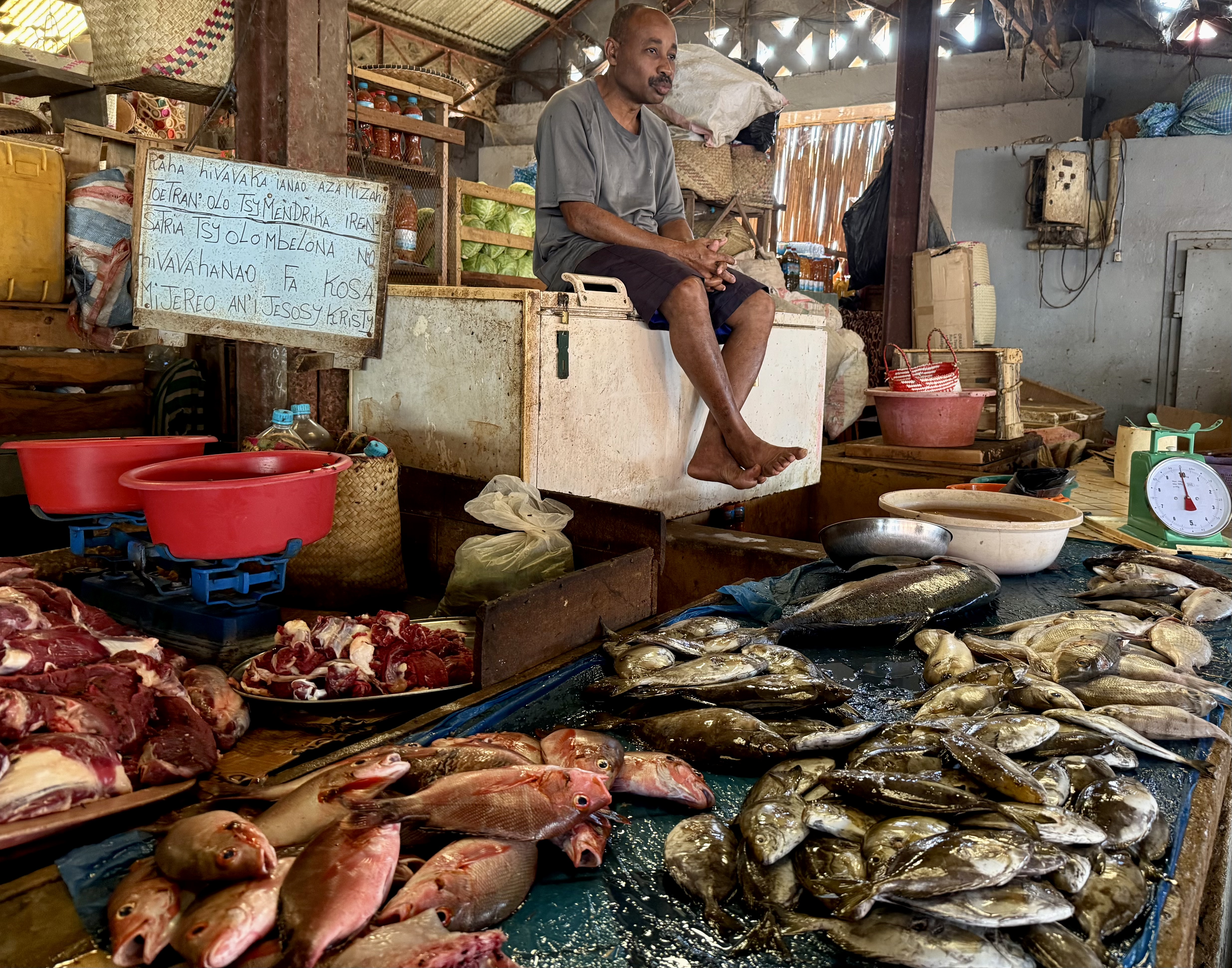
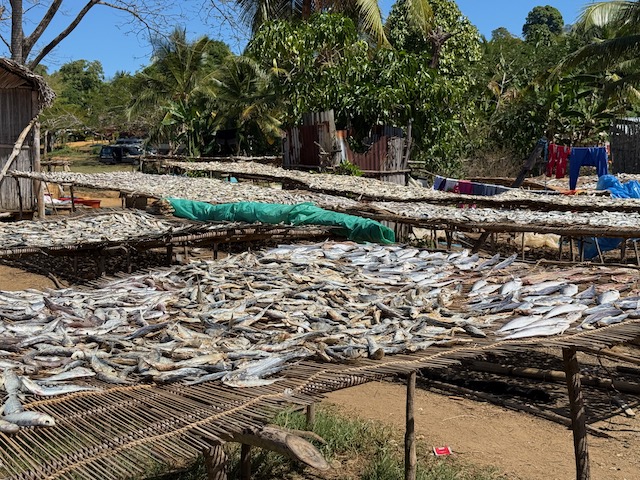
As an island nation, Madagascar offers a variety of fish and other sea creatures for the dinner plate. I visited a fishing village where thousands of sardines were drying in the sun.
Fish at the market
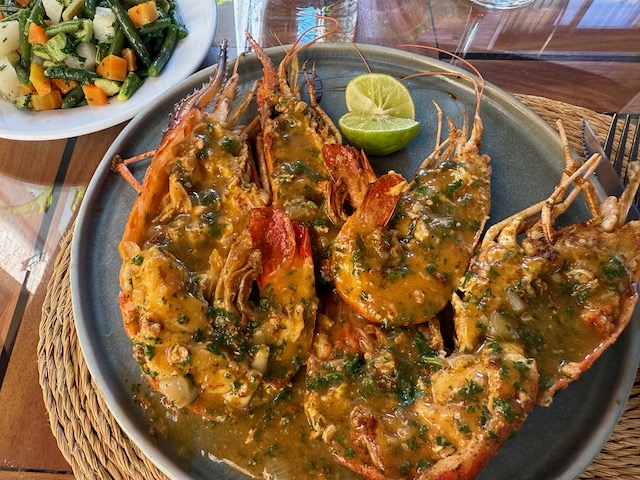
My all time favorite seafood in Mada: camarons, a type of large gamba from the waters of nearby Mozambique. To die for, along with zebu filet.
This was my last night treat at the Sakamanga (blue cat) hotel in Tana. The menu selections there were several notches up from restaurant food I had elsewhere. The restaurant was bustling. Reservations a must.
CamaronsZebu filet
The hotel itself could be a tourist attraction, its walls decorated with framed old newspaper front pages and photos, and hallways filled with ancient Malagasy treasures.
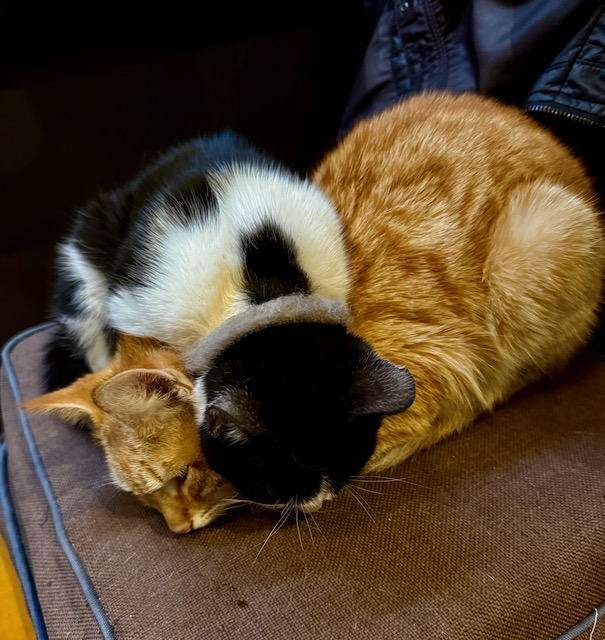
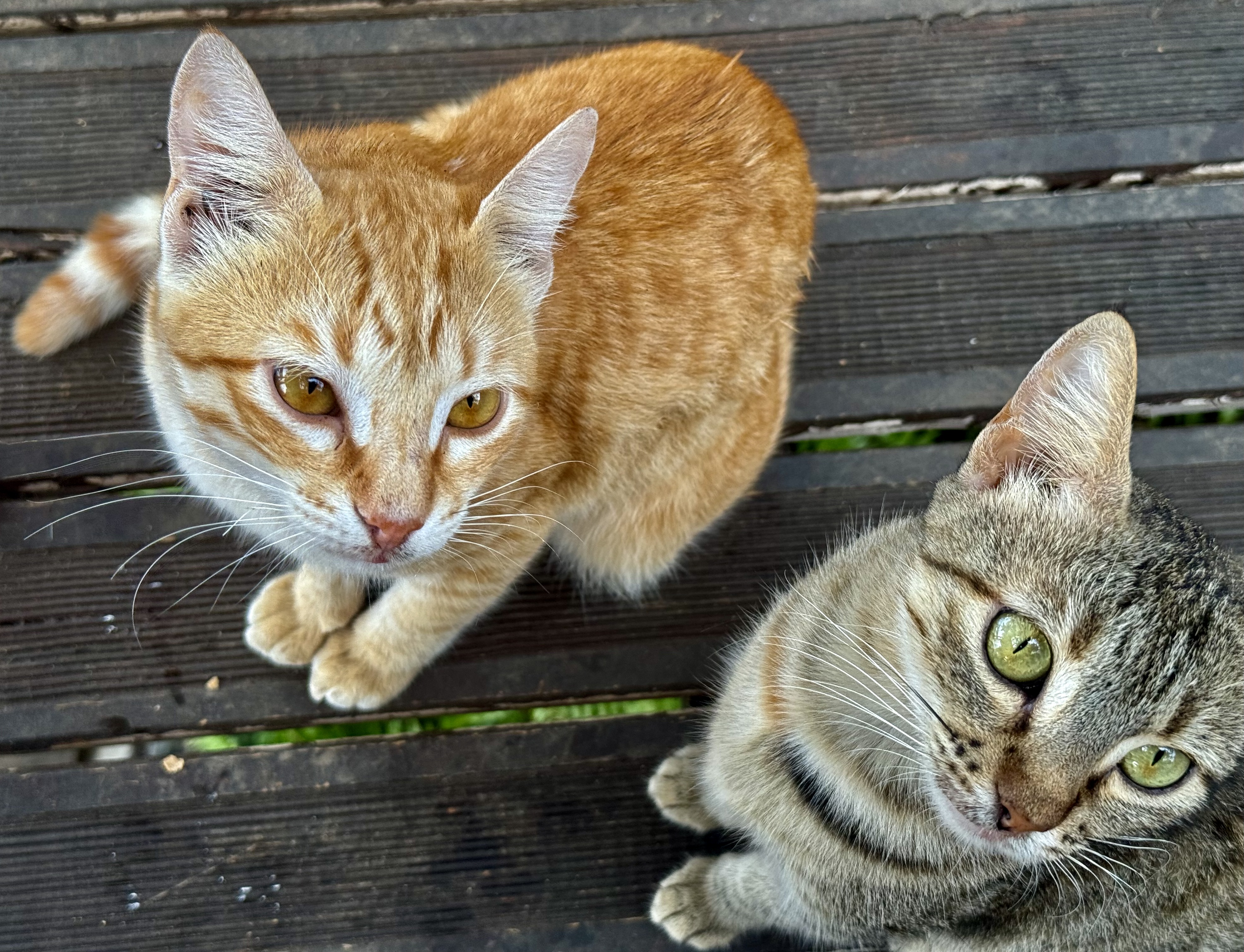
Why the hotel name meaning blue cat? No one could tell me. As a childless cat lady, I was delighted to spot two curled up kitties on an office chair, as well as other cats during my travels. Malagasy like felines, I learned.
If not a Tales and Travel follower, please sign up here. Trust me. It’s safe. Your address is not shared.
Malagasy John Delmas organizes and guides visits to Madgascar. John was my guide/driver for two days. He was super, taught me lots. Contact his company. https://www.mada-discovery-travels.com
I booked my African adventure, South Africa (Kruger) and Madagascar, with Worldwide Quest, http://www.worldwidequest.com
Today’s Taste. No new recipe, but one from the past, CHICKEN MAFE. It’s not a Malagasy recipe, but a West African speciality. I have made it several times for African dinner parties and it’s always a hit. Peanuts are the secret ingredient. For more tasty recipes, click here.
Scroll down for more Mada photos and for Comments. I’d love to know your thoughts.
Zebu is a market favorite.
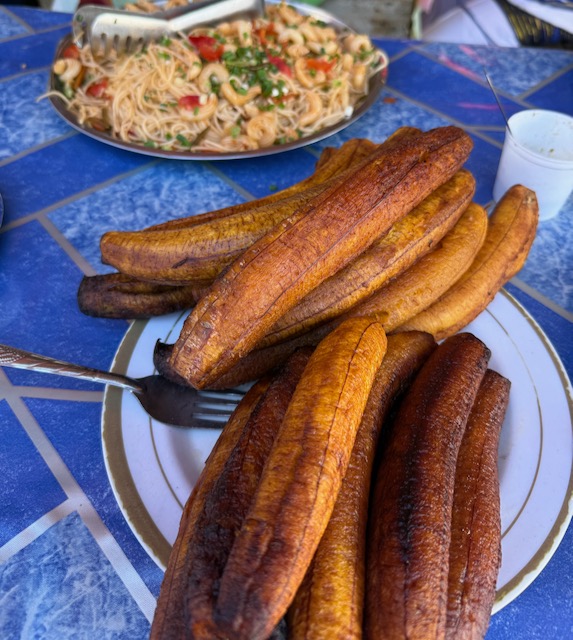
Mada produces several kinds of bananasSardines drying
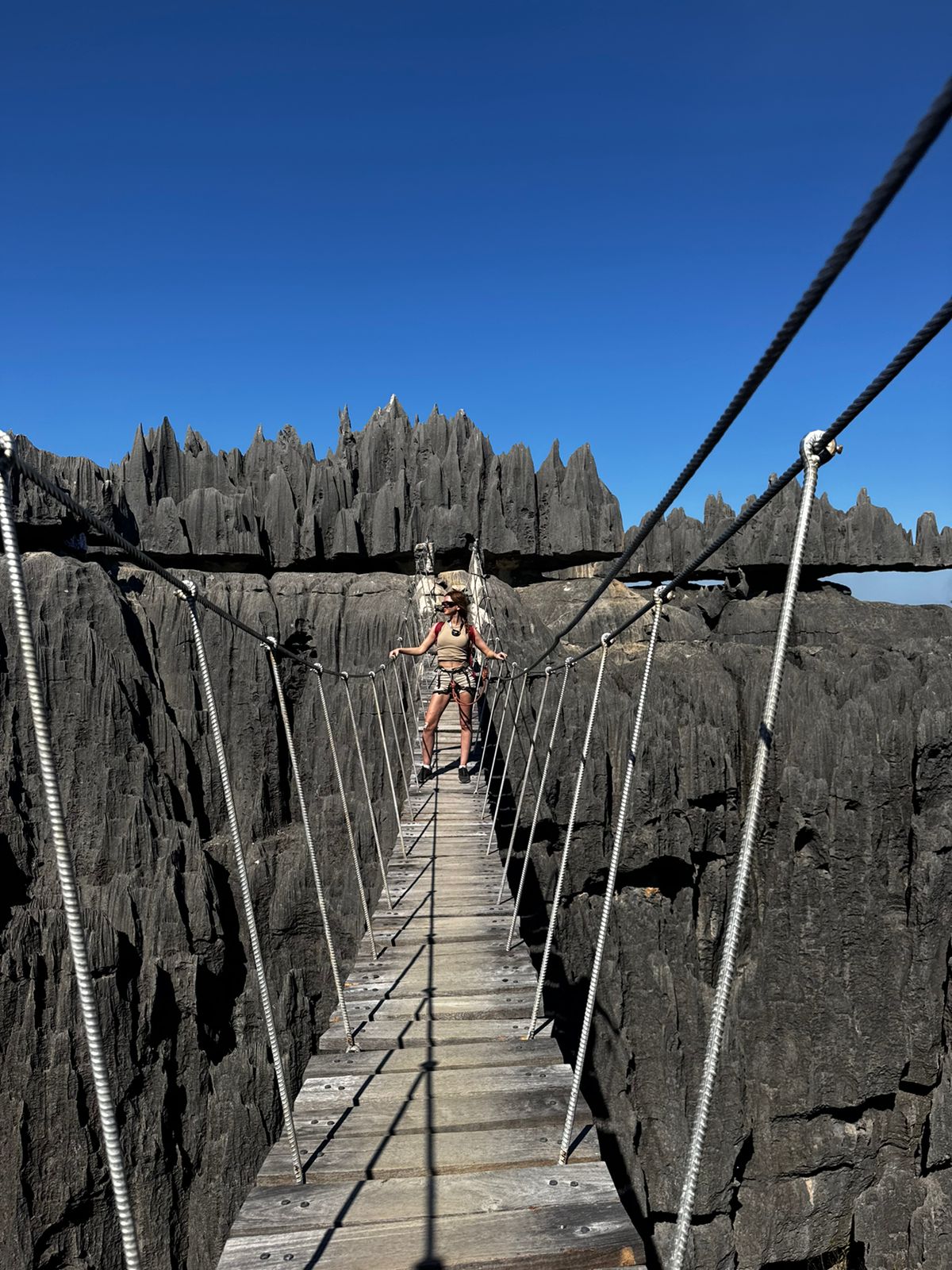
RedTsingy is one of the many wonders of Madagascar.
I was not the typical Madagascar tourist. Visitors come to this island nation to see its unique wildlife and admire dramatic landscapes: rainforests, deserts, canyons, lagoons, coral reefs. They come for adventure: rock climbing, kite surfing, scuba and snorkeling. They trek, backpack, camp. It can be rough and demanding. Distances are vast. Roads are poor. Lodges can be remote with few amenities.
Sadly these activités were beyond me.Photo on right by John Delmas.
I doubt Rick Steves has been to Madagascar. It’s probably not on many bucket lists. So why did I, an old, handicapped woman, come to Madagascar? Folks wondered, and gave me puzzling glances.
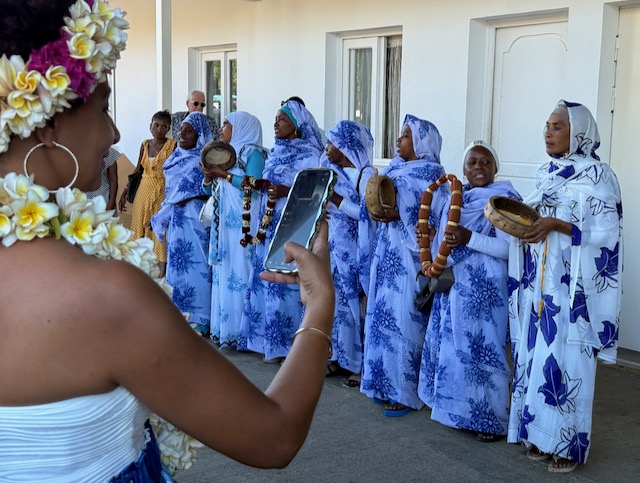
Welcoming committee at Nosy Be airport in Madagascar
I wanted to see the lemurs. I wanted to escape mass tourism. I wanted something different, off the beaten-track. Madagascar checked all the boxes.
Because of my age and limited mobility, I had a private chauffeur guide, many different ones, during my visit. I was based at a comfortable hotel just outside of Nosy Be, Madagascar’s (Mada’s) popular beach resort. But I did not come to lounge on the beach. Nor did I come to trek or indulge in rigorous activity — however I did scuba dive. You don’t need the fitness of a marathon runner to enjoy Mada.
Cottages and pool at Nosy Be hotel.
Every day during my 6-day stay, a different adventure awaited: a visit to a lemur park; snorkeling and swimming with huge turtles; visiting a fishing village, a sacred tree, markets, scuba. My driver guides were terrific. They taught me so much about this intriguing country
The island nation has a unique culture, a blend of Africa, Asia, (Indonesia) and the Middle East. Madagascar consists of 22 regions with 18 dialects of the Malagasy language, although people generally understand one another. French (Mada was a French colony until 1960) is spoken by many in the cities, as well as in government, business and education. English is not widely spoken, although it is common in tourist areas. Most of my guides spoke English, but some preferred to speak French, so we did.
More magnificent scenery. Photos by John Delmas
What makes Mada so unparalleled is isolation. It split from India 88 million years ago, and has been isolated ever since, “a living laboratory of evolution.” The island in the Indian Ocean is about 250 miles off Africa’s east coast. Land animals are locked in. Its ecosystem is distinct, with most of its wildlife endemic (found nowhere else).
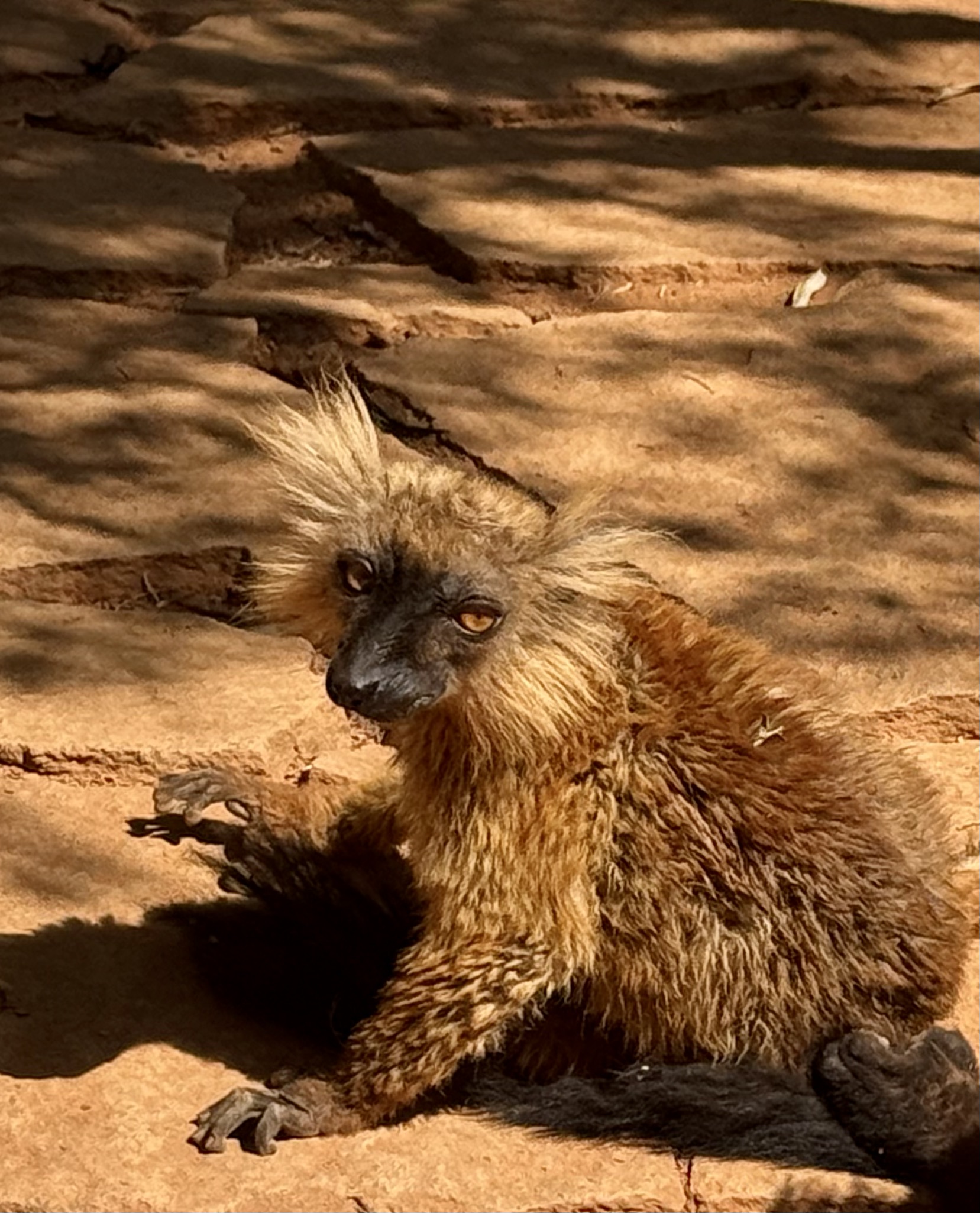
Including lemurs. The park I visited is a private conservation reserve, home to 61 lemurs representing seven species. Most have been rescued from various parts of the country.
Madagascar is home to 112 species of lemur, guide Femo told me. All are endangered. Their habitat is being destroyed by slash and burn agriculture, logging and mining. People capture them for pets. And, eat them — not just the poor who are hungry, but well-to-do city dwellers who find the meat tasty and good for health.
“It’s a matter of education,” Femo said. “People don’t realize the lemurs are a national treasure.”
Different species live in different parts of the huge country, and, rather than socialize with one another, they fight, Femo explained. In the park, each species hangs out in its own territory. “Lemurs are not as intelligent as monkeys. They don’t steal,” I learned.
I saw dancing lemurs (they side hop), bamboo lemurs, gray mouse lemurs… plus ring-tailed lemurs which are the most common. They have 14 white and 14 black rings on their tails. All are adorable and entertaining — jumping, swinging, dancing, hopping. . During our trek up and down the hills in the park and alongside the Katsaoka River, Femo pointed to a hill on the other side of the river. It’s the site of a royal burial grounds, a place where people come to worship their ancestors and ask favors, he told me.
Beyond the hill at right is a royal burial grounds, a popular place for worshipping the dead.
Mada is a land of spirits and taboos. For Femo, eating onions and pork is taboo. During the following days I learned much more about those spirits and taboos.
Madagascar’s baobab trees are among the most ancient on the planet, some thought to be more than 800 years old . Like much today, they are threatened by climate change and agriculture.Photo by John Delmas
AI labels Mada the “best bang-for-your-buck” destination. It offers “good value.” Another AI quote: “Madagascar isn’t just another destination. It’s one of the last places left where the world still feels bigger than us. Go before the rest of the world figures that out.”
I’m very happy I went to Madagascar. Please, don’t tell Rick Steves about this very special place.
Future posts will focus on Madagascar’s strange traditions and rituals, markets and food, and more. If not a Tales and Travel follower, please sign up here. Trust me. It’s safe. Your address is not shared.
Malagasy John Delmas, above, organizes and guides visits to Madgascar. John was my guide/driver for two days. He was super, taught me lots. Contact his company. https://www.mada-discovery-travels.com
OK, I want to go. The photos are great. It’s harder as you get older, but I’ve always found the best parts of traveling are the people you meet, the unexpected things that happen, and the challenges they present.
So many primate species endangered or on the brink of extinction.
You should go. You’d love Mada — and so would Tai. Most of the photos are by my fabulous guide John. I had fun times with guides, all so knowledgeable, understanding and patient.
I don’t think you will ever stop traveling to exotic adventure destinations, Leah. This one was a “must do” and it turned out to be the fascinating adventure you had hoped for. And, you got to see those adorable lemurs and so much more in Madagascar.
Kudos to you!
Karen
Childless cat lady – that’s me. I have been passionate about felines all my life, and have always had a cat, or several cats, in my life.
My safari to South Africa last summer gave me the opportunity to observe big cats in the wild. It was thrilling, and fascinating to learn more about these majestic creatures from the guides and trackers. In many cases, they know the animals, and their backstories, well.
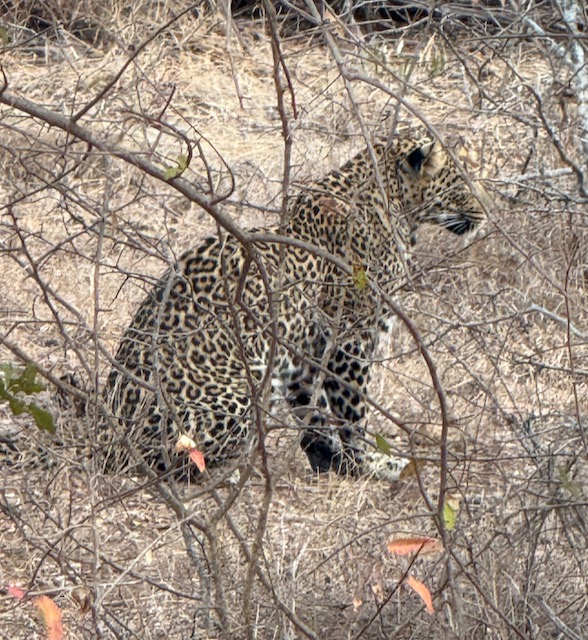
On the drive from the airport to my first safari lodge: a leopard sighting. Driver Cheryl pointed out that the spotted feline was stalking a kudo, well camouflaged in the bush. Numerous cars had pulled over to observe. Alas, we had to move on. Did the leopard succeed? Or, did the kudo live another day?
Eyes focused on a nearbykudo with hopes for a tasty lunch.
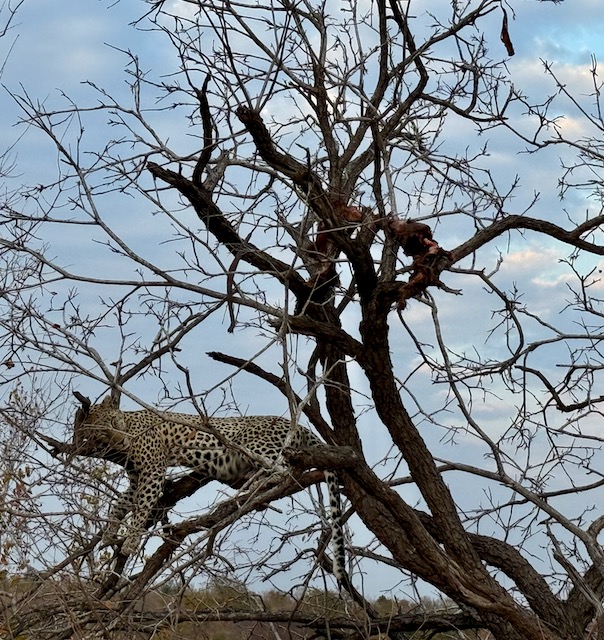
The next day on a safari trek, another leopard. This one was lounging near a tree with a hyena and a wildebeest not far off. The partially-eaten carcass of an impala was lodged high up in the tree branches. We learned that leopards, excellent climbers, often drag their kill up trees to protect it from hungry predators.
.
Hyena in the background in photo on the left.
Hyenas are scavengers– and ferocious. We were told they charge any animal, except a male lion. A leopard would not likely charge a hyena – too risky, according to the guide. In this instance, the hyena and wildebeest were waiting for the cat to return to the tree and have another go at the carcass, hoping some tasty morsels would fall to the ground.
The leopard, named Raven Scott, was well known to our crew. He, and other wildlife in this park, are regularly monitored and studied.
Raven Scott enjoys a siesta knowing his bounty, leftovers from lunch, is safe in the branches above.
Later our tracker zeroed in on lion tracks, but no lion to be found. He did smell the pee of a leopard. “It smells like popcorn,” he said. The potent urine smell is used to signal reproductive status, mark territory, and communicate with other leopards.
During excursions from my next safari lodge in another part of Greater Kruger, lions stole the show.
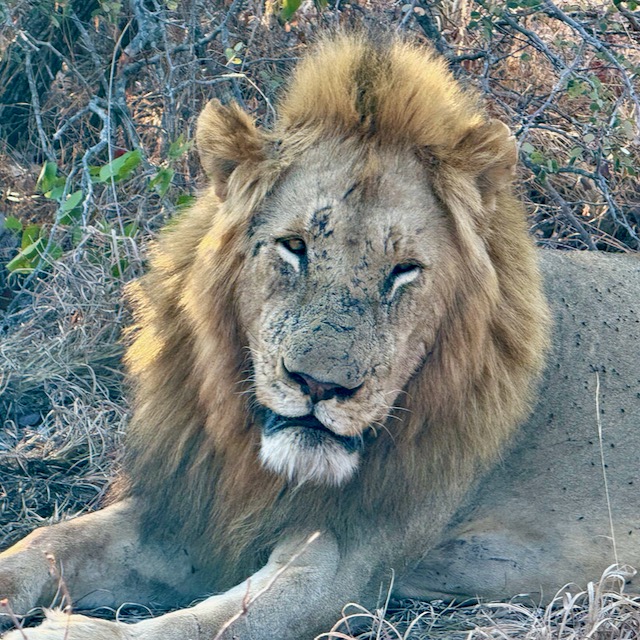
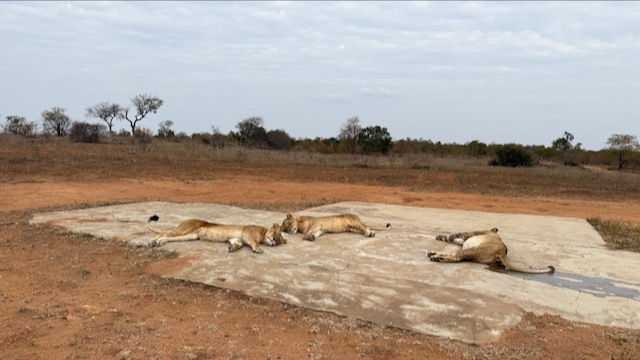
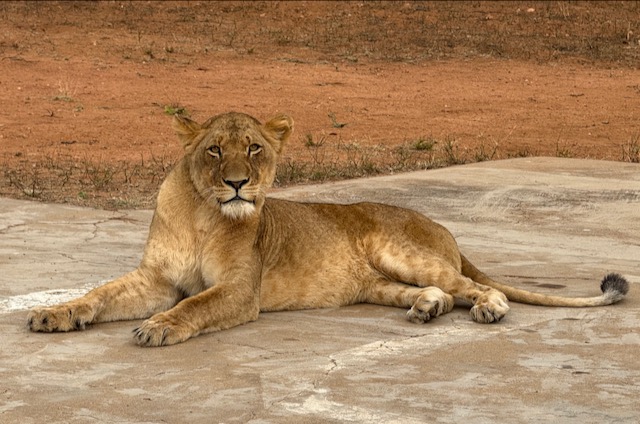
A family group lounging in the sun on an abandoned airport runway intrigued us. The guide said the male had made a recent kill of a buffalo. He and two lionesses were knocked out, digesting their feast. We could see the lion’s bloated stomach. He obviously savored “a lion’s share” of that buffalo.
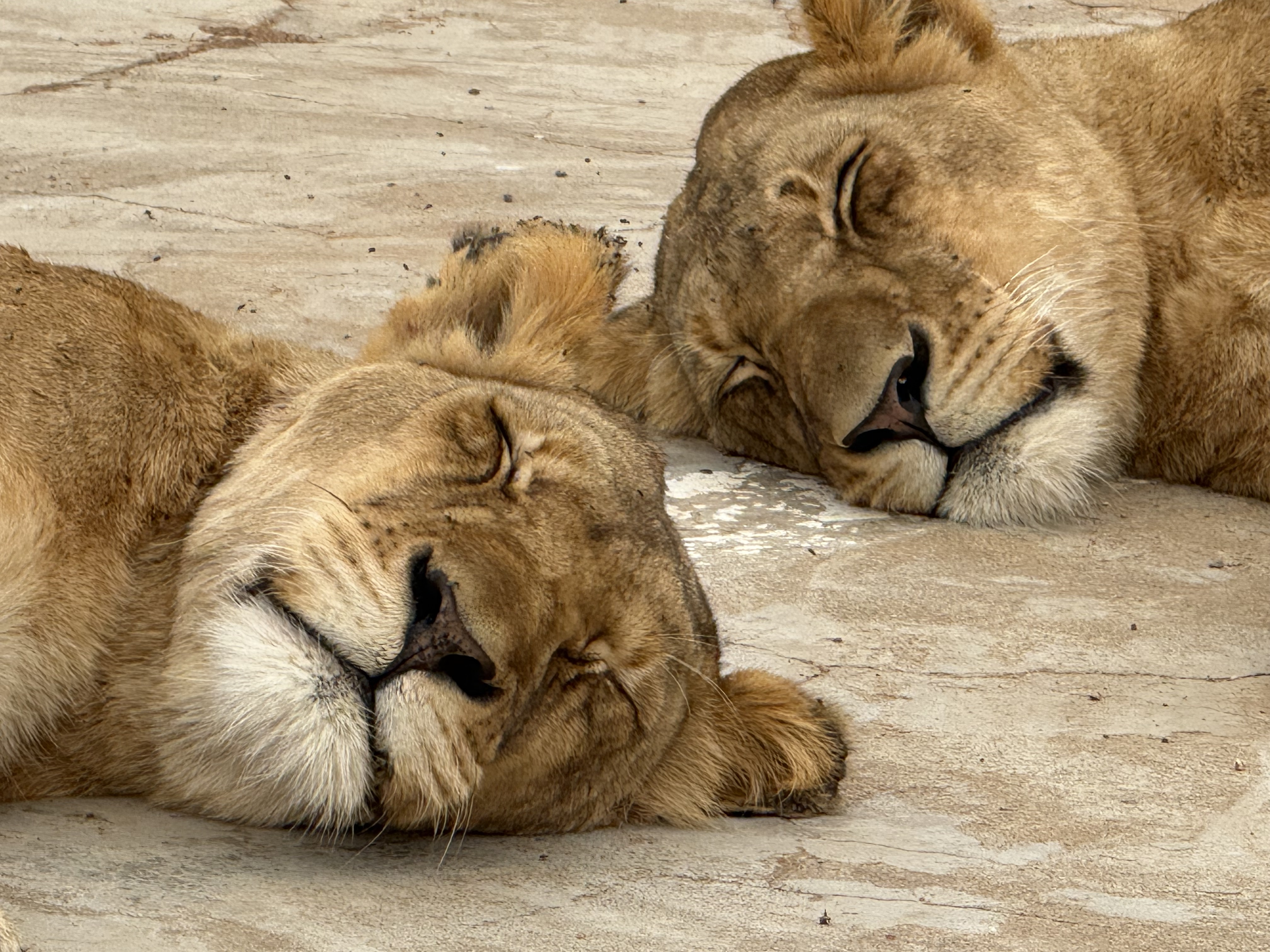
We later returned to the site. The lion had departed, but the “girls” were still enjoying R & R.
Lions are the only social cat, we learned. Family groups stay together. Not so with the leopard and other cats who are solitary souls, only getting together to mate or raise cubs.
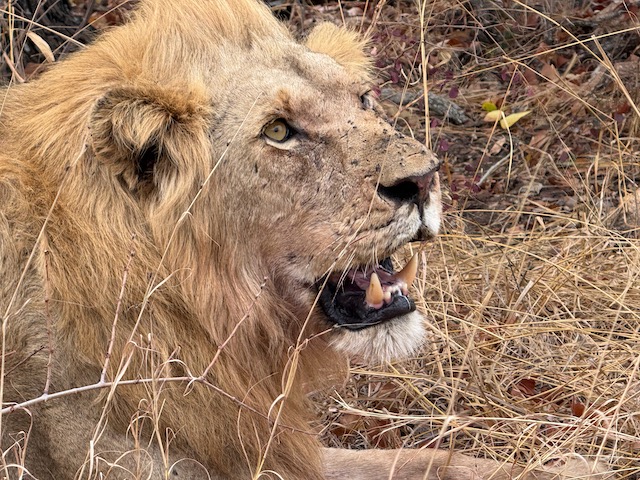
The following day our eagle-eye guide found the lion with his leftover kill. Vultures hovering above and a strong putrid stench led us to him. He was sacked out, a pause after yet another feast. Again, we could see his enlarged stomach. The rotting carcass and zillions of flies were nearby.
Note remains of buffalo, at left behind sleeping lion.
We returned later. He was awake and joined by his brother. They shared the carcass until one got fed up and growled. The other took no chances. He seized a hunk and moved away.
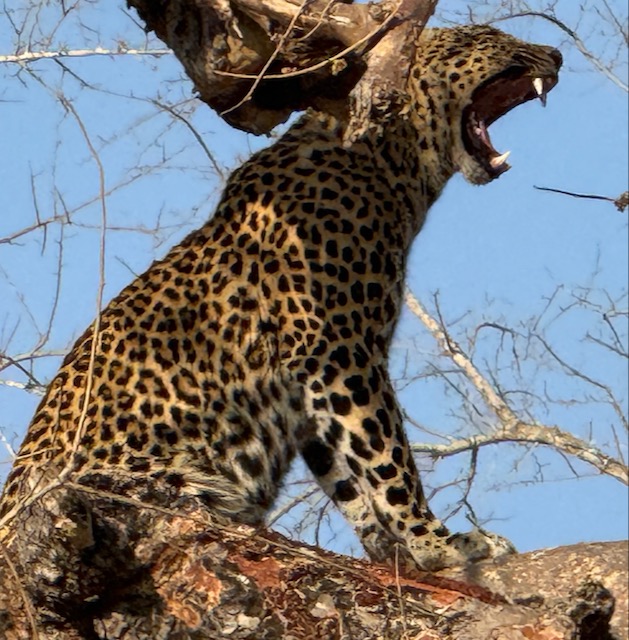
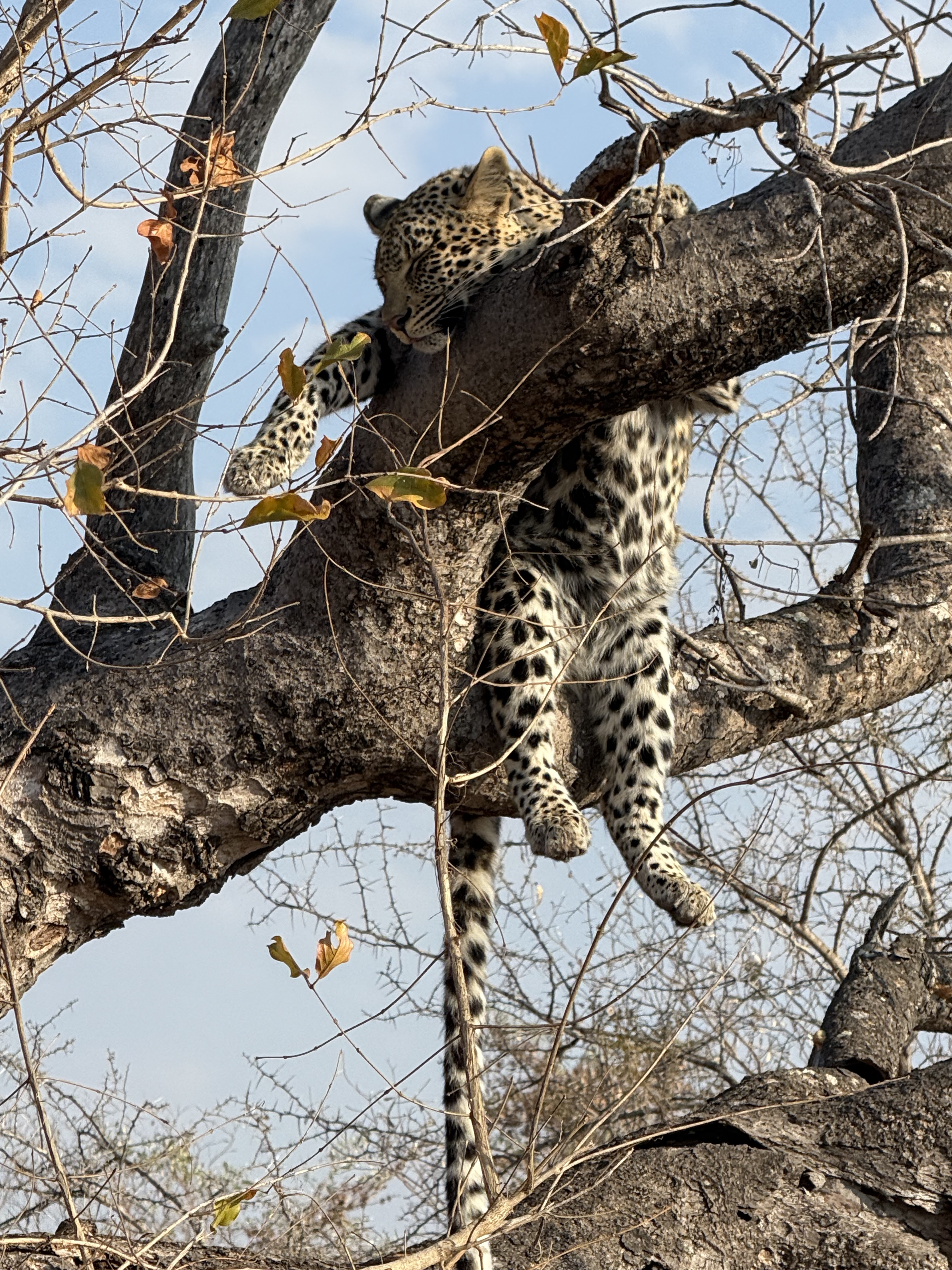
There was also a leopard sighting later that day– another beauty, this one snoozing in a tree in what seemed a most uncomfortable position. That fabulous signature tail dangled from the branches. Leopard tails, which are almost as long as the animal’s body, are used for balance while climbing.
I was elated with all the cat sightings. For a cat lady, it was awesome. But, also good to come home to my Simba.
I booked my African adventure, South Africa (Kruger) and Madagascar, with Worldwide Quest, http://www.worldwidequest.com
If not a Tales and Travel follower, please sign up here. Trust me. It’s safe. Your address is not shared. Don’t miss out. Madagascar: mysteries and marvels, coming next.
Wow you really got to see a lot of the leopards….and you took beautiful photos! I’ve always been told leopards (in Africa) are pretty shy so I’ve only ever had brief glimpses. Your photos are a treat. You should come to India to see tigers since you’re so fond of cats (though maybe you’ve already done that…I know you’ve been to India). Where to next?
Yes, those leopards were a sensation. Husband Bob and I did see tigers in Rajasthan, and one leopard there after a harrowing drive, but he was far, far away — up on a rocky mt side.
Ethiopia and Brazil (was in the Peace Corps there eons ago) are on my bucket list. I can hope.
Bravo, Leah! The photos are simply fab! Did you lug an entire line of camera equipment or ??? Thank you so much for documenting your intrepid travels to regions we may never see in person–Gayle
Those days of tons of camera equipment are long gone. My camera is my iPhone 6 pro. Love it.
I hope my days of intrepid travel are not over. My bucket list is long, too long, but must keep working on it.
Awesome photos!- as a fellow cat lover-you surely saw some wonderful cats – in their natural habitat- relaxed and well nourished! – and that leopard had obviously learnt Yoga? -how uncomfortable!! Your photos and tales are so interesting so k- Whats Next?! x
Grazie mille. We love those cats. I was mesmerized and could have observed them for hours. Yes, that leopard conquered advanced Yoga. There will be more adventure. It keeps me alive. Stay tuned.
Off to the big cities in northern Italy by car, my fire engine red Suzuki Swift. Brother Steve and sister-in-law Yoshie from Boulder came to visit me on the Mediteranean coast in France. We wanted to explore some new turf: Turin, Lake Como and Milan. . Steve was supposed to share the driving, but, before arriving in France, he was pickpocketed in Florence. Driver’s license gone, as well as credit cards and cash. You can’t be too careful in Italy.
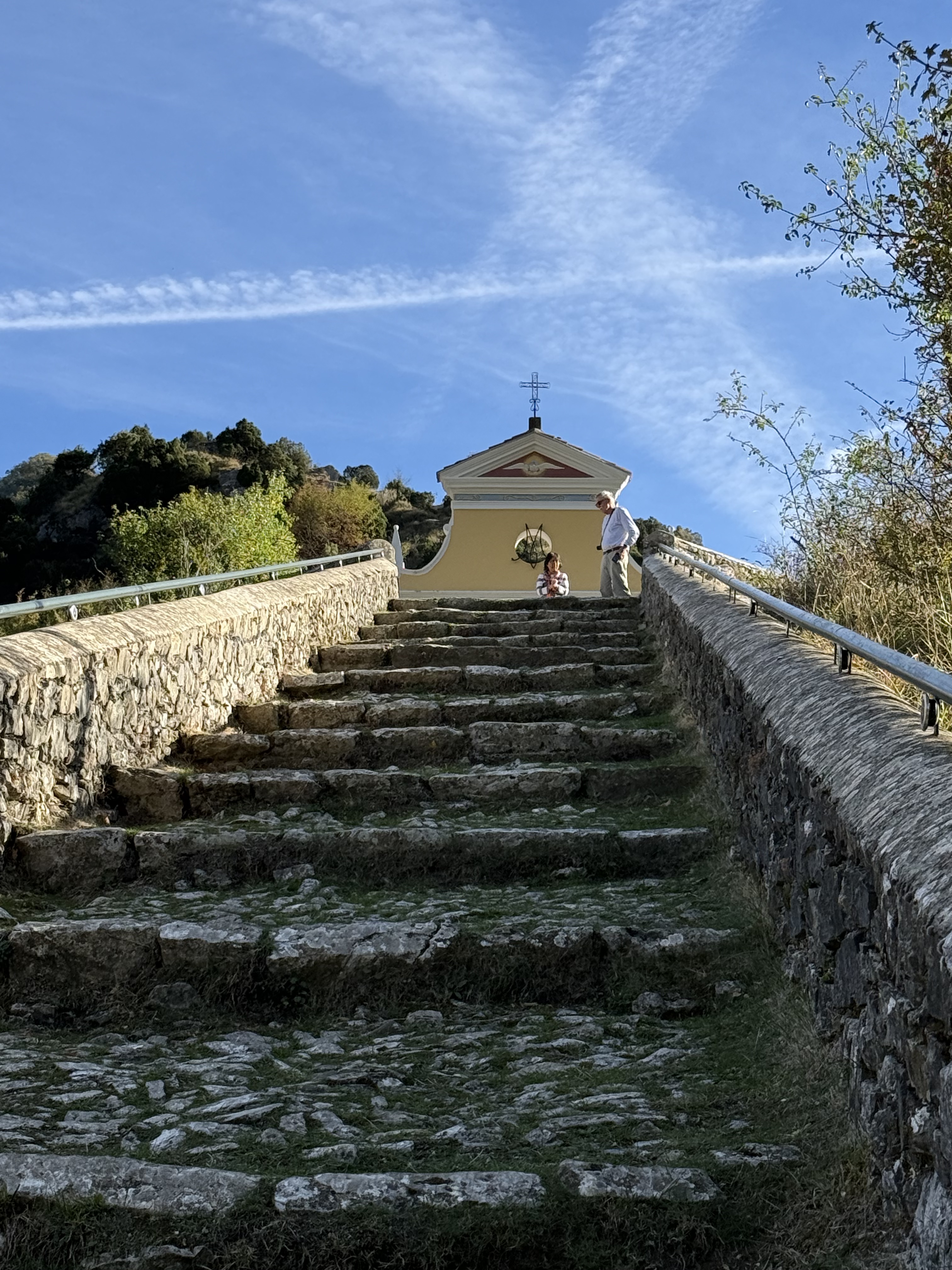
So, it was me behind the wheel. The driving was challenging. Before the Italian adventure we set off on the mountain road (too many hairpin turns) to the spectacular site where husband Bob’s ashes are dispersed around a pilgrimage chapel. Then, the dreaded Italian autoroute stretch from the French-Italian border, first towards Genoa: 114 tunnels and hundreds of monstrous trucks . It would be a nail biter if you didn’t need both hands on the steering wheel.
Pilgrimage chapel, Moulinet, Alpes Maritimes, France.
Finding our hotels in central Turin and Milan was borderline nightmare. These are big cities with lots of traffic and chaotic intersections – at times even too much for GPS. I screwed up more than once. Stress! And, our sorry adventure to Lake Como. We did see water, but the surrounding spectacular mountains were hidden in clouds. The road to our lakeside hotel was narrow and curvy – and treacherous when we had to depart in a downpour, driving through many ponds on the flooded road.
That would be more than enough. But the challenges were not over yet. Steve and Yoshie returned to Boulder by plane. I set out on the trek home in the Suzuki. After 45 minutes of nerve-wracking driving, I made it out of Milan to the autoroute. Not long thereafter, the clutch died. My guardian angel was with me. I got the car off to the side of the autoroute without being crushed by speeding cars and giant trucks. The car was towed to a garage (where it still is). I came home by train.
Driving aside, Turin and Milan are worth a visit.
Following are photo highlights or our journey
A major attraction in Turin is the Mole Antonelliana (left) and the National Cinema Museum which it houses (right).
My favorite, however, is the Egyptian Museum. It’s not Cairo, nonetheless fabulous.
Turin’s Mercato di Porta Palazzo is Europe’s largest open-air food market.
The decadent Bicerin: espresso, hot chocolate and whipped cream, is a Turin tradition. Aperol Spritz: the drink of choice these days, is everywhere.
Milan’s Duomo (cathedral) is dazzling. You can take an elevator to tour the roof, but only half way. Then steps, too many and yet another challenge for a handicapped old lady. But, she did it. Roof photo, right, by Stephen K.
Milan’s Galleria is also dazzling.
It’s not just Venice that has canals. Milan’s Navigli district with two canals is a hub of artisan shops, restaurants and bars.
We enjoyed this overwhelming collection of historic photos at a shop in Navigli. Steve bought copies of several.
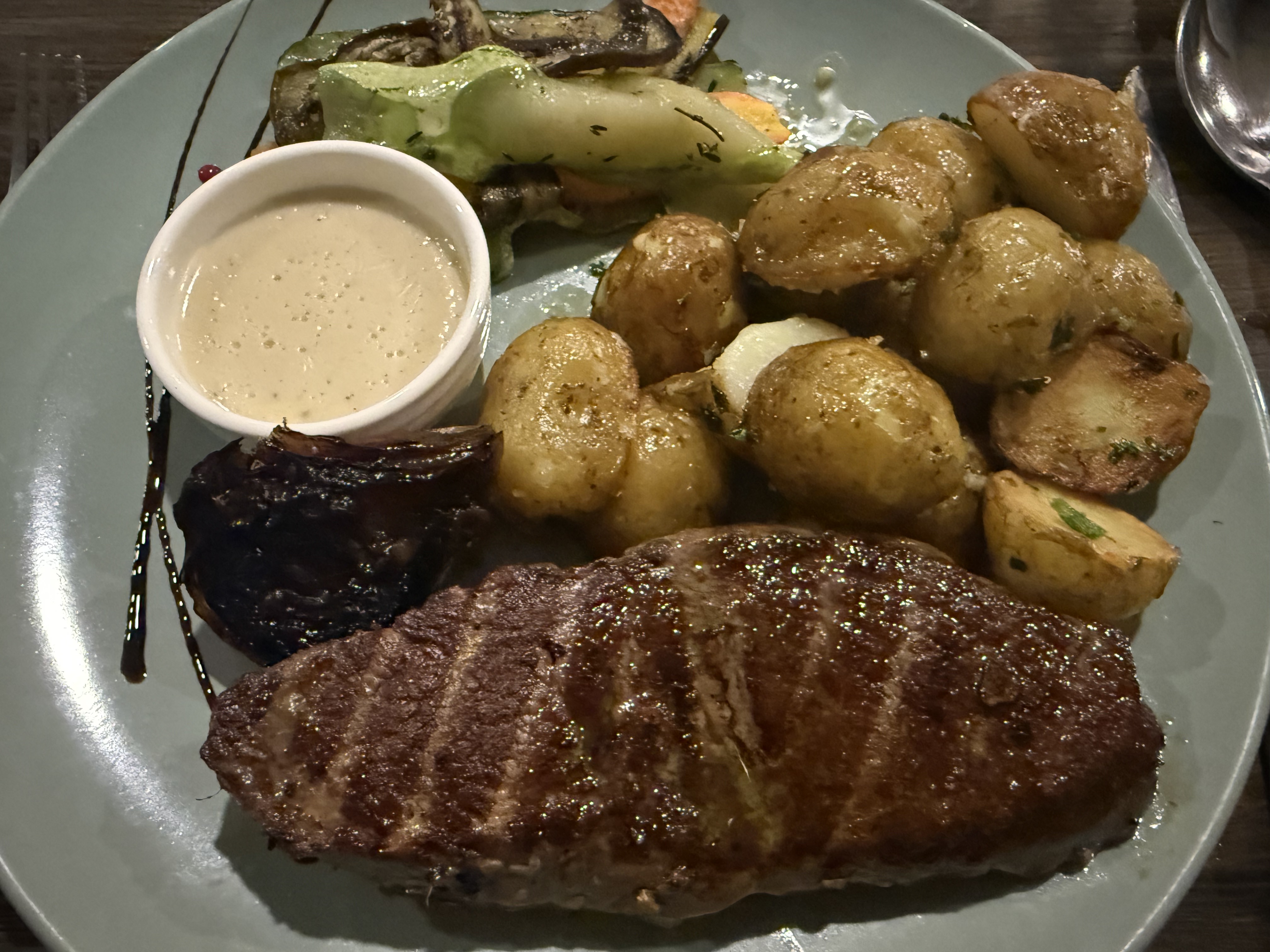
Best meals of the trip: Florentine steak in the Quadrilatero area (lots of restos and bars) in Turin, and osso bucco with risotto Milanese in Milan. We also feasted on delectable pizza and pastathroughout our Italian journey.
Entrance courtyard of the University of Arts in Brera, an area of Milan where we came across an outdoor vintage clothing market: Gucci, Armani, Dior and more.Fun, but we resisted purchases.
Yoshie and I attended a concert in Milan’s renowned La Scala. A poser in the Galleria.
We met my friends from Germany, Ian and Trina, who generously treated us to lunch at a charming agriturismo. Danke. Grazie! They now live in Varese, a stop on our way to Lake Como.
No spectacular views from our hotel on the shores of Lake Como. The night before the clouds and fog rolled in, the moon and lights from passenger ships made for a pretty picture.
If not a Tales and Travel follower, please sign up here. Trust me. It’s safe. Your address is not shared. Don’t miss out. Big cats of South Africa coming soon, plus more on Madagascar: mysteries and marvels .
No new recipe today, but for lots of tried and true and delicious recipes, click here.
Comments welcome. Please send your thoughts.
11 responses to “ Road trip to Turin and Milan”
Morray
What a trip — the clutch dying on the autoroute is the kind of thing that sounds funny only in hindsight! The Porta Palazzo market in Turin is something else, one of those places where you just wander for hours. The risotto Milanese you mentioned is one of those dishes that photographs beautifully too — that deep saffron colour. There are some really good shots of it at https://www.dreamstime.com/photos-images/risotto-milanese.html if you ever need images for the blog, the close-up ones really capture that creamy texture. Anyway, great read, Italy always delivers even when everything goes sideways.
The clutch episode was definitely not funny, but frightening. I survived, and I am glad all went well in Turin and Milan. Thank you for the photo link. I agree. Italy never disappoints.
But, all turned out well. Yes, the car is safely back in my garage. However, in the future, if I decide to go to Turin or Milan, I will take the train. Both do merit a return.
I’ve been debating what to do with the rest of my life, but thanks to Tobi and Erika’s comments I’ve decided to become a social influencer.
My favorite part of the trip with Leah was Torino, a city that feels somehow organic (I can’t think of another word), It’s scale is for people, it’s walkable, it has street cars, it has multiple open spaces, and in the inner part of the city it doesn’t seem to have any buildings higher than maybe six stories except for Mole Antonelliana, and one completely out of place condominium or apartment building. We had a surprisingly good dinner the first night at a little hole in the wall Peruvian restaurant and an absolutely horrible dinner at a “Japanese” restaurant run by a family from Mongolia. I thought my sister was going to die after eating the wasabi but she enjoyed the mochi ice cream.
Great photos, videos and stories. I also share the pain of driving in Italy. I think the Italian police are still after me! “Forgive me office…I donna speaka Italiano!”
Hi Leah What a wonderful and horrible story. So glad Yoshie and Steve visited you (it was a pleasure to met them in Boulder) Thanks for sharing the story, wonderful pictures and the lovely video from Steve. Hope you are fine after all this stress situations 🫣 you’re so adventurous. Take care, big hugs for you and Simba
********************************* Erika Niederer mit homesitting um die Welt
Leah, what an adventure! I’m so sorry Steve lost his wallet, credit cards and driver’s license, leaving you with all the driving. I have driven the roads in that part of Italy, so I feel your pain! What a trooper you are! And good for you making it to the roof of Il Duomo! Again, no easy feat! xo


















 Tales and Travel

Comments, please!