Discovering the Unique Wonders of Madagascar

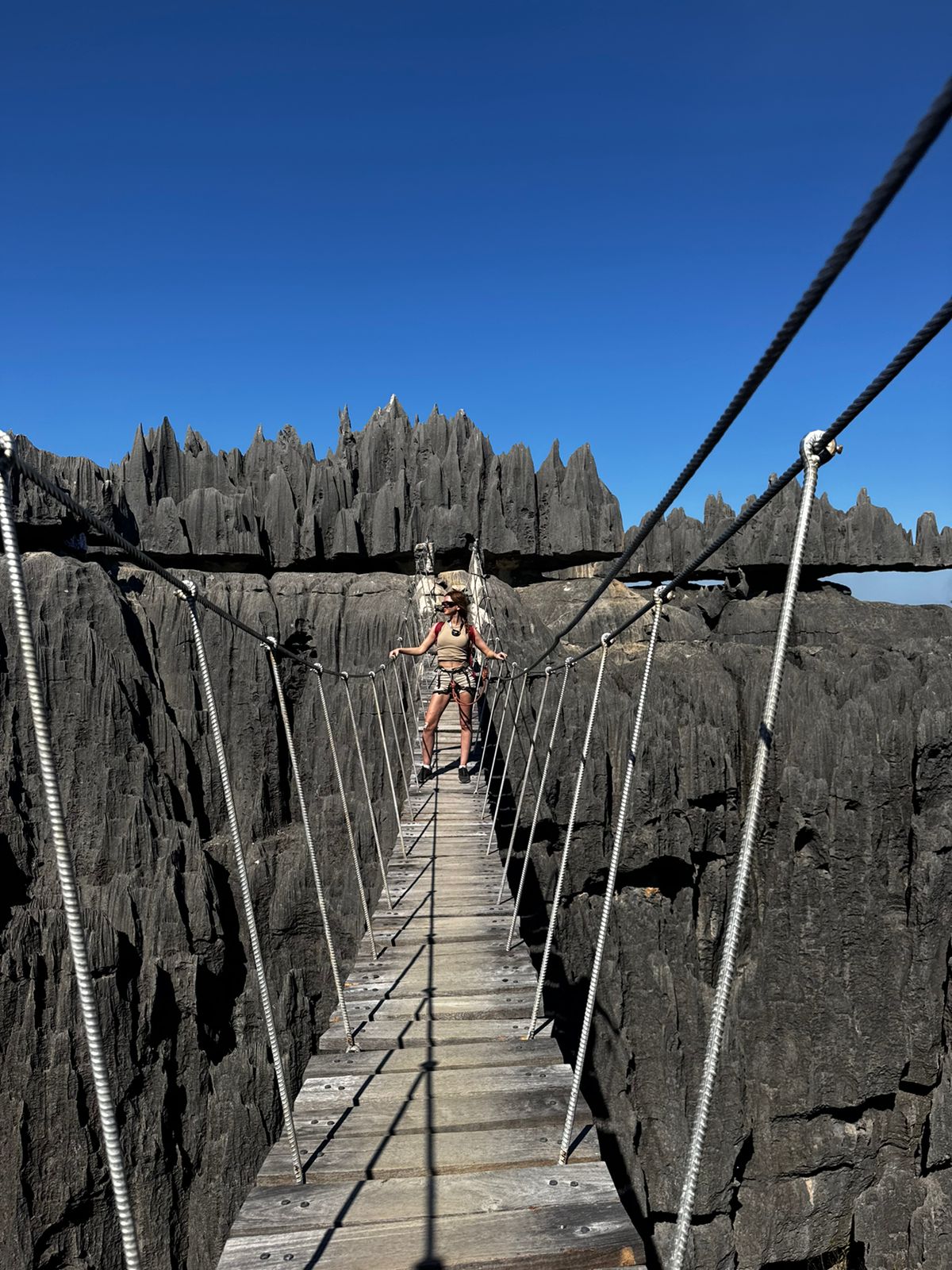
Red Tsingy is one of the many wonders of Madagascar.

I was not the typical Madagascar tourist.  Visitors come to this island nation to see its unique wildlife and admire dramatic landscapes: rainforests, deserts, canyons, lagoons, coral reefs. They come for adventure: rock climbing, kite surfing, scuba and snorkeling. They trek, backpack, camp.   It can be rough and demanding. Distances are vast.  Roads are poor.   Lodges can be remote with few amenities.

I doubt Rick Steves has been to Madagascar.  It’s probably not on many bucket lists. So why did I, an old, handicapped woman, come to Madagascar?  Folks wondered, and gave me puzzling glances.   
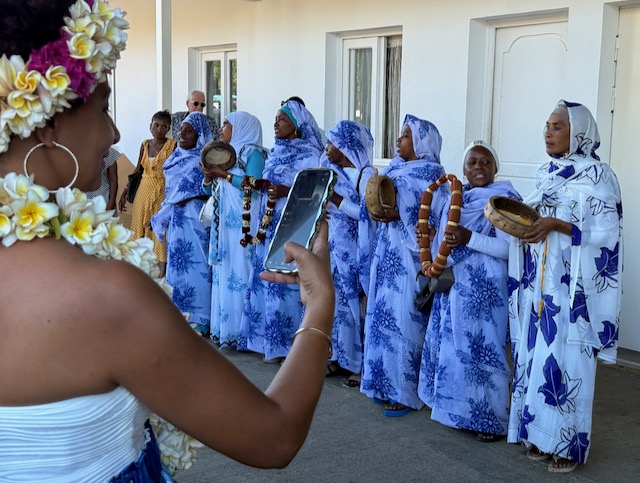
Welcoming committee at Nosy Be airport in Madagascar

I wanted to see the lemurs.  I wanted to escape mass tourism.  I wanted something different, off the beaten-track.  Madagascar checked all the boxes.

Because of my age and limited mobility, I had a private chauffeur guide, many different ones, during my visit. I was based at a comfortable hotel just outside of Nosy Be, Madagascar’s (Mada’s) popular beach resort. But I did not come to lounge on the beach. Nor did I come to trek or indulge in rigorous activity — however I did scuba dive. You don’t need the fitness of a marathon runner to enjoy Mada.

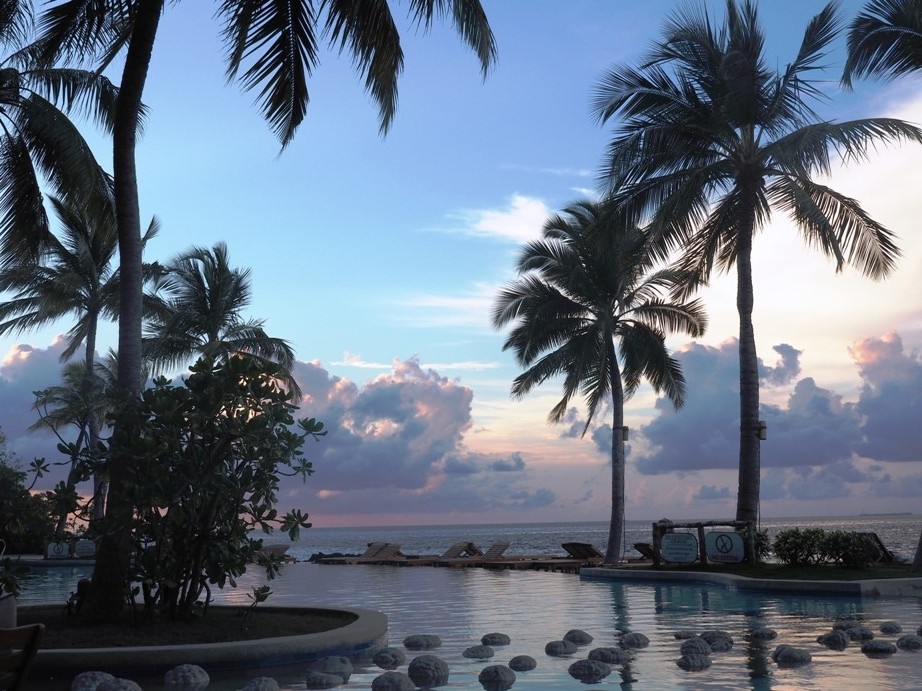
Cottages and pool at Nosy Be hotel.

Every day during my 6-day stay, a different adventure awaited:  a visit to a lemur park; snorkeling and swimming with huge turtles; visiting a fishing village, a sacred tree, markets, scuba.  My driver guides were terrific.  They taught me so much about this intriguing country

The island nation has a unique culture, a blend of Africa, Asia, (Indonesia) and the Middle East.  Madagascar consists of 22 regions with 18 dialects of the Malagasy language, although people generally understand one another.   French (Mada was a French colony until 1960) is spoken by many in the cities, as well as in government, business and education. English is not widely spoken, although it is common in tourist areas. Most of my guides spoke English, but some preferred to speak French, so we did.  

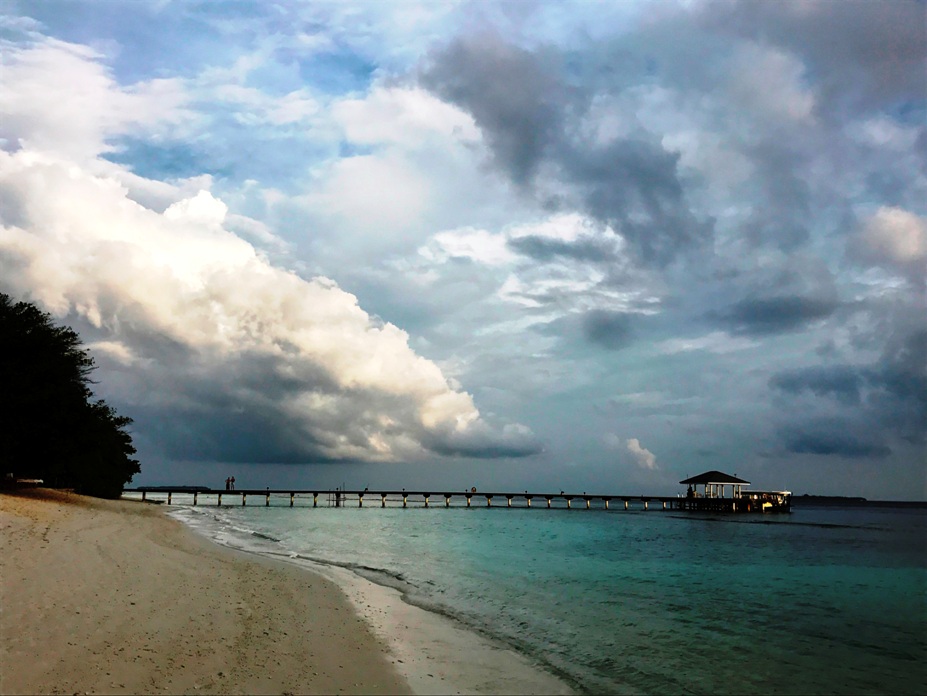
More magnificent scenery. Photos by John Delmas

What makes Mada so unparalleled is isolation. It split from India 88 million years ago, and has been isolated ever since, “a living laboratory of evolution.” The island in the Indian Ocean is about 250 miles off Africa’s east coast.  Land animals are locked in.  Its ecosystem is distinct, with most of its wildlife endemic (found nowhere else).

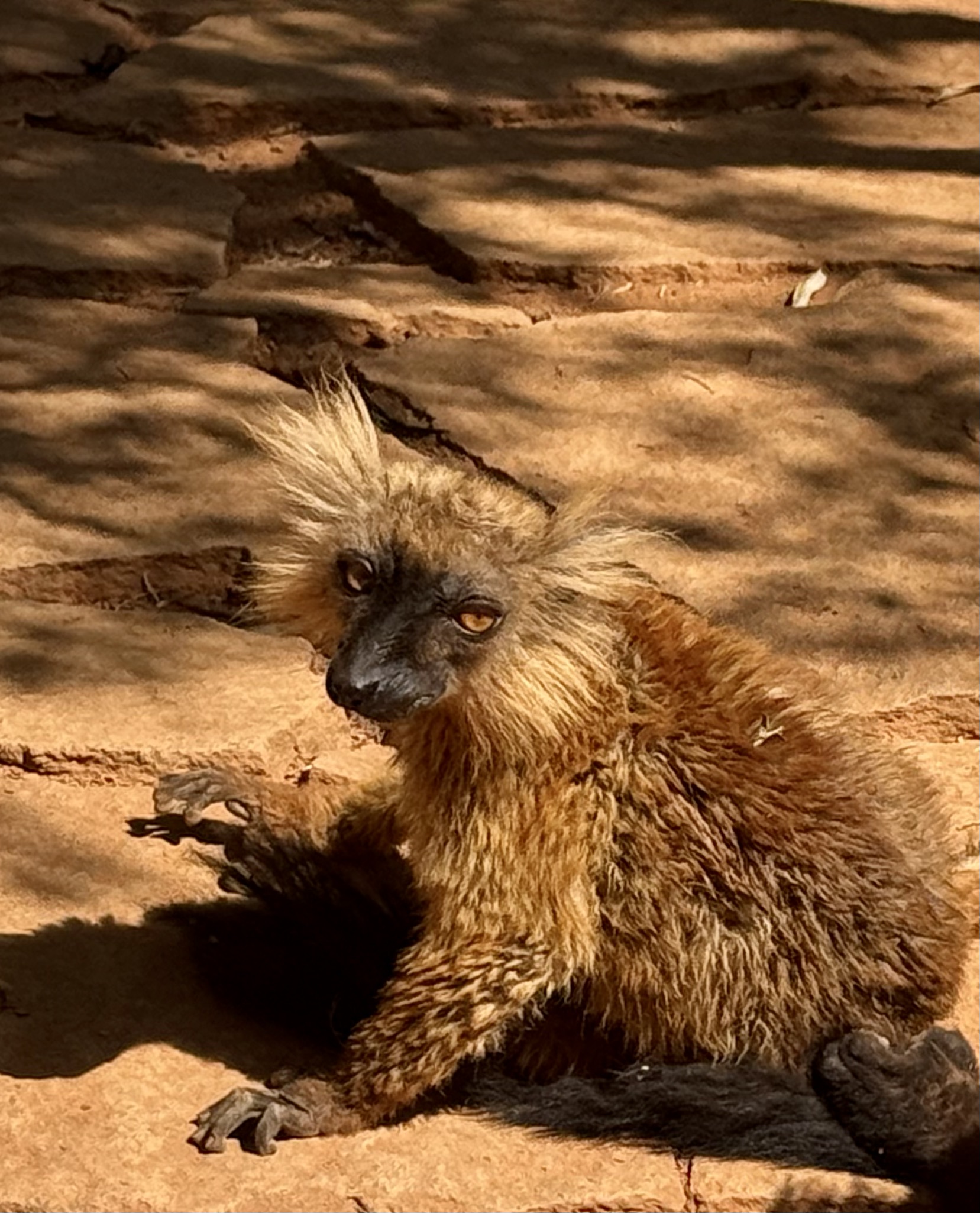
Including lemurs.  The park I visited is a private conservation reserve, home to 61 lemurs representing seven species.  Most have been rescued from various parts of the country.

Madagascar is home to 112 species of lemur, guide Femo told me.  All are endangered.  Their habitat is being destroyed by slash and burn agriculture, logging and mining.  People capture them for pets. And, eat them — not just the poor who are hungry, but well-to-do city dwellers who find the meat tasty and good for health.

“It’s a matter of education,” Femo said. “People don’t realize the lemurs are a national treasure.” 

Different species live in different parts of the huge country, and, rather than socialize with one another, they fight, Femo explained.  In the park, each species hangs out in its own territory. “Lemurs are not as intelligent as monkeys.  They don’t steal,” I learned.  

I saw dancing lemurs (they side hop), bamboo lemurs, gray mouse lemurs… plus ring-tailed lemurs which are the most common. They have 14 white and 14 black rings on their tails.  All are adorable and entertaining — jumping, swinging, dancing, hopping.                                                                                                                                                                                .                                                                                                                                                                                                 During our trek up and down the hills in the park and alongside the Katsaoka River, Femo pointed to a hill on the other side of the river.  It’s the site of a royal burial grounds, a place where people come to worship their ancestors and ask favors, he told me.  

Beyond the hill at right is a royal burial grounds, a popular place for worshipping the dead.

Mada is a land of spirits and taboos.  For Femo, eating onions and pork is taboo.  During the following days I learned much more about those spirits and taboos.

Madagascar’s baobab trees are among the most ancient on the planet, some thought to be more than 800 years old . Like much today, they are threatened by climate change and agriculture. Photo by John Delmas

AI labels Mada the “best bang-for-your-buck” destination.  It offers “good value.” Another AI quote: “Madagascar isn’t just another destination.  It’s one of the last places left where the world still feels bigger than us. Go before the rest of the world figures that out.”

I’m very happy I went to Madagascar. Please, don’t tell Rick Steves about this very special place.

Future posts will focus on Madagascar’s strange traditions and rituals, markets and food, and more. If not a Tales and Travel follower, please sign up here. Trust me. It’s safe. Your address is not shared.

For tasty recipes, click here. Christmas baking? Try this winner of a holiday cookie: Christmas Cookies: Cranberry Walnut Delights

Malagasy John Delmas, above, organizes and guides visits to Madgascar. John was my guide/driver for two days. He was super, taught me lots. Contact his company. https://www.mada-discovery-travels.com
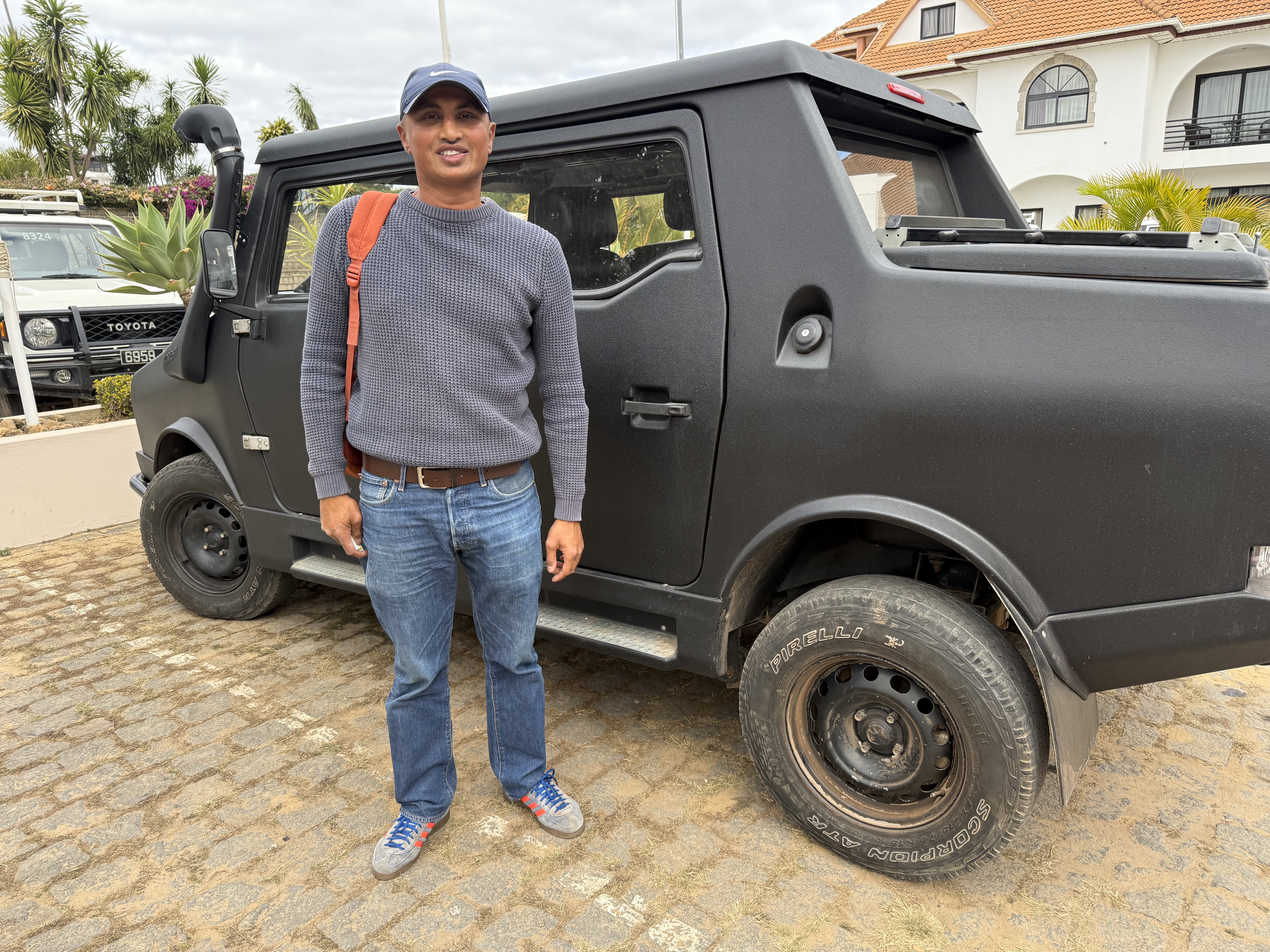
Ravi Matadeen rents made-in-Madagasar unique vehicles for self drive trips. http://www.selfdrivemadagascar.com


I booked my African adventure, South Africa (Kruger) and Madagascar, with Worldwide Quest, http://www.worldwidequest.com

.

5 responses to “Discovering the Unique Wonders of Madagascar”

  1. happily64dfa75244

    Just amazing, the story and the wonderful pictures, thanks so much for sharing 🙏

    Liked by 2 people

  2. Steve Koester

    OK, I want to go. The photos are great. It’s harder as you get older, but I’ve always found the best parts of traveling are the people you meet, the unexpected things that happen, and the challenges they present.

    So many primate species endangered or on the brink of extinction.

    Liked by 1 person

    1. You should go. You’d love Mada — and so would Tai. Most of the photos are by my fabulous guide John. I had fun times with guides, all so knowledgeable, understanding and patient.

      Like

  3. Karen Doyle

    I don’t think you will ever stop traveling to exotic adventure destinations, Leah. This one was a “must do” and it turned out to be the fascinating adventure you had hoped for. And, you got to see those adorable lemurs and so much more in Madagascar.
    Kudos to you!
    Karen

    Liked by 1 person

    1. I hope you are right, Karen. I love these adventures. There are still many places I want to explore.

      Like

Comments, please!

Your email address will not be published. Required fields are marked *

Return to Germany

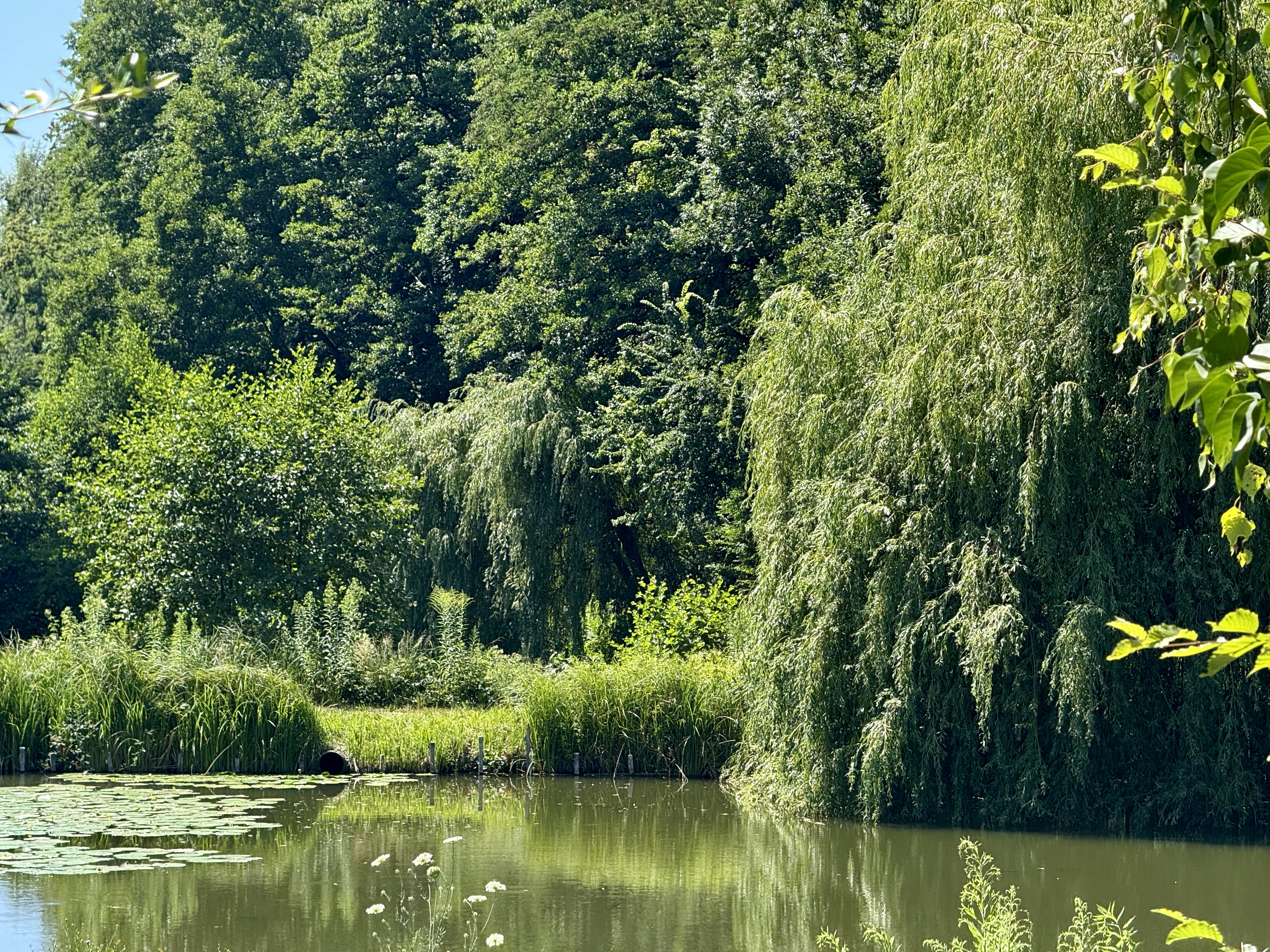
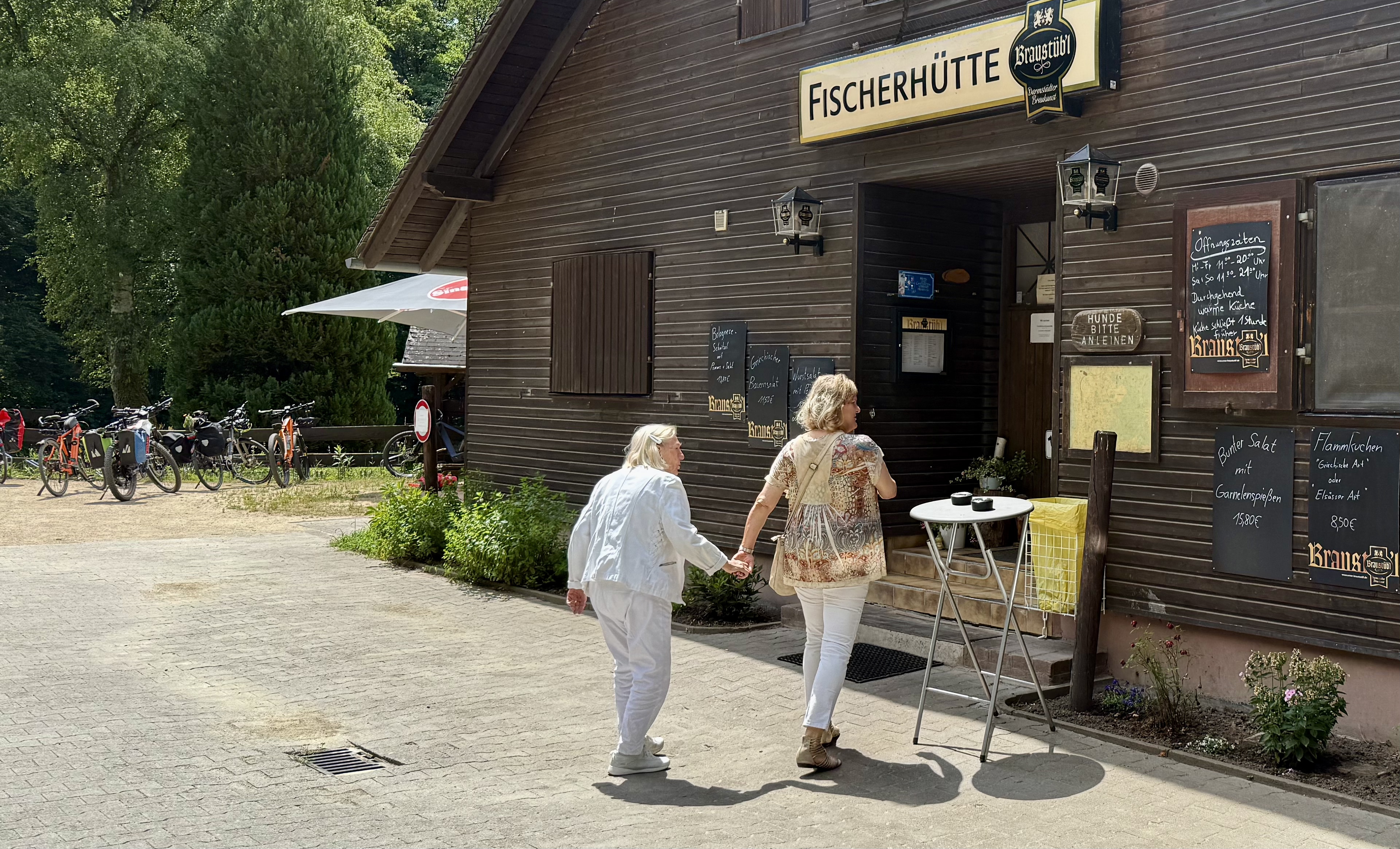
Like I remembered.  Idyllic.  We were surrounded by green, pure nature, at the Fischerhütte near Darmstadt, Germany.

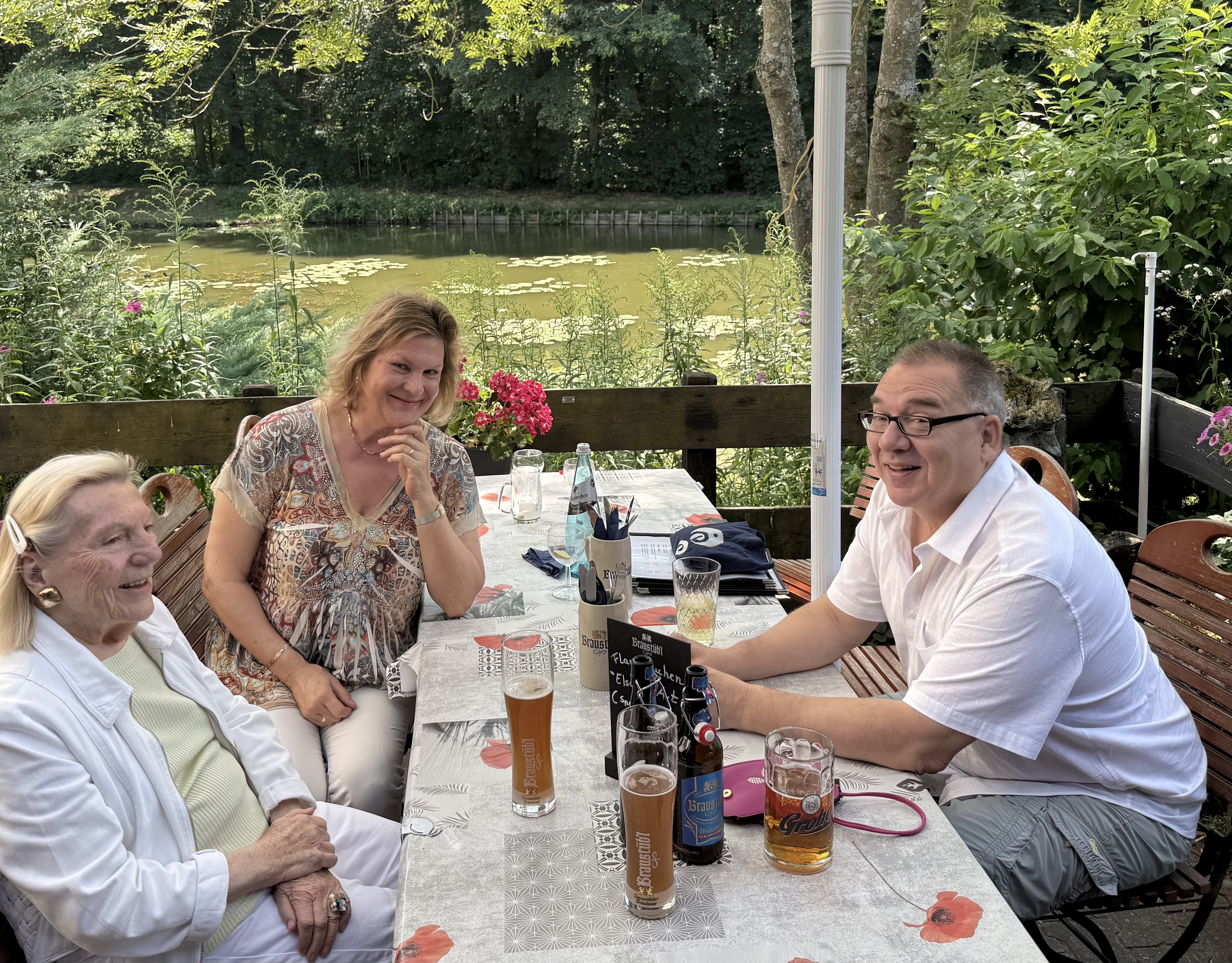
Thekla, Andrea and Thiemo at the Fischerhuettte

Many, many years ago when I worked as a journalist at the newspaper Stars and Stripes, I lived not so far away.  I remember hikes to the hütte in the forest. I remember treks to secret places in that forest in search of the coveted steinpilze (boletus, cepes, porcini – whatever the name, the king of mushrooms). I remember the tranquility, the beauty of those woods.

It was wunderbar to return to Germany after so many years. I have missed Deutschland – old friends, favorite foods, the lush forests.

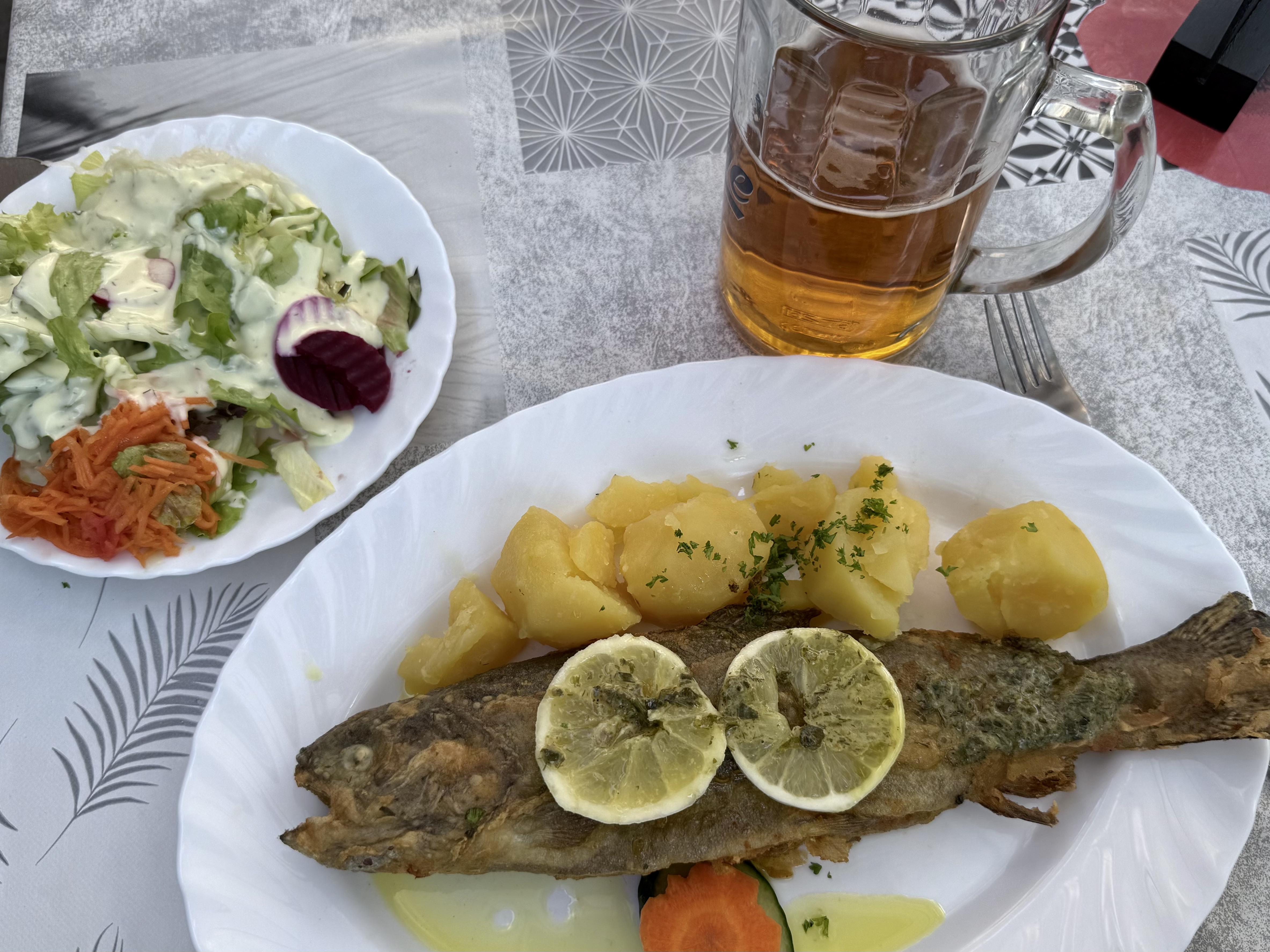
Trout for lunch at the Fischerhuette, and the best German beverage, beer.

Andrea, the daughter of an old friend, her husband Thiemo and her sweet mother, Thekla, led me down memory lane, not just to the Fischerhütte, but other special spots.  It was magical.

Many more memories were rekindled with friends in the Stuttgart area where I lived with husband Bob (RIP) for many years.

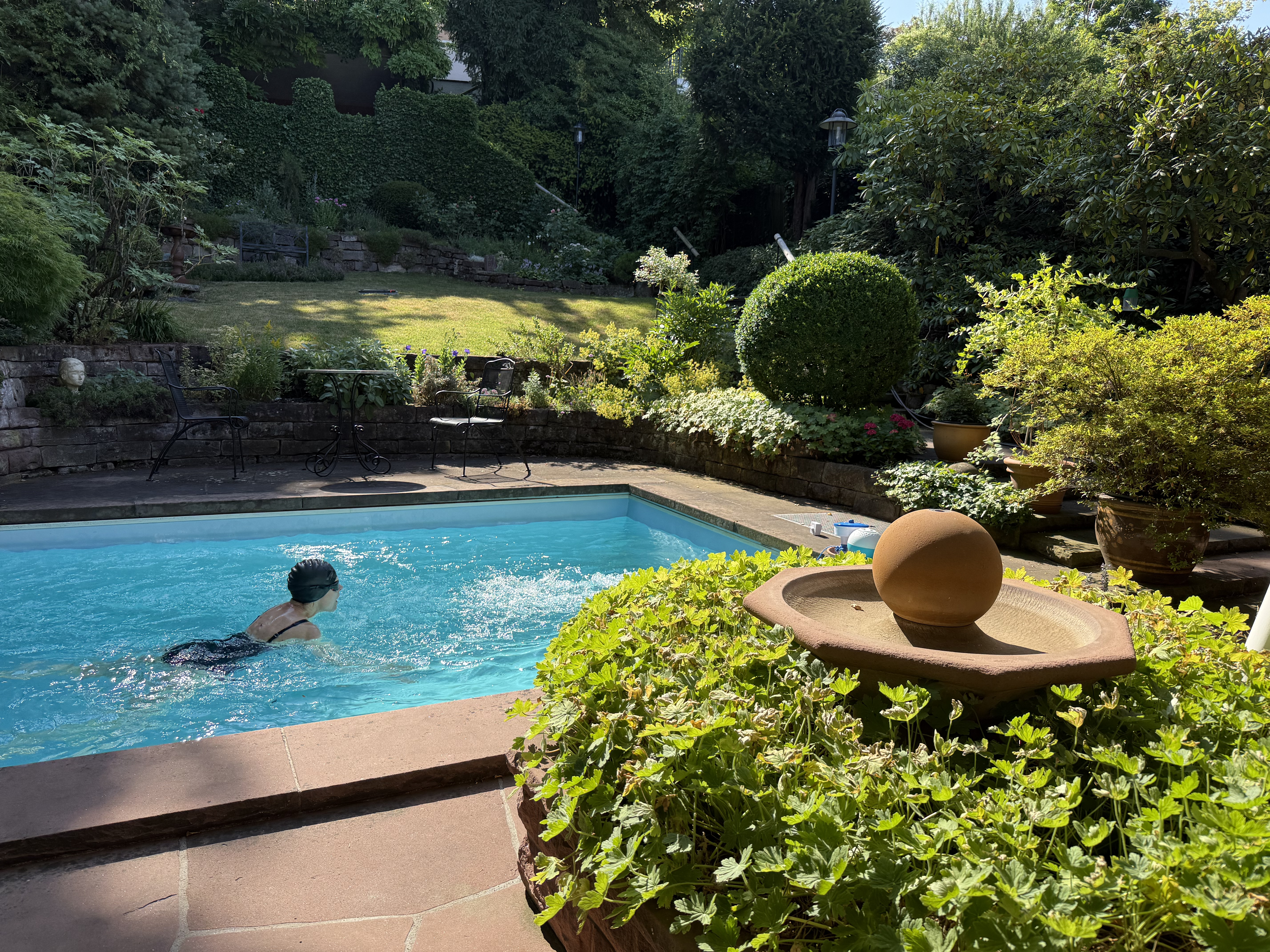
Gerlinde welcomed me in her Stuttgart home.  Like many of my friends, she is a foodie par excellence, even making her own yogurt and ice cream. She is also devoted to fitness and swims against the jet stream in her pool for 20 minutes every day.   I just swam, minus the jet stream.  

Gerlinde swims daily against a powerful water jet — Impressive.

We drove to Steinenbronn, past the apartment where Bob and I lived for 11 happy years. At a nearby restaurant, I indulged in my very favorite Swabian special, Zwiebelrostbraten (onion steak) with homemade Spaetzle.

I can’t complain about food on the Mediterranean coast where I now live, yet there is a shortage of ethnic eateries.

Not so in Germany where, among others, Turkish restaurants abound.  I miss those, too. Marianne treated me to lunch at her friendly neighborhood Turkish restaurant.  I wanted to bring those flavors back to France.

Then, that de rigeur German ritual, afternoon Kaffee und Kuchen (coffee and cake) at her apartment.   

Fun conversation and memories of good times enhanced all those luscious tastes. 

Marianne and Turkish delight

My friends indeed lavished me with generous and delicious hospitality.   Dagmar invited me and other friends to her home for a tasty lunch with a scrumptious raspberry cream dessert.  And, Heti invited us to a multi-course dinner of exquisite delicacies, each worthy of a magazine photo (photos below). This was especially remarkable as she had fallen and broken her wrist the day before.

On my last day we met in Bebenhausen. Bob and I were avid cyclists.  We liked to pedal from Steinenbronn to this tiny burg with an ancient monastery and an excellent restaurant.  It is still charmingly picturesque.  My last treat before heading home, another German delicacy:  Rehrücken filet (venison filet).  Delectable.

Living on the Mediterranean coast, I have the sea, palm trees, the Maritime Alps, tropical gardens – but no dense, enchanting forests.   I had not realized that I was forest deprived.  I was in awe of all the fabulous German greenery.

I mentioned this to Andrea, so we visited yet more. “I’ve never been to so many forests in one day,” she said.  Gerlinde told me that Stuttgart has more green space than any other German city.

“The woods are lovely, dark and deep…,” and a treasure.

Thank you, dear friends, I loved my return to Germany –especially seeing all of you.

Below: Heti’s superb creations. Each was mouthwatering.

I will add a new recipe next time. Meanwhile, for an easy, tasty dessert, try my recent discovery, RUM-SOAKED MANGOES. Sinfully delicious.

If not a Tales and Travel follower, please sign up here. Trust me. It’s safe. Your address is not shared. Don’t miss out. Thrilling adventure coming: South Africa, Madagascar and Mauritius.

Comments welcome. Scroll down and share your thoughts. To read previous comments, scroll way down.

Comments, please!

Your email address will not be published. Required fields are marked *

Magical Maldives

OLYMPUS DIGITAL CAMERA

My friend Mollie has been vacationing in this Indian Ocean paradise of islands almost every year for the past 26 years.  She swoons when talking about her perfect holidays:  sensational snorkeling, gorgeous accommodations, fabulous food, pristine beaches.  What more could one want?

We had booked a trip to Sri Lanka last February (see previous posts, “Wonders of Sri Lanka” and “Sri Lanka: Wondrous Wildlife”).  The Maldives were in the neighborhood, about an hour and 15 minutes flight time from Colombo.  We had to see this paradise for ourselves, so we added a week of Maldives R&R to our trip.

No doubt — the Maldives are magical.  Postcards cannot capture the beauty of beaches surrounded by shimmering sapphire waters.   Our resort was luxurious.  We had our own bungalow, our own piece of beach.  The food and resort staff all rate five stars.

blogm.13a
No crowds on Maldive beaches

Yet, we were not overwhelmed.  Unfortunately we did not have the best weather.  Too many cloudy, overcast days and rain.  When it rains in the Maldives, it teems. I had been eager to experience what is considered some of the best snorkeling in the world. I was disappointed.  I did see colorful, exotic fish and other creatures, but not the extravagant underwater wildlife I had expected. Mollie said we should have chosen a smaller island and resort, and I should have taken boat excursions to other places for better snorkeling…

The Maldives consist of more than 1,190 islands on a coral-formed archipelago.  Only about 190 of those islands are occupied by the country’s some 341,000 inhabitants.  The rest are virgin islands, or, like our Island, Horubadhoo, Baa Atoll, private islands developed for individual resorts – one resort per island.

Hasan Ibrahim, reservations manager at Royal Island Resort and Spa where we stayed, told me there are 114 of these private island resorts in the Maldives, with another 14 under construction.  On the main island, Malé, and on some of the other larger islands, there are guest houses offering far more reasonable accommodations than the pricey, private resorts.mblog.13a

Royal Island Resort and Spa has a capacity for about 300 guests, and a staff of 350 coming from at least 10 different countries, he said.  Most of the guests are Europeans.

“Since the tsunami (2004) everything has changed,” assistant manager Sharif said. “The winds, the waves, you can’t predict.  The rains are heavier now.’’ The inclement weather we experienced in March was abnormal. “This is supposed to be the dry season.”

He explained that El Nino in 2016 killed the coral, turning it brown.  “It will take eight years to come back.”  Although Royal Island did not suffer extensive damage from the tsunami, a rock wall, mainly underwater, was built around the island in 2008 to protect it from big waves and erosion.  I did venture outside the wall when snorkeling several times and spied different fish, but the sea was a bit rough and I feared venturing too far.  There were no other swimmers in sight. mblog.17a

I did fulfill one wish – to scuba dive again. I am certified, but have very few dives on my dive card.  I just wanted to prove that I could still dive, and thanks to a very patient and understanding diving instructor, Anne from Russia, I succeeded.

Bungalows at Royal Island are spread throughout a tropical forest, but all facing the beach.  The only sounds are the gentle slapping of waves on the white sands and bizarre shrieks from all manner of jungle fowl.  mblog.14a

In addition to diving and snorkeling, tennis, big game fishing, sailing, and canoeing are offered.  A posh spa offers a variety of treatments, massages etc.  We took beach walks around the island (800 meters in length and 220 meters wide), and rarely encountered another soul.

OLYMPUS DIGITAL CAMERA
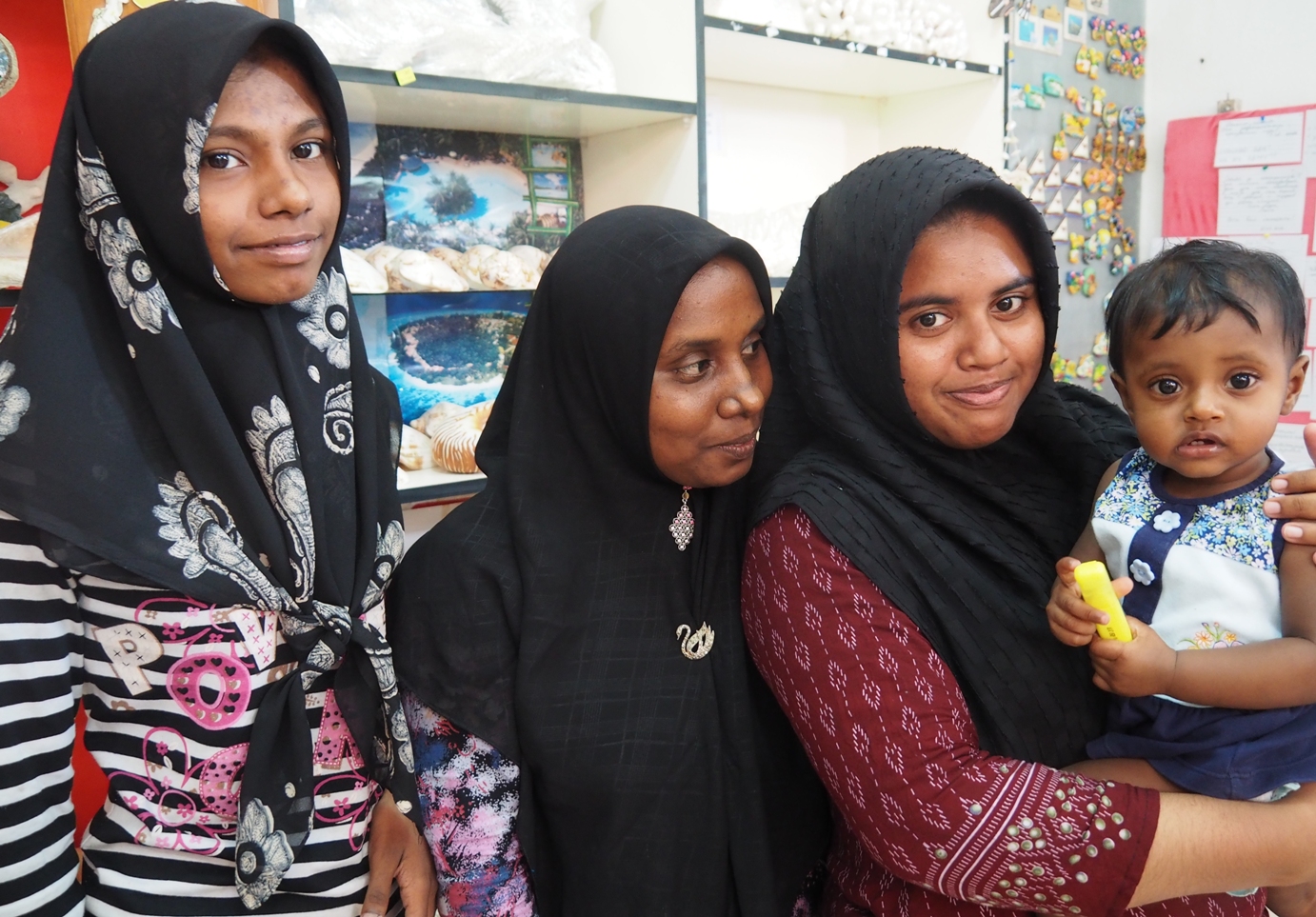
We left the island paradise to visit an island where Maldivians live and work. These friendly women were happy to pose for photos in their shop.

If you seek solitude and tranquility, the Maldives is the place. We like both, but mixed with exploring and mingling with locals. We had our chance for the latter on a boat trip to a larger island where we followed our guide through a tiny fishing village — and shopped.  There were just a few souvenir shops, but each offered bargains and friendly, delightful shopkeepers who, not only gladly posed for pictures, but showered us with small presents after we made our purchases.

OLYMPUS DIGITAL CAMERA
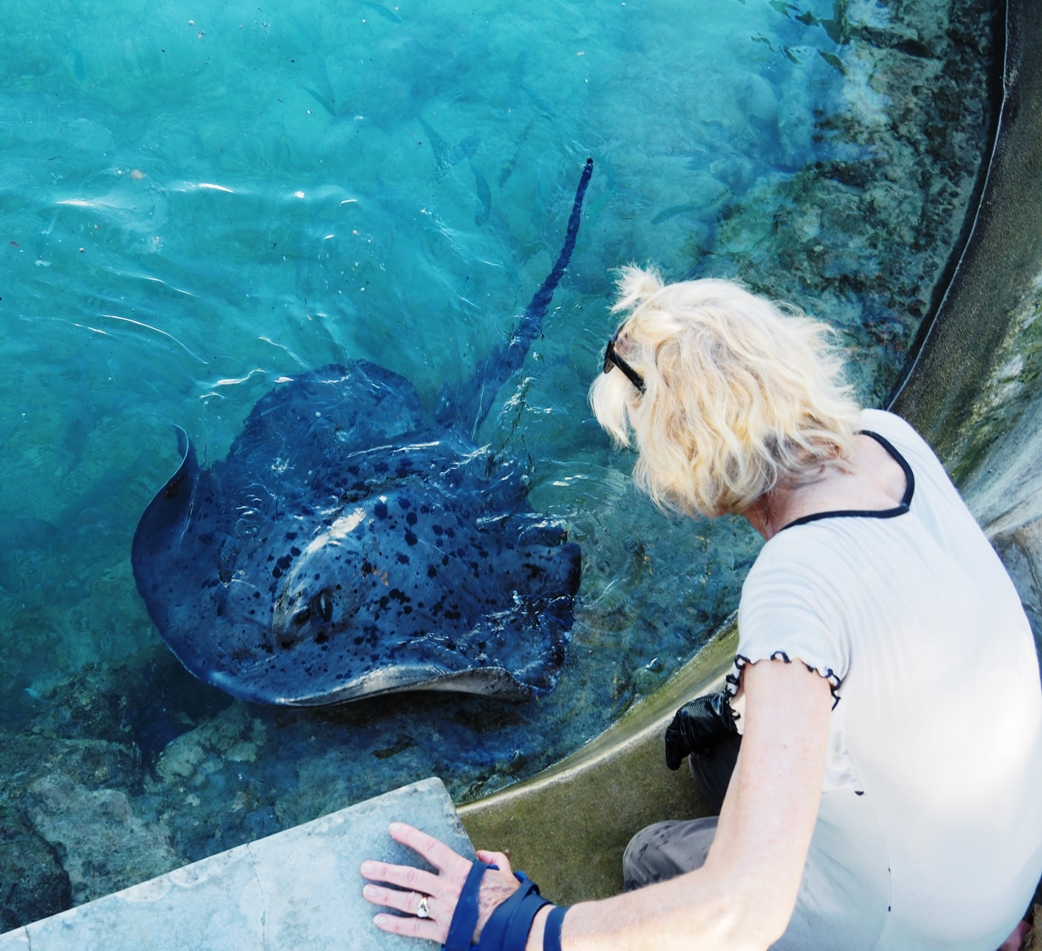
Fun feeding session on outing to a nearby island

A bit of adventure awaited on the shark and ray feeding outing. The marine mammals are obviously accustomed to visitors and snatch food from your hands if you are brave enough to offer. I was intrigued.

The majority of Maldivians, Sunni Muslims, live in the capital city on the island of Malé where the main international airport is located.  Their religion prohibits drinking alcohol and eating pork, but the resorts are an exception to this ban.

OLYMPUS DIGITAL CAMERA
Village women were at work cracking almonds.

Ibrahim said managing Royal Island is“like running a cruise ship. We have to do everything ourselves… We produce our own water. All the food is imported.”  All the staff live on the island, he said.  “We are like a family.  We live and work like a family.”

The Royal Island family treated us and all the guests royally. We were amazed with the variety of tasty food.  The surroundings, both the beach and the jungle-like interior, are enchanting.  All is magical, but perhaps not the kind of magic that will lure us back for a repeat visit.

More photos follow.

mblog.18a
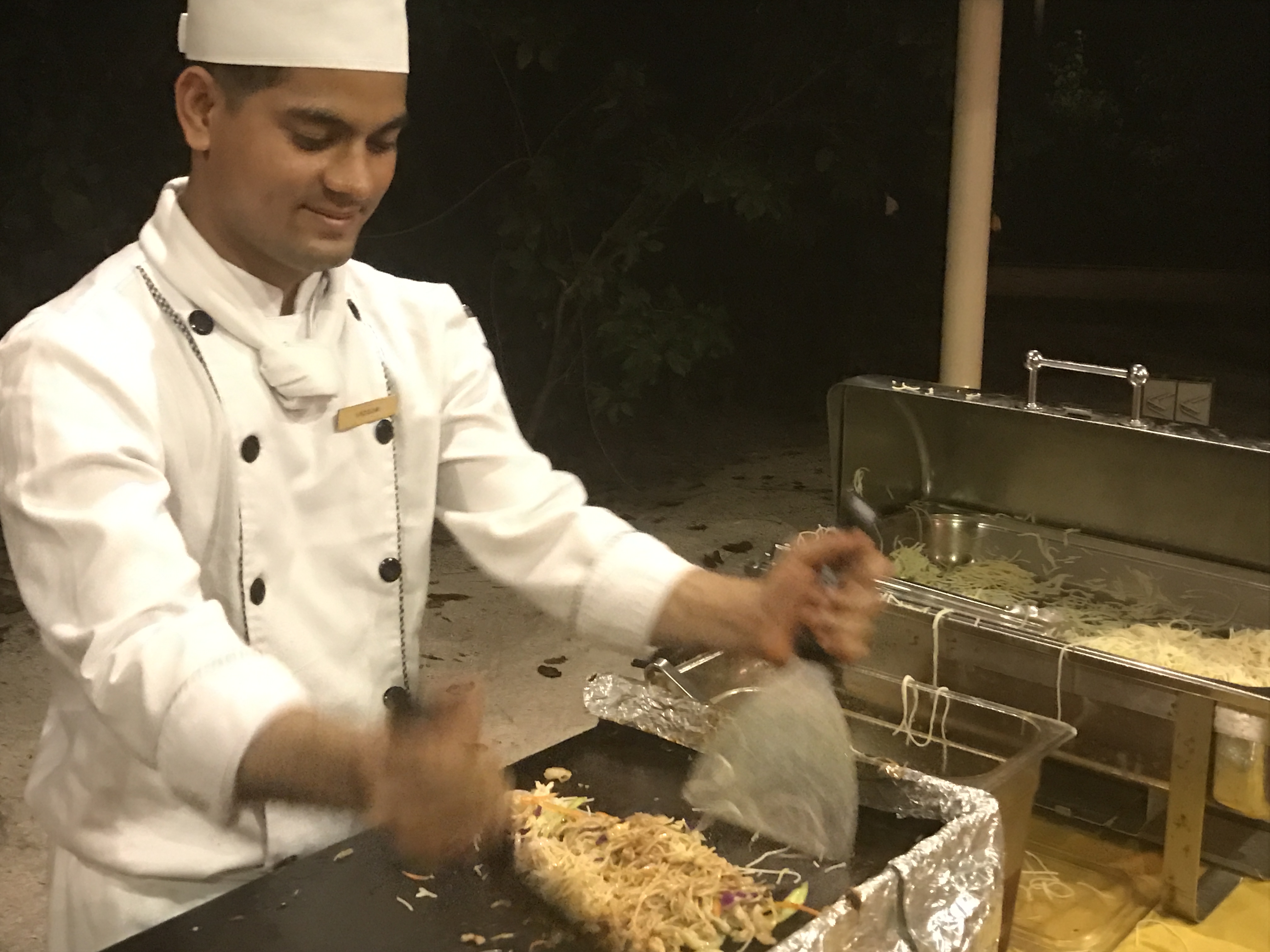
Chefs at resort prepared different ethnic specials every night.

OLYMPUS DIGITAL CAMERA
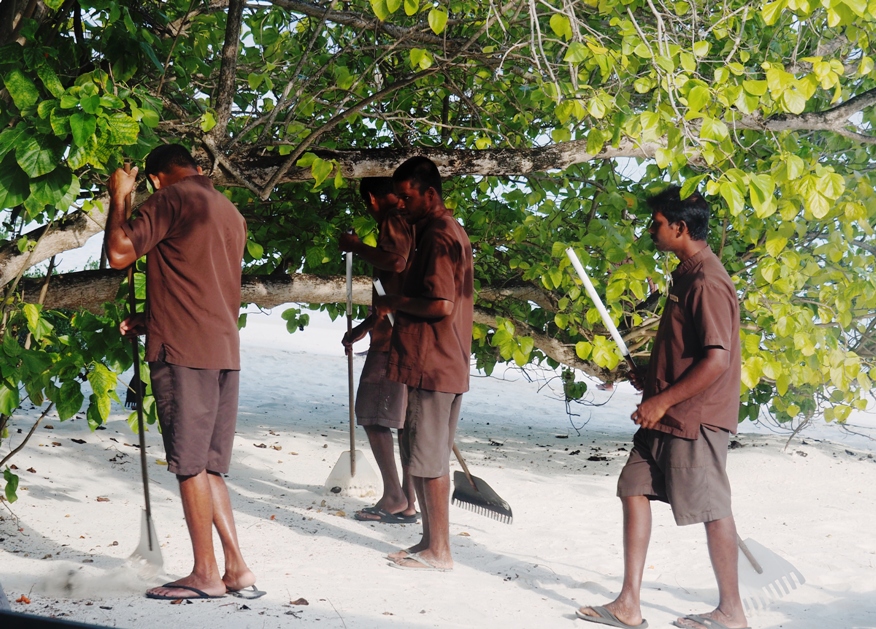
A beach brigade cleans and sweeps the sand very early every morning.

OLYMPUS DIGITAL CAMERA
The men fish.  The village women have other chores.

OLYMPUS DIGITAL CAMERA
Not camera shy, these Maldivians.

mblog.15a
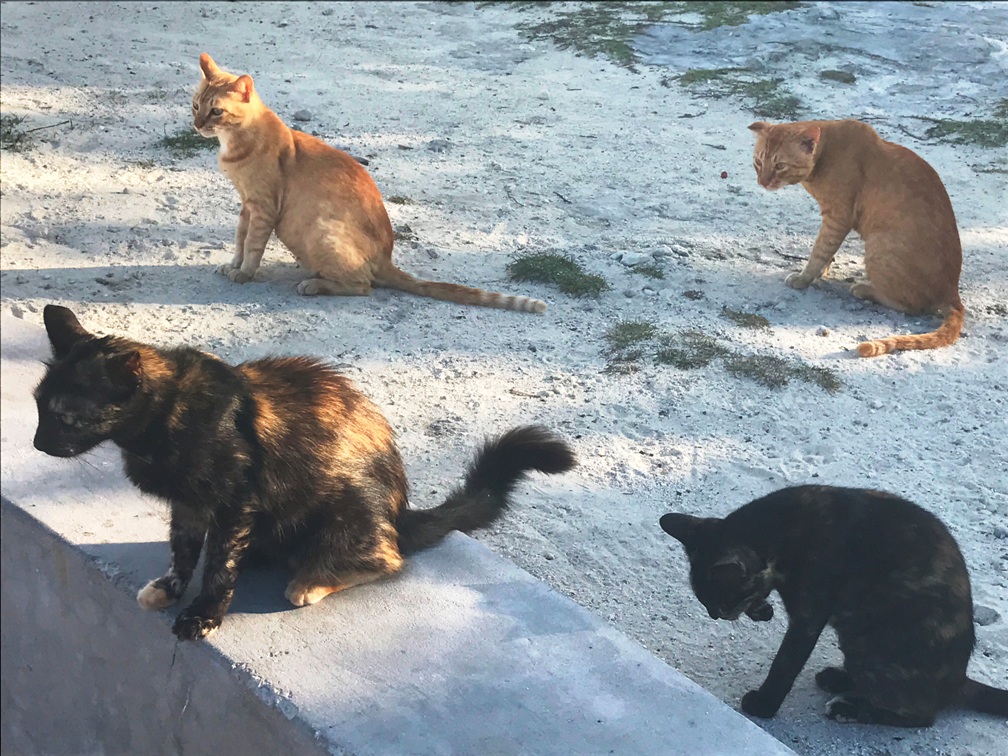
Cats wait for leftovers from shark and ray feeding.  I made sure they got plenty.

OLYMPUS DIGITAL CAMERA

If not already a Tales and Travel follower, sign up (upper right). Your address is kept private and never shared. 

Please feel free to comment.  Click below, scroll down to Leave a Reply and add your thoughts.


makeread2

Misadventures in New Zealand

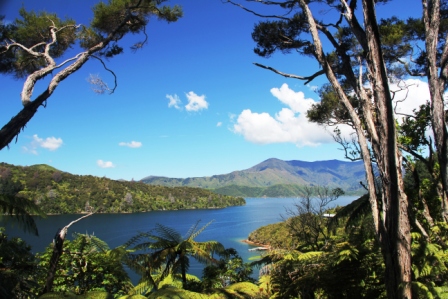
 Swimming with dolphins, kayaking on the open sea, hiking along the shore, plus visits to wineries and fabulous meals.  My kind of trip.

It was the Marlborough Nelson pre-trip on our voyage to New Zealand last November to attend the convention of the Society of American Travel Writers.

The food and wine were over the top.   Dolphins and kayaks – another story.

“These are very sturdy kayaks.  No one has ever capsized on one of my trips,” our perky kayak guide assured us as we prepared to put the boats in the frigid Pacific.   Maladroit Bob and Leah had obviously not been on one of her trips.

We were the retards in the group of six  or so kayaks – always way behind the others.  He (Bob)  kept yelling  at me to switch the paddle to the other side, to dig the oar deeper into the water.   I must admit, I was not adept with the blasted paddles.   And, I was always a bit nervous as I feared we were holding the others back, so I constantly tried to paddle faster and faster which was exhausting  and left my arms throbbing.  The scenery, however, was stupendous.

We held our own until we had to round a point to get back to shore. The winds were strong, so strong we weren’t moving, even though we were paddling hard.  The guide explained how we could use the paddle as a sail – just hold it up and the wind would blow us forward.  Bob was screaming at me, “Paddle left,  Paddle left.”  As I switched to the left, a gust caught the paddle and over we went.

A rude  shock.  12 degrees C. ( 54 degrees F.)  water is none too pleasant, but I popped right up and out of the kayak.  Where was Bob?  I was concerned as he does not know how to swim.  Fortunately he popped up instantly too. Nonetheless  I panicked.  My camera, my precious new Canon Rebel?  It was in one of those waterproof bags strapped to the boat, but I was devastated, convinced  it had drowned.

How to get back in the kayak which had righted itself?  The guide, no doubt eating her words, arrived at the scene of disaster and told us to turn the kayak upside down to empty it of water.  I refused, certain this would spell death for my camera if in fact it had survived.  I told her to help Bob, and that I could swim to shore which  did not seem that far off.  She was adamant – no way should I swim.  So, she gave us instructions and somehow, but with great effort and none too gracefully, we managed to manipulate our soaked and freezing bodies into the boat.  Then, she instructed  us  to pump the water out.  We pumped and paddled, but we were trembling with cold and making little progress.  Finally another guide came and towed us to shore (farther away than I thought – good I did not swim).

I  could not stop shivering, but once on shore I ripped open the bag with the camera. Unbelievable.  It was OK.  Bob’s expensive sunglasses did vanish to the bottom of the sea.  My prescription sunglasses, which I had been wearing, managed to stay on my head.  Another miracle.

We had been toId to bring an extra set of clothing.  Certain that it would not be required, I only brought a pair of jeans  — better than nothing, but more was needed.  Others in the group lent us T-shirts and sweaters.  Nonetheless, we quivered from the cold for what seemed like ages… (This kayak catastrophe brought back memories of our failed attempt at dancing lessons.  There, too, we were the duds in the group.  We best stick to bicycling.)

Then there was the boat excursion to swim with dolphins.   The lovely creatures were sure to appear, we were told.  Those in the group who planned to plunge into the freezing water, this time about 14 degrees  C ( 57 degrees F.) , were given wet suits.  Bob, not a swimmer, passed on this adventure.

The boat trip was scenic, and eventually we spotted dolphins.  The playful creatures followed right alongside the boat, jumping and soaring out of the water at times. Watching them was thrilling.  Swimming with them would be even better.

The boat captain maneuvered the craft  to get ahead of the dolphins, then we were told to jump in.  As dolphins are said to be curious and like humans, they were supposed to come and join us in the water.  We were told to make noise, to sing, through the snorkel mouth piece. This would surely attract the dolphins.

Nine bodies swimming around in frigid waters emitting bizarre sounds.  It was comical.  The wet suit did help, but after awhile, the cold penetrated.   We swam and sang, but the dolphins did not show up, so one by one we’d get back on board.  This ritual was repeated four different times as the captain tried yet again and again to position the boat where he thought the dolphins would be. And, time after time, we plunged into the icy water for naught.

The dolphins were nearby.  Why didn’t they join us? According to one of the guides, they were probably mating, and sex was more exciting than a bunch of crazy humans.  Can’t say I blame them.

Not all was amiss on our excursion in the Marlborough and Nelson regions which are at the top of New Zealand’s South Island.  Marlborough is the country’s largest wine-growing region, especially known for sauvignon blanc.  We visited several beautiful wineries where we tasted and savored some excellent vintages.

We also enjoyed a delicious boat excursion to mussel beds   Lunch was on board – a feast of succulent greenshelled mussels, the best I’d ever tasted.

And, we had a delightful overnight stay at the Lochmara Lodge Wildlife Recovery Center.  The lodge is accessible only by boat.  Hiking trails lead up in the hills above the cluster of buildings, offering super views, as well as interesting outdoor art and sculptures en route.  www.lochmaralodge.co.nz

Watch the slide show below for more photos of New Zealand.  And, try the recipe for “Two Cheese Spinach and Mushroom Casserole” listed in the column at right.  It’s a winner – and easy to prepare.

If you would like to continue to read Tales and Travel posts, please click the “Subscribe” bottom in  the upper right corner. Comments are welcome. See “Leave a Reply” below.

This slideshow requires JavaScript.