Bicycling with Battery Power

Press a button on the bicycle handlebar.  Whee…, you soar full speed ahead.  It’s like magic, a thrilling sensation.

The power of electric bicycles.  I was excited.  Husband Bicycle Bob (BB), a hardcore macho cyclist, less so. Yet, we enjoyed our recent all-day excursion on these fun bicycles in the Luberon hills of France’s Provence.

Electric bicycling seems to be surging in popularity.  Baby boomers getting too old and out-of-shape for demanding pedaling?  More folks wanting a bicycle excursion without stress and sweat?   Serious cyclists who want to cover many miles, including some steep ascents where a power boost would be welcome?

Whatever the reasons, electric bicycles offer an enjoyable and easy alternative to conventional pedaling.  We rented these sturdy monsters for a day in the Provence town of Gordes with the company Sun-E-Bike which just started renting the bikes, valued at 1,300 euros each, at Easter.

Florian Machayekhi, who spoke English, gave us a briefing. You must pedal for the motor to be in operation, he explained.   There are three settings for different levels of motor power.  For steep hills, for example, you may wish to select the highest.  When going downhill, or in the flats, you can press a button to switch off the motor and pedal as with a regular bike.  Sun-E-Bikes have seven speeds.

We have done a lot of bicycling and did not intend to pedal with auxiliary power all the time.  However, these bikes are heavy, 25 kilos, therefore not quite like your bike back home.  I always shut the power off for downhills, and, lest being a real wimp, tried to keep it off in the flats. But, as this is Provence where the winds often blow, I was happy to press the power button to offset those nasty gusts produced by the Mistral.  And, I was no martyr in the hills, loving the easy and effortless climbs.  BB, of course, had to do it the hard way most of the time.  For the first time on cycle trips, I beat him to the top.  So, I cheated…it was still fun being first.

Florian had given us a map with a 40-kilometer itinerary through some Provence highlights: Fontaine de Vaucluse, Saumane de Vaucluse, Isle sur la Sorgue…  He suggested we have lunch at the latter where we could exchange the batteries.  The bike battery will last for 35 kilometers.  When we arrived at Les Terrasses du Bassin, the restaurant/battery exchange point, our batteries still registered full – all four battery lights still glowing.

We enjoyed lunch on the restaurant terrace where the river forms a large pool of crystal water popular with hungry ducks, but did not bother to get a new battery.  Almost a mistake.  Several hours later when we neared Gordes, the quintessential perched village and our destination, my bike was down to one battery light.  And, the last part was five kilometers all up hill.  I kept the motor setting on the lowest, thus using less power, and said a prayer that it would get me all the way back to the rental station.  I did not want to pedal that weighty bike up this killer ascent.  Luck was with me.  I made it back under battery power.

We cycled on May 8, a holiday in France, so the walkway through the forest to the scenic source of the Sorgue River at Fontaine de Vaucluse was crowded with strollers.  Riding became too risky, so we pushed the bikes up the path along the raging river.  Not easy, but the sounds and sights of the water below charging over rocks and boulders detracted from the effort.

Isle sur la Sorgue, known as the Venice of Provence, is a pleasant spot for a lunch break.  The Sorgue River splits into numerous streams flowing through the town not unlike Venetian canals.    Pedestrian bridges decorated with flower boxes and mossy waterwheels add to the picturesque ambience.

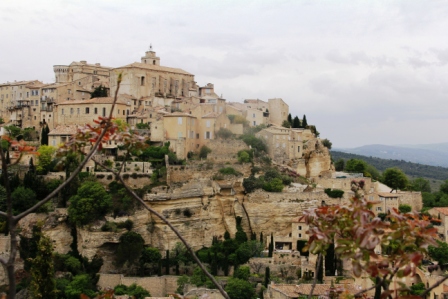
Between the towns on our itinerary we cycled past acres of vineyards, orchards, fields ablaze with wildflowers and weathered stone farm houses, all with the Luberon hills as a backdrop.
Pascal Hernoult welcomed us and the bikes back in Gordes.  The new electric bike venture is “encouraging,” he said.  “People return with big smiles.  They say it’s ‘formidable.’  They are not tired.”

Count me among those happy electric bicyclists.  Even BB admitted he was glad for the battery power to get back up that last long hill.

Watch the slideshow below for more photos.  Enjoy a tasty treat of the season: Hsin’s  Strawberry Cake.  See recipe in column at right.   Next blog post to focus on French health care — a first person account based on my upcoming knee replacement surgery.  Don’t miss it.  Click on “Email Subscription” at top of right column.

This slideshow requires JavaScript.

Sun-E-Bike has 200 electric bicycles for rent at three different sites in Provence: Gordes, Bonnieux and Lauris.  Cost for rental per day is 35 euros which includes a helmet and yellow safety vest.  Half-day rental (9 a.m. to 1 p.m. or 2:30 p.m. to 7 p.m): 22 euros.  Insurance: 2 euros per day.  A deposit of 200 euros or an ID card such as passport or driver’s license is required. Maps with suggested itineraries and battery exchange points are provided. Baby seats, baby trailers and panniers can be rented for an extra charge.

SuneE-Bike also offers bike rental for longer periods with hotel overnights and luggage transfer provided.  See the web site for details: www.sun-e-bike.com
Misadventures in New Zealand

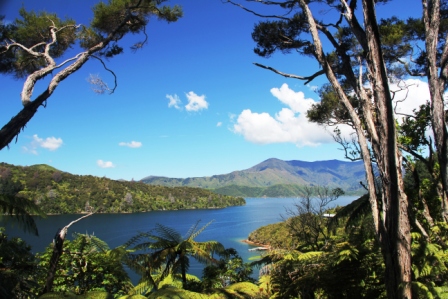
 Swimming with dolphins, kayaking on the open sea, hiking along the shore, plus visits to wineries and fabulous meals.  My kind of trip.

It was the Marlborough Nelson pre-trip on our voyage to New Zealand last November to attend the convention of the Society of American Travel Writers.

The food and wine were over the top.   Dolphins and kayaks – another story.

“These are very sturdy kayaks.  No one has ever capsized on one of my trips,” our perky kayak guide assured us as we prepared to put the boats in the frigid Pacific.   Maladroit Bob and Leah had obviously not been on one of her trips.

We were the retards in the group of six  or so kayaks – always way behind the others.  He (Bob)  kept yelling  at me to switch the paddle to the other side, to dig the oar deeper into the water.   I must admit, I was not adept with the blasted paddles.   And, I was always a bit nervous as I feared we were holding the others back, so I constantly tried to paddle faster and faster which was exhausting  and left my arms throbbing.  The scenery, however, was stupendous.

We held our own until we had to round a point to get back to shore. The winds were strong, so strong we weren’t moving, even though we were paddling hard.  The guide explained how we could use the paddle as a sail – just hold it up and the wind would blow us forward.  Bob was screaming at me, “Paddle left,  Paddle left.”  As I switched to the left, a gust caught the paddle and over we went.

A rude  shock.  12 degrees C. ( 54 degrees F.)  water is none too pleasant, but I popped right up and out of the kayak.  Where was Bob?  I was concerned as he does not know how to swim.  Fortunately he popped up instantly too. Nonetheless  I panicked.  My camera, my precious new Canon Rebel?  It was in one of those waterproof bags strapped to the boat, but I was devastated, convinced  it had drowned.

How to get back in the kayak which had righted itself?  The guide, no doubt eating her words, arrived at the scene of disaster and told us to turn the kayak upside down to empty it of water.  I refused, certain this would spell death for my camera if in fact it had survived.  I told her to help Bob, and that I could swim to shore which  did not seem that far off.  She was adamant – no way should I swim.  So, she gave us instructions and somehow, but with great effort and none too gracefully, we managed to manipulate our soaked and freezing bodies into the boat.  Then, she instructed  us  to pump the water out.  We pumped and paddled, but we were trembling with cold and making little progress.  Finally another guide came and towed us to shore (farther away than I thought – good I did not swim).

I  could not stop shivering, but once on shore I ripped open the bag with the camera. Unbelievable.  It was OK.  Bob’s expensive sunglasses did vanish to the bottom of the sea.  My prescription sunglasses, which I had been wearing, managed to stay on my head.  Another miracle.

We had been toId to bring an extra set of clothing.  Certain that it would not be required, I only brought a pair of jeans  — better than nothing, but more was needed.  Others in the group lent us T-shirts and sweaters.  Nonetheless, we quivered from the cold for what seemed like ages… (This kayak catastrophe brought back memories of our failed attempt at dancing lessons.  There, too, we were the duds in the group.  We best stick to bicycling.)

Then there was the boat excursion to swim with dolphins.   The lovely creatures were sure to appear, we were told.  Those in the group who planned to plunge into the freezing water, this time about 14 degrees  C ( 57 degrees F.) , were given wet suits.  Bob, not a swimmer, passed on this adventure.

The boat trip was scenic, and eventually we spotted dolphins.  The playful creatures followed right alongside the boat, jumping and soaring out of the water at times. Watching them was thrilling.  Swimming with them would be even better.

The boat captain maneuvered the craft  to get ahead of the dolphins, then we were told to jump in.  As dolphins are said to be curious and like humans, they were supposed to come and join us in the water.  We were told to make noise, to sing, through the snorkel mouth piece. This would surely attract the dolphins.

Nine bodies swimming around in frigid waters emitting bizarre sounds.  It was comical.  The wet suit did help, but after awhile, the cold penetrated.   We swam and sang, but the dolphins did not show up, so one by one we’d get back on board.  This ritual was repeated four different times as the captain tried yet again and again to position the boat where he thought the dolphins would be. And, time after time, we plunged into the icy water for naught.

The dolphins were nearby.  Why didn’t they join us? According to one of the guides, they were probably mating, and sex was more exciting than a bunch of crazy humans.  Can’t say I blame them.

Not all was amiss on our excursion in the Marlborough and Nelson regions which are at the top of New Zealand’s South Island.  Marlborough is the country’s largest wine-growing region, especially known for sauvignon blanc.  We visited several beautiful wineries where we tasted and savored some excellent vintages.

We also enjoyed a delicious boat excursion to mussel beds   Lunch was on board – a feast of succulent greenshelled mussels, the best I’d ever tasted.

And, we had a delightful overnight stay at the Lochmara Lodge Wildlife Recovery Center.  The lodge is accessible only by boat.  Hiking trails lead up in the hills above the cluster of buildings, offering super views, as well as interesting outdoor art and sculptures en route.  www.lochmaralodge.co.nz

Watch the slide show below for more photos of New Zealand.  And, try the recipe for “Two Cheese Spinach and Mushroom Casserole” listed in the column at right.  It’s a winner – and easy to prepare.

If you would like to continue to read Tales and Travel posts, please click the “Subscribe” bottom in  the upper right corner. Comments are welcome. See “Leave a Reply” below.

This slideshow requires JavaScript.


Sam’s Saga

It’s a feline fairytale come true,  a rags to riches story. From life as a stray cat wandering in the alleys of Cereste, a Provencal village in the Luberon, to that of a pampered pet in a posh apartment in Paris.  And, not just any apartment.  Sam’s new home is with the famed pianist and conductor Philippe Entremont and his wife.

There must be millions of homeless cats in France. How did this husky gray tomcat get so lucky?

The saga began last December when I decided to adopt Sam. Friends Marten and Jessica had been feeding him, but they have four other cats.  Sam was especially friendly and affectionate, however he was becoming a nuisance, fighting with their cats.  They needed to find a home for him.

I was in mourning at the loss of Buddy, my big black male cat, whom I had to have euthanized due to cancer.  Sam seemed to be the answer to cure my sorrow. He was a delight with people, loved to be petted, purred loudly. But, he quickly decided he must be king.  He made life hell for my two female cats.  This would not work.   I called friends, sent emails, put up posters.  I was determined to find him a home.  All to no avail.  Some friends, including cat experts, said the kindest thing would be to have him euthanized.  I could not bring myself to take this step.  Since he had been surviving as a street cat in Cereste for years, a town where kind souls do feed strays, I took him back to the village with great remorse and feelings of guilt.

Sam was born under a lucky star.  Along came Anne to the rescue. Shortly after his return to the streets, this kind English woman arrived to spend the winter in the apartment upstairs from Marten and Jessica. Anne and her friend Martine came to Cereste from Ireland with their dogs and horses.  They have been spending the winter training for a 500 kilometer charity ride on horseback across France to raise money for the Program for Assistance Dogs for Families of Children with Autism.  http://thewanderlywagons.blogspot.fr/

Anne took to Sam, who was hanging around and hungry.  He soon moved in with her and her canines: Fionn, a huge lab/Rottweiler cross, and Roxy, a lab/retriever mix.  Sam detests cats, but dogs are his pals.  All became friends, even sleeping together.  When Anne walked the dogs, Sam would follow.

But, Sam’s time was running out.  Anne would soon be starting her horse trek, then return home to Ireland where she has two cats – no hope for Sam there. Once again I started the search.  Friend David, a photographer with expert computer skills, made beautiful professional posters with Sam’s photo which I distributed to numerous vet offices and shops in the area.  Again no response.

I also told my friend Jude Reitman about my plight with Sam.    Jude is an award winning journalist and author – and devoted animal rescuer – who has been living part time in France.  www.judithreitman.com  She put me in touch with Amelia Tarzi, a lawyer born in Afghanistan who gave up law to work as an interpreter, the latter allowing her more time for her passion:  animal rescue.

Amelia has lived in the states and Switzerland, but is now at home in Paris.  However, she spends as much time as possible at an animal shelter in central France, DPA-Refuge de Thiernay, www.refuge-thiernay.com

I sent photos of Sam to Amelia who soon announced that she had found a home for the fortunate feline — but it was in Paris, some 610 kilometers away.  A friend of Amelia’s is a friend of Mme. Entremont,  wife of the noted musician Philippe Entremont.  She had just lost a cat.  The friend quickly put her in touch with animal rescuer  Amelia who sent photos of many cats needing homes to Mme. Entremont.  She zeroed in on Sam because he looked like the cat she had just lost.

How to get Sam to Paris?  Amelia said she would pick him up at the TGV train station in Aix en Provence en route back to Paris after a job in Nice.

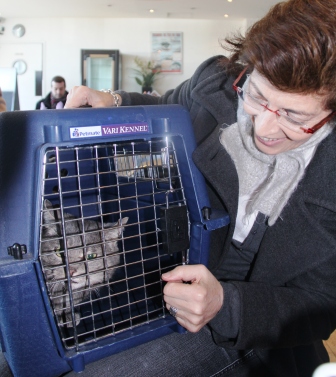
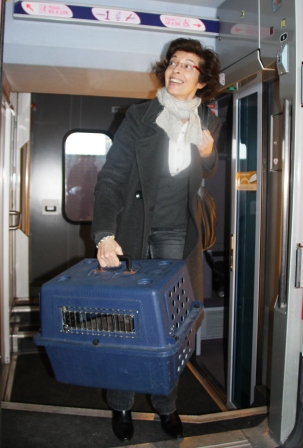
Sam needed to be vaccinated, micro-chipped and tested for disease before departing for the City of Lights.  The first attempt to cage him for the trip to the vet failed. (See Anne’s blog at the above address for more on this fiasco.)  The next morning Anne succeeded, and I took Sam to  the vet where he was a prince, a surprise to all.  Then, husband Bob (a dog person and a saint to put up with my cat capers),  drove me and caged Sam to the train station, more than a hour away.  This normally very vocal cat was amazingly subdued during the journey.

Shortly after 1 p.m. Amelia met us in the train station café, and soon street cat Sam was on his way to a new life in high-class surroundings.  Released from his cage in the Paris apartment, he ran to hide behind a bookcase.  During the night he emerged and, according to Amelia, got the shock of his life when he walked across the keys of his esteemed owner’s piano.  He’s adjusting to life with the upper crust, and Mme. Entremont is “thrilled” with her pet rescued from Provence, says Amelia.

Jude Reitman has recently started a company, La Bedouine, specializing in skin care products handmade by Berber women in Essaouira, Morocco.  http://www.labedouine.com  She has moved back to her home in North Carolina where she is active in finding homes for abandoned dogs.

Turkey: from Istanbul to the ski slopes

Masses of people. Pouring through the squares. Walking four and five abreast on the sidewalks. Strolling almost body to body on the popular, wide pedestrian street, Istiklal Avenue, on a Saturday evening.

Istanbul 2012, home to 17 million and booming. I’d been to the city twice before, but long ago. The changes, the vibrant pulse of round the clock activity, choking traffic, five-star hotels and designer shops –all overwhelming.

My recent visit was with the Ski Club of International Journalists (SCIJ, www.scij.info). We were en route to our annual meeting, this year held on the slopes towering above the city of Erzurum in far eastern Turkey. Some 200 skiing journalists from 30 countries met to ski, race, party, and learn about this dynamic country from distinguished speakers.

Some of the facts:

• Fifty percent of the Turkish population of 75 million is under 30.

• There are more than 25 universities in Istanbul.

. • One million people visited Turkey last year – the country ranks 7th in the world in number of visitors.

• Turkey has been a model for the Arab Spring, a secular democracy with a Muslim population.

• In 1980, the country’s exports totaled $3 billion. Last year that figure was $130 billion.

• Turkey is the sixth largest economy in Europe, 16th largest in the world.

The  media are thriving with some 1,000 daily newspapers, 100 television channels and two billion Internet users.

• But, all is not rosy. Freedom of the press is a hot issue.  Between 50 and 100 journalists are said to be in jail for being critical of the government.

• 69 percent of the population wants Turkey to join the EU.

As one of our speakers said, “Turkey is the new kid in town.”

I arrived in Istanbul a day early and spent an afternoon at the Grand Bazaar, a shopper’s Mecca with hundreds of shops and stands offering gleaming gold jewelry, silver jewels, carpets, scarves, ceramics and more.  Before setting off to the mountains, the group  visited Istanbul’s star attractions: Hagia Sophia  Museum, the Blue Mosque and Topkapi Palace.  A Bosphorus  cruise is a must

On the Bosphorus.

for an Istanbul visit.  We were blessed with warm sunshine for our boat trip on this 30-kilometer stretch of water which connects the Black Sea and the Marmara Sea and separates Europe from Asia.

We savored excellent cuisine. Turkish  Meze, small plates served as appetizers, are different and delicious, often seasoned cold vegetables, such as eggplant, zucchini, peppers… as well as stuffed grape leaves, cheese and a yogurt-garlic sauce for dipping.   Kebabs of beef or lamb are a frequent main course.  Baklava is a favorite dessert.

Not only a fabulous dinner, but over-the-top entertainment,  was a highlight when we dined beneath the streets of Istanbul in an ancient cistern which was constructed in the 5th century and is now used as a venue for special events.  A well-known Turkish clarinet player and his band played non-stop for more than an hour and a half – an incredible performance.  Then came the country’s famous belly dancer, Asena, whose sexy slithering  and amazing body movements were mind boggling.

For me, the best of Istanbul was the hamman or Turkish bath,  a soothing multi-step ritual which leaves you feeling ultra clean and relaxed.   For the bath, we visited the historic Hurrem Sultan that dates back to the 16th century but was restored in the 1950s.  There are separate sections for men and women.

The surroundings are opulent – all white marble under a  domed ceiling pierced with tiny windows to let in light.  Each bather is assigned an attendant who first pours warm water over your naked body.  The water is scooped from a basin under bronze faucets into embossed bowls –very classy.    This goes on for some time, then you are led to a large room where bodies lie on towels in a circle under the grandiose ceiling.  The attendants whirl a large cloth bag though the air, then, starting at the top of the bag, squeeze it until soap suds come out the  open end at the bottom— mountains of white foam.  The bodies soon look like mummies buried under mounds of cotton candy.  The attendant  gently massages the suds into the body from head to toe.  It’s glorious.  This is followed by an entire body scrub down with a rough mitt to  remove dead skin.  Then, more pouring of water, all ending with relaxation in a chaise lounge and a glass of rose hip tea.  I liked it so much, I went for a repeat performance at our hotel in the mountains.  There the surroundings were not quite as posh, but the experience was equally as  heavenly.

For most of our group, the best part of the trip was no doubt the skiing – and theobligatory races (giant slalom and cross country). But, as I have a knee which is worn out  (replacement surgery scheduled for May), I spent almost no time on the slopes.  I had relaxing days at the hotel, and, in addition to the hamman, took advantage of the swimming pool.

Nation’s Night is a SCIJ tradition.  Participants bring delicacies from their countries to share with the others.  Airline restrictions make this more and more challenging, nonetheless the variety of food and drink offered is a tribute to the determination and innovation of these skiing journalists.  Foie Gras from France.  Raclette from Switzerland.  Pasta from Italy… and Thanksgiving turkey  for a meeting in Turkey from the US.

The turkey was the idea of the U.S. team captain, Risa Wyatt.  Customs regulations prevented bringing turkey from the U.S., but the hotel did a commendable job of roasting two large birds.  I made and brought cranberry chutney to serve with it.  The beverage:  Wild Turkey.   It was a sensation.

We even had one bird leftover which we served at the end of the cross-country race, along with the legendary Dutch pea soup,  the latter a popular tradition prepared every year, with much difficulty, on site by our colleagues from Holland.

Unfortunately the trip ended on a sad note for my  Irish friend and roommate Isabel who broke her arm on a bad fall the last afternoon.  She had to have surgery in the hospital in Erzurum. The Turkish organizers of our meet, the hospital staff and Turkish Airlines treated her like royalty.  But,  now that she’s back home in Belgium, she has learned that mistakes were made during the operation and it must be redone.

She’s depressed and says she won’t ski again.  Skiing has been my passion, and  I am worried that a new knee may not permit me to get back on the slopes.  I told Isabel we must both give it a try – maybe sticking to the gentle slopes.  Next year SCIJ will celebrate its 60th anniversary in the Italian Dolomites – something not to miss.

For more on Turkey, see www.goturkey.com.  For more on the Ski Club of International Journalists, see www.scij.info.    See  “Poached Chicken Breasts with Arugula Pesto Sauce” for  a chicken recipe with a bit of green for St. Patrick’s Day.    Watch the slide show to follow.

This slideshow requires JavaScript.

Fine Dining à la Française

One of the reasons we were happy to move to France is food.  The cuisine here is hard to beat.  When we lived in Germany and were both working, hence a better income, we loved to make eating excursions to nearby Alsace.  The dollar was stronger back then, too.  Sometimes we would splurge and eat in a Michelin starred restaurant.

Since moving here and living on a fixed income, we’ve been happy with local restaurants, most of which are reasonable.  But, since the dollar is faring better these days, and since it was Valentine’s Day, I wanted to try a Michelin one-star restaurant, La Petite Maison, in nearby Curcuron.  I called and learned they had a special multi-course menu for Valentine’s Day – 120 euros ($159) per person.  That did include wine and champagne, but nonetheless way beyond our budget.  On regular days they offer a three-course menu for 46 euros ($61) per person, excluding wine.

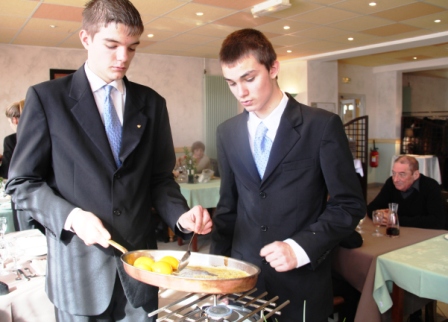
We decided to celebrate Valentine Day’s in a more economical fashion, but try La Petite Maison a few days later.  On February 14 we lunched at the restaurant at Lycée des Métiers Louis Martin Bret in the town of Manosque.  This is a professional school with a department where aspiring chefs and restaurant personnel are trained.  Several days per week at the school restaurant they offer lunches and dinner.  The menu is fixed – few choices—but good and reasonable.  The ambience is pleasing – fresh roses on the table, the young waiters and waitresses all looking spiffy in black jackets and pants, white shirts and baby-blue ties.  This time there were two choices offered for each course.  We chose the following.  Our average rating on a scale of 1 – 10 (10 is tops)  follows.

First course: Profiteroles à la mousse de foie gras sur roquette.  Three rounds of chou pastry, each filled with a different type of foie gras mousse, attractively arranged around a mound of arugula, with threads of spun sugar on top for added flair.  One was decorated with stripes of chocolate sauce. The others were accompanied by tiny mounds of chutneys. Yummy.  In my opinion, you can never go wrong with foie gras.  Rating: 8.5

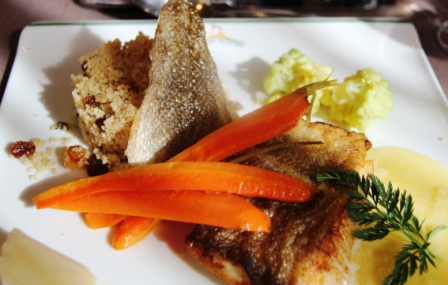
Main course: Dos de cabillaud, semoule aux raisins, carrots fanes glacées.  A slice of cod with a piece of the fried skin as decoration, served with a semolina/raisin mixture and glazed carrots. Tasty, but unfortunately we found the fish overcooked, which is too often the case with fish. Rating: 5.25

Dessert:  Pêches flambêes sur glaces. Flambéd peaches served on ice cream.  It was fun watching our young waiters, Nicolas, 15,(left)  and Jimmy, 15, undertake the flaming procedure. They handled it like pros, and the result was delicious – the vanilla ice cream full of flavor and obviously homemade. Rating; 7.5

We began the meal with an ”apéro,”  a before dinner drink that is de rigeur in France.   We ordered the cocktail of the day, a concoction of rum, orange juice, coconut milk and sugar.  With the meal, we drank a half liter of open white wine.  After dessert, we each had a coffee.  Total tab for two: 40 euros ($53).

Two days later we went for broke and had lunch in Curcuron at the renowned La Petite Maison with our friends Gayle and Ralph.  We economized on the apéro – a pre-dinner drink at the village café next door.  For two glasses of champagne, a beer and a Pastis, the bill was 14 euros ($18.50)  La Petite Maison charges the same for one glass of champagne.

Two fixed menus were offered, at 46 and 68 euros each. We all selected the less expensive one. Beef was the main course. Bob is not big on beef, so he was permitted to substitute fish.

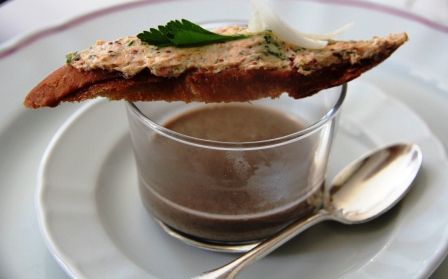
At this classy place, we were given an amuse-bouche ( appetizer )  a velouté de lentil et une tartine avec rillette de saumon.  A creamy lentil soup topped with a toasted wedge of bread spread with a salmon pâté.   Gayle thought it was outstanding.  I wasn’t that overwhelmed. Rating: 7.8

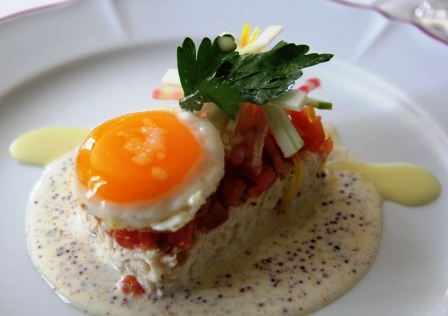
First course:  Céleri et pomme verte rémoulade rehaussé de dés de saumon fumé, oeuf au plat coulant.  A colorful combination of diced celery and green apple topped with tiny morsels of smoked salmon, all crowned with the yellow of an egg.   Definitely a work of art to admire, and it was good, but perhaps not as flavorful as it looked. Rating: 6.5

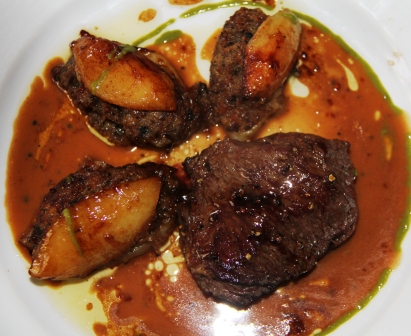
Main course;  Pièce de filet de boeuf d’origine européenne poêlée au poivre, pommes de terre fondantes.  Filet of beef ( European origin)  pan fried with pepper and served with interesting potatoes. (fondant means ‘‘melted,” but there was nothing melted about these potatoes.  Maybe this is just fancy restaurant vocabulary).  We were not asked how we wanted the beef cooked. It was served rare, a tad on the bloody side. This is the way French gourmets prepare beef.  I love beef, and this is just the way I like it, so I was happy.  Bob, who went for the fish substitute, was horrified at the bloody meat and very glad he chose monkfish served on a mousse of cauliflower.  Sharing the plate with the beef were sliced potatoes topping a tasty crumb melange which reminded Gayle of turkey stuffing. She noted that this dish would have been better with an added portion of vegetable – perhaps something green for color.  Rating: 7.4

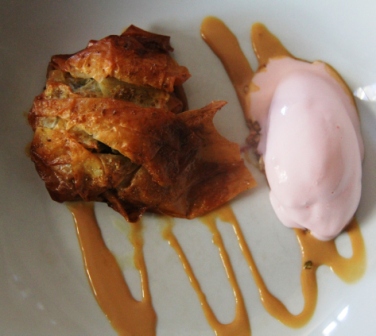
Dessert:  Croustade aux pommes et figues aux parfums d’orient, glace à la rose. A crusty concoction of phyllo pastry filled with Oriental flavored apples and figs  next to a scoop of rose ice cream.  Bob is a dessert fan and this was his favorite.  I thought it was good, although I did not detect any Oriental flavors and the rose ice cream did not send me.  Rating: 7.75

With the dessert a plate of small pots of a lemony-creamy liquid surrounded by mini cakes was placed on the table for us to share.  A nice touch.

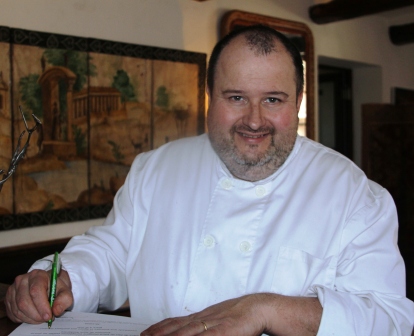
The restaurant is in an old house in the center of a charming village opposite a pond.  The dining room, all wood-paneled, is a bit on the bare side – no décor, just tables with white table cloths. Our waitress, all dressed in black, was pleasant – she even corrected my French.  That I appreciated.  Chef and owner, Eric Sapet, has impressive credentials in the world of cuisine.

We ordered the cheapest bottle of red wine on the menu: a 2007 Vin de Pays de Vaucluse, Domaine Hugues, Vendage des Chefs, 35 euros ($46).  Total cost per couple, about $144.

Moral of the story: Forget the stars and save your money. We all agreed that we’ve had better food at la Table du Bonheur (see previous blog, “Table of Happiness”) for much less money.

www.lyc-bret.ac-aix-marseille.fr

www.lapetitemaisondecurcuron