It’s officially over. It makes me sad, even though summer 2014 was not a normal Provence summer. Thanks to climate change, we had thunderstorms and cool, cloudy days. Too much wind and rain. The latter had a plus. July and August days are usually hot and sunny with almost no rain. This year we saved both money and time on watering all our flowers and trees. Still, I would have preferred a real summer.
Gone are those long summer nights when we could dine on the balcony by daylight up until 10 p.m. Soon many restaurants will close or drastically shorten their opening times. I am still swimming, but that too will come to an end before long. Tomatoes — those tasty gems I buy from farmers at the markets, will soon disappear and we will left with those tasteless Dutch hothouse tomatoes at supermarkets. Fall and winter are for cosying up with the cats by the fireplace — not as exciting as summer, but not so bad.
In spite of the less-than-perfect weather, we enjoyed some fun times and outings during summer 2014. The following photos are souvenirs of those good times.
Again I tried for the perfect lavender shot. Now that I have had photo lessons from friend and fab photographer George, there’s hope for improvement next year.
We joined fellow Americans for a Fourth of July party sponsored by Democrats Abroad in Avignon.
Then we joined the French for a Bastille Day fete in neighboring Vacheres. The July 14th sardinade (grilled sardines) is an annual event with plenty of wine, music and song – in addition to those petite fish.
On the cultural side, we joined a group from our town for a bus excursion to an outdoor piano concert in La Roque d’Antheron, also an annual event — preceded by a picnic in the park.
And, we went to Avignon for a day at the Festival d’Avignon which features almost 1,000 theatrical performances. The festivities in the streets are more than jolly.
And north to Sisteron for an outdoor concert under the Citadele.
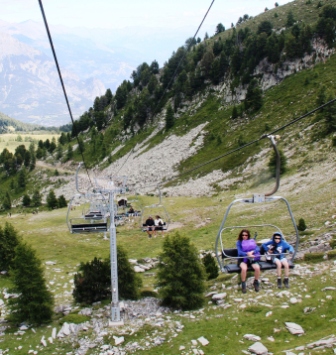
I longed for the mountains, so we drove to a winter ski town that draws hikers and mountain bikers in summer. We rode a chair lift to the heights for an easy trek. Alas, riding a chair lift in summer minus snow and skis is not easy. Getting off I did not jump aside fast enough and was whacked in the back with the chair and knocked to the ground. Painful. We canceled the hike, but enjoyed beautiful scenery on the way home.
Another community meal – paella in our town, Reillanne. We love these events, good food and socializing.
Again this summer we tried our luck at a Vide Grenier (Empty Attic). It’s a flea market, but our hopes of making money on our no-longer-used possessions were dashed. We could not even give things away. There were still treasures in the box labeled “Gratuit” (Free) after the last customers had gone home.
Cannes on the Riviera was our destination for an event sponsored by the American Club of the Riviera – mind-boggling fireworks shot from boats in the harbor. We spent the night in Cannes and enjoyed a visit to the off shore island, Sainte Marquerite, the following day. Gorgeous. On the way home, a quick dip in the Med at Theoule-sur-Mer
Friends Mollie and David put summer to bed with a fabulous garden party.
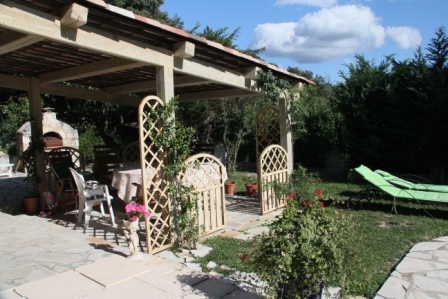
Summertime is also for enjoying our pool and yard and flowers — and the SPPS (State Park Picnic Shelter). See previous post “Pergola — Or State Park Picnic Shelter?” Aug. 22, 2013. It’s looking better, thanks to the decorative elements painstakingly installed by Bob, and Ben’s suggestion that we we lighten the posts and beams. That made a huge difference. Thank you, Ben. You saved it– and our marriage.
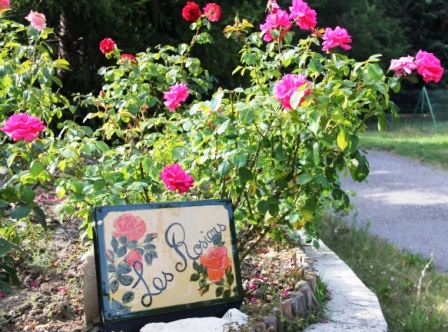
Don’t miss the next post featuring our summer renters. We meet fun and interesting people who rent the guest apartment at Les Rosiers for vacation. And then… a post on Incredible Iceland. If you are not a Tales and Travel follower, sign up now at top right so you don’t miss future tales.
Please comment below. Share your thoughts.
Summer may be over, but grilling is not. One of my favorites which is always a hit with guests is grilled lamb. See column at top right for recipe.
Strains of “The House of the Rising Sun” reverberated through the massive edifice. This was not a rock concert. No one was singing.
The sounds came from a powerful organ played by a monk in the abbey church of Ste. Foy. The Animals 1964 hit about a brothel in New Orleans seemed a strange choice of music in this religious shrine.
It was electrifying, and the perfect background for a nighttime tour of this Romanesque temple in Conques, a picture-perfect village in southwestern France.
Every evening from May through September at 9:30 p.m., visitors are permitted to wander freely around the upper galleries of the church, normally off limits, to look down at the vast nave, to study the unique windows, to look up at the sculpted capitals of columns, each a magnificent work of antique art. Spot lights grow dim and then brighter, highlighting architectural details. Shadows move. The music entrances. Even for the non-religious, this is a spiritual experience, a sound and light show like no other.
Conques was my favorite of the many places visited on a recent tour of the Midi-Pyrénées region in this corner of France. It’s easy to understand why it was named one of the “plus beaux villages de France,” (one of the most beautiful villages in France). The tiny burg of Romanesque fountains and half-timbered houses is nestled in a valley surrounded by green.
The abbey church’s roots go back to the eighth century when a Benedictine monastery was established at the site in the wilderness. Relics were needed to give the new monastery clout. In the ninth century a monk set off to Agen and came back with part of the skull of Saint Foy, a Christian who had been martyred in the town in 303 AD. Miracles were soon attributed to the relic, and Conques became a pilgrimage site, a holy place to visit on the road to Santiago de Compostela, the well-known pilgrimage destination in northwestern Spain.
Today about 13,000 pilgrims per year visit Conques, a town with just 90 year-round residents. Most visit the Treasury as well as the church. Lavish, bejeweled gold and silver reliquaries are displayed in glass enclosed cases. The most elaborate is said to contain the foreskin of Christ. “How do you know it’s the foreskin of Christ?” asked a doubting visitor. “I don’t know. I was not present at the Circumcision,” quipped the guide.
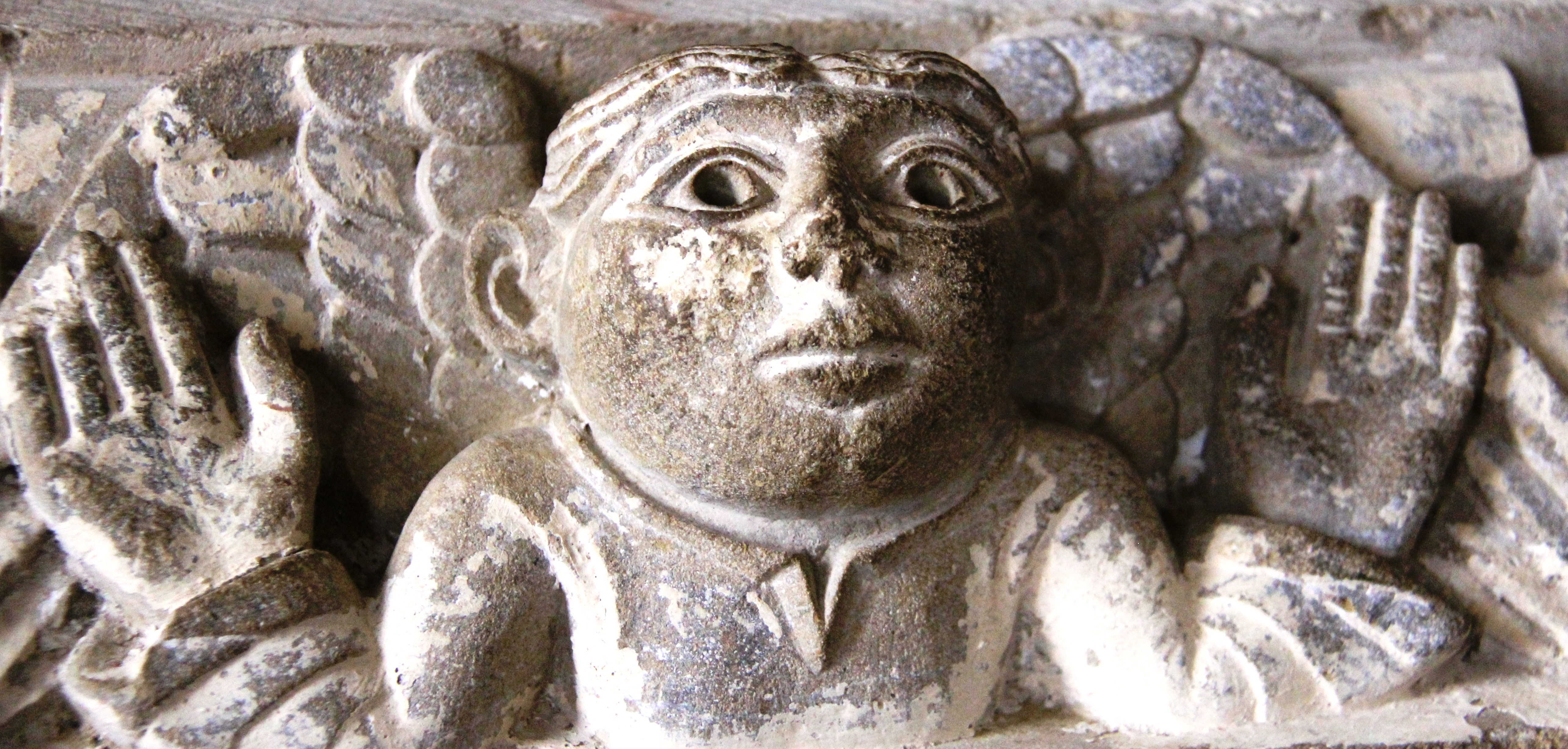
The Conques abbey Church has another attraction – windows designed by the French contemporary artist Pierre Soulages. These bear no resemblance to the usual church stained glass windows, but were designed to let light penetrate the grandiose yet somber structure. The Soulages windows, geometric shapes of glass of varying density, change color depending on the exterior light.
Models of Soulages windows in the Rodez museum.
Soulages was born in 1919 in Rodez, a Midi- Pyrénées town now a must for contemporary art fans. In May, the Soulages Museum opened with some 500 works of the renowned abstract artist who is known for his devotion to the color black.
Another artist, born some 150 years ago, was the reason for a visit to Chateau du Bosc. As a young boy, the famous post-impressionist painter, Henri de Toulouse-Lautrec who hails from nearby Albi, spent summers in the chateau. Today a distant relative gives fascinating tours of the grandiose medieval house which is her home. Nicole-Berangere Tapie de Celeyran, 89, tiny, frail, and slightly hunch backed, charges up the long staircases with the vitality of a teenager, visitors following behind. From the kitchen where she points out Lautrec’s sketches on the wall, she continues upstairs to a lavish salon and dining room, a bedroom, hallways, and then into the garden.
“I love to talk. I want to preserve this house, the spirit of the family,” she says. She also wants to show Lautrec mementoes and correct misconceptions about the legendary artist.
She embellishes the tour with stories passed on from her grandmother and other ancestors who knew the artist. Lautrec’s father and uncles often went hunting, I learned. They’d come back after an outing and relate tales of their adventures. Young Lautrec sat on the floor, using coal from the fireplace to make drawings of their exploits, she said. In his bedroom, the floor scattered with toys, she pointed out a boat Lautrec had made after his accident.
At ages 13 and 14, Lautrec had two bad falls resulting in broken legs which never healed properly. He stopped growing, reaching only 4 feet 9 inches. He developed an adult size torso, but child size legs and was unable to participate in sports. He immersed himself in art instead.
The chateau visit was ideal background for a visit to the Toulouse-Lautrec Museum in Albi.
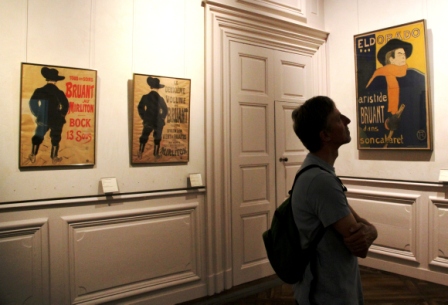
Lautrec’s cabaret posters have become synonymous with Paris and Montmartre, the area of Paris famous for its bohemian lifestyle and the haunt of artists, writers, and philosophers in the late 1800s. More than 1,000 of his works – paintings, lithographs, drawings, as well as the famous posters — are on display in the Albi museum which has the largest collection of his works in the world.
“What is important in a painting is the person. Landscape is secondary. That was his philosophy,” a museum guide said. He painted psychological portraits, and he understood advertising, hence the posters, she explained. Lautrec was an alcoholic and died at the age of 37 due to complications of alcoholism and syphilis.
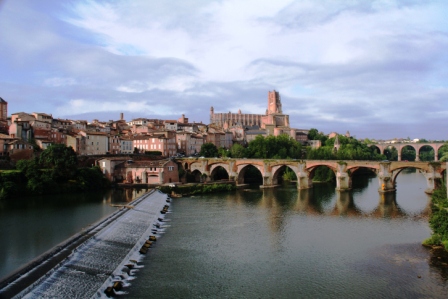
Albi, a UNESCO World Heritage site, hugs the banks of the Tarn River where it is spanned by an ancient bridge. The spires of the city’s mighty cathedral dominate the skyline for a scene almost too picture-perfect. The cathedral, Sainte Cecile, is the only cathedral in France that is still completely painted with the original 15th century paint still intact. During the Middle Ages, church interiors were painted although the paint on most has long since vanished. It survived here because the cathedral is very dark.
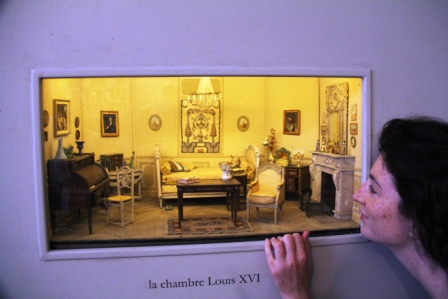
Albi’s museum of miniatures is curious if not incredible. It houses 55 miniature rooms all made by a 79-year-old woman who started the project 40 years ago. As a child she wanted a dollhouse, but she never got one. So, at the age of 39 she set out to make her own, room by room. The museum curator told us that it takes her from six months to a year to make one room. She is now busy making a miniature church.
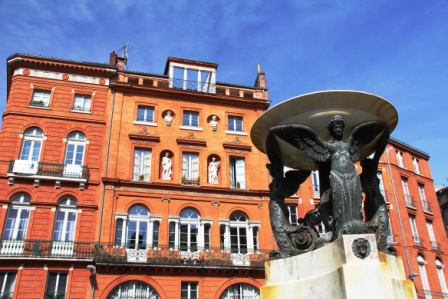
Toulouse, the capital of the Midi-Pyrénées and France’s fourth largest city, is also the European capital of aeronautics and the home of Airbus. The university city, often called the “ville rose” (pink city) due the bricks it produces which have been used in the construction of many of its buildings, is vibrant and attractive with magnificent churches, lively markets and excellent restaurants.
Saint Sernin Basilica, the largest complex of Romanesque buildings in the world, is listed as a UNESCO World Heritage site because it was a major stop en route to Santiago de Compostela.
The Jacobin Monastery, stark on the outside, is a marvel inside with famous and unique palm tree arches.
The heart of Toulouse is the Capitole, the city hall and its courtyard with a statue of Henry IV. The 18th century neo-classical façade of the elongated building dominates a large square that is always a hub of activity. Seats at one of its outdoor cafes are in demand.
The cuisine of southwestern France is legendary. For more about it, as well as well-known restaurants in the Midi-Pyrénées, see previous post, “Fabulous French Dining, a Post for Foodies.” I love to know what readers think about my posts, so please comment. See Leave a Reply below. And, don’t forget Today’s Taste, a recipe for Thai Green Beans, column at upper right. If you go…
Chateau du Bosc is located in Naucelle, 30 minutes by car from Albi. Madame Tapie de Celeyran gives guided tours only in French, but guided tours in English by other staff members who know all about Lautrec are offered year round from 10 a.m. until 7 p.m. If you visit, you are sure to meet Madame who loves to welcome visitors. + 33 (0) 5 65 69 20 83
The Hotel Mercure Albi Bastides on the banks of the Tarn has the perfect location for admiring – and photographing – Albi. Moulins Albigeois, 41 rue Porta, 8100 Albi, + 33 (0) 5 63 47 66 66 www.mercure.com/Albi
The Hotel Restaurant Hervé Busset, in a wooded setting on the banks of the lively Dourdou River just outside Conques, is a true delight. An old mill was transformed into an inn with a lovely riverside terrace for relaxing and/or dining. And, the food – fabulous. Busset has earned one Michelin star with his cuisine which makes use of plants and flowers from his garden. Domaine de Cambelong, 12320 Conques, +33 (0)5 65 72 83 91 www.moulindecambelong.com
Location, Location, Location – Toulouse’s Grand Hotel de l’Opera can’t be beat. Facing the heart of town, the Place du Capitole, the charming boutique hotel is located in a former convent of the 17th century. Place du Capitole, 31000 Toulouse, +33 (0) 61 21 82 66 www.grand-hotel-opera.com/uk
I recently had the good fortune to accompany other American journalists on a press trip to the Midi-Pyrénées region (southwestern France). Art and gastronomy were the focus of the voyage, and the gastronomy was extraordinaire with four and five course meals for both lunch and dinner on most days.
We savored cuisine at restaurants whose chefs are famous, restaurants with Michelin stars, as well as a few restaurants that were ordinary at best. We visited colorful markets and tasted the area’s wine. Following are highlights of our culinary experiences.
The week-long journey got off to a smashing start with dinner at Michel Sarran in Toulouse, France’s fourth largest city and the capital of the Midi-Pyrénées. The ambience in this two-Michelin star establishment named after its renowned chef is classy, elegant, modern. The food definitely wins stars for appearance and presentation. Each course (we had four) was a painstaking work of art with numerous bites of exotic creations, such as sea urchin mousse and hay ice cream.
Petite marmite basque, sauce Ttoro in unique bowl
As in most fancy French restaurants, the food descriptions are daunting. First course: La volaille de Monsieur Duplantier en crème onctueuse aux écrevisses, suprême poché au citron confit et raz el hanout, peau croustillante. Basically tiny pieces of chicken in a crayfish sauce with a delicious citrus flavor surrounded by delicate tidbits of other edibles. The main course was the overall favorite: Pigeon du Mont Royal (pigeon filet). The succulent bird was served with a tiny nest-like creation: Suprêmes frits en kadaïf et jus à l’encre – (a middle eastern cheese pastry with octopus ink), plus other petit delicacies.
Markets offered a profusion of berries.
For dessert, a wild strawberry melange with a lemon basil sauce, lime crumble and the hay ice cream (lait glacé au foin).
All very, very good. But we wondered if all that labor intensive preparation of so many different tiny bites wasn’t a bit much. Was the chef trying too hard to win a third Michelin star? I would have preferred fewer items served in slightly larger portions. http://www.michel-sarran.com
Lunch the following day at the outdoor terrace of Emile, a Toulouse favorite in the bustling Place Saint George, was a winner. Chef Christophe Fazan is known for both creative cuisine and local favorites.
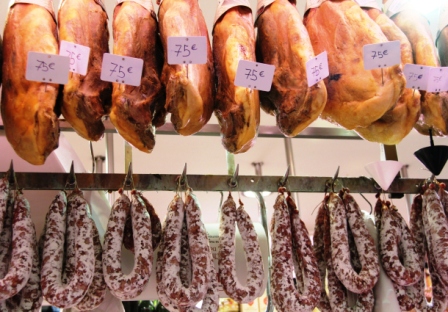
Hams and sausages are popular in southwestern France.
Foie Gras, the controversial fattened liver from force-fed geese and ducks, is a regional specialty. Several of my traveling companions ordered this served with mango chutney as their first course, while I chose ravioles de foie gras, crème aux cèpes. This was my all time favorite dish of the entire trip – ravioli filled with foie gras smothered in a cepe( bolet/porcini) sauce. Each bite was bursting with flavor. Elaine, our affable tour leader, went for Cassoulet, the signature Toulouse dish, a stew of meats, sausages and beans. Former French president Jacques Chirac is said to have especially enjoyed Emile’s Cassoulet. http://www.restaurant-emile.com
While Michel Sarran’s food was good, most of us preferred that of Christian Constant, another renowned French chef. His restaurant, Le Bibent, features glamorous baroque/art nouveau décor and great food. My first course, a tartare of several kinds of fish and oysters with a hint of ginger served in oyster shells, was excellent, and better than my main course, a confit of lamb. Confit or preserved meat is yet another regional favorite with duck confit the most popular.
An incredible dessert followed: a gigantic mille feuille. This pasty whose name translates as “a thousand leaves” is layers of thin, flaky pastry with custard in between. Constant’s version is enormous, yet light and yummy.
I was tempted to buy Constant’s cookbook in English. But, my shelves are already overloaded with cookbooks and my suitcase was already too heavy. http://www.maisonconstant.com/bibent/
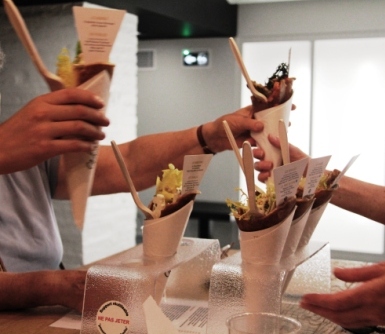
We were ready for a simple and light lunch the following day. Le Capucin, supposedly a gourmet fast-food eatery established by yet another famous chef, Michel Bras who has several restaurants which together have earned three Michelin stars, was the place. Sandwich type ingredients, albeit with some creative concoctions, fill edible cones which you eat like ice cream cones while sitting on high stools. A clever idea, but short on taste. A basic ham and cheese on rye would have been better. http://www.capucinbras.fr
We sampled more of Michel Bras’ cuisine and met the star chef at Café Bras, his newest restaurant in the new and stunning Soulages Museum, dedicated to the works of contemporary artist Pierrre Soulages, in the town of Rodez. Mixed reviews on the food here, although all were in awe of the first
Michel Bras
course, a light and creamy type of cheese soufflé. We requested – and were given – the recipe. The main courses were standard fare — a choice of veal, fish or beef — none of which excited the palate. But, ah…the dessert. As a chocolate lover, this got my vote as best dessert of the trip: le petit pot de crème praliné/chocolat croquant sésame. (a decadent chocolate praline cream). http://www.cafebras.fr
Most of us were not overly impressed with yet another star diner just outside of Rodez at Chez Isabelle (one Michelin star), but by this time perhaps we had
Isabelle won high marks for originality with this “eggplant burger,” but it was bland.
reached the saturation point with gourmet cuisine. I ordered Pressé de joues de boeuf et de foie gras au vin rouge, gratin de macaronis. (cheeks of beef with foie gras, red wine sauce and macaroni). Disappointing, and even without a star I can do a better job on macaroni. Chef Isabelle Auguy is one of the growing number of female chefs who have earned the coveted Michelin star. http://www.restaurantisabellesuguy.fr
There were a few other disappointments. The main course at a hotel meal sounded and looked exquisite: scallops (one of my favorites) atop a mound of risotto. Alas, the scallops were overcooked and the risotto was mushy. I am not
Scallops and risotto — appearance isn’t everything.
shy about trying unknown foods – all part of the taste experience. For lunch in the town of Conques, I bravely ordered the first course: gateau aux oreilles et pieds de cochon, vinaigrette à la moutarde (cake of pig ears and feet). The French let no part of an animal go to waste, but in this case, they should have. The cake was tasteless.
Not so the boudin noir (blood sausage) served with apples, onions and potatoes and rich in flavor at Le Clos Sainte Cécile, a lovely restaurant in the town of Albi where we sat in the garden under plane trees.
Dinner at the Hervé Busset restaurant won hands down as the favorite meal of this epicurean voyage. This was the trip finale with both an overnight and dinner at the one star chef’s hotel and eatery in a renovated ancient mill in a wooded setting on the banks of the Dourdou River just outside of our favorite town, Conques.
Black and White, lucky pet geese at Herve Buset. Their livers won’t end up on someone’s dinner plate.
Busset has a passion for nature reflected in his cuisine. Wild edible plants are used in the preparation of his food which is innovative, unusual, delicious. http://www.moulindecambelong.com
After a week of extravagant eating, I was ready for a Big Mac, but the zipper on my jeans told me it was time for starvation.
Comments welcome and appreciated. Today’s Taste features a recipe for Chilled Avocado Soup topped with Crab. My guests loved it!. See “Today’s Taste” at the top of this post. While you are up there, sign up to become a Tales and Travel follower.
Aligot, a puree of mashed potatoes and the local cheese, Laguiole.
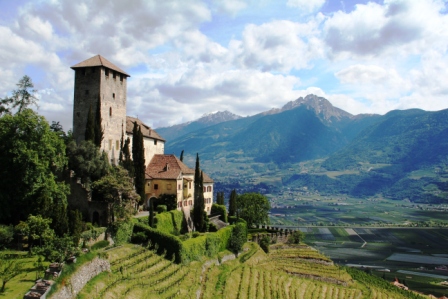
Signs advertising “Speck” everywhere we looked: along the roads, in shop windows, at street stands. ”Speck” is German for bacon, but we had just come down the mountains from Switzerland into Italy, not Germany.
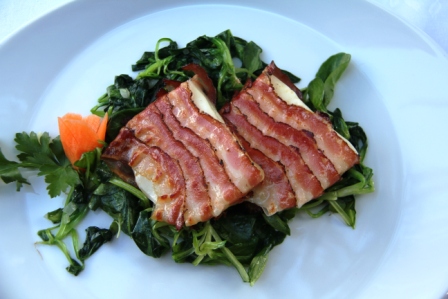
This was northern Italy, known as Sud Tyrol in German and Alto Adige in Italian. The majority of the population speaks German – and obviously eats plenty of Speck. Ordinary bacon this regional specialty is not, nor should it be confused with Italian prosciutto (ham). Speck is rubbed with herbs, spices and berries, smoked for different lengths of time with different hardwoods, and air dried in the area’s mountain climate. This makes it distinct, unique – the echt expression of the region.
Speckmantel gebratener Ziegenkase auf gedunsten Feldsalt (Goat cheese enveloped in Speck — yummy)
I was on my annual trip to research articles for the magazine German Life, with BB as my chauffeur, Sherpa and trusty companion. After a few days in Leukerbad, a Swiss spa town in the Alps, followed by a visit to Davos, we proceeded to this intriguing part of Italy.
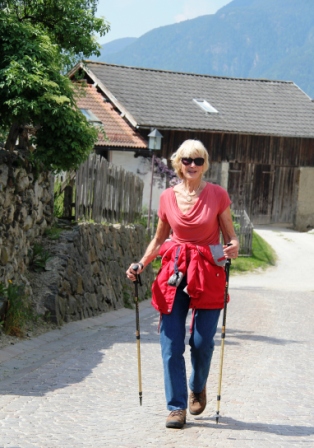
Since German predominates here, I’ll call it Sud Tyrol. Our travels took us to Merano, Bolzano, Brixen, and lovely spots in between. We found it all enticing and enjoyed two fascinating museums, picturesque hikes, the charming towns, some excellent meals and a wonderful hotel. BB, who sadly does not do much biking these days but is passionate about wine, was thrilled with the local vintages. I may have to change his name from Bicycle Bob (BB) to Vino Roberto (VR). Which shall it be?
Merano (Meran) is a marvel, a beauty of a town on the banks of the frisky Passirio River with fanciful flower beds, an arcaded shopping street and a spa center, all surrounded by mountains. The riverside summer and winter promenades (passeggiate d’Inverno and passeggiate d’Estate) – paths through woods, past flowers and tropical plants, with the sounds of the rambunctious river tumbling over rocks, are glorious. We stopped to watch a kayaker practice on surging rapids.
“North and south meet here. It’s the best of two worlds,” said our Bolzano city guide, Luciano Rech, who filled us in on the region’s history. Sud Tyrol was part of the Austro-Hungarian empire until World War I during which Italy initially remained neutral. In 1915, as an incentive to enter on their side, the Triple Alliance (Germany, Austria and Hungary) offered Italy a chunk of land, all territories south of the Alpine water divide regardless of the ethnic makeup of the regions. At the time, 92.2 per cent of the population was said to be ethnic Germans. In 1919 the territory was annexed by Italy, and has been Italian ever since, with the exception of the years 1943-1945 when it was de facto annexed to the German Reich until the fall of Germany. Both German and Italian are considered official languages.
It has not always been a peaceful co-existence, marred at times by repression and terrorism. During the 1930s and again in the 1950s Italians were forcibly resettled to the region. According to the 2011 census, German speakers make up 61.5 percent of the population, Italian speakers, 23.1 percent, and 4 percent speak Ladin, an ancient language derived from Latin. All seems peaceful, and the region has a significant degree of autonomy. However, there are still some who resent being under the yoke of Rome and argue for independence.
“I’m Tyrolean” announces Rech. “I don’t feel we are the same as people from Naples, Rome.” Many others I spoke too echoed his sentiments.Bolzano (Bozen), a bustling city and the capital of Sud Tyrol, is the home of Ötzi, the mummy of an Iceman discovered in
Recreation of Otzi
1991 in the mountains at the edge of a melting glacier. The museum where he is preserved behind glass is a must with enlightening exhibits of garb and objects that were found with him. And, extensive documentation, including videos, on the sensational find and what has been learned from and about Ötzi. He died 5,300 years ago after having been shot by an arrow, presumably murdered.
Famous mountain climber Reinhold Messner (first solo ascent of Mt. Everest without supplemental oxygen) has created the Messner Mountain Museum outside of town on the slopes of a mountain and in the ruins of a castle. It’s a genuine mountain experience, with lots of steps (I felt we were back in Myanmar), skinny walkways, metal ladders and fabulous views. Follow the itinerary in and out of buildings, up slopes and towers, across bridges, past exhibits on his climbs, mountain terrain, Himalayan artifacts and more. Messner, who is a native of Brixen in Sud Tyrol, has established four other mountain museums in the province.
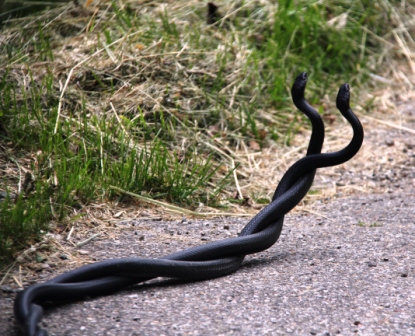
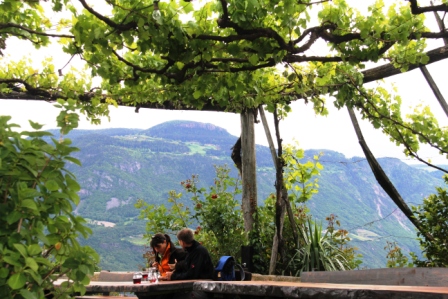
En route to Bolzano we stopped for an overnight so we could take a hike in the hills and soak in the scenery. We trekked amongst grape vines and apple orchards, and stumbled upon some sexy snakes. We had a wonderful lunch at an eatery under an arbor of grape vines with gorgeous views. The food, especially the apple strudel, was definitely more Germanic than Italian. The proprietors also sell wine, so of course we tasted and bought.
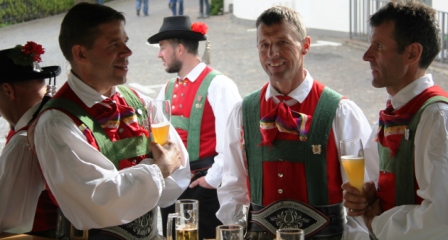
Unfortunately we did not make it to the mighty Dolomites which are part of the province for some real mountain hiking. After Bolzano we spent two nights at an inn, the Ansitz Zehentner, in the town of Lajen (Laion) where a rollicking fest was underway when we arrived. Women in dirndls. Men in trachten (traditional costume). Plenty of beer. And, blasen music (wind instruments). We could have been back in Germany.
Frau Schenk, proprietor of the inn which dates back to 1358, suggested a hike through fields and forests to a well-known hotel and restaurant , Gasthof Ansitz Fonteklaus. Sitting outside under mammoth trees amidst the mountain scenery was perfect — and so was the food.
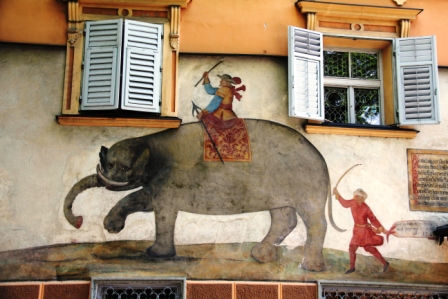
Our travels ended in Brixen (Bressanone), another gem of a town, where we splurged and spent a night at the classy Elephant Hotel with an excellent dinner in the hotel’s noted restaurant. The 450-year old hotel has been run by the same family since 1773. It was named after the pachyderm which was sent by Suleiman I to Archduke Maximilan as a gift in 1551. The elephant had a long journey from India, to Portugal, then Genoa and onto the Alps where it rested at the inn in Brixen, causing a sensation among the locals who had never seen such a beast, en route to Vienna. The elephant fresco on the hotel’s façade was painted many, many years later by someone who had never seen an elephant but based his rendering on descriptions. What happened to the well-traveled elephant? I learned that after the epic journey it only survived another two years.
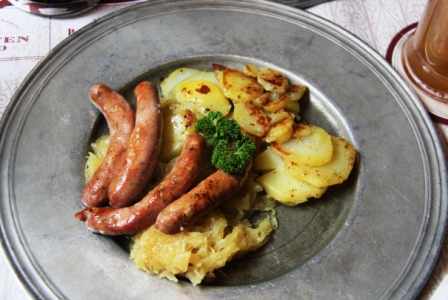
Before heading back to France I stopped at a butcher shop and loaded up on some very savory sausage — and Speck.
Comments welcome and appreciated. Today’s Taste features a recipe for Rhubarb Streusel Pie. If you like rhubarb, you’ll love this. See “Today’s Taste” at the top of this post. While you are up there, sign up to become a Tales and Travel follower.
Trip finale — dinner in the romantic Hotel Elephant dining room.
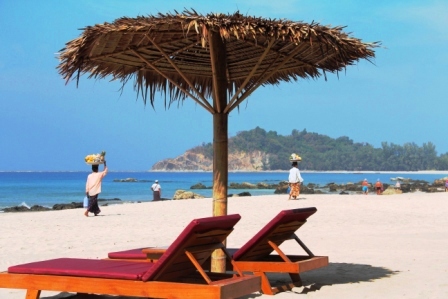
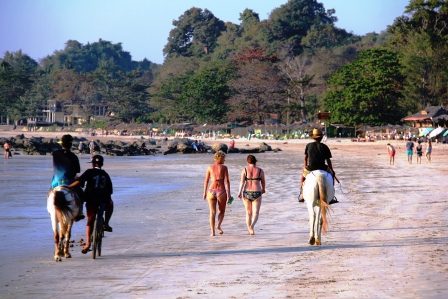
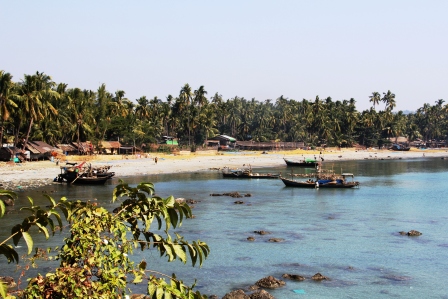
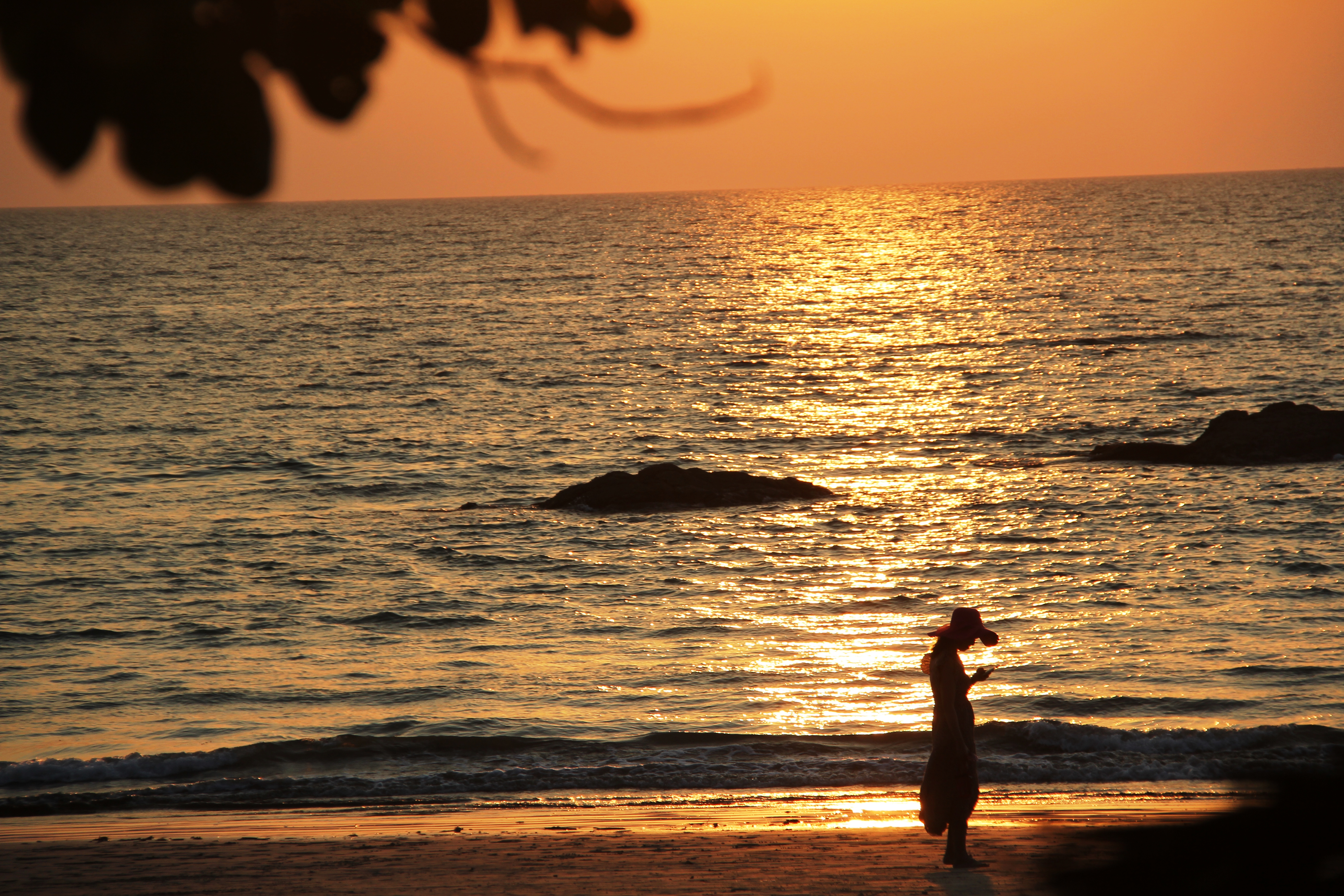
A long, broad strip of sand, a calm sea, a few lonely swimmers, a few more sunbathers lounging in beach chairs, tranquility: Myanmar’s Ngapali Beach is unspoiled splendor.
After our two-week sightseeing tour of this fascinating land (see previous posts: Burma Background and Myanmar’s Astonishing Sights), we sought seaside relaxation.
Our beach hotel, one of many luxury resorts here, offered a spacious sea-front room, pool, outdoor dining on a terrace above the beach – all in a perfectly manicured verdant setting.
luxury beach hotel–but not ours.
This is Myanmar for tourists. Just outside the hotel grounds is reality: rutted, dusty roads, primitive shacks, broken down temples, wild tropical vegetation. Plus, lots of motorcycles, women walking with burdens balanced on their heads, noisy kids, homeless dogs, monks draped in burgundy, nuns in pink…
While the hotel world was paradise perfect, we left the sanctuary several times to explore the real world. First, a trip by “bus,” a rickety tuck-tuck type vehicle with two parallel hard wooden benches for seats, passengers crammed together. The “bus” sped over the ruts, passengers holding on to anything for support while bouncing up and down, jolting to and fro. There were many stops, and not just for passengers to get on and off.
We stopped to pick up a few huge sacks of ice at an ice factory where a vintage machine crushed big ice blocks. The sacks were piled in the middle of the two rows of bus passengers. Then a gas station for a wee bit of petrol. And, stops for giving donations. In Myanmar, a country of devout Buddhists, it’s common to see folks along the roads with large silver colored bowls. These are for offerings for monks. Passers-by often stop and throw in some money. The bus stopped to oblige those wanting to contribute.
Nuns wear pink.
A woman with a bucket of live squid sat next to me. Another had a few eels on top of a pail of ice. Most had large parcels. Young men jumped on and off at random, hanging out the back of the vehicle. I was intrigued by the scene, but, BB (husband Bicycle Bob) seemed in agony and was all too happy to finally reach our destination, the inland town of Thandwe, after a 45-minute painful ride. I wanted to visit the town’s market in search of souvenir bargains. Alas, this was just a huge, chaotic, smelly market of produce, clothing, hardware. We did buy some fruit, a bathing suit for BB, some instant coffee, cookies, soft drinks and a couple of bottles of beer – all for less than $10.
Souvenirs for sale on the beach– but not in town.
There are no taxis in these parts. BB was not up for a return bus ride. We walked all over town, looking for someone we could persuade to give us a ride for cash. Finally the driver of an old and dirty station wagon agreed after his friend, who understood our request, translated.
Unfortunately the bus ride did a number on his BB’s butt. He is skinny – no padding, and ended up with rear end welts. The salty sea water only enhanced the pain. Since he is not a swimmer, he did not seem to miss forays into the water.
I did myself in with a bargain priced all-body Myanmar massage. Huts whose proprietors offer all kinds of massages for less than $10 are profuse at one end of the beach. My masseur, a slight fellow with the power of an Olympic weight lifter, pounded, stretched and jerked my body for an hour. Not pleasant, especially since I had sore ribs. On the last day of the sightseeing trip I fell, my ribs landing on my hard camera. The massage finished off the rib injury. Moving my arms was agony. I could no longer swim – my second favorite sport after skiing.
So, we walked along the beach, went to a “cooking school,” and rented bikes. BB, a bicycle aficionado, was not happy with the bikes, simple, ancient models, but there was no choice. The ride – even more ruts than on the bus ride. We pedaled to a nearby town, a wreck of a fishing village. We saw where much of the factory ice ended up. Trucks loaded down with the heavy bags pulled up to a wharf of sorts. Men loaded as many as five of the bags on their shoulders and headed down a jetty to the boats.
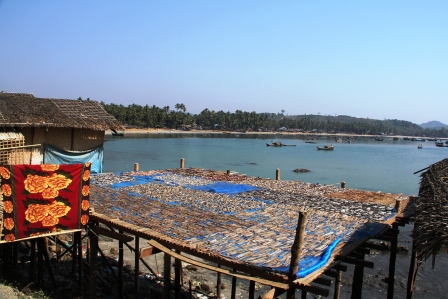
Along our bike route we passed areas blanketed with plastic sheets upon which fish baked in the sun. Dried fish are a staple in much of Myanmar cuisine. While we love fish — the fresh variety which was plentiful and delicious here — the stench of the dried fish was a bit much.
BB’s butt was still sore, so he passed on a snorkeling trip. I gave it a try since more leg than arm movement is involved in snorkeling. I was the only passenger in a simple motor boat driven by a man and his young son. The snorkeling was a disappointment – few fish. But, the ride was interesting, with a stop at a
Mini island
miniscule island with a mini restaurant selling food and drinks at inflated prices.
The women who ply the beach selling fruit from the baskets on their heads have also learned to inflate prices. Why not? If the tourists are dumb enough to pay… But, when one wanted to charge me more than $2 for three small bananas and $3 for a mango, I refused. Bananas are like peanuts in Myanmar – profuse, and I can buy a tropical mango in France for $3 or less.
Except for the soothing sounds of the sea slapping the shore, the only beach sound is these fruits sellers advertising their wares. They saunter up and down, past all the hotel lounge chairs, calling out in sing-song tone, “Ming guh la ba (hello), pineapple, banana, coconut.” It was like a ritual chant.
On one of our walks we had seen a sign in front of a rundown restaurant advertising cooking lessons. We liked the food in Myanmar. Since I love to cook, why not sign up? The kitchen was a health inspector’s nightmare, but our two instructors, neither of whom spoke English, washed their hands frequently. They chopped, sliced and diced with professional skill. The resulting meal was excellent, especially the avocado salad (see recipe in column at right).
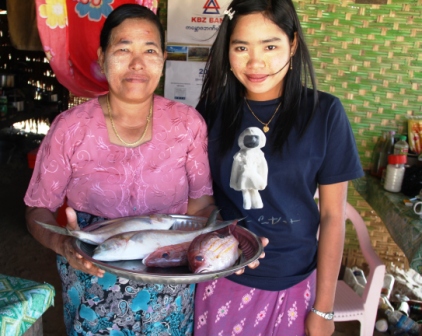
In addition to the beach massage “parlors,” food shacks are lined up along one part of the beach with tables in the sand. We became regulars at one run by a couple and their niece, a friendly young girl who spoke a bit of English and helped me master a few words of Myanmar. I had befriended one of the numerous homeless dogs and wanted to buy some food for it. I tried several beach eateries. All refused to sell me chicken pieces for a dog, except this one, hence we gave them our regular business.
The man was the chef. I asked to watch him prepare fish over an open fire in his tiny, rustic kitchen and picked up a few tips. For a beach finale dinner, we splurged on lobster. Perfect, and my friendly dog even appeared to bid good-bye.
Myanmar is on the move, emerging from decades of isolation and repression. Tourism is booming. Roads, including the one to the Ngapali beach resorts from the nearest airport, are being improved. Soon there will be quality bikes to rent and Cordon-Bleu type cooking schools at the beach. Throughout the country, new hotels are under construction. People are learning new skills, including English, to qualify for jobs in the tourist industry. According to an official estimate, the hotel and catering industry could create over a half million jobs in Myanmar by 2020. Lives will improve. But, hopefully the rapid rise of tourism will not destroy the allure of Myanmar, a place Rudyard Kipling found “quite unlike any place you know about.”
See below for more photos. And, for a different take on ratatouille, try Lecso, a Hungarian version mentioned in my recent blog post, Swiss Slopes Welcome Journalists. Click on photo at right for the recipe. Comments and new subscribers welcome. Add your email address at top right to receive future posts.
Village school along our bike route
Visiting monk from Thailand where monks wear orange.
 It’s officially over. It makes me sad, even though summer 2014 was not a normal Provence summer. Thanks to climate change, we had thunderstorms and cool, cloudy days. Too much wind and rain. The latter had a plus. July and August days are usually hot and sunny with almost no rain. This year we saved both money and time on watering all our flowers and trees. Still, I would have preferred a real summer.
 their opening times. I am still swimming, but that too will come to an end before long. Tomatoes — those tasty gems I buy from farmers at the markets, will soon disappear and we will left with those tasteless Dutch hothouse tomatoes at supermarkets. Fall and winter are for cosying up with the cats by the fireplace — not as exciting as summer, but not so bad.




 Cannes on the Riviera was our destination for an event sponsored by the American Club of the Riviera – mind-boggling fireworks shot from boats in the harbor. We spent the night in Cannes and enjoyed a visit to the off shore island, Sainte Marquerite, the following day. Gorgeous. On the way home, a quick dip in the Med at Theoule-sur-Mer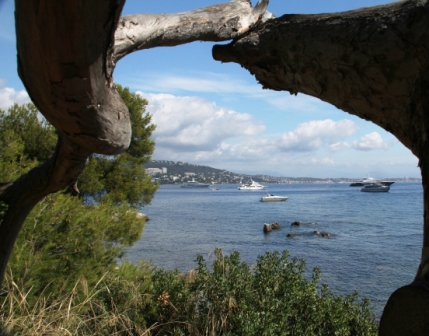



























 Tales and Travel