FOOD:  GLORIOUS CHRISTMAS FOOD

Forget the tree and presents.  Of course, they are important. For foodies like me, however, it’s food that makes the holidays especially tantalizing, delicious, rewarding.

An overload of Christmas desserts in Portugal.

Eggnog, Christmas cookies, fruit cake, turkey, standing rib roast and baked ham are among American holiday treats. What about other countries? What do their citizens savour during the holidays? I asked several non-American friends about their Christmas food traditions.

GERMANY : “It must always be fish on the 24th,” says my German friend Andrea. She prefers salmon and roasted potatoes.  Andrea, an excellent cook, seasons the fish with salt, pepper, rosemary, a bit of wine, and rubs it with oil, then roasts it. Delicious, and not a lot of work. Her father went for carp on Christmas Eve. 

On the 25th, it’s venison goulash with priselbeeren (similar to cranberries) and dumplings for Andrea, husband Thiemo and her mother, Tekla. In many German households, roast goose is the Christmas highlight. When I lived in Germany, I tried it. Good, but tricky. It can easily dry out. The array of German holiday sweets is almost decadent: Stollen, homemade cookies galore, gorgeous cakes. Lebkuchen, a type of gingerbread cookie, are ubiquitous.  

In FRANCE where I now live, the Christmas Eve Réveillon is the meal extraordinaire.  It could begin with champagne and oysters, although these are popular throughout the holiday season.  If not oysters, perhaps a mixture of shellfish or smoked salmon.
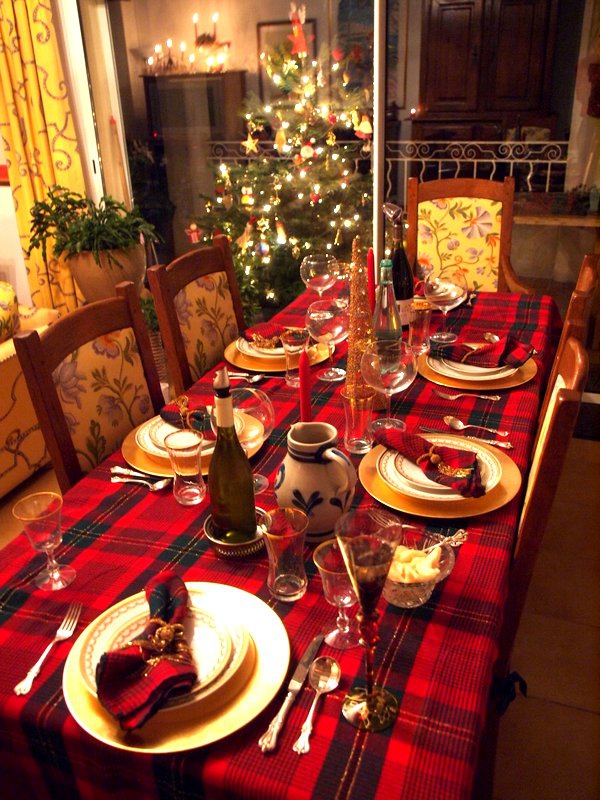
My Réveillon table – many years ago

Foie gras is also de rigeur, although controversial.  Geese or ducks are force -fed during the last weeks of their lives to yield extra-large livers. 

I love animals, but I also love foie gras.  Many years ago, for article research I spent a day working at a goose farm. The geese did not resist the force feeding.  Their owner insisted it was not cruel.  This was a beautiful farm.  The geese were free ranging until their last days.  However, not all geese and duck farms are like this. 

I even took a foie gras cooking course and learned to prepare the delicacy which I did for Christmas guests.  Those days are over.  Now I feel guilty eating foie gras, but I do indulge in a wee bit at Christmas.

Turkey, or another bird such as capon or guinea fowl, can take the spotlight at the Reveillon dinner.   A Buche de Noel (Christmas log), a fancy cake in the shape of a log, caps off the meal. 

In ITALY, Cinzia tells me, after midnight mass on the 24th, all return home to open presents and enjoy Panettone, the Italian holiday cake, with a glass of sweet wine.
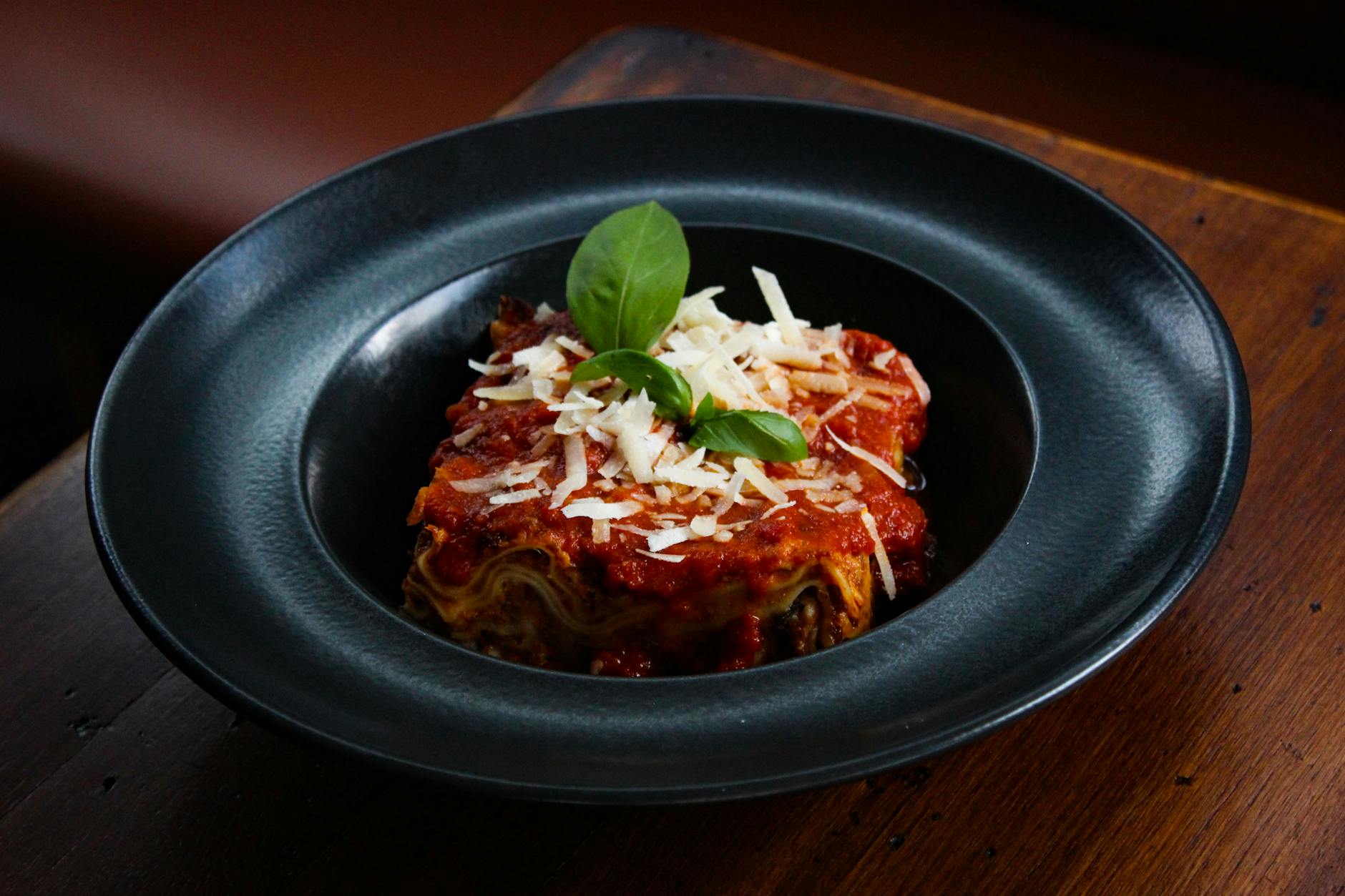
As in many countries, the customs can vary with regions.  She hails from Piedmont, the north, where Christmas lunch on the 25th is the major event. As this is Italy, there’s a pasta course which, at Christmas, is usually homemade stuffed pasta, such as tortellini or cannelloni.  Her favorite is her mother’s lasagna.  “Now people eat it all the time,” she says, but formerly it was reserved for Christmas and special occasions. Roasted lamb, beef or the holiday special, zampone  (stuffed pig’s feet) follow the pasta. 

For Cinzia, the Christmas meal represents “the fact of feeling part of a family which was there for you year after year, the (illusory) idea that, no matter what would come, every year the family tradition of eating what she was cooking would perpetuate, it’s about a sense of belonging and ‘safety'” 

Arabella (back to camera unfortunatley) leads her pupils in Christmas carols

Like Cinzia, Italian Arabella says her favorite is Panettone.  But, at her house the major feast is on Christmas Eve featuring some type of meat. That’s fine for her husband and daughter. But, she’s a vegetarian and will also prepare ravioli stuffed with spinach and ricotta. She is also a big fan of an Italian Christmas chocolate, Cri Cri, with hazelnuts and praline.

ROMANIA: Romanian Florin remembers childhood Christmases in his country where carnati (smoked sausage) is a holiday must. Preparation in country villages begins on December 18 when neighbors gather outdoors to kill a pig, then cover it with hay and set it afire.  Gruseome! Florin even remembers killing the pig once. The cooked beast is divided into parts.  All work together to turn out the tasty sausage.

Killing the pig is illegal today, but Florin says it probably continues in some areas. Those who are not up to the carnati labor, not to mention killing a pig, can purchase the ready-made sausage. Other Romanian Christmas musts are sarmale (stuffed cabbage) and cozona, a light “puffy” holiday bread.

PORTUGAL:“We eat a lot at Christmas and Easter, a lot of different things,” Portuguese Catarina says. “We have a full table of food. It’s too much. We don’t eat it all.” For Christmas Eve dinner, potatoes, carrots, the famous Bacalhau (boiled, dried salted cod), and more fill the table. Her favorite, however, follows the next day, roasted octopus at lunch.  She hails from northern Portugal where roasted goat is also common on the 25th.
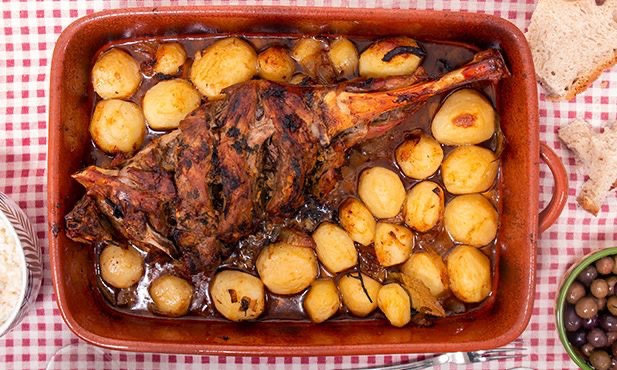
Roast goat takes center stage on many a holiday table in Portugal.

But it’s the desserts that shine – many, many different treats.  She admits they are very rich and sweet, and she is not fond of all.  “But I love to see and smell them.  That’s Christmas.”  

She’s right. It’s not just the taste, but the enticing aromas and beautiful presentations that enhance holiday food and make it special. And — friends and family. “Christmas is to be at the table with family,” Catarina adds. Enjoy.

Happy Holidays and Bon Appetit to all.

Scroll down for more holiday photos

My German holiday decorations.

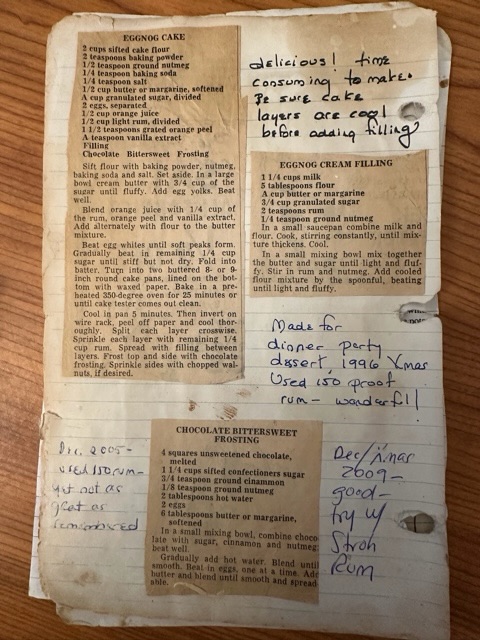
I’m old and so is this treasured Christmas recipe. Long ago I clipped recipes from newspapers and magazines. This one is a winner. Read my scribbled notes. I always go for recipes with a bit of booze. Rum makes this cake.
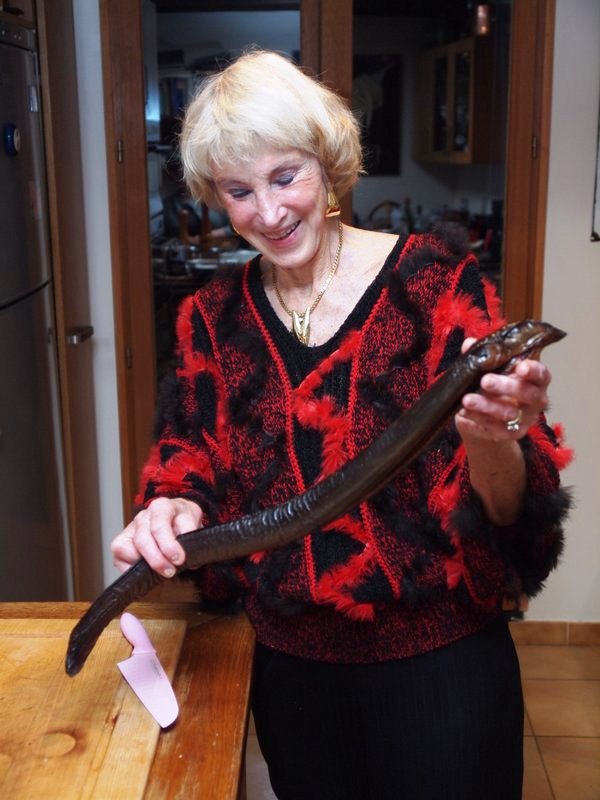
Smoked eel (exquisite) was a treat at one of my long-ago holiday dinner parties.
British friends brought “crackers” and hats to this holiday dinner years ago.
My poinsettia

Coming soon, a guest blog by Swedish friend Lars on the Julbord, “the king-sized jumbo version of the famous smorgasbord.” It’s a food orgy, a mind-boggling, lavish assortment of tastes -and plenty of vodka. Don’t miss it.

If not a Tales and Travel follower, please sign up here. Trust me. It’s safe. Your address is not shared.

Check out my tried and true recipes — keep scrolling down on a phone, or, if on a /PC or tablet, up to the column on right then down to “Recipes.”  I will add new recipes soon.

Cooking with a View

This was a cooking class like no other –and I have been to many.  The setting: 
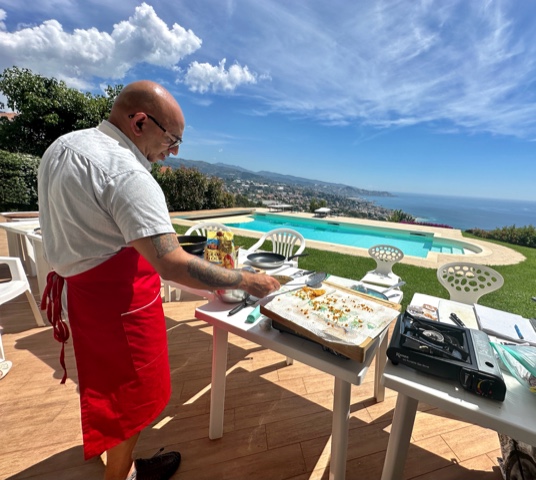
A precise row of seven white plastic tables and chairs on a terrace overlooking a sumptuous pool with the Mediterranean and the Italian town of San Remo below. Breathtaking.  How was I supposed to concentrate on dicing garlic in this seductive ambiance?  I wanted to stroll around, sink my feet into the thick grass blanketing the hillside, explore the gardens, take photos.  A swim would have been a delight, too.

But we, myself and five others, came to conquer Indian cooking, that is several specialties of this spicy cuisine.  We were at the home of Jeryl, the American founder of the Benvenuto Club of San Remo which sponsored the event.

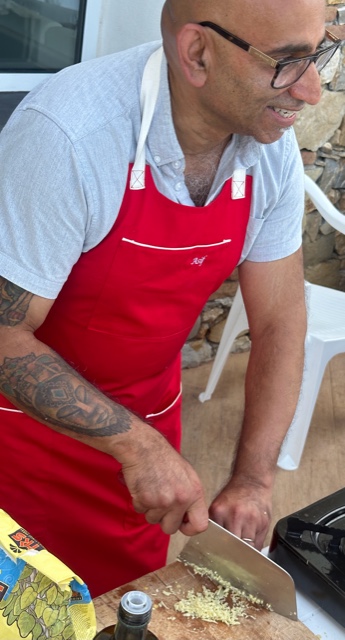
Our teacher: energetic Asif who calls himself “Anglo, Afro, Asian.”  He was born in Tanzania of Indian parents, but as a child moved with his family to England.  He and his Italian wife Cinzia, a yoga and dance teacher, now live in Italy where they work together on events.  He also teaches drums, in addition to “vegan cooking,” often with Cinzia. 

The day began with chai, tasty tea with milk and the distinctive flavors of cinnamon and cardamom. “I will give you the skills, showing how to chop… We will move forward from there,” he said, as we enjoyed our morning chai. 

“Cooking is smelling, tasting and feeling.  Also, memory.  Food creates memories.” As the day wore on, we did lots of tasting.

We prepared five different dishes, beginning with potato pakoras, a common street food in India, and tamarind chutney.  Most were favorites of his “Mum, ” and he often referred to her techniques. 

He mixed up the pakora batter using gram flour which is made from black chickpeas, and water, whisking until ribbons formed.  He then added cumin and garam masala.

We each had a potato to peel and slice very thin.  He demonstrated the way to position the knife, tip pointed downward.  “Let the knife do the work.”  My slices were not that skinny.   I compared them to those of my friend Kate at the table next to me.  Hers looked perfect. Damn.

Ludovica, center, and her mother Jeryl watch pakora preparation.

Asif heated a large frying pan half full with oil.  “Don’t let it smoke,” he cautioned.   

The fun, messy part –dipping each potato slice in the gooey batter to thoroughly coat.  We used his batter to coat our slices, which also coated our hands, then one by one dropped the slices into the hot oil. 

Make a double batch, he suggested.  They are so good you will eat them as they are cooked.  We couldn’t resist, taking  one then another from the finished batch. When all were cooked, we moved on to tamarind chutney. 

This requires a jar of concentrated tamarind paste, available in Asian stores.  The prep is simple.  Just add water, salt, sugar and chili powder to the paste in a pan and bring to simmer. Stir and taste until you have a perfect balance of sweet and sour.  Here is where tasting is essential.  You may need more sugar.  You may want to turn up the heat (as in taste). 

Before moving on to curry, we took a break to savor more pakoras with the chutney.  The combo was a delicious hit with all.

Ginger and garlic are the base of curry, Asif told us.  We had to dice both as well as an onion.  He demonstrated nifty techniques to simplify the procedures.  Sharp knives are essential.  We had been told to bring chopping knives, a peeler and a large frying pan.  He used his steel to fine tune our knives.  Unfortunately, mine needed more serious sharpening.  I’ll add that to my never-ending to-do list.

He emphasized the importance of a very fine (tiny) dice of garlic and ginger lest you come across a chunk when eating the curry. Again, Kate outdid me with miniscule bits of garlic and ginger.  I was jealous.  What is her secret?

She explained that her husband cooks and she does the prep. Dicing and slicing are tasks which she has perfected. I have never had the patience for perfection, nor did I think a piece of ginger or garlic would be so bad.

Cooks at work

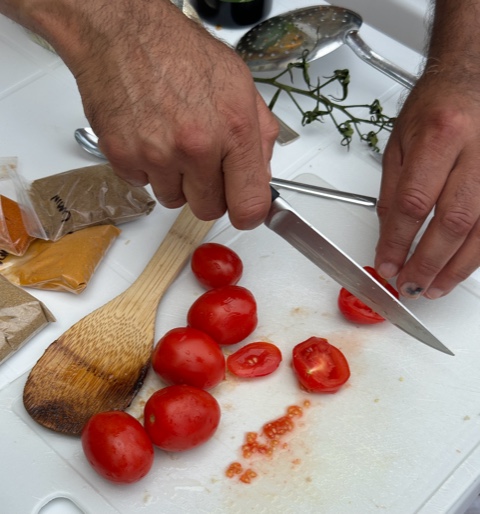
We each had a portable gas stove with one burner on our table. We were given pots to cook the curry which began with caramelizing the onions in oil.  To prevent burning, small amounts of water were added as needed.  Then came the ginger and garlic which cooked briefly before adding cut up tomatoes — and spices.

We had been given five small plastic bags, each containing a different spice:  garam masala, coriander, cumin, basaar (an extra hot Pakistani curry powder) and turmeric.

“In Italian cooking you get amazing flavors with four ingredients.  In Indian cooking you can use 13 or 14 different spices,” Asif noted.

After the curry mixture simmered for what seemed like a long time, chopped spinach and chickpeas were added for more simmering, this time with the pot lid on.  Throughout the process, we tasted, ours and the curry of others. Seasoning was adjusted accordingly.

Kate gives her curry the taste test.

While the simmering continued, we struggled with chapatis (flatbread):  mixing the dough, kneading until clumps formed, breaking off chunks, forming into small balls, and, with a rolling pin, flattening the balls into circles.  Our dynamic teacher showed us an easy method to roll and obtain perfect circles.  Kate mastered it. I failed. My chapati looked like amoeba on steroids. 

Asif then showed us how to cook the circles (or giant amoeba) in oil in our frying pans.  He also prepared rice, sharing his secrets for a perfect result.

 It had been a long day of cooking. We were hungry. We sat around a large round table and enjoyed our culinary creations: spinach and chickpea curry with rice and chapati. There were ample portions of curry to take home.

I was not the star of the class, but I had an enriching, delightful day.  I picked up some helpful tips and relished the ambiance.

Back at home, since I am neither a vegan nor vegetarian, I added pieces of sauteed chicken breast to my curry mixture. Shame!  It was tasty, and Asif was right. The curry tasted better the second day.  The flavors of all those spices had mellowed 

“Food to me is joy,” he said.  “It brings smiles to people’s faces.”

We were all smiles after a fun day of learning, tasting, and eating, especially with that spectacular view for inspiration.

Cooks’ view: San Remo and the Mediterranean

For more recipes and how-to demos, see Asif and Cinzia on You Tube.

Another cooking adventure: Read about my experience at Cordon Bleu

If not a Tales and Travel follower, please sign up here. Don’t miss future posts.

Check out my recipes here