With its gorgeous landscapes and numerous attractions, Provence is a Mecca for tourists. French. British. Dutch. Belgians. Asians. Russians, and many more.
Hilltop Gordes — the quintessential Provence perched village.Friends and relatives who come to visit us in the Luberon hills also enjoy the allure of Provence. Carol and Noel, friends from Germany who have retired to northern Italy, arrived in early October. Soon after came John and Mickey, VR’s (husband Vino Roberto’s) brother and sister-in-law from northern Ohio.
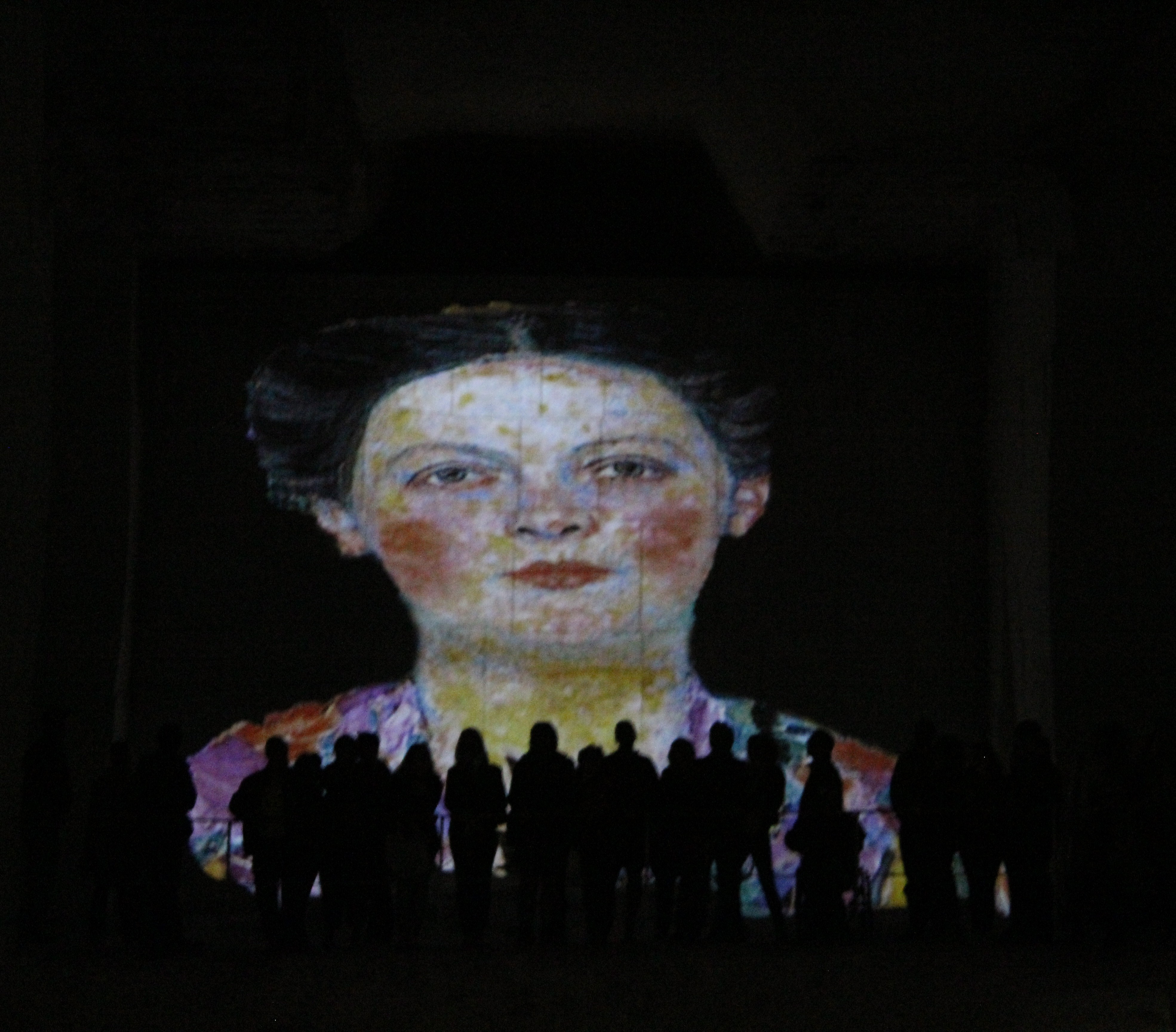
We kept on the move and had fun showing off our Provence favorites. A hit with all was Carrières de Lumières in Les-Baux-de-Provence. Words fail to describe this amazing place –vast caverns, formerly quarries, where a unique multimedia presentation enthralls all. The show changes every winter.
“Klimt and Vienna” is this year’s show, ending Jan. 4, which features the works of turn-of-the-century artists Gustav Klimt and Egon Schiele, plus Fritz Hundertwasser, projected on the walls and floors. Wander through the immense space, engulfed by the gigantique tableaux. Enjoy the mesmerizing musical background.
“Klimt is now one of my favorites. The show is awesome. I could have just sat there all day looking at the images,” said Carol. We, too, are overwhelmed with the production and return every year to see the new show.
The ancient town, Les-Baux-de-Provence, with its medieval château, spectacular views and boutique lined cobblestone streets, is also captivating. ”I’ve been to a million of those cutesy towns that have become little more than amusement parks. Les Baux seemed, to me, to have retained some of its soul,” commented Noel.
Mickey was especially intrigued with the site where the ruins of an 11th century citadel dominate a plateau perched on a rocky spur. She listened to the explanations on an audio headset at each numbered stop throughout the historic site. “I love castles,” she said.
Carol and Noel were also impressed with Roussillon, a touristy town whose attraction is its Sentier des ocres (ochre footpath). A trail descends into a gorge of orange/yellow walls, then winds through the woods bordered by these exotic, colorful cliffs. The area was also formerly a working quarry.
Carol and Noel and Bouillabaisse.Noel had made a special request . He remembers a scene in the movie, “In Like Flint” with James Coburn, during which Coburn savors Bouillabaisse, Marseilles’ signature dish. He had to eat this legendary fish soup in Marseille. I did some
Bouillabaisse is much more than fish soup. A plate brimming with different kinds of fish comes with the soup. Carol ordered the deluxe version with lobster.restaurant research to find a place serving authentic Bouillabaisse. Many restaurants have a version for tourists. My find, Le Ruhl, has a perfect setting on a hillside just adjacent to the Mediterranean. Great views – but the food? OK, but not great. Next time I’ll try another restaurant for Bouillabaisse
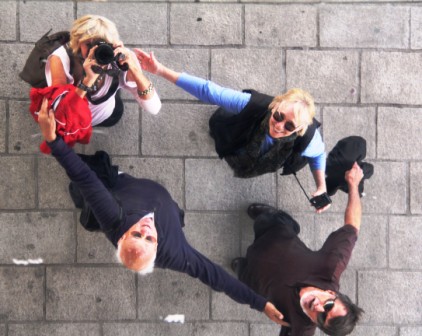
Selfie, of sorts, under the new, giant mirrored canopy at Marseille’s Vieux Port.Before lunch we had hoped to take a boat ride of the calanques (dramatic fjord like inlets in the limestone cliffs between Marseille and Cassis), but due to the fierce Mistral which blows too frequently in these parts, the boats were not running. We braved the winds and took a long walk through the Vieux Port, then on to the J4 Esplanade, Marseille’s swanky new addition for 2013 when the city was the European Capital of Culture. I never tire of admiring the dazzling architecture of the new Villa Méditerranée and MuCem ( museum of Mediterranean and European culture).
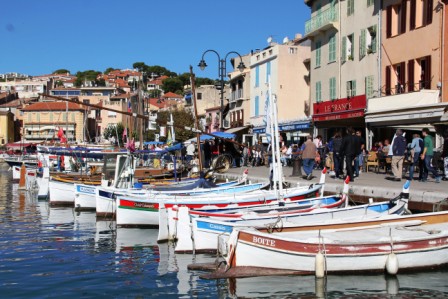
Mickey and John did get to see the calanques. On a delightfully calm day we boarded the sightseeing boat in the enchanting port town, Cassis, for the excursion through parts of this dramatic coastline. It was market day in Cassis with vendors selling clothing, food, purses and all manner of souvenirs.
Markets are a major Provence attraction. Mickey accompanied me to Forcalquier, a town near our home known for its big Monday market. “I loved the shopping you did at the outdoor market,” she later said. “ I really liked that you were able to purchase fresh fruit, vegetables, produce, eggs, fish and sausages direct from the farmers the same morning they were picked. I enjoyed listening to you get a better price for the shawl/cape you purchased, especially after the seller informed you this would be the last time he was going to be at the market with his items.” (It was a coat I could have done without. But when my bargaining was successful, I could not resist.)
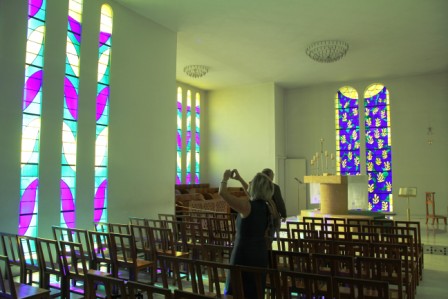
Although photos are “interdit” at the Vence chapel, many manage to get a shot.VR and I recently joined the American Club of the Riviera. Their October agenda included an event during Mickey and John’s visit I knew we should not miss – a tour of the Henri Matisse Rosary chapel in hillside Vence above the Riviera. A documentary, basically an interview by American Barbara Freed with the late Sister Jacques Marie, the nun who played a major role in the realization of this unique structure, preceded the tour. Freed has translated the nun’s book about her relationship with Matisse into English and served as director of the documentary. She was on hand with more fascinating commentary. It’s an unbelievable story – the deep friendship between this renowned artist who was not religious and the Dominican nun, and how she influenced, inspired and encouraged him on the chapel project.
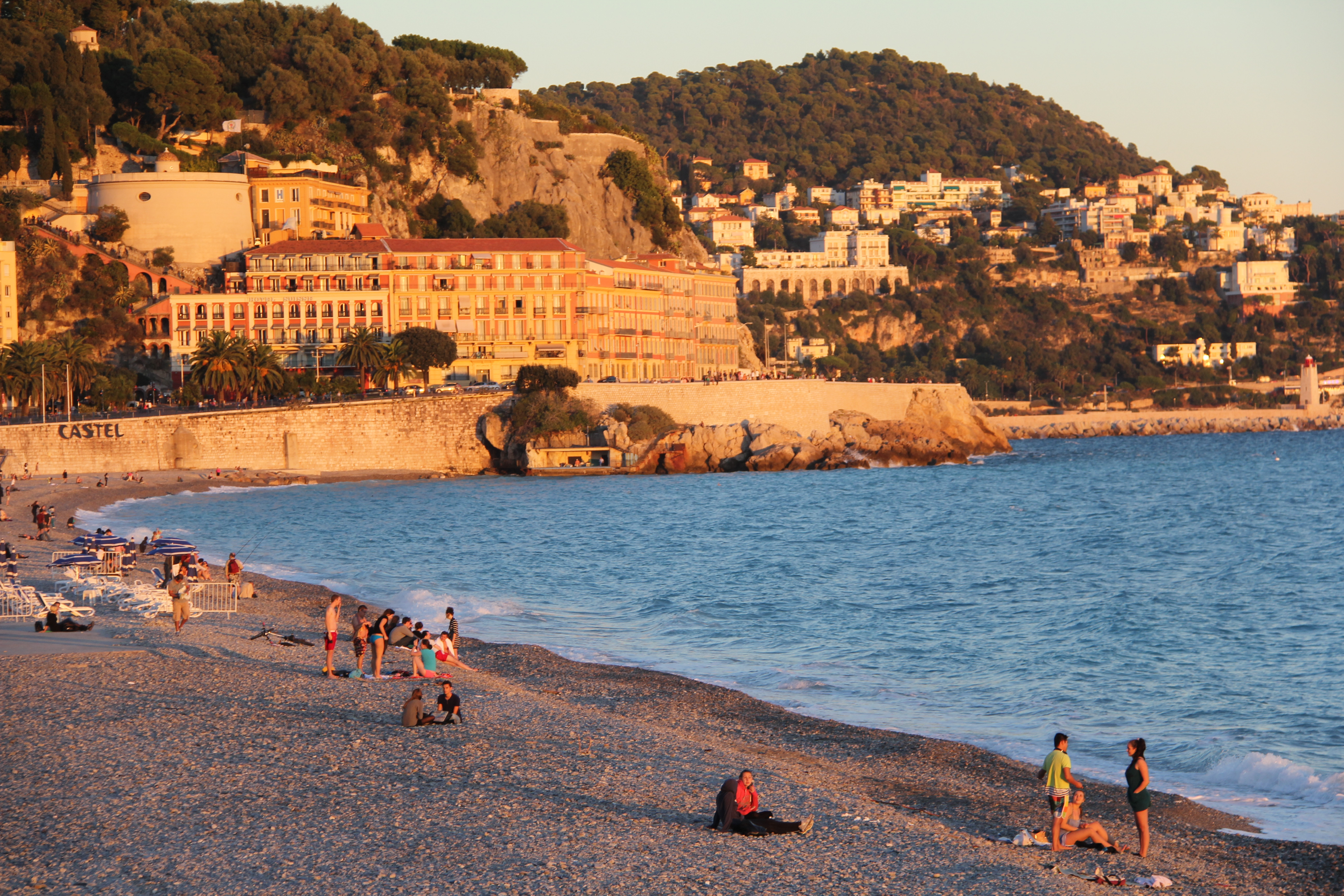
An overnight stop in Nice, my Riviera favorite, preceded our trek to Vence. We strolled along the seaside Promenade des Anglais and wandered through Old Nice.
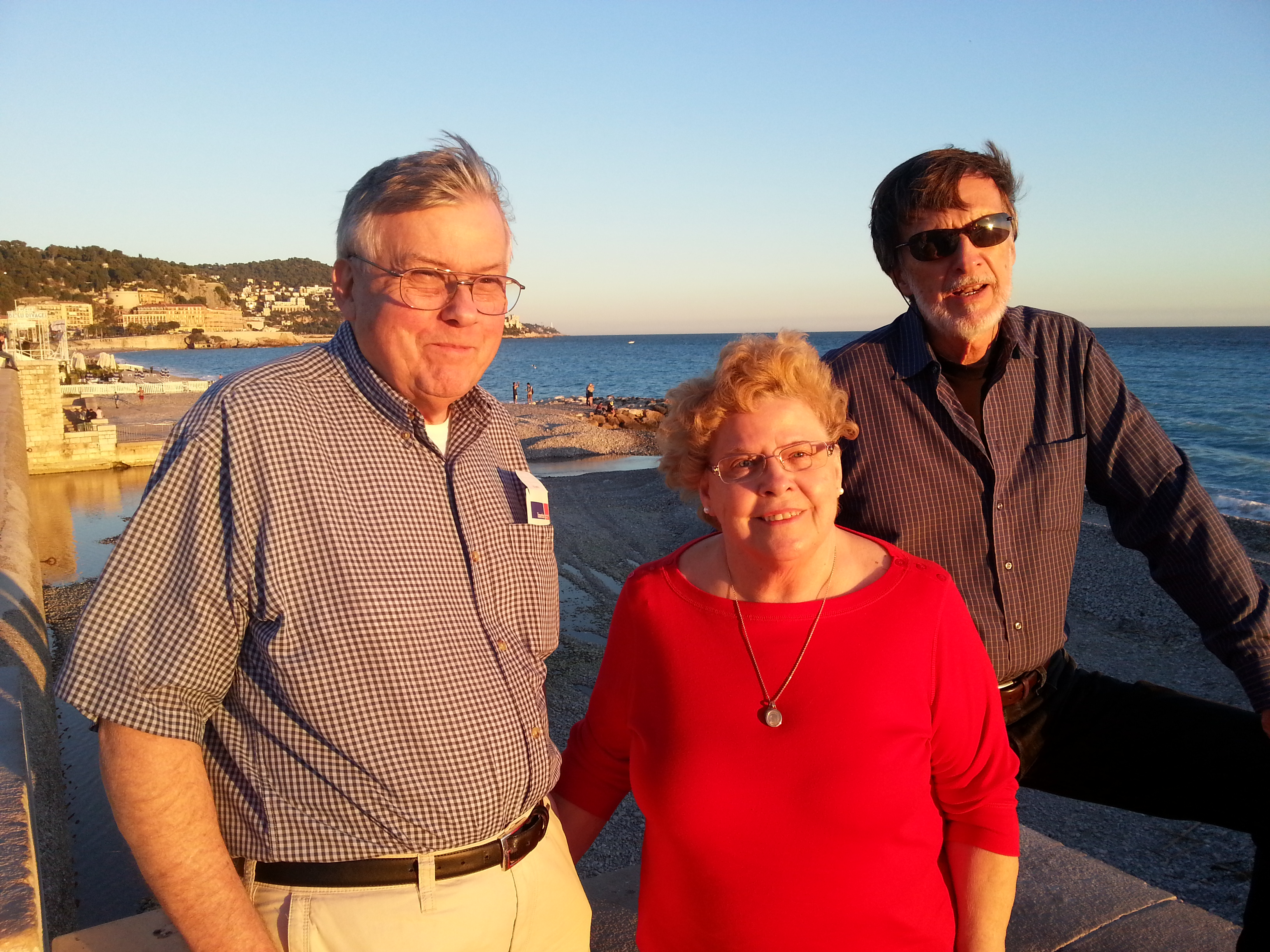
John, Mickey and VR.Then back into the hills to Sospel, a town VR and I had visited many times. We had even considered moving there. We became friends with Marie Mayer who
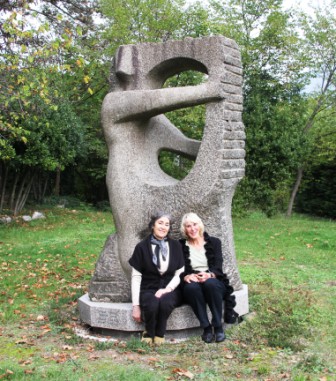
Marie and I with one of her father’s sculptures.runs a chambre d’hote (bread and breakfast), Domaine du Paraïs, where we always stayed. Her late father, Marcel Mayer, was a well known sculptor. She invited us for an aperitif in her living room filled with some of her father’s remarkable art works.
Noel and Carol are foodies like VR and I. ”Food, of course, is always high on our list,” Noel said. “The afternoon at the Dutch guy’s place was unforgettable… everything about that afternoon was wonderful – the intimate setting, the company and the food, which really was excellent.”
He was referring to Table du Bonheur, a special eatery in the hinterlands where we had an excellent lunch. (See previous post, Table of Happiness, Sept. 2, 2011)
Noel and Carol treated us to lunch and some fine wines at Le Bistrot de Lagarde which now has a Michelin star.Our food extravaganza with John and Mickey was an over-the-top meal in Italy – a lunch of multi courses at an agriturismo (farm inn), La Locanda degli Ulivi, hidden up a very long, very narrow, very windy road in the hills above Dolceacqua, a small, picturesque town just north of Ventimiglia. This was a first for me and VR. We will return, but VR said I can drive up that taxing hill next time. We must have had at least six different antipasti before two different types of pasta followed by the main course, rabbit, and the dessert. Not gourmet cuisine, but a fun experience in a livey, cozy – and very Italian — ambiance .
Clean plates after an Italian feast.Throughout our drives, Mickey, who is very interested in vegetation, often asked me the names of different trees. I failed . All the lavender fields fascinated her. She’d like to come back to see them in bloom (usually July). Olive trees were another favorite. ”The olive orchards were amazing to see. It might be interesting to see the trees when in bloom or when the farmers are harvesting the olives. I noticed olives were served at all the meals.”
DolceacquaI asked her what was most memorable about her visit. “The view of the mountains was unbelievable, and the winding roads took our breath away. What a wonderful trip and fantastic weather! The sight reminded me of what heaven must be like. Not a lot of noise, heavy traffic, or trucks unloading but just a peaceful, restful vacation place.”
Not quite heaven, but Provence has its charms.
Like my blog? Tell your friends. If you are not a Tales and Travel follower, please sign up with your email address at upper right. Your address is kept private and never shared. Please comment, Leave a Reply below. I love feedback. Coming next: Incredible Iceland Part II –horses, fish, food, adventure. And, for a taste of fall, try my recipe for Spaghetti Squash Gratin — above right.
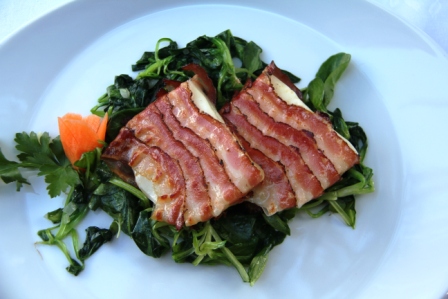
Signs advertising “Speck” everywhere we looked: along the roads, in shop windows, at street stands. ”Speck” is German for bacon, but we had just come down the mountains from Switzerland into Italy, not Germany.
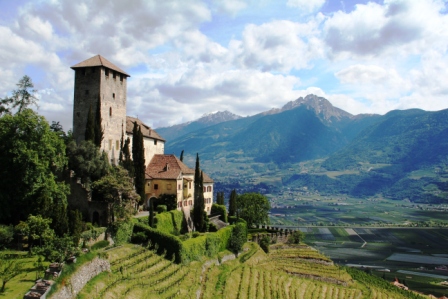
This was northern Italy, known as Sud Tyrol in German and Alto Adige in Italian. The majority of the population speaks German – and obviously eats plenty of Speck. Ordinary bacon this regional specialty is not, nor should it be confused with Italian prosciutto (ham). Speck is rubbed with herbs, spices and berries, smoked for different lengths of time with different hardwoods, and air dried in the area’s mountain climate. This makes it distinct, unique – the echt expression of the region.
Speckmantel gebratener Ziegenkase auf gedunsten Feldsalt (Goat cheese enveloped in Speck — yummy)
I was on my annual trip to research articles for the magazine German Life, with BB as my chauffeur, Sherpa and trusty companion. After a few days in Leukerbad, a Swiss spa town in the Alps, followed by a visit to Davos, we proceeded to this intriguing part of Italy.
Since German predominates here, I’ll call it Sud Tyrol. Our travels took us to Merano, Bolzano, Brixen, and lovely spots in between. We found it all enticing and enjoyed two fascinating museums, picturesque hikes, the charming towns, some excellent meals and a wonderful hotel. BB, who sadly does not do much biking these days but is passionate about wine, was thrilled with the local vintages. I may have to change his name from Bicycle Bob (BB) to Vino Roberto (VR). Which shall it be?
Merano (Meran) is a marvel, a beauty of a town on the banks of the frisky Passirio River with fanciful flower beds, an arcaded shopping street and a spa center, all surrounded by mountains. The riverside summer and winter promenades (passeggiate d’Inverno and passeggiate d’Estate) – paths through woods, past flowers and tropical plants, with the sounds of the rambunctious river tumbling over rocks, are glorious. We stopped to watch a kayaker practice on surging rapids.
“North and south meet here. It’s the best of two worlds,” said our Bolzano city guide, Luciano Rech, who filled us in on the region’s history. Sud Tyrol was part of the Austro-Hungarian empire until World War I during which Italy initially remained neutral. In 1915, as an incentive to enter on their side, the Triple Alliance (Germany, Austria and Hungary) offered Italy a chunk of land, all territories south of the Alpine water divide regardless of the ethnic makeup of the regions. At the time, 92.2 per cent of the population was said to be ethnic Germans. In 1919 the territory was annexed by Italy, and has been Italian ever since, with the exception of the years 1943-1945 when it was de facto annexed to the German Reich until the fall of Germany. Both German and Italian are considered official languages.
It has not always been a peaceful co-existence, marred at times by repression and terrorism. During the 1930s and again in the 1950s Italians were forcibly resettled to the region. According to the 2011 census, German speakers make up 61.5 percent of the population, Italian speakers, 23.1 percent, and 4 percent speak Ladin, an ancient language derived from Latin. All seems peaceful, and the region has a significant degree of autonomy. However, there are still some who resent being under the yoke of Rome and argue for independence.
“I’m Tyrolean” announces Rech. “I don’t feel we are the same as people from Naples, Rome.” Many others I spoke too echoed his sentiments.Bolzano (Bozen), a bustling city and the capital of Sud Tyrol, is the home of Ötzi, the mummy of an Iceman discovered in
Recreation of Otzi
1991 in the mountains at the edge of a melting glacier. The museum where he is preserved behind glass is a must with enlightening exhibits of garb and objects that were found with him. And, extensive documentation, including videos, on the sensational find and what has been learned from and about Ötzi. He died 5,300 years ago after having been shot by an arrow, presumably murdered.
Famous mountain climber Reinhold Messner (first solo ascent of Mt. Everest without supplemental oxygen) has created the Messner Mountain Museum outside of town on the slopes of a mountain and in the ruins of a castle. It’s a genuine mountain experience, with lots of steps (I felt we were back in Myanmar), skinny walkways, metal ladders and fabulous views. Follow the itinerary in and out of buildings, up slopes and towers, across bridges, past exhibits on his climbs, mountain terrain, Himalayan artifacts and more. Messner, who is a native of Brixen in Sud Tyrol, has established four other mountain museums in the province.
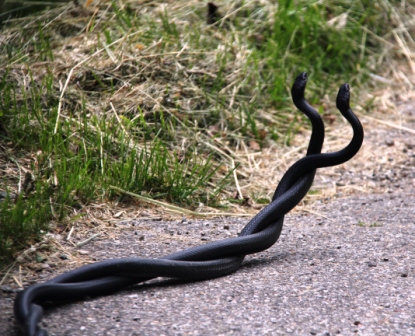
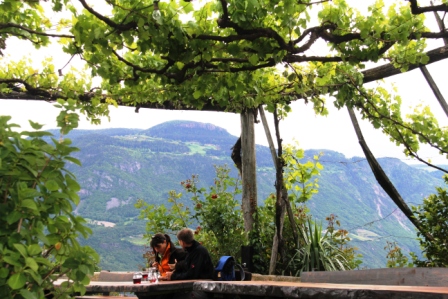
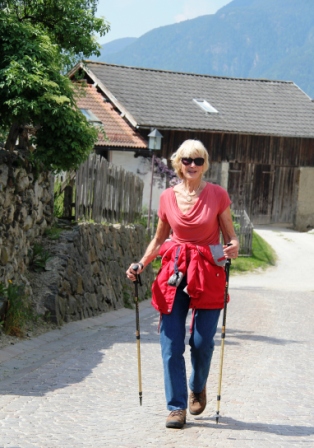
En route to Bolzano we stopped for an overnight so we could take a hike in the hills and soak in the scenery. We trekked amongst grape vines and apple orchards, and stumbled upon some sexy snakes. We had a wonderful lunch at an eatery under an arbor of grape vines with gorgeous views. The food, especially the apple strudel, was definitely more Germanic than Italian. The proprietors also sell wine, so of course we tasted and bought.
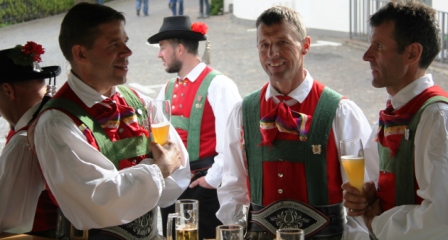
Unfortunately we did not make it to the mighty Dolomites which are part of the province for some real mountain hiking. After Bolzano we spent two nights at an inn, the Ansitz Zehentner, in the town of Lajen (Laion) where a rollicking fest was underway when we arrived. Women in dirndls. Men in trachten (traditional costume). Plenty of beer. And, blasen music (wind instruments). We could have been back in Germany.
Frau Schenk, proprietor of the inn which dates back to 1358, suggested a hike through fields and forests to a well-known hotel and restaurant , Gasthof Ansitz Fonteklaus. Sitting outside under mammoth trees amidst the mountain scenery was perfect — and so was the food.
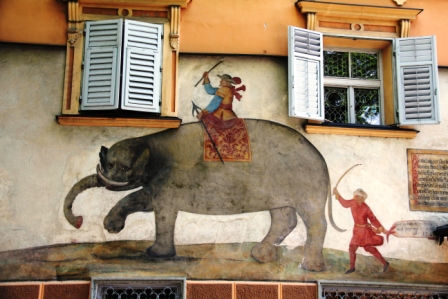
Our travels ended in Brixen (Bressanone), another gem of a town, where we splurged and spent a night at the classy Elephant Hotel with an excellent dinner in the hotel’s noted restaurant. The 450-year old hotel has been run by the same family since 1773. It was named after the pachyderm which was sent by Suleiman I to Archduke Maximilan as a gift in 1551. The elephant had a long journey from India, to Portugal, then Genoa and onto the Alps where it rested at the inn in Brixen, causing a sensation among the locals who had never seen such a beast, en route to Vienna. The elephant fresco on the hotel’s façade was painted many, many years later by someone who had never seen an elephant but based his rendering on descriptions. What happened to the well-traveled elephant? I learned that after the epic journey it only survived another two years.
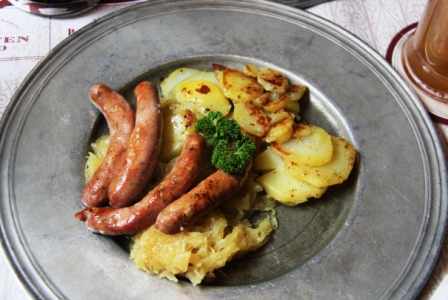
Before heading back to France I stopped at a butcher shop and loaded up on some very savory sausage — and Speck.
Comments welcome and appreciated. Today’s Taste features a recipe for Rhubarb Streusel Pie. If you like rhubarb, you’ll love this. See “Today’s Taste” at the top of this post. While you are up there, sign up to become a Tales and Travel follower.
Trip finale — dinner in the romantic Hotel Elephant dining room.
I felt I should have been reporting for Bon Appétit magazine. It was one of those fabulous food and people spreads – a multi-course meal in the huge, homey kitchen of a 500-year-old house in a tiny Italian village shared by Italians and Americans. And, I was lucky enough to be part of it. Too good to be true.
Thanks to our friends Noel and Carol, whom husband Bob and I know from our days together in Germany, we were included in this memorable feast which went on for five fun-filled hours. Noel and Carol have retired to northern Italy where they enjoy la dolce vita. We were their houseguests.
Carol and Noel
The lunch hosts: Fabio and his American wife Victoria. Fabio is a vintner (www.policreti.it) with a passion for precious gems as well as grapes. He has been trading in gem stones since the age of 18, worked for the up market jeweler Bulgari in New York as well as in Italy, and is also dedicated to restoring his
Fabio
family’s ancient home, Palazzo Policreti Negrelli in Aviano, which has 47 rooms and has been in his family for more than 200 years. The original owner, engineer Luigi Negrelli , played a significant role in the construction of the Suez Canal.
Fabio met his warm and gracious wife Victoria in California. She is employed by a German construction company as a translator and much more. “I am lucky to have an American wife,” says Fabio. “Italian women often have headaches or give you headaches.”
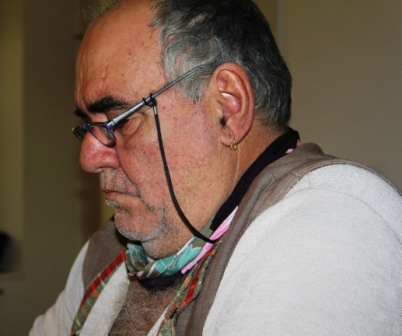
The guests: In addition to me and Bob, Noel and Carol, seated at the table were Riccardo and Zeta, two jolly Italian characters who have known each other since the age of 3, met Fabio in Los Angeles years ago, and call themselves “professional travelers.” Riccardo said he “doesn’t belong to one place,” while Zeta calls himself “a man of the planet.” ”We can’t retire, we don’t work,” explained burly Riccardo, who says he has four wives, each in a different country, and claims his only possessions are “an old car and a bicycle.”
Riccardo
Zeta, a chef, does work six months out of the year at his brother’s restaurant in Greenville, S. C. “When Zeta visits us the first question is ‘what’s on the menu?’ His creations are famous at our hose,” says Fabio. “Instead of making a grocery list, he just looks in the refrigerator and his imagination begins to spin. He can literally put together a feast by using all the various items which have been abandoned in our frig. Needless to say, I like to work around him as there is always something to learn or a new taste to discover.”
Zeta
The food: Zeta was the coach, Fabio the student who made a big patch of Ligurian pesto with guidance from the chef. They wanted to share their creation with friends, hence the lunch party.
The French are obsessed with food — Italians perhaps even more so. Most Italian men cook, Fabio told us, as he checked the boiling pasta for texture. “A big part of the day is based on food,” he said. And, it is essential that ingredients be of top quality, he explained. He claims that Victoria is “thankful to me for showing her the true secrets of Italian cooking improvisation.”
A refreshing cocktail, a combination of Campari, white wine, Prosecco, and Schweppes, got the afternoon of to a festive start.
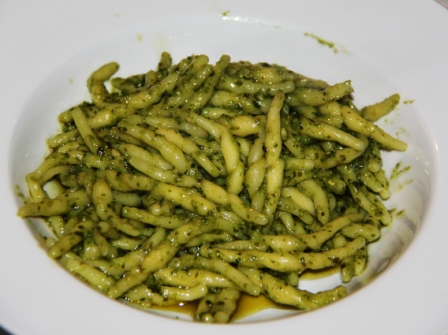
The meal began with fresh ricotta, so creamy and delicate, served with homemade mango chutney and caramelized figs with balsamic vinegar. The cheese was locally produced, and it was exquisite with the tangy chutney and figs. There was a platter of prosciutto from the local butcher who cures it himself, we learned. And a salad — greens, tomatoes and luscious mozzarella di Bufala with pungent olive oil from Puglia and black salt from Cypress. The main course: trofiette, a Ligurian pasta, with the pesto which had been prepared with pecorino. “Never use parmesan,” insisted Fabio.
This was followed by a bowl of spaghettini with the same pesto. The flavor of the pesto changes with the different type of pasta, we learned. It seemed hard to believe, but it was true. I preferred the pesto on trofiette, others liked the spaghettini version. This initiated an animated discussion of the difference between trofiette and trennette, another type of pasta… Food is definitely serious business in Italy.
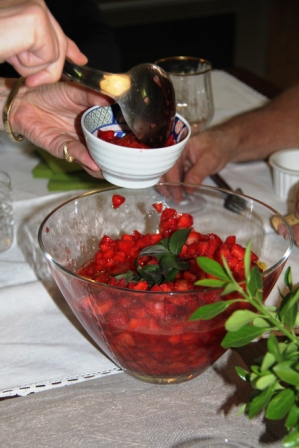
For dessert, aged Sardinian pecorino and pears. “It’s hard to get good pears…these are organic from Trentino… Never tell a farmer he has good cheese. Then he will eat it all, ” said Riccardo. The cheese was knock-your-socks- off strong. I loved it, but it was too much for Bob. He had several helpings of the perfectly diced fresh strawberries that followed. This prompted Fabio to tell of his grandmother’s fantastic crop of strawberries in 1986, the year of the Chernobyl disaster. A boost from radiation?
He went on to relate more engaging tales of his grandmother, a remarkable woman who “was a very special person to me.” She lived through two great wars, suffered the tragic deaths of several family members, but was always a positive and smiling person, Fabio recalled. “She was the oldest car rally driver in 1996 at the age of 95. I was the only person brave enough to be her co-pilot.”’
Fabio and his grandmother in 1996.
We drank Fabio’s Pinot Grigio, followed by a strong red wine called Stroppolatini, then a Sud Tyrol Kerner as an after dinner wine. Some indulged n a rare 45-year–old herb Grappa to top off the meal. There were also chocolates, courtesy of Riccardo who brought them from a special shop in the Dolomites.
All the ingredients for a magical afternoon: lively ambience, fascinating personalities, excellent food and amusing, entertaining, educational conversation covering everything from religion and politics, to the economy, movies — and food of course.
“Italians lose interest in politics,” Victoria said. “That’s the problem. They’d rather discuss food.”
Just in time for summer picnics, Super Slaw. See recipe in column at right. Comments on blog post and recipes are welcome. See “Leave a Reply” below under Comments. Subscribers also welcome. Don’t miss future posts. Click on Email Subscription at top right
Instead of moving to France from Germany eight years ago, I tried to convince my husband to consider Italy as our future home. It seems such a happy, fun, cheerful place. I love the language, the people, the food, the countryside. But, Bob finds it all a bit too chaotic, so France won and life here is fine (see previous blog post, All about Life in France). But, I still adore Italy and am always thrilled with visits.
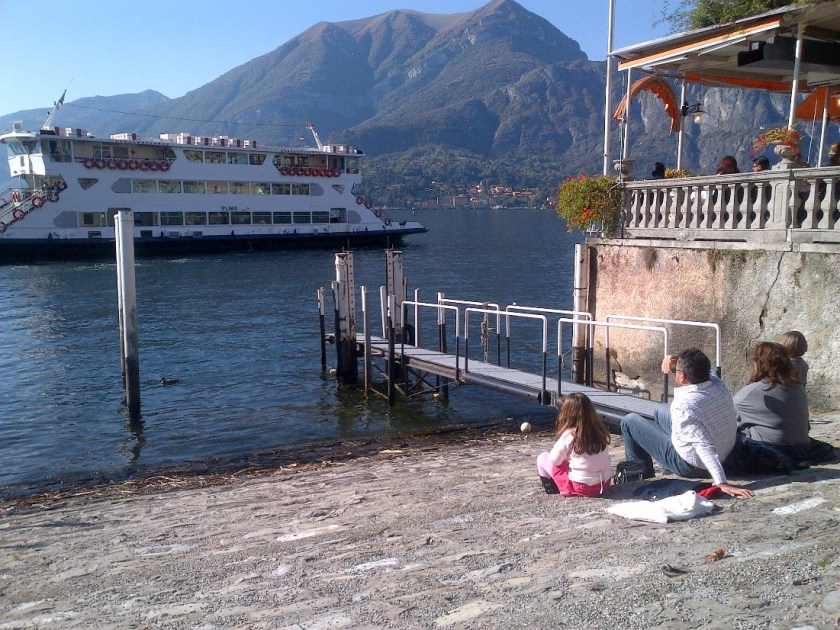
Watching the boats go by.
On the way home from our recent trip to Germany we spent three joyful days in Bellagio on the shores of Lake Como. Friend Trina, whom we visited later in nearby Comerio, suggested the perfect hotel, Silvio, www.bellagiosilvio.com, just outside of town where we had a room with a balcony overlooking the lake and the distant Alps. We’d been to Bellagio twice before, once with my mother who was also a fan of bella Italia and loved Bellagio.
View from our balcony at the Hotel Silvio.
The ancient village is perched on the shores of this idyllic lake ringed by mountains. Steep steps climb skinny alleys lined with intriguing shops. Sightseeing ships and ferries blow their horns as they pull in and out of the harbor. It’s the perfect place to hang out and enjoy il dolce far niente (the sweetness of doing nothing)
Our journey began with a car ferry ride at sunset from Colico on the northern end of the lake to Bellagio which sits on the promontory jutting into the water at the junction between the Como and Lecco legs of the lake. Unfortunately the lens on my Canon Rebel camera froze on our last stop in Germany, so my photos were limited to my Blackberry. I was amazed. Not too bad. And, there were
Lake Como at sunset.
scenic, spectacular photo opps all around — splashes of coral and orange across a dark sky streaked with wisps of clouds, rays of light dancing on the rippled water, postcard villages hugging the shore — all framed by deep blue silhouettes of mountains.
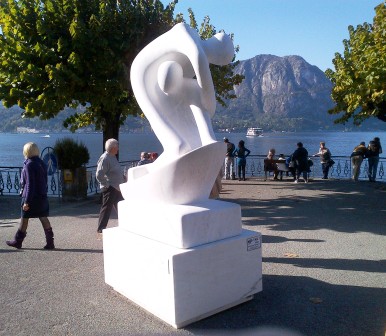
We did more than lounge on that lovely hotel balcony and ponder the Bellagio scenery. Walk. Down to the shore and through the perfectly manicured gardens of the Villa Melzi along the lake. The English garden is enhanced with
October at the Villa Melzi Gardens.
sculptures, small ponds, a stream, exotic plants and ancient trees. The complex, including the neoclassical villa, was built between 1808 and 1816 for Francesco Melzi d’Eril, Duke of Lodi, and vice president of the Italian Republic under Napoleon. www.giardidivillamelzi.it
The garden walk led us to the village where we wandered in and out of the shops and found the perfect souvenir – an olive wood basket. It was pricey, almost beyond our budget. I tried to bargain, but the proprietor and craftsman, who had his workshop on the premises, would not budge. He explained that it was a very time consuming process to create this piece. We splurged – and are happy we did. It’s a sensation on our table.
Bellagio is known for another villa on a hill above the town, the Villa Serbelloni, owned by the Rockefeller Foundation. It is used mainly for conferences. On a previous visit we toured its gardens which are open for guided tours from April to October. In town the Grand Hotel Villa Serbelloni is the address of class where Churchill and John F. Kennedy stayed.
Along the shore in Bellagio.
Another day we walked up a hill and along a road to Pescallo which I had remembered as being a quaint fishing village. My memory failed. It was not much. No fishing boats. We did find a lakeside restaurant where we had an expensive but disappointing lunch. The next day we set out by car for a hair raising ride along the all- too-narrow- winding coastal road (well suited to the Honda S2000) to Lezzeno and a fabulous lunch at the restaurant of the Hotel Villa Aurora adjacent to the lake. www.hotelauroralezzeno.com There, as well as at the restaurant in the Hotel Silvio, we enjoyed fresh fish from Lake Como. Twenty-eight different species are said to thrive in its waters. Lavarello is a favorite.
On the way back home to France, we stopped first to visit the major town on the lake, Como, and its majestic cathedral, then to Comerio to visit Trina in her gorgeous apartment overlooking Lake Varese. I met Trina years ago in an Italian class in Germany (she was the star of the class). Her husband Ian, who used to work in Italy, now works in London. Trina, who teaches English, and her faithful companion, Lucky, a precious 16-year-old Bichon Frisé, are holding down the fort in Italy.
We arrived on the evening of Bob’s birthday. Trina prepared a delicious mussels pasta dish for our dinner – and there was a tart with a candle for the birthday boy.
See slideshow below for more photos. For a holiday brunch, try the Puffed Apple Pancake, recipe in column at right. Comments on blog post and recipes are welcome. See “Leave a Reply” below under Comments. Subscribers also welcome. Don’t miss future posts. Click on Email Subscription at top right.


 Hundertwasser, projected on the walls and floors. Wander through the immense space, engulfed by the gigantique tableaux. Enjoy the mesmerizing musical background.


















 Tales and Travel