Discovering the marvels of MUD

Five days a week, beginning in the wee hours, Askit is on the job, filling buckets with deep brown, slimy, gooey mud. Therapeutic mud.
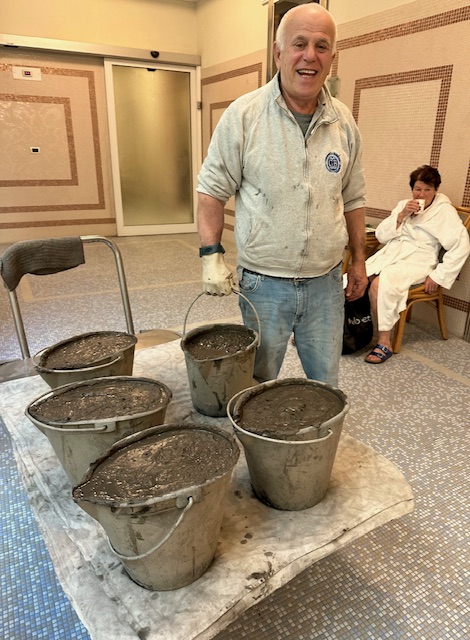
The husky, jovial native of Albania then pulls a cart with six heavy buckets of the yucky substance to the treatment area at the Hotel Residence, a spa hotel in Abano Terme, Italy.  He has been doing this for 30 years, he tells me with a hearty grin, then dumps a pail of mud onto a therapy bed.

Vanni, his Italian colleague, takes over, spreading the mud into one or more puddles on a bed in a small therapy room.  The room also has a shower for hosing off the mud and a deep tub for après-mud soaking in warm thermal water. 

Vanni motions me into the room.  I shed the hotel robe.  Mud treatments are not for the prudish.  This is naked body treatment, however miniscule thong “undies “of a gossamer-like paper are available.  

Vanni checks the soaking tub.

Vanni is a joy, always smiling.  I stop trying to cover my sagging boobs with my arm and follow his instructions to  lie on the bed, back positioned on the big puddle. He lathers me with mud, covers me in plastic, puts a blanket on top and disappears. The mud is hot initially, but soon deliciously warm. I stay that way for 20 minutes.  Vanni returns midway to wipe my face with a cool, moist cloth.

He started working at the hotel in 1979, he says, and now calls himself “fango meister,” German for mud master.  Many Germans previously patronized this spa hotel.  Vanni has mastered the language in addition to the mud.

I am a water rat.  The mud is pleasant, but I adored the soak in the hot, bubbling thermal water.   According to the Abano web site (abano.it), the water makes a long, underground journey from the pre-Alps.  Rain enriches it with mineral salts.  It is transformed and “classified as salted-bromide iodic hypothermal water.” 
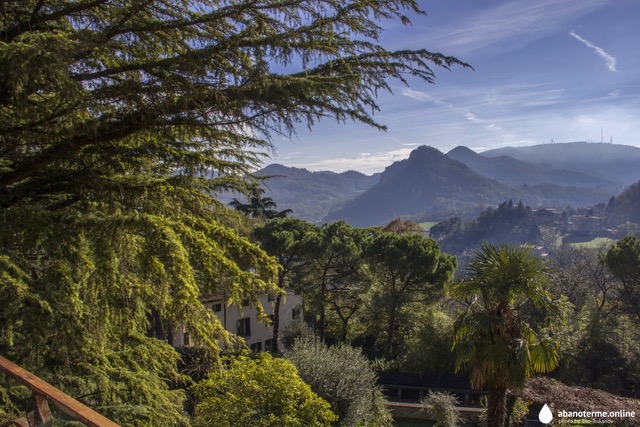
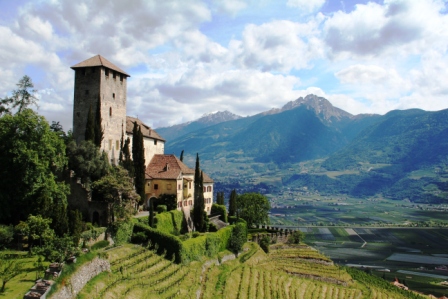
Euganean Hills, Abano Terme photo

The mineral rich water is the secret ingredient of the mud. Abano is at the feet of the Euganean Hills, a region of prehistoric volcanoes in northeastern Italy. Clay is extracted from lakes in the area, filtered and purified, then left to “ripen” for at least two months in special tanks with the hot thermal water.  Not just hot, but scalding water which emerges from the ground at 75-90 °C (167-194°F). For pool use, it travels through a piping system and is cooled to 30-35 °C (86-95°F). 

The final mud product is natural therapy with a healing, anti-inflammatory and analgesic action.  It is said to stimulate cartilage restoration, enhance the immune system, as well as restore vitality and a mineral balance of the body.

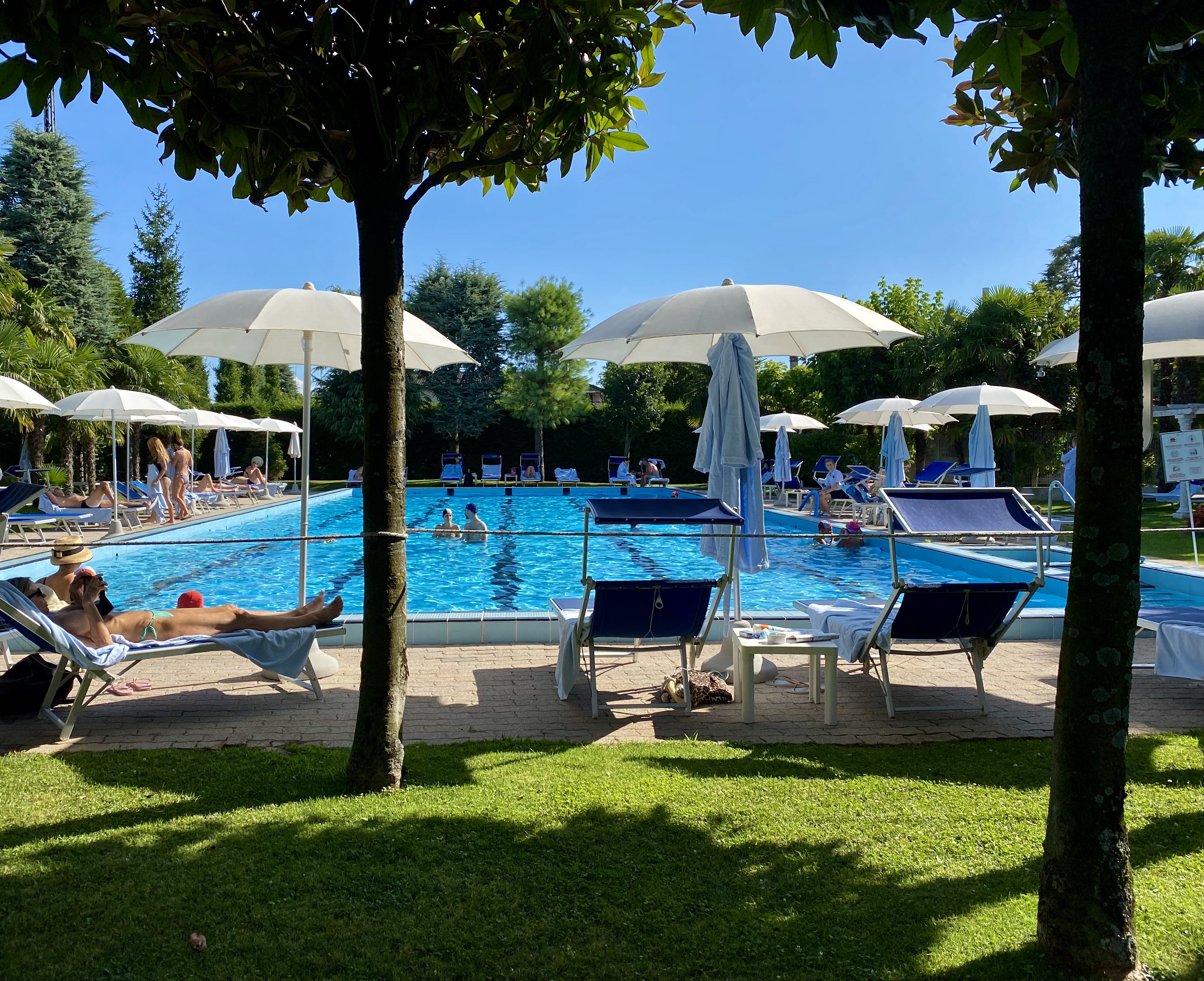
Pool at Hotel Residence

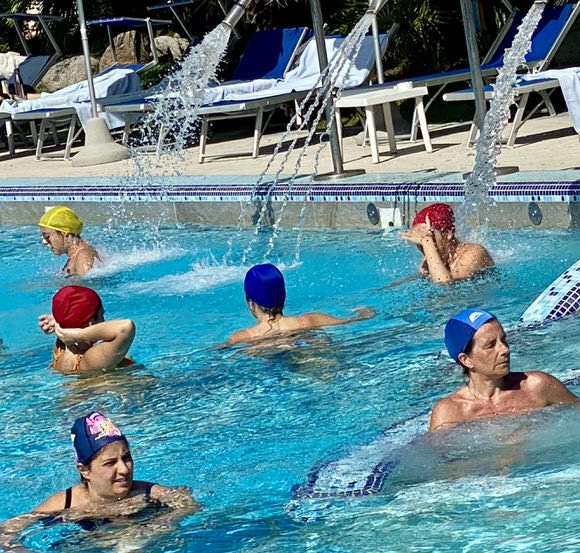
The tub soak is a delight, but even better are the thermal pools, large indoor-outdoor pools with warm thermal water and powerful water jets. They are not meant for swimming, just relaxing and enjoying the soothing water.  I could have spent hours at the pool, but learned from experience that was not a good idea.  The recommendation is for 30-40 minutes maximum per session.  Of course, I disobeyed the first time, and then was completely wiped out. 

Abano has been a wellness destination since ancient times.  According to legend, the first settlement in the territory was founded by Hercules who is said to have restored his strength and health here after his challenging feats.

Romans were fans of water treatments and appreciated the healing properties of hot springs and mud from the valley.  More than 2,000 years ago, they built villas and settlements whose ruins are still prevalent in the area.
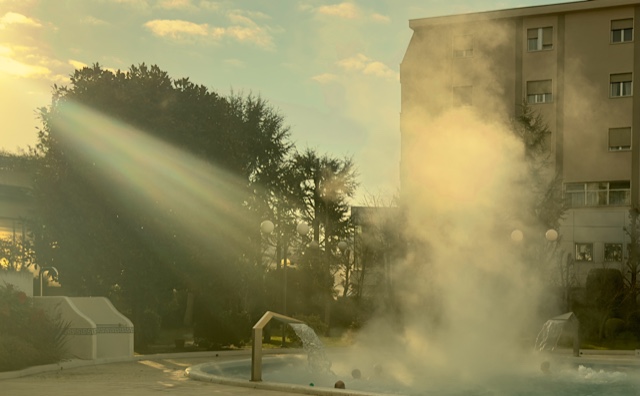
Sun beams and steam at hotel pool

This was my third visit to Abano. The first was in the summer (not recommended). See my previous blog, “Taking the waters – and the mud” for more details.

This past Christmas as well as Christmas 2023, I joined friend Angi for a 10-day visit to Abano.  Angi is a dedicated fan of the mud.  For years she lived in Rome and spent two weeks every year in Ischia, a volcanic island off the coast of Naples known for thermal springs and mud.  She had serious back pain following an auto accident which resulted in five fractured vertebrae.  The treatments “took away the pain and inflammation,” she says.

Friend Vera has been to Abano six times for “wellness, cooling out, relaxing… I enjoy it.  I enjoy the treatments,” she says.

I can’t say Abano made any difference with my numerous body infirmities following my disastrous fall and seven surgeries.   But it was sublime, a definite morale booster, a rewarding experience. For me, it did “restore vitality.”   I just may return next Christmas.

In addition to mud and water, I treated myself to massages and facials.  I spent an afternoon exploring nearby Verona.  I joined the excursion to Villa Selvatico, one of many villas, castles and abbeys in the surroundings.  I attended a church concert. And, I found bargains at the town’s weekly market. 

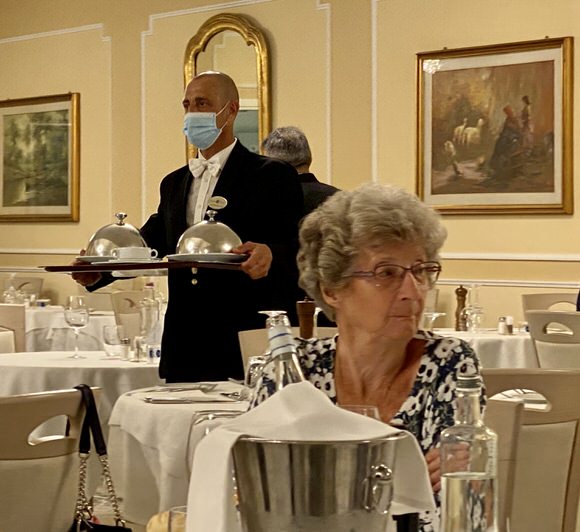
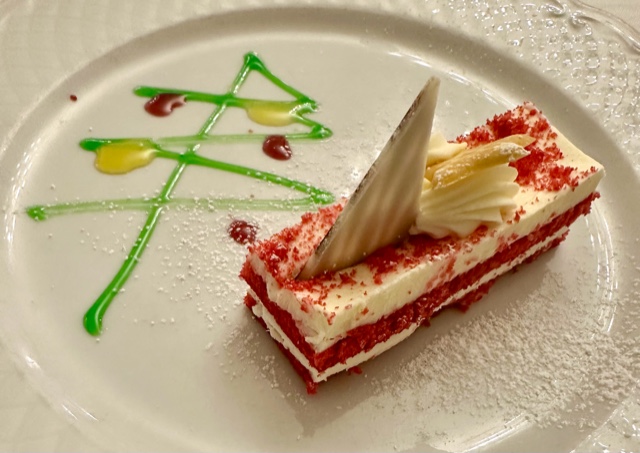
Food was another highlight – very good, varied, healthy.  Angi and I shared a table in the welcoming dining room. Fatima, an “angel” from Brazil, was our waitress. She brought us real cappuccino in the morning so we could skip the watery machine variety. She gave us advice on menu selections. Like most of the hotel staff, she was cheerful, helpful and fun to chat with.

Fatima

The town Abano Terme has a population of 20,000, but claims 250,000 visitors annually.  There are some 37 spa hotels of all categories offering pools and mud treatments, as well as other hotels and different accommodation possibilities.

My package included nine nights single room, three meals per day excluding drinks, unlimited pool and sauna use, plus bus transportation: 1,400 euros (about $1,500 at current exchange rate).  A doctor visit is required before beginning the program, 70 euros ($72). The doctor determines, recommends which treatments are best for each visitor.  I paid 35 euros ($36) for each mud wrap and tub soak; 70 euros ($72) for a heavenly detox facial; 75 euros ($77.50) for a 50-minute-deep tissue massage.   The latter were so exquisite, I had to have more — an anti-stress facial and another deep tissue massage.
Throughout the year, GB hotels, a group of five Abano spa hotels, organizes bus transportation from several  cities in southern France where I to Abano.

More information on Abano: www.abano.it.  More info on the four-star Hotel Residence and other Abano hotels at www.gbhotelsabano.it

If not a Tales and Travel follower, please sign up here. Trust me. It’s safe. Your address is not shared.

Check out my tried and true recipes — keep scrolling down on a phone, or, if on a /PC or tablet, up to the column on right then down to “Recipes.”  I will add new recipes soon.

On to Venice and Padua

I had visions of an empty Venice, like those I had seen during the lockdown. Deserted alleys and waterways. No gondolas on the canals. No lines to enter attractions, such as San Marco (St. Mark’s Basilica). A dolphin or two frolicking in the Grand Canal.

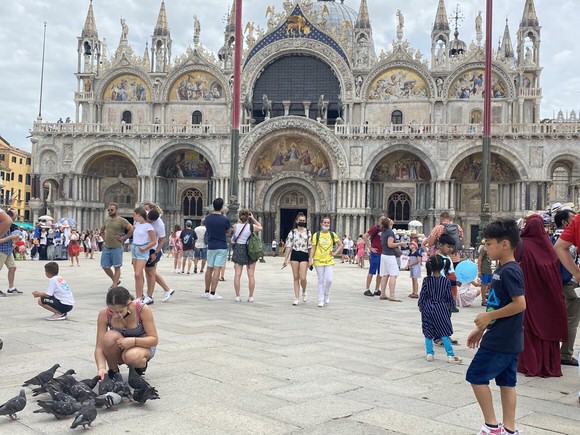
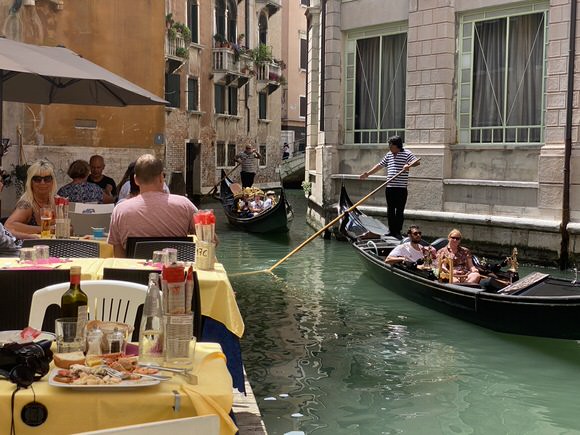
That was then. Fast forward to early July when I visited. Even though travel restrictions were in place, tourists had returned to Venice. Long, long lines to climb the campanile (bell tower) of the Basilica. Gondolas aplenty gliding through the canals. Happy crowds feeding pigeons on the Piazza San Marco.

And, it was hot, much too hot. But, I adore Venice. I was spending a week at Abano Terme, about an hour from the city. (See previous post, “Taking the waters – and the mud”) I could not pass up a visit, especially after a conversation with a staff member at the spa. 

“I love Venice,” she said. “You must visit.” She planned an all-day itinerary for me. “Don’t schedule any treatments on the day you visit Venice. You will need all your energy for Venice.”

More energy than I had. I followed her recommendations, took the train to Venice, then hired a water taxi to take me to the Piazza San Marco, under the Rialto Bridge, past magnificent centuries-old palaces. There was no shortage of boats of all sizes on the Grand Canal. No dolphins in sight. 

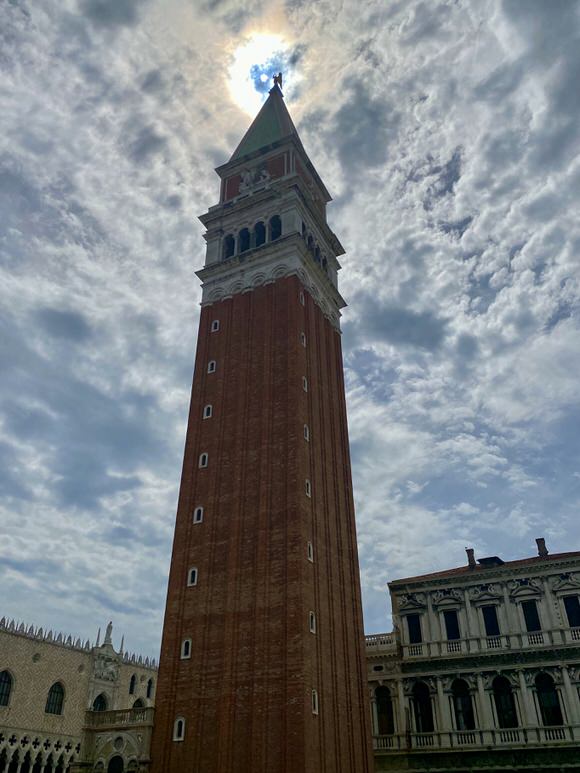
Campanile (bell tower) of the San Marco Basilica

I was surprised and disappointed to see the lines, both to enter San Marco and climb the campanile. I decided against both, instead opted for a very expensive cappuccino (11 euro) at one of the many cafes lining the piazza. The pricey cafes had few customers. However, the legendary San Marco pigeons happily soared above, then landed and soaked up attention from tourists who were happy to fed them and pose for photos.

Even though the waiter at the cafe complained of little business, restaurants I passed during my wanderings were not lacking for customers. Gondolas seemed to be in high demand, yet a young gondolier also complained. “It’s very quiet. There are not a lot of people. Normally in July and August, it’s crazy. You can’t walk around here.”

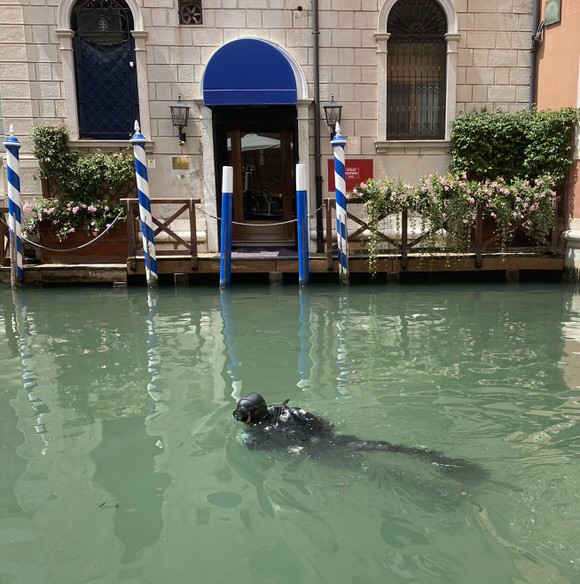
Perhaps I was lucky after all. I could walk without being pushed by throngs. I found a quiet restaurant adjacent to a canal and enjoyed a fascinating lunch. A government building stood on the opposite side of the canal. A police boat arrived. Two scuba divers jumped off and quickly disappeared under water. Looking for underwater explosives? It was intriguing. I also wondered about the wisdom of being immersed in this water which I assumed was dreadfully polluted. Then I noticed fish. I mentioned this to the restaurant proprietor. He threw some bread in the water. More fish appeared. The dolphins have not returned, but, at least for now, fish are thriving.

Police diver on a secret mission?

Thanks to a recent ruling by the Italian government to ban cruise ships from approaching Venice’s lagoon, things could be looking up for those fish, not to mention the foundations of the city.

Cruise ship opponents argue that the massive ships which can transport more than 5,000 passengers each are responsible for waves and pollution that damage the delicate fabric of the city. Work is underway to construct a cruise terminal outside the lagoon. 

The Wall Street Journal quoted Gianluigi Rizo, a porter at the Piazza San Marco, who summed up the sentiments of those whose business depends on tourists. “It’s good that tourists are back, but the real money comes from the cruise ships with the Americans and the well-off Asians. They spend big in a short time, before sailing out.”

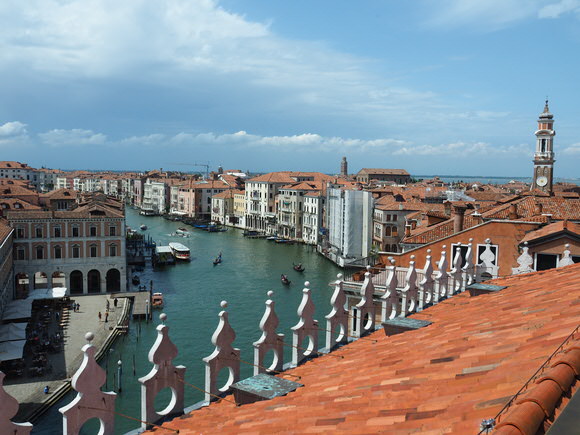
View of Venice from the Terrazza Panoramica, a new observation deck a top a multi level. upmarket shopping gallery.

Even with the tourists and the heat, I was happy to return to Venice. I love to meander, discovering intriguing alleys and passageways, off the beaten tourist track, usually getting lost. However, since I had a train to catch this time, I dared not be too adventurous. 

The trek to the station was longer than anticipated. I panicked, walking faster and faster so as not to miss my train. I made it, exhausted and perspiration drenched.

That excursion should have been enough. Perhaps best to stay and relax at the spa.? No, I needed to see Padua, again urged on by my mentor. She raved about the city’s star attractions, the Scrovegni Chapel with frescoes by Giotto and the Basilica of St. Anthony.

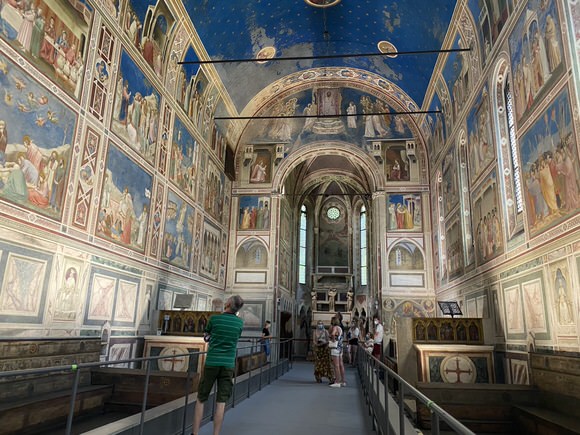
Scrovegni chapel with Giotto frescoes.

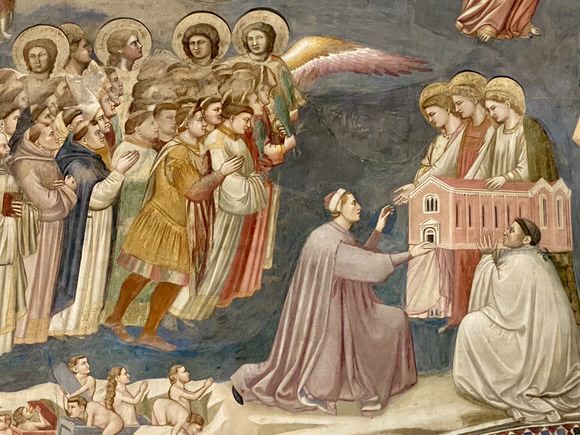
Giotto, an Italian painter of the late Middle Ages, and his team covered the walls of the entire chapel with frescoes illustrating the life of the Virgin and life of Christ. Their work, completed in 1305, is considered a masterpiece of the early Renaissance. It is mind boggling.

St. Anthony’s Basilica with Byzantine-style domes and art treasures was a must for me. St. Anthony played a role in my Catholic upbringing. My mother was a fan of the saint, the patron of lost items. Whenever she or we lost something, “Pray to Saint Anthony,” she urged. Often he came through. 

St. Anthony’s tomb.

The church shelters the saint’s grandiose tomb. Worshippers place hands on the tomb and pray. St. Anthony holy cards are available for free. I gave a donation, took a few, and mailed one of each of my three brothers.

Praying at St. Anthony’s tomb.

I passed up relaxing days and therapeutic treatments at the spa for Venice and Padua. I have no regrets.

Statue of St. Anthony.

Please scroll down and comment. I love to hear from readers.

Another monumental church in Padua: Basilica of Saint Giustina

We recently returned to Marseille, one of my favorites. It merits a blog post. And, soon I will off for Adventure Croatia with friend Karen.

Don’t miss out. If not a Tales and Travel follower, sign up. Your address is kept private –not shared.

Giotto’s Last Judgment fresco.

Taking the waters – and the mud

Volcanic mud is the attraction at Abano.

Hot! It was sweltering. The pool waters were warm. Taking a walk left me drained, clothes and hair glued to my body. Even lounging in the shade was unpleasant.

I blew it. Yes, I needed a week of R and R. Life as an Alzheimer’s caregiver is stressful. But a thermal spa is not the place to go in July when temperatures soar.

Unfortunately I had no choice on the timing. I wanted to take advantage of the July visit from Bob’s son and two grandsons who could take over care of grandpa. I should have opted for a cool mountain resort. Instead, I chose to spend a week at Abano Terme, a spa town in northeastern Italy recommended by friends. I have never been that enamored of spas, but I figured it would be good for my decaying body and uplifting for the spirit.

Not all was negative. Just being in Italy, where joie de vivre is in the air, is therapeutic for me. I enjoyed speaking my broken Italian, chatting with the super friendly spa staff, and learning what a terme is all about.

Soaking in thermal waters supposedly does wonders for the body.

The entire town and numerous hotels are all geared to take advantage of thermal waters and volcanic mud from the surrounding Euganean hills. Hotels offer packages which include room and board and treatments. 

Fango, or pure mineral-rich volcanic ash, forms the basis of the mud which is said to have anti-inflammatory properties. It is recommended for  strained joints and muscles, arthritis, rheumatism, as well as the stress of everyday life.

First step: Visit to the hotel/spa doctor. Before undergoing the mud treatments, a doctor must give the OK. He was a jolly chap who spoke four languages. After examining me and studying my MRI and X-rays, he asked questions. “Do you do Yoga?” No. “Are you a vegetarian?” No. “Thank God.” 

He said I was fit for mud, and advised I eat more protein, take vitamin D, drink more water and build muscle mass. He failed to provide details on the latter. Weight lifting?

He wrote a prescription for the type of treatments that would help my arthritic body. Next came a visit to Zoia, the charming and effervescent spa manager. She checked my package plan and the doctor’s rec’s, then devised a schedule for me which included gentle massages, mud, a fruit peeling facial.

Mud relaxation

I was a bit leery of the mud. I feared it would be more intense heat. Fortunately it was pleasantly warm, but I found the odor anything but pleasant. Carmela slathered a huge slab of mud on a bed which I then lain on. She smeared mud on my arms and legs, then wrapped me in plastic and covered me with a sheet. I was a mummy for 15 long minutes. The first time was annoying. I had an itch on my nose which was driving me crazy. My arms and hands were cemented to my body. For future sessions, I requested my hands be kept free to scratch if needed. 

About half way through the treatment, Carmela returned, delicately wiped my face with a cool scented cloth. After the allotted time, she returned again to unwrap me. I stepped into a shower and she hosed me down, washing away all the stinky mud. This was followed by a 10-minute soak in a tub of warm bubbling thermal water scented with therapeutic oil. I liked it all.

Aqua gym was intense

Water – thermal water – is also an essential part of the Abano experience. My hotel had five different outdoor pools, plus a large indoor pool. The most popular pool had all sorts of water jets and bubbling fountains. Since this is thermal water, it was warm – too warm for me. I preferred the lap pool, cooler water, not thermal, thus no healing benefit. 

Few swimmers in the lap pool.

Again I blew it. To get full advantage of the mud I should have spent leisurely days soaking in the waters. Not me. I spent a day trekking, wilting, through nearby Venice, another day slogging through Padua, and a half day hiking to and shopping at the market in Abano. None were relaxing. All were exhausting. But, I did see the sights and added some bargain Italian fashion to my wardrobe. More about those escapades in an upcoming post.

In between my sightseeing, in addition to the mud treatments, I enjoyed “gentle” massages from Joanna, another delightful staff member. We chatted as she massaged. “Only speak Italian while your are here,”she advised.

Hotel provides bathrobes, white to wear to the pools and blue for the treatment area..

According to Zoia, Abano is especially popular with Germans and Austrians, many who come two to three times per year. Italians are among the clientele, however, they “don’t spend so much on the treatments. They come for relaxation, the pools.” The British? “It’s not in their culture,”she said. 

My hotel, the Metropole, was less than half full during my stay – not due to Covid, but the heat. This was not spa season, but “the cheapest time.” Fall and spring are the ideal times for the terme, she said. Russians love it during the holidays, staying at the five-star hotels. The Metropole rates four stars. There are Americans who patronize Abano, but, like the Russians, they go for five stars. 

Classy dining at the Metropole.

My friend, Angi, British, is an exception to Zoia’s take on the Brits. Angi swears by volcanic mud, but that on the island of Ischia, just off the coast from Naples, where she spends two weeks every fall. She claims it does wonders for her aches and pains. Abano did nothing for mine, but I have myself to blame. Maybe I should try Ischia sometime, take both the water and the mud – minus sightseeing and shopping.

Red berry smoothie for a healthy terme treat.
Desserts were not for those on a diet. Masks are required indoors in Italy – strictly enforced at the hotel.

If not a Tales and Travel follower, sign up. Your address is kept private –not shared

Comments welcome. Scroll down.

Coming soon: Venice and Padua.

A real Fantasyland? (only in Italy)

toptownOnce upon a time, high in the Italian hills overlooking azure Mediterranean waters, a local gardener decided he would like to become a prince. But, he needed a kingdom – or at least a patch of land to rule. No problem. He did some research and figured a small portion of this mini paradise did not legally belong to Italy. (That is all a bit complicated.) He convinced the local population of his claim and managed to have them vote to give him the title of Prince. That was in 1963, and Giorgio Carbone, His Supreme Highness, ruled the micro nation Seborga until his death in 2009, when Prince Marcello I assumed the throne.
So, all 2,000 citizens of the fairytale-like kingdom have been living happily ever after? More or less, but with some political intrigue to muddy the waters from time to time.

I had never heard of Seborga.  When the American Club of the Riviera sponsored an event in the principality, a gala dinner following festivities for the national holiday, the feast of Saint Bernard, I signed up. And, did some Seborga research.

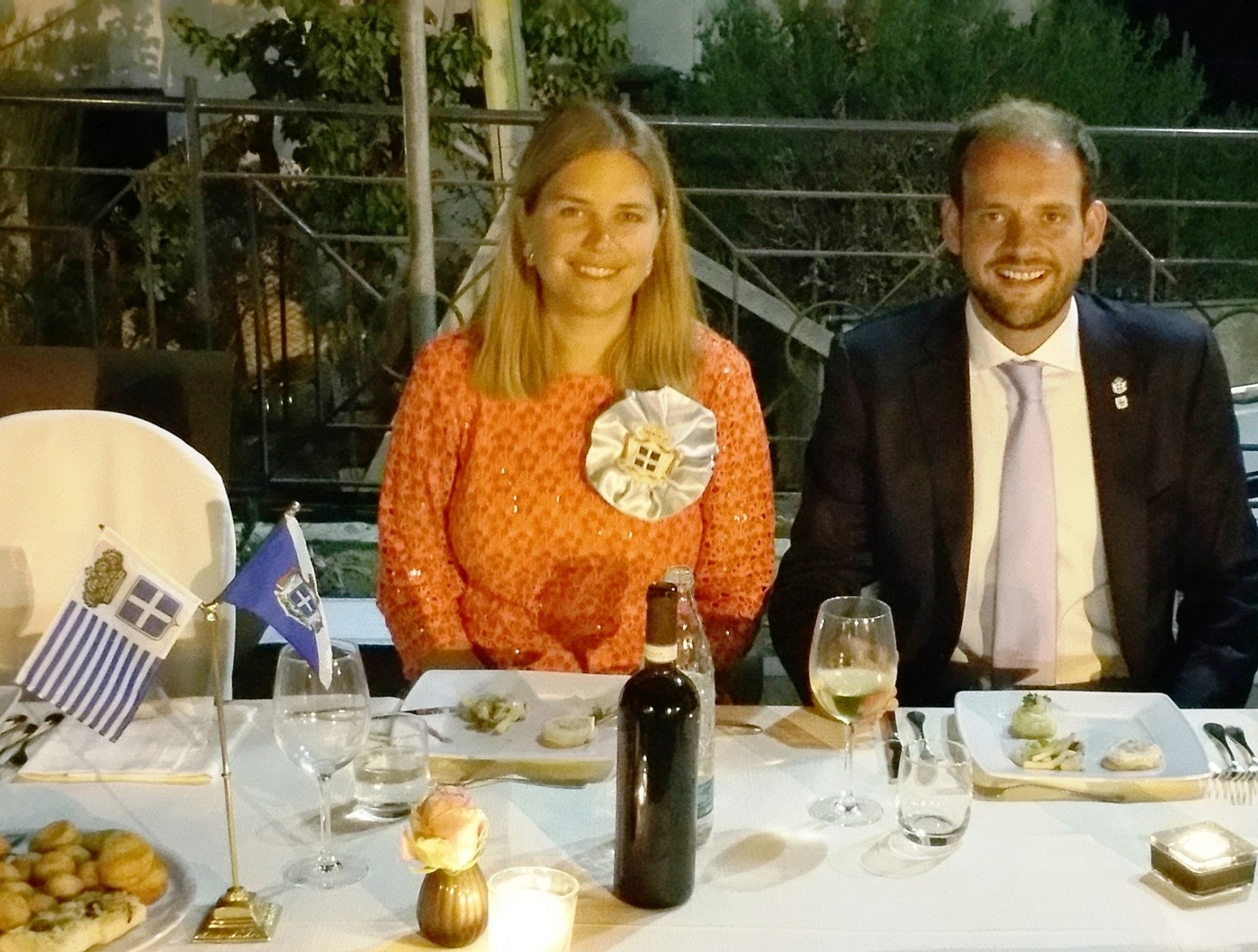
A gala dinner to commemorate Seborga's national festival.
A gala dinner to commemorate Seborga’s national festival.

Perhaps I exaggerated the part about Giorgio wanting to become prince. Who knows? For details on Seborga history, see Wikipedia.   In brief, from the 10th century, monks ruled the principality. They sold it to the King of Sardinia in 1729, a sale Giorgio and his followers claim was invalid. Italy, they maintained, annexed Seborga “illegitimately and unilaterally.”

The Principality of Seborga (14 square kilometers) calls itself a separate state within Italy’s borders, similar to Vatican City and San Marino.

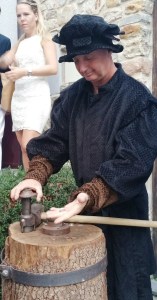
A demonstration to show how Seborga's currency was made in days gone by.
A demonstration to show how Seborga’s currency was made in days gone by.

Italy ignores these claims and has jurisdiction over the territory.   . Nonetheless Seborga has its own army, flag, royal family and currency. The latter, as well as passport stamps, are popular with tourists.

Prince Marcello, a 38-year-old former professional speedboat racer, is protected by his eight-member, blue-bereted Corpo della Guardia who were on duty for the national day festivities. To the delight of spectators, the Prince and Princess made a ceremonial entrance to the town in a horse-drawn carriage following a parade of costumed locals and guards.

Princess Nina and Prince Marcello

Marcello’s German born wife, Nina, serves as foreign minister of Seborga. The couple were formally received by Queen Elizabeth in 2011. On the world stage, Burkina Faso recognized Seborga as an independent state in 1998. According to one source, some 20 other nations also recognize the tiny nation’s  independence.  The U.S. has an ambassador to Seborga who attended the national festivities.

blog.1That is not enough, says Nicolas Mutte, described by the Wall Street Journal as “a shadowy, possibly French figure whose occupation is unknown.” He posted an online video this spring proclaiming himself “His Serene Highness Nicolas I,” Seborga’s new ruler. Mutte, who says he is a descendent of Napoleon, seeks a split from Italy and accuses Marcello of only promoting tourism and folklore.

Although the Prince, a local real-estate entrepreneur, was elected on promises to fight for independence, secession has taken a back seat as Seborga and its traditions have become a tourist magnet. Marcello does not seem threatened by Mutte. “Seborga is a free and blog.3sovereign principality that has elected me as its prince,” he told the Wall Street Journal. “Mr. Mutte has no rights over Seborga.”

Even Giorgio had to fend off pretenders to his throne. In 2006, a woman calling herself “Princess Yasmine von Hohenstaufen Anjou Plantagenet” stated that she was the rightful heir to the Seborga throne. Giorgio dismissed her claims, calling her the “internet princess.”

All of this intrigue adds to the fascination of this secluded fairytale sovereignty snuggled aside a long and twisty road above the coastal city of Bordighera on the Italian Riviera. Throngs of visitors conquered the challenging journey to attend the August festivities. Flags, hundreds of the principality’s blue and white banners, set the scene for a parade, music, seborga+fone 069flag throwing demonstrations, costumes, dancing – and the dinner. ( I only hope Seborgans have better food than the definitely-not-delicious offerings we were served at this repast. At least there was no shortage of wine.)


Seborga, the eponymous capital city of the principality with a mere 337 inhabitants, is one of those ancient hilltop villages of skinny, cobbled streets that climb and descend, past old stone dwellings decorated with flower boxes.   Views of the Med and distant peaks from the town terraces are splendid. A visit to its privately owned gramophone museum is mind boggling.

So, too, is the Seborga story.  Could I overthrow Nina and become Princess Leah (think Star Wars ) ?

?
We wore our finest for Seborga.

If not already a Tales and Travel follower, sign up (upper right) so you will not miss future posts. Your address is kept private and never shared.

blog.8
Members of the prince’s Corpo della Guardia were happy to pose with guests for photos.

Like my blog? Tell your friends.  Please leave a Reply below. Feedback is welcome. I love to know what my readers think about my posts.

Like tomatoes? Click here for Today’s Taste, a tasty tomato dessert.

makeread

Italy’s German Accent: Sud Tyrol

blog.st.10Signs advertising “Speck” everywhere we looked: along the roads, in shop windows, at street stands. ”Speck” is German for bacon, but we had just come down the mountains from Switzerland into Italy, not Germany.blog.st.6

This was northern Italy, known as Sud Tyrol in German and Alto Adige in Italian. The majority of the population speaks German – and obviously eats plenty of Speck. Ordinary bacon this regional specialty is not, nor should it be confused with Italian prosciutto (ham). Speck is rubbed with herbs, spices and berries, smoked for different lengths of time with different hardwoods, and air dried in the area’s mountain climate.   This makes it distinct, unique – the echt expression of the region.

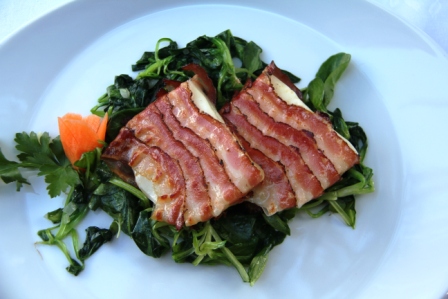
Speckmantel gebratener Ziegenkase auf gedunsten Feldsalt (Goat cheese enveloped in Speck -- yummy)
Speckmantel gebratener Ziegenkase auf gedunsten Feldsalt (Goat cheese enveloped in Speck — yummy)

I was on my annual trip to research articles for the magazine German Life, with BB as my chauffeur, Sherpa and trusty companion. After a few days in Leukerbad, a Swiss spa town in the Alps, followed by a visit to Davos, we proceeded to this intriguing part of Italy.

Since German predominates here, I’ll call it Sud Tyrol. Our travels took us to Merano, Bolzano, Brixen, and lovely spots in between. We found it all enticing and enjoyed two fascinating museums, picturesque hikes, the charming towns, blogst.1some excellent meals and a wonderful hotel. BB, who sadly does not do much biking these days but is passionate about wine, was thrilled with the local vintages. I may have to change his name from Bicycle Bob (BB) to Vino Roberto (VR).   Which shall it be?

Merano (Meran) is a marvel, a beauty of a town on the banks of the frisky Passirio River with fanciful flower beds, an arcaded shopping street and a spa center, all surrounded by mountains. The riverside summer and winter blog.st.2promenades  (passeggiate d’Inverno and passeggiate d’Estate) – paths through woods, past flowers and tropical plants, with the sounds of the rambunctious river tumbling over rocks, are glorious. We stopped to watch a kayaker practice on surging rapids.blog.st.13

“North and south meet here. It’s the best of two worlds,” said our Bolzano city guide, Luciano Rech, who filled us in on the region’s history. Sud Tyrol was part of the Austro-Hungarian empire until World War I during which Italy initially remained neutral. In 1915, as an incentive to enter on their side, the Triple Alliance (Germany, Austria and Hungary) offered Italy a chunk of land, all territories south of the Alpine water divide regardless of the ethnic makeup of the regions. At the time, 92.2 per cent of the population was said to be ethnic Germans. In 1919 the territory was annexed by Italy, and has been Italian ever since,  with the exception of the years 1943-1945 when it was de facto annexed to the German Reich until the fall of Germany. Both German and Italian are considered official languages.blog.st.18

It has not always been a peaceful co-existence, marred at times by repression and terrorism. During the 1930s and again in the 1950s Italians were forcibly resettled to the region. According to the 2011 census, German speakers make up 61.5 percent of the population, Italian speakers, 23.1 percent, and 4 percent  speak Ladin, an ancient language derived from Latin. All seems peaceful, and the region has a significant degree of autonomy. However, there are still some who resent being under the yoke of Rome and argue for independence.blog.st.15

“I’m Tyrolean” announces Rech. “I don’t feel we are the same as people from Naples, Rome.”   Many others I spoke too echoed his sentiments.Bolzano (Bozen), a bustling city and the capital of Sud Tyrol, is the home of Ötzi, the mummy of an Iceman discovered in

Recreation of Otzi
Recreation of Otzi

1991 in the mountains at the edge of a melting glacier. The museum where he is preserved behind glass is a must with enlightening exhibits of garb and objects that were found with him. And, extensive documentation, including videos, on the sensational find and what has been learned from and about Ötzi. He died 5,300 years ago after having been shot by an arrow, presumably murdered.

Famous mountain climber Reinhold Messner (first solo ascent of Mt. Everest without supplemental oxygen) has created the Messner Mountain Museum outside of town on the slopes of a mountain and in the ruins of a castle. It’s blog.st.20a genuine mountain experience, with lots of steps (I felt we were back in Myanmar), skinny walkways, metal ladders and fabulous views.   Follow the itinerary in and out of buildings, up slopes and towers, across bridges, past exhibits on his climbs, mountain terrain, Himalayan artifacts and more. Messner, who is a native of Brixen in Sud Tyrol, has established four other mountain museums in the province.blog.st.19

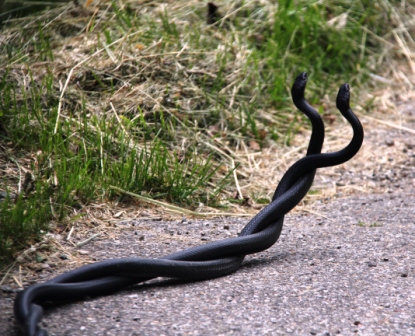
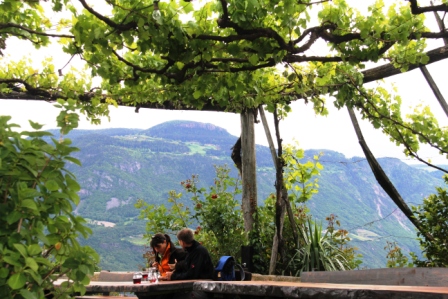
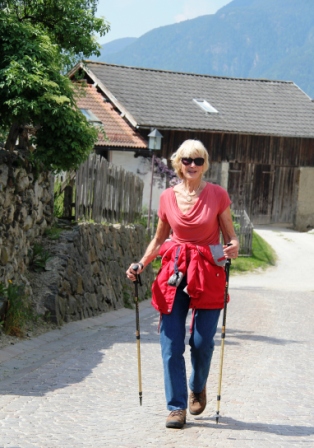
En route to Bolzano we stopped for an overnight so we could take a hike in the hills and soak in the scenery. We trekked amongst grape vines and apple blog.st.11orchards, and stumbled upon some sexy snakes. We had a wonderful lunch at an eatery under an arbor of grape vines with gorgeous views. The food, especially the apple strudel, was definitely more Germanic than Italian. The proprietors also sell wine, so of course we tasted and bought.blog.st.12

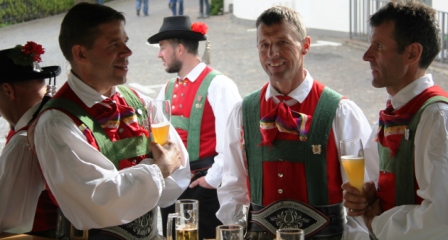
Unfortunately we did not make it to the mighty Dolomites which are part of the province for some real mountain hiking. After Bolzano we spent two nights at an inn, the Ansitz Zehentner, in the town of Lajen (Laion) where a rollicking fest was underway when we arrived. Women in dirndls. Men in trachten (traditional costume). Plenty of beer. And, blasen music (wind instruments). We could have been back in Germany.blog.st.22

Frau Schenk, proprietor of the inn which dates back to 1358, suggested a hike through fields and forests to a well-known hotel and restaurant , Gasthof Ansitz Fonteklaus. Sitting outside under mammoth trees amidst the mountain scenery was perfect — and so was the food.blog.st.21

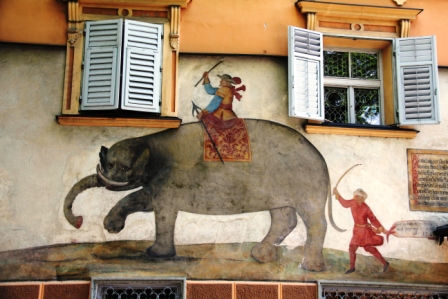
Our travels ended in Brixen (Bressanone), another gem of a town, where we splurged and spent a night at the classy Elephant Hotel with an excellent dinner in the hotel’s noted restaurant. The 450-year old hotel has been run by the same family since 1773. It was named after the pachyderm which was sent by blog.st.24Suleiman I to Archduke Maximilan as a gift in 1551. The elephant had a long journey from India, to Portugal, then Genoa and onto the Alps where it rested at the inn in Brixen, causing a sensation among the locals who had never seen such a beast, en route to Vienna. The elephant fresco on the hotel’s façade was painted many, many years later by someone who had never seen an elephant but based his rendering on descriptions.   What happened to the well-traveled elephant?   I learned that after the epic journey it only survived another two years.blog.st.17

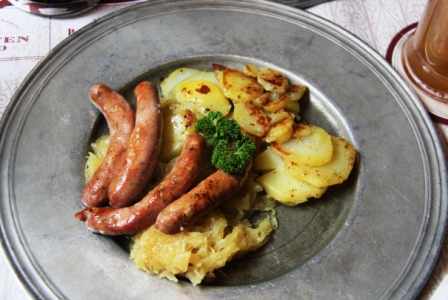
Before heading back to France I stopped at a butcher shop and loaded up on some very savory sausage — and Speck.

For more information:

Bolzano: www.bolzano-bozen.it

Ötzi : www.iceman.itblog.st.26

Messner Mountain Museum: www.messner-mountain-museum.it

Excellent central hotel in Bolzano (Stadt Hotel Citta): www.hotelcitta.info

Ansitz Zehentner: www.zehentnerhof.com

Hotel Elephant: www.hotelelephant.com


Comments welcome and appreciated. Today’s Taste features a recipe for Rhubarb Streusel Pie.  If you like rhubarb, you’ll love this.  See “Today’s Taste” at the top of this post. While  you are up there, sign up to become a Tales and Travel follower.

blog.st.23

Trip finale -- dinner in the romantic Hotel Elephant dining room.
Trip finale — dinner in the romantic Hotel Elephant dining room.