ON SAFARI

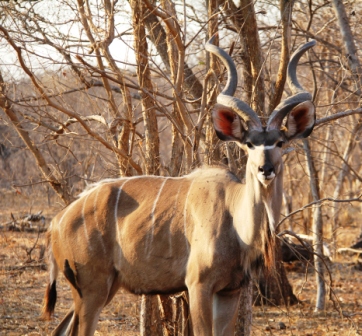
Elephants, giraffes, zebra, kudos, wildebeest, a hyena — I saw them all on my drive from the airport in Skukuza, South Africa, to the Idube safari lodge 3 1/2 hours away. I was excited and decided this was a good omen meaning lots more to come. I was right.

The highlight on the drive was a mother hyena with two tiny, lively puppies. Driver Cheryl said they were just a few days old, if that. Mom was worn out, sleeping soundly, not disturbed by one of her offspring who was chewing on her ear.

I spent the next two days at the Idube lodge and the following two days at the Motswari Game lodge. Both are vast private game reserves in Greater Kruger, an area with unfenced boundaries outside but adjacent to the Kruger National Park.

Game drives begin in the wee hours, about 6 a.m.  It was winter in South Africa, coal black and cold, freezing, at that hour.  Hot water bottles and blankets are provided, but still frosty until the sun pops up.  At 9 we returned to the lodge for a hearty breakfast, setting out again about 3 p.m. for an afternoon drive.

A tracker sits on a special elevated seat in the front of the safari vehicle, his eagle and trained eyes searching for tracks, movement, listening for sounds, any sign of animal life.  The driver/field guide is an encyclopedia of info, as well as a fearless driver, charging off road at Formula 1 speed to reach a site before the animal moves on. Duck under branches, bounce over bumps and ruts, hold onto your seat — more thrills than an amusement park ride.
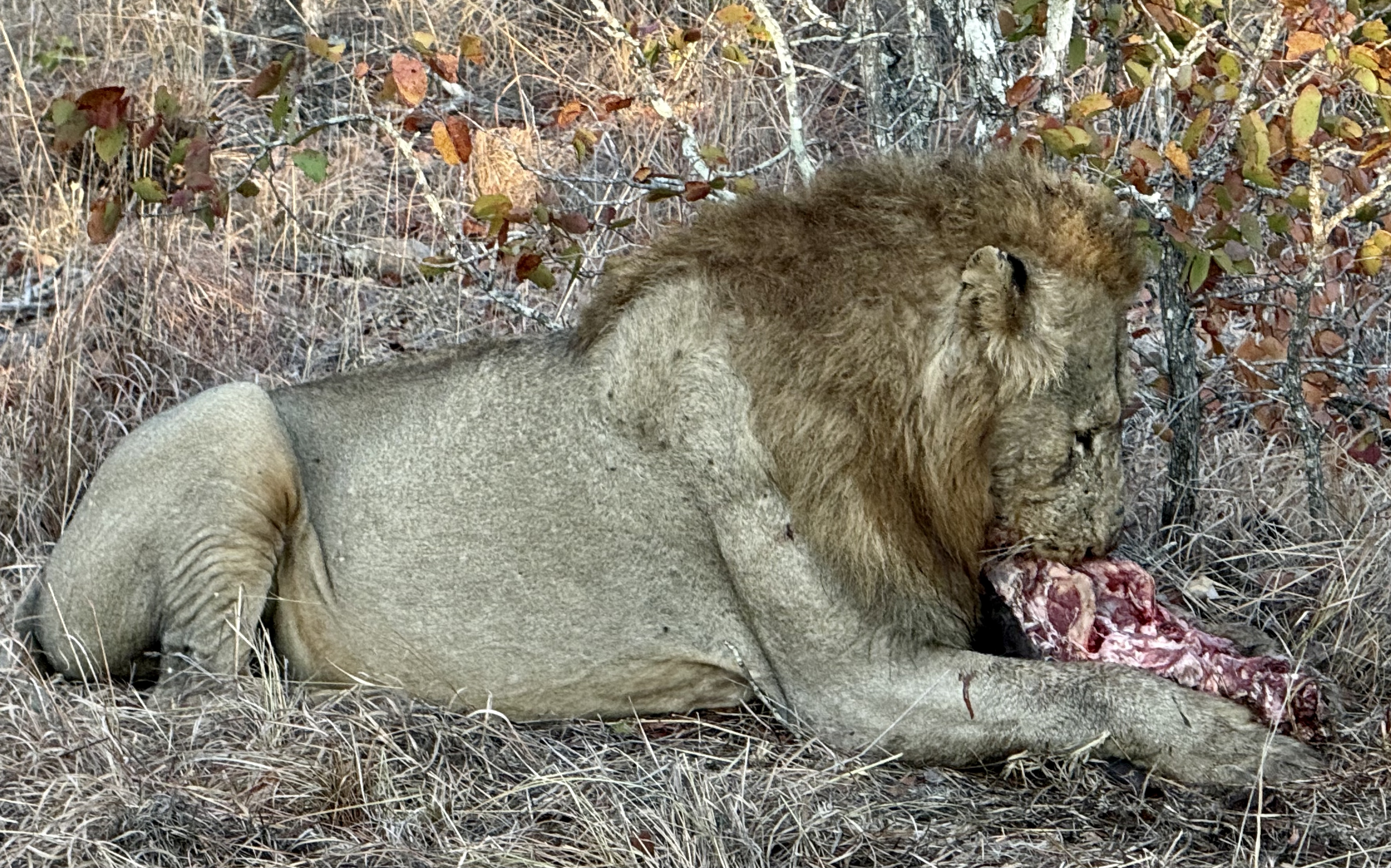
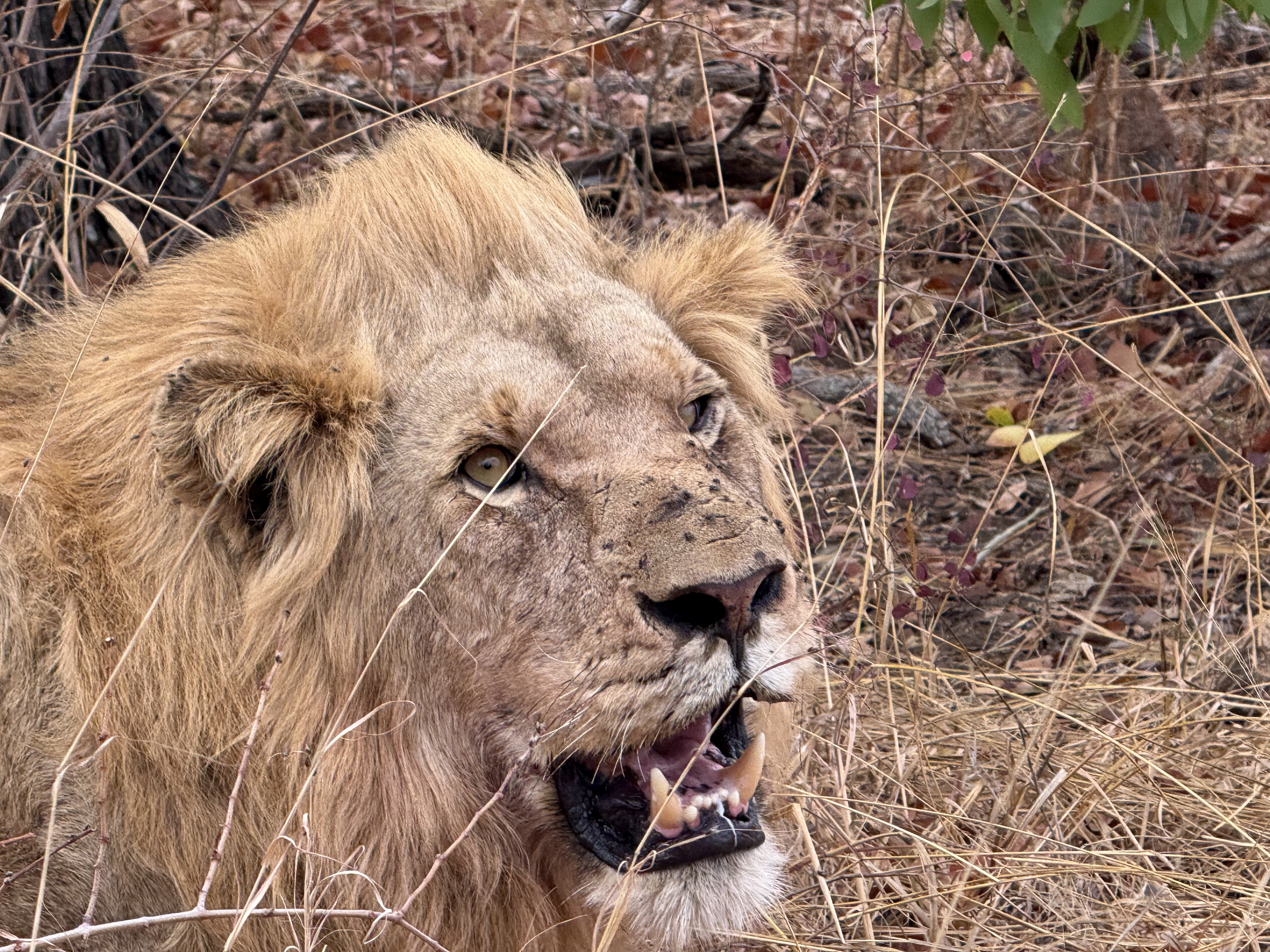
An abrupt halt. There — right in front of us — is the Lion King, gnawing on a bloody piece of carcass. A thrilling, awesome, incredible sight. You almost need to pinch yourself to be sure it’s real.

As in this instance, it is astonishing how close the vehicles get to the animals which completely ignore the visitors. They are accustomed to human intruders and definitely not camera shy. Even with a phone camera you can get decent photos (I used an I-phone 16 pro). For perfection, however, serious gear is best.

 Following are photos of my “sightings.” Since I am a “childless cat lady” who adores cats, large and small, I will devote a separate post to cats.  I saw many, all magnificent.  Watch this space.

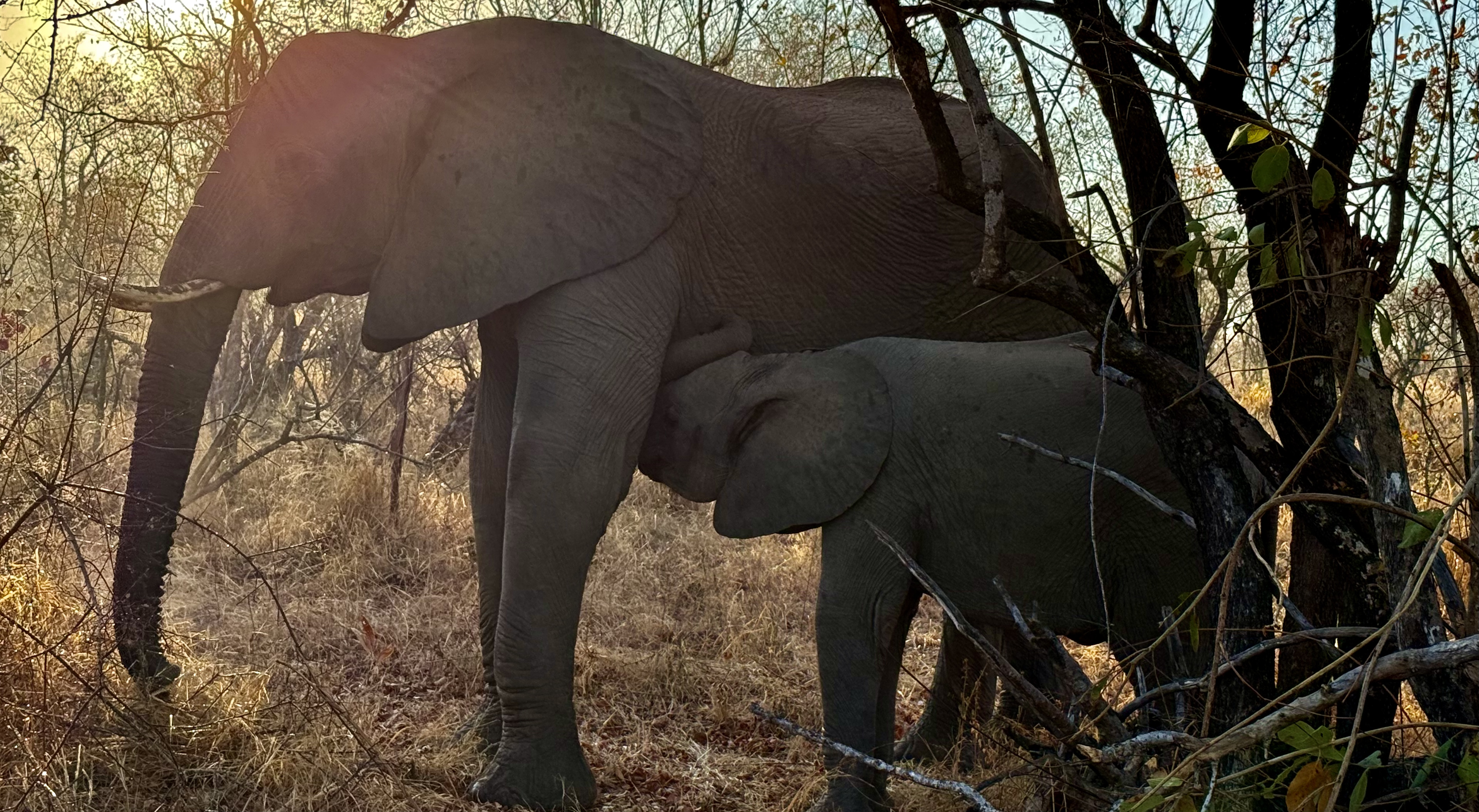
No shortage of elephants on the game drives: majestic males, families, youngsters. These mammoth creatures can live to be 60 to 80 years old. If they manage to survive that long, they die of starvation as their teeth wear out, making it impossible to chew food.  The elephant gestation period is 22 months and “babies” nurse for three to four years.  Elephants can eat for up to 18 hours per day. 
Rhinos, with and without horns.  The horns are treasured in many Asian countries for medicinal properties, although there is no scientific evidence that the horns have medicinal value. In some countries, namely Vietnam, the horns are a luxury item and status symbol.

Hence, poachers kill for the valuable horns.  In the Idube reserve, rhinos are de-horned at the age of two to dissuade the poachers.   Not so in the Timbavati private reserve where the Motswari lodge is located.      
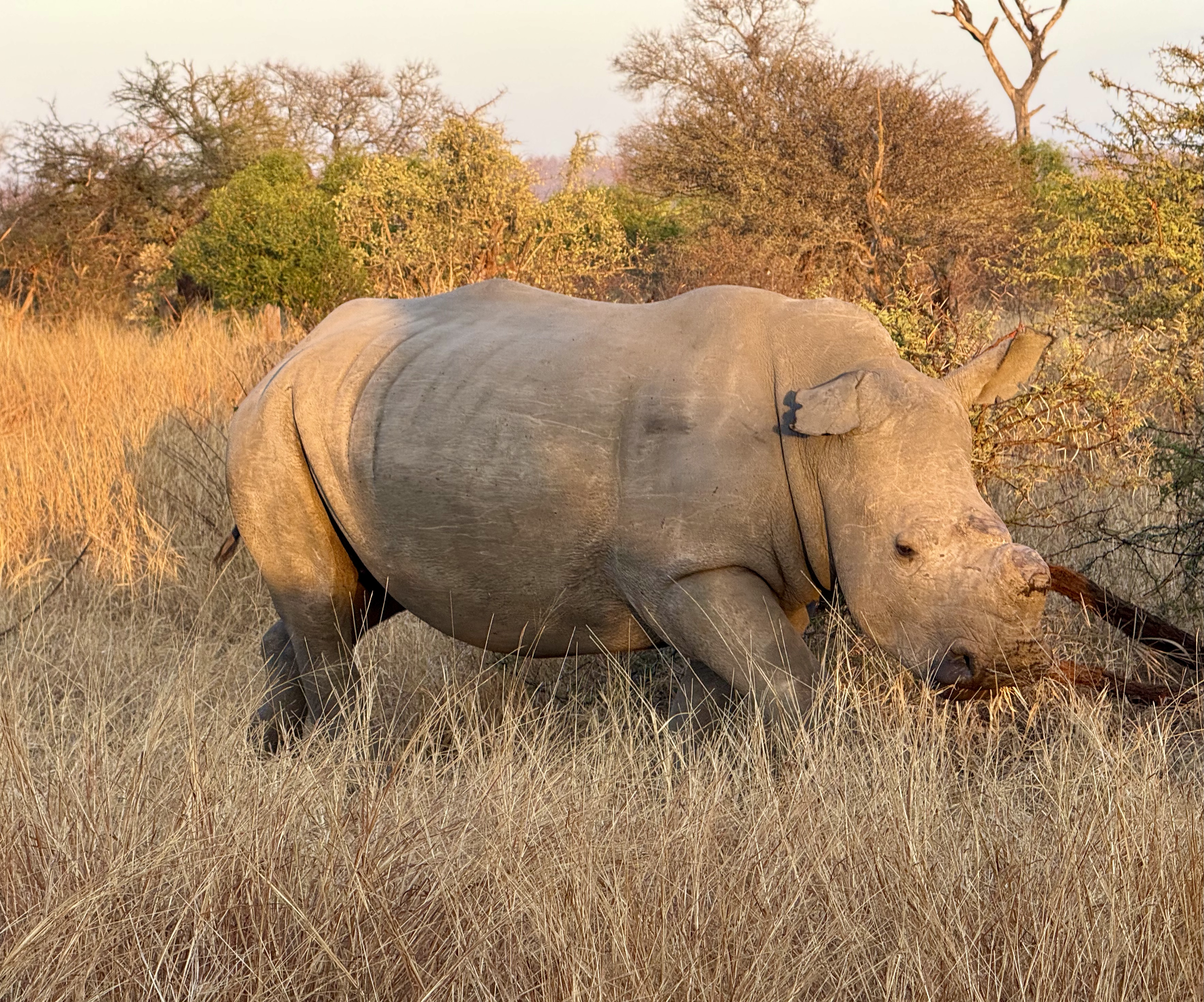
There guide Landon told us that dehorned rhinos are defenseless against predators and in territorial disputes with other rhinos.  Poachers may still kill them to avoid tracking the same rhino again.  And, the dehorning procedure must be repeated every 12-24 months, expensive and labor intensive.  It can also alter natural behavior, leading to social disruption.  Rhinos in Timbavati keep their horns.

The buffalo, one of Africa’s most dangerous animals, is one of the Big Five of African wildlife (elephant, lion, leopard, rhino and Cape or African buffalo). We were lucky and saw not just a few of these aggressive beasts, but hundreds crossing a lake.  

Foreground, hippos.

We never spotted a hippo out of the water, but we did see lots of hippo heads up for air in various lakes.  Hippos can stay under water for six to seven minutes, we learned, and they eat grass not meat.

Ian, the guide in Idube, told us the hippo is the number two killer in South Africa, following malaria, number one.  Number three is the buffalo. Landon at Motswari disagreed on number two.  He said number two is the crocodile, not the hippo which is number three.  Both put malaria as the number one killer.

Male kudo

An African safari is a thrilling, rewarding, unforgettable experience. In addition to being awed by the wildlife, I was intrigued with the country and its citizens. I talked to South Africans about their languages, tribal customs, problems in the country and life since the official end of apartheid in 1994. A look beyond safari in the next post.

Below, more photos.

Another hyena mom with puppies, one with his neck in her mouth. Guide Landon said the adorable hyena puppies are his favorite baby animal.
Wild dog puppies. The guide said two nearby packs were having a territorial dispute. The fight did not interest the playful puppies, but our vehicle did.
These fellows, nyala and a wildebeest, hung out in the front yard of my room at Idube. All were very tame, including the wildebeest. I thought I could try to pet him, but suddenly I heard screams. I was warned that he might decide I was not so friendly and turn those horns on me. I retreated.
Impalas are more numerous than other African antelopes.

I booked my African adventure, South Africa (Kruger) and Madagascar, with Worldwide Quest, http://www.worldwidequest.com

If not a Tales and Travel follower, please sign up here. Trust me. It’s safe. Your address is not shared. Don’t miss out. More about my travels in future posts:   South Africa beyond safari, Big cats, the mysteries and marvels of Madagascar.
Big cats coming soon.

No new recipe this time. But, it’s not too late to take advantage of those summer tomatoes and try this delicious Savory Tomato Tarte Tatin. For more recipes, click here.

Comments, please!

Your email address will not be published. Required fields are marked *

Adventure Africa: The People – and Polygamy

Women’s lib. Not in Zimbabwe. It’s a man’s world in this African country, our safari group learned during a “Learning and Discovery” session. Polygamy is widely practiced there as it is in many African countries. To tell us all about it: Mafuka, 74, who has three wives and 10 children.

Mafuka, 74, three wives, 10 children

“Our wives never say they have a headache,” the jolly Zimbabwean told us. He went on to describe his family life. We were mesmerized. It was entertaining, fascinating – and somewhat unbelievable.

Mafuka, a burly sort with an infectious smile, has been a safari guide for some 50 years, often away from his village and wives for months at a time. He has a farm, grows tobacco and corn; and has livestock, chicken, cows, etc.  The wives and children work the fields and tend to the animals.

Family at town market

He explained that his first wife requested a second wife to help with the chores. “She invited her cousin, a beautiful girl. I agreed.” For five years, he had just two wives.

As he tells it, the two decided a third wife was needed. He took a third wife, but they did not like her. “They teamed up against her,” he said. “Women in our society are very strong. I got rid of her,” he announced matter-of-factly. Some time later, he found a replacement. New wife number three is a nurse, but it’s the first wife who is always in charge.people.e

According to Mafuka, whose grandfather had 15 wives, before taking a wife, a man must prove his manhood and impregnate a woman. The baby stays with the mother and her family, but the father may later adopt the child. If a wife cannot conceive, she arranges for a sister or cousin to bear her husband’s child which she will raise. If a man has later difficulties (infertility), he secretly asks a brother or cousin to impregnate his wife.

It was all a bit much for us to comprehend. Was he putting us on? Change and progress have come to Africa, and certainly this scenario does not apply to all?

people.1
Women basket makers at a co-op in Botswana

I wanted to know more. “After long periods away from home, how do you satisfy all these women?” I asked.

“I drink a root preparation,” he proclaimed, beaming. “It makes me very strong. I go home with rhino horns.”

What if one of his wives would decide to take another man? ”I would kill him,” he boasted.

Mafuka went on to proudly relate that three of his ten children have degrees. He wanted to send one of his daughters to the university, “but she eloped as the fourth wife of a guy still in college… He hasn’t paid me in cows yet. I am going to go after him.”people.h

The family is of utmost importance in Africa, and big families are common.    At our camp in Zambia, there was a booklet with staff bios. One man had 12 children with two wives. Several had nine children each. Mafuka told us about the upcoming family reunion that he was organizing. He expected 1,000 guests.

people.iWhile there are many families like Mafuka’s, monogamy is gaining followers. Sally, a young married woman working at our camp, said she would not accept sharing her husband with another wife.   “It’s a controversial subject,” she said. “A man may have just one wife, but many mistresses. I think it will change. Women are getting stronger.”

Another woman told me that Africa is changing.   “Women now wear pants, but they still sit on the floor.”

Village huts in background. Our food gifts, center.

That was the case when we visited a family home in a village. All the women sat on the floor, the men — and we — in chairs.

The village/family visit was another Learning and Discovery event.   The village, Bhangale, was actually a homestead of 434 people who live in a cluster of huts with a communal outhouse and outdoor shower.   Our hosts, Fransica Lambani and her husband Philippe, are the homestead owners. They live in a cement house which was a gift from their children. “They are lucky,” our guide Abiot said. “They have two sons working in South Africa. They had the money for the house.”

people.14Prior to visiting the village, we went to a nearby town where we visited a supermarket and bought food supplies to offer the villagers as a gift. They welcomed us with song and dance, proudly showed us their homes – all neat and tidy. A woman gave a demonstration of how they carry heavy loads on their heads.

More song greeted us as we arrived to visit a Catholic primary school which has about 800 pupils. The school is in a rural area, and most all the children walk to school, from three to 10 kilometers one way.

Children welcomed us with a song.

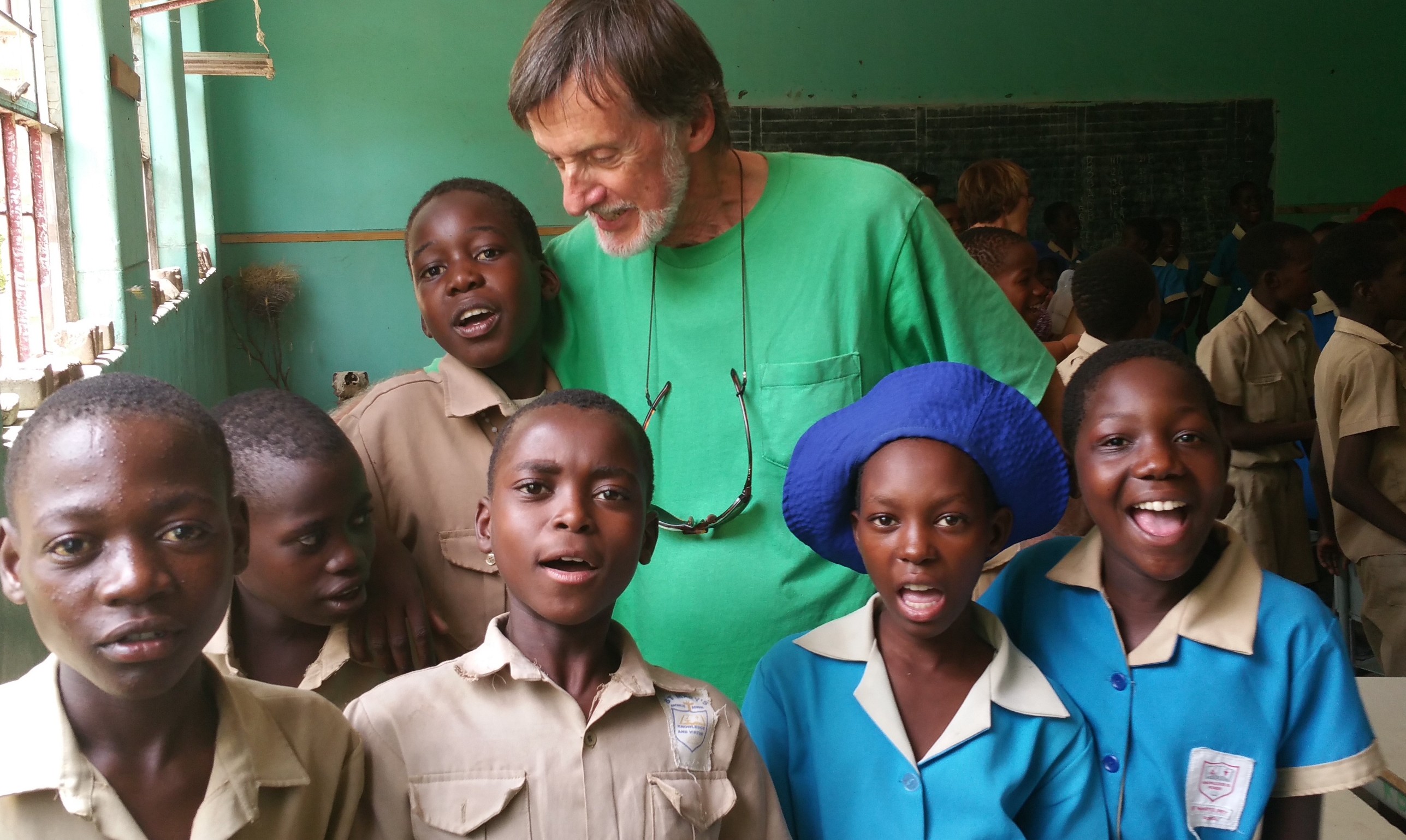
The principal led us to a sixth grade classroom where we had a chance to talk to the youngsters. They are taught 12 different subjects, including agriculture and HIV/AIDS, their teacher told us. An 11-year old told me he wanted to study world economics.   All were eager to pose for photos, and then see the photos on the camera or phone screens.

Kids were happy to pose for us.

Education in Zimbabwe used to be free, but now parents must pay $45 per child per year.   Education is considered essential and Zimbabwean are considered among the best educated in Africa. According to Zimbabwean Abiot, who pays school tuition for four of his nieces and nephews, Zimbabwe has the highest literacy rate in Africa.

Bob and friends.
Bob and friends.

While this school was Catholic, not all the children are Catholic. Religion is very important in the African countries we visited: Catholicism and many different evangelical religions. As we drove into the town of Hwange, we people.jpassed church after church, one after another, each representing a different evangelical sect. “Going to church” was listed as “favorite pastime “on many of those staff bios I read at the Zambian camp.

We stayed at four different safari camps, two in Botswana, and one each in Zambia and Zimbabwe.   All were run by an African company, Wilderness Safaris, whose staff are terrific. From the guides to the cooks, all were caring, helpful, knowledgeable …and fun. They danced and sang for us, entertained us with stories about close encounters with wildlife, life back in their villages and much more.

Staff performed a farewell dance for us.

Our 16-day safari was organized by Overseas Adventure Travel, www.oattravel.com We paid $4,495 each for the all-inclusive package (lodging, all meals, most tips, land and air transport within Africa). For more on our trip, see previous posts:  Adventure Africa: The Animals and Adventure Africa: A Day on Safari

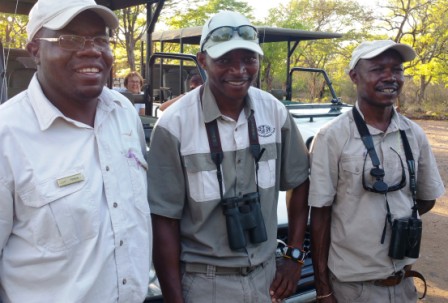
Abiot, center, with fellow guides in Zimbabwe

Like my blog? Tell your friends.  Please leave a comment – if you can’t see the Leave a Reply block and or Recent Comments list below, use the link on the right-hand menu (below “Recipes”). Feedback is welcome. I love to know what my readers think about my posts.

Guide Idos in Zambia


For a taste of Africa, try the recipe for Mafe, a chicken-veggie-peanut-concoction which was a hit at my African dinner party. Click here for the recipe.

Follow Tales and Travel on Facebook:  http://www.facebook.com/talesandtr

If not already a Tales and Travel follower, sign up (upper right) so you will not miss future posts. Your address is kept private and never shared.


Adventure Africa: The Animals

animal.1The Big Five – almost. The leopard, the most secretive and elusive of cats, escaped us, however we were hot on a leopard trail more than once. Sightings of lions, elephants and Cape buffalo were plentiful. We even saw one rhino. Impala, giraffes, zebra, various antelopes, crocodiles, warthogs, hyenas and lots of birds were also captured on our cameras.

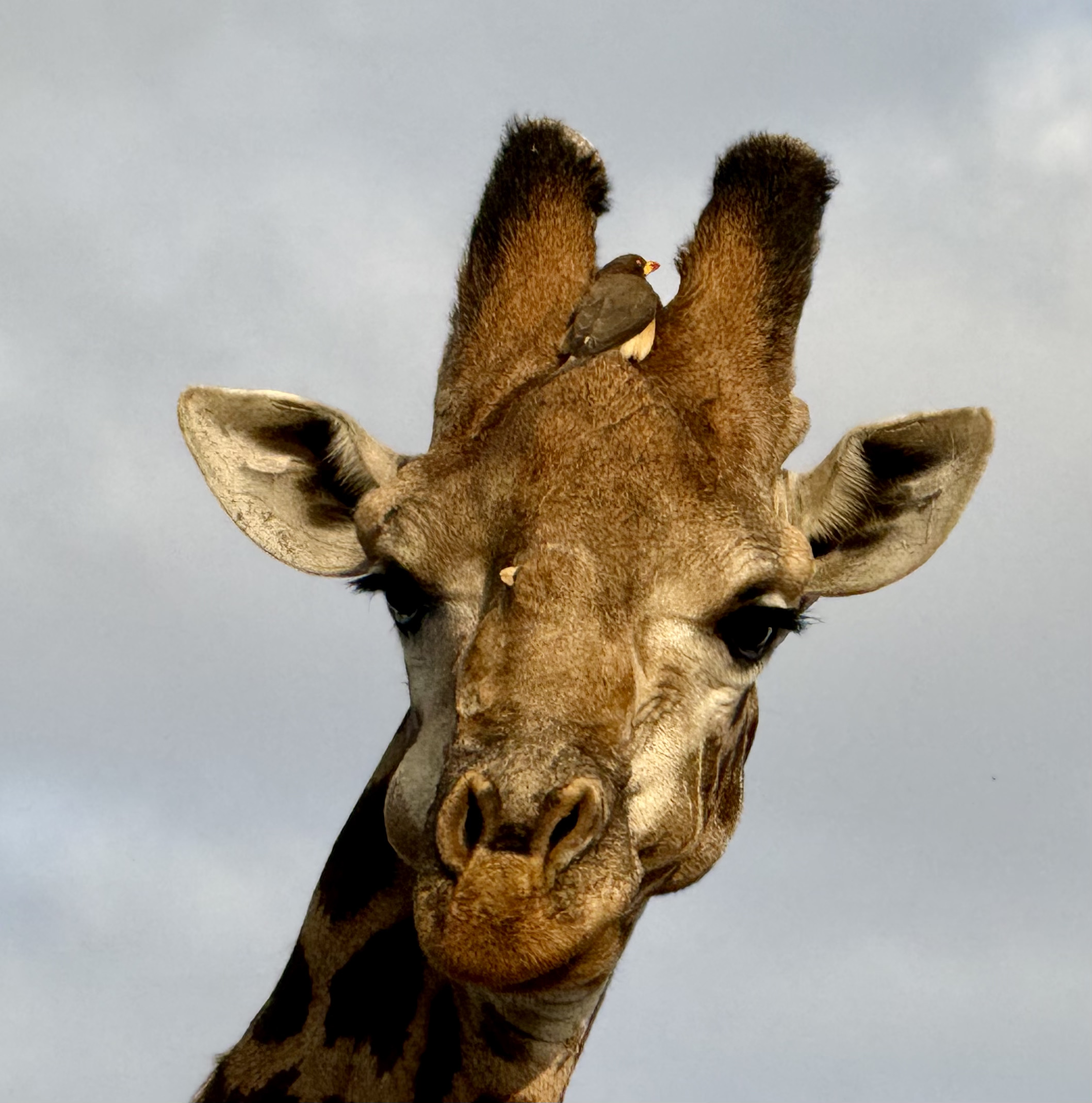
Birds eat blood-sucking parasites found on may animals.

(A previous post was devoted to gorillas in Rwanda, “Gorillas in our Midst,” truly the most outstanding animal experience during our African adventures.) Subsequent visits to Botswana, Zambia and Zimbabwe were nonetheless rich, rewarding, often exciting, and always educational. Following are highlights of our animal encounters.

For more, see previous post, "Gorillas in our Midst."
For more, see previous post, “Gorillas in our Midst.”

ELEPHANTS: These massive creatures are a source of wonder. We spotted them in all three countries, and learned much about them. Botswana, specifically Chobe National Park, is home to 65,000 elephants. They eat 18 hours per day, as much as 150 kilos of food per day. In Chobe, most all the trees are bare, stripped clean by hungry elephants. During a Learning and Discovery session, we were told that one elephant requires about one square kilometer of space.

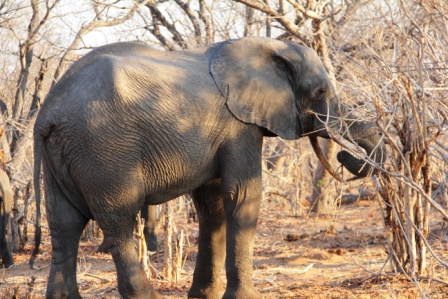
Elephants strip the trees bare.

Chobe encompasses 11,000 square kilometers – clearly not enough for such a large elephant population. It is a dilemma. Sterilization or translocation is too expensive for the country. Furthermore, translocation does not usually work as elephants, no matter how far from their original home, will head back. Culling has been considered but would generate negative publicity that would surely cut down on tourism. “What can we do?” our lecturer asked. Anyone have any ideas?

Super large elephants with gigantic tusks are rare. Most have been taken out by poachers and/or hunters. In Botswana, guards “shoot to kill” poachers. The country has fewer poaching problems than many other countries, and has banned safari hunting.animal.17We marveled at solitary elephants munching on trees, large groups marching to rivers and mothers with babies in tow. Elephants can communicate for great distances with a rumbling sound, and other sounds not audible to humans. They can run at speeds up to 25 mph. If you happen to be charged by an elephant, do not run. “Stop and clap and shout.”

animal.10
The lion is not the King of Beasts as he is easily killed by elephants, Cape Buffalo, even Honey Badgers.

LIONS: None of our safari group was charged by an elephant , but one angry lion did charge an open safari vehicle. The driver saved the day and raced away at great speed. We had numerous lion sightings – magnificent, astonishing, brutal, gruesome. More than once we witnessed lion sex . No wonder. They are champion copulators, we learned, — up to 100 times in 24 hours. A male and female can be at it more or less nonstop for three to five days – without Viagra.

Lions have no need of Viagra.

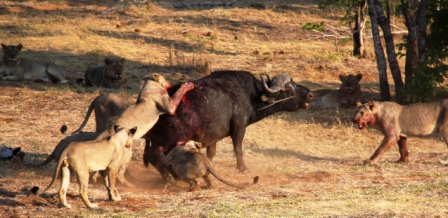
“This is National Geographic stuff,” our guide Abiot commented after we had watched a mating couple. Later that day, more National Geographic – too much for some. The Kill. Along the side of a road, a group of eight female lions was in the process of attacking and eating a live Cape Buffalo. It was bloody. It was fascinating. It was agonizing.

The poor beast struggled to stand up, only to fall down and groan in pain. The killer team took turns. A few would lunge and bite, while others rested and observed. We watched and photographed for at least 20 minutes, but had to move on to our next camp. We later learned from the bus driver who passed the scene many times that the buffalo’s suffering went on for three hours before he succumbed.animal.7“This is a training session,” Abiot said. “These lionesses are young. They are not skilled at killing.”

I had naively assumed that when killing lions went for the jugular to put the prey out of its misery. That is far too dangerous with Cape Buffalo due to the horns. For this reason, Cape Buffalo, considered the most dangerous of African animals, are rarely attacked by lions.

He looks sweet, but the Cape Buffalo is the most dangerous of African animals.

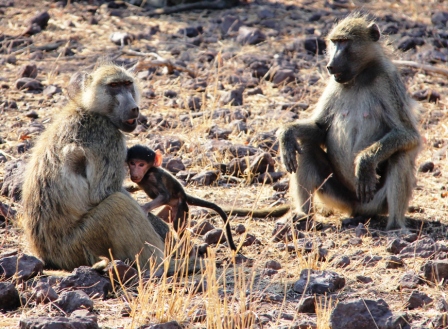
Elephants are also not normally targets for lions. “Most lions are afraid of elephants,” a guide said. Even lions have enemies. Honey badgers – small but fierce – can kill a mighty lion. “They are very clever. They go for the private parts. If you ever encounter one, back off,” we were warned. We did see one along a safari track. The driver floored for a close-up view. The petite creature stopped and bared his teeth at us, as if daring us to get any closer.animal.18A group of baboons can also kill a lion. They have very sharp teeth. They are also mischievous. Several broke into the tent of a couple in our group. No real damage was done, but all their belongings were helter skelter.

Hippos can stay submerged for six minutes.

HIPPOS: It is rare to see more than the heads of these giants which spend most of their days submerged. They do emerge from the water at night in search of food, eating up to 45 kilos per night. During the day they must stay under water because the sun cracks their skin, and they have no sweat glands. They are fast and can run at speeds up to 34 mph.   Because of the weight of the male, hippos mate under water. Babies are born in shallow water and stay with their mother for up to eight years.   A canoe guide in Zambia where we spotted hippos on a game viewing boat excursion complained that business was down due to an erroneous report on Facebook that hippos are the most dangerous animal in Africa. Not true — the Cape Buffalo as mentioned above.

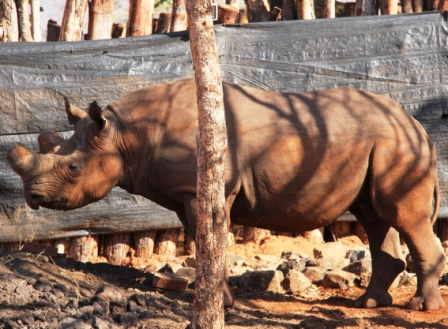
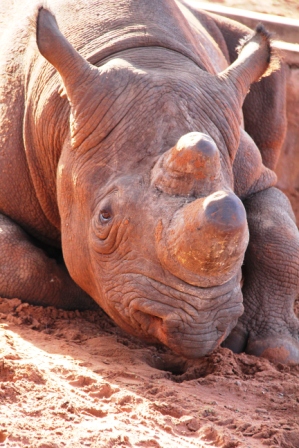
RHINOS: It was at a private game reserve in Zimbabwe where we saw one rhino. Three rhinos were introduced to the reserve in 2000 and six more animal.11have been born since. The reserve has an anti-poaching team who live on the grounds.   Rhinos are dehorned every two to three years to discourage poachers, but they are often killed nonetheless. Poachers don’t want to waste time tracking a rhino only to learn it has no horns, so they eliminate all. Horns do grow back.animal.5

Horns are sold to powerful criminal syndicates who ship them to Asian countries, including Vietnam and China where their weight is valued at more than gold due to the erroneous belief that Rhino horn can cure everything from cancer to hangovers.

It’s a thrill viewing these creatures up close and leaning so much about them. As fascinating and wonderful as the animals are the people. Coming soon:  Adventure Africa: The People.  If not already a Tales and Travel follower, sign up (upper right) so you will not miss future posts. Your address is kept private and never shared.

Our 16-day safari was organized by Overseas Adventure Travel, www.oattravel.com We paid $4,495 each for the all-inclusive package (lodging, all meals, most tips, land and air transport within Africa).animal.25Like my blog? Tell your friends.  Please leave a comment – if you can’t see the Recent Comments list below, use the link on the right-hand menu (below “Recipes”). Feedback is welcome. I love to know what my readers think about my posts.

Follow Tales and Travel on Facebook:  http://www.facebook.com/talesandtravel