
Bali Ha’i * may call you,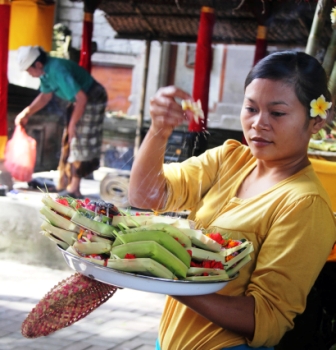
Any night, any day,
In your heart, you’ll hear it call you:
“Come away…Come away.”
Bali Ha’i will whisper
On the wind of the sea:
“Here am I, your special island!
Come to me, come to me!”
Your own special hopes,
Your own special dreams,
Bloom on the hillside
And shine in the streams.
If you try, you’ll find me
Where the sky meets the sea.
“Here am I your special island
Come to me, Come to me.”
My parents loved Broadway musicals. They often played sound track records. South Pacific was a favorite. My favorite song: “Bali Ha’i.” (*Bali Ha’i in the above song, according to Wikipedia, was not Bali, but based on the island of Ambae, part of what was formerly known as New Hebrides, now Vanuatu. Never mind, for me, it was Bali.)
I was mesmerized, both by the words and the melody of this song . I knew I had to see this “special island” someday.
It took almost a lifetime, but I made it last October. The Indonesian island was all I had hoped – and more. A British friend, Jenny, recommended we stay in Ubud, a town in the hills, rather than at a popular tourist beach resort. Thank you, Jenny.
In the book and movie, “Eat, Pray and Love,” Ubud was the focus of author Elizabeth Gilbert’s quest for spirituality and healing. Tourism is the chief industry in Bali, and Ubud, the island’s artistic hub, has seen a surge in visitors thanks to both the book and movie.
 Our home (husband Bob was with me) for six days was the Tanah Merah resort and gallery about a 20-minute drive outside of the funky town in a verdant, tropical setting. I found the resort on the Web. It was reasonable, beautiful, serene, fascinating – a bit of paradise. The fascinating part was the Danish dentist, Peter Bloch, owner and creator of this magical place which has just 14 rooms, including many individual cottages, and an incredible art and artifact galley with Peter’s extensive collection. For more about Peter and Tanah Merah, see my next blog post.
Our night arrival at the chaotic airport in Denpasar, the capital of Bali, was a horror story, (also more about that in a future blog on Travel Mishaps). But all turned out well thanks to a friendly Australian airline steward, Peter, whom we  met on our Qantas flight to Singapore. He recommended a friend and driver in Bali, Wayan Sukada. He sent Wayan an email and arranged for him to meet us at the airport and take us to Ubud – about an hour and a half drive through a crazy, congested city into the peaceful countryside.
Wayan became our guide and mentor. He drove us on an excursion to temples and sites. He recommended restaurants. He invited us to a ceremony at his temple. He taught us much about Bali and its religion.
There is a pervasive spirituality in Bali is that is both intriguing and soothing. Most Balinese are Hindu, but they practice a form of the religion somewhat different than Hinduism in India. It governs their daily life. Every town, no matter what the size, must have three temples, Wayan told us, each dedicated to one of the three elements: air, water and fire. All homes have a main temple, and often an additional one in each room. Ceremonies are profuse – not just the usual ones for weddings, births and cremations, but celebrations for the rice harvest, in honor of animals, to bless machinery…During our brief Ubud visit, Wayan attended three ceremonies. He said he must give 10 percent of his earnings to the temple.
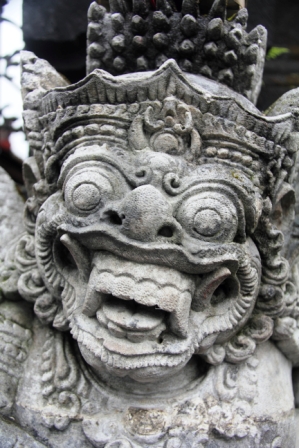
Statues of gods, goddesses and demons are everywhere, and often draped from the head down in sarongs. The latter is to protect the spirit inside the statue. The sarongs are in various colors, but each color has significance. White,  for example, is for prosperity. Trees, which also have spirits, are also sometimes covered with sarongs. Offerings to the statues are made twice each day – tiny baskets made with coconut leaves and filled with blossoms. Every morning we watched employees at Tanah Merah put fresh offerings of flowers at the base of the numerous statues on the property.
Besakih is the Mother Temple in Bali. We passed hills of rice paddies and drove  through poor villages, past numerous temples, en route to the holy site, a huge complex of structures on seven levels. Before visiting the site, we both had to “rent” sarongs to wear in respect at the temple. A government guide led us through the complex, first up the steps on the left side, the negative side, then down on the right side, the positive side. At each level there are terraces, altars, statues, and ceremonies were underway at some.
Our excursion that day also included a stop at Klungkung Palace which was 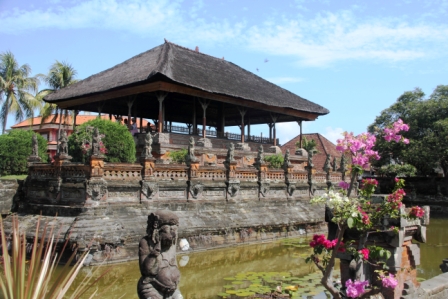 erected at the end of the 17th century, but largely destroyed during the Dutch colonial conquest in 1908. Among the remaining portions is a lovely floating pavilion which was added in the 1940s. While visiting the palace, we heard the beat of drums and commotion in the adjacent street. It was a funeral procession, with groups of mourners following the wrapped body. Wayan explained that the body would be interred first, then unearthed at a future date for a cremation ceremony during which the remains of many would be burned.
 As we (especially Bicycle Bob) love cycling, we signed up for an all-day bike excursion. Unfortunately the supposedly spectacular view of Mount Batur, near where the trip originated, was hidden by clouds; it rained most of the day, and Bob had a crash in the mud on a skinny route through a rice paddy. But, it was an enlightening trip nonetheless. Our group stopped in a village where we toured a home — several rooms, virtually no furnishings, a temple in the yard, — all very basic and poor. Bali may be the home of numerous luxurious resorts, but life for the average citizen is at the other end of the spectrum.
While he (Bob) is passionate about bicycles, food and cooking are among my hobbies. So, we also signed up for a Balinese cooking class at the Bambu Bali restaurant. It started out with a visit to the colorful market where our teacher explained 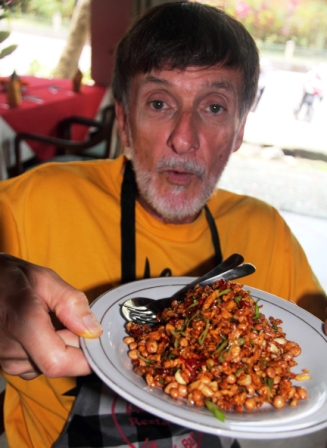 some of the indigenous produce. The dishes we prepared, seven different ones, were all delicious, many on the hot and spicy side. We also received a souvenir cook booklet with recipes. Unfortunately all seem to require ingredients which I’ll never find here.
Bicycles, food – and animals. We love them, too, and our visit to the Monkey Forest in Ubud was enchanting. Thousands of monkeys: mothers with babies, teenagers wrestling with one another, couples diligently picking bugs off each other’s backs… All roaming freely in a vast tropical forest complete with temples, statues and a picturesque stream strewn with rocks.
The visit to an elephant sanctuary was somewhat disappointing. Just to view the elephants, we had to pay $15; an elephant safari ride cost an extra $45. We passed on the costly ride, but one of the guides, who agreed the charge was ridiculous, offered us a brief ride as his boss was not around. It was fun, and his commentary on the elephants was informative.
On our last night, Wayan took us to a ceremony to inaugurate a new temple in his village. He was a member of the all male band: drums, bamboo flutes, 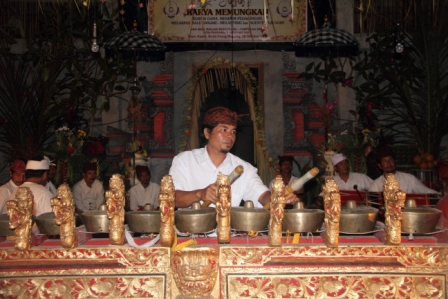 hammers, cymbals, and a xylophone. The sounds, lots of clinging and clanging, all sounded much the same. The men in the band all wear white with a bandana around their heads. The latter, Wayan explained, is to keep them focused on god and prayer.
Villagers arrived with enormous creations of fruit, flowers and food, all placed on an altar as offerings. The women, wearing their finest, sat together, while the  men were off in another section – some gathered in an adjacent room smoking and gambling, according to Wayan. Children, dogs and chickens wandered freely around the festive scene.
Even if it’s not Bali Ha’i, for me Bali is indeed a “special island.”
Bali is reasonable. Wayan charged us about $28 for the transportation from the airport to Ubud; about $36 for an all-day excursion. Our spacious room with full English breakfast at Tanah Merah was $100 per night. Cycling tour with bike rental, breakfast, lunch and van transportation to and from the start of the ride, about $36 per person. Cooking class, about $22 per person, including eating the food you prepare.
Email: wayan_sukada70@yahoo.com (underscore between wayan and sukada)
For a fantastic soup, see recipe in column at right for Baked Garlic and Onion Cream Soup. Watch the slideshow below.











 Tales and Travel