FOOD:  GLORIOUS CHRISTMAS FOOD

Forget the tree and presents.  Of course, they are important. For foodies like me, however, it’s food that makes the holidays especially tantalizing, delicious, rewarding.

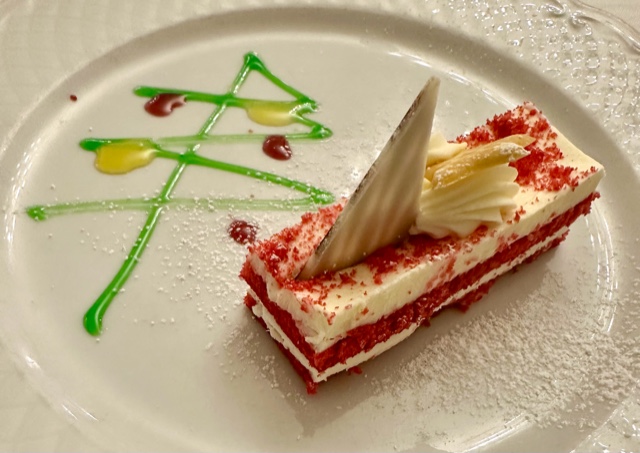
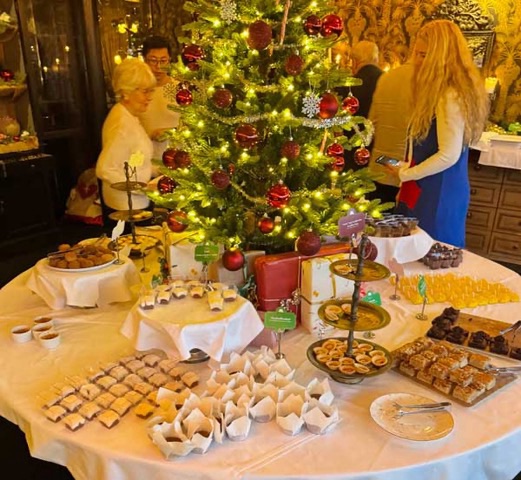
An overload of Christmas desserts in Portugal.

Eggnog, Christmas cookies, fruit cake, turkey, standing rib roast and baked ham are among American holiday treats. What about other countries? What do their citizens savour during the holidays? I asked several non-American friends about their Christmas food traditions.

GERMANY : “It must always be fish on the 24th,” says my German friend Andrea. She prefers salmon and roasted potatoes.  Andrea, an excellent cook, seasons the fish with salt, pepper, rosemary, a bit of wine, and rubs it with oil, then roasts it. Delicious, and not a lot of work. Her father went for carp on Christmas Eve. 

On the 25th, it’s venison goulash with priselbeeren (similar to cranberries) and dumplings for Andrea, husband Thiemo and her mother, Tekla. In many German households, roast goose is the Christmas highlight. When I lived in Germany, I tried it. Good, but tricky. It can easily dry out. The array of German holiday sweets is almost decadent: Stollen, homemade cookies galore, gorgeous cakes. Lebkuchen, a type of gingerbread cookie, are ubiquitous.  

In FRANCE where I now live, the Christmas Eve Réveillon is the meal extraordinaire.  It could begin with champagne and oysters, although these are popular throughout the holiday season.  If not oysters, perhaps a mixture of shellfish or smoked salmon.

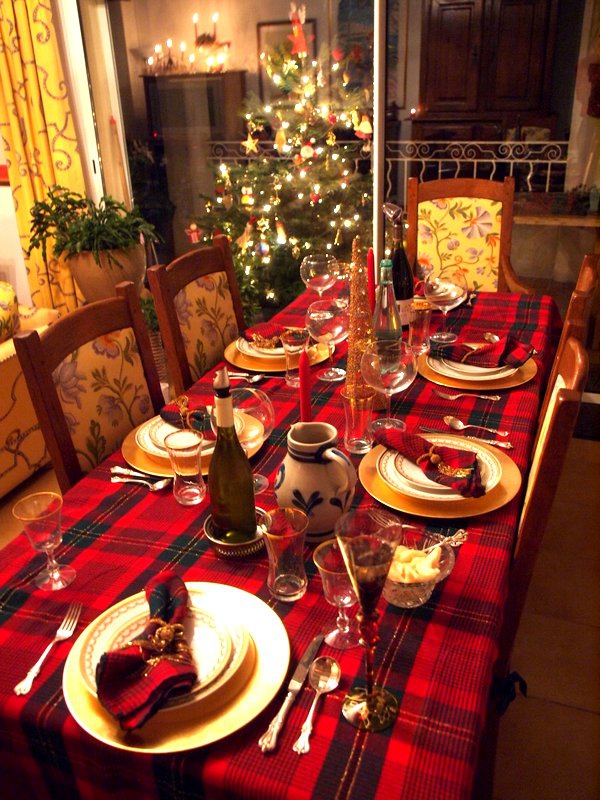
My Réveillon table – many years ago

Foie gras is also de rigeur, although controversial.  Geese or ducks are force -fed during the last weeks of their lives to yield extra-large livers. 

I love animals, but I also love foie gras.  Many years ago, for article research I spent a day working at a goose farm. The geese did not resist the force feeding.  Their owner insisted it was not cruel.  This was a beautiful farm.  The geese were free ranging until their last days.  However, not all geese and duck farms are like this. 

I even took a foie gras cooking course and learned to prepare the delicacy which I did for Christmas guests.  Those days are over.  Now I feel guilty eating foie gras, but I do indulge in a wee bit at Christmas.

Turkey, or another bird such as capon or guinea fowl, can take the spotlight at the Reveillon dinner.   A Buche de Noel (Christmas log), a fancy cake in the shape of a log, caps off the meal. 

In ITALY, Cinzia tells me, after midnight mass on the 24th, all return home to open presents and enjoy Panettone, the Italian holiday cake, with a glass of sweet wine.

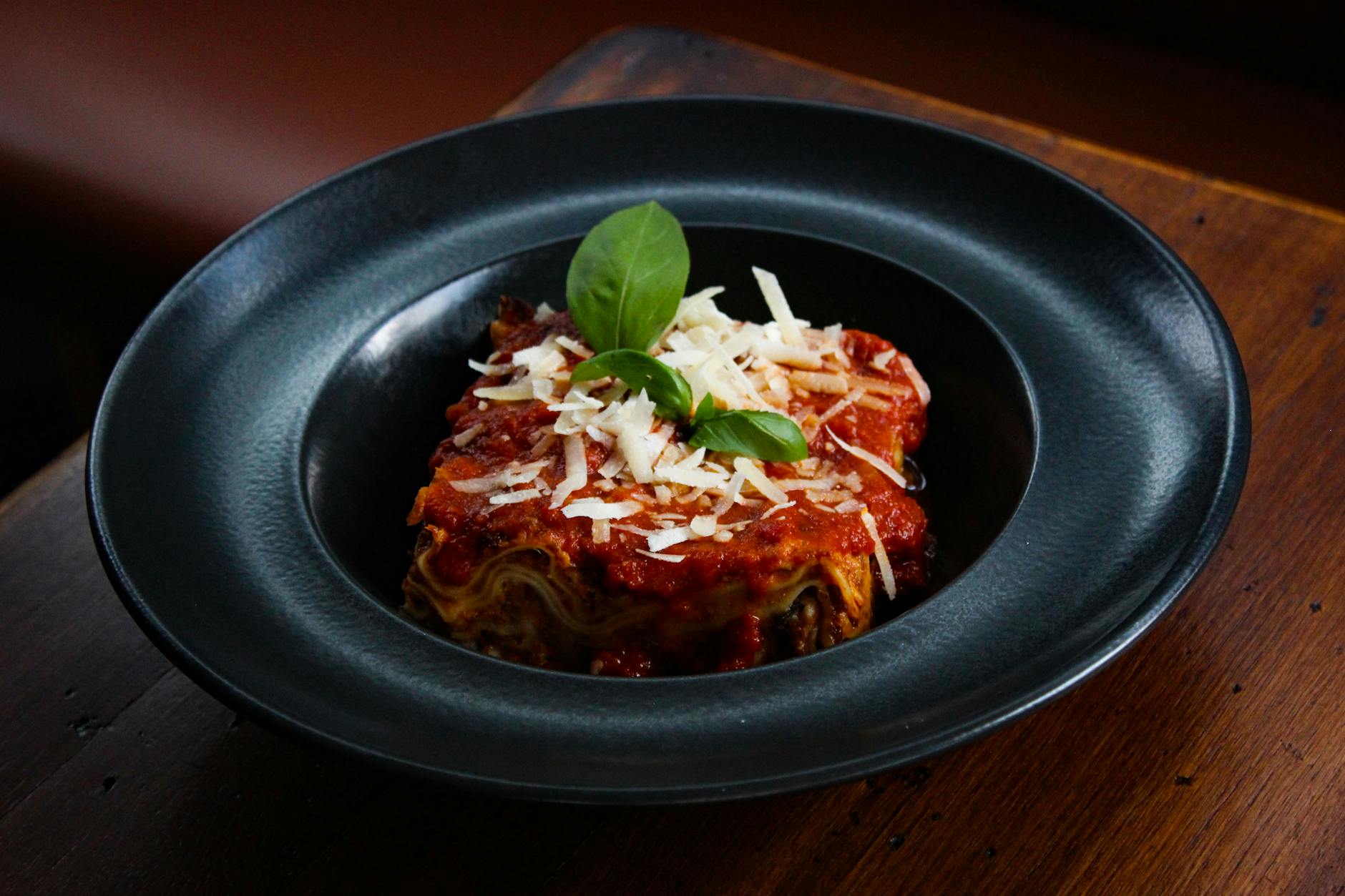
As in many countries, the customs can vary with regions.  She hails from Piedmont, the north, where Christmas lunch on the 25th is the major event. As this is Italy, there’s a pasta course which, at Christmas, is usually homemade stuffed pasta, such as tortellini or cannelloni.  Her favorite is her mother’s lasagna.  “Now people eat it all the time,” she says, but formerly it was reserved for Christmas and special occasions. Roasted lamb, beef or the holiday special, zampone  (stuffed pig’s feet) follow the pasta. 

For Cinzia, the Christmas meal represents “the fact of feeling part of a family which was there for you year after year, the (illusory) idea that, no matter what would come, every year the family tradition of eating what she was cooking would perpetuate, it’s about a sense of belonging and ‘safety'” 

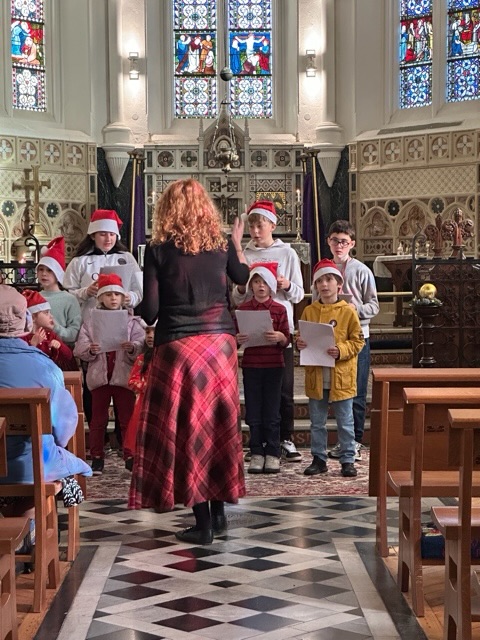
Arabella (back to camera unfortunatley) leads her pupils in Christmas carols

Like Cinzia, Italian Arabella says her favorite is Panettone.  But, at her house the major feast is on Christmas Eve featuring some type of meat. That’s fine for her husband and daughter. But, she’s a vegetarian and will also prepare ravioli stuffed with spinach and ricotta. She is also a big fan of an Italian Christmas chocolate, Cri Cri, with hazelnuts and praline.

ROMANIA: Romanian Florin remembers childhood Christmases in his country where carnati (smoked sausage) is a holiday must. Preparation in country villages begins on December 18 when neighbors gather outdoors to kill a pig, then cover it with hay and set it afire.  Gruseome! Florin even remembers killing the pig once. The cooked beast is divided into parts.  All work together to turn out the tasty sausage.

Killing the pig is illegal today, but Florin says it probably continues in some areas. Those who are not up to the carnati labor, not to mention killing a pig, can purchase the ready-made sausage. Other Romanian Christmas musts are sarmale (stuffed cabbage) and cozona, a light “puffy” holiday bread.

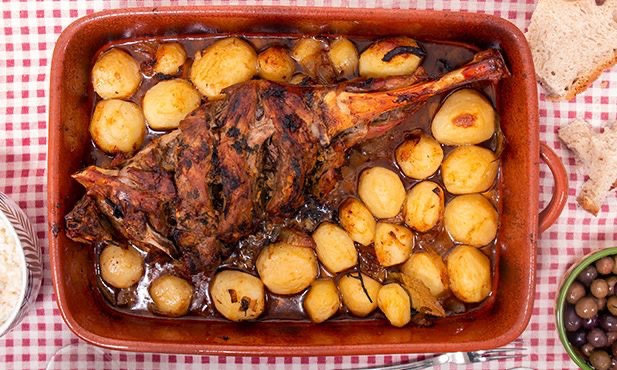
PORTUGAL:“We eat a lot at Christmas and Easter, a lot of different things,” Portuguese Catarina says. “We have a full table of food. It’s too much. We don’t eat it all.” For Christmas Eve dinner, potatoes, carrots, the famous Bacalhau (boiled, dried salted cod), and more fill the table. Her favorite, however, follows the next day, roasted octopus at lunch.  She hails from northern Portugal where roasted goat is also common on the 25th.

Roast goat takes center stage on many a holiday table in Portugal.

But it’s the desserts that shine – many, many different treats.  She admits they are very rich and sweet, and she is not fond of all.  “But I love to see and smell them.  That’s Christmas.”  

She’s right. It’s not just the taste, but the enticing aromas and beautiful presentations that enhance holiday food and make it special. And — friends and family. “Christmas is to be at the table with family,” Catarina adds. Enjoy.

Happy Holidays and Bon Appetit to all.

Scroll down for more holiday photos

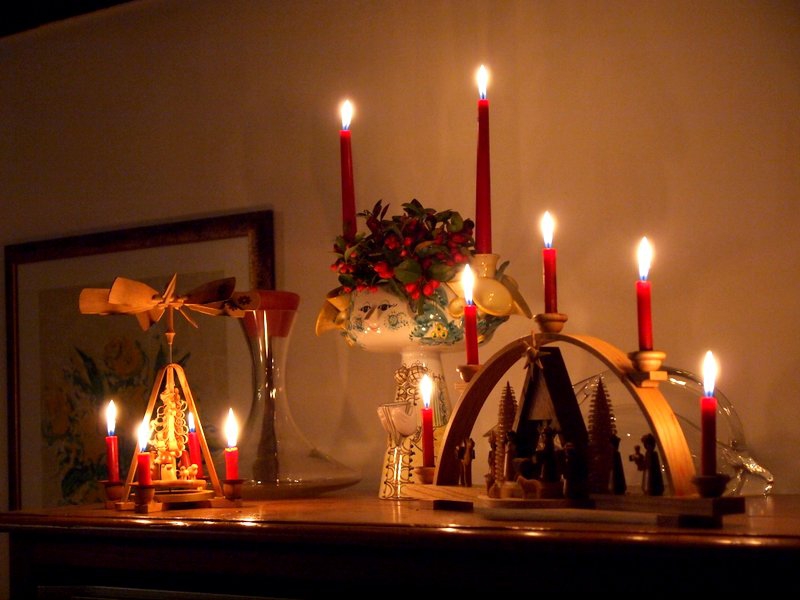
My German holiday decorations.

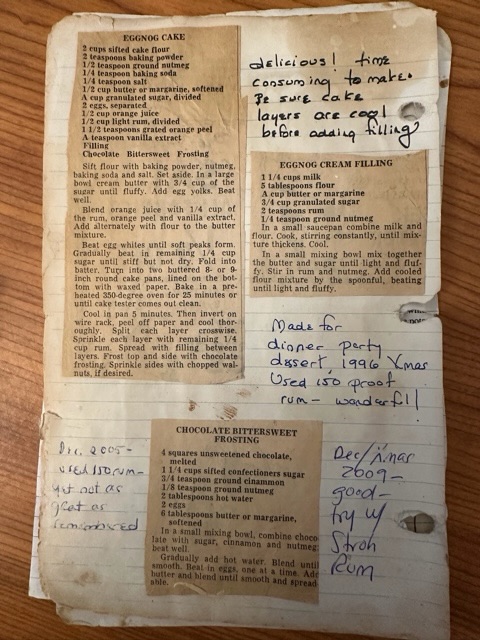
I’m old and so is this treasured Christmas recipe. Long ago I clipped recipes from newspapers and magazines. This one is a winner. Read my scribbled notes. I always go for recipes with a bit of booze. Rum makes this cake.

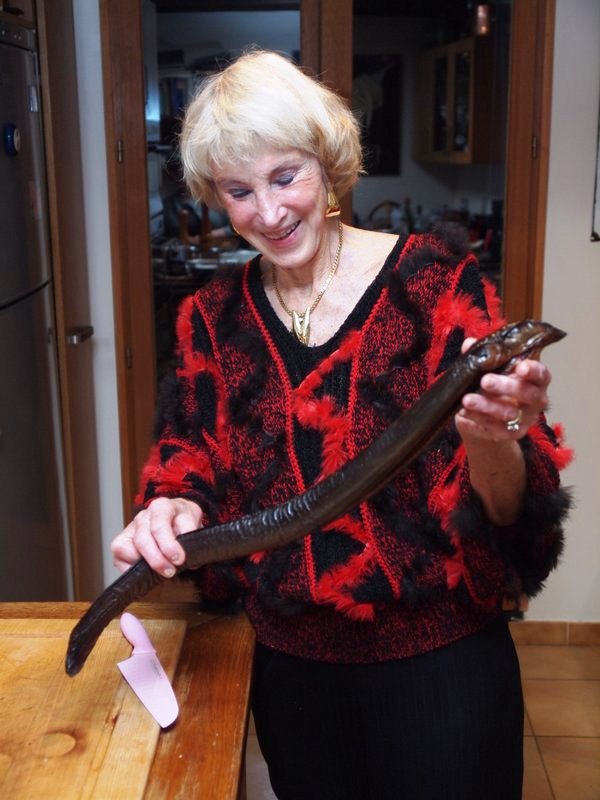
Smoked eel (exquisite) was a treat at one of my long-ago holiday dinner parties.
British friends brought “crackers” and hats to this holiday dinner years ago.
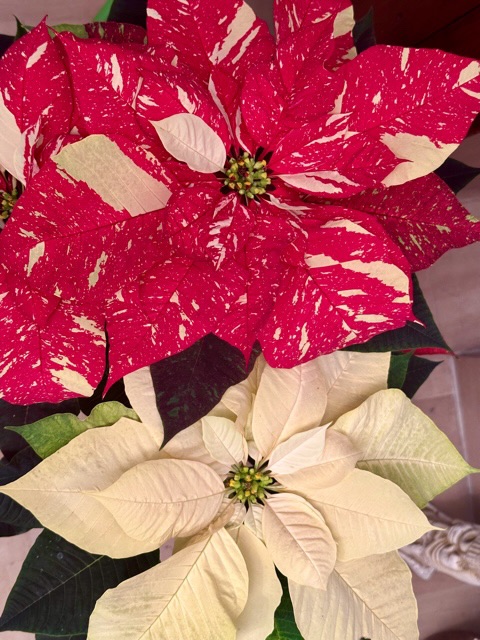
My poinsettia

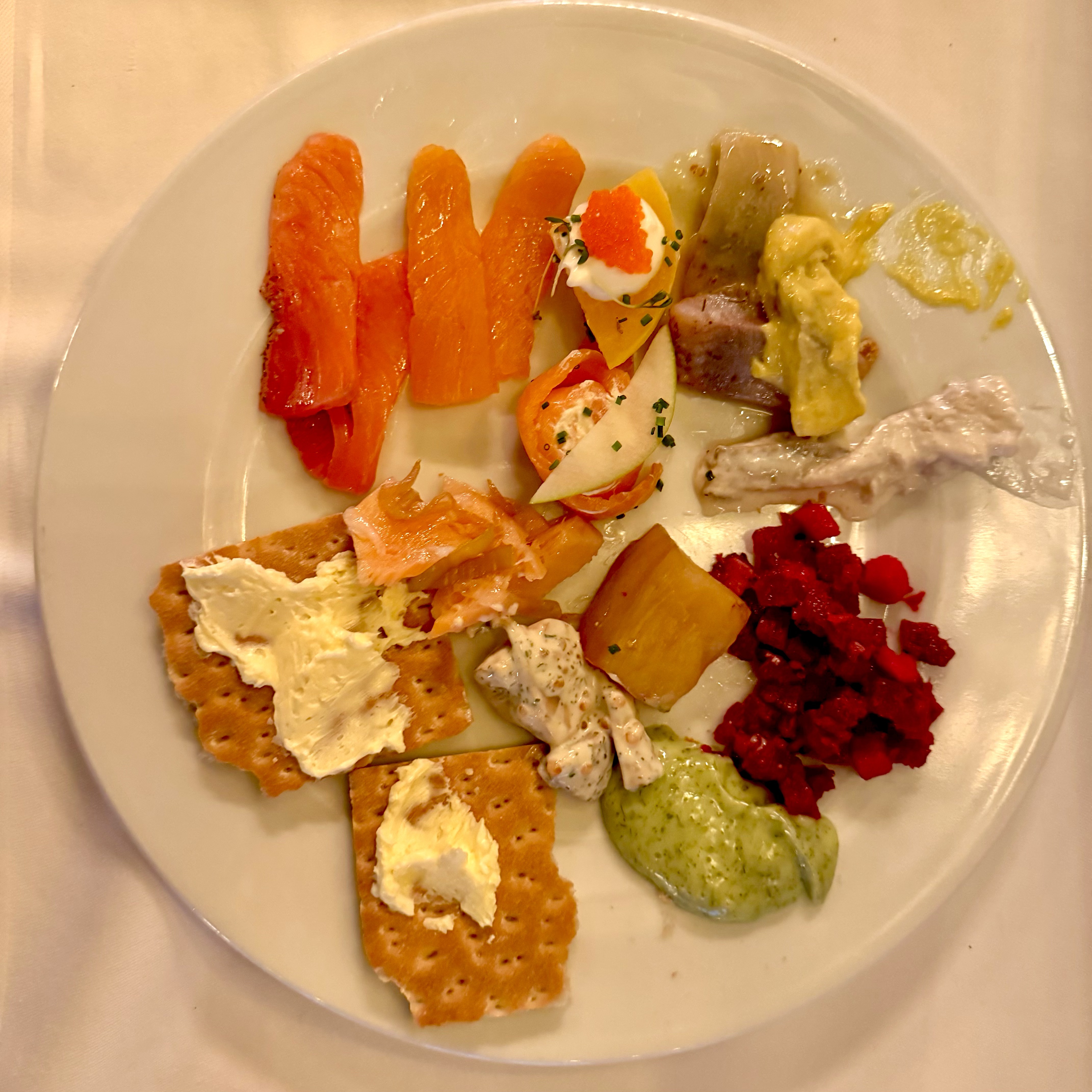
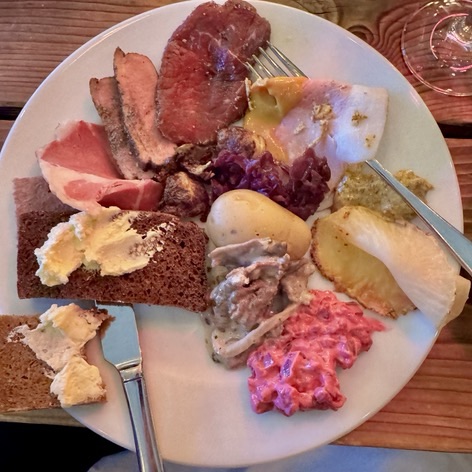
Coming soon, a guest blog by Swedish friend Lars on the Julbord, “the king-sized jumbo version of the famous smorgasbord.” It’s a food orgy, a mind-boggling, lavish assortment of tastes -and plenty of vodka. Don’t miss it.

If not a Tales and Travel follower, please sign up here. Trust me. It’s safe. Your address is not shared.

Check out my tried and true recipes — keep scrolling down on a phone, or, if on a /PC or tablet, up to the column on right then down to “Recipes.”  I will add new recipes soon.

Intro to Europe 101

“It’s a blast.” He was enthusiastic, curious, at times in awe, and termed almost everything a “blast.” It was so much fun and gratifying to be with him, a blast for me too.

That’s my nephew, David Koester, who visited me recently, his first time to Europe.

David and Leah
Nephew David and Aunt Leah

“It was an eye-opening experience.  I’ve never experienced another culture before,” David told me during a recent phone conversation. “I’ve been raving about the trip ever since I got back.”

David, 39, is an account executive with Logicalis, an IT consulting firm. He lives with his wife Sabrina and 8-year-old son Jonah in Louisville, Ky.

 His buddy Matt had a business trip to Berlin.  They decided to meet in Switzerland for a few days.  He visited me in southern France prior to the Swiss rendezvous.

We had lunch here before David explored the old chateau in the Vieux Village of Roquebrune Cap Martin

His visit here was short, three days.  We were on the move.  First stop the Vieux Village (old village) of Roquebune Cap Martin. I live in the “new town.”

After an outdoor lunch in the town plaza, David explored, up to the old chateau, then up and down the skinny pedestrian alleys.  Since I am now walking with a cane, I stayed back.  “It’s so cool walking through these alleys, seeing the old architecture,” he remarked.

Old town Roquebrune Cap Martin

A favorite spot in the old village is the viewpoint overlooking Monaco.  Another day, a very rainy day, we ventured to the principality and opted for the hop-on, hop-off bus which gives a good overview of Monaco.  

Monaco

David, who is a financial wizard, informed me that Monaco’s Formula One makes more money than any other sporting event.   “It was cool driving over the starting line,” he said.

Roquebrune Cap Martin is adjacent to Menton, a Riviera town on the border with Italy.   It too has an old town, a maze of twisty alleys, as well as the imposing basilica of Saint Michael.  David visited all, as well as the city’s market, my favorite.  

The old town of Menton
David was impressed with Menton’s market hall. This is my bread stand where we bought some tasty goodies.

We crossed the border for an Italian snack at Grotta.  I love to stop there – Italian ambience, reasonable food and an enticing setting just above the coast.  

Another must is nearby Sainte Agnes, a medieval village classified as “one of the most beautiful villages in France.” Reaching the burg, said to be the highest coastal village in France at an altitude of 760 meters (2,493 feet), is not for the faint of heart. Follow a treacherous, narrow mountain road —  lots of hairpin turns and places where there is room for only one car.  Someone may need to reverse. Fortunately, David was behind the wheel. 

He drove my Suzuki Swift.  I was still recovering from the San Francisco broken wrist (see previous post, “I lost my money in San Francisco”) and could not yet drive.

He found driving in southern France “wild.”  He summed it up: “There are mopeds everywhere.  Everything is very tight.  You’ve got to be on our toes all the time…you need to be aggressive out there.” He did enjoy my humble car.  “I haven’t driven stick shift in ages,” he said. “It was fun.”

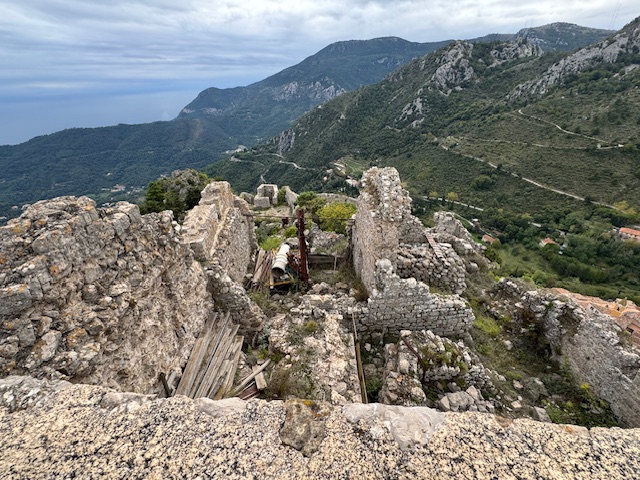
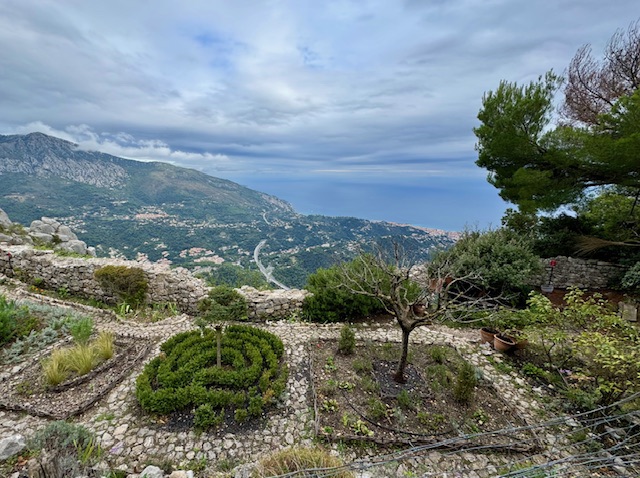
The views from Sainte Agnes are worth the trip. David trekked up a steep path to investigate the ruins of a chateau.

A steep path leads to the ruins of a 12th century chateau above Sainte Agnes
A medieval garden and cemetery are part of the chateau site.

Lunch was a treat, a multi course meal at a popular, rustic, local restaurant:  pork pate, followed by ravioli, and a main course of either wild boar stew or rabbit, all topped off with a slice of blueberry pie.  He ordered rabbit.  I went for the wild boar.  We shared.

For David, food in France is “phenomenal, awesome.”  He was impressed with the taste and presentation, and said it was much healthier than food in the U.S. 

The plan was to leave Sainte Agnes and continue up the mountain to Col de la Madonne, a mountain pass my super cyclist friend Bridget had raved about. The route is popular with serious riders on two wheels. 

We had three choices after leaving the village:  a road down to where we had come from, another with a sign to the town of Peille, and a third unmarked. GPS was no help.  We took the road less traveled – and too much adventure awaited.

No one has lived here recently — the only house we saw on our adventure into the hinterlands.

On and on we drove.  Nothing. No signs. Few other cars.  No civilization.  The road deteriorated.  Dirt. Bumps.  Pot holes.  Where were we?    We charged on until we came to a fork with a gate /barrier blocking  the road on the right.  Yet, according to David’s GPS (now working), we should take that road.  He got out and opened the gate.  

I was nervous.  This can’t be right. What if we get stuck?  We are alone in the boondocks.

 But on we went, deeper into nowhere. To my relief, my chauffeur decided to turn back and take the other road. There was little improvement, but it had to lead us out of this isolated back country.

Peille is another remote medieval village tucked in the mountains.

Hope: A sign to Peille, the town we had rejected when leaving Sainte Agnes.  We gleefully took it, and realized we were retracing much of the territory we had just covered. ??  This road was not much better than the others and nightfall was coming.  But, we were en route to civilization. 

Peille is old and picturesque, a cluster of stone buildings below the main road where we parked and then headed downhill to check it out.  Nothing was open except a funky, bar café.  Perfect. We loved the cozy ambience, the local vibe, and the well-earned beer.

Our salvation: A bar that was open.
Downtown Peille: old stone houses, vaulted passageways.

David was good natured about this fiasco.  He was a joy to be with – never complained and was thrilled with all. Mea Culpa.  I will not subject future visitors to the search for the Col de la Madonne. 

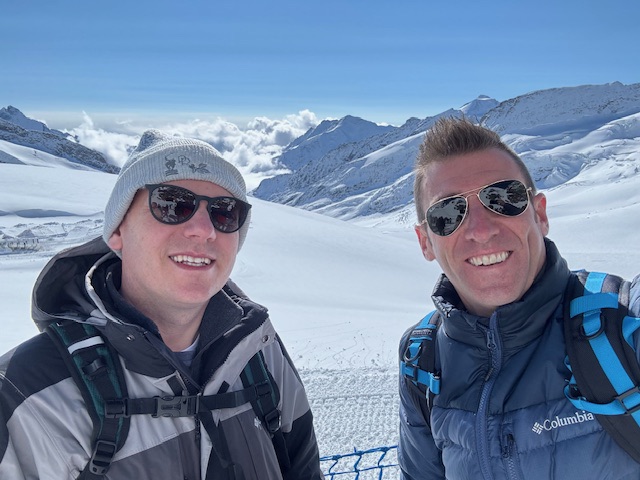
David continued to Switzerland where he spent a few days in the Grindelwald-Lucerne area with Matt.  He called the country “the most beautiful place I have ever been to.”  However, he found it very expensive.

The boys in Switzerland. Matt and David.

In an email after returning home, David wrote the following:

“I had such a great trip.  I think about it all the time.  It was so great to see you.  I’m so excited to come back.  I can understand why you made the life decisions you did.  Seeing the world is so much fun.  We are going to plan a family trip to Europe.”

I hope they will visit me.  I can’t wait.  I know it will be a blast.

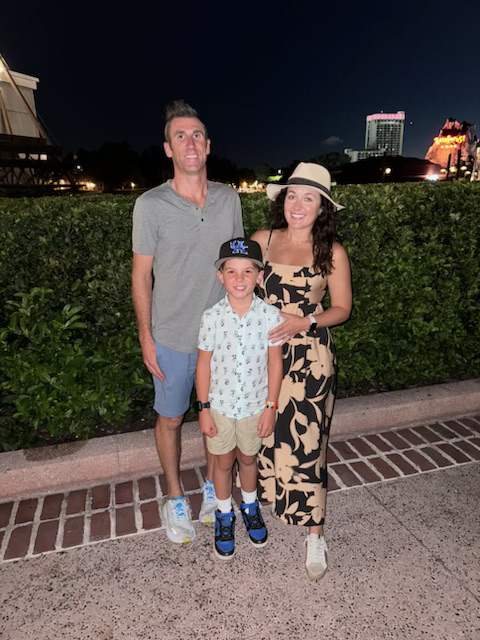
David, Sabrina and Jonah

ALL PHOTOS ABOVE BY DAVID KOESTER

If not a Tales and Travel follower, please sign up here. Don’t miss future posts.

Check out my tried and true recipes — keep scrolling down on a phone, or, if on a /PC or tablet, up to the column on right then down to “Recipes.” 

MORE PHOTOS BY DAVID BELOW

David followed the coastal Corbusier trail near my apartment. The scenery is spectacular.
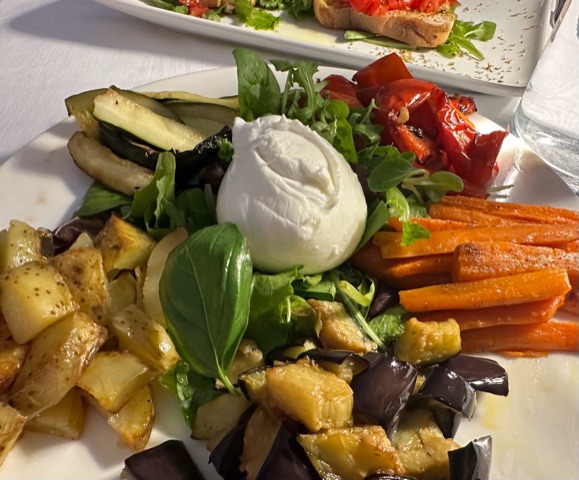
We split this veggie entree at a Menton restaurant. David found food here healthier than that in the U.S.
Peille by night
La Turbie, a town near Roquebrune.
Chateau in the old village of Roquebrune Cap Martin
Basilique Saint Michel in Menton.

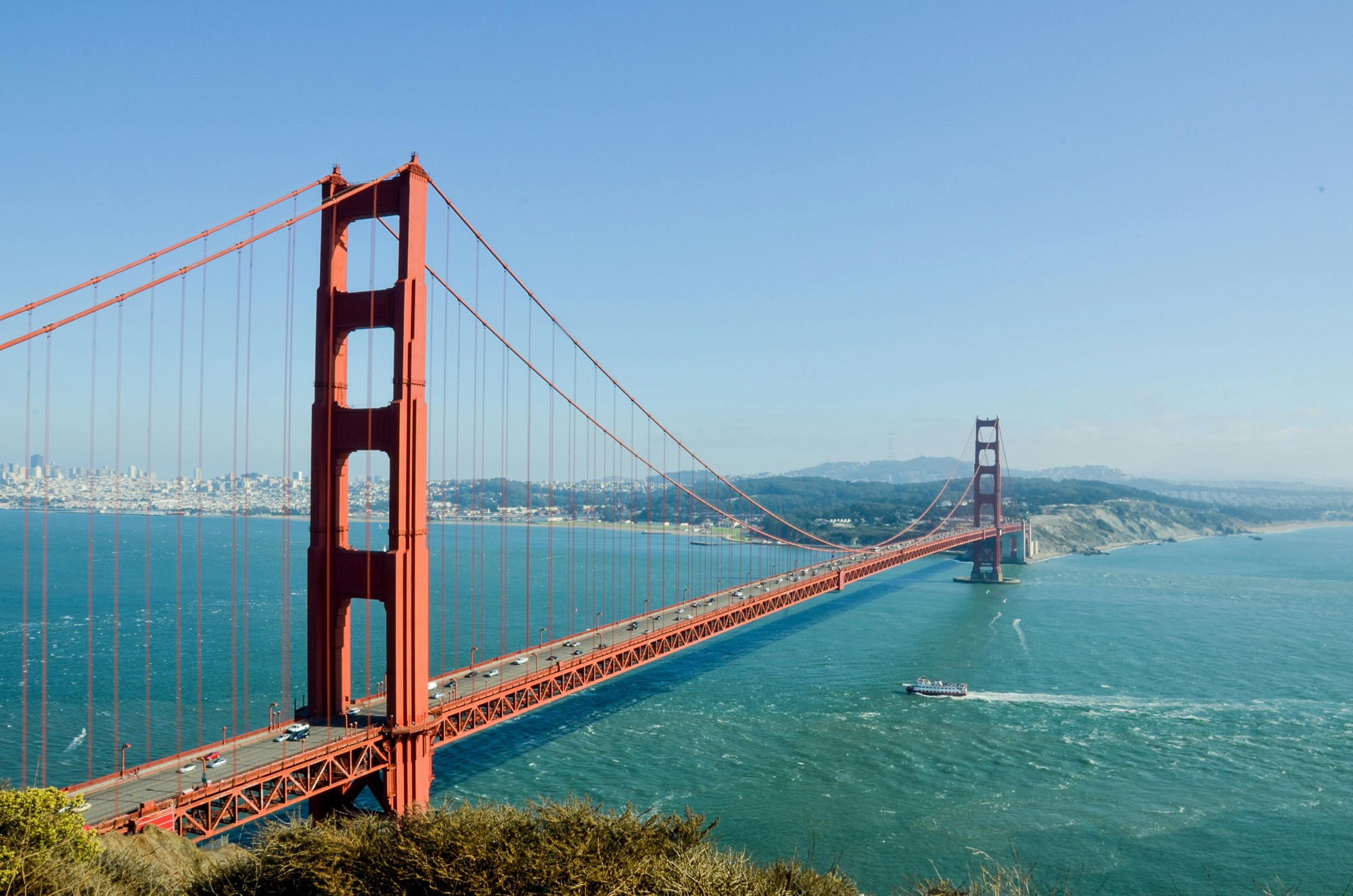
I left my $ in San Francisco

Photo by Pixabay

It is an expensive, very expensive city.  Having lived in Europe for so many years, I was shocked.  I assumed that nothing – with the exception of Switzerland — could be more expensive than the French Riviera where I now live.

San Francisco proved me wrong. Following are some costs I found outrageous:      


1 small box of Tylenol 500mg (pain reliever like paracetamol) $8.  The equivalent here about 2 euros, $2.16

1 glass of house wine in a restaurant, $14. At restaurants I frequent here, usually from 5 to 8 euros, $5.40-$8.64.

In both San Francisco and southern France, prices vary from one locale to another. In most cases, however, San Francisco seems over the top. I was surprised to learn that prices in much of the US may not be significantly less. While walking through a supermarket with my brother Steve, I asked, “How can people afford these prices?”  “They can’t” he answered.  “That’s why Trump will become president.” Hope he’s wrong.

The above costs were bad enough, but the whopper for me was $16,700 for emergency room treatment and a night spent in “observation” at the University of California San Francisco hospital.

I tripped over a scooter parked half way on the sidewalk, fell, broke my wrist and smashed my face.  Hence the hospital.

Scooters are often parked on the sidewalk. I was looking across the street and did not notice the beast. Photo model: Steve Koester

I do not have Medicare, nor American health insurance.  In France I benefit from socialized medicine (most costs covered), but I have a travel/medical insurance. Let’s hope I get reimbursed.

The San Francisco visit was not vacation. I went to see my brother Tom who had been diagnosed with terminal cancer.  Sadly, he has since passed away, but I am grateful I had the opportunity to spend time with him. He was a special guy, very kind, generous and liked by all.

Fisherman’s Wharf. Tom’s apartment was not far from here.

Due to the accident, my stay in San Francisco was not as long as planned.  I had a cast from my wrist to my elbow and had been told to come back to the orthopedic clinic in two weeks.  Fortunately, after a week I returned to France and saw a specialist.  The wrist should have been operated on immediately after the accident, I learned.  The doctor was concerned that due to the time delay, the surgery might not be completely successful.  I am lucky. So far, all is on track.  

The surgery here has cost nothing.  I will need to pay the specialist his fee: 370 euros (about $400).  There would have been no extra charge for a regular hospital staff doctor.   Surgery in the US? That price tag would have added a heart attack to my woes.

The hospital bill was overwhelming.  Abby, the very caring intern assigned to me, insisted on numerous X-rays and cat scans. A cat scan of my head; $3,288; cat scan of spine, $4,734; shoulder X-ray, $402, plus other X-rays.  The charge for one night in observation, $6,780.  Not much happened.  I slept.  

There were plenty of other hefty charges. This was a simple broken wrist.  What happens to those in the US who have serious medical conditions and no medical insurance?  It’s criminal – both the exorbitant charges and the lack of insurance for all.

On the positive side, an aspect of the US I relish is people: friendly, helpful, smiling.   As I lay on the sidewalk with a bloody face and painful wrist, passers-by were eager to offer assistance. I was alone, in pain, in shock, not to mention somewhat frightened.  As readers of this blog know, I have recently had far more serious mishaps. I feared the worst. The concern from strangers was comforting.

One couple, nurses, determined I had broken my wrist.  The young woman gently wiped blood from my face.  Her partner called an ambulance.  Someone asked if I had been riding the scooter.  OMG! Had that been the case, I would not be writing this blog

View from Chinatown.

From taxi and Uber drivers to waiters and waitresses, from nurses to hotel personnel, I found people interesting, delightful, and not shy to converse and tell their stories.  A taxi driver from Vietnam, now a citizen, told me how he came to the US.  An Uber driver related the details of his job. A young Moroccan who pushed me in a wheel chair at the airport was happy with her job but missed her country.

They came from distant lands, not just those mentioned above.  Mexico. China.  Philippines. Ethiopia. Turkey. Nigeria…. Hard working folk, not drug addicts, rapists and criminals.  Immigrants make the US.  I can’t imagine how San Francisco would survive without them.  

As I read somewhere, the country is a quilt, far more interesting than a boring sheet. 

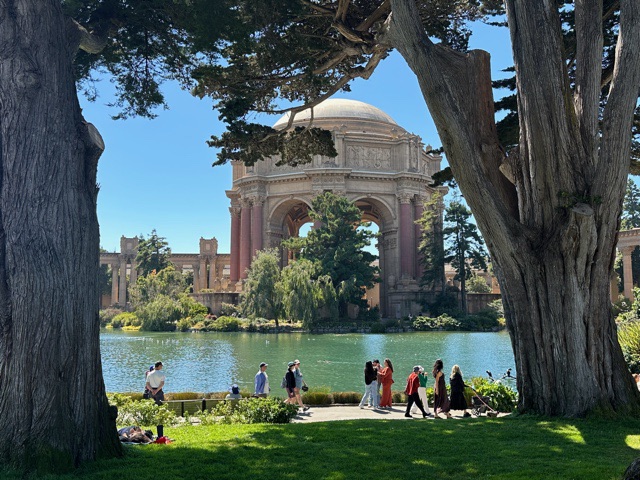
My San Francisco visit left little time for sightseeing.  If circumstances had been different and I had had time to experience the city’s attractions, perhaps I would have left my heart there too, not just my $.

Palace of Fine Arts. I enjoyed a walk in this beautiful area.

If not a Tales and Travel follower, please sign up here. Don’t miss future posts.

Check out my tried and true recipes — keep scrolling down on a phone, or, if on a PC or tablet, up to the column on right then down to “Recipes.” On

A Picture is Worth 1,000 Words

Since I have been doing nothing exciting to write about, this will be mainly a photo blog.

The heat and humidity here in southern France have been too much for me.  Fortunately, my apartment building has a TDF (to die for) pool.  I swim and do my pool rehabilitation exercises every morning, then spend the rest of the day in the comfort of my air-conditioned apartment. It gets monotonous.

At 9 a.m. I am often the only one in the pool. Heaven!

Not just the heat, but the crowds also keep me home bound. I live in a vacation paradise.  The beaches are packed.  Finding a parking place is as challenging as finding a contact lens in the sea. A tranquilizer is required to negotiate the traffic.

Everyone is at the beach.

It is in the French DNA to take vacation in July or August, with August being the preferable month.  This applies to all – not just families with children which is understandable.

A bachelor lawyer I know has closed shop for all of August.  Friend Karen bought an apartment in the spring. She is having it renovated, but all work stopped in mid July and will not continue until September. Vacation time.

My physical therapist is “en vacance “ for the entire month. (The French get five weeks of paid vacation per year, plus lots of holidays.). It’s best not to get sick in France in August.   Your doctor will likely be on the golf course or beach somewhere far off.   Your favorite pharmacy, bakery, butcher shop – likely closed until September.  

Fortunately, the “rentree” ( when kids go back to school) is around the corner. Life will return to normal soon.

Following are random photos retrieved from the innards of my computer. Most are from fascinating trips husband Bob and I had the fortune to enjoy. We loved to explore far off lands, learn about different cultures, and meet the locals. It was all fun and enriching.

Before long I hope the beach will be like this.
Sri Lanka hills at sunset
Fort gunnery platform, Nizwa, Oman
Daisies – and bees
Peillon, France. I went there on July 9 to commemorate the 1 year anniversary my beloved Bob’s death. We had been there many, many years ago.
Geraniums in Grimentz, Swizerland
Name this bird. Seen in Sri Lanka.
Muscat, Oman, at daybreak.
Mountain goat in Oman mountains
In the medieval garden at the Chateau of St. Agnes, France
Maldives
Wildlife in Sri Lanka
Memories
Beauty in the canton of Valais, Switzerland
On safari in Rajasthan, India.
Classy mansion in Cap Martin, France.
Sultan Qaboos Grand Mosque, Muscat, Oman
Dalmatian coast, Croatia

If not a Tales and Travel follower, please sign up here. Don’t miss future posts.

Check out my tried and true recipes — keep scrolling down on a phone, or, if on a PC or table, up to the column on right then down to “Recipes.”

Cooking with a View

This was a cooking class like no other –and I have been to many.  The setting: 
A precise row of seven white plastic tables and chairs on a terrace overlooking a sumptuous pool with the Mediterranean and the Italian town of San Remo below. Breathtaking.  How was I supposed to concentrate on dicing garlic in this seductive ambiance?  I wanted to stroll around, sink my feet into the thick grass blanketing the hillside, explore the gardens, take photos.  A swim would have been a delight, too.

But we, myself and five others, came to conquer Indian cooking, that is several specialties of this spicy cuisine.  We were at the home of Jeryl, the American founder of the Benvenuto Club of San Remo which sponsored the event.

Our teacher: energetic Asif who calls himself “Anglo, Afro, Asian.”  He was born in Tanzania of Indian parents, but as a child moved with his family to England.  He and his Italian wife Cinzia, a yoga and dance teacher, now live in Italy where they work together on events.  He also teaches drums, in addition to “vegan cooking,” often with Cinzia. 

The day began with chai, tasty tea with milk and the distinctive flavors of cinnamon and cardamom. “I will give you the skills, showing how to chop… We will move forward from there,” he said, as we enjoyed our morning chai. 

“Cooking is smelling, tasting and feeling.  Also, memory.  Food creates memories.” As the day wore on, we did lots of tasting.

We prepared five different dishes, beginning with potato pakoras, a common street food in India, and tamarind chutney.  Most were favorites of his “Mum, ” and he often referred to her techniques. 

He mixed up the pakora batter using gram flour which is made from black chickpeas, and water, whisking until ribbons formed.  He then added cumin and garam masala.

We each had a potato to peel and slice very thin.  He demonstrated the way to position the knife, tip pointed downward.  “Let the knife do the work.”  My slices were not that skinny.   I compared them to those of my friend Kate at the table next to me.  Hers looked perfect. Damn.

Ludovica, center, and her mother Jeryl watch pakora preparation.

Asif heated a large frying pan half full with oil.  “Don’t let it smoke,” he cautioned.   

The fun, messy part –dipping each potato slice in the gooey batter to thoroughly coat.  We used his batter to coat our slices, which also coated our hands, then one by one dropped the slices into the hot oil. 

Make a double batch, he suggested.  They are so good you will eat them as they are cooked.  We couldn’t resist, taking  one then another from the finished batch. When all were cooked, we moved on to tamarind chutney. 

This requires a jar of concentrated tamarind paste, available in Asian stores.  The prep is simple.  Just add water, salt, sugar and chili powder to the paste in a pan and bring to simmer. Stir and taste until you have a perfect balance of sweet and sour.  Here is where tasting is essential.  You may need more sugar.  You may want to turn up the heat (as in taste). 

Before moving on to curry, we took a break to savor more pakoras with the chutney.  The combo was a delicious hit with all.

Ginger and garlic are the base of curry, Asif told us.  We had to dice both as well as an onion.  He demonstrated nifty techniques to simplify the procedures.  Sharp knives are essential.  We had been told to bring chopping knives, a peeler and a large frying pan.  He used his steel to fine tune our knives.  Unfortunately, mine needed more serious sharpening.  I’ll add that to my never-ending to-do list.

He emphasized the importance of a very fine (tiny) dice of garlic and ginger lest you come across a chunk when eating the curry. Again, Kate outdid me with miniscule bits of garlic and ginger.  I was jealous.  What is her secret?

She explained that her husband cooks and she does the prep. Dicing and slicing are tasks which she has perfected. I have never had the patience for perfection, nor did I think a piece of ginger or garlic would be so bad.

Cooks at work

We each had a portable gas stove with one burner on our table. We were given pots to cook the curry which began with caramelizing the onions in oil.  To prevent burning, small amounts of water were added as needed.  Then came the ginger and garlic which cooked briefly before adding cut up tomatoes — and spices.

We had been given five small plastic bags, each containing a different spice:  garam masala, coriander, cumin, basaar (an extra hot Pakistani curry powder) and turmeric.

“In Italian cooking you get amazing flavors with four ingredients.  In Indian cooking you can use 13 or 14 different spices,” Asif noted.

After the curry mixture simmered for what seemed like a long time, chopped spinach and chickpeas were added for more simmering, this time with the pot lid on.  Throughout the process, we tasted, ours and the curry of others. Seasoning was adjusted accordingly.

Kate gives her curry the taste test.

While the simmering continued, we struggled with chapatis (flatbread):  mixing the dough, kneading until clumps formed, breaking off chunks, forming into small balls, and, with a rolling pin, flattening the balls into circles.  Our dynamic teacher showed us an easy method to roll and obtain perfect circles.  Kate mastered it. I failed. My chapati looked like amoeba on steroids. 

Asif then showed us how to cook the circles (or giant amoeba) in oil in our frying pans.  He also prepared rice, sharing his secrets for a perfect result.

 It had been a long day of cooking. We were hungry. We sat around a large round table and enjoyed our culinary creations: spinach and chickpea curry with rice and chapati. There were ample portions of curry to take home.

I was not the star of the class, but I had an enriching, delightful day.  I picked up some helpful tips and relished the ambiance.

Back at home, since I am neither a vegan nor vegetarian, I added pieces of sauteed chicken breast to my curry mixture. Shame!  It was tasty, and Asif was right. The curry tasted better the second day.  The flavors of all those spices had mellowed 

“Food to me is joy,” he said.  “It brings smiles to people’s faces.”

We were all smiles after a fun day of learning, tasting, and eating, especially with that spectacular view for inspiration.

Cooks’ view: San Remo and the Mediterranean

For more recipes and how-to demos, see Asif and Cinzia on You Tube.

Another cooking adventure: Read about my experience at Cordon Bleu

If not a Tales and Travel follower, please sign up here. Don’t miss future posts.

Check out my recipes here