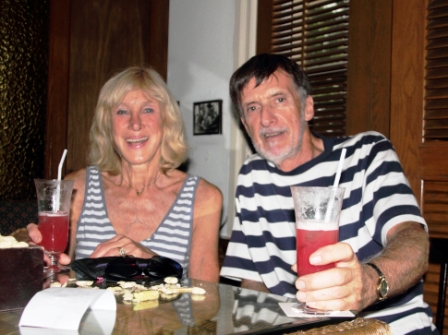
A Dentist and his Jungle Haven

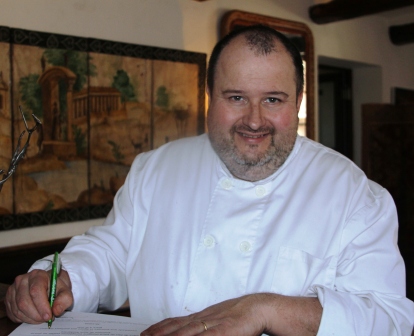
He’s known as the “jungle dentist.” Danish oral surgeon Peter Bloch began coming to Bali 43 years ago. During visits he realized the need for his skills among the local population living in rural areas.  He equipped a boat to be a dental clinic on water, then sailed around the island, making stops at remote villages and offering his services to those in need.

“Having a toothache is the worst pain,” says the dedicated dentist.  “You can’t sleep.  You can’t eat. You can only cry.”  Without dental care, decayed teeth can become infected.  Sepsis can set in and can lead to death, he explained.  ”It’s a common way of death here.”

Bloch, who had a practice in Fort Myers, Fla., for 19 years, as well as a part-time practice in Denmark, would spend two to three months a year as a volunteer “jungle dentist,” seeing as many as 60 – 70 patients per day.  “We used an upside down canoe as a dental chair,” he says.

He now lives at his magnificent resort, Tanah Merah (red earth), four kilometers outside of the Bali town of Ubud, but still practices jungle dentistry several months of the year.  He also gets patients from Ubud where he operates under the slogan “No Pain, No Pay.”

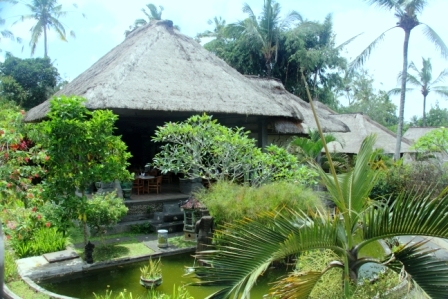
But these days most of his energies are directed to Tanah Merah, a secluded paradise in a luxuriant tropical setting.  Our stay there was the highlight of our recent six-week trip which took us on to Australia and New Zealand.

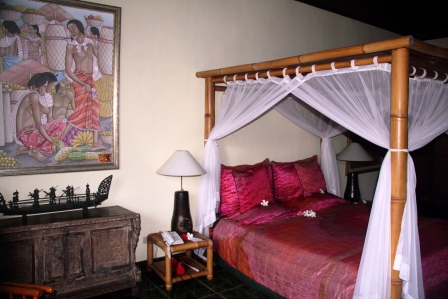
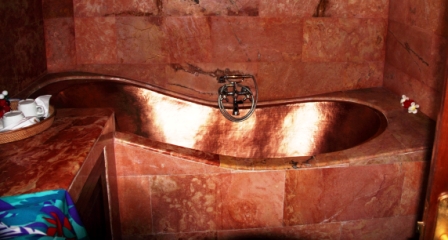
Bloch bought the land on a hillside above the Petanu River and began construction in 2000.  There are now 17 rooms, including some individual cottages and luxurious villas.  The latter have private plunge pools, some even with waterfalls.  We had a deluxe studio with a canopied bed, private terrace and enormous bathroom with a giant, gleaming copper bathtub.  We visited several other rooms and villas.  Bloch, who designed all the rooms himself, did not stint on the bathrooms – all lavish and spacious.  Fascinating art objects and paintings from his private collection add elegance to the guest rooms.

Collecting these treasures is the jovial Dane’s passion.  “I am constantly collecting.  It’s terrible. It’s a disease,” he says. Because of his work on Bali and his hobby of collecting, Bloch is well known on the island.  Owners of palaces who are in need of funds contact him when they have treasures to sell.  Museum directors also know he is interested in art objects.

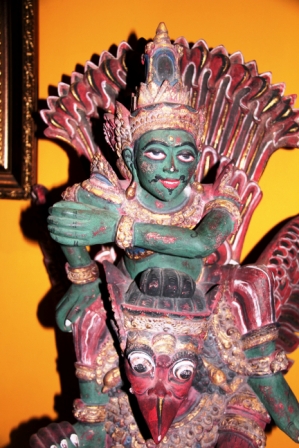
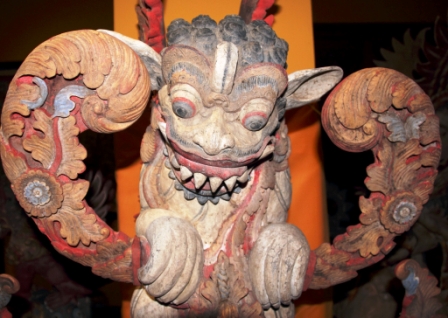
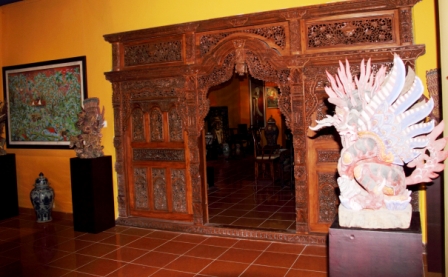
He recently opened a museum at the resort, nine rooms, each behind heavy, elaborately carved wooden doors, and all underground in a temperature-controlled environment.  The contents —  priceless, amazing and unusual objects — include paintings, weavings, objects of gold, daggers, masks and carved furniture.

One room features a large collection of Chinese porcelain from the Yuan dynasty (1271 – 1368) all recovered from a shipwreck.  The star attraction in another room is gigantic tusks.  According to Bloch, the former president of Indochina, Suharto, wanted a set of tusks from a mammoth. He got them from Russia and sold them to Bloch after he lost his presidency and was in financial need.  The tusks have been tested and are said to be 28,000 years old.

The highlight of the Bali room is a 400-year-old Indonesian structure which he had reassembled.  From Europe, there’s his mother’s dining room recreated from furnishings from the family home in Denmark, complete with a lavish table setting.

“It’s fun.  It’s a beautiful atmosphere.  I like to sit here and read’’ he says of the museum.

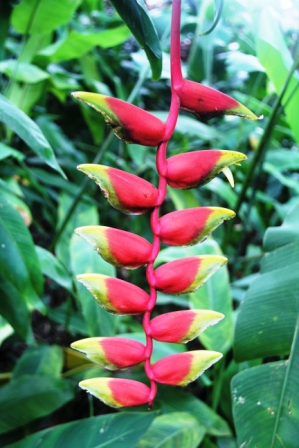
He also likes to wander the grounds of his resort.  Steps lead up and down the verdant hillside with its colorful blossoms and lush foliage.  There’s an infinity

pool at the edge of a cliff with fabulous views of the surroundings.  Exotic birds live in cages around the area of the individual cottages.  Noisy frogs thrive in a spring-fed pond adjacent to one of the resort’s three restaurants.

A staff member told me Bloch likes to get up early and make the rounds of the bird cages, talking to his feathered friends. He might be accompanied by his dogs, three very friendly Rottweilers.

The resort complex is large so you rarely see other guests.  On most occasions I had the pool to myself. Even husband Bob, a non-swimmer who normally avoids pools, could not resist a dip in the inviting water. For a jungle experience, you can trek down to the river and swim in a pool under a waterfall.  Unfortunately I saved this for our last day when it rained, making the descent to the river too slippery.

The many stone statues of gods and spirits throughout Tanah Merah add to the almost mystical, enchanting ambience of this romantic resort.  Young Balinese women clad in vibrant sarongs place fresh offerings of flowers at the statues each morning.  I’m not a big fan of massages, but I indulged at Tanah Merah for the best massage of my life.  The breakfasts, the English version with eggs and meat, as well as fresh fruit and croissants, are the perfect way to start the day at the open restaurant Petanu, half way down the hillside amidst the jungle greenery.

The town of Ubud with shops, restaurants and a thriving market, is about a 15-minute drive from the resort.  Tanah Merah offers guests free shuttle service to town, but if the resort cars are not available, you can hop on the back of a staff member’s motorcycle for a fun trip.

Bloch likes to mingle with his guests and can communicate in numerous languages: Danish, English, French, German, Swedish, Swahili, Indonesian and Balinese.  He has lived in Singapore, and Africa where he opened a dental clinic in Nairobi.  He is divorced with two children and a grandchild who live in the U. S.   In addition to dentistry and collecting art works, he writes and is especially proud of his recently published book, “Mads Lange, The Bali Trader and Peacemaker,” the story of this Danish expatriate who lived in Bali in the 19th century and was influential in the island’s history.

Before leaving, I decided to ask the jungle dentist about a dental problem and related headaches.  He invited me to his private villa at the resort where I lay on a couch on the porch with lots of pillows behind my head.  His houseboy held a surgical light above my mouth while the dentist took a look at my teeth and gave his advice which I’ve since heeded with good results.

Our deluxe studio at Tanah Merah in October was $100 per night, including breakfast.  For more on the resort, see   www.tanahmerahbali.com

Hungry for Tex Mex?  In the recipe column at far right, see “Enchilada Pie.”

High on Bali

Bali Ha’i *  may call you,
Any night, any day,
In your heart, you’ll hear it call you:
“Come away…Come away.”

Bali Ha’i will whisper
On the wind of the sea:
“Here am I, your special island!
Come to me, come to me!”

Your own special hopes,
Your own special dreams,
Bloom on the hillside
And shine in the streams.
If you try, you’ll find me
Where the sky meets the sea.
“Here am I your special island
Come to me, Come to me.”

My parents loved Broadway musicals.  They often played sound track records.  South Pacific was a favorite. My favorite song: “Bali Ha’i.” (*Bali Ha’i in the above song, according to Wikipedia, was not Bali, but based on the  island of Ambae, part of what was formerly known as New Hebrides, now Vanuatu.  Never mind, for me, it was Bali.)

I was mesmerized, both by the words and the melody of this song .  I knew I had to see this “special island” someday.

It took almost a lifetime, but I made it last October. The Indonesian island  was all I had hoped – and more.  A British friend, Jenny, recommended we stay in Ubud, a town in the hills, rather than at a popular tourist beach resort.  Thank you, Jenny.

In the book and movie, “Eat, Pray and Love,” Ubud was the focus of author Elizabeth Gilbert’s quest for spirituality and healing.  Tourism is the chief industry in Bali, and Ubud, the island’s artistic hub,  has seen a surge in visitors thanks to both the book and movie.

Our home (husband Bob was with me)  for six days was the Tanah Merah resort and gallery about a 20-minute drive outside of the funky town in a verdant, tropical setting.  I found the resort on the Web.  It was reasonable, beautiful, serene, fascinating – a bit of paradise.  The fascinating part was the Danish dentist, Peter Bloch, owner and creator of this magical place which has just 14 rooms, including many individual cottages, and an incredible art and artifact galley with Peter’s extensive collection.  For more about Peter and Tanah Merah, see my next blog post.

Our night arrival at the chaotic airport in Denpasar, the capital of Bali, was a horror story, (also more about that in a future blog on Travel Mishaps).  But all turned out well thanks to a friendly Australian airline steward, Peter, whom we met on our Qantas flight to Singapore.  He recommended a friend and driver in Bali, Wayan Sukada.  He sent Wayan an email and arranged for him to meet us at the airport and take us to Ubud – about an hour and a half drive through a crazy, congested city into the peaceful countryside.

Wayan became our guide and mentor.  He drove us on an excursion to temples and sites.  He recommended restaurants.  He invited us to a ceremony at his temple.  He taught us much about Bali and its religion.

There is a pervasive spirituality in Bali is that is both intriguing and soothing. Most Balinese are Hindu, but they practice a form of the religion somewhat different than Hinduism in India.  It governs their daily life.  Every town, no matter what the size, must have three temples, Wayan told us, each dedicated to one of the three elements: air, water and fire.  All homes have a main temple, and often an additional one in each room. Ceremonies are profuse – not just the usual ones for weddings, births and cremations, but celebrations for the rice harvest, in honor of animals, to bless machinery…During our brief  Ubud visit, Wayan attended three ceremonies.  He said he must give 10 percent of his earnings to the temple.

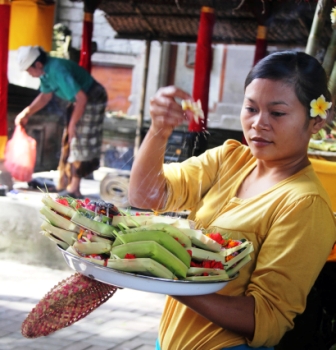
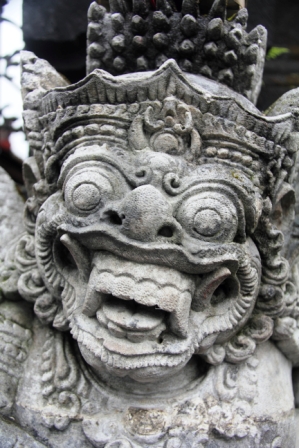
Statues of gods, goddesses and demons are everywhere, and often draped from the head down in sarongs. The latter is to protect the spirit inside the statue. The sarongs are in various colors, but each color has significance. White, for example, is for prosperity. Trees, which also have spirits, are also sometimes covered with sarongs. Offerings to the statues are made twice each day – tiny baskets made with coconut leaves and filled with blossoms.  Every morning we watched employees at Tanah Merah put fresh offerings of flowers at the base of the numerous statues on the property.

Besakih is the Mother Temple in Bali.  We passed hills of rice paddies and drove through poor villages, past numerous temples,  en route to the holy site, a huge complex of structures on seven levels.  Before visiting the site, we both had to “rent” sarongs to wear in respect at the temple.  A government guide led us through the complex, first up the steps on the left side, the negative side, then down on the right side, the positive side. At each level there are terraces, altars, statues, and ceremonies were underway at some.

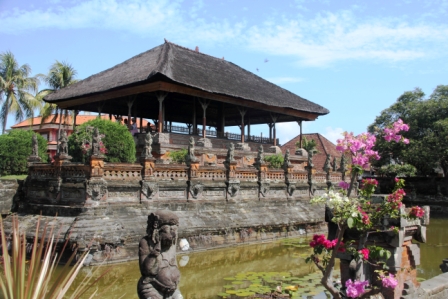
Our excursion that day also included a stop at Klungkung Palace which was erected at the end of the 17th century, but largely destroyed during the Dutch colonial conquest in 1908. Among the remaining portions is a lovely floating pavilion which was added in the 1940s.  While visiting the palace, we heard the beat of drums and commotion in the adjacent street.  It was a funeral procession, with groups of mourners following the wrapped body.  Wayan explained that the body would be interred first, then unearthed at a future date for a cremation ceremony during which the remains of many would be burned.

As we (especially Bicycle Bob) love cycling, we signed up for an all-day bike excursion.  Unfortunately the supposedly spectacular view of Mount Batur, near where the trip originated, was hidden by clouds; it rained most of the day, and Bob had a crash in the mud on a skinny route through a rice paddy.  But, it was an enlightening trip nonetheless. Our group stopped in a village where we toured a home — several rooms, virtually no furnishings, a temple in the yard, — all very basic and poor. Bali may be the home of numerous luxurious resorts, but life for the average citizen is at the other end of the spectrum.

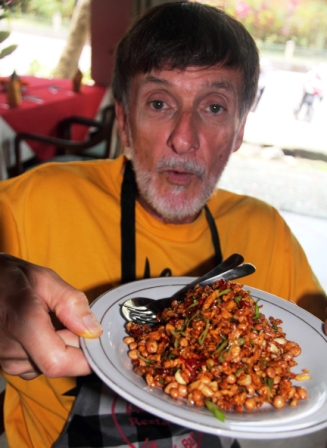
While he (Bob) is passionate about bicycles, food and cooking are among my hobbies.  So, we also signed up for a Balinese cooking class at the Bambu Bali restaurant. It started out with a visit to the colorful market where our teacher explained some of the indigenous produce.   The dishes we prepared, seven different ones,  were all delicious, many on the hot and spicy side. We also received a souvenir cook booklet with recipes.  Unfortunately all seem to require ingredients which I’ll never find here.

Bicycles, food – and animals.  We love them, too, and  our visit to the Monkey Forest in Ubud was enchanting.  Thousands of monkeys: mothers with babies, teenagers wrestling with one another, couples diligently picking bugs off each other’s backs… All roaming freely in a vast tropical forest complete with temples, statues and a picturesque stream strewn with rocks.

The visit to an elephant sanctuary was somewhat disappointing.  Just to view the elephants, we had to pay $15; an elephant safari ride cost an extra $45. We passed on the costly ride, but one of the guides, who agreed the charge was ridiculous, offered us a brief ride as his boss was not around.  It was fun, and his commentary on the elephants was informative.

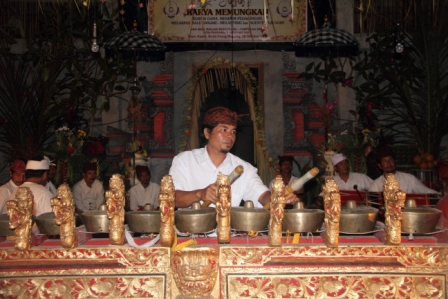
On our last night, Wayan took us to a ceremony to inaugurate a new temple in his village.  He was a member of the all male band: drums, bamboo flutes, hammers, cymbals, and a xylophone.  The sounds, lots of clinging and clanging, all sounded much the same.  The men in the band all wear white with a bandana around their heads.  The latter, Wayan explained, is to keep them focused on god and prayer.

Villagers arrived with enormous creations of fruit, flowers and food, all placed on an altar as offerings.  The women,  wearing their finest, sat together, while the men were off in another section – some gathered in an adjacent room smoking and gambling, according to Wayan.  Children, dogs and chickens wandered freely around the festive scene.

Even if it’s not Bali Ha’i, for me Bali is indeed a “special island.”

Bali is reasonable. Wayan charged us about $28 for the transportation from the airport to Ubud; about $36 for an all-day excursion. Our spacious room with full English breakfast at Tanah Merah was $100 per night. Cycling tour with bike rental, breakfast, lunch and van transportation to and from the start of the ride, about $36 per person.  Cooking class, about $22 per person, including eating the food you prepare.

www.tanahmerahbali.com

Email: wayan_sukada70@yahoo.com  (underscore between wayan and sukada)

For a fantastic soup, see recipe in column at right for Baked Garlic and Onion Cream Soup.  Watch the slideshow below.

This slideshow requires JavaScript.

Dazzling Singapore

I was blown away by the airport.  All so sleek, modern, clean, beautiful.  Greenery in the middle of the baggage belt.  Vast carpeted halls. Classy shops.  No lines at customs.  Pristine washrooms.   The drive into the city was even more impressive with lush bougainvillea in bloom along the highway and stunning skyscrapers looming in every direction.

Welcome to Singapore. For futuristic architectural magnificence, it’s tops.  Of course, there’s more.  Fascinating ethnic neighborhoods.  Beautiful botanic gardens.  Mega shopping.  Fun and interesting entertainment venues.  And, of course those pricey Singapore Slings at the legendary Raffles hotel bar.

 Husband Bob and I began a six-week odyssey which would take us to Bali, New Zealand and Australia in this awesome metropolis.

Dinner after arrival at the Maxwell Road Food Center near our hotel on the edge of Chinatown was a fun and tasty introduction to the city. This “hawker center” — there are many in Singapore — is  a big building packed with vendor stands, all selling different Asian specialties, and bustling with diners, all using chopsticks, seated at tables opposite the stands. Pigs’ organ soup.  Braised pigs’ trotters. Soup dumplings. Onion pancakes. Plus, desserts and strange drinks such as chestnut wheat grass and dragon fruit.  I chose a stand with Seafood Crispy Noodles for  3.20 Singapore dollars ($2.50) — a bargain.

Friends had raved about the Botanic Gardens, first stop on our city visit.  We mastered the subway, another marvel of modernity, to get close, then trekked, and trekked yet more once we arrived.  It’s enormous (150 acres).  Meandering paths lead up hills, around lakes and waterfalls, all lined with abundant  vegetation and colorful blossoms. The Rain Forest and Orchid sections were  my favorites.

These days Singapore’s star attraction is the new Marina Bay Sands, a gargantuan three-towered, five-star hotel complex with more than 2,500 rooms. On the rooftop there are viewing platforms and a glamorous, monstrous infinity pool, said to be the world’s largest. 

“This was all sea three years ago.  This is all reclaimed land and these buildings weren’t here three years ago,” explained the taxi driver on our ride to the sensational structure.

The $15.50 admission to the Sky Park viewing platform no longer includes a walk around the pool. Guests who obviously pay big bucks to lounge in these elegant surroundings on top of the city were probably complaining about groups of tourists parading around.  Now only one pool tour is scheduled each day at 2 p.m.  But the views of the sprawling city, its dramatic skyline, numerous construction sites and harbor, are worth the price.

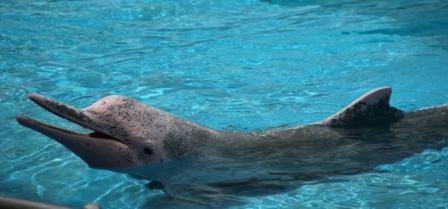
Sentosa Island, a tram ride from the city center, has been developed as “Asia’s Favorite Playground” with all manner of attractions: Universal Studios (a Hollywood theme park), rides, interactive movies, a water show, a sandy beach and more.  We rode the elevated tram to the last stop, Underwater World Singapore, an oceanarium with an 83-meter long tunnel surrounded by water and all matter of sea life.  We watched divers feed sharks and rays, admired fish large and small, sea dragons, jelly fish and more. The show at the outdoor Dolphin Lagoon is a treat with adorable seals clapping, dancing, shaking hands, and  dolphins swimming in synchronization, then leaping out of the water, even gliding over to the edge of the pool so selected visitors could touch them.

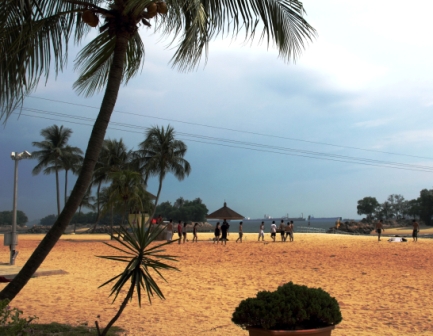
After our sea adventure, we walked to the beach where we had lunch and watched as a young couple tried to master the Flying Trapeze. Harnessed and attached to a cable, they jumped off a platform and soared, bounced, and flew high above a mat.

My Singapore research recommended the  Night Safari,  an excursion through a jungle park on the edge of the city.  Instead of riding the tourist train into the darkness, we walked along paths in the tropical forest, spooky at times, but full of surprises.  Crazy, noisy birds; bats you could pet hanging from branches; otters frolicking in streams; lions; civets; even a beauty of a leopard who stared at us from behind a glass enclosure.  A fun finale is the Night Creation Show at an outdoor auditorium where handlers come on stage and entertain with various creatures – otters trained to recycle, raccoons, wolves etc.  For drama, a boa constrictor was said to have escaped. Staff ran up and down, rousing the audience.  The missing critter was discovered under the seat of someone in the audience where it had obviously been planted.   

Singapore’s Chinatown and Little India are packed with ethnic shops and eateries.  Chinatown features a lively night market with colorful lanterns decorating the streets.  Our best meal of the trip was at Da Nang in Chinatown where I went for the special, Chili Crab, a whole crab smothered in a gooey, red, spicy sauce.  It was very messy to eat, but delicious.  Bob ordered a scallop, shrimp and broccoli dish with fried rice.  Tab with two beers:  $105.   

Other highlights of our visit included a river cruise with interesting commentary on the city, and the obligatory Singapore Slings, the city’s legendary cocktail served at the Long Bar, a woodsy place with ceiling fans, in the Raffles Hotel. The colonial style hotel was built in 1887, its white façade and old world architecture standing out amidst the contemporary surroundings.  It is considered one of the world’s finest hotels.

The Long Bar was the favorite watering hole  of  Somerset Maugham and Ernest Hemingway. Today it’s a must for tourists who want to relive the colonial era,  soak in the ambience, and are willing to pay $60 for the privilege of sipping two of the sweet  pink drinks. You do get some peanuts at no extra cost. 

We loved our Singapore hotel, the Berjaya Singapore Hotel, with a friendly and helpful staff, convenient location.  www.berjayahotel.com  

For a taste of Malaysia, click on “Malaysian-Style Chicken Curry” under Recipes in right column. Photos follow. Click on photo to see full size.


Au Revoir Buddy

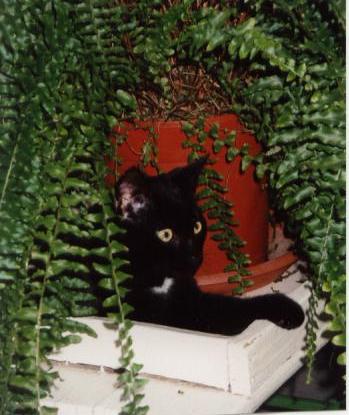
I miss you so much, Buddy Boy.  And, I am so sorry we had to say Good-bye.  But, the tumor in your throat was growing.  There was no hope.  The vet said you would suffocate – a horrible death.  I wanted to spare you that.  You were such a loyal, loveable companion, indeed my special buddy. 

Buddy was put to sleep on Oct 20, a peaceful, painless death.  He was 11 years old, and during those years he went through most of his nine lives.  He owes those years to several guardian angels who rescued him. 

Chris, an assistant to the military vet in Stuttgart, Germany, trapped Buddy’s mother with seven kittens (including Buddy).  They were feral, the mother having been abandoned by a military family who moved back to the states.  This is the fate of too many cats on military installations.  Chris rescued many starving felines.    Buddy and his brothers and sisters, about three months old, were wild, fearful and ferocious.  Chris’ mission was to tame them.  Wearing extra heavy gloves, she forced the kittens to eat out of her hand, thus becoming accustomed to human contact.  It took patience, dedication and time. 

Chris knew I had been considering getting another cat to be a companion to my cat Molly.   She felt Buddy was special.  She wanted him to have a good home.  She offered him to me when he was ‘ready” for adoption.  He quickly adapted to his new home, becoming affectionate and loving. I was smitten. 

Buddy’s second brush with death came just a few months after I got him.  We lived in a second floor apt, with a large balcony/terrace adjacent to a giant pine tree.  Molly would climb down the tree for outdoor excursions.  Buddy did the same, but shortly after his first foray, he did not return.  I searched the neighborhood, called, put up signs. 

After a lapse of several days, he tried to make his way back up the tree.  I was on the balcony and was overjoyed. But, he didn’t make it.  A hind leg was dangling from his body.  He fell back down and ran away.  We spotted him hiding in the backyard, but he wouldn’t let us near him.  It was as if he had become feral again.  We put a dish of food out and after several tries, managed to throw a blanket over him while he was eating.  His leg had been broken, probably caught in a fence, according to the vet. 

After that, Buddy became an indoor cat.  He had many endearing habits.  His favorite pose was lying on his back, his front paws curled up.  He loved to get on my lap and knead, cat fashion.  And, as a special sign of affection, he liked to chew my hair. He was also a glutton.  Buddy devoured all food.  He always hung around in the kitchen when I was cooking, and I often spoiled him with bits of meat or fish.  He especially loved licking the almost-empty containers of crème fraiche, yogurt, and the bowl after I had whipped cream. He’d end up with a white face. 

Buddy’s remarkable and miraculous rescue came many years after his second brush with death.  I took him to Sigrid Ruckaberle, the cat lady of Stuttgart, because we were preparing to go on a vacation.    Sigrid, like Chris, trapped and rescued many feral cats in military housing areas.  She had more than 20 cats herself, all rescues, but she also boarded cats.

I got out of the car in front of her house (about a 1 ½ hour drive from our home) and picked up Buddy’s cage.  He pushed the door open, bolted and sped like lightning up the street. The door had obviously not been fastened securely. My heart sank.  I knew I would never catch him, and he was so far from home.

Sigrid was also upset, but, she was confident she could catch him.  I could not go on vacation knowing that Buddy was wandering in the wilderness, so far away.  We canceled the trip, and every day, for 10 days, I drove back to Sigrid’sneighborhood, walked all around, calling Buddy.  I knew he would not come, but I thought if he heard my voice he would meow and I could at least locate him.  I asked all the neighbors time and time again if they had seen a back cat with a white mark on his chest.  They got sick of seeing me, and finally one neighbor got nasty and told me to stop coming on his property.  I gave up my search, but continued to be plagued by worry and sorrow. 

Sigrid, meanwhile, had been putting out food dishes in several neighborhood locations.  The food always disappeared, but any number of cats or wild creatures could have been eating it.  She also set cat traps.  She caught a hedgehog, but not Buddy. 

After six weeks, I had given up hope and set off on a short trip with a friend, still thinking too often about Buddy.  When I came home, husband Bob told me to sit down; he had some good news and bad news.  I was certain the bad news was that Buddy’s body had been found.

“The good news is that I have a cat outside in a cage.   The bad news is that I don’t know if it’s Buddy,” he said.  I raced to the cage.  It was my Buddy.  Sigrid, after all this time and tireless efforts, had caught my baby.  I was thrilled, overjoyed, and ecstatic. 

Yet, one more time Buddy escaped.  We had gone on a vacation and left a young neighbor in charge of feeding Buddy and Molly.  I told her she could let Molly out, but not Buddy.  When we came home after a week, no Buddy.  I quizzed her.  She said I had told her that Molly could go out so she left the balcony door open for her.   ???  How could she have not realized that Buddy would go out too? Again, I was frantic.  

I consulted Sigrid who assured me that he would not venture far. We put food out, it disappeared.  After about a week, we saw him.  But he always ran from us. Again, he reverted to his feral past. We monitored the food dish.  And, we used the blanket trick again.  While he was eating, we threw a blanket over him.  He was wild. He scratched and bit me.  But, once we got him in the apartment, he was his old self again. 

Some years later we moved to a rural area of southern France.  Here the neighborhood is safe with lots of territory for cats to roam.  Buddy was permitted outdoors.  He never ventured far, but obviously enjoyed his freedom.  He knew the sound of the car.  Whenever I returned home after an outing, he would be waiting for me at the edge of the driveway. 

Now he’s gone….no friendly cat to welcome me.  I miss you, Buddy. 

Buddy was the third male cat I have lost to cancer at the age of 11.  Molly lived to be 17 ½.  I have two young female cats I rescued as kittens from a shelter to replace Molly, but they are completely “sauvage” as the French say.  Real outdoor cats that only  appear to eat.   

As this is Christmas time, this story needs a happy ending.  Welcome Sam, a big, sturdy gray tomcat who has been living in the streets of nearby Cereste. Friends Martin and Jessica have been feeding him, but they already have four cats and now a new baby, a beautiful girl named Sam. They could not adopt another cat.  Sam (I named him), who is very affectionate and loves to be caressed, needed a home.  He’s my Christmas present.

For a tasty holiday dinner, see Holiday Pork Roast under Recipes in the far right column. 

HAPPY HOLIDAYS TO ALL

A Fishy Tale

But, this one is real, genuine.

It’s well known that folks go to extremes and spend big bucks on their pets.  Cats, Dogs, Horses, Birds, Guinea Pigs….but goldfish?  Read on. 

It all started some years ago when friends Mollie and David, who restored a 17th century house near here, decided to buy a few goldfish for their “bassin” (spring-fed basin).  Shortly thereafter they noticed huge herons swooping down on the bassin.  The fish were nowhere to be found.  They figured they had become bird food.  So, they bought a few more, only later to discover the original fishies had just been in hiding.

 All survived and multiplied  — in profusion. They even named some of the fish: Mister Gold, Mister Silver, Chocolate Drop. Many quadrupled (or more) in size and grew into beautiful, multi-colored specimens.  Mollie and David became attached to their underwater pets and proudly showed them off to visitors.

All was not well, however, as it appeared the bassin was losing water.  Not great amounts at first.  So, they just refilled.

This summer the small leaks grew to rivers of escaping water.   The water level was descending at a rapid level.  The precious fish were in danger of asphyxiation.  No problem.  They’d buy an inflatable swimming pool and transfer the fish to a temporary home while they repaired the leaks.

Inflating the pool and filling it were challenging, time-consuming tasks.   Meanwhile, water continued to escape from the bassin, so they kept refilling. It was a hectic race to keep the fish underwater.  Nerves were on edge.  Tension soared.  The fight for the fish was grueling.

Once the temporary fish pool was ready, the monumental task of catching the critters was underway. They called in reinforcements to assist, friends Dee and Alan. David got in the bassin and scooped with a net – over and over, then passed the net with his catch to the others who dumped it into the temporary fish pond. There were always those that got away. How many fish were there?  The supply seemed endless, mind-boggling.  Finally, at a count of 226, they had rescued all the fish. (Happy goldfish obviously have an active sex life.)

At last the fish were safe and they could take a breather and repair the bassin. Or, so they thought. After the trauma and nerve wracking tasks of fighting leaks and catching fish, David was about to enjoy a soothing shower.

Mollie and David are not just fish fanciers.  They also have three cats and a dog.  Prudence, a big gray feline, came streaking into the house drenched — looking like she stepped out of a cartoon.  She was soaked.  Mollie quickly realized she had tried to go fishing and fallen into the swimming pool/fish pond.  But, how did she get out?  Using her razor sharp claws of course, to grab onto the pool’s inflatable rim.

David was diverted from the shower and they raced to the fish pool.  Sure enough, it was punctured with tiny holes and water was gushing out.  They got the repair kit that came with the pool and started patching – all this long after the sun had gone down. They kept re-pumping the pool. They could not get all the holes sealed.  It seemed to be a losing battle. Water was still escaping – overflowing as the pool deflated.  Both wet to the bone, they worked furiously until midnight.

Every few hours that night David got up to re-inflate the pool and add more water. Thanks to his diligence, there were no dried fish for breakfast next morning.

Next day they took on the repair of the bassin.  It was an all day job, and of course they continually had to refill and re-inflate the swimming pool fish pond to keep the fishes submerged.  More stress. More anxiety.  Exhaustion.  All this to save some goldfish?

As if the fish fiasco was not enough, they had another battle to rage.  Droves of nasty wasps had taken up residence under their roof.  They dared not go near their swimming pool (a real one for humans).  Wasps love to drink swimming pool water and beware if you are in their way. They had to have a crew of men wearing space-like suits come to eradicate the wasps.

The wasps are dead. The pampered fish are alive and well and back in their bassin home – all 226 of them. And, Mollie and David are enjoying a well deserved rest.

Photos by David Regan