Bella Italia

There were flag throwers, drummers, peasants with their donkeys, a fire eater, a stilt walker, a princess and knights. There were competitions: rope pulling, sack races, log sawing.  There was a hike in the woods and a tasty meal.

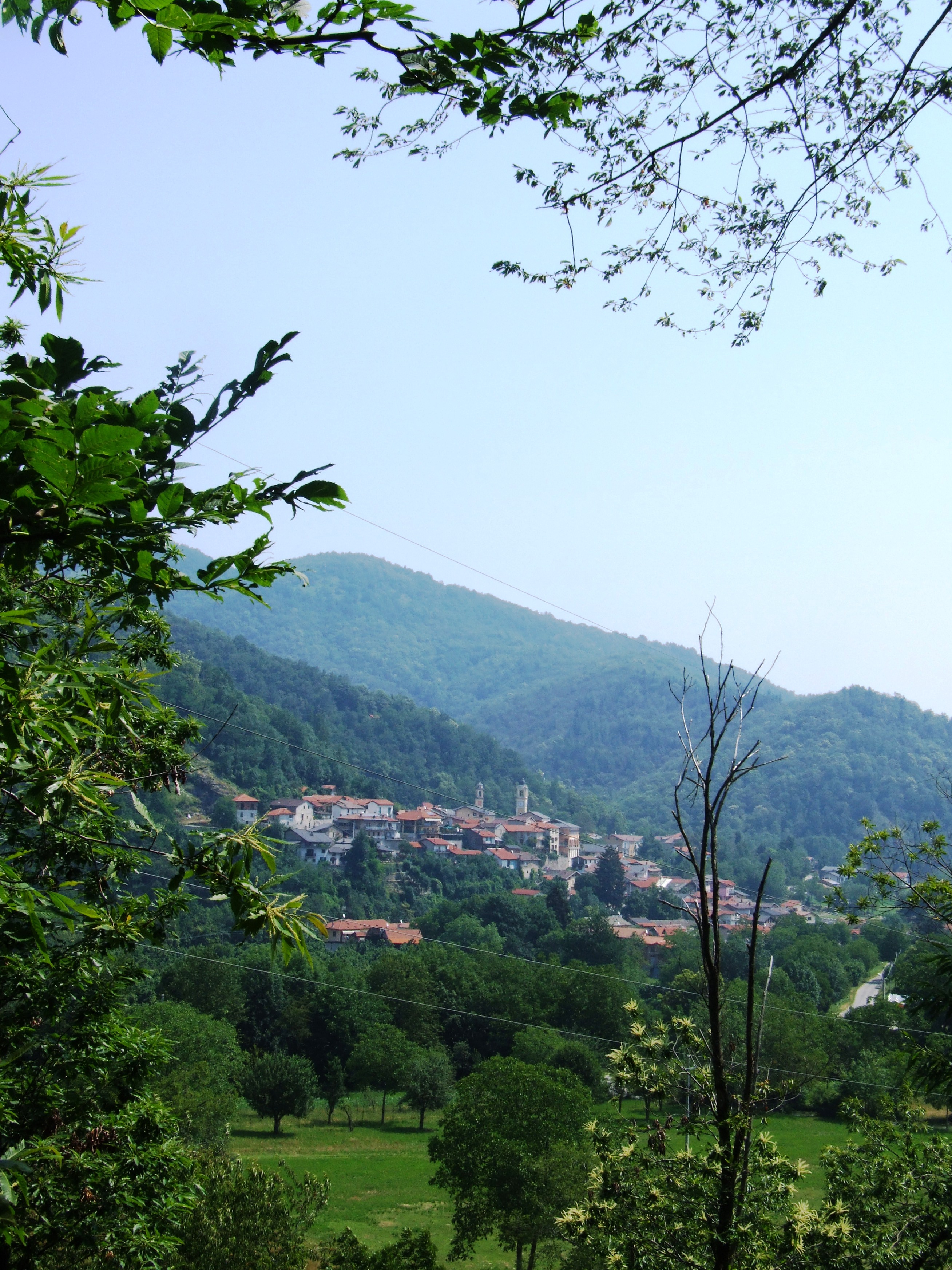
It was a medieval festival in Roccasparvera, Italy, a tiny burg that is the sister cityRocca6   of Reillanne, our tiny town in southern France. We, and some 45 others from Reillanne, made the trek to southern Piedmont to join the festivities in early June.

The folks from Reillanne stayed at a hotel/restaurant outside of town known for its cuisine with porcini  (boletus), the king of mushrooms.  This region of Italy produces an abundance of these delicious fungi.

The Saturday night meal at the hotel was over the top – eight courses:  carpaccio with porcini, sliced cold turkey with a tomato/caper sauce, porcini flan, asparagus flan with a cheese sauce, porcini risotto, cannelloni, beef with roasted rosemary potatoes, venison stew – all topped off with a yummy peach/chocolate/hazelnut praline concoction. And, of course, wine – red or rose.

Italian breakfasts, in comparison, leave a bit to be desired.  With the exception of the croissants.  The Italian version filled with jam is excellent.

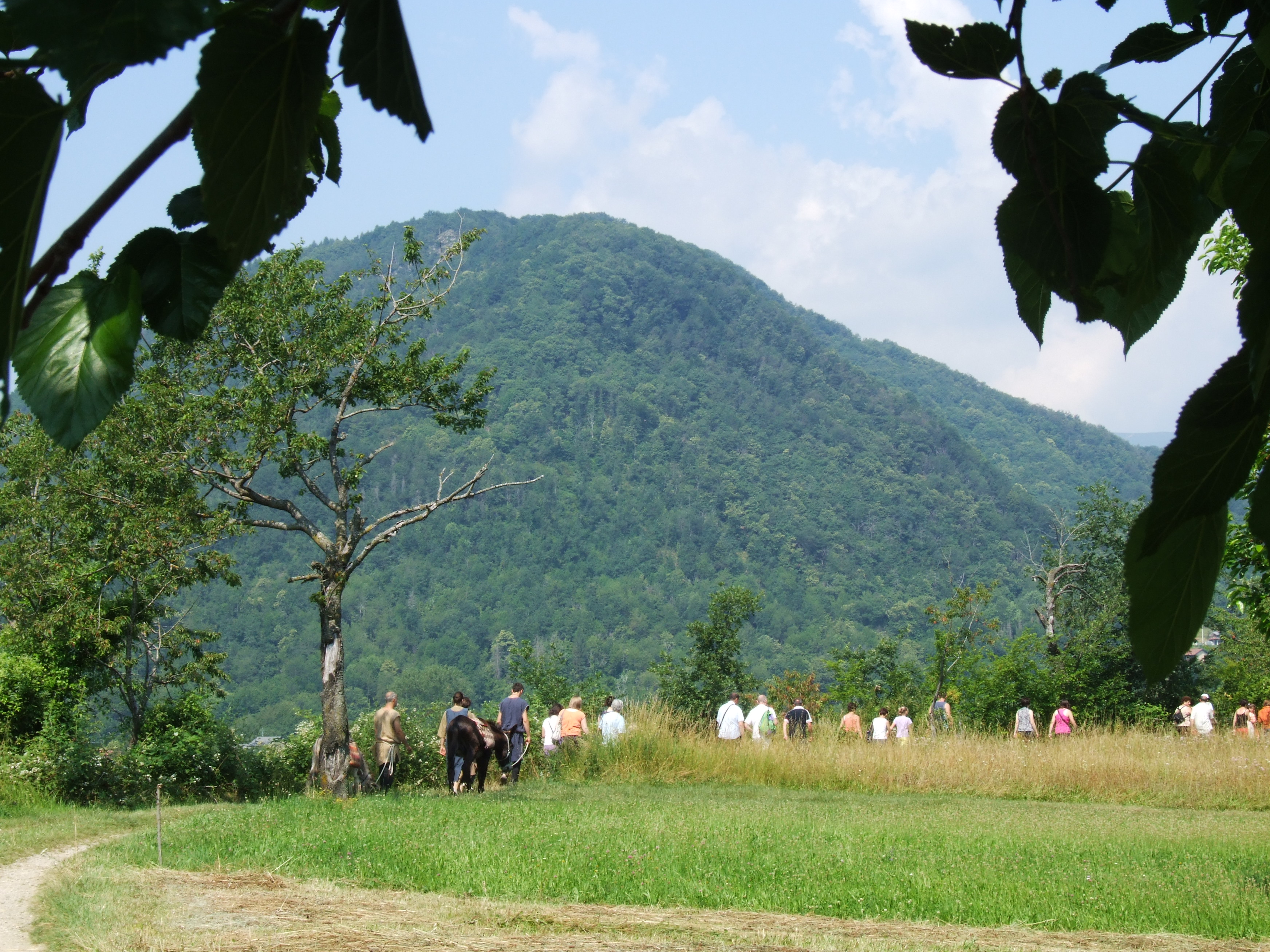
The festivities on Sunday got underway with a hike in the surrounding forests and Rocca4 countryside.  The mayor of Roccasparvera led a group of Italian speakers.  Another guide led those who spoke French. The princess, the peasants and donkeys, and a few others in medieval costumes accompanied the hikers. There were many stops en route for lengthy explanations of the history of the area.  At one point a naturalist took over to talk about an enormous ancient chestnut tree.

Back in town following the hike, there was an outdoor buffet lunch in the town square followed by impressive demonstrations by a troop of flag throwers.  Then the games.  Teams from Reillanne, Roccasparvera and a few neighboring communities competed to see which village had the strongest (rope pulling), the fastest (sack Rocca10 racing) and another test of strength, sawing a fat log. There was yet another contest – running behind a ball which rolled down a street.  I didn’t quite understand that one. 

It was all good fun.  Last November we went to another fest in Roccasparvera, the chestnut festival.  It snowed so much  the fest had to be cancelled. This time we had glorious sunshine, perfect festival weather.

Most of those from Reillanne headed back to France by bus after the festivities.  We had traveled by car and went on to nearby Cuneo for two nights.  It’s a lovely town with a huge central square surrounded by arcades.  My reason for wanting to visit Cuneo was to attend its huge Tuesday market.  Italian markets (the kind where they sell everything, not just produce) are fabulous.  I especially go for the bargain fashions.

Cuneo was rockin’ Sunday evening with an international festival. Numerous nationalities were represented, all with stands selling their culinary specialties.  I tried a chicken creation from Ghana, then Vietnamese tidbits.  The line was long with those waiting for Argentine beef. There was also street entertainment making for a jovial ambience.

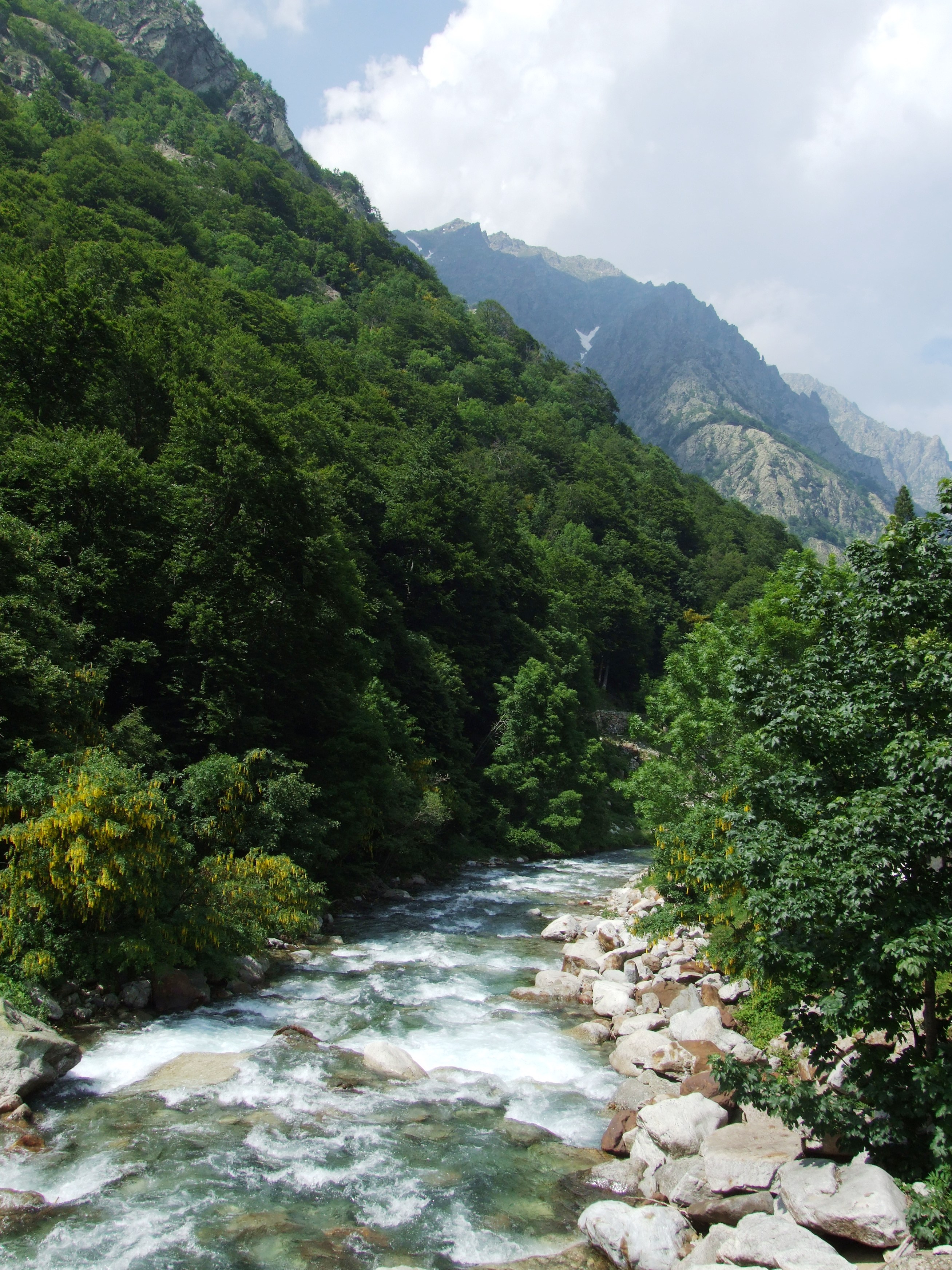
After walking around town Monday morning, we drove (at the suggestion of the helpful woman at the tourist office) into the nearby mountains.  Our destination was Thermes Cuneo3 de Valdieri, a spa with a huge hotel and pool next to a roaring mountain stream.  A peaceful and beautiful spot.  We set out on a hike into the mountains, but had to abort as the path deteriorated, requiring proper hiking boots.  We were in sneakers, a sturdy version, but not sturdy enough.

Back in Cuneo, we stayed at a hotel in the town center.  A loud racket outside our window awoke me at 5 a.m. Tuesday.  They were setting up the market stands.  I went back to sleep,  but was ready for power shopping by 9. Bob, fortunately for me, stayed in the hotel and read the Herald Tribune.  He detests shopping and makes me nervous.

The main city square and surrounding streets were filled with stands offering everything from kitchen utensils and tools, to food, clothes, wallets and purses…..

I zeroed in on the clothes – trendy tops and pants at sensational prices.  Most of the clothes stands are run by women from the Philippines.  The clothes all have tags: “Made in Italy,” but you know they come directly from China. We’re not talking quality merchandise, however,  the prices can’t be beat and the shopping is fun.  As the prices are already so low, there’s not much room for bargaining.

I ended up with an assortment of tops, pants, a wallet and a purse – and some Parmesan, Italian sausage, blueberries, raspberries and zucchini blossoms.  The latter are hard to find in our part of France, and the produce was also a bargain compared to French prices.

France is great, but I love these trips to Italy.

(For more photos click on Photo Album, center column.)


Return to Germany

I lived and worked in Deutschland for some 27 years; husband Bob for almost as long. We love the country and have many friends there.  But, when it came time for Bob to retire, we decided to seek the sun in southern France.  Too often Germany is gray and gloomy.  A friend remarked they should have named a shade of the color gray “German.” 

We just returned from our annual trek back north to see friends, dentist (they don’t do proper teeth cleaning in France where there are no dental hygienists), to take the car to the garage for annual service (Bob thinks they do a better job in Germany).  And, as a contributing writer to the magazine German Life, I did research for articles.   During our two week visit, we had but two days and a few hours of sun.  We were elated to return to sunny Provence.

First stop on our trip was in Austria: Bregenz on the shores of Lake Constance where elaborate preparations were underway for the annual summer festival featuring productions of opera on a floating stage on the lake. Bregenz1 This summer billing goes to Aida.  We visited the “stage” where cranes were in place to build two gigantic feet (shoe size 2,400) which will feature in the production.

An eight-minute segment of the latest James Bond film was shot on this stage.

We continued along the lake which is the third largest lake in Europe and borders on three countries:  Austria, Germany and Switzerland. When we lived in Germany, we pedaled the delightful bike route around the lake through the three countries several times.

One of our favorite lakeside towns is Lindau in Germany where we spent a night. It’s Lindau1 picture-book perfect with snow-covered mountains providing a backdrop for the harbor, its lighthouse, and boats big and small.  The town suffered no damage during World War II and has several well-preserved structures from the Middle Ages, including the old City Hall.

Northwest of Lindau is the Swabian Alb, a region of bizarre rock formations, dense forests, rolling hills and sheer cliffs.  We wandered in this beautiful area for two days Swabalb4 with many stops.  We admired a collection of historic buildings which have been reassembled in an open air museum in Neuhausen ob Eck.  We followed an especially scenic route to Beuron and its Benedictine abbey.  There we spent the night in a lovely hotel, Haus Maria Trost, on the side of a hill with spectacular views of the abbey below. The hotel’s managers, Herr and Frau Zimmermann, told us frightening stories about how they and their three sons escaped from East Germany in the late 1980s. 

The next day we continued on to Sigmaringen with its famous castle, then to Zwiefalten to admire an outstanding Baroque church, and finally to a cave, the cave of Wimsen where we took a boat ride on Germany’s only cave navigable by boat.  It was eerie, but fun.

Our overnight stop was in Lichtenstein with its impressive castle perched Swabalb8 dramatically on the edge of a cliff.  We had a fabulous trout dinner below the castle at a restaurant which has its own trout farm.

The Swabian Alb tour ended with a visit to the town of Bad Urach with its noted collection of half-timbered houses and then to Blaubeuren where there is an old Benedictine Abbey and the Blautopf, a spring fed pond in the woods whose water is an amazing bright blue. 

We lived in a small village on the edge of  Stuttgart for many years. The home of Porsche and Mercedes was next on our agenda.  We stayed with friends, Heti and Heinz, who organized a pot luck dinner for all of our old friends from a dining-out group we previously belonged to.  Heti is an excellent cook.  She was ecstatic about her new kitchen “toy,” a machine which does everything from weighing, kneading dough for bread, mixing, chopping, blending to steam cooking.  I was impressed and decided to purchase this kitchen wonder, “Thermomix,” which is amazing.

We left Stuttgart for a day and headed north to Heidelberg to visit friends Gayle and Ralph who hope to follow our footsteps and retire in southern France.

After Stuttgart and visits to the dentist, the garage and friends, we made one last stop in Germany, the town of Esslingen.  A special treat there was a visit to the German “champagne” producer Kessler where we tasted and bought.

When we lived in Germany, we often visited nearby Alsace in France.  We always stayed at Neufeld, a bed and breakfast horse farm west of Strasbourg where dinners are also available. We love its laid-back ambiance, delicious food and scenic surroundings.   Owners Marcel, Marguerite and their daughter Francoise have become friends.  We couldn’t return to Provence without spending a few nights there. Alsace1 We spent a day revisiting favorite haunts along the Alsatian Route du Vin.  The hills of vineyards, the storybook villages,  the flower-bedecked half timbered houses – all are a wonder. 

Of course, we made some stops to taste and purchase some of that delicious Alsatian white wine. 

Special places to stay:  Hotel Weisses Kreuz in Bregenz: www.hotelweisseskreuz.at,

 Hotel Helvetia in Lindau: www.hotel-helvetia.com, Haus Maria Trost in Beuron:www.mariatrost.de; Farm Neufeld in Alsace: http://www.leneufeld.fr

For photos of our trip, click on the Photo Album in the center column

Off to the Auvergne

I just returned from a wonderful press trip in the Auvergne, a pretty region in central France.  “In the footsteps of Coco Chanel” was the theme of the journey.  The fashion icon hailed from this part of France and spent her youth and teenage years in its towns and villages.

I must admit, the theme did not excite me.  However, as I learned more about her early years, I became intrigued.  And, during our five-day journey, we (a group of five US journalists) saw and did much that had nothing to do with Coco Chanel.

The trip began in Clermont-Ferrand, the capital of the Auvergne known for the black/gray volcanic stone that was used to construct most of its buildings. Auvergne1 The Auvergne is a region of long dormant volcanoes, its landscape punctuated with hilltops that rise from the flats.  The pièce de résistance in Clermont-Ferrand, a town that was built on the butte of an ancient volcano, is the cathedral whose construction went on for centuries, from the 13th to the 19th.  The interior of the Gothic structure is a wonder.  Black stone gives it a dark and spooky atmosphere with electric candle-like bulbs adding just enough dim light so that wandering up and down the aisles borders on a mystical experience.  The profound colors of the stained glass windows provide a vivid, exquisite contrast.

In the town of Issoire, where the Chanel family lived between 1885-1887 (Coco, whose real name was Gabrielle, was born in 1883), we discovered another magnificent church, this one Romanesque. Auvergne2 Auvergne is known for many churches in this style of architecture. The unique aspect of this church is its columns  — all brightly painted in red.  The guide told us that studies showed the columns were this color when the church was constructed in the 12th century, so during restoration they were returned to their original state.  Other bright colors decorate the column capitals – all with detailed sculptures of figures.  It’s a shock, albeit a delightful one, to see a church in such bright and cheery tones.

In Issoire, we also took a stroll down a side street to see the Chanel family house, now occupied by a woman who had no idea that Coco Chanel had resided there.

I enjoyed admiring the countryside as we drove from town to town.  It’s pastoral perfect with the volcano-hills providing a scenic backdrop for lush green fields where white cows graze.  We saw plenty of these white bovines.  Auvergne, we were told, is famous for its cheeses.  We had the opportunity to try many at sumptuous lunches and dinners.

Food on press trips, especially those in France, is a highlight. We had many outstanding four-course repasts, with a cheese-course preceding the dessert. My favorite was at the Domaine de Gaudon, a classy chambre d’hote (bed and breakfast) where hostess Auvergne9 Monique Bozzo prepared a feast for us, beginning with champagne and foie gras mousse as an aperitif served on the terrace overlooking the surrounding picturesque countryside.  For dinner, we moved inside to an impressive dining room in the 19th century house all furnished with antiques. The table, under a crystal chandelier, was set with fine china and silver.  The meal began with scallops and a terrine of monk fish, then filet of beef and potatoes au gratin, on to a choice of numerous cheeses, all topped off with homemade strawberry ice cream and a slice of layered creamy mocha cake.  We drank local Auvergne wines.

Monique’s husband, Allain, is a delight who entertained us with lively tales, including Auvergne5 the story of their purchase and restoration of the stately house.  We also met the family menagerie, two Golden Retrievers, and two cats, one of which is 23 years old.

During a visit to the National Center of Theater Costumes in the town of Moulins, we toured the museum’s current exhibit featuring costumes from Russian operas.  And, we went behind the scenes to see how the museum, which opened in 2006, stores its collection of 10,000 garments.

Coco Chanel wanted to be a cabaret singer, and it was in the cafes in Moulins that she tried, unsuccessfully, to launch a singing career.  We visited Le Grand Café there, declared a historic monument thanks to its remarkable Art Nouveau décor dating from Auvergne6 the turn of the century. It was here that Gabrielle Chanel became known as “Coco”  from the title of a song she frequently sang, “Who has seen Coco in Trocadero?”

Chanel also spent time in nearby Vichy, an elegant spa town put on the map by Napoleon III who ordered construction of a casino, chalets, boulevards and parks in the 19th century.  During the Belle Époque, its Art Nouveau opera house, elegant thermal centers, and splendid parks were popular hangouts for the upper crust who came to take the waters. 

Strange, but Vichy has no monuments nor museums in memory of the darker side of its past during World War II when it was the center of the right-wing government under Prime Minister Pétain after the country's defeat by the Germans in June 1940. The Vichy government cooperated with the Germans, imprisoning some 135,000 people, deporting 76,000 Jews and sending 650,000 French workers to Germany.  “This is a city of pleasure,” commented a guide.  After the demise of the Vichy regime, all remnants of it were destroyed in the town, she said. “People don’t like to discuss it,” she added.

We ended our travels in the medieval village of Charroux, declared “one of the most beautiful villages in France.”  It’s a gem with sections of the old walls, towers and gates, as well as numerous quaint boutiques offering candles, lace, soap,  pottery — and mustard. At the latter, a tiny shop with an adjoining workshop where the mustardAuvergne7 is made, we watched proprietor Olivier Maenner operate a giant mill stone to grind the seeds, then add a combination of vinegar, water and wine to make the final product.  We tasted several varieties of the 20 different kinds of mustard Maenner produces.  And, we made purchases.  

For our last night, we enjoyed luxurious accommodations at a castle, the Château de la Canière, where we were treated to yet another memorable and tasty dinner.

Coco Chanel left the Auvergne when she was 24 years old, moving on to Paris where she entered the world of fashion which brought her fame and fortune.  However, it is said her youth in the Auvergne formed her character.  “I am the last of the Auvergne volcanoes which is not extinct,” the couture goddess once said.

For more information on the Auvergne, contact vanessa-michy@crdt-auvergne.fr.  For more photos, see the photo album in the center column.


What’s cooking in Paris?

My husband Bob  (also known as Bicycle Bob),  is more comfortable on the seat of a bicycle than at a kitchen counter. Nonetheless on our recent trip to Paris I talked him into joining me for a lunchtime cooking course.  Chef7

He was fearful of slicing shallots as the chef teacher instructed (he left that task to me), but he did a masterful job of separating the meat of a duck breast from its skin, then cutting the flesh it into small, evenly sized chunks.  I was relieved – and proud of his culinary precision. At home, he leaves all the cooking to me.

We were at L’atelier des chefs, a cooking school with a broad palette of offerings, from the 30-minute lunch course to two-hour sessions. We chose the former and joined five others to whip up  “Farfalle au canard, citron et câpres,” (Farfalle with duck, lemon and capers).  Cost of course and meal: €15.

After everyone donned an apron, instructor-chef François Pelletier got right down to business, explaining and directing procedures in rapid-fire French. I speak French, but at times he lost me.  No problem.  Just watch.  Chef2

First, he showed how to skin the duck. Then, how to properly slice and dice a shallot, explaining that the same procedure should be followed for an onion.  Hold the vegetable with the fingers bent back to avoid cutting yourself.  Don’t press down too Chef1 hard or the juices of the shallot/onion will escape.  You need the juice for flavor.  His slicing technique was fast and smooth, a delight to watch, and the slices all equally sized and perfect. Several of our classmates, who no doubt had been to these classes before, were almost as proficient.  I was a failure — slow and clumsy. Some of my slices were fat, others skinny, but I did not worry.  Who would know the difference in the final dish?

When we were ready to move on to cooking the pasta and sautéing the duck, Pelletier offered this advice:  For cooking pasta, add 2 teaspoons of coarse salt per liter of water, and don’t add oil to the cooking water.  For al dente pasta, check the pasta for the correct consistency by breaking a piece.  It will be al dente when there is still a tiny bit of white left in the middle.  Not to worry as the pasta will continue to cook after it is removed from the heat and water.

As to sautéing the duck, or any meat, let the pan heat up before adding the meat. Chef5 Resist turning it until it begins to brown.  If you try to turn or move it too soon, it will stick to the pan.  When it begins to color it means it has reached the same temp as the pan and will turn easily.

Salt and pepper: Add a bit of salt in the beginning of cooking as it aids the cooking process.  Add more as desired at the end of cooking. Add pepper at the last minute – or at the table.  If you add it too soon it loses its taste.  

While some students finished the cooking process, others showed their creative skills by decorating the plates with swirls of crème de balsamique, a product that is very trendy these days, Pelletier said. 

The lesson was efficient, fast – and impressive.  We all gathered in an adjoining room to savor the tasty creation and chat.  Several of the group, who work nearby, were regulars.  Jack Bussy, a burly type who fit the stereotype image of a chef,  has been coming two to three times a week since 2007Chef4

“I love to cook and eat,” he said.  “It’s calm here.  I know everyone. Restaurants are noisy and you don’t know what you’re eating.  The people are not always nice.  Restaurants are more expensive.”

It was the second time for Natalie Ceillier. “It’s good, economical and very enjoyable.  You meet nice people here,” she said.

Add another €7 to the basic price of €15 and you can have a glass of wine, dessert and coffee, in addition to the main dish.

Two French brothers, Nicolas and Francois Bergerault, started L’atelier des Chefs in Chef6 2004 “to get people back in the kitchen.”  The lunchtime courses have been a huge success, but for those with more time, there is a range of lengthier courses from a one-hour “party sushis” course (€36) to a two-hour “products of spring” course (€72).

There are now 12 ateliers around the world, including one in London, five Paris locations, five other French locations and Dubai.  Thirty more are planned to open by the end of 2011.

Each location has a shop with an excellent range of kitchen gadgets and paraphernalia, as well as gourmet products.  I purchased a bottle of tomato vinegar which is exquisite. Bob went for concassée de poivrons grillés (grilled red pepper puree).

BB excelled in the Paris kitchen.  But, unfortunately now that we’re home, he remains more enamored of his bicycle than frying pans and casseroles.

More information on the web site www.atelierdeschefs.fr  where you will find a complete list of courses and dates, as well as recipes and videos.  You can sign up online. The English language version is only for the programs in London. 


Bonjour Paris

The trees were still bare.  There were more clouds than sunshine. It rained some.  This was March – not April – in Paris, but it was still wonderful, glorious to be in my favorite city.2010_0327paris20100039  

Thanks to a special offer, we rode in style (first class) on France’s high speed train, the TGV, to the city of light, just a three-hour journey from Avignon. As in the past, we stayed at a delightful bed and breakfast in St. Germain, a convenient, lively and beautiful district of the city. 

We visited museums and markets.  We prepared our own lunch at a cooking school. We ate some good – and some not so good – restaurant meals.  We enjoyed a musical at Folies Bergère. We lingered at outdoor cafes.  We rode the Metro.  And, we walked – and walked, and walked.

Our first full day was devoted to museums, six different ones, which is way too many for one day. We concentrated on museums we had never visited on previous trips, beginning with the Grand Palais where we had hoped to view a Turner exhibit.  Alas, the line to see the special collection was long, too long for us.  We 2010_0327paris20100018 skipped Turner and took in the museum’s permanent collections which involved no wait.  The nearby Petit Palais was next.  The special exhibit there was a collection of 307 haute couture “costumes” by Yves Saint Laurent.   There was also a line, but thanks to my press card, I was able to walk right in. The card would have worked for me with Turner, but not for Bob. As fashion is not big on his favorites list, I felt we could separate and he could take in the museum’s permanent collection (lots of 19th century French painting) while I admired years of Yves Saint Laurent.  Superb.

We headed down the Champs Élysées for a visit to the Orangerie to view the enormous canvases of Monet’s Water Lilies.  We liked the other art on display, lots of Impressionist works, better than Monet’s flowers.  2010_0327paris20100041 Then over to Place Madeleine for another special exhibit, Edvard Munch at the Pinacothèque de Paris. No line here and the exhibit, entitled “Edvard Munch or the Anti-Scream” gives ample proof that Munch deserves recognition for much more than his famous painting, “The Scream.”

After a late lunch break, we took the Metro to the Marais to visit two more museums, the Musée Carnavalet and the Musée Cognacq-Jay.  By then, we were museumed out.  My fault.  I act as tour guide on our trips, and I overdid it big time.  The Carnavalet, also known as the Museum of the History of Paris, is housed in two connecting mansions from the mid 16th century with objects on display charting the history of the city. We loved the gardens where we took a welcome rest.  The Cognacq-Jay houses the private collection of objets d’art owned by Ernest Cognacq, but we were too wiped out to appreciate them.

Fortunately we saved the Quay Branly museum for another day.  It’s a new jewel, opening in 2006, on the Paris museum scene. A New York Times writer called the controversial building, a jumble of mismatched structures, “defiant, mysterious and wildly eccentric.”   The gardens, an inviting arrangement of reeds and pools and 2010_0327paris20100086 grasses, are exquisite.  No less so are the interior collections, objects and artifacts from Africa, Oceania, Asia and the Americas all bathed in inky light. 

Yet another day we visited the small Musée Jean Moulin which focuses on the German occupation of Paris in WWII, the Resistance led by Jean Moulin, and the liberation of the city. It has an excellent film, and was Bob’s favorite in the museum category.

Markets were also on the tour guide’s “to-do” list.  We visited the huge, bustling 2010_0327paris20100102 Belleville market where shoppers crowd body-to-body in the narrow aisle between the rows of stalls. The merchants, mainly North African, shout out the prices and merits of their products, mainly fruits and vegetables, but some clothing and other items.  It’s chaotic, noisy, but fun.  Far more civilized and tiny in comparison is the Rue Mouffetard market, noted as the “most photogenic” in the city.  The gourmet shops that line this street are as enticing as the market produce. Windows beckon with homemade pastas, cheese, wines, olives and more.

We made two shopping stops.  Bob was bowled over by the basement of Bazar de l’Hotel de Ville (BHV) department store.  It’s hardware heaven – an enormous space filled with anything any handyman ever wanted. We zeroed in on the sign section. “Vicious Pig,”  “Nice dog, mean owner,” “Lunatic Rabbit,” … take your pick, but all in French of course.  We purchased a few in a more serious vein for our guest apartment. Our other shopping venue was the Grande Epicerie de Paris, the sumptuous food hall at Le Bon Marche department store.  Gourmet delicacies from around the world fill the shelves. My kind of store.

Our evening entertainment was usually a restaurant meal, but we did take in a musical, Zorro, at the Folies Bergère. We bought half-price tickets offered on the day of the performance at the kiosk at 15 Place de la Madeleine. The energetic and lusty musical features Flamenco dance, gypsy songs, sword fights, and dramatic scenes with Zorro to the rescue, swinging from a rope.  Good entertainment.

In the meal category, we were often disappointed.  Restaurant meals in Paris are pricier than those in Provence. The dollar is stronger these days, but still not in great shape, so we try to find economical eateries.  The best meal was our splurge at Le Train Bleu in the Gare de Lyon.  The Belle Époque setting is superb: spacious ornate2010_0327paris20100148 rooms laden with gilded décor, gigantic ceiling paintings and sculptures. You feel special, and my meal, the TGV special, was indeed that. Foie gras as an entrée followed by perfectly cooked leg of lamb (rosy) with potatoes au gratin, topped off by coffee with a selection of different mini-sized desserts.

The most fun dining was the lunch we prepared ourselves under the direction of a cooking school chef at L’atelier des Chefs.  More on that in my next blog post.

See more photos of Paris by clicking on the Photo Album in the center column.

For more about Paris see friend Herb Livesey's blog: www.akeyinthedoor.com